
Your team finishes a brainstorm with a wall full of ideas. Everyone leaves energised. Then client deadlines return, nobody owns the next experiment, and nothing ships. At the next planning meeting, someone asks whether the team is good at innovation.
An idea count won't answer that question. You need to understand what the team can do reliably, where work gets stuck, and whether promising concepts ever receive a fair test.
Table of Contents
- What an Innovation Capability Assessment Measures
- The Four Pillars to Score
- Leading and Lagging Indicators to Track
- Comparing Scoring Methods
- How to Run the Assessment Step by Step
- Reading Scores Against Peer Benchmarks
- Turn Gaps Into Your First Three Improvements
What an Innovation Capability Assessment Measures
An innovation capability assessment examines the conditions, skills, routines, and results behind a team's ability to innovate. It works like a medical checkup: a single result shows how things went on one occasion, while a broader assessment looks for strengths and problems that may shape future performance.
A team's launches and revenue are results. Its capability lies in how it identifies useful problems, brings in relevant perspectives, tests assumptions, and carries promising work toward implementation. Score these separately. A team may generate many ideas yet have few tested experiments; counting launches alone would miss that distinction.
Intent isn't readiness
Many organizations say innovation matters, but that priority does not by itself show they are ready to deliver. Readiness depends on whether people have the skills, routines, time, and support to turn intention into action.
Product managers might examine how discovery connects to delivery. Innovation groups might look for organizational obstacles. Creative and advertising agencies might consider where concepts stall between a pitch and client approval. The questions differ, but the aim is similar: identify the conditions that help ideas progress.

A workshop can show who participates and how a group generates ideas. It cannot, by itself, establish whether leaders protect resources, experiments change decisions, or customers benefit. Treat one session as a snapshot, not a full diagnosis.
Assess the system around the session, as well as what happens inside it.
Tools are one part of that system. For specialist teams, choosing innovation tools for materials R&D means considering whether the tools fit the work people need to do.
A useful assessment makes its evidence clear: what to measure, what to observe, how to interpret scores, and which obstacle deserves attention first.
The Four Pillars to Score
Four pillars for an innovation capability assessment
| Pillar | What It Tests | Example Team Question |
|---|---|---|
| Framework Conditions | Human resources, research-system attractiveness, digitalisation | Do we have the skills and tools to experiment? |
| Investments | Finance, business investment, IT investment | Is time and budget protected for trials? |
| Innovation Activities | Innovators, linkages, intellectual assets | Do we work with outside partners and users? |
| Impacts | Sales and employment, trade, resource and labour productivity | Did new ideas reach customers and revenue? |
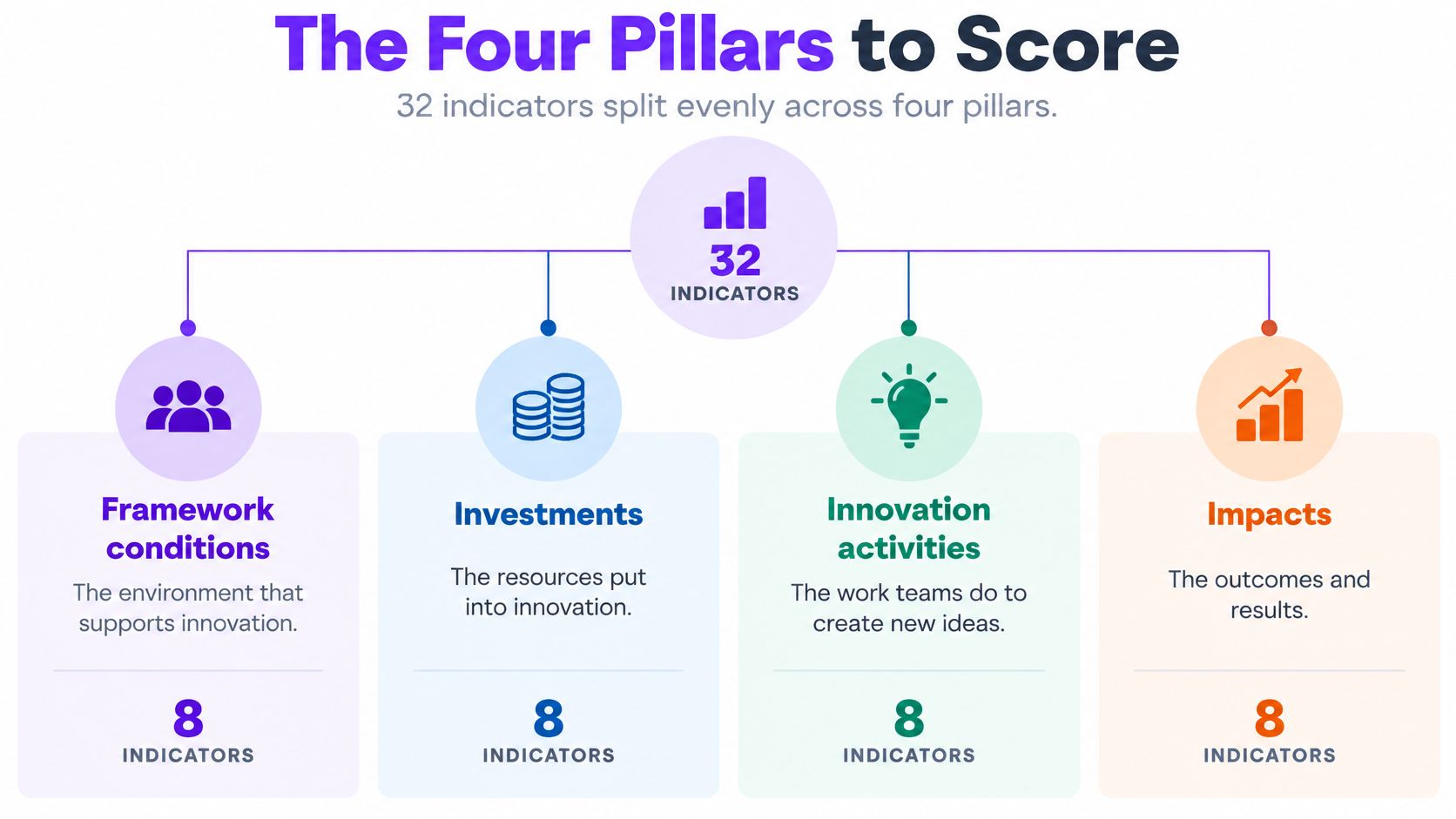
The European Innovation Scoreboard's 2025 methodology assesses national innovation systems using 32 indicators, grouped into four equally weighted pillars and 12 dimensions. It's a national framework, not a ready-made team questionnaire, but its structure offers a useful model for avoiding a narrow assessment.
The diagram shows how the pillars fit within a broader scorecard.
Translate the pillars into team behaviour
Framework Conditions concern the environment people work in. At team level, examine skills, access to knowledge, digital tools, and permission to challenge assumptions. An agency might check whether strategists can access customer interviews rather than relying entirely on the client brief.
Investments concern what the organisation commits. An approved innovation budget means little if billable work always takes priority. Look for protected experiment hours, usable research budgets, and access to specialist support. For an agency, evidence could include calendar blocks that remain protected during busy delivery periods.
Innovation Activities concern the work people perform. Check whether colleagues combine different expertise, involve users, document learning, and develop ideas beyond discussion. A pitch team could examine whether its proposed messaging draws on tested customer insights.
Impacts concern what changes after implementation. National measures need translating into relevant business outcomes, such as customer adoption, client results, or delivery productivity. An agency might examine whether a new creative approach improved campaign performance against the agreed objective.
Keep the profile visible
A composite score can support comparison, but it can also conceal the obstacle that matters most. Report capability pillars separately from the impacts pillar, even if you also calculate an overall index.
An innovation culture assessment can deepen the conditions discussion. When AI readiness is a specific gap, Prometheus Agency's guidance to build an AI transformation roadmap can help connect that diagnosis to implementation planning.
For another format to support a team discussion, use the accompanying video.
Leading and Lagging Indicators to Track
Leading indicators describe the habits and activities that make useful results more likely. Lagging indicators describe what happened after the work reached users or customers. Think of practice sessions and match results: they're related, but they aren't interchangeable.
The OECD Oslo Manual recommends measuring organisational capabilities, including management practices, knowledge, skills, external linkages, and readiness, because these apply even to firms that haven't yet produced an innovation.
Track the work before the outcome
Useful leading indicators include:
- Problem framing: Check whether briefs identify a user, a need, and an assumption worth testing.
- Contributor diversity: Record which disciplines contribute, not merely who attends.
- Cross-functional interaction: Track working sessions that combine relevant expertise.
- Experiment cadence: Monitor whether tests happen regularly and produce documented learning.
- Idea-to-test progression: Track the share of eligible ideas that reach an experiment.
Define “eligible” before calculating conversion. Otherwise, a team can improve its apparent performance by excluding difficult ideas after the fact.
Lagging indicators include:
- Adoption: Whether intended users use the new approach.
- Commercial impact: Revenue or other agreed business value attributable to implementation.
- Client outcomes: Progress against the problem the client wanted solved.
- Campaign performance: Results against the campaign's stated objective.
Read the relationship, not just the totals
Stronger routines for gathering, combining, and applying knowledge give teams a better basis for choosing and improving ideas. They don't guarantee success, so treat leading indicators as evidence of readiness rather than promises.
Say an agency generates plenty of concepts but tests none. Its experimentation capability should score poorly, however impressive its idea board looks. Conversely, a product team working through a long validation cycle shouldn't automatically receive a weak capability score because revenue hasn't arrived.
Measuring only successful launches creates survivorship bias: you overlook abandoned work and the decisions behind it. A practical guide to how to measure innovation can help connect measures to the decisions you need to make.
Keep capability separate from performance, attach evidence to each rating, and measure change over time.
Comparing Scoring Methods
Common innovation capability scoring methods
| Method | Best For | Effort | Main Weakness |
|---|---|---|---|
| Self-assessment survey | Quick baseline across many teams | Low | Scores reflect confidence, not proof |
| Expert review | An outside view of practices | Medium | Depends on the reviewer's judgement |
| Structured team workshop | Shared understanding and buy-in | Medium | Louder voices dominate unless input is anonymous |
| Evidence audit of records | Checking real activity such as experiments and launches | High | Records are often incomplete |
| Peer benchmarking | Context against similar organisations | Medium to high | Peer data is hard to find and compare |
| Interviews | Reasons behind the numbers | High | Slow and hard to compare across teams |
These effort ratings are planning judgements, not measured delivery times. Choose methods according to the uncertainty you need to resolve.
A survey tells you how people perceive their work. An audit tells you what the available records support. Interviews help explain why those accounts differ.
Ask about observable behaviour
A framework described in a Springer chapter on innovation capability measurement specifies six capability areas, 18 sub-areas, and 55 formative measurement items. That detail illustrates why a broad question about whether a team feels inventive isn't enough.
You don't need to copy an academic instrument blindly. You do need items that distinguish strategic direction, learning, resource allocation, execution, and commercialisation rather than blending them into confidence.
Instead of asking whether collaboration is strong, ask whether relevant disciplines review experiment findings before the team makes a decision. Then request a decision record.
Combine methods deliberately
A structured workshop is useful for interpreting disagreements, not settling them through the loudest voice. Gather individual ratings before discussion and let quieter participants submit explanations privately.
For surveys, clear Likert scale definitions help participants distinguish response options. But consistent wording doesn't make a perception-based score objective.
Audits have limits too. Missing records may mean the routine doesn't exist, or that people perform it without documenting it. An interview can distinguish those situations, although the team still needs better documentation before claiming a reliable process.
Expert reviewers should explain their criteria and show which evidence supports their judgement. Peer benchmarking requires equally careful checks of definitions and scope.
Practical rule: Pair a self-report method with an evidence-based method, and write down the basis for every score.
A homemade scorecard can support management decisions. Don't describe it as a validated measurement instrument unless it has undergone validation.
How to Run the Assessment Step by Step
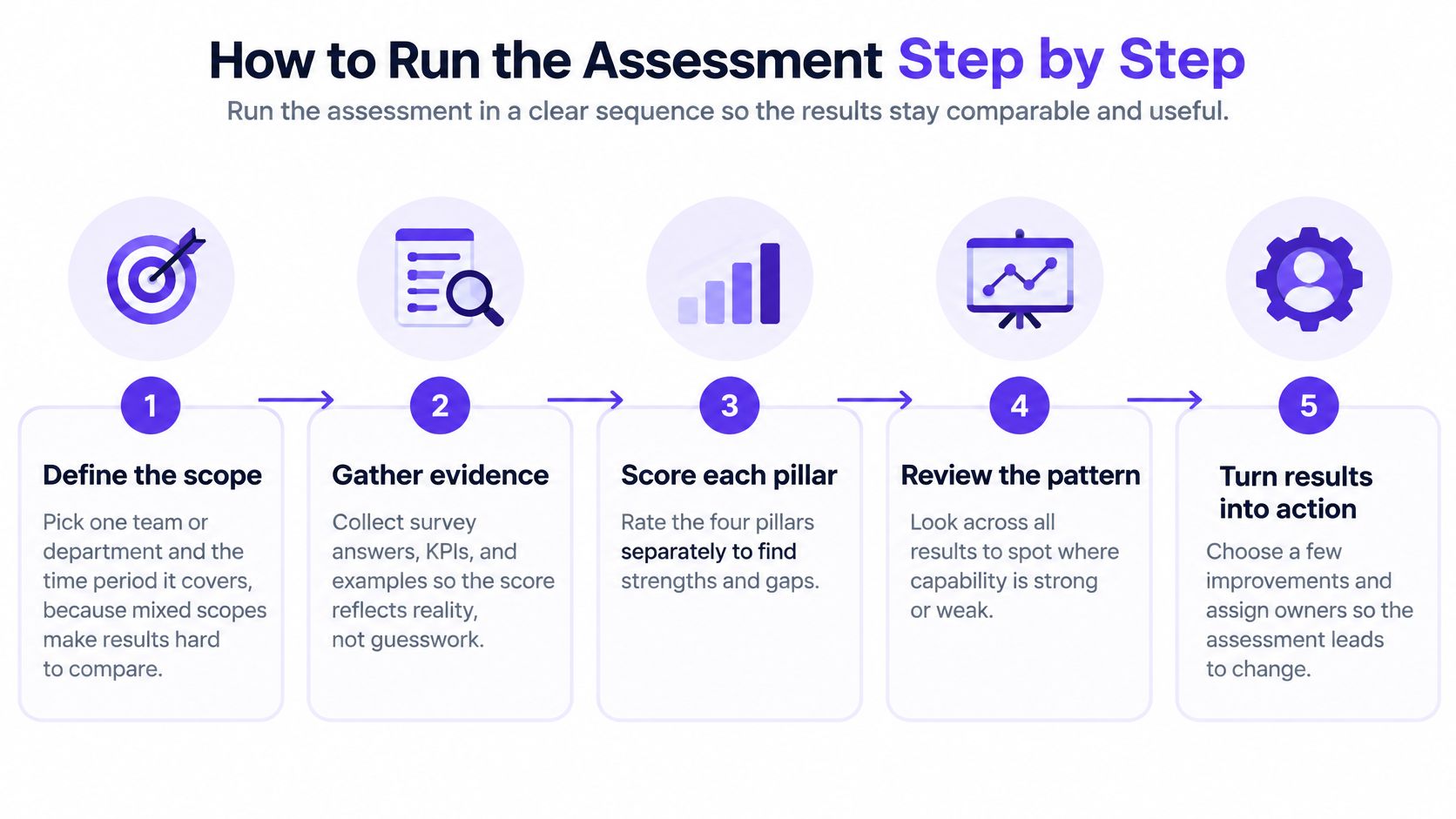
Run the assessment in a clear sequence so people rate the same work against the same expectations. The following is a proposed working procedure, not an external certification standard.
Establish the scope and evidence
Define the boundary. Choose a team or department and a review period. Keep unrelated business units separate, because different responsibilities and innovation cycles make a blended score hard to interpret.
Write behavioural items for each pillar. Use a small, manageable set of statements describing observable practices, such as documenting experiment assumptions before testing. Start with innovation survey questions and adapt them to your team's work rather than copying opinion statements unchanged.
Gather survey answers and records. Add interviews where the accounts disagree. In our Bulby process, teams enter a challenge, invite participants through a shared link, receive unique random exercises, write and share ideas anonymously with AI-powered inspiration, automatically collect and summarise ideas with AI surfacing the best and providing actionable next steps, then share the AI-generated report; that report can support an ideation review, but it isn't evidence that experiments or implementation occurred.
The visual gives a compact overview of the working sequence.
Apply a shared scoring rubric
- Agree on anchors before rating. Use the proposed scale below and replace the illustrative experimentation examples with ones appropriate to your review period. An activity count alone shouldn't establish maturity; the evidence must also demonstrate the routine described.
Scoring anchors for each 1 to 5 item
| Score | Evidence Required | Example for an Experimentation Item |
|---|---|---|
| 1 | No routine or record exists | No experiment logged in the last quarter |
| 2 | Routine is described but rarely used | One experiment, with no written criteria |
| 3 | Routine runs in most cycles and is documented | Two or more experiments, each with a written result |
| 4 | Routine is consistent across the team and measured | Experiments run on a set cadence with tracked conversion |
| 5 | Routine is consistent, measured and refined from results | Cadence adjusted after each review, with outcomes linked |
Reconcile conflicting evidence. Compare survey ratings with records and discuss material differences. Mark unavailable evidence as unknown rather than automatically treating it as failure.
Calculate and display pillar scores. Average applicable items within each pillar using a documented rule, and show the results in a bar chart. Keep the individual items available so an average doesn't hide a critical weakness.
Schedule reassessment. Set the review date alongside the improvement plan, allowing enough time for the relevant work cycle to occur. Keep item definitions stable so changes in wording don't masquerade as progress.
The scale only works when raters share examples of what each level means. Hold a calibration discussion using the same sample record before scoring independently.
Reading Scores Against Peer Benchmarks
A score needs context before you can call it strong or weak. A relevant peer group helps, provided everyone uses comparable questions, evidence rules, and review periods.
The European Innovation Scoreboard classifies countries as Innovation Leaders above 125% of the EU average, Strong Innovators at 100%–125%, Moderate Innovators at 70%–100%, and Emerging Innovators below 70%. The table borrows those bands as a discussion convention for teams, not an official organisational standard.
Interpreting innovation capability bands
| Band | Position vs Peer Average | What It Signals | Focus Next |
|---|---|---|---|
| Leader | Above the upper benchmark boundary | Capability appears comparatively strong; practices may be worth sharing | Sustain and document what works |
| Strong | Between the peer average and upper boundary | Established practices, with specific gaps to investigate | Close the weakest pillar |
| Moderate | Between the lower boundary and peer average | Routines may be uneven | Build repeatable processes |
| Emerging | Below the lower boundary | Foundational practices need investigation | Start with conditions and small experiments |
Choose peers before calculating bands
Compare teams with similar responsibilities, size, client type, and market conditions. A specialist agency handling regulated client approvals shouldn't be judged against a team that can release changes without external review.
To construct a relative index, divide a pillar score by the matching peer average and express the result as a percentage. Assign exact boundary values consistently and document that convention before comparing teams.
Be cautious with this calculation. Behaviourally anchored ratings aren't precise physical measurements, so a relative index is a rough management aid, not proof that one team has proportionally more capability.
Interpret the pattern over time
A small team's score can change sharply when a key person leaves or a demanding client pauses experiments. Examine repeated assessments alongside staffing, workload, and project context before declaring improvement or decline.
Say an agency protects recurring experiment time and later moves into a stronger investment band. Check whether people used that time, whether tests informed decisions, and whether the peer group remained comparable. Don't credit the calendar change alone.
Read the pillar profile first, then the band, then the trend.
If you don't have credible peer evidence, skip the label. A clear internal baseline is more useful than a confident comparison against mismatched organisations.
Turn Gaps Into Your First Three Improvements
Trying to fix every weak pillar at once usually leaves people with a longer task list and no additional capacity. Choose the obstacles that constrain other work before adding new initiatives.
Missing experiment time, for example, can prevent promising concepts from receiving tests. Another brainstorm won't solve that problem. A useful review of barriers to innovation can help you distinguish a skills gap from a resource, approval, or leadership problem.
Select work the team can complete
Use impact to describe how much a gap limits useful progress. Use effort to describe the time, coordination, and authority needed to change it within your chosen improvement cycle.
Set the target and list the gaps. Choose the maturity description or benchmark band you want each pillar to reach. Include gaps below that target, but don't assume every pillar needs the same ambition immediately.
Judge impact. Mark each gap high, medium, or low based on the work it blocks. Require an example, such as a promising concept abandoned because nobody could authorise a user test.
Estimate effort. Consider dependencies as well as workload. Changing an internal review template may be straightforward; changing a client's procurement process may not be.
Choose three improvements. Prefer high-impact work with low or medium effort. Where a difficult foundational problem blocks everything else, define a smaller first intervention rather than ignoring it.
Assign ownership and a test. Give each improvement a named owner, a leading indicator, and a time-bounded trial. For protected experiment time, the indicator could be whether scheduled sessions produce a documented test decision.
Schedule delivery and review. Put the work and reassessment on the team calendar. Agree in advance what evidence would justify continuing, changing, or stopping each intervention.
Check that the plan is executable
Before committing, confirm that each improvement has:
- An accountable owner: Someone with the authority to move the work forward.
- An agreed measure: A definition everyone can apply consistently.
- A scheduled test: A real opportunity to try the changed routine.
- A review date: A decision point, not a reporting deadline.
For a lightweight start, run a short self-assessment using the pillar descriptions and proposed anchors. Treat disagreements as questions to investigate, not scores to negotiate upward.
You can also test a structured brainstorming routine before making a wider commitment. Our public demo requires no login and lets you work on the question of how to improve team meetings to save time. Use it to examine participation and follow-through, not to declare the whole organisation innovation-ready.
Bulby offers structured, AI-powered brainstorming with anonymous contributions and actionable session summaries. Visit Bulby to try a guided session, then use your assessment to decide which ideas deserve a test and who will own the next step.