
Your team leaves a workshop with promising ideas. Then the budget owner asks for stronger evidence, the product manager needs technical input, and the customer research sits in folders nobody has time to review. By the next meeting, everyone's busy delivering work that already has approval.
That's a frustrating place to be, especially when people care about doing something better. Understanding barriers to innovation starts with looking beyond individual creativity and examining what happens between an interesting idea and a decision to test it.
Table of Contents
- Why Good Ideas Get Stuck
- The Three Most Common Barriers
- How Barriers Reinforce Each Other
- How to Recognize Barriers in Your Team
- Using Collaboration to Break Down Barriers
- Structured Ideation as a Practical Solution
- Real-World Examples of Overcoming Barriers
- Building a Barrier-Resistant Innovation Culture
Why Good Ideas Get Stuck
Consider a hypothetical agency team developing a new campaign concept. The strategist sees an unmet customer need, the creatives have an unusual approach, and the account manager believes the client might be interested. Nobody objects to exploring it.
Yet nobody knows who can authorize the research. The creative director wants customer evidence before assigning people, while the research team needs an approved brief before starting. Each person has a reasonable requirement, but together they've created a process nobody can move through.
The obstacle isn't the idea. It's the dependency between decisions.
Separate objections from blocked decisions
An objection gives the team something to investigate: perhaps customers won't understand the concept. A blocked decision is different: nobody knows whose judgment counts or what evidence would be sufficient.
Before asking people to generate more ideas, identify what the current idea needs to advance:
- A decision owner: Name the person authorized to approve the next action, rather than everyone who might offer feedback.
- An evidence requirement: Specify what needs to be learned, without demanding certainty that an early experiment can't provide.
- A clear handoff: Record who receives the work next and what they need to act.
For teams whose concepts repeatedly stall during review, TheContentMap's content approval workflow design guide is a relevant resource to consult when examining approval responsibilities.
Follow the whole journey
A useful way to investigate the problem is to trace an idea's path from idea to implementation. Look at requests, decisions, waiting periods, and handoffs, not just workshop activity.
Practical rule: When an idea stalls, ask what decision is missing before asking who needs to work harder.
This shifts the conversation away from blaming an uncreative team. You can then examine the conditions people need to do useful work, including resources, expertise, evidence, and permission to proceed.
The Three Most Common Barriers
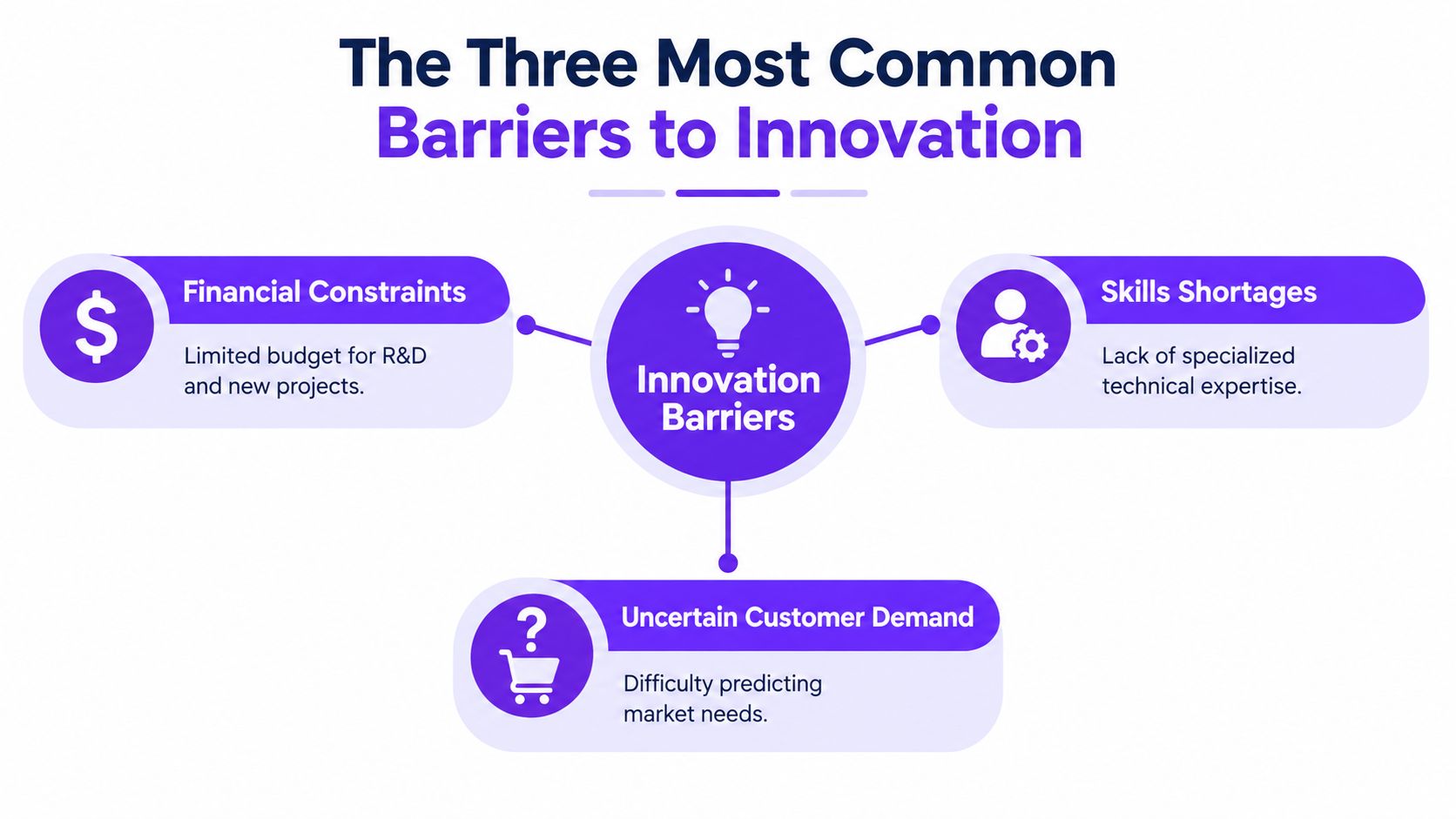
Financial constraints, skills shortages, and uncertain customer demand are recurring obstacles in the European Commission's Community Innovation Survey evidence. In most countries covered by the analysis, finance and demand uncertainty rank ahead of shortages of qualified personnel; the supplied European innovation evidence also reports that 51.4% of EU enterprises undertook innovation activities during 2020–2022, illustrating that barriers affect active innovators, not only organizations doing nothing new (European innovation evidence).
These categories describe different reasons a team might hesitate to move forward.
What each barrier means in practice
| Barrier | What it can look like | What the team needs to clarify |
|---|---|---|
| Financial constraints | A concept has support, but no resources are available for exploration. | What can we afford to learn before committing further? |
| Skills shortages | People understand the opportunity but can't build or evaluate the proposed solution. | Which capability is missing from this particular project? |
| Uncertain demand | Decision-makers can't tell whether customers will adopt the offering. | Which customer behavior would provide useful evidence? |
Financial constraints aren't a refusal to spend. A team may have an operating budget but no allowance for experiments that could produce an unfavorable answer. Asking for a launch budget in that situation can create pressure when the immediate need is a modest feasibility test.
Skills shortages also require a precise diagnosis. A product team might not need more developers generally; it might need someone who can assess a particular integration. An agency might have excellent designers but lack research interpretation skills.
Uncertainty isn't the same as rejection
Demand uncertainty means the team doesn't yet know enough about adoption. It doesn't establish that customers won't be interested.
For example, customers praising a prototype and customers changing their purchasing behavior are different signals. A practical response is to decide which signal the next decision requires.
These barriers are persistent because leaders must allocate scarce resources while outcomes remain unclear. The challenge is to make uncertainty manageable without pretending it can disappear before exploration begins.
How Barriers Reinforce Each Other
Innovation resources resemble ingredients in a recipe: having plenty of one doesn't compensate for having none of another. A team can receive funding and still struggle if nobody can access the information needed to use it.
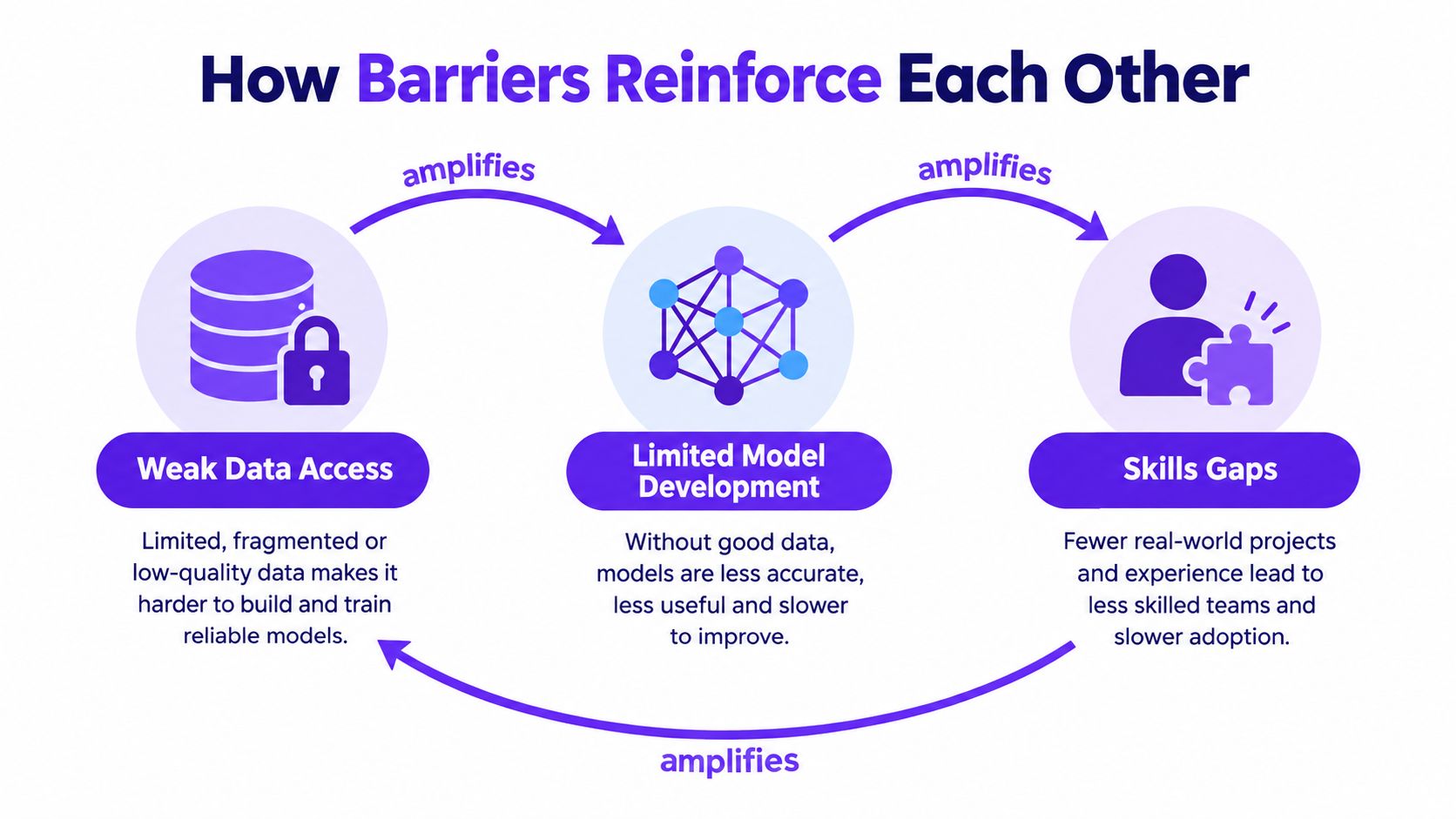
The OECD identifies barriers involving data, digital technology, skills, finance, and regulatory capacity as mutually reinforcing. Weak data access restricts model development and market validation, while skills gaps limit the ability to turn available information into products; specialized training also costs proportionally more for smaller firms (OECD analysis of SME innovation barriers).
Follow the dependency, not just the complaint
Consider a hypothetical product team testing a recommendation feature. Developers request customer data, but the records are scattered across systems and access permissions are unclear. The analyst spends the available project time reconciling records rather than assessing recommendations.
Buying another development tool wouldn't address that immediate problem. Hiring an analyst without clarifying access might leave the new person equally stuck.
Privacy requirements belong in this diagnosis too. Lawful access, security controls, and documentation are necessary conditions for responsible experimentation, not details to postpone until launch.
Fix the conditions required for an experiment, not merely the resource someone requested most loudly.
Choose a connected intervention
Instead of treating each department's difficulty as a separate issue, assemble a minimum viable data-governance layer:
- Approved inputs: Identify which datasets the team can use and for what purpose.
- Accountable owners: Assign responsibility for access decisions and data quality.
- Usable boundaries: Document permissions, retention limits, and required review.
- Shared evaluation: Agree how the team will judge the experiment's output.
This isn't a proposal to build an elaborate governance program before doing anything useful. It's a way to give people enough clarity to begin safely.
The systems perspective changes the question from “Which resource are we missing?” to “What combination of conditions would let this team complete a meaningful test?”
How to Recognize Barriers in Your Team
Start with an actual stalled project, not a general discussion about whether your organization supports innovation. Ask participants to reconstruct what happened using meeting notes, project tickets, research requests, and decision records.
The aim is to distinguish visible symptoms from the conditions producing them. A delayed prototype may look like a capacity problem when the team is waiting for an unresolved customer requirement.
Ask questions that reveal the blockage
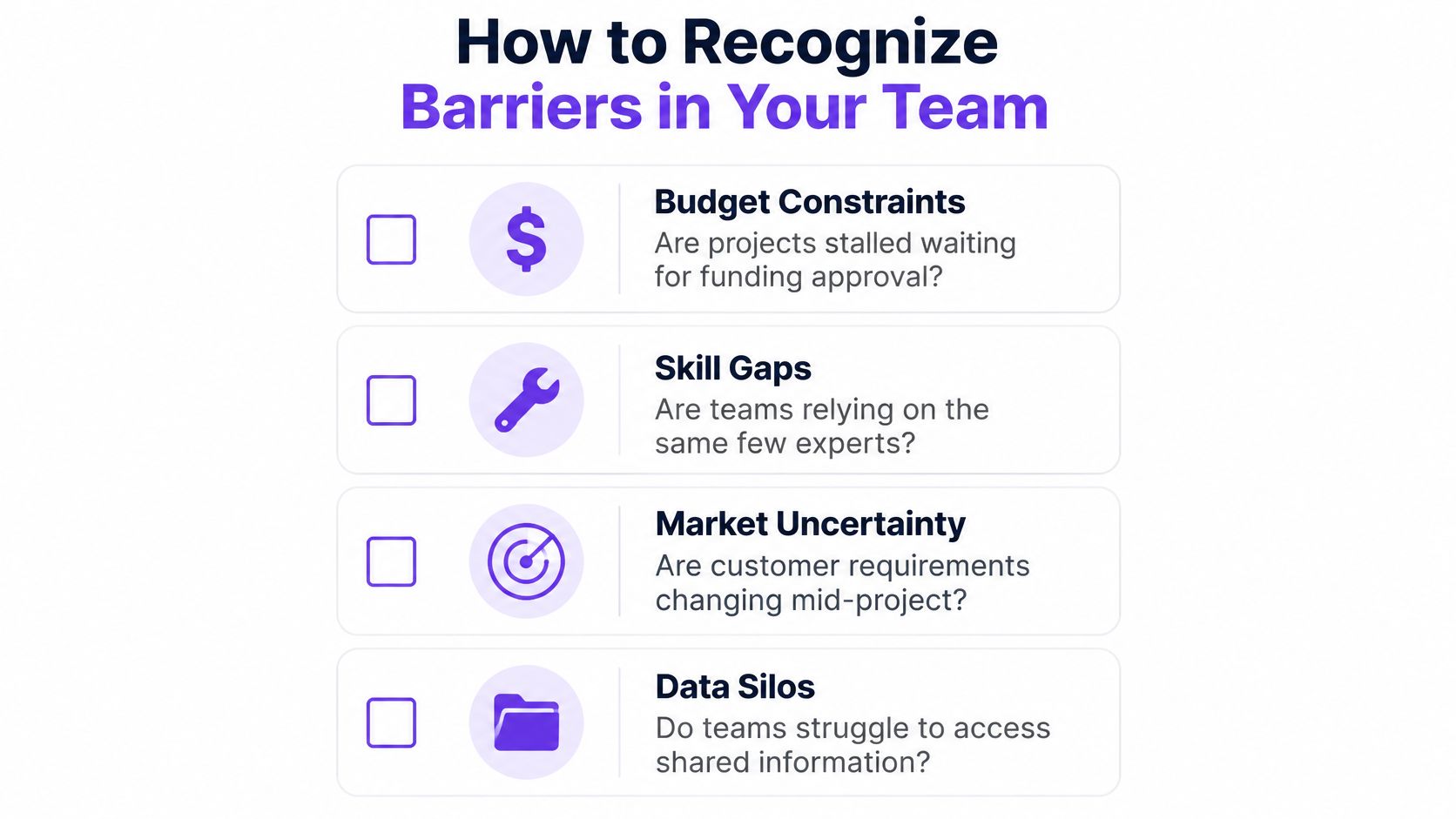
- Funding: Is the project awaiting money, or is the approver awaiting a clearer explanation of the proposed learning?
- Capability: Can someone name the missing skill, or has “we lack expertise” become a general explanation?
- Customer evidence: What unanswered question prevents a decision, and does the existing research address it?
- Information access: Is useful evidence unavailable, or available but difficult to locate and interpret?
- Accountability: Who can resolve conflicting feedback when reviewers disagree?
Use an innovation audit to organize these observations rather than relying on whichever concern sounds most urgent in a meeting.
Check for information overload
A team requesting more research may already have more information than it can use. Ipsos reports that 91% of business leaders say data volume limits organizational success, while 70% gather data faster than they can analyze or use it (Ipsos innovation executive survey).
A warning sign is a meeting where participants exchange research documents but can't agree on what those documents imply. Another is repeated discovery work without a clear explanation of what remains unknown.
For each stalled project, write a short diagnosis: the pending decision, the evidence available, the missing condition, and the person who can address it. Keep interpretation separate from observation.
“Leadership doesn't support innovation” is difficult to act on. “The sponsor hasn't defined what evidence would justify a prototype” gives everyone a concrete conversation to have.
Using Collaboration to Break Down Barriers
Collaboration is useful when it brings decision-relevant knowledge into the same conversation. Inviting more people isn't enough; participants need a shared problem and distinct responsibilities.
A working session should connect the people who understand customers, delivery constraints, commercial expectations, and technical feasibility.

Give different perspectives a specific job
In a hypothetical campaign planning session, an account manager might explain the client's commercial concern, a researcher might challenge assumptions about the audience, and a designer might suggest a way to communicate the concept without producing a finished campaign.
The facilitator's job is to preserve those differences long enough to learn from them. Immediate consensus can conceal an important disagreement, especially when a senior person states a preference early.
Useful practices for collaboration for innovation include:
- Independent contributions: Let people record their observations before discussing them together.
- Explicit challenges: Ask participants to identify what would have to be true for a proposal to work.
- Visible decisions: Record disagreements, the chosen direction, and the reasoning behind it.
A shared viewing prompt can help teams discuss how they work together. Ask participants to note a practice they would test in their next session.
Leadership must make participation consequential
Leaders need to explain what the team can decide and which constraints aren't negotiable. Otherwise, people may contribute thoughtfully only to discover that the important choices were already settled elsewhere.
A sponsor should also make room for inconvenient findings. If customer-facing colleagues can only share evidence that supports the preferred direction, cross-functional participation becomes ceremonial.
Collaboration won't create unlimited funding or eliminate specialist shortages. It can, however, help people define a smaller, more coherent experiment that uses their combined knowledge. The practical benefit comes from connecting expertise to decisions, not from increasing meeting attendance.
Structured Ideation as a Practical Solution
A folder full of customer interviews isn't an insight, and an insight isn't yet a concept. Structured ideation gives a team a deliberate path between those stages.
The distinction matters. An observation describes something noticed; an interpretation suggests what it means; an opportunity identifies something worth exploring. Mixing them together makes assumptions look like evidence.
Move from evidence to possibilities
Begin with a specific challenge, such as helping customers understand an unfamiliar product before committing to it. Avoid broad prompts like "How can we be more creative?"
Then work through a practical sequence:
- Capture observations: Record relevant customer actions, comments, and constraints without immediately proposing solutions.
- Separate interpretations: Explain what each observation might mean and note plausible alternative explanations.
- Define opportunities: Express the underlying need without prescribing a particular feature or campaign.
- Generate contrasting concepts: Explore different mechanisms rather than minor variations of the first suggestion.
- Choose a testable proposition: State who might benefit, what would change, and what evidence would challenge the concept.
Use structured brainstorming methods to choose exercises that match the work. A session intended to reframe a customer problem needs a different prompt from a session intended to develop execution options.
Borrow methods without copying assumptions
Domain-specific resources can provide useful prompts. For teams exploring apparel or retail ideas, Sprello's concept generation methods for fashion offers a relevant place to look for approaches to adapt to their own context.
The important discipline is to keep the connection between evidence and concept visible. A fashionable reference or persuasive AI suggestion shouldn't become a substitute for understanding the customer.
Facilitator's check: Ask what evidence supports the idea, what assumption it introduces, and how the team could discover it's wrong.
For example, an agency could turn an observation about confusing purchase terminology into concepts involving clearer language, guided comparison, or a demonstration. These are different responses to the same need, not cosmetic variations.
Conclude the session with a concept statement and an unanswered question. That gives the next team member something concrete to evaluate.
Real-World Examples of Overcoming Barriers
Evidence from actual firms offers a useful lesson, but it's important not to turn research findings into invented success stories. The following findings show relationships and documented concerns; the accompanying applications are recommendations, not claims about named companies.
Funding and expertise in manufacturing
Research involving 4,000 South Korean manufacturing firms found a negative relationship between financing constraints and product innovation. Firms with stronger research and development human capital, including a higher share of research employees and more highly educated technical staff, were better able to innovate under financial constraints (research on financial constraints and product innovation).
The practical lesson isn't that talented people can replace an adequate budget. It's that funding decisions and capability decisions belong together.
For a product manager, that could mean evaluating whether a proposed experiment has the technical judgment it needs before authorizing development. A cheaper project isn't necessarily a more economical choice if nobody can assess its feasibility or interpret the result.
AI adoption and the trust problem
AI-supported innovation introduces a different set of decisions. Deloitte findings cited in an analysis of data and AI adoption identify barriers including errors with real-world consequences at 35%, failure to achieve expected value at 34%, poor-quality data at 30%, and loss of trust through bias or inaccuracies at 29%.
For an agency developing positioning concepts, the appropriate response is to distinguish creative suggestions from factual assertions. An unusual message can be explored; an unsupported claim about a customer or competitor needs verification before reaching a client.
| Situation | Practical response | What to avoid |
|---|---|---|
| Limited development resources | Match the experiment to available technical judgment. | Funding implementation without evaluation capability. |
| AI-generated strategic concepts | Assign human review and preserve the evidence behind claims. | Treating fluent output as validated reasoning. |
| Unclear commercial relevance | Define the decision the experiment should inform. | Celebrating a prototype without identifying its purpose. |
These examples point toward a common principle: assess whether people can use resources responsibly, not merely whether those resources are available.
Building a Barrier-Resistant Innovation Culture
A barrier-resistant culture doesn't mean every idea receives approval. It means people understand how to investigate an opportunity, challenge a weak proposal, and make an informed decision without navigating avoidable confusion.
Consistency matters more than occasional enthusiasm. If exploration depends on a particular leader's spare time, employees can't plan around it. Make the expectations visible enough that teams know how to proceed when priorities compete.
Make learning part of ordinary management
Establish a distinction between exploratory work and delivery commitments. Exploratory work should answer a meaningful question; delivery work should execute an adequately understood solution.
Protect promising exploration from being judged solely by immediate revenue, while ending projects that no longer offer useful learning. Continuing every experiment isn't supportive leadership, and stopping every uncertain project isn't financial discipline.
Build the review conversation around:
- Progress through the process: Track time from problem definition to prototype and experiments completed.
- Useful learning: Record what changed in the team's understanding and which decision that enabled.
- Blocked work: Monitor ideas awaiting data, expertise, permissions, or other resources.
- Follow-through: Check whether agreed improvements changed the next project's experience.
These measures complement spending records. They help leaders see where teams can't translate available resources into action.
Reuse what works without freezing the process
Standardize recurring coordination tasks so teams don't have to redesign every handoff. For agencies developing repeatable campaign practices, CreativeClaw's walkthrough for social campaign system is a relevant resource to consider alongside their own process documentation.
Keep templates editable. A useful standard makes responsibilities clearer; an unhelpful one forces every problem through the same answer.
Building a culture of innovation is therefore an ongoing management practice rather than a launch event. Review the barriers people encounter, choose a connected improvement, and inspect what happens on the next project.
Start with a stalled opportunity your team still cares about. Clarify the next decision, bring together the necessary knowledge, and give someone responsibility for making the test possible.
Bulby offers AI-guided, structured brainstorming exercises for teams developing campaign concepts, messaging, and creative strategies. If scattered input or predictable discussions are blocking progress, visit the platform and use an upcoming creative challenge to explore a more structured approach with your team.