
Your calendar is full of workshops. The pitch deck has plenty of concepts. Yet when the team presents its strongest recommendation, the client asks for something less familiar. You schedule another brainstorm, even though nobody can explain why the last one failed to produce work worth backing.
Table of Contents
- When Bright Teams Stop Producing Breakthrough Work
- What an Innovation Audit Actually Is
- The Four Core Areas Every Audit Must Test
- Designing a Two-Stage Audit You Can Actually Run
- Measuring AI Capability Without Confusing Tools for Innovation
- What to Do in the First 30, 60, and 90 Days After the Audit
- Running the Audit as a Quarterly Management Control
When Bright Teams Stop Producing Breakthrough Work
Consider a familiar agency scenario, not a case study. Strategists bring audience research, creatives bring references, and account leads bring client constraints. Everyone contributes, but the concepts that survive look suspiciously like last season's campaign.
The problem might not be imagination. Perhaps the brief leaves the commercial problem unresolved. Perhaps reviewers select familiar ideas because nobody agreed on how to assess originality against feasibility. Or perhaps promising concepts lose their distinctive features during approval.
An innovation audit should investigate those mechanisms before anyone prescribes more brainstorming. Otherwise, you're asking the team to work harder inside the same constraints.
Diagnose the decisions behind the work
Start by tracing a recent project backward from delivery. Find the original brief, discarded concepts, review comments, client feedback, and final execution. Look for where someone changed direction, withheld resources, or rejected an idea without a clear reason.
Ask questions that expose operating choices:
- Brief interpretation: Did contributors agree on the problem, or merely acknowledge the same presentation?
- Selection: Could reviewers explain why one concept advanced and another didn't?
- Execution: Did the team have permission, capacity, and client access to test its strongest recommendation?
- Learning: Did anyone compare the finished work with the assumptions that justified it?
This makes a culture of innovation something leaders can examine through behavior, rather than a value they print on a slide.
Practical rule: Don't diagnose a creativity problem until you've examined how people commission, select, and deliver creative work.
Be candid about the trade-off. An audit takes attention away from delivery, so keep it focused on decisions you're prepared to change. Don't interview everyone about everything when the immediate question is why promising concepts never reach client testing.
The cost of skipping that diagnosis is continued uncertainty. Leaders can keep approving workshops while delivery teams keep encountering the same unresolved barriers. The useful outcome isn't a flattering assessment of talent. It's a defensible explanation of what prevents that talent from producing different results.
What an Innovation Audit Actually Is
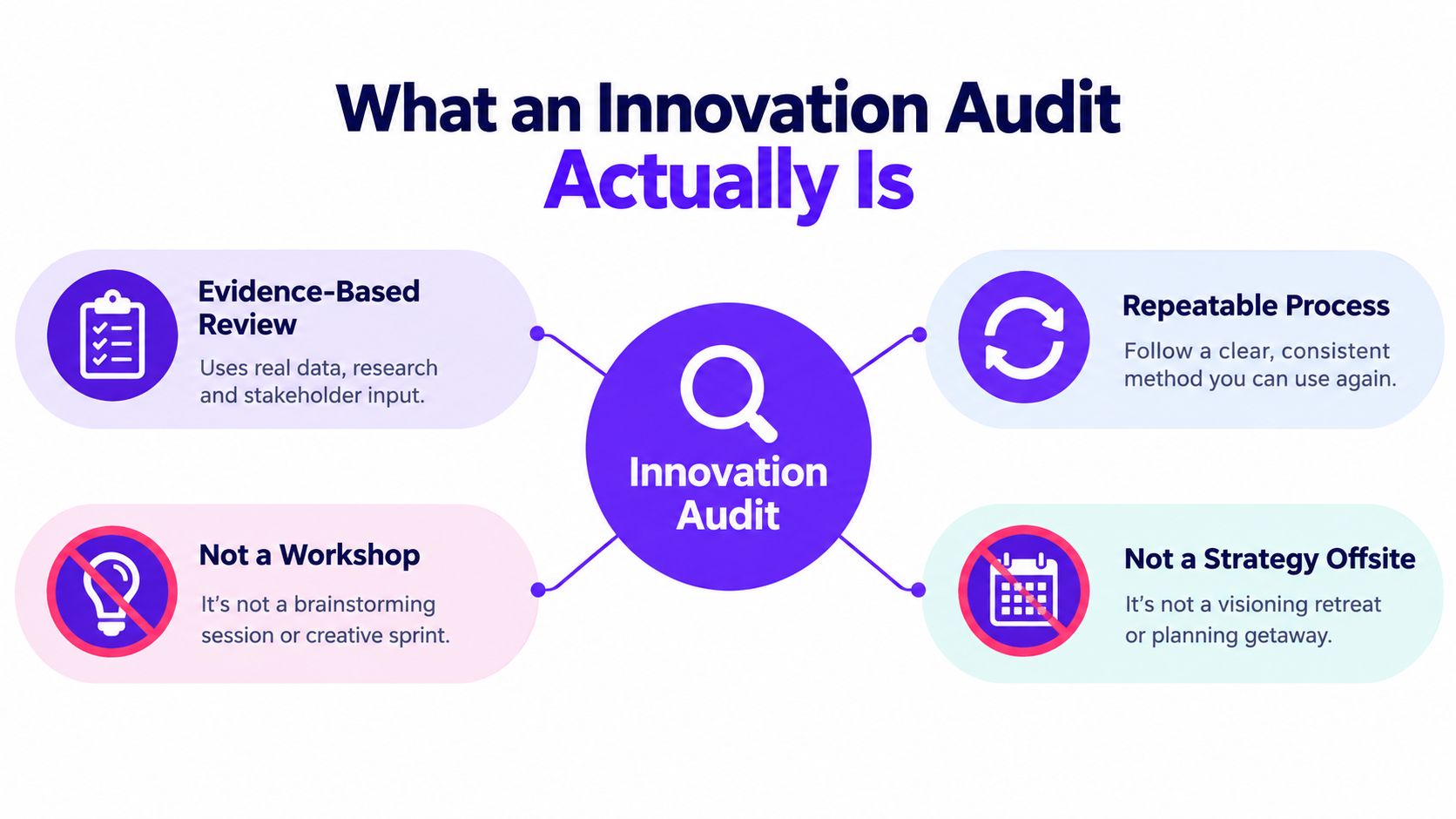
An innovation audit is a repeatable, evidence-based review of how an organization develops and implements new or improved work. Its purpose is to identify weaknesses in the operating system and connect them to corrective action.
That scope matters. The Oslo Manual, first published in 1992 and revised in 2018, expanded innovation measurement beyond manufacturing to all economic sectors, covering processes, knowledge flows, business capabilities, and outcomes, as described in this overview of the Oslo measurement framework. The Community Innovation Survey belongs to that measurement lineage, rather than the much narrower tradition of counting patents or research spending.
The distinction is straightforward: innovation involves more than generating something new. Your audit needs to examine whether people can develop, implement, and learn from it.
Separate diagnosis from idea generation
A brainstorm produces possibilities. A benchmark compares performance against a reference. An audit examines evidence against explicit expectations and identifies what needs to change.
| Activity | Main question | Useful output |
|---|---|---|
| Brainstorm | What could we try? | Concepts and hypotheses |
| Benchmark | How do we compare? | Context for performance |
| Innovation audit | What can we reliably execute, and what blocks us? | Findings and corrective decisions |
Review strategy, culture, processes, resources, and outcomes together. A clear strategy without available delivery capacity is an intention. A supportive culture without disciplined selection can leave teams with plenty of enthusiasm and no commitment.
Keep the evidence concrete. Strategy should appear in portfolio choices. Culture should appear in who gets heard and how disagreement is handled. Resources should appear in allocated time, access to customers, and the skills available to deliver.
An audit also needs boundaries. Define which teams, workflows, and types of innovation you're reviewing. Don't compare an exploratory positioning project with routine campaign production as though they face identical uncertainty.
When findings point toward establishing a formal program, Ekipa's resource on how to launch innovation initiatives is a useful companion for planning that next step. Keep diagnosis and program design separate, though. Decide what's broken before selecting the initiative that will address it.
The Four Core Areas Every Audit Must Test
A team can have a convincing process and disappointing results. It can also achieve a strong result through individual heroics that nobody can repeat. Process capability and innovation outcomes need separate judgments.
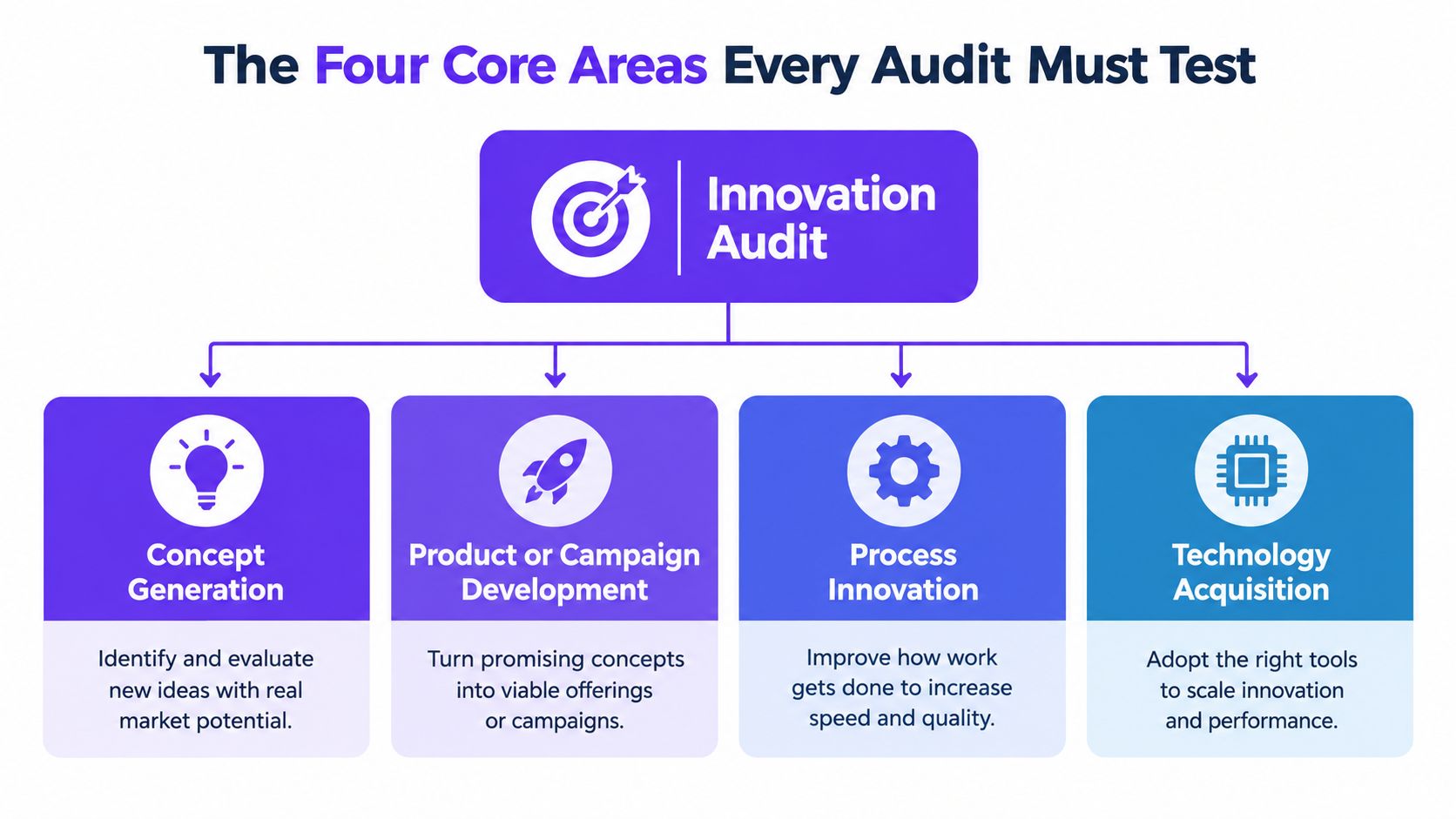
Chiesa, Coughlan, and Voss's innovation audit framework identifies four core processes: concept generation, product development, process innovation, and technology acquisition, supported by resource deployment, systems and tools, and senior-management leadership. For agencies, product development translates naturally into campaign, service, or positioning development.
Examine the whole delivery chain
Concept generation starts before the workshop. Inspect how the team interprets the brief, gathers evidence, and explores different directions. A folder full of variations on the same premise isn't convincing evidence of divergent thinking.
Follow selected concepts into product or campaign development. Can someone explain the selection rationale? Does the team validate important assumptions with customers or clients before committing to production? Look for continuity between the original insight and the work that ships.
Process innovation deserves its own examination. Ask whether teams can change how they work, not just what they make. For example, a proposed change to brief approval should have a defined problem, an owner, and a way to assess whether the new approach is better.
Technology acquisition is broader than purchasing software. Examine whether the organization can select, integrate, maintain, and responsibly use new tools. If autonomous workflows are under consideration, Cyndra's guide for operators launching AI employees offers an additional planning resource. Don't treat a readiness exercise as proof that a particular deployment will succeed.
Test the support beneath each process
Use the same supporting questions across these areas:
- Resources: Who has protected time to do the work, and what gets deprioritized?
- Systems and tools: Can people find research, record decisions, and retrieve previous learning?
- Leadership: Who resolves conflicts between exploratory work and immediate delivery commitments?
Those questions make the trade-offs visible. A creative director might encourage experimentation while approving schedules that leave no room for testing. The audit should document the mismatch, not average it into a comfortable score.
A well-attended workshop proves that people attended. It doesn't prove that the organization can develop and implement a worthwhile idea.
Judge the chain, not its busiest moment. Strong concept generation can't compensate for arbitrary selection, and advanced technology can't compensate for a team that lacks permission to change its process.
Designing a Two-Stage Audit You Can Actually Run
Run the audit in two stages: a rapid scorecard to locate weaknesses, followed by an evidence-based investigation of the areas that could change an important decision. Don't turn every capability into an equally large research project.
Use a shared scorecard to make disagreements visible before discussing solutions.

Stage one establishes the evidence standard
Write the scoring criteria before collecting responses. Consistent criteria, separate treatment of inputs and outputs, and comparable benchmarks are central to a credible assessment, alongside the methodological cautions discussed in this analysis of innovation indicators and measurement.
Use descriptive maturity labels rather than unexplained numerical grades:
| Rating | Evidence required |
|---|---|
| Ad hoc | Individuals choose their own approach |
| Defined | A documented approach and owner exist |
| Practiced | Project records show consistent use |
| Improved | Teams review results and adjust the approach |
Mark unknown separately. Missing evidence isn't automatically poor capability, but it isn't proof of maturity either.
Collect individual assessments before the group discussion. Pair interviews with innovation survey questions that distinguish personal experience from assumptions about how other teams work. Ask respondents to identify a project or artifact that supports their answer.
Stage two follows the weak points
Choose deep dives by consequence, not merely by lowest score. An inconsistent research archive might matter less immediately than a selection process that prevents any unfamiliar concept from reaching a client.
Build an evidence register with the definition, record location, responsible person, and limitations for each measure:
- Brief-to-concept time: Define when the clock starts and what qualifies as testable.
- Evaluation-gate survival: Record why concepts advance, change, or stop.
- Contributor diversity: Examine relevant disciplines, perspectives, and participation.
- Brief-related rework: Separate unclear direction from legitimate learning.
- Downstream results: Connect adoption or commercial evidence to the original objective.
Use the embedded video as a discussion prompt, not as audit evidence.
If approval delays emerge, AdCrafty's resource on ways to streamline creative approvals can inform potential interventions. First establish whether the constraint is routing, unclear authority, conflicting feedback, or an unresolved brief. Automating a disputed decision won't settle the dispute.
Finish each deep dive with a finding, supporting evidence, confidence level, and decision required. That's more useful than a score without an explanation.
Measuring AI Capability Without Confusing Tools for Innovation
An AI subscription belongs in the inventory, not in the results column. Don't award innovation maturity because employees have access to a model or use it frequently.
The OECD reported in 2025 that a persistent gap remained in measuring AI capabilities in an understandable, policy-relevant way in its AI capability indicators report. For a team audit, the sensible response is to examine several dimensions instead of inventing a single AI-readiness score.
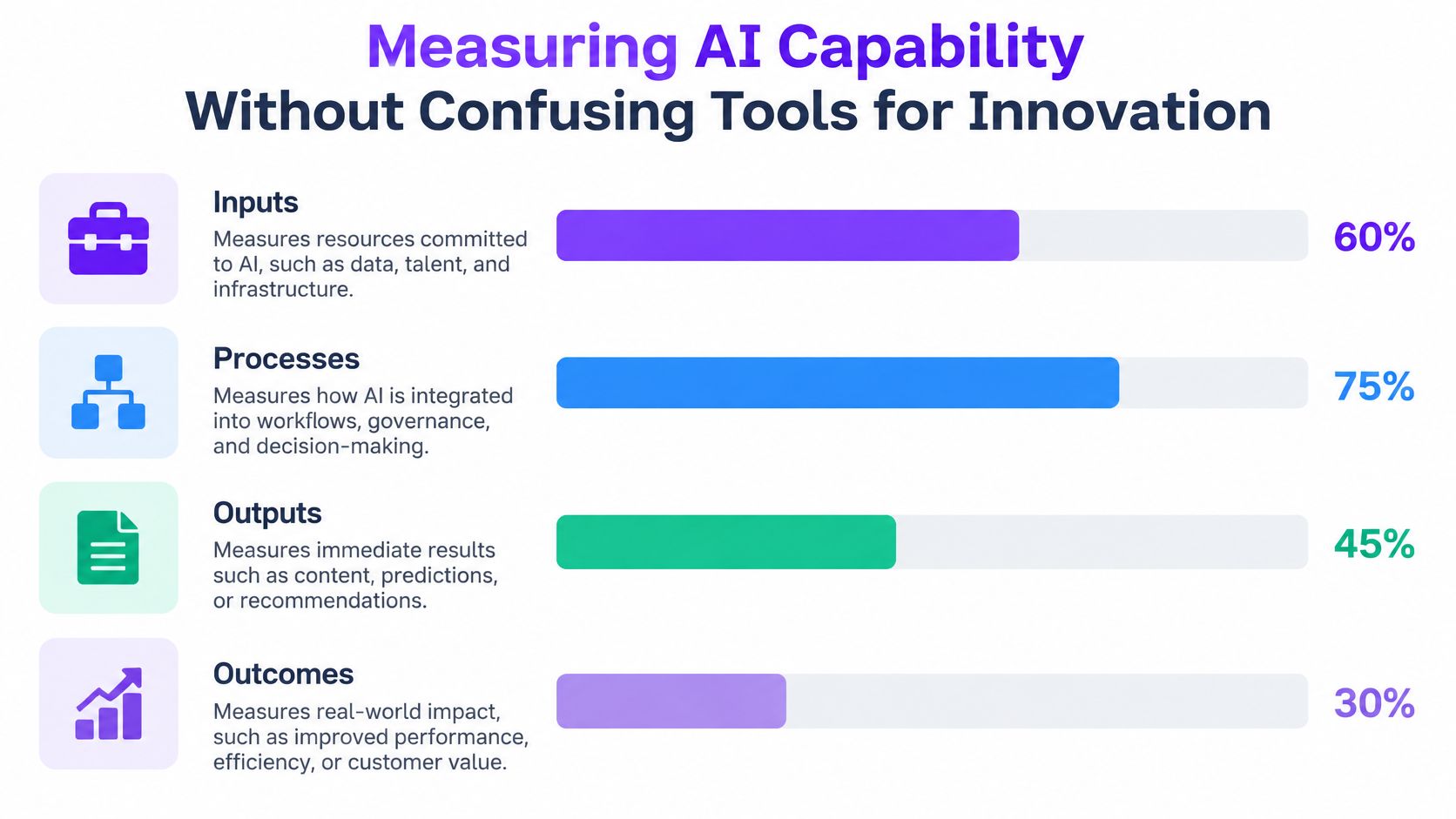
Treat the following graphic as a conceptual illustration, not as measured performance or a target distribution.
Audit the work around the tool
I recommend separating AI-enabled work into these indicator layers:
| Layer | What to examine | What doesn't establish success |
|---|---|---|
| Inputs | Tools, training, approved data, spending | Access alone |
| Capabilities | Research synthesis, idea variation, evaluation | Fluent output alone |
| Workflow design | Human review, handoffs, accountability | A documented policy nobody follows |
| Outcomes | Quality, cycle time, customer evidence, commercial relevance | Output volume alone |
For capability, give the team a representative task. Ask it to synthesize research, develop contrasting concepts, and explain which claims require verification. Review what people can reliably accomplish, including the corrections they make.
For workflow design, inspect who supplies context, checks factual claims, protects client information, and approves material for external use. Keep accountability attached to a named person. A handoff to AI shouldn't become a handoff away from responsibility.
Compare complete workflows, not isolated prompts
Suppose a team proposes AI-assisted positioning exploration. Test the workflow against a comparable task using its existing approach, with reviewers applying the same quality criteria. Include research preparation, verification, editing, and approval time, not just generation time.
A useful discussion of whether AI can generate ideas should lead to a harder operational question: which outputs are distinctive, relevant, supportable, and worth testing? Have reviewers assess the work without tool labels where practical.
Decision test: Keep the AI intervention only if the team can explain what improved, what became riskier, and who handles the remaining judgment.
Don't sacrifice originality to speed without acknowledging the choice. Likewise, don't call an intervention unsuccessful because verification takes time, if the resulting work meets an important need better. Set the trade-off before the test.
The adoption trap is treating installation as implementation. If roles, review standards, and decision rights remain undefined, tool usage tells you little about the team's ability to produce better work.
What to Do in the First 30, 60, and 90 Days After the Audit
The audit presentation isn't the finish line. In Ireland's 2025 Innovation Index, among 556 innovation-active companies, 55% had no formal innovation-management process or relied on an ad-hoc approach, while only 22% used a structured system tracking inputs, throughputs, outputs, and outcomes.
That finding isn't a benchmark for every agency or product team. It does make the governance question concrete: who turns a diagnosis into funded work?
By day 30, choose and fund the experiments
Appoint an executive sponsor who can release capacity and resolve competing priorities. Give each accepted finding a delivery owner, then select a small portfolio of experiments based on business importance, uncertainty, and feasibility.
Create an experiment charter containing:
- Hypothesis: What change should improve which part of the work?
- Commitment: What staff time, customer access, and spending are authorized?
- Evidence: What baseline and observations will inform the decision?
- Decision rights: Who can stop, revise, or expand the experiment?
Don't approve an experiment without identifying what its participants will stop doing. Unfunded recommendations are requests for overtime.
By day 60, test changes in live work
Launch experiments where the audit found a consequential constraint. For an unclear-brief problem, test a revised intake process on suitable work. For arbitrary selection, trial documented criteria and independent concept reviews.
Use an idea management system to connect the original finding, experiment, evidence, and decision. Keep the record compact enough that owners will maintain it.
Set stop-or-scale criteria before results arrive. Stop when the intervention breaches a firm quality requirement or the underlying hypothesis no longer holds. Expand only when the evidence supports the intended benefit and the team can sustain the operating cost.
By day 90, decide what becomes routine
Hold a decision review, not a showcase. Owners should recommend stopping, adapting, continuing, or scaling each intervention, with unresolved questions made explicit.
Separate an unsuccessful intervention from an uninformative test. If nobody collected the agreed evidence, you haven't learned whether the change works.
Update roles, templates, approval rules, and capacity plans for interventions you retain. Archive rejected approaches with their reasoning so another team doesn't repeat the same test unknowingly. The deliverable is a changed operating routine, not an expanded audit deck.
Running the Audit as a Quarterly Management Control
Make the innovation audit a quarterly management control, not an annual performance ceremony. Keep the assessment rubric stable so leaders can distinguish a genuine change in capability from a change in how reviewers assign scores.
ISO 56001's innovation-management framework describes auditing as a systematic, independent examination of evidence against defined criteria and uses Plan-Do-Check-Act for continual improvement. Apply that discipline without pretending a lightweight internal review constitutes certification.
Review progress without chasing a vanity score
Pair leading indicators, such as experiment throughput and time to a testable concept, with lagging indicators, such as adoption, campaign performance, revenue contribution, and reduced rework. Choose the combination that fits the decision, rather than requiring every team to report every measure.
Use a consistent approach to measuring innovation, and disclose changes in project mix or measurement definitions. Don't interpret unlike work as a clean performance trend.
Bring these questions to the next planning meeting:
- Priority: Which business problem justifies the innovation work?
- Evidence: Which finding is supported strongly enough to act on?
- Ownership: Who is accountable for the next decision?
- Capacity: What delivery commitment has been reduced to make room?
- Funding: What resources are authorized?
- Testing: Which assumption needs direct customer or client evidence?
- Quality: What must not deteriorate while the team experiments?
- AI: Where does a person retain judgment and approval?
- Learning: What will cause the team to stop or change direction?
- Continuation: Which successful practice becomes standard work?
The review should end with decisions and named commitments. If leaders only discuss whether the score improved, they've turned a management control into a reporting exercise.
Bulby offers AI-powered, structured brainstorming exercises for agencies, creative teams, and brand strategists developing campaign concepts, messaging, and positioning. Visit Bulby to try a guided session on a live brief, then assess the resulting concepts against the selection and testing criteria established in your innovation audit.