

Most brand messaging examples fail for a simple reason: they try to be memorable before they become useful. Strong messaging gives a team a precise job to perform, whether that job is clarifying value, overcoming an objection, creating emotional momentum, or helping buyers distinguish one brand from another. A 2024 enterprise research summary found that 67% of B2B buyers couldn't distinguish between competing brands in their consideration set, while persona-specific messaging produced 4.2x higher message recall than generic value propositions. The benchmark report makes the practical point clear: differentiation needs structure.
The 10 examples below treat messaging as an agency workflow, not a gallery of slogans. For each format, evaluate the audience, problem, promise, proof, differentiation, and next action. Then apply four questions: What role does the message perform? Which tactic makes it effective? What reusable template can your team adapt? What prompt can you take into a Bulby brainstorming session?
That approach turns this brand messaging strategy from a set of abstract principles into working material for pitches, campaigns, positioning projects, and product launches.
Table of Contents
- 1. Value Proposition and the Core Problem Solution Statement
- 2. Tagline and the Memorable Action Oriented Catchphrase
- 3. Mission Statement and Purpose Driven Organizational Intent
- 4. Positioning Statement and Competitive Market Context
- 5. Brand Voice and Consistent Tone
- 6. Positioning Against the Status Quo with a Before After Narrative
- 7. Unique Value Angle with Structured Methodology and AI
- 8. Objection Handling and Why Not Just Use What We Have
- 9. Emotional Benefit Messaging and the How It Feels Narrative
- 10. Collaboration First Messaging and Team Inclusion
- 10-Point Brand Messaging Comparison
- Turn Examples Into Your Next Messaging Sprint
1. Value Proposition and the Core Problem Solution Statement
A value proposition should help a buyer understand the specific outcome a brand creates. It's not a feature inventory. “AI-powered brainstorming platform” describes Bulby, but it doesn't explain why an agency team should care. “AI-guided brainstorming that helps creative teams generate breakthrough ideas faster without getting stuck in predictable thinking” connects the product to a recognizable workflow problem.
Slack's “Be more productive and organized with less effort” works because it leads with an outcome. HubSpot's “All the tools you need to run your business, in one platform” uses breadth and convenience to frame the product's value. Neither message attempts to explain every capability at the point of first contact.
For a B2B brand, the strongest value proposition usually answers three questions:
- Who is this for? Name the buyer or working team.
- What problem does it solve? Use the language customers use when describing friction.
- What changes after adoption? Lead with the result, not the mechanism.
A useful template is: For [audience] facing [problem], [brand] helps [desired outcome] through [distinctive approach].
The agency workflow
Test the draft with actual strategists, creatives, product managers, or buyers. Ask them what they think the product does, what they expect to gain, and what sounds interchangeable with a spreadsheet, workshop, or generic collaboration tool. If they repeat your features instead of your outcome, the message needs work.
Practical rule: If a competitor could place its logo at the beginning of the sentence without changing the meaning, your value proposition isn't differentiated enough.
Use the brand strategy development resource to connect the proposition to a broader brand system. In a Bulby session, prompt the team: “Write five value propositions for one audience, each focused on a different pain point, then remove every feature that doesn't support the promised outcome.”

2. Tagline and the Memorable Action Oriented Catchphrase
A tagline compresses a brand idea into a phrase people can remember and repeat. Nike's “Just Do It” is direct and active. Apple's “Think Different” expresses a point of view about identity. Canva's “Design for Everyone” turns accessibility into a simple promise. These lines don't explain the entire product. They create a mental doorway into the brand.
For Bulby, “Break Through. Build Better.” points toward momentum and improved creative output. Its strength comes from the verbs. Its weakness is that it could still belong to a consultancy, software company, or innovation program unless surrounding copy makes the brainstorming context clear.
That trade-off matters. A tagline can be broad enough to travel across campaigns, but excessive breadth makes it vague. A highly descriptive line may explain the product but lack emotional or verbal stickiness.
Make the line usable
A tagline needs to work in a homepage header, a sales presentation, an email signature, a video end frame, and spoken conversation. Test it aloud with creative directors and strategists. If salespeople avoid saying it, or customers can't repeat it after hearing it once, the line probably isn't doing enough.
Use a short evaluation pass:
- Action: Does the phrase suggest movement or a decision?
- Distinctiveness: Does it avoid familiar category language?
- Flexibility: Can it support several campaigns without becoming irrelevant?
- Clarity: Does the rest of the message quickly explain what the brand does?
Adobe's “Change the World” is aspirational, so it needs product and campaign context to ground it. Bulby's line should likewise sit beside a clear value proposition rather than carry the whole explanation alone.
The brainstorming prompt is: “Create tagline territories for speed, originality, confidence, and collaboration. Write five options per territory, then identify which ones sound ownable rather than merely positive.”
3. Mission Statement and Purpose Driven Organizational Intent
A mission statement gives the organization a reason to exist beyond a product category or revenue target. It should guide decisions, not decorate an About page. For Bulby, a useful direction is: “To release the creative potential of every team by removing the barriers that limit original thinking.”
That statement reaches beyond brainstorming software. It names a belief about how teams work, what gets in their way, and what the organization wants to change. Patagonia's “Build the best product, cause no unnecessary harm” connects product standards to conduct. TOMS frames business as a force for good. Mailchimp's mission language centers on helping small business owners operate more effectively.
The risk is making the mission so expansive that nobody can use it. “We drive innovation everywhere” sounds positive, but it doesn't tell a product team, salesperson, or agency partner what to prioritize. A mission should connect to actual customer problems and visible company behavior.
Turn purpose into decisions
Start with “We exist to” or “Our purpose is to.” Then identify the barrier your organization removes and the people who benefit. Ask whether the mission appears in product choices, customer support, hiring, partnerships, and content. If it only appears in brand guidelines, it isn't functioning as a mission.
A Bulby workshop can separate internal purpose from external messaging:
- Internal belief: What does the team believe should change?
- Customer impact: What does that change make possible for users?
- Behavioral proof: What would the organization do differently because of this belief?
The prompt is: “Write mission statements for the same company from the perspectives of a customer, employee, product leader, and skeptical buyer. Combine the strongest shared idea into one sentence.”
A mission doesn't need to promise universal transformation. It needs to be meaningful enough to motivate the team and specific enough to influence trade-offs.
4. Positioning Statement and Competitive Market Context
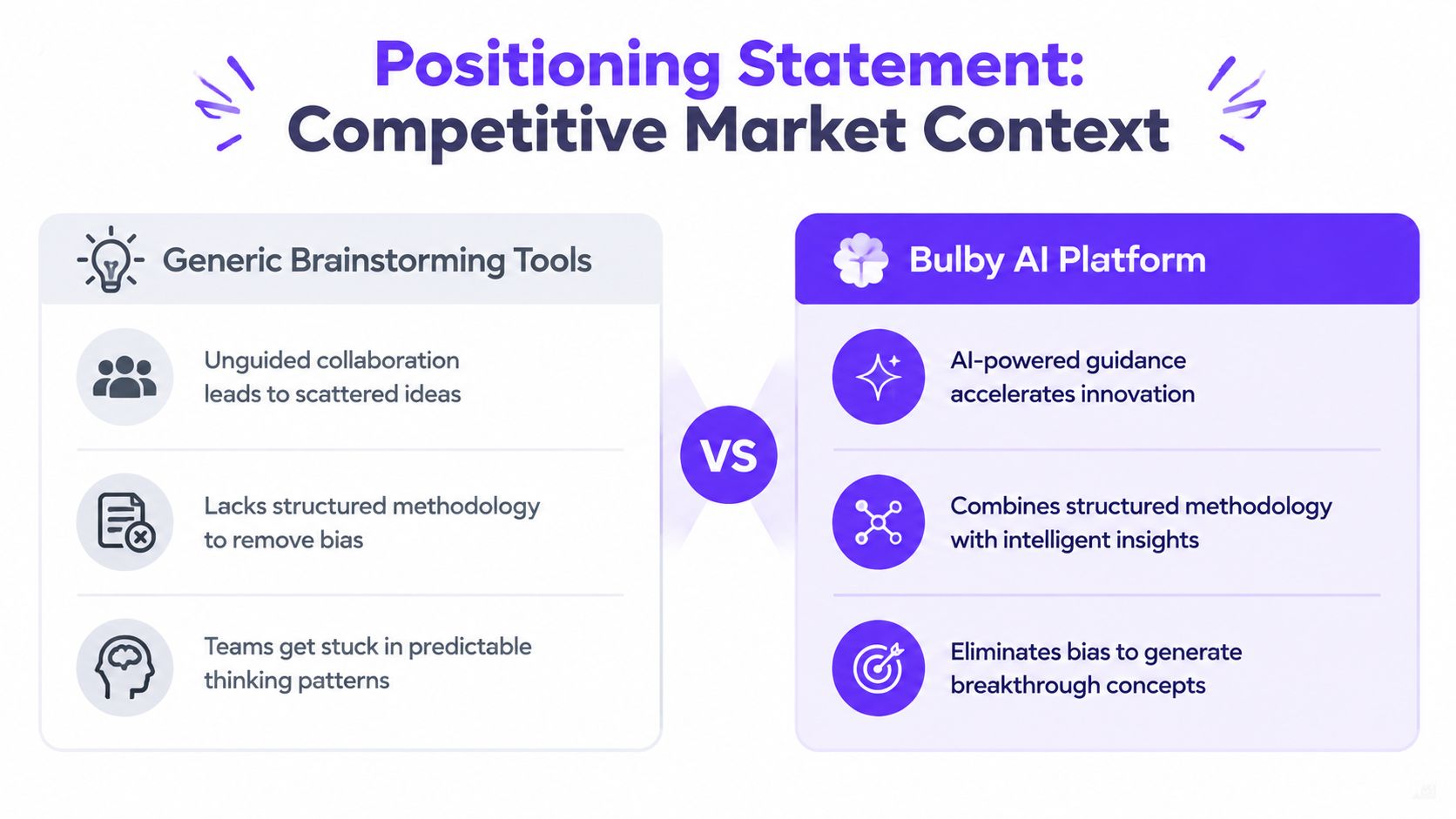
Positioning explains where a brand belongs in a buyer's mental map. It identifies the audience, category, problem, distinctive approach, and competitive alternative. For Bulby, that means distinguishing structured, AI-guided brainstorming from spreadsheets, open-ended whiteboards, traditional facilitation, and unguided collaboration platforms.
A practical positioning statement might read: “For creative teams and strategists struggling to produce original ideas efficiently, Bulby is an AI-powered brainstorming platform that combines structured methodology with intelligent guidance, unlike generic tools that leave teams to create the process themselves.”
Slack positions itself as a collaboration hub that reduces fragmented email communication. Figma positions itself around real-time design collaboration, contrasting with desktop workflows that require file passing. In both cases, the contrast makes the category easier to understand.
Positioning shouldn't claim every possible advantage. It should choose the difference the company can defend.
Compare the alternatives honestly
Interview customers about what they used before choosing the product. Their answer may reveal a stronger position than internal brainstorming does. A team might buy Bulby because Miro is too open-ended, because meetings keep circling familiar ideas, or because a facilitator can't be present for every session. Each reason suggests a different market position.
The LinkedIn About section perspective from Mallary.ai is useful here because a positioning idea often needs to become a concise public explanation. Keep the internal statement rigorous, then adapt the language for profiles, sales decks, and homepage copy.
In a Bulby session, use this prompt: “List every realistic alternative for this audience, including doing nothing. For each one, identify what it makes easier, what it leaves unresolved, and where our brand can make a credible claim.”
If the position depends on a capability competitors can copy quickly, anchor it in a repeatable method, customer experience, or point of view.
5. Brand Voice and Consistent Tone
Brand voice determines how the organization sounds when it explains, sells, supports, and teaches. Bulby's sample voice is helpful and confident: “Your team has brilliant ideas. We help you access them faster and with less bias.” It acknowledges the customer's capability, names the friction, and presents the product as an enabler rather than a replacement for human creativity.
Mailchimp is known for a friendly, witty style that remains professional. HubSpot often combines educational clarity with occasional humor. Intercom tends toward direct, conversational, human-first communication. These examples show that voice is more than a list of adjectives. It becomes recognizable through sentence length, vocabulary, confidence, warmth, and what the brand refuses to say.
A voice guide should distinguish fixed traits from flexible expression. A sales email can be strategic and direct. A social post can be more energetic. Support copy may need extra patience and clarity. The personality remains consistent, but the delivery changes with the situation.
Build a usable voice system
Create three or four attributes, then define each with examples. “Approachable” might mean explaining specialist terms instead of using them as shorthand. “Authoritative” might mean making a clear recommendation rather than hiding behind vague possibilities.
Use do and don't examples:
- Do: “Move from scattered input to a focused concept.”
- Don't: “Access next-generation ideation synergies.”
- Do: “Bring more perspectives into the session.”
- Don't: “Revolutionize collaboration forever.”
The brand voice development guide can help connect voice decisions to a wider identity system. In Bulby, prompt: “Rewrite this message in three voices, strategic, energetic, and reassuring. Keep the factual meaning unchanged, then identify which voice best fits the audience's emotional state.”
Consistency matters because repeated exposure builds recognition. Lucidpress and Marq research summarized by Omnibound reported that consistent brand presentation across channels can increase revenue by 10% to 33%, and 68% of companies said consistency contributed directly to revenue growth. Use the figures as historical benchmarks, not guarantees for every brand.
6. Positioning Against the Status Quo with a Before After Narrative
Before and after messaging makes transformation visible. It doesn't need to attack a named competitor. It shows the customer's current condition, then describes a more useful working reality.
For Bulby, the contrast might be:
Before: Teams spend meetings circling familiar ideas and debating how to structure the session.
After: Teams move through guided exercises that turn different perspectives into focused concepts.
Asana uses the same basic logic when it contrasts project chaos and scattered communication with organized workflows and visible progress. Notion often frames scattered tools as the old state and a unified workspace as the new one. These narratives work because buyers recognize the starting point before they evaluate the solution.
Specificity makes the transformation credible. “From chaos to clarity” is emotionally neat but operationally thin. “From unstructured discussion to a guided session with a clear output” gives the team something it can inspect.
Show the cost of staying put
Interview customers about the old workflow. Ask what happened before the product entered the process, who felt the friction, and what changed in the room. Avoid manufacturing a precise improvement if the team hasn't measured it. Qualitative detail can be stronger than unsupported performance claims.
For a status quo analysis, distinguish practical and emotional changes:
- Practical state: Fewer disconnected inputs and a clearer path to a decision.
- Team state: More participation and less dependence on the loudest voice.
- Client state: More focused concepts and a stronger rationale for recommendations.
The status quo bias explanation gives teams useful language for understanding why familiar processes persist. In a Bulby workshop, ask: “What does the customer tolerate today because changing feels harder? Describe the current state without blaming the customer, then write the smallest believable step toward improvement.”
Before and after messaging shouldn't imply that the old process was foolish. It should show why a better process is worth adopting.
7. Unique Value Angle with Structured Methodology and AI
Some brands need a message built around a combination that buyers won't find in a generic tool. Bulby can position its difference through the relationship between structured brainstorming methodology and AI guidance. The point isn't that AI replaces creative judgment. The point is that guidance can help teams work through a repeatable process while people contribute context, taste, and imagination.
A clear message might be: “Bulby combines structured brainstorming methods with AI guidance to help teams move from scattered input to stronger concepts without relying on the same predictable starting points.”
Adobe Firefly connects creative work with generative AI. GitHub Copilot connects software engineering practice with AI assistance. In both examples, the technology becomes more persuasive when attached to an established human discipline.
The trade-off is complexity. “Methodology plus AI” may sound impressive to an internal team but unclear to a buyer. Explain what the combination changes in practice. Does it help the facilitator guide a session? Does it give participants a sequence of exercises? Does it help the team explore alternatives before selecting an idea?
Make the combination tangible
Create separate versions for different personas. A strategist may care about framing and differentiation. A creative may care about generating more varied routes. An account manager may care about bringing client-facing teams into a clearer process.
Use the AI for brand strategy resource to develop supporting education around the method, not just the tool. Then prompt Bulby: “Write one message explaining the human benefit of AI guidance, one explaining the process benefit, and one explaining the strategic benefit. Remove any claim that we can't demonstrate.”
Proof should appear close to the message. Show the exercise, the decision path, or the output. Buyers trust a visible workflow more than a grand statement about intelligence.
8. Objection Handling and Why Not Just Use What We Have
Objection-handling messaging answers the question a prospect may not ask aloud: “Why should we change?” For Bulby, the comparison isn't only against another software product. It's against spreadsheets, Miro, existing meeting habits, and the belief that a capable team can improvise its own process.
A fair comparison starts by acknowledging what the alternative does well. Spreadsheets are flexible, but they don't provide brainstorming guidance. Miro supports visual collaboration, but an open canvas can leave teams deciding how to think before they begin. Traditional facilitation can be powerful, but access depends on the facilitator, timing, and budget.
The message should then explain the missing layer: “Your existing tools can collect ideas. Bulby adds structure and intelligent guidance to help teams explore beyond the first obvious responses.”
Reduce perceived switching risk
Objection copy works best when it respects the buyer's existing setup. Don't tell a prospect that its current process is useless. Show where Bulby fits alongside it, such as a pitch preparation session, a positioning workshop, or a campaign concept sprint.
Ask sales and customer teams to collect the exact words prospects use. Group objections into practical themes:
- Cost: What makes the investment difficult to justify?
- Control: What does the team fear losing?
- Adoption: Who needs to participate for the process to work?
- Proof: What evidence would make a pilot worthwhile?
A Bulby prompt could be: “Write a response to the objection ‘We can do this in Miro.’ Acknowledge Miro's strength, identify the unresolved workflow problem, explain Bulby's distinct role, and end with a low-friction next step.”
Don't overpromise return on investment. If you have measured time saved, session outcomes, or adoption, use that evidence. If you haven't, describe the workflow improvement and invite the buyer to test it.
9. Emotional Benefit Messaging and the How It Feels Narrative
People evaluate creative tools through outcomes and identity. They want stronger concepts, but they also want to feel that the team is capable, engaged, and proud of the work. Emotional benefit messaging gives language to that experience.
Bulby can express the desired state like this: “Leave the session with creative momentum, shared ownership, and confidence in the ideas your team built together.” The message doesn't replace proof. It gives the practical result human meaning.
Apple's “Think Different” appeals to creative identity. Nike's “Just Do It” connects action with personal achievement. Patagonia's environmental communication connects purchase and participation with values. These messages work because they tell the audience something about who it can be, not only what it can buy.
The danger is emotional language without an observable experience. “Feel inspired” is weak if the product or service doesn't explain how that feeling emerges. Tie the emotion to a moment in the workflow, such as a quieter participant contributing, a team finding a stronger route, or a group leaving with a decision instead of unresolved debate.
Connect feeling to evidence
Interview customers about the best session they've had, not only the result they produced. Ask what changed in the room. Did people contribute more freely? Did the team stop defending its first idea? Did the client conversation become easier?
The messaging strategy examples resource can help teams compare emotional language with functional value. In Bulby, use this prompt: “Describe the emotional shift between the start and end of a successful session. Write versions for the team leader, the quiet contributor, and the client-facing strategist.”
A credible emotional message doesn't inflate the promise. It names the feeling the workflow is designed to support.
10. Collaboration First Messaging and Team Inclusion
Collaboration-first messaging focuses on who gets heard and how the group reaches a decision. That matters in agencies, where strategists, creatives, planners, account managers, and client teams often see the same challenge from different angles.
Bulby's collaboration message could be: “Bring strategists, creatives, and account teams into one guided process, so stronger ideas don't depend on a single voice dominating the room.” Figma's real-time collaboration language emphasizes shared visibility. Slack's “All your team's communication in one place” emphasizes central access. Mural focuses on making team ideas visible.
Each example highlights a different collaboration benefit. Visibility isn't the same as inclusion. A shared canvas can still favor confident contributors. Collaboration messaging becomes more credible when it explains how the process creates room for different perspectives.
Link participation to client value
Start with the actual agency problem. Siloed teams may produce disconnected recommendations. Dominating voices can narrow exploration. Group consensus can arrive too early. A structured process can help the team separate idea generation from evaluation, invite role-specific input, and make the rationale easier to communicate.
Ask each role what it needs from the session:
- Strategists: A sharper problem frame and stronger routes.
- Creatives: Space to explore without premature judgment.
- Account teams: A process they can explain and coordinate.
- Leaders: A focused output that supports a client decision.
Use Bulby to turn those needs into a shared session structure. Prompt the team: “Generate messaging that shows how each role benefits from participating, then combine the role-specific benefits into one client-facing promise.”
The strongest collaboration message doesn't stop at “work better together.” It explains how broader participation produces better thinking and a more confident next step.
10-Point Brand Messaging Comparison
| Message Type | 🔄 Implementation Complexity | 💡 Resource Requirements | 📊 Expected Outcomes | Ideal Use Cases | ⭐ Key Advantages |
|---|---|---|---|---|---|
| Value Proposition: Core Problem-Solution Statement | Moderate, needs research & iteration | Moderate, user interviews, metrics for claims | 📊 Clear ROI framing; faster prospect qualification ⚡ | Product positioning, sales enablement, landing pages | ⭐ Communicates core value and guides product strategy |
| Tagline: Memorable, Action-Oriented Catchphrase | Low, creative refinement, rapid testing | Low, creative time, lightweight testing | 📊 Increased recall and brand recognition | Campaigns, hero headlines, ads | ⭐ Concise, memorable hook that energizes audiences |
| Mission Statement: Purpose-Driven Organizational Intent | Low–Moderate, leadership alignment required | Low, workshops with leadership & teams | 📊 Strong cultural alignment and talent attraction | Employer branding, investor & internal communication | ⭐ Articulates purpose and guides long-term decisions |
| Positioning Statement: Competitive Market Context | High, requires deep market & competitor research 🔄 | High, competitive analysis, customer interviews | 📊 Clear differentiation; sharper GTM messaging | Go-to-market strategy, sales pitches, investor decks | ⭐ Defines defensible market space and "why us" |
| Brand Voice: Consistent Tone and Communication Style | Moderate, guidelines + governance | Moderate, voice guide, training, examples | 📊 Consistent customer experience; stronger trust | All customer touchpoints: web, support, emails | ⭐ Builds recognition and emotional trust across channels |
| Positioning Against Status Quo: The "Before/After" Narrative | Moderate, customer journey mapping & storytelling | Moderate, case studies, UX examples | 📊 High persuasiveness; tangible transformation claims ⚡ | Landing pages, demos, pitch decks | ⭐ Makes value tangible by illustrating transformation |
| Unique Value Angle: Structured Methodology + AI Integration | High, requires technical & research validation 🔄 | High, evidence, case studies, product demos | 📊 Defensible differentiation; supports premium pricing | Enterprise sales, technical buyer materials | ⭐ Hard to replicate; appeals to both creatives & strategists |
| Objection-Handling Messaging: Addressing "Why Not Just Use What We Have" | Moderate, tailored by segment | Moderate, sales playbooks, ROI analyses | 📊 Shorter sales cycles; reduced friction in deals | Sales enablement, onboarding, comparison content | ⭐ Reduces adoption resistance and builds credibility |
| Emotional Benefit Messaging: The "How It Feels" Narrative | Low–Moderate, requires authentic stories | Low, testimonials, creative assets | 📊 Stronger brand affinity and shareability | Brand campaigns, video testimonials, social | ⭐ Connects on identity and motivates through feeling |
| Collaboration-First Messaging: Emphasizing Team Dynamics and Inclusion | Moderate, role-specific messaging & evidence | Moderate, cross-role case studies, UX examples | 📊 Better adoption across roles; more inclusive outcomes | Agency teams, internal adoption, client-facing stories | ⭐ Drives team buy-in and diverse-idea generation |
Turn Examples Into Your Next Messaging Sprint
The 10 formats work best as a sequence rather than a collection of disconnected lines. Start with the value proposition, because the team needs a clear answer to what the brand does for a specific audience. Move into positioning, where you define the alternatives and the difference you can defend. Then express the core idea through voice and tagline, so the message becomes recognizable in everyday communication.
Strengthen that foundation with transformation, emotional, collaboration, and objection-handling messages. The before and after narrative makes the change visible. Emotional messaging explains why the change matters to people. Collaboration-first messaging shows who participates and how. Objection handling gives buyers a reason to leave a familiar process.
A compact workshop can produce a useful first draft:
- Choose one audience and problem. Don't write one message for every buyer at once.
- Draft several formats. Create a value proposition, positioning statement, tagline, before and after narrative, and objection response.
- Add proof. Use customer language, product evidence, observed workflow changes, or a clear demonstration. Don't add unsupported performance claims.
- Test specificity. Could a competitor say the same thing? Does the message identify a real problem?
- Test differentiation. Does the message explain why this brand instead of a familiar alternative?
- Choose the action. Decide whether the reader should book a conversation, start a trial, join a workshop, or explore a use case.
Teams often rush to the tagline because it feels creative. That's backwards. A memorable line can't rescue unclear positioning, and a detailed value proposition won't create a distinctive brand voice on its own. Use each format for its intended job, then make the messages reinforce one another across the website, sales process, campaigns, and product experience.
For agency teams, Bulby provides a way to structure that work, bring more perspectives into the session, and move from scattered concepts to focused messaging. It's especially useful when a team needs to explore several strategic routes before choosing the idea that can survive client questions and real-world execution. The same disciplined approach supports crafting messages for SaaS growth, where clarity and action need to work together.
Run the sprint with one audience, one problem, and one desired action. Then test the strongest messages with real users or customers before treating them as finished brand language.
Bulby helps marketing agencies, creative teams, ad agencies, and brand strategists run structured, AI-guided brainstorming sessions for positioning, campaign ideas, messaging angles, and creative strategy. Visit Bulby to turn your next brand messaging workshop into a focused process that includes more perspectives and produces clearer ideas.