

The popular advice says brand strategy starts with a bold purpose, a memorable tagline, and a distinctive visual identity. That advice is incomplete. In agency work, the difficult part usually isn't finding an attractive idea. It's building a decision system that helps strategists, creatives, account teams, executives, regional leaders, and AI tools make consistent choices after the workshop ends.
Brand strategy development works when research informs positioning, positioning controls messaging, and governance keeps every activation connected to the original business choice. It fails when teams confuse activity with progress, approve creative by committee, or launch a new identity without defining who owns the strategy. The practical question isn't only, “What should this brand say?” It's also, “Who decides, using what evidence, through which process, and how will the decision survive across channels and markets?”
Table of Contents
- Why Most Brand Strategy Projects Fail Before They Start
- Discovery and Positioning Audit Fundamentals
- Positioning and Brand Architecture Decisions
- Messaging Frameworks and Visual Identity Systems
- Activation Plans and Governance Models
- Using AI-Powered Collaboration Throughout the Process
Why Most Brand Strategy Projects Fail Before They Start
Brand strategy isn't purely a creative exercise. Creative thinking generates possibilities, but strategy has to reduce those possibilities into choices that a business can repeat, defend, measure, and adapt.
That distinction matters because external research summaries report that roughly 40% of rebrands fail to deliver positive ROI, with insufficient consumer testing and weak strategy alignment identified as major causes. The figure appears in rebranding campaign statistics from Amra & Elma, and it points to a practical problem: teams often approve the expression before they've proved the strategic premise.
A polished identity can't repair an unclear market position. A compelling campaign can't compensate for stakeholders who disagree about the audience. A brand book can't prevent drift if no one has authority to interpret it.
The three failure modes to diagnose early
Insufficient consumer testing is the first. Internal enthusiasm isn't evidence of audience relevance. Before a team commits to a new promise, it should test the positioning, proof points, language, and competitor context with the people the brand needs to influence. Testing doesn't mean asking respondents to choose a favorite logo. It means finding out whether the proposed position is understandable, credible, distinctive, and useful.
Weak strategy alignment is the second. Marketing may want emotional differentiation, sales may want product detail, the executive team may want a purpose narrative, and regional teams may need local relevance. Those needs can coexist, but only after the team agrees on the strategic job the brand must perform. If that job remains vague, every function will optimize for its own preference.
Lack of governance is the third. Many projects end with a presentation, a PDF, and a collection of assets. They don't end with a decision owner, escalation route, review cadence, or rules for exceptions. That's why the operating model deserves as much attention as the creative platform.
Practical rule: Don't approve a new expression until the team can name the audience, the problem, the desired perception, the proof, and the person authorized to resolve disagreements.
Treat the strategy as an operating system
At the beginning of an engagement, create a one-page strategy charter. It should identify the executive sponsor, day-to-day client owner, agency lead, decision rights, business objectives, research gaps, approval stages, and measures of progress. The charter prevents a familiar failure pattern where everyone contributes but nobody owns the final call.
A useful workflow separates four decisions:
- Diagnosis: What is true about the market, audience, competitors, and current brand?
- Choice: Which audience, problem, position, and promise will the brand prioritize?
- Expression: How should that choice appear in words, visuals, experiences, and campaigns?
- Control: How will teams apply, review, test, and update the system?
Paid media teams need the same discipline. A practical 6-step paid media strategy can help connect audience, channel, creative, budget, measurement, and optimization decisions. Brand and performance planning shouldn't become separate universes. The brand strategy should define the meaning that paid activity repeatedly reinforces.
The best agencies don't remove creativity from the process. They place creativity inside a structure that protects it from random feedback and gives it stronger inputs. That structure is the essential starting point for brand strategy development.
Discovery and Positioning Audit Fundamentals
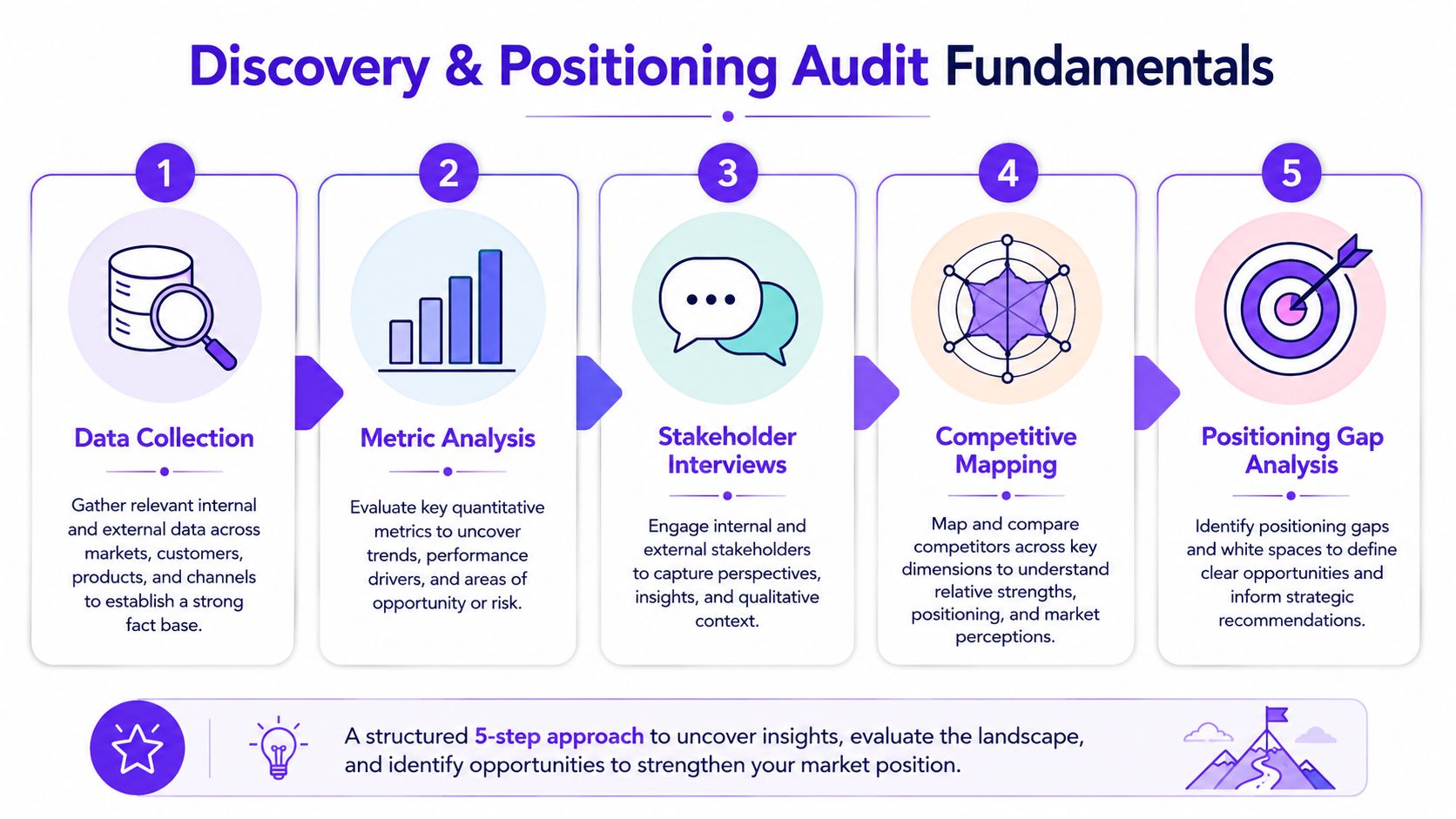
A positioning decision made without a baseline is mostly opinion. Discovery should establish what the market currently knows, feels, remembers, and associates with the brand before the team changes its message.
A rigorous audit begins by measuring brand awareness, differentiation, and trust through repeated tracking waves, then comparing those measures with competitors. The Brand Tracking 101 guide from Hanover Research recommends keeping the core question set stable across waves and defining KPIs, sample, and cadence in advance. That discipline helps teams distinguish genuine movement from survey noise.
Build the baseline before changing the story
Use a stable question set covering:
- Brand-name recognition: Can people identify or recall the brand within the category?
- Category association: What do they think the brand offers, and what situations bring it to mind?
- Purchase history: Have they considered, purchased, or rejected the brand?
- Sentiment: What feelings or judgments do people attach to it?
- Open-text descriptors: Which words do people use without being prompted?
The open-text component is particularly useful because it exposes the gap between internal language and market language. If leadership describes the brand as “simple” but customers describe it as “limited,” the discrepancy is strategic evidence, not a copywriting problem.
Define the KPI set, audience sample, fieldwork cadence, and comparison group before collecting the first wave. Keep the core items unchanged, while allowing a small number of diagnostic questions for current business issues. This gives the team a defensible baseline for mental availability and perception gaps.
Add qualitative depth and competitive context
Quantitative tracking tells you where a gap exists. Interviews, focus groups, customer-support analysis, sales-call reviews, and social listening help explain why it exists. For teams building a primary research plan, this definition of primary research provides useful terminology for separating newly collected evidence from existing sources.
Stakeholder interviews should follow a consistent guide rather than becoming informal opinion sessions. Ask each participant:
- Which audience matters most to the business?
- What customer problem does the brand solve better than alternatives?
- What proof can the company provide?
- Which perceptions are accurate, outdated, or aspirational?
- Where does the current experience contradict the desired position?
- Which decisions should the brand strategy make easier?
Map competitors by customer need, perceived benefit, proof, price logic, experience, and distinctive cues. Don't merely list slogans. A competitor can occupy a strong position without saying it explicitly, because its product design, service model, distribution, or customer experience communicates the idea.
Finish the audit with a gap statement that separates current perception, desired perception, and credible permission to move. That final phrase matters. A brand can want to own an idea, but it still needs evidence that customers will believe it and that the organization can consistently deliver it.
Positioning and Brand Architecture Decisions
Positioning sets the idea a brand will own, along with the ideas it will deliberately leave to competitors. Architecture organizes the portfolio so customers and employees can understand how the parent brand, products, services, and sub-brands relate.
A credible position combines the type of value the audience cares about with an advantage the organization can prove. Functional positioning can clarify a complex offer. Emotional positioning can give a familiar category greater meaning. Values-based positioning can guide behavior and attract people who share the principle. Each option weakens when the business cannot consistently deliver its promise. For further context on keeping positioning clear in AI-mediated discovery, review these Sight AI brand positioning tips.
Use the audit to score each positioning option against four criteria:
| Decision criterion | Question to ask |
|---|---|
| Relevance | Does the position address a meaningful customer need? |
| Distinctiveness | Can people separate it from competitor territory? |
| Credibility | Can the organization prove and deliver it? |
| Extendibility | Can the idea guide products, content, service, and growth? |
The scorecard should become a decision record, not a workshop artifact. Assign an owner for each criterion, document the evidence behind every score, and record which trade-offs leadership accepts. A position that wins on distinctiveness but fails on credibility should not advance without a plan to close that proof gap.
Choose architecture by managing risk
A branded house gives products and services a shared identity. It can improve consistency and operational efficiency, but a problem in one offer may affect the wider portfolio. A house of brands gives each offer more freedom and can isolate reputational risk, but it demands more investment, management, and explanation. A hybrid structure can balance both, though it introduces its own rules and exceptions.
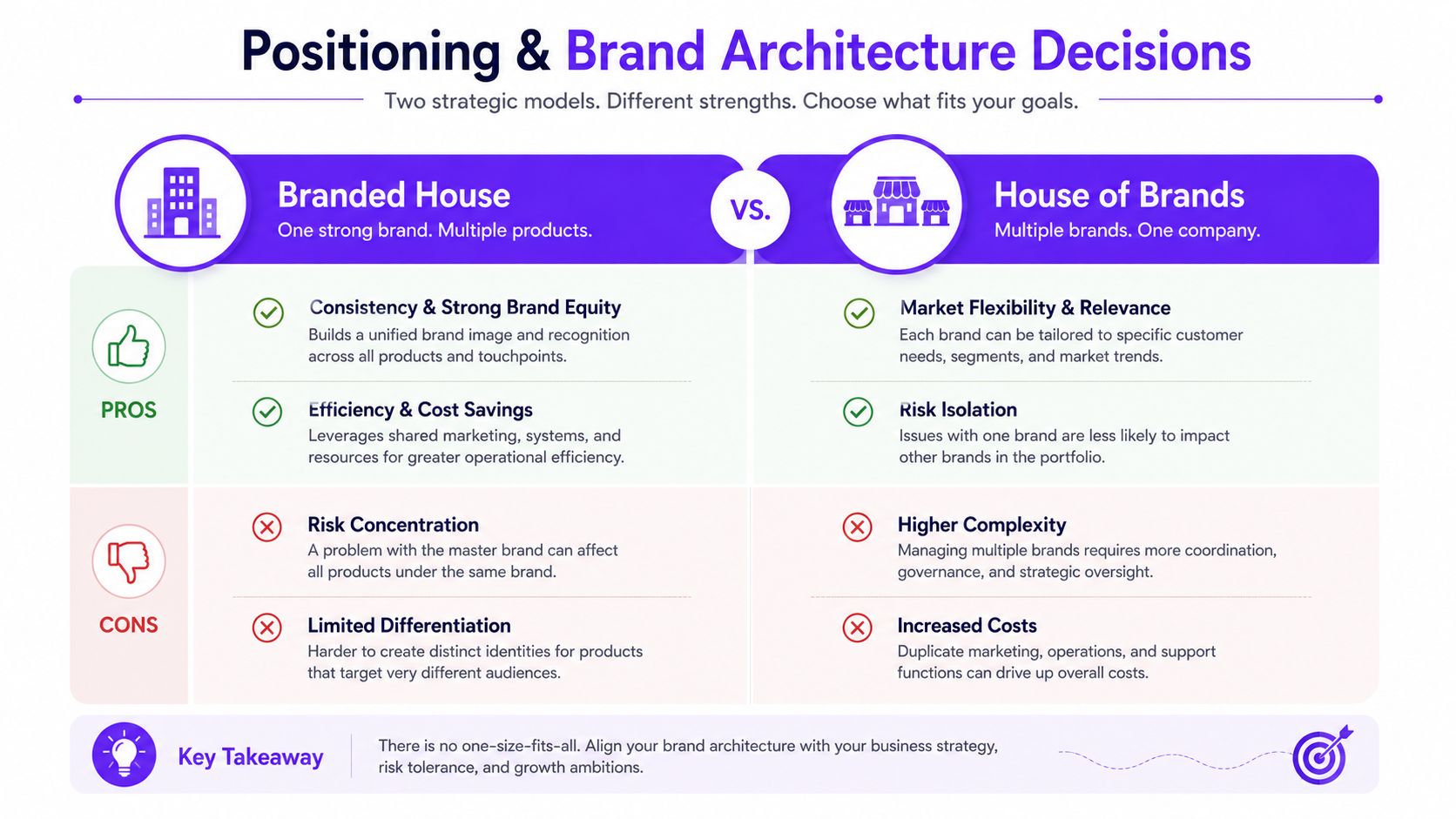
Use a branded house when shared trust, cross-selling, and a common experience matter more than independent identities. Consider a house of brands when audiences, purchase contexts, value propositions, or reputational risks differ materially. Choose a hybrid when the portfolio needs a visible parent relationship alongside meaningful product-level distinction.
Deliberate fragmentation can also be the right choice. Regionalization, hyper-localized strategies, and hyper-niche communities may suit markets where a single global narrative creates confusion or weak relevance. The decision should rest on evidence, not on the assumption that localization is automatically modern. Examine whether customer needs, credibility, purchase context, or reputational exposure differ enough to justify separate identities.
Convert the choice into usable assets
A strategy becomes operational when it produces a small set of assets:
- Positioning statement: The internal expression of audience, need, category, distinction, and reason to believe.
- Value proposition: The customer-facing explanation of the value created.
- Proof points: Product, service, behavior, evidence, or experience that makes the promise believable.
- Message hierarchy: The order in which the brand communicates the core idea, supporting benefits, and detail.
Test these assets with target segments and against competitor frames before rollout. Then place them in a governed workspace with named approvers, version control, and rules for exceptions. That structure lets agency, marketing, product, and sales teams make consistent decisions without reopening the strategy in every meeting.
A positioning map can expose crowded territory, but the visual should support judgment rather than replace it. Use the brand positioning map resource to structure the analysis, then return to the evidence. The strongest position is not always the empty space. Empty space may exist because customers do not value it or because the business cannot credibly occupy it.
Messaging Frameworks and Visual Identity Systems
Positioning only becomes real when people can recognize it in a sales conversation, product page, support interaction, social post, presentation, and campaign. Messaging and visual identity should therefore be designed as one system, not as separate agency deliverables passed from strategy to creative with no shared logic.
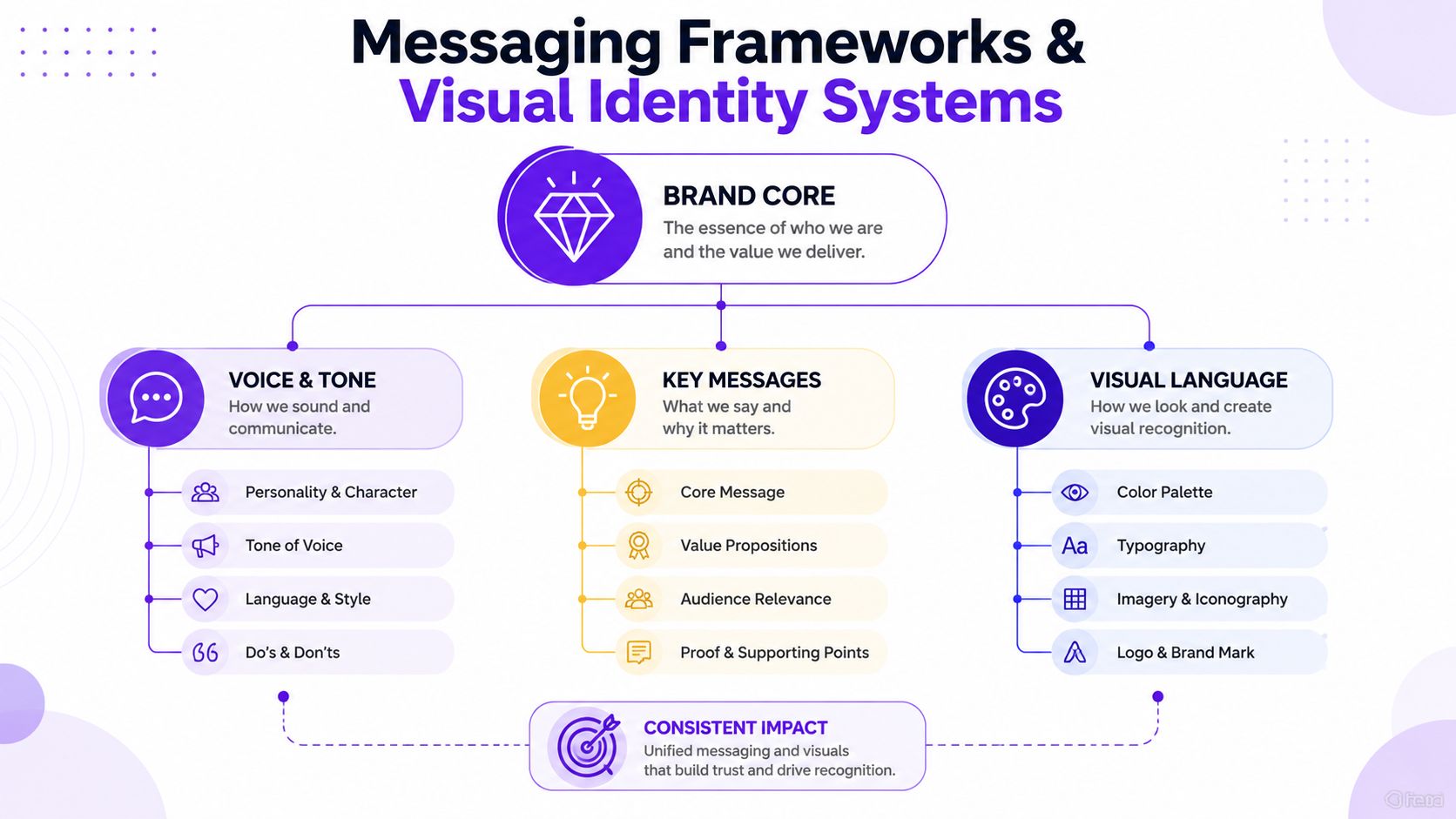
Start with the brand core. Define the central promise, the audience tension it resolves, the personality that expresses it, and the proof that supports it. Then build outward into voice, tone, messages, content themes, visual language, and experience principles.
Create a hierarchy people can use
A practical messaging framework might include:
- Core narrative: The most durable explanation of why the brand matters.
- Primary message: The clearest expression of the strategic promise.
- Supporting messages: The benefits or reasons to believe that reinforce the promise.
- Audience adaptations: Variations for needs, markets, buying stages, or communities.
- Evidence library: Approved facts, examples, demonstrations, and customer language.
The hierarchy prevents every team from treating every message as equally important. It also gives creators room to adapt without inventing a new position for each channel.
Voice should remain recognizable, while tone changes with context. A support response may need patience and clarity. A campaign may use more energy. A technical document may prioritize precision. The brand shouldn't sound like three unrelated organizations just because three teams wrote the content.
This brand voice development resource can help teams formalize those choices. A useful tone matrix describes the audience situation, desired feeling, acceptable language, language to avoid, and an example transformation from generic copy into brand-specific copy.
Design for consistency without freezing the brand
A visual identity system needs fixed elements and flexible elements. Fixed elements might include the logo structure, core colors, typography rules, and accessibility requirements. Flexible elements might include layouts, image treatments, motion behavior, illustration, and campaign-specific composition.
The goal isn't to force every asset into the same template. It's to ensure that variation still signals the same strategic idea. A brand that relies only on a logo for recognition has a fragile system. Distinctive typography, color behavior, photography, composition, sound, and interaction patterns can distribute recognition across the experience.
The broader strategic tension is global consistency versus local relevance. A single story scales efficiently, but it may flatten cultural nuance or sound generic. Deliberate fragmentation can improve relevance, but it increases governance demands. Set evidence thresholds for localization: a meaningful audience difference, a material category need, a credible local proof point, and a clear owner for the variant.
A message framework and identity system should be tested together. Show the audience the proposition in words, then in a page, ad, interface, or service scenario. If the meaning changes when the design appears, the system isn't aligned yet.
Activation Plans and Governance Models
A launch plan without ownership is only a calendar. Brand strategy development becomes operational when approved decisions move through briefs, assets, reviews, measurement, and updates with named owners at each stage.
Set up a small governance group before production begins. The client brand owner protects strategic intent. The agency strategist interprets the positioning. The creative lead protects expression. The account lead manages scope, dependencies, and decision flow. Regional, product, sales, legal, and customer-experience representatives join when their expertise affects execution.
Assign decisions, not just attendees
A simple RACI model should define who is:
- Responsible: Completes the work and prepares the recommendation.
- Accountable: Makes the final decision.
- Consulted: Provides required expertise before approval.
- Informed: Receives the decision and applies it.
Keep accountability with one owner wherever possible. Giving every stakeholder approval rights slows decisions and encourages compromise language. Document an escalation route for disputes involving legal risk, market relevance, or material business change. The governance system should make disagreement visible without turning every review into a committee meeting.
A practical activation sequence looks like this:
- Foundation: Publish the strategy charter, messaging hierarchy, identity toolkit, approved proof points, and briefing template.
- Pilot: Apply the system to selected campaigns, channels, regions, or customer journeys.
- Integration: Update templates, content workflows, sales materials, product experiences, and partner guidance.
- Optimization: Review brand health, business outcomes, consistency, and exceptions on a defined cadence.
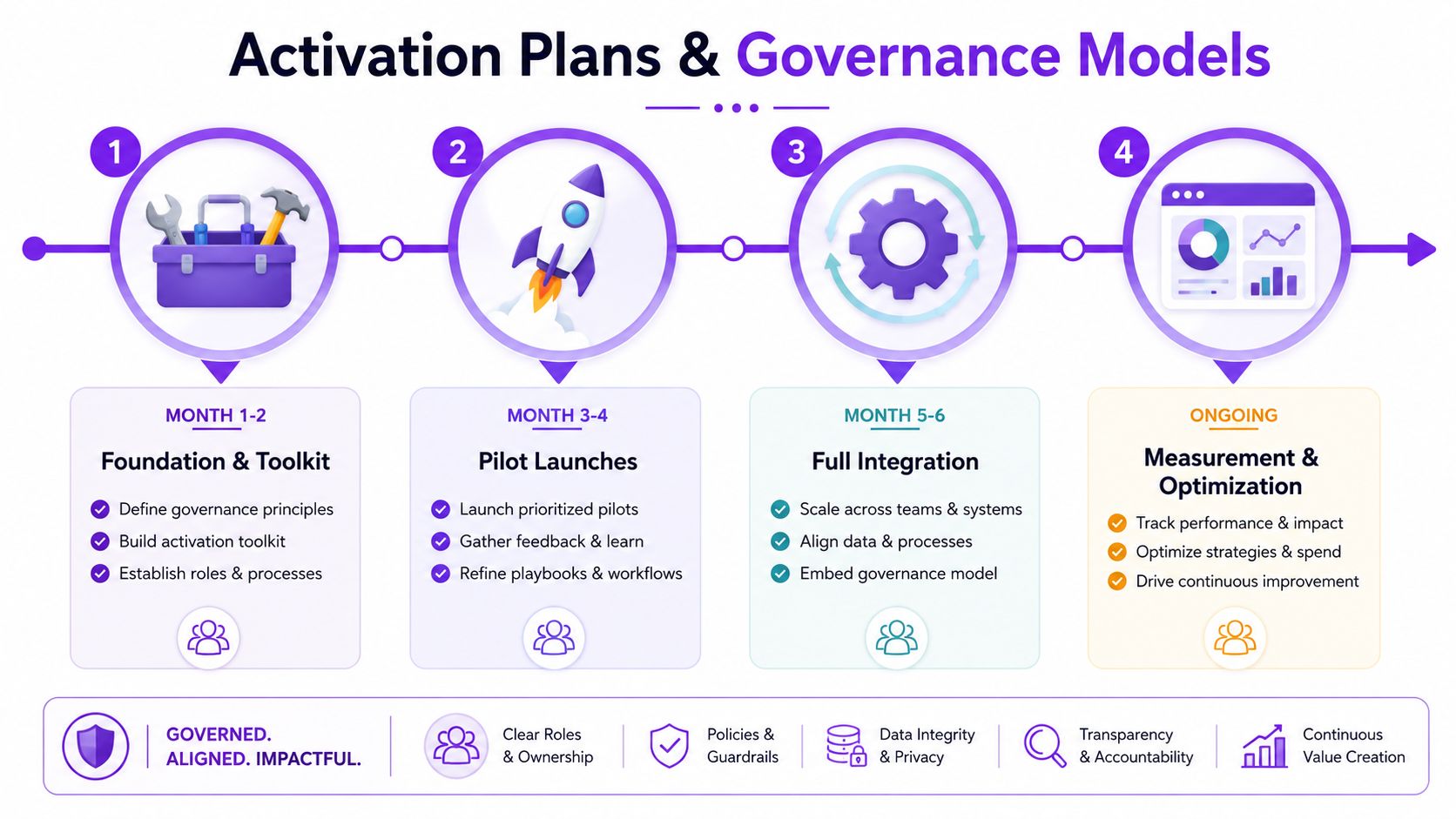
Treat these milestones as a planning structure, not universal deadlines. A smaller organization may move faster, while a regulated or geographically complex organization may require more review. Speed is useful only when the decision rights and quality thresholds remain clear.
Measure consistency and usefulness
Track brand health through stable questions, then pair those measures with business outcomes that reflect the strategy's role. Depending on the business, this may include consideration, qualified demand, conversion quality, retention, sales-cycle friction, or customer-experience signals. Avoid attributing every movement to brand activity. Record major launches, pricing changes, distribution changes, competitor actions, and product shifts so interpretation stays honest.
Governance also needs a content rule. Research summarized in the rebranding campaign statistics source reports a gap between what B2B buyers want from branded content and the degree to which brands center their own products and services. The operational lesson is clear: brief content around the buyer's problem first, then connect the solution to the brand's role.
Turn that principle into a review question: does the asset help the audience understand, decide, or act, or does it only repeat a product claim? A governance group can apply the question consistently across campaign briefs, sales materials, and customer-facing experiences.
AI-enabled production requires its own approval rules. Define how teams handle prompts, source materials, confidential information, generated concepts, factual verification, and final human sign-off. Faster content creation increases the need for governance because more assets can reach review in less time.
Teams that need a broader workflow can use this marketing campaign planning guide to connect strategic choices with execution planning.
Using AI-Powered Collaboration Throughout the Process
AI is most useful in brand strategy when it improves the quality of collaboration, not when it replaces judgment. The strongest use cases involve structured divergence, broader participation, faster synthesis, and clearer next steps.
Consider a pitch team preparing for a client workshop. The strategist enters the research questions and known constraints into a guided brainstorming session. Account managers add client concerns. Creatives contribute provocative routes. The team generates alternatives individually before discussing them, which reduces the chance that the first confident speaker determines the direction.
A platform such as Bulby can support that workflow with structured brainstorming, anonymous input, AI-generated sparks, and curated summaries that help teams move from scattered ideas toward actionable outcomes. The strategist still validates the ideas against research, positioning criteria, brand constraints, and client realities.
Use AI at each decision point
During discovery, AI can organize interview notes, cluster recurring language, identify contradictions, and produce questions for follow-up. It shouldn't decide which customer insight is true. Human researchers still need to examine context, source quality, and what the data fails to explain.
During positioning, the team can ask for alternative audience tensions, competitor frames, proof-point requirements, or risks associated with a proposed claim. The output should expand the option set, not become an untested strategy. A useful workshop prompt asks participants to reject an idea, defend it, and identify the evidence that would change their minds.
During messaging development, AI can transform one approved proposition into channel, audience, or journey variations. The strategist checks whether each version preserves the core meaning and whether the tone remains recognizable. During creative development, designers can use AI tools alongside established systems. Teams exploring options may find a curated overview of AI design tools useful, provided they protect brand assets and review outputs for originality, accessibility, and accuracy.
Keep the collaboration human
AI sessions need a facilitator, a clear question, a time boundary, and a decision artifact. End each session with selected ideas, rejected ideas, unresolved questions, owners, and next actions. Without that final step, brainstorming becomes an impressive archive rather than progress.
The same principle applies to AI-driven marketing solutions. Tools can accelerate research handling, content variation, and coordination, but the brand owner remains responsible for meaning, evidence, risk, and consistency.
The agency advantage comes from combining structured participation with experienced judgment. AI can make it easier for quieter contributors to enter the process and for teams to explore beyond familiar patterns. It can't decide which trade-off the business should accept. That decision still belongs to accountable people who understand the market, the customer, and the organization's ability to deliver.
Bulby gives marketing and creative teams a structured way to turn research, stakeholder input, and early ideas into focused brainstorming outcomes with clear next steps. Use Bulby to bring strategists, creatives, and account teams into a more organized brand strategy development workflow.