
The most popular advice about brand positioning tools is to start with a perceptual map. That's useful only if you know whose perceptions you're mapping. A clean chart built from internal opinions can make an unsupported position look settled.
Most positioning work stalls because the team has a clear map but no evidence that buyers see the brand the way the map says. In 2025, 51% of global marketers reported having a clear, documented, and unique value proposition that differentiates their brand from competitors, according to HubSpot's Loop Marketing Landscape Report. A finished positioning statement isn't something every team can take for granted.
The practical distinction is between generating a position, organizing it, auditing competitor claims, and measuring buyer perceptions. Those are different jobs. A brainstorming platform can help develop alternatives, but it can't establish what buyers believe. A tracking platform can reveal perception changes, but it won't choose your strategic response.
Start with the missing evidence, not the longest feature list. Decide what you need to learn before choosing where to work.
The options below are grouped by those jobs rather than ranked as interchangeable products. Agencies and in-house teams should use them to turn competitor research into decisions, then test the assumptions behind those decisions. Budget matters, but paying for the wrong kind of answer is the more expensive mistake.
Table of Contents
- 1. Bulby. Online AI Brainstorming for Creative Teams
- 2. SmokeLadder
- 3. Branding5
- 4. Storyflow
- 5. Miro
- 6. Canva
- 7. MyMap
- 8. Kantar Marketplace
- 9. YouGov BrandIndex
- 10. Qualtrics Brand Tracking
- How the ten brand positioning tools differ by primary job, best user, free access, and pricing visibility
- Matching Each Tool to the Stage You Are In
1. Bulby. Online AI Brainstorming for Creative Teams
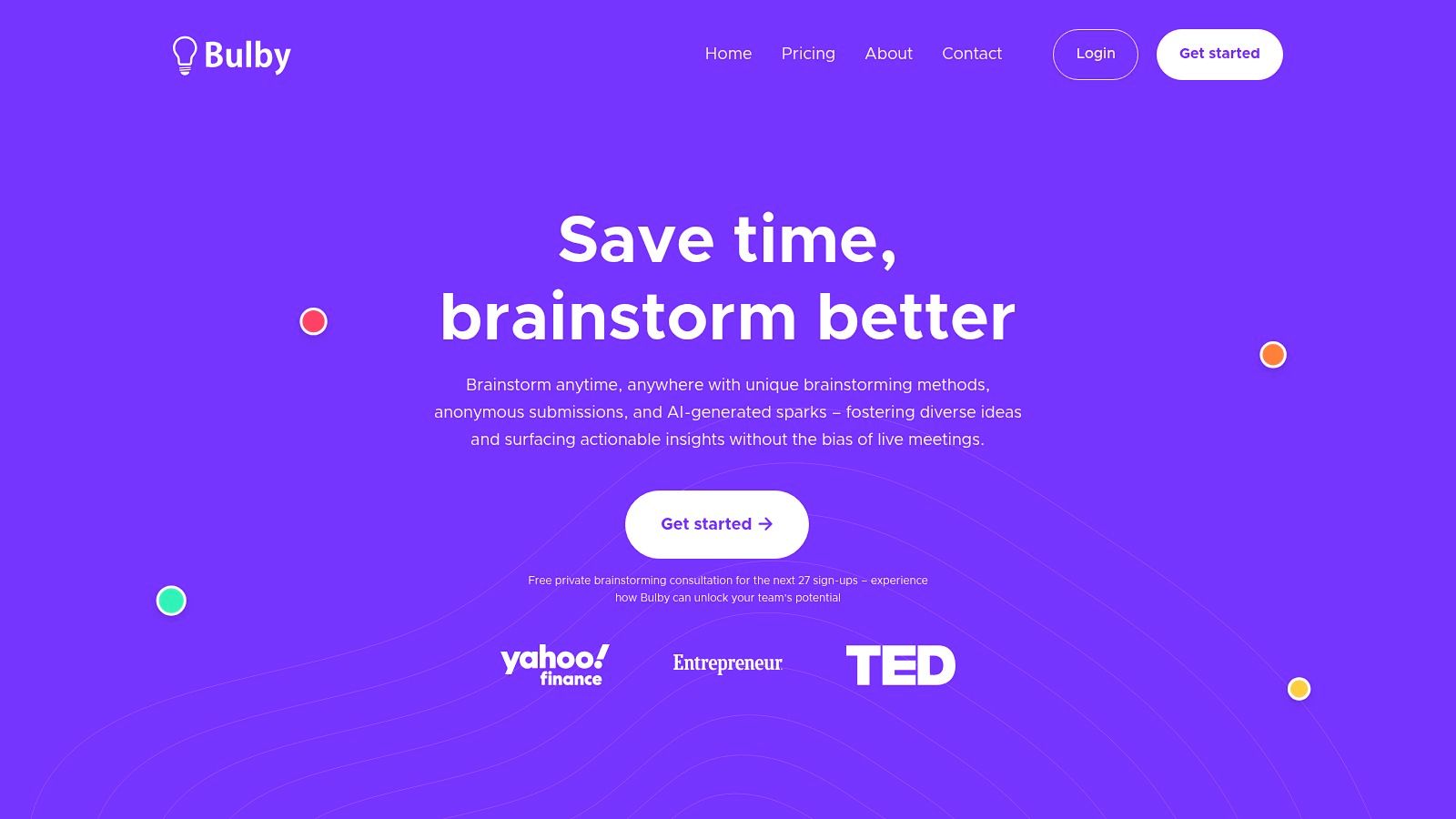
Best for generating positioning alternatives with a team, rather than accepting the first plausible proposition.
Our platform combines structured brainstorming exercises, anonymous brainwriting, and AI-generated sparks. Participants can contribute before a senior stakeholder's preferred answer becomes the default. That's useful when strategists, creatives, product managers, and account leads approach the same positioning problem differently.
Start with a focused challenge. For example, ask how a product could become the preferred choice for buyers who distrust complicated implementation. That gives people a customer tension to work on, rather than asking them to invent a better tagline.
From Ideas to Testable Territories
Our workflow guides participants from the challenge through individual exercises, anonymous contributions, and an AI-generated summary with suggested next steps. For positioning work, the useful output is a set of candidate territories, each with an audience, promise, supporting evidence, and unresolved assumptions.
- What works: Structured exercises help teams explore beyond familiar category claims.
- What needs review: AI suggestions still need checks for relevance, originality, and product truth.
- What it doesn't replace: Customer research, brand tracking, or a broader project-management system.
Use AI for brand strategy to expand the options, not certify the answer. If you also explore AI mind maps in Acres, distinguish organizing related ideas from deciding which territory deserves investment.
We offer a 14-day free trial and custom plans for organizations with distinct needs. You can explore the platform through our brainstorming website. The strongest reason to choose it is a need for better collaborative thinking before committing to a position, not a need for automated market validation.
2. SmokeLadder
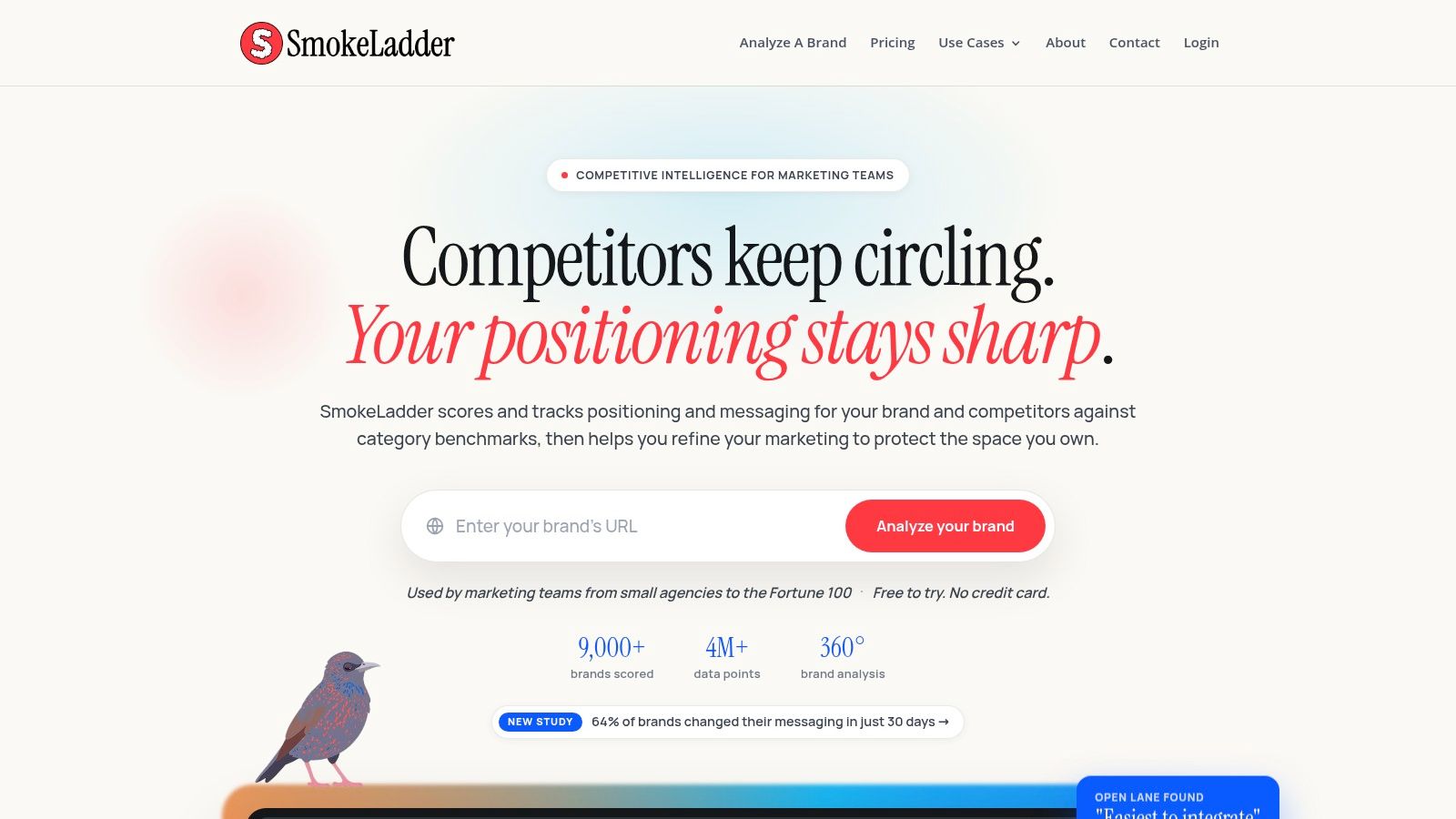
Your competitors all promise simplicity, expertise, and better results. SmokeLadder helps inspect how those promises are expressed, rather than leaving the audit as a folder of screenshots.
SmokeLadder reviews a brand's website alongside competitor websites. Its positioning and messaging analysis assesses communicated value and differentiation, giving strategists a structured starting point for discussion. Paid plans add ongoing monitoring and broader multi-brand capabilities.
Audit Claims Before Writing Alternatives
Use the analysis to examine homepage promises, audience definitions, proof points, and repeated category language. Then check the underlying pages yourself. An apparently distinctive phrase may describe a familiar benefit, while a vague headline may hide a useful product advantage.
- Strong fit: Agencies preparing a competitive messaging audit or maintaining visibility across client categories.
- Budget trade-off: Free access can support an initial trial, while ongoing monitoring requires paid access.
- Main limitation: Website analysis measures what companies communicate, not what buyers understand or remember.
Bring the findings into positioning workshop exercises as evidence to debate. Ask which claims are crowded, which are credible, and which customer problems competitors barely address.
The tool is less useful if you expect an automated score to settle strategy. A company can communicate poorly and still hold a strong position through product experience, distribution, or reputation. Treat the report as an audit of messaging, not a verdict on market position.
3. Branding5
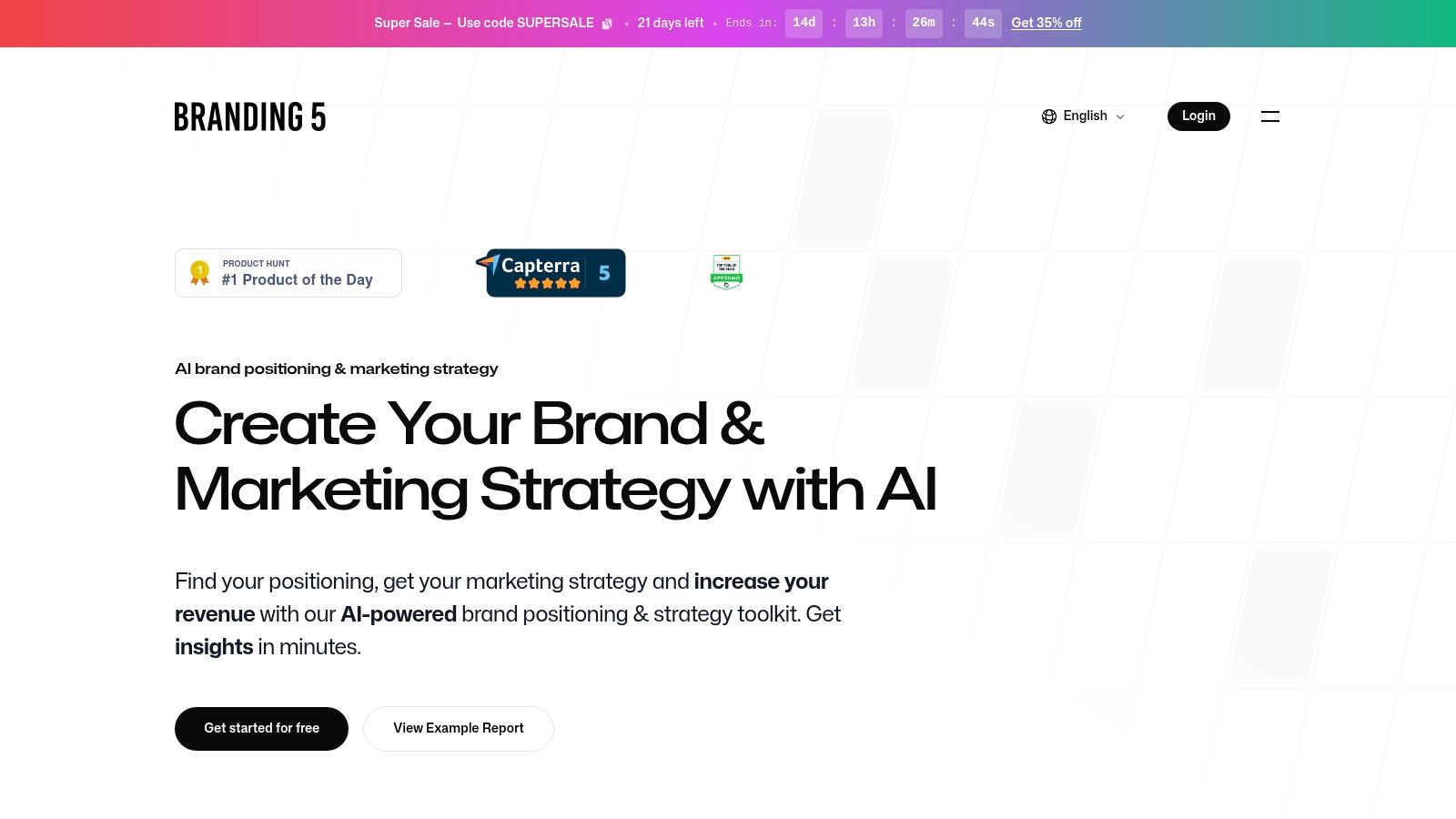
Branding5 suits teams that need a connected strategy draft, not just a blank positioning canvas.
Branding5 guides users through inputs such as audience, competitors, values, and personality. It then generates positioning reports and related marketing materials. Export, sharing, and agency white-labeling options make it relevant to founders and agencies preparing client deliverables.
The practical advantage is continuity. A team can examine positioning alongside voice, audience, and campaign ideas instead of developing each in isolation. The risk is accepting a coherent document as proof that its central premise is correct.
A report can be internally consistent and still describe a position buyers don't care about.
Control the Inputs and Challenge the Output
Feed the tool specific customer problems, purchase objections, and credible product evidence. Broad inputs such as customer-focused or premium won't give it much strategic substance.
Use established brand positioning frameworks to review the draft. Check the competitive frame, the intended audience, the promised benefit, and the reason buyers should believe it.
The trade-off is breadth versus control. Teams that need positioning, voice, and marketing outputs together may find the package useful. Teams that already have a strategy method may prefer a lighter workspace.
Before frequent agency use, inspect credit allowances and export requirements against your expected workload. The relevant cost is the usable client deliverable, including strategist review, not access to a generated report.
4. Storyflow
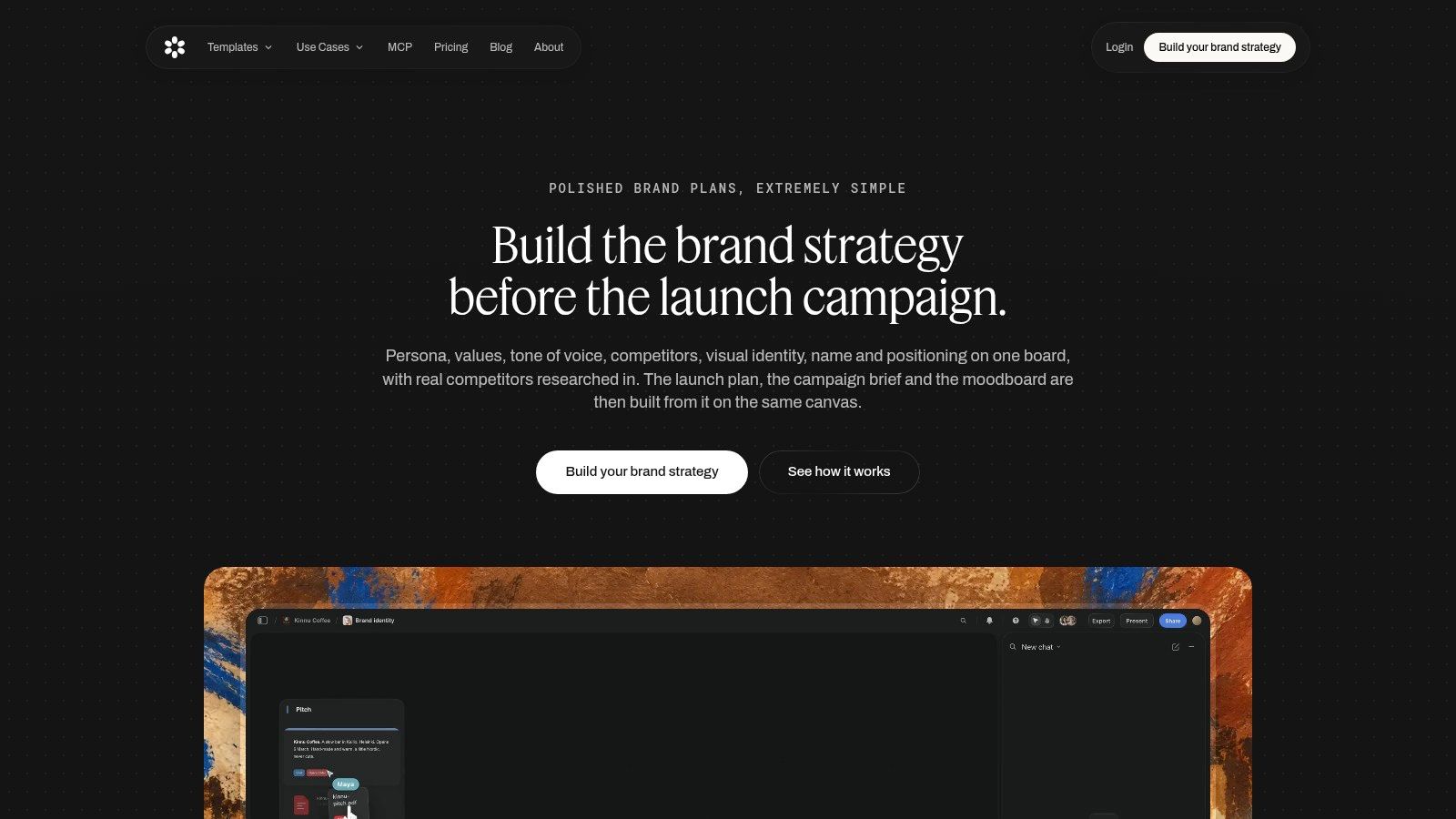
A positioning document often loses usefulness when the campaign team starts from a separate brief. Storyflow's strongest fit is keeping strategy and execution connected.
Storyflow provides collaborative visual boards for positioning, audience, values, voice, competitors, and visual direction. Shared canvases, comments, stakeholder links, moodboards, and campaign planning let different disciplines work around the same strategic material.
That connection is useful during review. A creative director can question whether the proposed visual direction supports the promise. A product manager can flag a claim the product can't yet substantiate. An account lead can see which decisions remain unresolved.
Make the Board a Decision Record
- Keep visible: The chosen audience, customer tension, brand promise, and supporting evidence.
- Separate clearly: Approved decisions, alternative directions, and assumptions awaiting validation.
- Carry forward: The same strategic choices into campaign briefs and launch planning.
AI-assisted drafting and competitor research can accelerate preparation, but a strategist still needs to verify the material. Otherwise, an unsupported assumption can spread from the strategy board into every execution.
Storyflow isn't a specialist consumer-perception measurement platform. Choose it when collaboration and continuity are the bottleneck, not when you need representative evidence about market beliefs.
Check the current plan details against the sharing and export functions your reviewers need. A workspace is useful only if the people responsible for decisions can review it.
5. Miro
Miro is a workshop surface, not a positioning method. That distinction makes it flexible, but it also puts more responsibility on the facilitator.
Miro's brand-positioning templates give teams a shared place to map audiences, competitors, benefits, and alternatives. Facilitation features such as voting, timers, and private working modes can support participation, depending on the plan.
Use it when the team already has a process and needs people to work through it together. For example, product, sales, and marketing can each map the alternatives buyers consider, then discuss where their interpretations disagree.
Separate Internal Maps From Perceptual Maps
An internally created competitive map is a hypothesis. A consumer-based perceptual map uses structured evaluations to represent perceived similarities and differences, as explained in the academic paper on perceptual mapping and brand positioning.
That distinction should be visible on the board itself.
- Workshop map: Useful for exposing assumptions and agreeing on research questions.
- Evidence-based map: Useful for examining how customers distinguish brands.
- Decision summary: Necessary to turn either map into an actionable recommendation.
Miro's free access can suit an initial workshop, while paid collaboration features may matter for recurring facilitation. Check which controls your session requires before inviting participants.
Its main weakness is accumulation. A large board can preserve every contribution without clarifying the choice. End with a concise decision frame, not a screenshot of everything the team discussed.
6. Canva
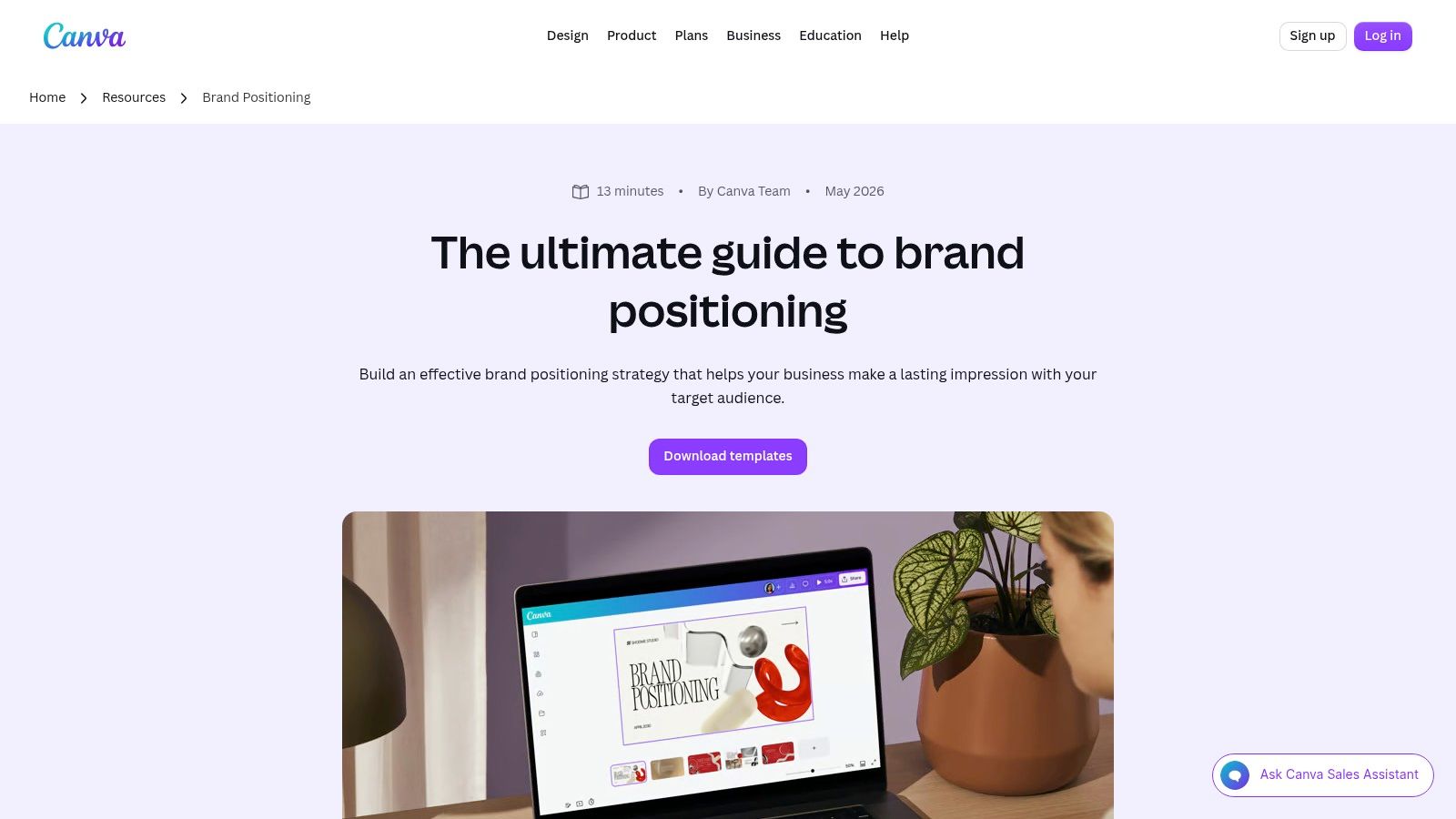
The strategy is ready for review, but the explanation is hard to follow. Canva helps communicate the work clearly, especially when the audience doesn't need access to a live workshop board.
Canva's brand-positioning resources support visual exercises such as positioning maps, competitor analysis, and go-to-market planning. Teams can carry that work into presentations and creative materials in the same environment.
For smaller teams, that reduces the need to learn a specialist presentation workflow. Brand identity controls can also help keep strategy materials visually consistent, although available features depend on the plan.
Presentation rule: Label an assumption before you polish it. A finished-looking chart shouldn't imply finished research.
Use Design to Explain the Decision
Show the customer problem, the competitive alternatives, the proposed promise, and the evidence supporting it. If you include a positioning map, state whether its coordinates came from customer evaluations or internal judgment.
An aesthetic mood board can help explore how the position might feel in execution. It doesn't establish whether buyers find the promise relevant or credible.
The budget advantage is accessibility. A free plan may be enough for a simple strategy presentation, while advanced brand controls and AI functions depend on paid access.
Canva falls short when the task requires specialist research or automated competitor analysis. Choose it to make a defensible recommendation easier to understand, not to make an untested recommendation appear authoritative.
7. MyMap
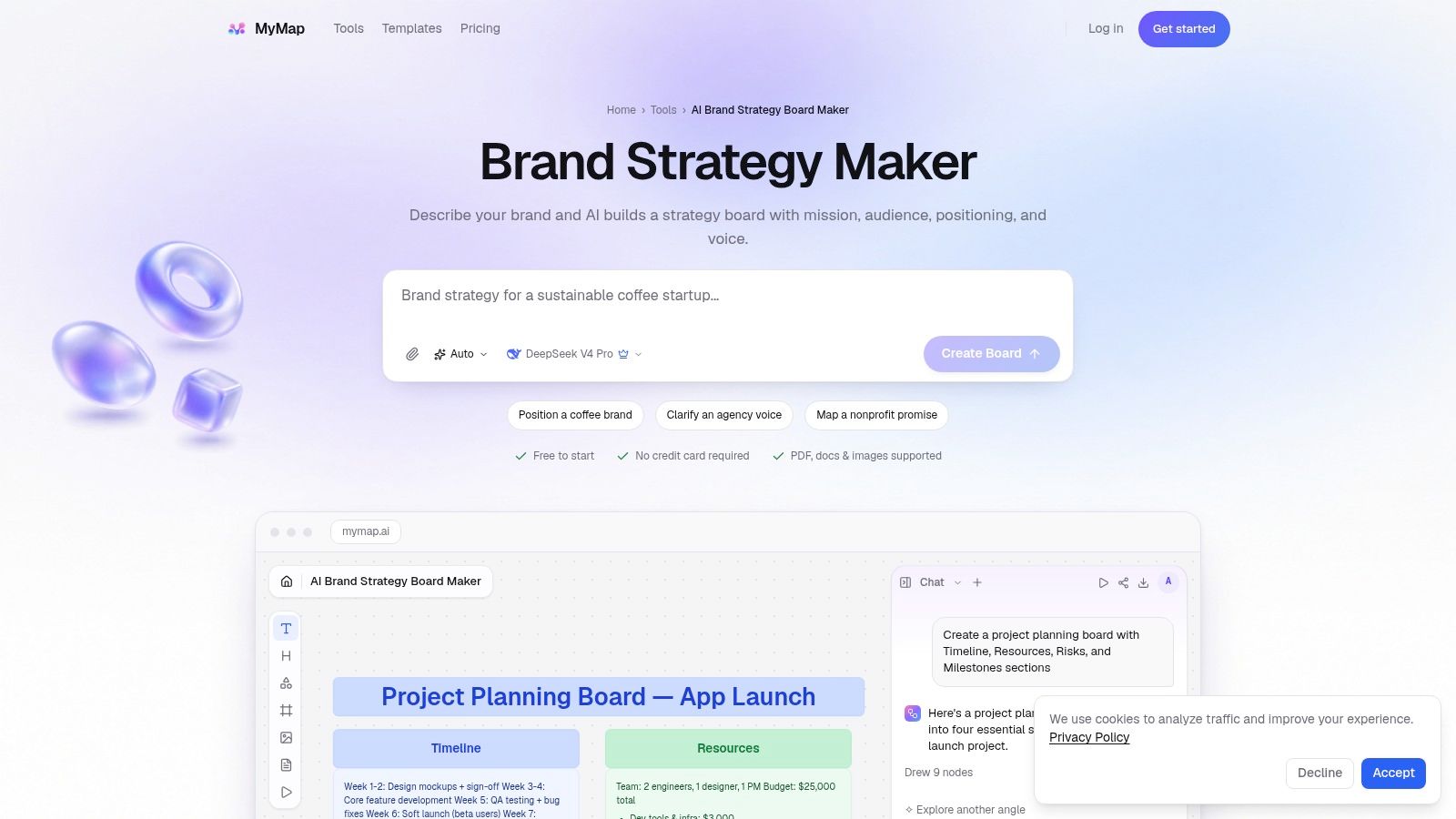
MyMap is useful when the immediate problem is an empty canvas. Give it a brand description, then use the generated structure as material to revise.
MyMap's brand strategy board covers areas such as mission, audience, positioning, competitors, personality, and voice. Its editable workspace lets teams rearrange and develop those sections rather than treating the initial output as fixed.
That makes it a reasonable preparation tool for a workshop. A product manager can bring an initial board into the discussion and ask colleagues to correct assumptions, add evidence, and remove generic language.
Review Before Expanding
- Keep: Accurate product facts, useful audience distinctions, and questions that need answering.
- Rewrite: Benefits that could describe any competitor.
- Flag: Competitor claims, customer motivations, and category assumptions that haven't been verified.
The free tier makes trialling the workflow relatively accessible, but credits and map allowances constrain repeated use. Agencies should consider whether the available capacity matches their revision process, not just initial generation.
The main limit is evidence. A detailed board can create the impression that every strategic area has been investigated when the content came from a short description.
Choose MyMap if you need an editable starting structure quickly. Skip it if you already have a clear framework and the gap is customer understanding, ongoing tracking, or a difficult strategic choice.
8. Kantar Marketplace
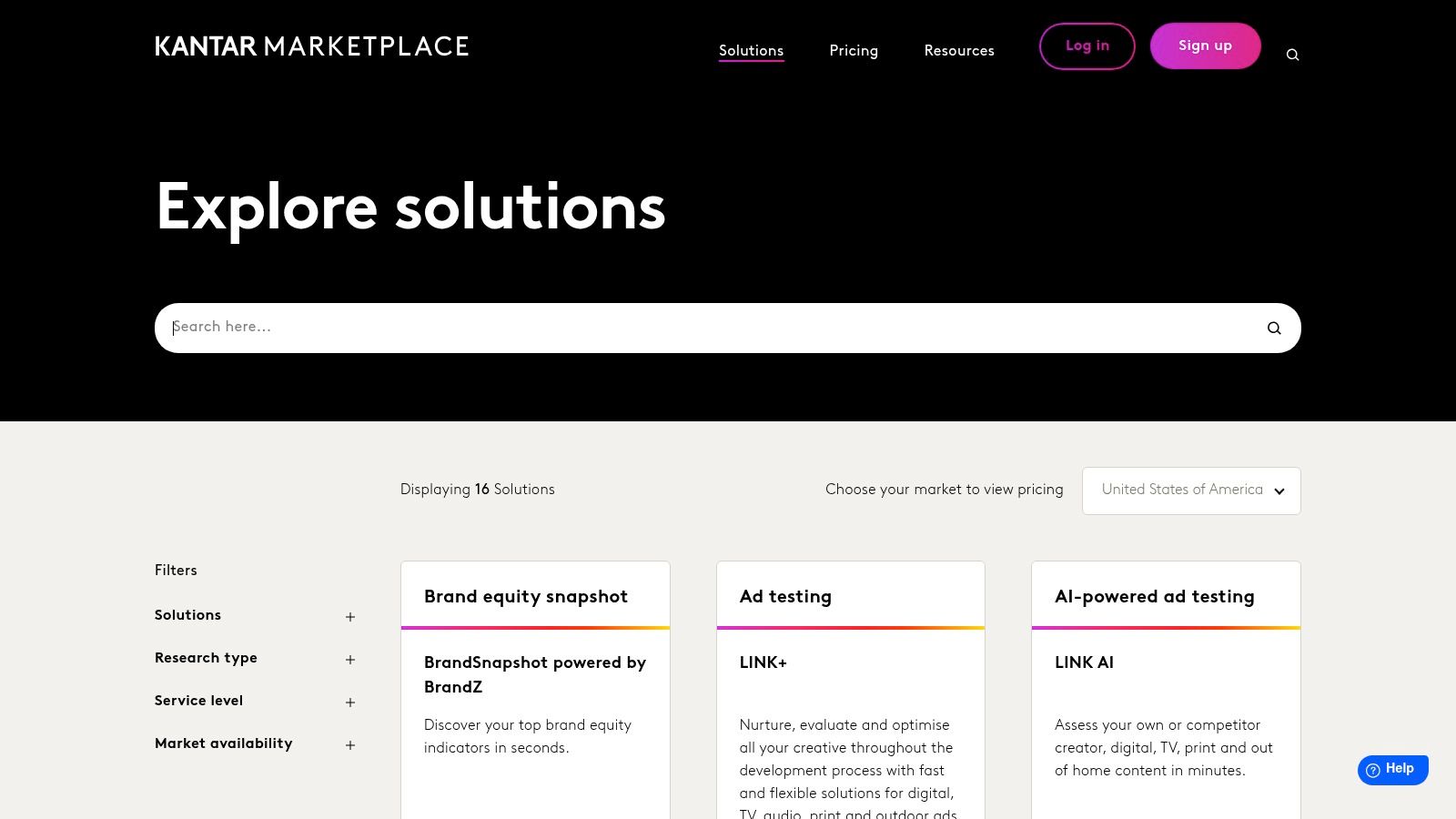
When a positioning decision affects a launch, portfolio, or substantial investment, a workshop alone may not provide enough evidence. Kantar Marketplace belongs in the research-backed decision group.
Kantar Marketplace includes NeedScope Positioner for positioning work and BrandEvaluator for examining brand equity and growth opportunities. Its Meaningfully Different and Salient framework gives teams a defined way to investigate brand strength.
This is a different purchase from a whiteboard subscription. You're choosing research scope, methodology, market coverage, and potentially support, rather than buying a place to organize ideas.
Define the Decision Before the Study
Use a market research framework to specify the audience, alternatives, hypotheses, and action the results will inform. Ask whether buyers understand the territory, care about it, believe the promise, and associate it with competitors.
For international work, distinguish the global promise from local interpretation. A cross-cultural study of perceived globalness and localness found that consumers could interpret those qualities as complementary. Don't assume global consistency requires identical local expression.
The trade-off is research depth against cost and setup. Some needs justify a structured study; an early idea-generation session usually doesn't.
Confirm which offering fits the question and whether it is self-service or service-supported. Avoid buying broad brand research when the actual uncertainty is a narrowly defined claim or audience response.
9. YouGov BrandIndex
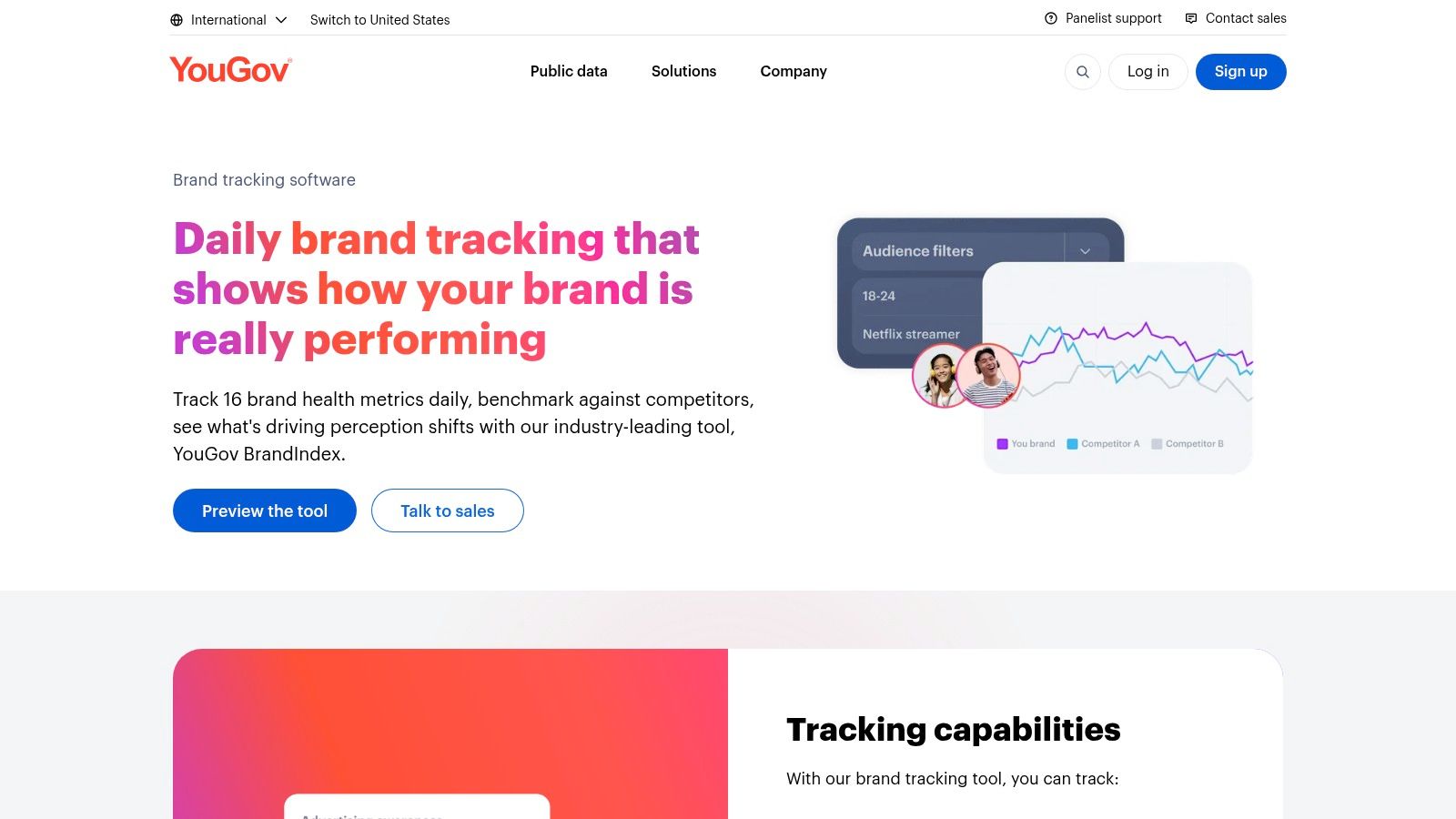
Perception data only pays off if you already know which claim you are testing. YouGov BrandIndex is the measurement job in this set: recurring consumer surveys, competitive benchmarking, audience filters, and historical views that show whether perceptions move, and how the brand sits against competitors.
Brand-health measures such as awareness, consideration, and purchase intent tell you whether the intended position is registering. Quality and value sit in the same family of measures. The useful part is continuity. One baseline and one competitor set make movement readable. A pile of unrelated snapshots does not.
Track the Claim You Are Betting On
A value position needs perceived value read next to consideration, plus the commercial evidence the team already holds. A quality position needs quality perceptions and a check that buyers attach that belief to this brand, not just the category. A relevance problem is narrower. Ask whether the intended audience becomes more willing to consider a purchase.
Keep a log of launches, price changes, distribution shifts, and large campaigns beside the scores. Without that context, more exposure can look like a stronger position.
Paid access starts with a sales conversation. Confirm brand coverage, audience availability, and the markets you sell in before you commit. A free BrandIndex Lite snapshot can introduce the product. It is not a full positioning evaluation.
The limit is explanation. Tracking can show what changed and still leave the cause open. I would not rewrite the strategy on a score move alone. Interviews, message tests, or purchase research still have to explain the mechanism. You trade speed and a self-run session for a consistent read that depends on sample, markets, and a commercial agreement.
10. Qualtrics Brand Tracking
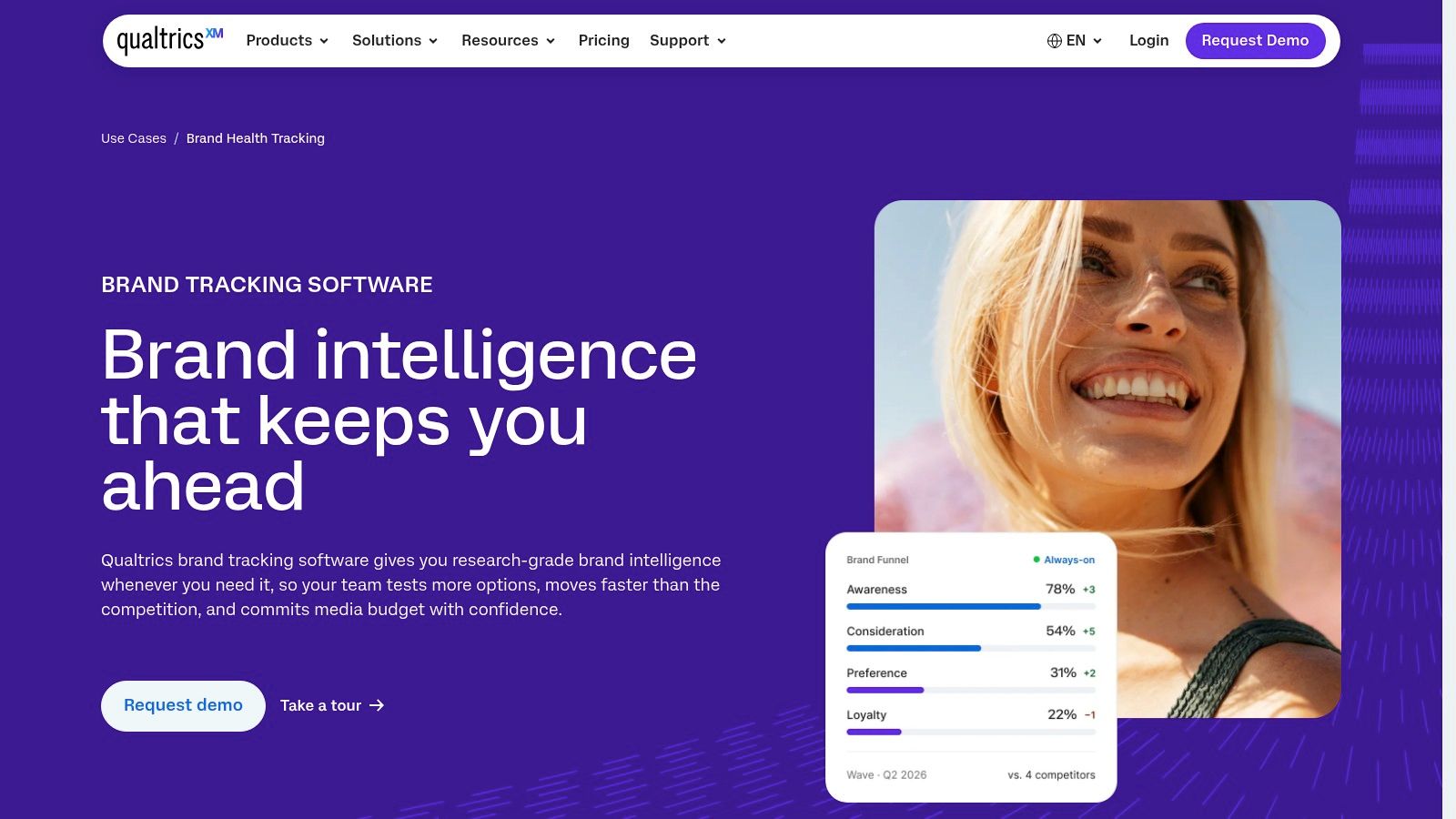
Qualtrics fits teams that need brand tracking connected to a broader research program. Its value is the ability to investigate positioning alongside segmentation, message testing, and product questions.
Qualtrics Brand Tracking supports recurring survey programs, competitive benchmarking, driver analysis, and alerts. Teams can manage research themselves or use research services, depending on their resources and requirements.
Say a product team wants to position around confidence rather than convenience. It needs to measure whether buyers understand that promise, which segments value it, and whether product experience supports it. A connected research program can address those questions without treating each as an unrelated exercise.
Design for Comparable Results
Keep the core measures and sampling approach consistent. Add diagnostic questions carefully, so a change in wording doesn't look like a change in perception.
A dashboard can automate reporting. It can't rescue an ambiguous question or an unsuitable sample.
Quote-based pricing makes early budget assessment harder for smaller teams. Include research design, respondent access, analysis, and ongoing ownership when evaluating the commitment.
For teams considering adjacent monitoring options, the CitationOS article on brand tracking tools can support a wider comparison. Keep the measurement question clear: monitoring visibility or mentions isn't the same as measuring buyer beliefs.
Qualtrics doesn't replace facilitated strategy development. Choose it when you have explicit hypotheses and need a repeatable way to investigate them across audiences and time.
How the ten brand positioning tools differ by primary job, best user, free access, and pricing visibility
Sort these ten by the job they do, the team they fit, and whether a free trial or a public price exists.
| Item | Primary Job | Best For | Free Option | Pricing Visibility |
|---|---|---|---|---|
| Bulby | AI-guided team brainstorming | Creative teams and agency ideation | 14-day free trial | Standard plan $59/month billed annually; custom plans for larger needs |
| SmokeLadder | Positioning and competitor messaging analysis | Comparing brand websites and differentiation | 10 analysis credits | Free credits stated; paid pricing not specified |
| Branding5 | AI-generated brand positioning and marketing strategy | Founders, small teams, and agencies | Not stated | Public pricing, including a one-time option |
| Storyflow | Collaborative brand strategy and campaign planning | Teams connecting strategy with execution | Free access not published | Paid pricing not published |
| Miro | Collaborative whiteboarding for positioning workshops | Teams facilitating shared strategy exercises | Free plan with up to 3 editable boards | Free and paid plans available |
| Canva | Visual positioning exercises and presentations | Teams creating and sharing strategy visuals | Free plan with 1 Brand Kit | Free and paid plans available |
| MyMap | AI-generated editable brand strategy boards | Teams seeking a quick starting structure | Limited monthly credits and maps | Free tier stated; paid pricing not specified |
| Kantar Marketplace | Research-backed positioning and brand-equity analysis | Organizations making evidence-led brand decisions | Not stated | Public starting prices for some offerings |
| YouGov BrandIndex | Consumer-based brand-health tracking | Teams monitoring brand perceptions and competitors | Free BrandIndex Lite snapshot | Paid access requires a sales conversation |
| Qualtrics Brand Tracking | Survey-based brand perception and market tracking | Teams connecting brand tracking with broader research | Not stated | Quote-based pricing |
Matching Each Tool to the Stage You Are In
Choose brand positioning tools by the question you need answered. If the team lacks alternatives, use a structured ideation tool. If it disagrees about the strategy, use a shared canvas. If it lacks customer evidence, another workshop won't close that gap.
For idea generation, the featured brainstorming platform helps teams contribute and develop alternatives. Branding5 suits a more connected strategy draft, while MyMap provides a quick editable structure. These outputs remain proposals until the team checks them against product truth and buyer needs.
Match the Purchase to the Bottleneck
- Generating ideas: Choose structured exercises when familiar answers dominate the discussion.
- Mapping strategy: Use Storyflow or Miro for collaborative decisions, and Canva for clear presentation.
- Auditing competitor messaging: Use SmokeLadder to inspect communicated claims and differentiation.
- Measuring market perception: Consider Kantar Marketplace, YouGov BrandIndex, or Qualtrics when the decision requires consumer evidence.
Most agency and in-house teams need a workshop tool and an evidence tool, not the entire list. Existing software may already cover presentation and collaboration. Add another platform only when it addresses a specific missing capability.
Adoption matters as much as feature breadth. Organizations used 42% of their martech stacks on average in 2022, according to Gartner figures discussed by Duke's Fuqua School of Business. Give each tool an owner, a recurring workflow, and a defined decision output.
Decide What Success Would Look Like
Before changing the position, record the baseline and define the expected effect. Test whether buyers understand the message, find it relevant, believe the proof, and distinguish it from alternatives. Then connect those leading signals to consideration, conversion, retention, or another appropriate business outcome.
In 2025, 30% of U.S. marketers said they validate positioning through customer surveys about brand perception, according to HubSpot's positioning research. Customer validation should be part of the decision process, not a task postponed until the campaign is live.
Set stop/go criteria before reviewing results. Continue when the territory improves the intended perception without creating a credibility problem. Revise when buyers misunderstand the promise, and stop when the product can't support it.
Finally, separate positioning effects from media exposure, pricing, product changes, and distribution. A defensible recommendation explains both what the team believes and what evidence would change its mind.
Bulby offers structured brainstorming, anonymous contributions, and AI-generated inspiration to help teams develop stronger positioning alternatives. Visit Bulby to explore a focused brand challenge with your team, then turn the most promising territories into hypotheses you can test with buyers.