
If buyers understand what makes your brand different, does that mean you've given them a good reason to buy?
Not necessarily. A memorable market position can attract attention without proving value. A useful offer can solve a problem without giving buyers a clear reason to remember the brand behind it.
The distinction between brand positioning vs value proposition becomes clearer when you treat them as separate decision tools. One guides the comparison buyers make. The other needs evidence that choosing you will improve something they care about.
Table of Contents
- Brand Positioning and Value Proposition Compared
- How to Test Positioning and Value Proposition Separately
- Closing the Gap Between a Claim and Proof
- Positioning in an AI-Saturated Market
- Choosing What to Lead With by Situation
- Confirm Both Before You Brief the Campaign
Brand Positioning and Value Proposition Compared
Positioning answers what the brand should mean compared with alternatives. A value proposition answers what value a specific buyer receives and why they should choose this offer.
Brand positioning is the effort to establish a clear, distinctive, attractive place relative to competitors in customers' minds. It sets the association you want your target market to remember.
A value proposition describes the value offered to a defined customer group, how you create it, and why that group should choose your offer. It translates your strategic direction into a customer-level promise.
Different decisions, connected responsibilities
A CEIBS working paper on positioning and value propositions distinguishes these strategic roles and identifies value through better performance, lower customer costs through price or efficiency, and lower perceived risk through trust. Those forms of value give you a practical way to evaluate a promise before polishing its wording.
For example, a creative platform might help a team develop more useful concepts. That's performance value. Reducing workshop preparation creates efficiency value, while showing how ideas were evaluated can help a buyer feel more confident about the decision.
These benefits can support a position, but they don't automatically establish one. A long list of useful outcomes still leaves buyers asking which category the brand belongs in and what makes it different.
Brand positioning vs value proposition at a glance
| Dimension | Brand positioning | Value proposition |
|---|---|---|
| Question it answers | What should the brand mean compared with alternatives? | What value does this buyer receive, and why choose this offer? |
| Strategic level | Market and category frame | Offer and buyer-specific promise |
| Typical owner | Leadership and brand strategy | Marketing, product and sales leads |
| Main output | Positioning statement and category claim | Value proposition statement and proof points |
| Primary audience | Whole market and competitor set | One defined buyer segment |
| Time horizon | Multi-year, changes rarely | Reviewed for each campaign or launch |
Treat the ownership row as a working arrangement, not an organizational law. Leadership should protect strategic coherence, while the people responsible for delivery and selling help ensure the promise is achievable.
Likewise, whole market means the relevant market you've chosen to compete in. It doesn't mean a brand should appeal to everyone. A tightly defined position can deliberately exclude buyers whose needs don't fit.
How the distinction works in practice
Consider Bulby positioned as a structured AI brainstorming partner for agencies. That position asks buyers to see it as a guided creative-thinking workflow, rather than just another place to generate text.
A supporting value proposition might promise faster movement from raw ideas to usable concepts and broader team participation. Those are proposed customer outcomes, not results you should assume without testing.
The difference becomes easier to see across these criteria:
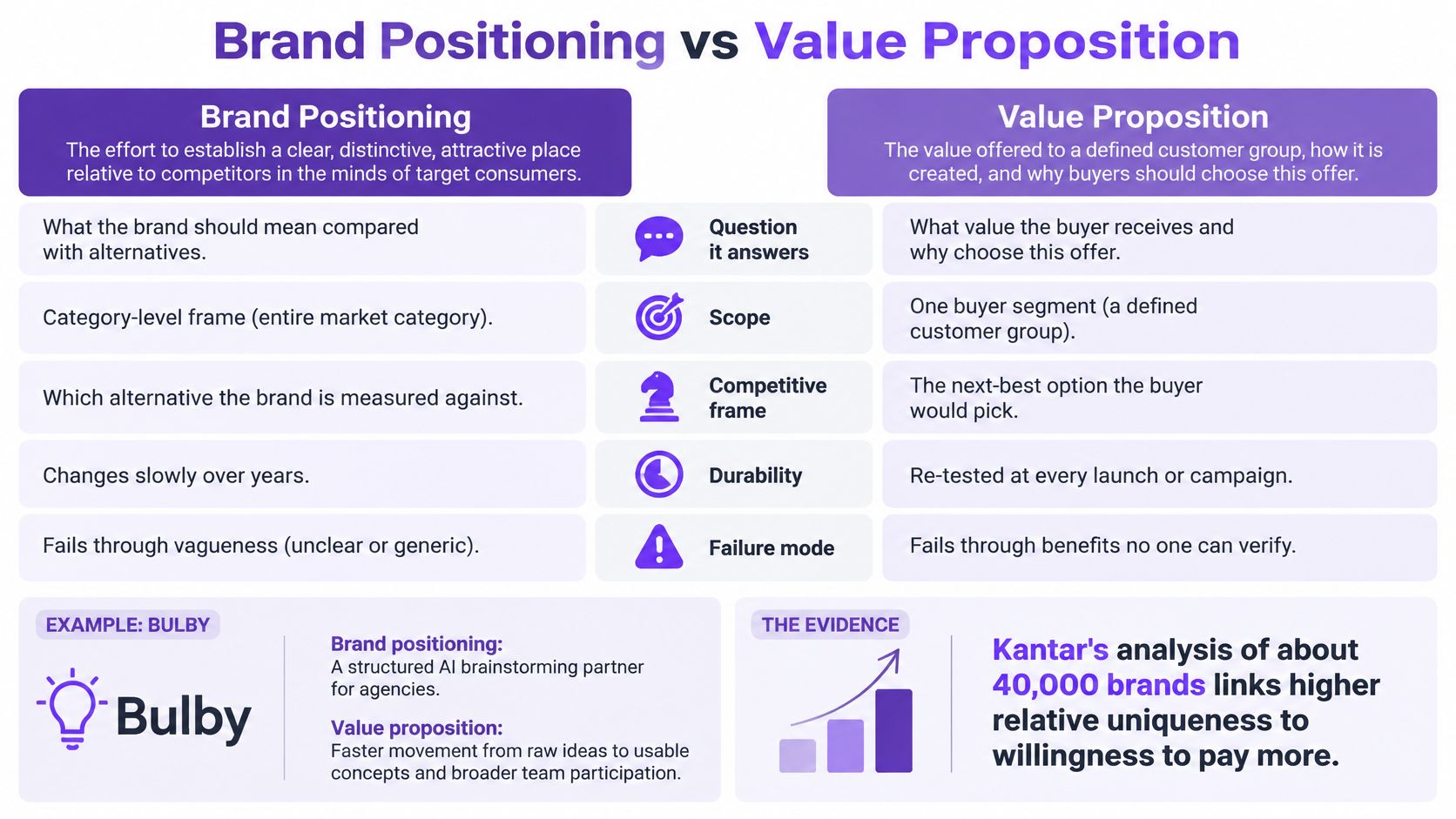
- Scope and audience: Positioning establishes a category-level identity across the relevant market. A value proposition addresses a particular buyer segment and job.
- Competitive frame: Positioning influences which alternatives buyers consider. The value proposition addresses why your offer is preferable to the next-best option they would choose.
- Durability: Protect positioning from constant tactical changes. Re-test the value proposition when an offer, audience, or campaign changes.
- Failure mode: Vague positioning leaves the brand interchangeable. An unsupported value proposition leaves buyers unable to verify the promised benefit.
The visual comparison makes these distinctions easier to scan.
Difference matters, but it isn't proof of delivery
In its analysis of approximately 40,000 brands, Kantar linked higher relative uniqueness with consumers' willingness to pay more. That supports taking differentiation seriously, but it doesn't establish that any particular product delivers its promised outcomes.
Work on competitive differentiation should therefore identify a meaningful distinction, not just an unusual description. Ask which difference customers care about and whether your team can sustain it.
Positioning decides what the buyer compares you with; the value proposition decides why they choose you once they compare.
Once those choices are clear, the conversion messaging advice from Polish is a useful resource for expressing the buyer-facing promise. Use copywriting to clarify the strategy, not to compensate for missing evidence.
When the concepts diverge, diagnose them separately. Buyers might remember your distinctive position but doubt the offer's value. Or they might appreciate the offer while struggling to distinguish your brand from its competitors.
How to Test Positioning and Value Proposition Separately
Run separate research tracks. Positioning tests examine what prospects perceive about the brand. Value proposition tests examine what buyers experience, value, and act on.
A customer-value study covering Finland, Japan, and the United States found that value profiles differed by country, channel, product category, and competitive context, according to the Journal of Retailing and Consumer Services study. Its framework includes functional, economic, emotional, and symbolic value. Test within your intended buyer segment rather than assuming one audience's priorities represent everyone.
Match the measure to the decision
Test measures for each concept
| Concept | What to test | Example measure |
|---|---|---|
| Brand positioning | Uniqueness and dissimilarity | Share of prospects naming the brand first in a category recall task |
| Brand positioning | Credibility and favorability | Agreement rating that the brand is credible for structured brainstorming |
| Brand positioning | Sustainability | Change in unaided awareness across repeated research waves |
| Value proposition | Functional value | Time from session start to first usable concept |
| Value proposition | Economic value | Preparation hours saved per workshop |
| Value proposition | Emotional and symbolic value | Team confidence before a client pitch, rated before and after |
| Value proposition | Behavioral outcome | Session completion rate and willingness to recommend |
Recall provides a signal of the association you've established, but it doesn't fully explain uniqueness. Ask prospects which alternatives feel similar and why. For credibility and favorability, separate whether they believe the claim from whether they find it attractive.
For a practical positioning experiment, show comparable prospect groups alternative statements while keeping the product description constant. Ask them to explain the offer in their own words, identify its closest alternative, and rate its distinctiveness and credibility.
The team reviewing the results should include people responsible for both the promise and its delivery.

Observe value during real work
For the offer test, agree on what counts as a usable concept before a session starts. Otherwise, teams can appear faster by accepting weaker ideas. Record how many generated ideas meet that standard as well as the time needed to reach it.
Keep the brief, task difficulty, and evaluation criteria comparable. A guide to conducting A/B testing can help structure a controlled messaging experiment, while workflow observations establish whether the promised benefit occurs.
Ask what the experience means to participants, too. Emotional value might involve confidence; symbolic value might involve feeling like a thoughtful, collaborative creative leader. Check whether those responses align with satisfaction, continued use, and recommendations rather than relying on positive comments alone.
High uniqueness with low credibility suggests an interesting position that needs stronger support. Strong functional value with weak emotional value may mean the offer works, but your message misses the buyer's personal concern or professional identity.
Closing the Gap Between a Claim and Proof
Teams can mistake positioning and value proposition for interchangeable copywriting exercises. They agree on a polished statement, put it in a sales deck, and never establish what would make it true.
The harder question is: what evidence must exist before a positioning claim becomes a credible value proposition? Changing the comparison buyers make isn't the same as proving that you deliver a better result.
Keep the promise separate from its evidence
A workable value proposition identifies the buyer, job, next-best alternative, differentiated change, and proof. If any part is missing, a persuasive sentence can hide an unresolved business decision.
Maintain separate working documents:
- Category choice: The market-facing position you want buyers to associate with your brand.
- Buyer-specific promise: The improvement a defined customer should expect compared with their current alternative.
- Proof system: The usage records, customer interviews, reviews, or experiments that support that improvement.
The distinction matters when different departments write for different audiences. A sales team might emphasize lower risk, a product team might emphasize capability, and a campaign team might emphasize speed. These can be compatible, but someone must reconcile them.
A survey summary published by Isoglu reports that 51% of global marketers have a clear, documented, unique value proposition, 39% have only an informal idea, and 8% have multiple competing propositions. Documentation alone won't resolve competing priorities, but it makes them visible.
A careful review connects each sentence to the evidence behind it.

Reconcile claims before publishing them
Write a single claim for each document. Attach a metric, source, or observed behavior, then flag anything unsupported. Use voice-of-customer interviews to check whether customers describe the problem and benefit in terms that match your promise.
Say an agency promises faster concept development. Show median hours from brief to usable concept, using a consistent definition and a relevant baseline. Record whether the work still meets the client's acceptance criteria.
Evidence also has boundaries. A successful workshop supports a claim about that workshop, not every future engagement. Customer comments can explain perceived value without establishing a universal performance improvement.
Evidence rule: Any claim without a number, source, or observed behavior stays a hypothesis.
A hypothesis can guide an experiment. It shouldn't become a guarantee in the next campaign.
Positioning in an AI-Saturated Market
Don't lead with AI unless the technology itself creates a meaningful, defensible difference for the buyer. Naming a capability doesn't explain why your brand deserves a distinct place.
The Creativebrief trends report treats AI increasingly as operational infrastructure and emphasizes proprietary insight, distinctive creative judgment, and culturally relevant storytelling. The strategic question isn't whether you use AI. It's what you help people do differently with it.
Choose the basis for your difference
The technology itself is the most obvious anchor. An AI idea generator describes a capability, but a competitor offering similar generation can make the same claim. This approach needs a technical distinction buyers understand and value.
The workflow you improve offers a more concrete basis for comparison. Bulby uses brainwriting, anonymous submissions, and AI-generated sparks. That supports exploring a position around structured creative decision-making rather than generation speed alone.
The unique asset you build over time can offer another foundation. Consider a hypothetical agency that develops proprietary evaluation frameworks and a permissioned record of which creative directions clients accept. Its accumulated judgment may become more useful than access to generation alone.
Structured participation gives teams something concrete to assess beyond the amount of output.

Prove a better process, not just more output
For a process-led position, examine participation rates, idea diversity, revision cycles, pitch outcomes, and client acceptance. Define idea diversity through genuinely different strategic directions, not superficial wording changes.
Don't assume that anonymous input automatically produces inclusion or that more concepts mean better work. Check whose contributions reach the shortlist and whether the team can explain its selection decisions.
The human contribution matters here: creative taste, collaboration quality, and cultural nuance. An approach to AI for brand strategy should make these judgments explicit rather than treating generated output as the final answer.
Your public descriptions also need to remain coherent across channels. AnswerLion's guidance on when AI gets your company wrong offers a practical companion for investigating inaccurate AI-generated descriptions of a business.
Use a simple removal test before approving the position. Delete AI from the statement. If nothing meaningful remains about the buyer, problem, or distinctive approach, you've probably described a feature rather than a position.
Choosing What to Lead With by Situation
| Situation | Lead with | Why it wins |
|---|---|---|
| New brand entering a crowded category | Brand positioning | Buyers need a clear mental place before any benefit lands |
| Feature launch for an existing brand | Value proposition | Buyers already know the place and need the concrete change |
| Client pitch to a skeptical buyer | Value proposition with proof | Procurement needs measurable outcomes and a named alternative |
| Rebrand after a repositioning | Brand positioning first | Old associations must be replaced before new benefits make sense |
| Short performance campaign | Value proposition | Conversion needs a buyer-specific promise |
| Diverse audience with mixed motives | Positioning on inclusion, then segment promises | Inclusive reputation can shape purchase decisions across segments |
Let the buyer's immediate question set the opening
Say an agency is pitching a sustainability-focused client. Its positioning might establish the agency as a specialist in translating complex sustainability evidence into clear consumer communication.
That tells the buyer which kind of partner they're considering. It doesn't yet explain what the engagement will change.
The proposal should then name the buyer-level improvement: a clearer path from technical evidence to approved campaign concepts, with explicit checks on what each message can support. To substantiate an efficiency claim, the agency could compare approval time and revision rounds against a relevant previous workflow.
For a skeptical procurement team, open with that concrete promise and its evidence. For an unfamiliar brand team considering potential partners, establish the specialist position first. The underlying strategy stays coherent even when the order changes.
Inclusion needs both relevance and delivery
According to Kantar's Brand Inclusion Index 2024, 75% of consumers globally said a brand's diversity and inclusion reputation influenced their purchase decisions, based on more than 23,000 people across 18 countries. That supports considering inclusion in positioning when it matters to the audience, not adding it automatically to every agency promise.
For the sustainability pitch, inclusion could mean ensuring the proposed communication reflects different audience realities. The agency would still need buyer-specific promises and evidence appropriate to the brief. Consumer attitudes don't prove that a particular brainstorming method delivers inclusive work.
Use the video as a prompt for a team discussion about how you develop and compare ideas.
Bulby supports solo brainstorming as well as team brainstorming. A strategist can draft buyer-specific promises independently, then bring positioning options into a collaborative session before the pitch.
Choose the session format according to the decision. Independent preparation gives people space to form an opinion; team review lets them challenge assumptions and resolve conflicting priorities.
The same brand can lead with different concepts on different channels. A brand introduction may need a category-level idea. A landing page or proposal may need the specific improvement that makes the next action worthwhile.
Confirm Both Before You Brief the Campaign
Make the decisions in a practical order
Write the category claim. Put the intended position into a single sentence and check it against the alternatives buyers consider. This prevents the team from building a campaign around a comparison customers don't make.
Name the buyer and the job. Identify the segment, the task they need to complete, and what they'd choose without your offer. Include doing the work manually or leaving the problem unresolved when those are realistic alternatives.
Attach proof to the differentiated change. For every promised improvement, record a metric, source, or observed behavior and its limitations. This stops an appealing but untested statement from entering the brief as an established fact.
Translate the strategy by channel. Use positioning to guide brand headlines and advertising frameworks, then express buyer-specific value in offers, landing pages, and sales decks. A useful creative brief in marketing records the shared strategic decision without forcing every channel to use identical wording.
Test and make an explicit decision. Keep claims that hold up under prospect feedback and workflow observation. Revise or remove those that don't, and assign an owner to gather any missing evidence before publication.
Leave the session with decisions, not just wording
Run this sequence in a focused planning session before the next campaign brief. Start with a structured brainstorm on possible positions and buyer promises, then compare the options against actual customer alternatives.
Leave with a selected category claim, a defined buyer promise, an evidence record, and a list of unresolved questions. If the evidence isn't available yet, brief the test rather than briefing an unsupported promise.
Bulby offers structured, AI-guided brainstorming for solo strategists and collaborative teams. Visit Bulby to develop positioning options and buyer-specific promises, then identify the evidence each needs before your next campaign brief.