
When we talk about business model innovation, we're not just talking about tweaking a product or launching a new marketing campaign. We're talking about a fundamental rethink of how your business operates—how it creates value for customers, delivers that value, and, crucially, how it makes money from it.
It’s about asking bigger, bolder questions. Instead of "How can we improve this feature?", the question becomes, "Is there a completely different way we could run this business to gain a massive advantage?"
So, What Does Business Model Innovation Actually Mean?
Imagine your business is a high-performance car. You could give it a fresh coat of paint (a marketing refresh) or upgrade the tires (product improvement). Both are good things. But business model innovation is like swapping out the entire engine for a more powerful, efficient, and modern one. It changes how the whole machine works from the inside out.
This kind of strategic shift forces you to challenge the long-held assumptions that your company was built on. It’s about looking at your entire operation and questioning everything, from your supply chain to your pricing structure. Digging into effective SaaS Growth Strategies, for example, often reveals that the most successful companies didn't just have a great product; they had an ingenious business model.
Business model innovation isn't just for scrappy startups in a garage. It's a critical survival tool for established companies looking to stay relevant, defend their turf, and find new avenues for growth in a world that never stops changing.
The Three Pillars of a Business Model
To really get your head around this, it helps to break any business model down into three core components. True innovation often comes from making a significant change in one or more of these areas.
Here’s a simple way to think about it:
The Three Pillars of a Business Model
| Pillar | What It Means | Example Question for Innovation |
|---|---|---|
| Value Creation | How do we make our stuff? This covers all your key activities, resources, and partners that help you build your product or service. | Could we use a different manufacturing process or build a radically new type of supply chain to cut costs or improve quality? |
| Value Delivery | Who are our customers and how do we reach them? This is about your target audience, sales channels, and customer relationships. | What if we skipped retailers and sold directly to consumers online? Could we serve a completely new customer segment? |
| Value Capture | How do we get paid? This includes your revenue streams, pricing strategy, and the costs you incur to make it all happen. | Instead of a one-time purchase, what if we offered a monthly subscription? Could we create a freemium model? |
Thinking this way helps you pinpoint exactly where the opportunities for innovation lie.
This isn't just a theoretical exercise. It's become a top priority for companies everywhere, especially in industries being shaken up by new technology. For instance, one global study found that 33% of automotive executives now see business model innovation as a critical priority. That tells you something when an industry that big is rethinking its core playbook.
By challenging these pillars, you open up possibilities that a team focused only on product features might never see. If you want to dive deeper into the different forms innovation can take, our guide on the core definitions of innovation in business is a great place to start. It’s how you build a company that’s ready for whatever comes next.
Why Your Business Model Is Your Secret Weapon (Not Your Product)
In the race for market leadership, it's easy to get tunnel vision. Companies pour resources into chasing the next feature, a slicker design, or a minor performance boost. The common wisdom says a better product will always win. But honestly? That’s a short-sighted and often dangerous game.
Sure, a great product matters. But features can be copied. A competitor's slightly faster, cheaper, or shinier version is always just around the corner. A truly lasting advantage comes from innovating how you do business, not just what you sell. This is the heart of business model innovation.
Building a Moat, Not Just a Taller Wall
Think of your company as a castle. A new product feature is like adding a new turret. It looks good and offers a bit more defense, but an enemy can just build a bigger catapult to knock it down.
A new business model, on the other hand, is like digging a wide, deep moat around the entire castle. It fundamentally changes the competitive landscape and makes it incredibly difficult for anyone to follow you. A strong business model is hard to replicate because it’s deeply woven into how you operate—connecting your value, your customers, and your revenue in a way no one else can.
This holistic approach is a world away from simply improving a single item. You can see the contrast when you look at different examples of product innovation and realize they mostly focus on the "what," not the "how."
Look no further than the classic Netflix vs. Blockbuster showdown. They both offered the same product: movie rentals. But Netflix’s subscription model with no late fees completely dismantled Blockbuster’s brick-and-mortar, penalty-driven system. The product was the same, but the business model changed everything.
Unlocking New Markets and Hidden Value
When you shift your focus from the product to the model, you start asking bigger, better questions that can uncover massive opportunities:
- Who else could we serve? Could a different pricing structure make our solution accessible to a totally new audience?
- What are we wasting? Do we have an amazing logistics network or a treasure trove of data that could become a service in its own right?
- How can we change the relationship? Can we move from one-off sales to a recurring subscription or a "product-as-a-service" offering?
This isn't just about playing defense. It’s about going on offense and creating entirely new markets where you get to set the rules.
The Data Doesn't Lie
This isn't just a theory; the numbers back it up. Research consistently links business model innovation to better company performance. A 2023 study on small and medium-sized manufacturers, for example, found a direct positive link. Tweaking any part of the business model—how they created, delivered, or captured value—gave their overall performance a significant boost. You can dig into the full research on how business model changes affect firm performance for the details.
At the end of the day, product innovation might keep you in the race. But business model innovation lets you redefine the race itself.
Powerful Frameworks for Your Innovation Journey
Trying to innovate your business model without a plan can feel like sailing into a storm without a compass. You know you want to get to a safer, more competitive harbor, but the path forward is anything but clear. That's where frameworks come in. Think of them as your map and compass, giving you a structured way to navigate a process that can often feel chaotic.
Instead of staring at a blank whiteboard, these tools give your team a shared language to brainstorm and analyze what’s next. They help you break down big, complex ideas, question your long-held assumptions, and see new possibilities together.
The Business Model Canvas: See Your Whole Operation on One Page
One of the best tools out there for getting a bird's-eye view of your business is the Business Model Canvas. It’s basically your entire strategic plan laid out on a single sheet of paper, showing you all the moving parts of how your business works. The goal is to help you see the connections between how you create value, deliver it to customers, and actually make money from it.
The canvas is broken down into nine core building blocks:
- Customer Segments: Who are you actually selling to?
- Value Propositions: What problem are you solving for them? What makes you special?
- Channels: How do you find and reach your customers?
- Customer Relationships: What kind of relationship do you have with them?
- Revenue Streams: How do you make money?
- Key Activities: What are the most important things you have to do every day?
- Key Resources: What assets—people, tech, money—do you absolutely need?
- Key Partnerships: Who do you rely on to make it all work?
- Cost Structure: What are your biggest expenses?
Putting it all on one page makes it ridiculously easy to spot weak links, find new opportunities, and test out ideas just by moving sticky notes around. It’s a fantastic tool for sparking real strategic conversations and turning vague ideas into a concrete plan. While the Business Model Canvas is great for a full overview, you might also find the startup-focused version useful. You can learn more in our guide on what is a Lean Canvas.
Here’s what the canvas looks like in action. You can see how all nine blocks fit together to tell the story of a business.
This visual approach is so effective because your team can grasp the entire business model in a single glance and instantly see how a change in one area ripples through all the others.
Jobs-to-be-Done: Figure Out What Customers Really Want
If the canvas helps you map out your business, the Jobs-to-be-Done (JTBD) framework flips the script and forces you to live in your customer’s world. The idea is simple but powerful: people don't just "buy" products; they "hire" them to get a specific "job" done.
This completely changes your perspective from focusing on who the customer is to what they’re trying to accomplish. Instead of asking, "What are the demographics of our ideal user?" you start asking, "What progress is this person trying to make in their life?"
It’s the classic drill example. Nobody wakes up wanting to buy a drill. They want to hang a picture, which means they need a hole in the wall. The "job" is the hole, not the tool. Once you understand that, you can innovate in new ways—maybe by inventing a better drill, or maybe by creating a new way to hang pictures that doesn't need a hole at all.
JTBD helps you dig into the real functional, social, and emotional needs behind a purchase. By focusing on the "job," you can create solutions that solve the real, underlying problem your customers are facing.
Blue Ocean Strategy: Stop Competing and Start Creating
The third framework, Blue Ocean Strategy, is all about escaping the bloody "red oceans" of fierce competition. The goal is to create entirely new, uncontested "blue oceans" of market space where the competition is simply irrelevant. It’s about creating such a leap in value that customers flock to you.
The strategy is built around the "Four Actions Framework," which pushes you to redefine your industry by asking four simple but challenging questions:
- Eliminate: What things does our industry take for granted that we can get rid of?
- Reduce: What things can we scale back, well below the industry standard?
- Raise: What things should we crank up, well above the industry standard?
- Create: What new things can we offer that the industry has never seen before?
Cirque du Soleil is the textbook example. They didn't try to build a better circus with more impressive animal acts or famous ringmasters (they eliminated those). Instead, they created something entirely new—a blend of circus arts and theater that appealed to adults who were happy to pay a premium. They created a blue ocean.
To round out your toolkit, pairing these strategic frameworks with something like the Design Thinking methodology can be a game-changer. It adds a human-centered approach that focuses on empathy and experimentation, giving you a powerful, multi-faceted approach to your business model innovation efforts.
A Practical Process to Innovate Your Business Model
Frameworks are great for giving you a map, but a solid process provides the turn-by-turn directions you actually need to get somewhere. Turning the big idea of business model innovation into real action demands a structured approach. Without one, teams get stuck in brainstorming loops or chase shiny ideas that have no grounding in reality.
This repeatable process breaks the journey down into four clear stages. It’s designed to take you from a deep analysis of where you are today to real-world testing of where you could go tomorrow. This keeps your efforts focused, strategic, and way more likely to deliver results that matter.
Stage 1: Analyze Your Current Model
Before you can build something new, you have to truly understand what you already have. This first stage is all about deconstructing your existing business model with unflinching honesty. The point isn't to find fault; it's to get crystal clear on how every part of your operation really works together.
Grab a tool like the Business Model Canvas and map out your nine core building blocks. Get a cross-functional team in a room and start asking tough questions. What are the unspoken assumptions we've been running on for years? Where are our hidden weaknesses or risky dependencies?
This exercise almost always surfaces some eye-opening insights. You might discover a customer segment you thought was crucial is actually draining your profits, or that a key partnership is more of a liability than an asset. This deep understanding is the essential foundation for everything that comes next.
Stage 2: Identify Drivers for Change
Once you have a sharp picture of your current state, it’s time to look outside your four walls. What forces are putting pressure on your model? These "drivers of change" are the catalysts that make innovation a necessity, not just a nice-to-have project for a slow quarter.
To make sure you don't miss anything, it helps to sort these drivers into a few key buckets:
- Market Forces: Are your customers' needs changing? Are new competitors popping up with different ways of doing things? Are your supply chains getting shaky or more expensive?
- Technological Forces: What new tech could help you deliver value in a completely different way? Could automation radically change your cost structure? Is there a new platform that could make your current channels obsolete?
- Regulatory Forces: Are there new laws or regulations on the horizon that could throw a wrench in your operations or revenue streams?
- Social Trends: Are cultural shifts changing how people see your industry or product? Is sustainability suddenly a major factor in buying decisions?
Answering these questions helps you pinpoint the most urgent threats and the most exciting opportunities. It gives your innovation efforts a clear direction and a sense of purpose.
This simple flow shows how these early stages connect, moving from seeing what you have to finding opportunities for what could be.
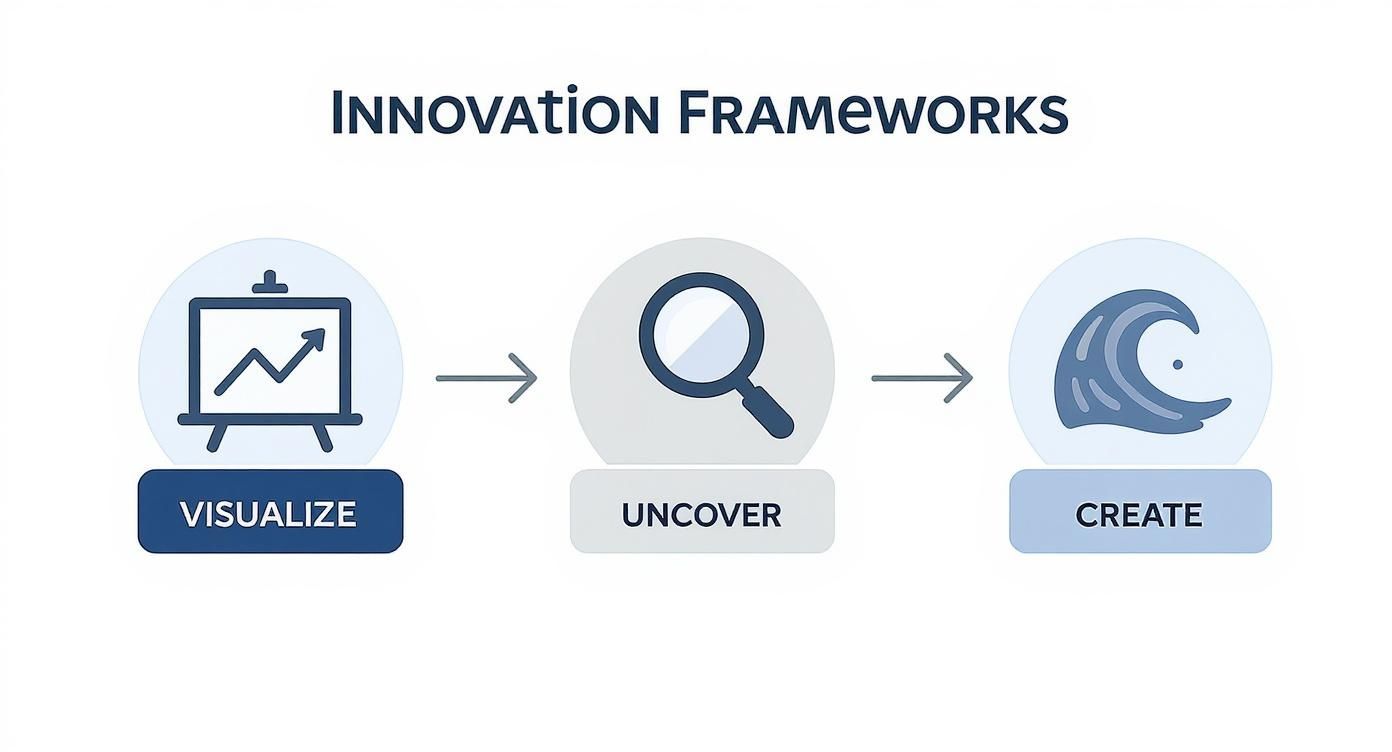
The diagram boils the journey down to three core actions—Visualize, Uncover, and Create—that are at the heart of any successful innovation cycle.
Stage 3: Brainstorm New Models
Now for the fun part. Armed with your analysis and the drivers you've identified, it’s time to start generating new business model ideas. The goal here is to think as broadly as possible and challenge every single assumption you uncovered back in Stage 1.
A workshop is a fantastic way to get the creative juices flowing. Here’s a simple exercise you can run with your team, even if everyone is remote. Using a tool like Bulby can make facilitating a guided brainstorm like this a breeze.
The "What If" Challenge Workshop:
- Set the Stage (10 min): Kick things off by quickly recapping the key insights from your current model analysis and the most powerful drivers for change.
- Generate Prompts (15 min): As a group, brainstorm a list of "What if…" questions based on those insights. Think big: "What if our biggest cost was suddenly free?" or "What if we only sold to people who aren't our customers today?"
- Ideate in Silence (10 min): Have everyone individually brainstorm and jot down as many business model ideas as they can for each prompt. Working alone at first helps avoid groupthink and lets quieter voices contribute.
- Share and Cluster (25 min): Go around the room (or virtual room) and have people share their best ideas. As the facilitator, group similar concepts together on a whiteboard to see what themes start to emerge.
The point of this exercise isn't to find the one perfect idea right away. It's about generating a wide range of possibilities, from small tweaks to total reinventions. At this stage, quantity is far more important than quality.
To bring these stages to life, here's a table that breaks down what you should be focused on at each step.
Business Model Innovation Process Stages
| Stage | Primary Focus | Key Activities | Success Metric |
|---|---|---|---|
| 1. Analyze | Gaining clarity on the current state | Mapping the existing model, identifying assumptions, SWOT analysis | A complete and honest Business Model Canvas of "as-is" operations. |
| 2. Identify | Understanding external pressures and opportunities | Market research, trend analysis, competitive intelligence | A prioritized list of the top 3-5 drivers for change. |
| 3. Brainstorm | Generating a wide range of new possibilities | "What If" workshops, pattern-spotting, challenging assumptions | A portfolio of 10+ diverse, potential new business models. |
| 4. Test | Reducing uncertainty through real-world experiments | Creating hypotheses, building prototypes, running pilot programs | Validated learning about what works and what doesn't. |
This table provides a quick reference for the distinct goals and activities of each phase, helping you stay on track as you move from one to the next.
Stage 4: Test and Validate Your Ideas
This final stage is where your ideas meet the real world. Before you bet the farm on a new model, you have to test its most critical assumptions. This is all about running small, cheap experiments to gather actual data and reduce the risk of failure.
For each promising idea, ask your team: "What absolutely must be true for this to work?" These are your riskiest assumptions. For instance, if you’re thinking about a new subscription service, your assumptions might be:
- Customers are actually willing to pay a monthly fee for this.
- We can find and sign up customers for less than what they'll be worth to us over time.
- We have the technical chops to deliver the service without it breaking.
Then, design simple tests to see if you're right. This could be a quick landing page to measure sign-up interest, a survey, or even a small-scale pilot with a handful of friendly customers. The data you get back will tell you whether to push forward, pivot your approach, or kill the idea and move on.
This cycle of testing and learning is the engine of successful business model innovation. For a more detailed look at this iterative approach, you can explore the key steps in the innovation process in our related guide.
Inspiring Examples of Innovation in Action
Theory and frameworks are one thing, but seeing business model innovation out in the real world is what makes it all click. Let’s move past the abstract and look at some companies that didn’t just create a new product—they completely changed the game in their industries. These stories show just how powerful a shift in how you do business can be.
By digging into these examples, you can pinpoint which parts of the business model were flipped on their head and the incredible results that followed. These aren't just case studies; they're blueprints for inspiration.
Adobe: From Software Boxes to Cloud Subscriptions
For years, Adobe’s model was straightforward: sell software like Photoshop in a box for a hefty one-time fee. This worked, but it created a high barrier to entry for new users and made revenue unpredictable, spiking only around major releases every couple of years.
Their big move was a total reinvention of how they delivered and captured value.
- The Change: Instead of selling one-off software licenses, Adobe switched to a subscription service (SaaS) called Creative Cloud.
- The Impact: This pivot instantly made their top-tier tools affordable for a much bigger audience. More importantly, it created a stable, recurring revenue stream. It also allowed them to push continuous updates, which built a stronger, ongoing relationship with their users. The result was a phenomenal boost in both revenue and market value.
IKEA: Revolutionizing the Furniture Value Chain
Before IKEA, buying furniture was often a pain. You'd go to a showroom, order a pre-assembled piece, wait weeks for it to be delivered, and pay a premium for all of it. IKEA saw a chance to rethink the entire value chain, from design to delivery.
They completely upended their key activities and cost structure. Instead of selling fully assembled furniture, they designed everything to be shipped in a flat-pack box, handing off the final assembly to the customer.
This one simple change created a domino effect. It slashed shipping and storage costs, letting IKEA offer stylish furniture at prices their competition couldn't even dream of. Their real innovation wasn't the chair itself, but the entire system for getting that chair into your home.
This model also redefined their relationship with customers, turning them into active partners in the process.
Dollar Shave Club: Disrupting the Razor Giants
The men's grooming market was completely dominated by a few giants selling expensive razor cartridges in big retail stores. Dollar Shave Club jumped into this crowded space not with a technologically superior razor, but with a brilliant business model that sidestepped the old rules.
- The Change: They cut out the retailers entirely and built a direct-to-consumer (DTC) subscription. For just a few dollars a month, guys could get quality razors sent right to their door.
- The Impact: This move erased the "retail markup" and solved a huge customer headache: the annoyance and high cost of constantly buying new blades. Paired with clever, witty marketing, their simple and convenient model quickly built a massive, loyal following. It proved that even in a market with entrenched leaders, business model innovation can win.
These companies show that the most game-changing moves often have less to do with the product than you'd think. And today, new technologies are making these kinds of shifts happen even faster. Take artificial intelligence, for example—it has become a huge driver of innovation, with 78% of companies now using AI in at least one business function. This is giving rise to entirely new models, like AI-native platforms that charge per task, kicking off a whole new wave of disruption. You can find more insights about how AI is fueling new business models on startus-insights.com.
So, you’ve launched your new business model. That’s a huge step, but the real test is just beginning. How can you tell if your brilliant idea is actually paying off? Just looking at revenue won’t give you the full story, especially not at first. To truly know if you're on the right track, you need to measure what matters, turning hunches into a clear, data-driven strategy.
Think about it like flying a plane. You wouldn't just stare at the altimeter. You'd be checking your speed, fuel levels, and navigation systems, too. The same goes for your new business model; you need a dashboard of metrics that paints a complete picture of its health.
Building Your Innovation Dashboard
To get that complete view, you need to track metrics across three key areas. This approach ensures you’re not just bringing in cash but building something sustainable that your customers actually want and that gives you a real edge.
-
Customer Value Metrics: Is the new model actually resonating with people? This is where you measure customer happiness and loyalty. Look at your Net Promoter Score (NPS), customer lifetime value (CLV), and churn rate. A high NPS is a fantastic sign that you’re creating fans, not just customers.
-
Operational Efficiency Metrics: Is everything running smoothly behind the scenes? Keep an eye on your cost to serve a customer, customer acquisition cost (CAC), and how long it takes to get a new client up and running. If these numbers are trending down, it means your new processes are working.
-
Strategic Advantage Metrics: Is your innovation actually setting you apart from the competition? Track your market share in a new segment, how quickly your target audience is adopting the model, and even how fast competitors are scrambling to respond. This tells you if you’re successfully carving out your own niche.
Tracking a balanced set of metrics is everything. It helps you confirm (or challenge) the big assumptions you made in the design phase and gives you an early warning if things aren’t clicking with your customers.
This isn't just about getting a grade on your performance. It's about creating a continuous feedback loop. By watching these key performance indicators (KPIs), you get the intel you need to tweak, adjust, and pivot, making your model stronger and more aligned with what the market truly wants.
For a much deeper dive into setting up these systems, check out our guide on how to measure innovation. It’s packed with more frameworks to help you track what matters most.
Building a clear dashboard means your business model innovation is driven by evidence, not just excitement. That data-backed approach is what separates a short-term win from a long-term market shift.
Common Questions About Business Model Innovation
When it comes to shaking up a business model, leaders tend to ask the same few questions. I hear them all the time. Let’s tackle the big ones.
How Often Should We Revisit Our Business Model?
This is probably the most common question I get. Everyone's looking for a magic number—once a year? Every five years? The truth is, there isn't one.
A better way to think about it is to see your business model as something that needs constant monitoring, not just a scheduled check-up. You should be ready to rethink things whenever a major trigger pops up. This could be anything from seeing your customer loyalty take a nosedive, a new piece of tech changing the game in your industry, or watching a competitor find success with a wildly different approach.
What Is the Biggest Barrier to Innovation?
Without a doubt, the single biggest hurdle is organizational inertia. It’s that powerful, almost gravitational pull that keeps established companies stuck in their old ways—the same processes and assumptions that brought them success in the first place. It’s comfortable. It’s known. And it’s dangerous.
Getting past inertia isn’t about a single memo or a one-off workshop; it demands a real cultural shift. You can start small by:
- Celebrating the experiments, especially the ones that don't pan out. Learning what doesn't work is just as valuable.
- Creating small, nimble teams—sometimes called "skunkworks" teams—that can operate outside the usual corporate red tape.
- Getting leaders on board to champion these projects and shield them from the pressure of hitting short-term targets.
The fear of cannibalizing your own successful products is a huge part of this inertia. But history is littered with giants who learned a hard lesson: if you don’t disrupt your own business, someone else will be more than happy to do it for you.
Can Small Businesses Really Innovate Their Models?
Yes, and they might even have an edge. Business model innovation isn't just for mega-corporations with bottomless R&D budgets. Small businesses have a superpower: agility. They can turn on a dime and test new concepts far more quickly than a corporate behemoth.
For a small or medium-sized business, innovation can be beautifully simple. Think of a local bakery that starts offering a weekly subscription box, or an IT consultant who stops billing by the hour and packages their services into a fixed-price product. These moves don't require massive investment, just a sharp eye for what customers really want and the courage to break from tradition.
Ready to overcome inertia and unlock your team's best ideas? Bulby provides guided, AI-powered brainstorming exercises that help remote teams break through creative blocks and build their next great business model. Start your innovation journey today.