

A creative team can have plenty of talent and still struggle to choose a campaign direction. The strategist wants a sharper promise, the designer wants a visual hook, the account lead wants something the client can approve, and the client wants a line that works across every channel. By the end of the meeting, everyone has contributed, but nobody can explain which idea deserves development.
The strongest campaign slogan ideas aren't selected because they sound catchy in isolation. They earn their place by fitting the audience, expressing a credible promise, matching the brand voice, and adapting to paid social, video, landing pages, presentations, and sales conversations. Historical examples such as De Beers' “A diamond is forever” show how a short line can become a durable creative asset when teams repeat it consistently over time. The history of advertising slogans also shows why memorability works best when it serves a clear strategic role.
This list organizes slogan directions by the job they need to perform, from creating structure and originality to earning client approval. Use the lines as starting points, then test each one against tone, proof, audience, and campaign objective. If your team needs help turning scattered contributions into a focused concept, Bulby offers structured, collaborative brainstorming for marketing and creative teams. For the copy that surrounds the slogan, use these principles for how to write better ad copy.
Table of Contents
- 1. Clarity Through Collaboration
- 2. Break Free From Predictable Thinking
- 3. From Scattered Input to Focused Innovation
- 4. Smarter Ideas, Faster Delivery
- 5. AI-Guided Thinking for Human Creativity
- 6. Confident Ideas Clients Can't Resist
- 7. Bring More Voices, Better Ideas
- 8. From Blank Page to Campaign Strategy
- 9. Reduce Bias, Increase Originality
- 10. Your Team's Creative Advantage
- Top 10 Campaign Slogans Comparison
- Turn a Strong Slogan Into a Campaign Direction
1. Clarity Through Collaboration
A campaign begins with competing priorities: strategy needs a sharper promise, design wants a visual hook, account teams need client approval, and the client expects a line that works across channels. “Clarity Through Collaboration” gives that tension a practical direction. It positions collaboration as a way to organize different perspectives into a campaign idea the team can explain, develop, and present.
Agencies need that structure because an open discussion can produce repeated ideas, dominant voices, and a long list without a clear decision. Bulby can frame the work around guided steps, giving strategists, creatives, account teams, and clients defined opportunities to contribute. The slogan becomes credible when the process shows how input is grouped, tested, and reduced to a lead direction.
IBM's “Let's Build” makes innovation feel participatory, while Atlassian connects teamwork with practical progress. The useful lesson is not to copy either brand. Tie the line to a working method the audience can see.
Make the promise demonstrable
Show the movement from raw input to a usable brief. An agency prospect might see a session start with competing campaign territories, then follow prompts that group themes, question assumptions, and identify the strongest route.
Support the slogan with:
- Before-and-after examples: Show an unstructured discussion becoming a concise campaign territory.
- Process demonstrations: Present the guided steps instead of asking prospects to accept an abstract promise.
- Team participation stories: Explain how quieter contributors influenced the final direction.
Practical rule: If the slogan promises clarity, make the team's decision process easy to see.
The line suits a calm, intelligent, facilitative voice. A more energetic agency could use “Many Voices. One Direction.” An enterprise audience may respond better to “Align Ideas. Build Forward.” Teams can ground the campaign narrative in established structured brainstorming methods, then adapt the wording to the audience's priorities and the campaign objective.

2. Break Free From Predictable Thinking
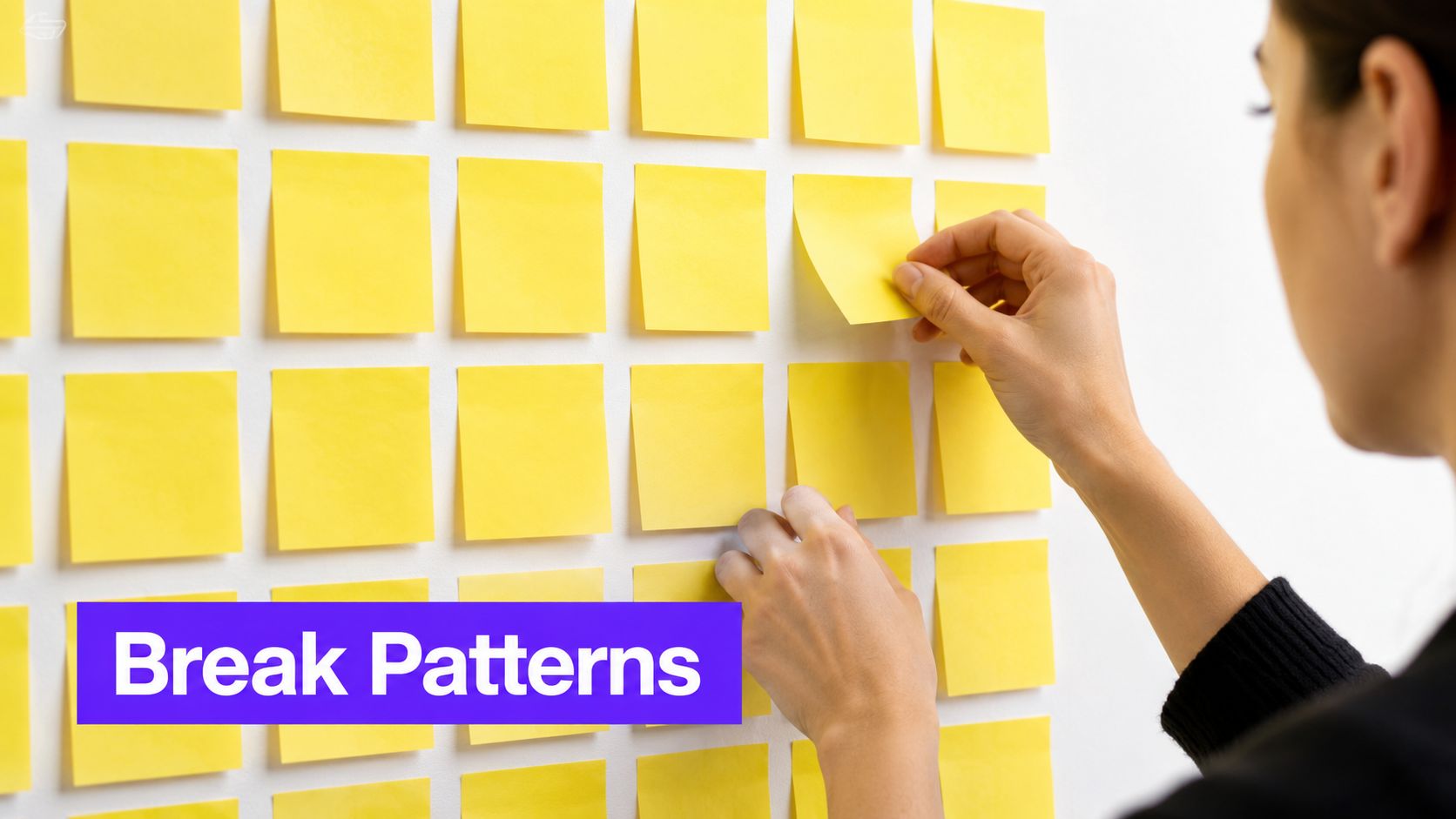
A campaign brief arrives with familiar category language, the same competitor references, and a first idea that feels safe because everyone recognizes it. “Break Free From Predictable Thinking” gives an agency a clear strategic job: expose that pattern, then show how the team finds a stronger route.
The line works because it challenges habit without demanding novelty for its own sake. It positions the platform as a guide that helps people question assumptions, compare alternatives, and retain human judgment. That distinction matters. A slogan promising originality must show a useful change in thinking, not merely claim to be unconventional.
Apple's “Think Different” is a reference for turning a creative attitude into a memorable brand position. Nike's “Just Do It” demonstrates how a short imperative can create momentum. Bulby should adapt the principle rather than imitate either brand. If the product helps teams test assumptions, the campaign should make that process visible.
Give originality a practical test
Start with one brief and show two routes. The first repeats the category formula. The second reframes the audience insight, emotional angle, or creative device. Viewers can then see what the slogan changes and why the alternative deserves consideration.
Adapt the line to the approval risk and campaign goal:
- For bold creative teams: “Break the Brief Open.”
- For cautious brand teams: “Question the Obvious.”
- For innovation leaders: “Beyond the Expected.”
A surprising line still needs a clear benefit. Ask, “What does this help the audience do?” If the answer stops at “think differently,” add the practical outcome, such as finding a sharper position, challenging a weak assumption, or generating routes beyond the first idea.
Show familiar traps in the execution: anchoring on the first suggestion, copying competitor language, or accepting the senior person's view as final. Then demonstrate how prompts from lateral thinking techniques create alternative routes while the team makes the decision.
3. From Scattered Input to Focused Innovation
A campaign can show its value through the change it creates. “From Scattered Input to Focused Innovation” suits a collaborative idea-management platform because it names both the working problem and the useful outcome.
“Scattered input” gives the audience a recognizable starting point: research notes, client comments, workshop outputs, competitor references, and unfinished ideas stored across different places. “Focused innovation” gives the team a direction it can evaluate and develop. The sequence makes the slogan strategic rather than merely inspirational.
The line is longer than a typical brand tagline. Use it as a campaign platform or primary headline, then pair it with a shorter sign-off in smaller formats. An ad might carry the full phrase, while social assets use “Focus the Thinking.”
Make the workflow visible
Follow one brief from collection to choice. Show contributions from a strategist, designer, account manager, and client arriving in different forms. Then show themes grouped, tensions identified, and a creative route taking shape.
Use evidence from the working process:
- Alignment: Each role can see where its contribution fits.
- Decision quality: The team can explain why one direction leads.
- Actionability: The next meeting starts with a defined task rather than another open discussion.
Salesforce connects its value to transformation and connected information, while HubSpot emphasizes a unified system. Bulby can borrow that structural logic, but the campaign should show the creative decisions behind the result. Broad transformation language alone will not prove how the platform helps.
Match the wording to the audience and approval risk. The original line fits a strategic, confident voice for product managers, innovation teams, and agency leaders. A warmer option is “Make Sense of Every Idea.” A performance-focused alternative is “Turn Input Into Direction.”
The execution should connect the promise to a repeatable workflow. Content about collaborative idea management can show contribution, synthesis, evaluation, and refinement without suggesting that creativity comes from a one-click output.
4. Smarter Ideas, Faster Delivery
A client approves the strategy on Monday and expects presentation-ready concepts soon after. “Smarter Ideas, Faster Delivery” addresses that commercial pressure by linking distinctive thinking with dependable execution. It suits agency owners and creative operations leaders who must protect quality while meeting deadlines.
The wording carries a real risk. “Faster” can suggest rushed work, so the campaign must show what makes speed credible. Bulby should frame efficiency as less repetition and clearer decisions, giving teams more time to develop the strongest route. The slogan works when the audience sees how the process improves, not when speed is presented as a replacement for judgment.
Operational brands offer useful positioning cues. Slack's “Work Simplified,” Asana's efficiency-focused messaging, and Basecamp's productivity language make process improvement accessible. Bulby can apply that principle to ideation, where time is often lost in unfocused exploration rather than a shortage of creative ability.
Show the gain in the work
Start with a vague client request, then show the team shaping it into evaluated campaign territories. The sequence should make the improvement visible: fewer dead ends, clearer decisions, and a quicker move into execution.
Build the message around three practical gains:
- Better briefing: Define the audience, problem, and desired response before generating routes.
- Faster convergence: Compare options against agreed criteria rather than personal preference.
- Cleaner handoff: Give creative and production teams a direction they can act on.
The campaign should demonstrate this workflow instead of claiming unsupported efficiency results. Verified customer evidence can strengthen the proof. Without it, show the decisions, criteria, and handoff clearly enough for prospects to assess the benefit.
Voice should follow the approval concern. A premium consultancy may prefer “Sharper Thinking. Smoother Delivery.” It sounds measured, though less energetic. A creative agency could use “Think Faster. Make More.” The line creates momentum but may imply higher output rather than better choices. Select the version that matches the audience, brand voice, and campaign objective, then adapt the supporting copy to prove the specific promise.
5. AI-Guided Thinking for Human Creativity
A creative team is reviewing an AI-generated campaign route. The suggestion is relevant, but its tone feels wrong for the brand. “AI-Guided Thinking for Human Creativity” gives agencies a useful way to frame that moment: AI expands the options, while people decide which direction deserves attention.
The line addresses a real concern. Creative teams want assistance without giving up judgment, craft, or ownership. A product demonstration should show the team defining the brief, asking the system to challenge an assumption or examine another audience angle, then selecting and refining the useful output.
Adobe's “Creativity for All” provides a broad frame for creative technology. GitHub Copilot's “Your AI Pair Programmer” describes assistance while keeping the human contributor visible. Bulby can apply that augmentation principle to campaign planning, where originality depends on both wider exploration and disciplined choice.
Put the division of work on display
Build the campaign around a marked-up brief, several AI suggestions, and the team's reasons for rejecting or developing them. That format makes the strategic job clear and gives the slogan practical meaning.
- Guidance: Prompts help contributors examine a brief from different perspectives.
- Judgment: People test each idea against the brand, audience, evidence, and campaign objective.
- Ownership: The team turns selected thinking into work it can explain and defend.
AI should widen the team's field of view, not replace the team's point of view.
Choose the supporting line according to the audience. Technical teams may respond to “Guide the Thinking. Keep the Craft.” Agency leaders may prefer “More Human Ideas, AI-Guided.” Cautious brand teams may value “AI Support. Creative Control.” Each option serves a different approval concern, so the surrounding proof should match it.
AI-generated suggestions still require checks for relevance, originality, brand safety, and factual accuracy. An educational asset can explain whether AI can generate ideas and show how structured prompts, human review, and selective development create a more responsible creative process.
6. Confident Ideas Clients Can't Resist
Client approval depends on more than an attractive concept. Agencies need a slogan that supports a clear recommendation, gives the audience a reason to care, and helps decision-makers understand the commercial logic.
“Confident Ideas Clients Can't Resist” captures the desired outcome, but its promise needs careful handling. No platform can guarantee approval, and a clever idea does not automatically produce revenue. The credible interpretation is confidence built from a defined audience insight, strategic rationale, and workable execution plan.
Stratos' “Ideas Worth Pursuing” takes a more measured position. Wistia's “Trusted by Creative Teams” shows another route, using professional credibility and social proof to support confidence. Bulby can make the claim believable by helping teams prepare a recommendation they can explain, test, and defend.
Give confidence a proof point
Start with the client decision, then build the slogan around the evidence that supports it. A campaign asset might show a strategist comparing three routes, each with an audience tension, promise, creative expression, and reason to believe. The platform helps the team assess those routes and shape a recommendation. The client still makes the decision.
A useful approval path answers three questions:
- Why this audience? Tie the idea to a specific need, tension, or behavior.
- Why this direction? Show how the creative route serves the campaign objective.
- Why trust the execution? Clarify what the team will make and how it will work.
That structure turns confidence into something visible rather than a claim attached to the slogan.
Choose the line according to the campaign's audience and sales context. Senior agency leaders may respond to “Present Ideas You Can Defend.” A sales-led campaign could use “Turn Creative Conviction Into Approval.” For a more collaborative relationship, “Build the Idea They Believe In.” Each option emphasizes a different strategic job, so the supporting examples should match.
Use testimonials only with real, approved evidence. Without client proof, show the pitch workflow and the reasoning behind the recommendation instead of claiming approval rates or business results.
7. Bring More Voices, Better Ideas
A campaign team is reviewing three promising routes. The strongest insight comes from a junior planner, a customer support observation, and a client-side specialist, but the usual meeting format gives each contribution uneven weight. “Bring More Voices, Better Ideas” positions inclusion as a practical way to improve the creative route.
The line performs a clear strategic job: it connects participation with quality. It suits agencies that want to show how Bulby broadens input without suggesting that every person should shape every decision. Miro's collaborative workspace positioning and design thinking's focus on varied perspectives offer useful reference points, but the campaign should show the process rather than make a broad cultural claim.
A strong execution follows one idea from contribution to campaign direction. Show the initial observation, the question it raises, and the decision it influences. The story can begin with a junior planner, a support-team detail, or a client specialist identifying an overlooked audience tension. The contributor does not need to become the hero. The evidence is the stronger route that follows.
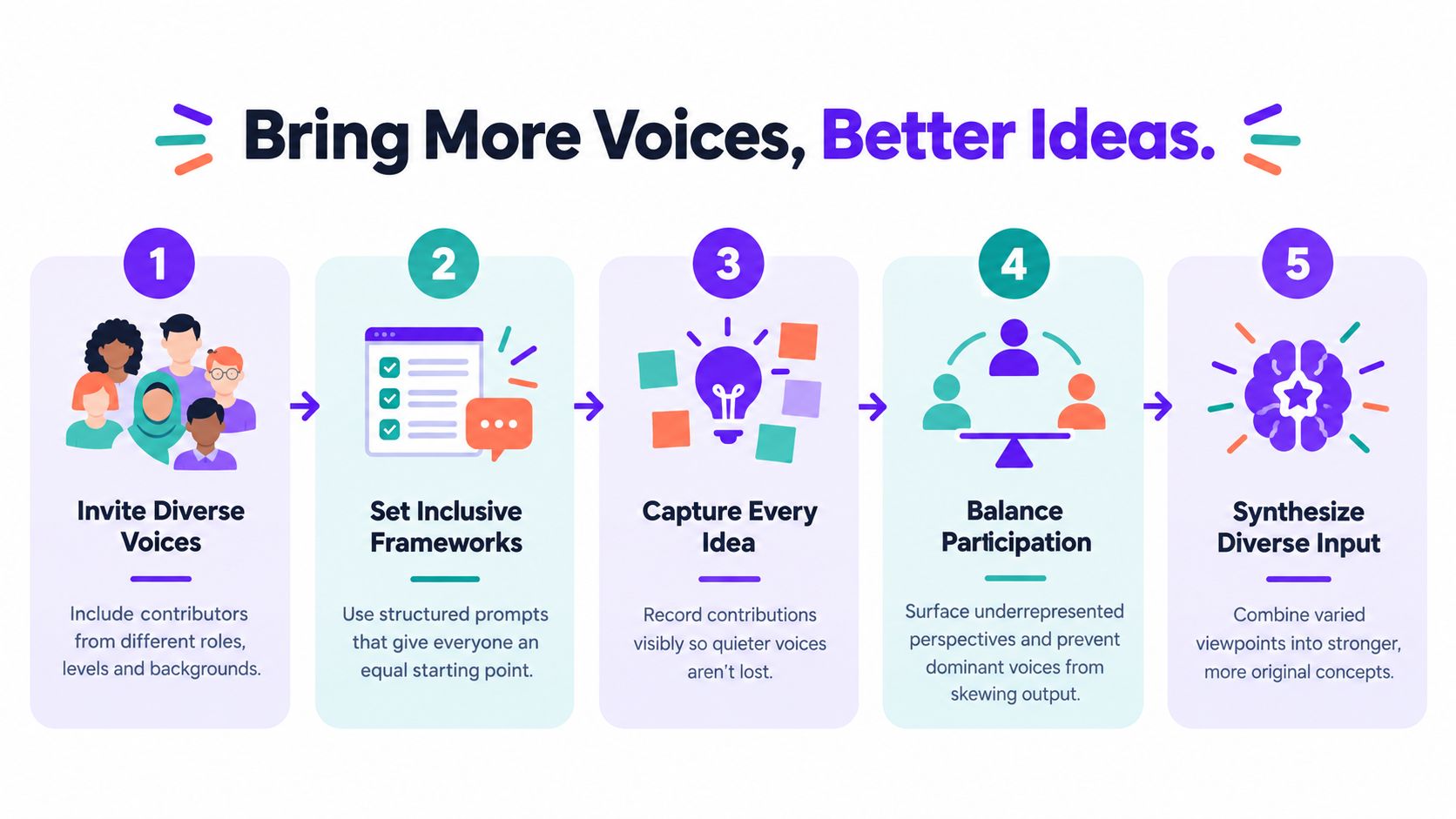
Give each voice a defined role:
- Invite: Use prompts that make useful contributions easier.
- Balance: Give ideas room to be considered before seniority or speed shapes the outcome.
- Connect: Show how separate observations combine into one coherent route.
The wording should match the campaign's audience. A people-focused agency message could use “Every Perspective Moves the Idea.” A confident leadership message could use “More Perspectives. Stronger Work.” For a product demonstration, “Make Room for Better Thinking” keeps attention on the working method.
Participation does not guarantee originality. A clear brief, useful constraints, and a decision process still determine whether input becomes usable strategy. Bulby should demonstrate that progression through a visible workflow, such as this five-step inclusive collaboration process.
8. From Blank Page to Campaign Strategy
A campaign team can have a clear business problem and still stall at the first blank page. “From Blank Page to Campaign Strategy” gives that moment a useful shape: move from uncertainty toward a direction the team can develop and defend.
The line works well for onboarding and product education because it defines a starting point and an outcome. Its weakness is the suggestion that software creates strategy automatically. Bulby should show the decisions between those points, helping the team build the strategy rather than bypassing the work.
A practical demonstration can open with an unfinished brief and scattered notes. The team identifies the audience, clarifies the tension, tests possible promises, and chooses a creative territory. Each decision should leave a usable input for the next one, so viewers can see how the campaign development process turns raw information into campaign direction.
The slogan can then shift with the strategic job and audience:
- For product teams: “From Product Insight to Market Story.”
- For innovation teams: “From Open Question to Clear Direction.”
- For agencies: “From Brief to Campaign Territory.”
These variations change the emphasis without losing the central movement. Product teams need a line that connects knowledge of the offer to market communication. Innovation teams may respond to progress from ambiguity into a decision. Agencies need language that reflects the handoff from client brief to a territory the creative team can explore.
The strongest execution keeps uncertainty visible. A launch may begin with incomplete customer insight, a repositioning project with competing interpretations, or a client pitch with several plausible routes. Showing how the team chooses among them makes the promise credible and gives viewers a method they can apply.
Templates for launches, repositioning, seasonal campaigns, and client pitches can reinforce the idea. Each should prompt a concrete next decision, so the slogan becomes a working route from an open question to a campaign strategy.
9. Reduce Bias, Increase Originality
“Reduce Bias, Increase Originality” gives Bulby a clear role in the creative decision process. It speaks to strategists and agency leaders who recognize how anchoring, familiarity, hierarchy, and the first plausible answer can narrow a campaign before the team has tested other directions.
Use the slogan when the campaign must show how originality is developed, not just announced. Teams still need ideas that fit the audience, category, and production reality. The practical trade-off is to challenge familiar thinking without treating every conventional idea as weak. A structured platform can make assumptions visible, giving contributors a shared way to question them.
The message should stay grounded in workflow. Daniel Kahneman and Amos Tversky's work influenced how marketers discuss cognitive bias, but Bulby does not need a psychology lecture. Its proof should show prompts that expose a narrow frame and help the group develop credible alternatives.
Show the decision change
Open with a familiar brief and the team's first response. Then show the questions that widen the work: who receives priority, which category convention is being repeated, and whose interpretation has been left out. This example-first structure makes the slogan useful to agencies presenting a method, rather than another promise of limitless creativity.
Build the campaign around three visible actions:
- Name the pattern: Identify the assumption shaping the initial idea.
- Widen the frame: Test what changes when the audience, context, or desired action changes.
- Choose the route: Judge originality alongside relevance and feasibility.
Adapt the line to the audience and objective. For research-minded teams, “Challenge Assumptions. Create Distinction.” sounds precise. For creatives, “See Past the First Idea.” is easier to grasp. For brand strategists, “Less Bias. More Brand Difference.” connects the method to positioning.
Avoid presenting an originality score as objective truth unless its method and scope are clear. A stronger proof compares the starting idea with the alternatives produced after the team examined its assumptions.
10. Your Team's Creative Advantage
A client rejects the first route, the team revisits the brief, and the next idea needs to be stronger without starting from zero. “Your Team's Creative Advantage” gives that moment a clear campaign role. It presents Bulby as part of the agency's working method, helping teams produce stronger work, respond to briefs with confidence, and stand apart in competitive pitches.
The phrase needs a defined edge. “Creative advantage” might mean sharper insight, more original territories, faster alignment, clearer presentations, or stronger execution. Selecting one makes the slogan easier to believe and easier to adapt. A campaign aimed at agency leaders could focus on repeatable thinking, while a pitch-focused audience may care more about defending the chosen route.
Slack's “Where Work Happens” makes the product's role central to everyday work. Figma's collaborative design positioning connects the tool to how teams create together. Bulby can take the same strategic direction by showing its place in the agency workflow, from brief intake to strategic recommendation.
Define the edge you can defend
Show a traditional brainstorming session beside a structured one, while treating both fairly. Freeform discussion can produce excellent work, especially with an experienced facilitator. The useful comparison is between a deliberate process and one without shared criteria, documentation, or a clear path to a decision.
Choose the proof that matches the campaign objective:
- Distinctive thinking: Show the team moving beyond familiar category language.
- Operational confidence: Show contributors how the work progresses and what happens next.
- Pitch readiness: Show how a selected idea becomes easier to present, explain, and defend.
Adapt the line to the audience:
- “Make Your Best Thinking Repeatable” suits teams seeking a reliable creative process.
- “Build the Edge Into the Process” connects differentiation with daily workflow.
- “A Better Way to Win the Brief” speaks directly to agencies, but requires evidence of competitive results.
The slogan earns credibility when the team can state its advantage in one sentence and demonstrate the workflow behind it. Bulby should support the people who create, challenge, and improve the work, giving the campaign a practical reason to believe the line.
Top 10 Campaign Slogans Comparison
| Slogan | 🔄 Implementation Complexity | ⚡ Resource Requirements | 📊 Expected Outcomes | 💡 Ideal Use Cases | ⭐ Key Advantages |
|---|---|---|---|---|---|
| Clarity Through Collaboration: The Structured Brainstorming Approach | Medium, set up frameworks & facilitation | Moderate, onboarding, team time | Clearer ideas, less noise, faster decisions | Agency brainstorms, cross-team workshops | Structured process + collaboration; reduces cognitive bias |
| Break Free From Predictable Thinking | Medium‑High, tune bias-reduction flows | Moderate, prompts, algorithm tuning | More original, unconventional ideas | Innovation sessions, idea expansion sprints | Differentiates emotionally; drives originality |
| From Scattered Input to Focused Innovation | Medium, consolidate inputs & synthesize | Moderate, stakeholder coordination, AI synthesis | Actionable strategy, aligned teams | Pitches, multi-stakeholder strategy work | Strong synthesis; produces strategic outputs |
| Smarter Ideas, Faster Delivery | Low‑Medium, apply templates & QA steps | Low‑Moderate, time tracking, process tools | Faster ideation, fewer revisions, client-ready concepts | Tight timelines, client delivery cycles | Improves quality + speed; measurable ROI |
| AI-Guided Thinking for Human Creativity | Medium, implement human-in-loop workflows | Moderate, training, oversight, trust-building | Augmented creativity while preserving control | Teams cautious of automation, hybrid workflows | Reduces AI anxiety; positions AI as partner |
| Confident Ideas Clients Can't Resist | Medium, build validation & pitch workflows | High, client-validation data, case studies | Higher client approval rates, revenue impact | Pitch prep, client-facing concept development | Results-oriented messaging; ties ideas to outcomes |
| Bring More Voices, Better Ideas | Medium‑High, manage inclusive participation | Moderate‑High, facilitation, participation tooling | Diverse input, improved idea quality & engagement | Large teams, inclusion-focused workshops | Boosts diversity of thought; increases psychological safety |
| From Blank Page to Campaign Strategy | Low‑Medium, provide starters & guided flows | Low, templates, walkthrough content | Faster kickoff, clearer campaign roadmaps | Kickoffs, overcoming creative block, early-stage briefs | Easy to adopt; broad applicability across projects |
| Reduce Bias, Increase Originality | High, implement bias detection & scoring | High, analytics, research, transparent metrics | Measurable bias reduction and originality gains | Data-driven agencies, research-led creative work | Scientific credibility; quantifiable creative improvement |
| Your Team's Creative Advantage | Medium, standardize processes & benchmarks | Moderate, adoption efforts, benchmarking tools | Competitive differentiation, improved KPIs | Agency positioning, internal capability building | Positions Bulby as strategic asset; benchmarking insights |
Turn a Strong Slogan Into a Campaign Direction
A promising line is only the beginning. The team still needs to decide what the slogan is supposed to do, who should respond to it, and what campaign experience will make the promise believable. Treating the line as a complete strategy creates the same problem as choosing a headline before defining the brief.
Start by selecting one primary job. Do you need to make a complicated process clearer, challenge predictable thinking, invite more participation, speed up delivery, or help the team present its recommendation with confidence? A slogan can support several outcomes, but one should lead. “Clarity Through Collaboration” and “Break Free From Predictable Thinking” may both fit Bulby, yet they speak to different problems and different moments in the buyer journey.
Next, identify the audience and desired action. A creative director may want a better process for developing concepts. A product manager may want alignment around a launch narrative. An innovation team may need a way to explore possibilities without losing direction. The same slogan can be adapted for each audience, but the supporting language, proof, imagery, and call to action should change.
Then test the line against the brand voice. Read it aloud. Put it beside the logo. Place it on a paid social image, a landing page headline, a pitch deck cover, and a short video end frame. A line that works in a workshop may become awkward in a client presentation. A clever phrase may lose its meaning when separated from the visual that explains it.
Create controlled variations
Don't generate endless alternatives with no decision rule. Create two or three controlled variations, changing one element at a time:
- Promise variation: “More Voices. Better Ideas.” versus “More Voices. Clearer Direction.”
- Tone variation: “Break the Pattern” versus “Challenge the Obvious.”
- Audience variation: “Your Team's Creative Advantage” versus “Your Agency's Creative Edge.”
Compare the versions against audience relevance, promise clarity, voice, proof, and channel flexibility. Also ask whether the line can support several executions without becoming repetitive. Slogans matter partly because repetition builds recognition. Kantar reports a 14-point increase in brand recognition for digital ads that reuse a slogan already associated with the brand, as described in its analysis of slogan effectiveness. That makes consistency a strategic choice, not just a style preference.
Keep the final line close to a proof point. “AI-Guided Thinking for Human Creativity” needs a visible example of human judgment. “Smarter Ideas, Faster Delivery” needs a clear process explanation. “Confident Ideas Clients Can't Resist” needs a pitch experience that shows why the team can defend the recommendation.
Finally, validate the slogan with the people who will use or approve it. Ask a strategist to explain the promise, a designer to place it in layouts, an account lead to use it in a client conversation, and a target buyer to describe what they think the product does. If their interpretations diverge, refine the line or strengthen the surrounding message.
Bulby can help agency and brand teams structure that refinement process when several directions need to be compared. Use it to collect contributions, surface assumptions, evaluate alternatives, and turn the selected slogan into a campaign concept the team can develop.
Bulby helps marketing agencies, creative teams, product groups, and brand strategists move from scattered input to focused campaign ideas through guided, collaborative brainstorming. If you're developing campaign slogan ideas and need a clearer way to compare directions, visit Bulby and give your team a structured path from first thought to confident concept.