

A competition SWOT analysis isn't just another business acronym. It's a way to get inside your rival's head, mapping out their Strengths, Weaknesses, Opportunities, and Threats to spot gaps you can drive a truck through. It takes you beyond a simple list of who you're up against and gives you a concrete method for turning competitive intelligence into a real-world strategy for your product and marketing teams.
Why Bother With a Competition SWOT Analysis?
Most people are familiar with a standard SWOT analysis, where you look inward at your own company. That’s valuable, but a competition SWOT analysis flips the entire script. You're putting yourself in your competitor's shoes and seeing the world from their boardroom.
This simple shift in perspective is a game-changer. It’s what lets you move from constantly reacting to their latest launch to actually anticipating what they’ll do next.
This kind of analysis is a critical piece of any solid https://www.remotesparks.com/strategic-planning-process-steps/, giving you the raw material you need to make smarter, faster decisions. When you truly grasp a competitor's internal pros and cons, you get much better at predicting their behavior and finding their weak spots.

It’s More Than Just a List of Names
Too many businesses just make a list of their competitors and call it a day. The real magic happens when you dig into the "why" behind their market position. It's not just about knowing who they are. It’s about understanding how they tick, where their money is going, and what keeps their CEO up at night.
Let's take a classic example: a beloved local coffee shop sees a new Starbucks setting up across the street. A quick glance just shows a massive, intimidating brand. But a competition SWOT analysis tells a much richer story:
- Strength: Starbucks has an ironclad brand and a killer mobile ordering app.
- Weakness: The menu is the same everywhere, and the vibe can feel pretty corporate and sterile.
- Opportunity: They could easily team up with services like DoorDash to reach customers who aren't walking by.
- Threat: The rising cost of coffee beans could hurt their profits, and a "shop local" movement could limit their customer base.
Suddenly, the local cafe has a playbook. They can’t out-brand Starbucks, but they can lean into their own strengths. They can highlight unique pastries from a local baker (hitting a Starbucks weakness) or foster a genuine community space that feels like a second home.
To make this clearer, here’s a quick breakdown of what each component of the analysis tells you.
Competition SWOT Analysis At a Glance
| Component | What It Reveals About Your Competitor | Why It Matters For Your Business |
|---|---|---|
| Strengths | What they do exceptionally well. Think strong brand, patented tech, or a loyal customer base. | These are the areas where you need to either match them, find a different angle, or avoid a head-on battle. |
| Weaknesses | Their internal vulnerabilities. This could be poor customer service, outdated technology, or high employee turnover. | This is where you attack. Their weakness is your opportunity to offer a superior alternative. |
| Opportunities | External factors they could use to their advantage, like new market trends or a competitor stumbling. | By spotting their opportunities, you can anticipate their next strategic move and prepare a counter-strategy. |
| Threats | External challenges they face, such as new regulations, a changing economy, or a disruptive new startup. | Their threats can become your advantages. If you can adapt faster to a market shift, you can steal their customers. |
This table shows how each quadrant gives you a different lens through which to view your rival, turning abstract data into actionable intelligence.
The Real Goal: Turning Insight into Action
At the end of the day, this isn't just an academic exercise destined to be forgotten in a Google Drive folder. The whole point is to connect the dots between your competitor's position and your own next steps.
It's crucial to remember that even the biggest companies aren't invincible. A key part of your work is analyzing the impact of rising competition on market leaders. When external threats pile up, a company's internal weaknesses can quickly become fatal flaws.
This framework forces you to ask sharp, strategic questions. If your main competitor is known for terrible customer support, that’s your cue to make your amazing service team the star of your next marketing campaign. If a new privacy law threatens their business model, you can get ahead of it and win trust. Every piece of their SWOT is a potential play for you, turning their problems into your progress.
Gathering Your Competitive Intelligence
A powerful analysis is built on solid data, not guesswork. Before you can really map out a competitor's strategic landscape, you need to put on your detective hat. The goal is to assemble the kind of intelligence that reveals their true advantages and, more importantly, their vulnerabilities. This is way more than a quick Google search; it's about finding the signals that show what’s really happening behind the corporate curtain.
First things first, head straight to their digital storefront—their website. But don't just browse. Dissect it. What language do they use to describe what they sell? Who are they talking to? Pay extra close attention to their pricing pages, case studies, and blog content. These are direct clues about their target market and the value they promise.

Uncovering What Customers Really Think
Let's be honest, the most revealing feedback comes directly from a competitor's customers. This is where you find the unvarnished truth.
- Review Platforms: Get familiar with sites like G2, Capterra, or Trustpilot. Look for patterns in both the glowing five-star reviews and the scathing one-star rants. A consistent complaint about terrible customer support? That’s a clear weakness you can pounce on.
- Social Media Comments: Don't just look at what they post on social media; look at how people respond. Are customers excited, confused, or downright angry? The comment section is a goldmine of candid feelings.
- Online Forums: Pop into communities on Reddit or industry-specific forums where people are talking about solutions. Users are often brutally honest when asking peers for advice, giving you unfiltered intel on product flaws.
These sources give you a street-level view of how the market actually sees your rival, which is absolutely vital for an accurate competition SWOT analysis. If you want a more detailed playbook for this, our guide on how to conduct competitive analysis is a great place to start: https://www.remotesparks.com/how-to-conduct-competitive-analysis/
A key step in any SWOT analysis is understanding your rivals. This comprehensive guide on how to conduct competitor analysis offers essential insights to help you gather competitive intelligence effectively.
Reading Between the Lines
Some of the best data isn't shouted from the rooftops; it's hidden in plain sight. Learning to spot these quieter signals can give you a real advantage.
Take the hyper-competitive market for global swimming competition suits. A classic SWOT analysis shows Speedo and Arena owning 45-50% of the market. Their biggest strength? Decades of brand loyalty built on cutting-edge hydrodynamic fabrics. Back at the 2008 Beijing Olympics, an incredible 94% of medal-winning swimmers wore Speedo's Fastskin suits. This helped boost the company's revenue by over 20% that year alone, showing just how a dominant strength can be turned into market power.
This kind of historical data is crucial for understanding a competitor's deep-rooted strengths. You can find similar clues by looking at who they're trying to hire right now.
Decoding Their Next Moves
A company's job postings are basically a public roadmap of their future plans. Are they suddenly hiring a dozen AI engineers or a whole new team of international sales reps? These aren't random moves. They signal strategic shifts and potential entries into new markets.
Here’s a quick-and-dirty checklist to guide your intel-gathering:
-
Product & Pricing Analysis:
- Map out their core features and pricing tiers.
- Nail down their unique selling proposition (USP).
- If you can, sign up for a demo or trial to experience it firsthand.
-
Marketing & Content Review:
- Figure out the keywords they're targeting in their content.
- See which of their blog posts and whitepapers are getting the most traction.
- Get a feel for the tone and messaging they use on social media.
-
Customer Voice & Reputation:
- Summarize the major themes you find in G2 or Trustpilot reviews.
- Look for patterns in discussions on forums like Reddit.
- See if you can find their Net Promoter Score (NPS).
-
Corporate & Strategic Signals:
- Keep an eye on their careers page for hiring trends.
- Track their press releases and mentions in the news.
- Note any new partnerships or big-name executive hires.
By systematically pulling all this information together, you get past making assumptions. You're building your SWOT matrix on a foundation of solid facts. This initial legwork is what turns the exercise from just filling in boxes into a genuinely powerful strategic tool, ensuring your insights are sharp, relevant, and ready to be acted on.
Turning Your Research Into a Competitor SWOT Matrix
Alright, you've done the hard work and gathered a mountain of competitive intelligence. Now, let’s make sense of it all. The goal is to turn that raw data into a clear, strategic picture, and the best tool for the job is a classic SWOT matrix.
Think of it as sorting your puzzle pieces before you start seeing the final image.
The matrix itself is just a simple two-by-two grid. It’s designed to separate internal factors—the stuff your competitor can actually control (Strengths and Weaknesses)—from the external ones they have to react to (Opportunities and Threats).
Here’s what that classic framework looks like:
This layout instantly clarifies what’s happening inside their company versus what’s going on in the wider market.
Filling in the Four Quadrants
Let's get down to filling in the boxes. You’ll want to create a separate matrix for each major competitor you're tracking. The most important rule here? Be specific. Every point you add should be backed by the evidence you found during your research, not just a gut feeling.
A digital whiteboard or a shared doc is perfect for this. If you want to get your team involved and keep the ideas organized, using a brainstorming graphic organizer is a fantastic approach. We've got some great templates and ideas you can steal from our guide here: https://www.remotesparks.com/brainstorming-graphic-organizer/
Strengths (What they do well – Internal)
These are the inherent advantages your competitor has, the things they do exceptionally well.
- Brand Power: Is their name the first one that comes to mind in your industry? Do they have a loyal following?
- Proprietary Tech: Are they sitting on a patent or unique software that gives them a real edge?
- Operational Muscle: Is their supply chain incredibly efficient? Can they operate at a lower cost than everyone else?
For a SaaS rival, a huge strength might be their massive user base, which creates powerful network effects that are hard to compete with. Or maybe it's their extensive library of integration partners, making their tool super sticky for customers.
Weaknesses (Where they fall short – Internal)
These are the chinks in their armor—the internal vulnerabilities and problem areas.
- Bad Customer Reviews: Are you seeing a pattern of complaints on G2 or Capterra about terrible support or a buggy product?
- An Outdated Product: Is their interface clunky and confusing? Are they missing key features that are now table stakes?
- High Employee Turnover: Take a look at LinkedIn. If you see a revolving door of talent, it’s often a sign of bigger problems internally.
A common weakness, especially for an older SaaS company, could be their reliance on an outdated tech stack. This makes it incredibly slow and expensive for them to innovate and keep up.
The key here is brutal honesty. Acknowledging a competitor's real strengths is just as vital as spotting their weaknesses. True strategic advantage comes from seeing the complete, unbiased picture.
Looking Beyond Their Four Walls
Next, let's zoom out and look at the world outside your competitor's control. These are the market forces they have to navigate, for better or worse.
Opportunities (Favorable external factors)
These are the tailwinds they could ride to fuel their growth.
- Market Trends: Is there a growing demand for a particular feature that they are already well-positioned to build?
- Regulatory Shifts: Is a new law or regulation coming that happens to benefit their business model?
- A Rival's Misstep: Is another competitor fumbling the ball, creating an opening for them to gain market share?
Threats (Unfavorable external factors)
These are the external storms on the horizon that could seriously harm their business.
- New Players: Is a scrappy startup popping up, ready to undercut their pricing or offer a slicker solution?
- Economic Headwinds: Could a recession make their customers rethink paying for a premium product?
- Shifting Tastes: Are customers starting to want a completely different type of solution to solve their problems?
The swimwear industry offers a great real-world example. A SWOT analysis shows North America’s dominance as a major market opportunity, with projected sales of USD 68.69 billion in 2025. But a huge threat looms from fast-fashion giants like Shein, which have already snatched 15% of the market with their rock-bottom prices.
This shows just how powerful external forces can be. By mapping all these elements out, you’re no longer just looking at a company; you’re looking at their entire strategic world.
Running a Collaborative SWOT Workshop
A competition SWOT analysis done by one person is just an analysis full of blind spots. To get the real story, you need to bring your research to the team and tackle it together. A workshop is the perfect way to do this. It gets sales, marketing, and product development in the same (virtual) room, turning a pile of data points into a clear, unified strategy.
Think about it. Your sales team hears customer objections every single day. Your product team knows the technical debt that’s secretly slowing your competitor down. Your marketers see which campaigns are landing and which are flopping. Each person holds a piece of the puzzle, and a workshop is where you put it all together.
Here’s a simple way to visualize the flow from raw intel to actionable strategy.
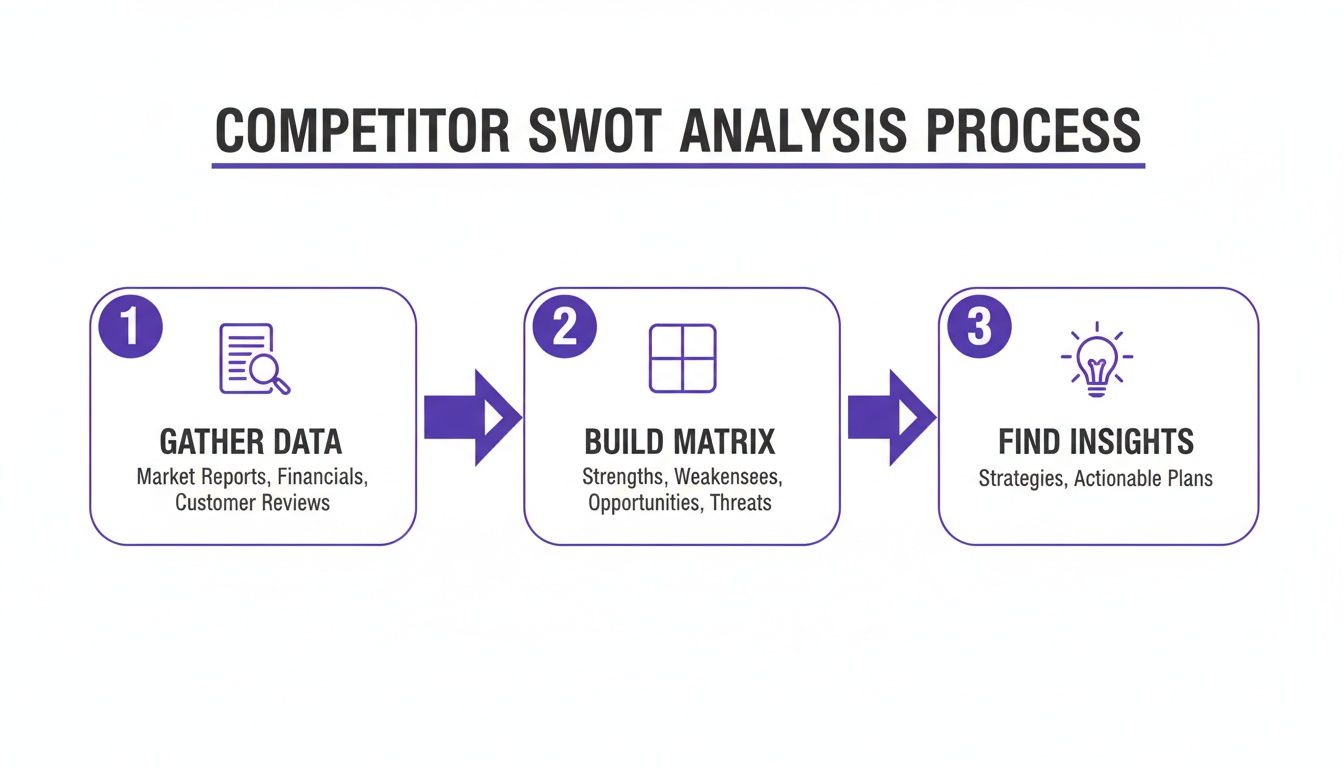
This process really highlights how building the SWOT matrix acts as the bridge between just having data and actually discovering something strategic. Without this structured step, your research is just a collection of facts that are tough to act on.
Setting the Stage for a Productive Session
The success of your workshop really comes down to good prep and clear facilitation. Just tossing everyone into a Zoom call and asking, "So, what do you think?" is a recipe for chaos. You absolutely need a structured agenda to guide the conversation and make sure you walk away with something tangible.
A solid plan keeps everyone focused and shows you respect their time. It stops the conversation from spiraling into tangents and ensures you give every quadrant of the SWOT matrix the attention it deserves.
Here’s a simple agenda I've used that you can adapt:
- (5 mins) Welcome & Goal Setting: Kick things off by clearly stating the purpose: "Today, we're building a SWOT analysis for Competitor X to help us shape our Q3 strategy."
- (10 mins) Silent Brainstorming: Give everyone a few minutes to individually add sticky notes to a digital whiteboard for all four quadrants (S-W-O-T).
- (20 mins) Grouping & Discussion: Now, talk it out as a group. Start clustering similar ideas, get clarification on any vague points, and discuss the themes that emerge.
- (10 mins) Dot Voting: Give each person five virtual "dots" to vote on what they believe are the most critical points in each quadrant. This is a quick way to see what resonates most.
- (10 mins) Prioritization & Next Steps: Talk about the top-voted items. What do they mean for us? Who will own turning these insights into actions?
This structure gives people space for individual thinking before jumping into a group discussion, which is critical for preventing groupthink and making sure everyone's voice is heard.
The most powerful insights often come from the quietest person in the room. Kicking off with a silent brainstorming exercise ensures that introverted team members can contribute their best ideas without being overpowered by louder voices.
Facilitation Techniques to Keep Things Moving
Running a remote workshop well is a real skill. As the facilitator, your job is to be a neutral guide, keeping the energy up and the conversation on track. Without strong direction, even the best agenda can fall flat. If you're new to this, it's worth reading up on some expert tips on how to facilitate workshops; it can make a huge difference in your confidence and the outcome.
One of the biggest hurdles is stopping one or two people from dominating the entire conversation. Timeboxing is your best friend here. Use a visible timer for each part of the agenda. It creates a gentle sense of urgency and keeps things moving.
Here are a few other facilitation tricks I rely on:
- Use "How Might We…" Prompts: Frame challenges in a positive, open-ended way. Instead of getting stuck on "Their brand is too strong," reframe it by asking, "How might we carve out a niche their brand can't touch?"
- The Parking Lot: When a great but off-topic idea comes up, don't shut it down. Add it to a "parking lot" section on your board to revisit later. This validates the contribution without derailing the current focus.
- Encourage Healthy Debate: Remind everyone that the goal is to get to the best ideas, and constructive disagreement is part of that. Ask questions like, "What's another way to look at this?" or "Is there anything we're missing here?"
When you combine a solid structure with active, thoughtful facilitation, you create an environment where your team can truly connect the dots. This collaborative process ensures your final competition SWOT analysis isn't just a document, but a shared, comprehensive strategy owned by the entire team.
Turning SWOT Insights Into Winning Strategies
An analysis is only as good as the action it inspires. You've done the hard work of gathering intel, mapping it out, and debating the most pressing points with your team. Now comes the most critical part of any competition SWOT analysis: turning all those notes and ideas into a real, tangible strategy that gives you an edge.
The magic of a SWOT analysis isn't just in filling the four boxes; it’s in connecting them. You start to build a powerful strategy when you pair your competitor's internal factors (their Strengths and Weaknesses) with the external forces they're up against (the Opportunities and Threats). This is where the dots connect, and a clear path forward begins to emerge.
From Quadrants to Actionable Plays
To make this process less abstract, I find it helps to think in terms of creating strategic "plays" by combining the different quadrants. This approach forces you to move beyond a static grid and build a dynamic playbook, prompting you to ask the tough questions that lead to smart business decisions.
Let's break down the four key combinations you should be looking for.
- Strength-Opportunity (S-O) Plays: How can our competitor use their strengths to jump on market opportunities? This is their most obvious growth path. If they have a powerful brand (Strength) and see a new customer segment popping up (Opportunity), you can bet a big marketing campaign is on the horizon.
- Weakness-Opportunity (W-O) Plays: How could they fix an internal weakness by seizing an external opportunity? This is where you can spot potential turnaround strategies. For instance, if their tech is ancient (Weakness) but there’s new, affordable AI software on the market (Opportunity), they might be gearing up for a major tech overhaul.
- Strength-Threat (S-T) Plays: How will they use what they're good at to defend against threats? This reveals their defensive game plan. A competitor sitting on a huge pile of cash (Strength) is probably going to use it to weather an economic downturn (Threat) better than everyone else.
- Weakness-Threat (W-T) Plays: Where are they most exposed? This is the intersection of their biggest flaws and the market's biggest dangers. This quadrant is your prime hunting ground.
By systematically walking through these pairings, you develop a much richer, more realistic picture of their likely moves—and, more importantly, where you can intercept them.
Translating Insights into Product and Marketing Actions
Let's make this real. Imagine you run a project management software company, and you're up against a big, established player we'll call "LegacyCorp."
Your competition SWOT analysis just uncovered a gem in their W-T quadrant:
- Their Weakness: LegacyCorp's user interface is a clunky, outdated mess.
- A Market Threat: Small, nimble startups are popping up everywhere, and they're all demanding simple, intuitive tools.
This combination is a ticking time bomb for them and a massive opportunity for you. It immediately points to a coordinated attack plan for both your product and marketing teams.
For the Product Team:
Suddenly, the next development sprint is crystal clear. The top priority is to double down on your user experience. The product roadmap should now be full of tasks like these:
- Launch a new onboarding flow that gets users up and running in under 3 minutes.
- Build an "Import from LegacyCorp" feature to make switching totally painless.
- Focus every design decision on creating a clean, minimalist UI that's the polar opposite of their cluttered dashboard.
For the Marketing Team:
Your messaging just got a whole lot sharper. The goal is to agitate their customers' pain points and position your product as the clear solution. The marketing plan could now include:
- A targeted LinkedIn ad campaign aimed at LegacyCorp users, with copy like: "Tired of complicated software? Switch to simple in minutes."
- Creating detailed comparison pages and blog posts that visually highlight your superior user experience.
- Running a testimonial campaign featuring happy customers who switched from LegacyCorp and love your tool's simplicity.
This is a perfect example of how one key insight from a SWOT matrix can drive specific, high-impact actions across your entire company.
The most powerful strategies are born at the intersection of a competitor's biggest weakness and a significant market threat. This is their Achilles' heel—and your opening to shake things up.
Prioritizing Your Strategic Moves
After brainstorming, you'll probably have a long list of potential actions. You can't do it all at once, so you have to prioritize. A simple effort vs. impact matrix is a fantastic tool for this. For a more detailed approach, you could use a prioritization matrix template to get your team aligned on what to tackle first.
This final step ensures you’re putting your resources where they’ll actually make a difference. The idea is to find the high-impact, low-effort "quick wins" you can jump on right away, while also making a plan for the bigger, more strategic projects.
Think about the global swimming apparel market. Analysis shows that top European brands have a strength in tech innovation but a weakness in high production costs. With opportunities growing in Asia and the constant threat of counterfeit goods, a leader like Arena can use this insight to act. They might prioritize high-impact moves like launching sustainable product lines or digital fitting tools—directly turning their SWOT insights into a defense against threats and a play for new opportunities. You can see a deeper dive in the full market research on swimming apparel.
Ultimately, a competition SWOT analysis is a compass, not a map. It points you in the right direction, but it’s up to you and your team to chart the course and take the first step.
Got Questions? We’ve Got Answers
Even with a great game plan, a few questions always seem to surface when a team gets into the weeds of a competition SWOT analysis. Let's clear up some of the common ones right now—it'll save you some headaches later and make the whole process a lot more effective.
How Often Should We Run a Competition SWOT?
This is probably the number one question I get. A competition SWOT isn't a "one-and-done" deal. The market is always moving, new challengers pop up, and your competitors are definitely not standing still.
A good baseline is to do a comprehensive, deep-dive analysis at least once a year, usually tying it into your annual strategic planning cycle.
But you also need to be ready to pull the trigger on a faster, more targeted analysis when something big happens. Think about moments like:
- A major competitor gets bought out.
- Some game-changing tech lands in your industry.
- You’re about to launch a major product or move into a new market.
The real value comes from treating your SWOT as a living document, not a report that just gathers dust.
How Do We Keep Personal Bias Out of It?
This is a big one, and it's a totally valid concern. Your team has history and opinions. It’s only natural for personal feelings about a rival to sneak into the discussion.
Maybe your top sales rep, who keeps losing deals to Competitor X, overinflates their strengths. Or maybe your head of product scoffs at their clunky interface, underestimating its appeal to a certain user segment.
The best defense here is to insist on evidence for every single point.
Make this your golden rule: If you can't back up a claim with data, a customer review, a screenshot, or some other concrete proof, it doesn't make it onto the board. This immediately shifts the conversation from "I feel like they're better at…" to "Their G2 reviews consistently show that…"
This simple rule keeps the entire exercise grounded in reality, not just a vent session.
What if We Have Way Too Many Competitors?
Feeling swamped by a crowded market? You're not alone. Trying to run a full-blown SWOT on a dozen or more companies is a fast track to burnout and, worse, weak insights. You just can't analyze everyone with the depth they deserve.
The key is to be ruthless about prioritization. Group your competitors into tiers so you can focus your energy where it'll have the biggest impact.
- Tier 1 (Direct Competitors): These are the 2-3 companies going after the exact same customers with a nearly identical offering. Pour the vast majority of your analysis efforts here.
- Tier 2 (Indirect Competitors): They solve the same root problem for your customers, but they do it in a completely different way. Keep them on your radar, but a full SWOT is probably overkill.
- Tier 3 (Aspirational & Emerging): This bucket includes the established market leader you're chasing and that buzzy new startup that could become a real threat in 18-24 months. Monitor them, but don't get bogged down in the details just yet.
By zeroing in on just your Tier 1 competitors for the in-depth competition SWOT analysis, the work becomes manageable. More importantly, your findings will be rich and actionable instead of a mile wide and an inch deep.
Turn your competitive insights into breakthrough ideas. Bulby guides your remote team through structured brainstorming exercises, helping you transform SWOT analysis findings into actionable strategies that win. Discover how to outmaneuver the competition at https://www.bulby.com.