
A competitive SWOT analysis isn't your standard internal review. It's a strategic framework that looks at your company's own Strengths and Weaknesses but puts them directly up against the Opportunities and Threats coming from your competitors.
This gives you a much richer, 360-degree view of where you actually stand in the market. It’s absolutely essential for making sharp decisions, spotting gaps no one else is seeing, and building a strategy that can withstand a few punches.
Why A Competitive SWOT Is Non-Negotiable
Let's be honest, the old-school, once-a-year SWOT analysis is a bit of a relic. Too often, it ends up as a static document that gets filed away and completely forgotten.
A competitive SWOT, on the other hand, turns that classic framework into a living, breathing strategic tool. You stop just listing your company's good and bad points and start seeing them in the context of the rivals who are actively trying to win over your customers.
This approach forces your team to constantly look over their shoulder, creating a culture of market awareness. Instead of a vague statement like, "we have a strong brand," a competitive SWOT makes you ask the tougher question: "How does our brand really stack up against Competitor X's, and where are they leaving the door open for us?" This shift in thinking is critical, especially for remote teams that need a shared, data-driven picture of the market to stay aligned and move in the same direction.
If you want to dig deeper into the nuts and bolts, our guide on how to conduct a competitive analysis is a great place to start.
Making Quicker, Smarter Decisions
Think of a competitive SWOT as the engine for agile decision-making. When you're constantly scanning the competitive field, you can pivot fast and with confidence.
Here’s what that looks like in practice:
- Catching threats early: You'll spot a competitor's new feature launch or a surprise pricing change before it starts eating into your market share.
- Finding hidden opportunities: It's great for uncovering underserved customer needs or weaknesses in a competitor's product that you can pounce on.
- Smarter resource allocation: It brings real clarity to where you should put your money and people. Do you double down on a strength to own a niche, or do you need to fix a weakness a competitor is starting to exploit?
This cycle of analysis and action keeps your strategy from getting stale and prevents your business from getting blindsided by sudden market shifts.
Building a Foundation for Real Growth
At the end of the day, truly understanding where you stand against the competition is the bedrock of sustainable growth. The insights you gain aren't just for playing defense; they're for going on the attack and carving out a path to market leadership.
The proof is in the numbers. The competitive intelligence (CI) market was valued at a massive $50.9 billion in 2024 and is on track to hit $122.8 billion by 2033. That explosive growth shows just how seriously businesses are taking CI to inform their biggest moves. You can discover more trends about the rise of competitive intelligence on competitiveintelligencealliance.io.
When you bring real-time market data into your SWOT, you stop making assumptions and start making evidence-based strategic bets. It stops being an academic exercise and becomes a powerful tool for winning.
Setting Up Your Remote Analysis for Success
A powerful competitive SWOT analysis doesn't just happen. It's not about throwing a blank four-quadrant chart on a screen and asking, "So, what do you think?" That's a recipe for a generic, uninspired meeting.
The real magic happens before the workshop even begins. For remote teams, this prep work is non-negotiable. It’s what separates a frantic, disorganized scramble from a sharp, strategic discussion. The goal is to lay the groundwork so everyone shows up informed, aligned, and ready to dig in.
First, Nail Down Your Scope and Focus
Before you can analyze a single competitor, you need to know exactly what you're trying to achieve. An analysis that's too broad becomes a vague conversation that goes nowhere. But one that's too narrow can cause you to miss major threats or opportunities just outside your peripheral vision.
The best way to get this right is to frame your analysis around a central strategic question. Don't just say, "Let's do a SWOT." Get specific.
- Launching a new product? Your question might be, "How can we position our new feature set to win market share from established players?"
- Entering a new market? Try, "What unique strengths can we leverage to compete in the European market, and what local threats should we be worried about?"
- Losing customers? Frame it as, "What weaknesses are our top three competitors exploiting that's causing our churn rate to spike?"
This one question becomes your North Star. It keeps the entire exercise grounded and prevents the conversation from drifting into unproductive tangents. You'll end up with actionable answers, not just a random collection of ideas.
This prep phase is the bridge between gathering raw intelligence and actually forming a coherent strategy.
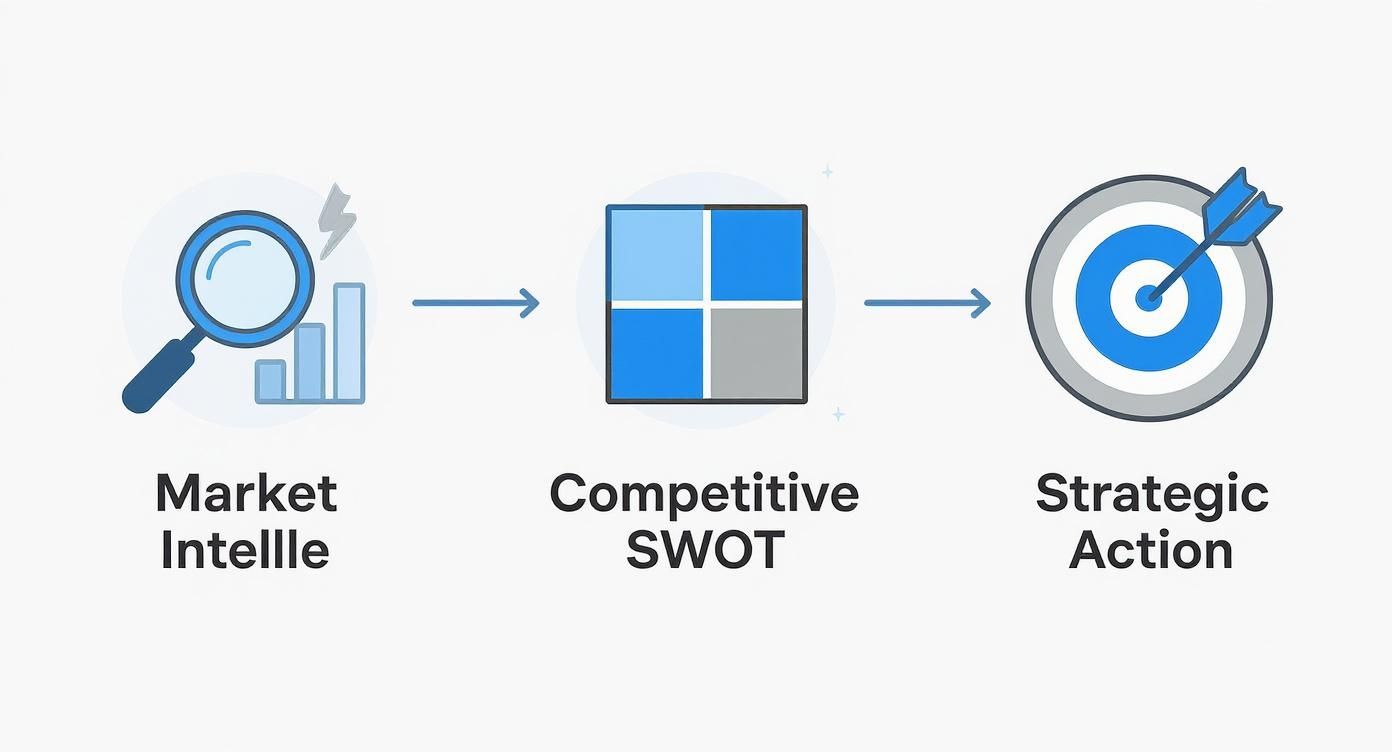
As you can see, a successful SWOT is the critical link between raw data and a focused plan of attack.
Choose Your Competitors Wisely
One of the most common mistakes I see is teams only looking at their direct rivals. That's like driving while only looking straight ahead—you're going to get blindsided. A truly comprehensive analysis requires a more nuanced view of the competitive landscape.
I recommend picking a mix of players to get the full picture:
- Direct Competitors: These are the obvious ones—the companies selling a similar solution to your exact audience. Think Coca-Cola vs. Pepsi. You'll want to pick two to three of your most significant direct competitors for a deep dive.
- Indirect Competitors: These guys solve the same problem for your customers, but with a totally different product or service. If you're building a project management tool like Asana, an indirect competitor could be a simple spreadsheet, or even a team's physical whiteboard. They reveal a lot about different customer habits and unmet needs.
- Aspirational Competitors: These are the companies you admire. They might not even be in your industry, but they're world-class at something you want to improve, like Zappos for customer service or Apple for branding. Studying them is a great source of inspiration for your "Opportunities" quadrant.
By analyzing this blend, you avoid the tunnel vision that comes from just obsessing over your main rivals and get a much richer, more realistic view of the world.
Assemble Your Remote Collaboration Toolkit
For a distributed team, your digital tools are your office. A messy toolkit—with documents in one person's email, links flying around in Slack, and notes in yet another app—creates friction and kills momentum before you even start.
Your goal is to create a single, centralized hub for everything related to this analysis. Here’s what you'll need:
- A Virtual Whiteboard: This is non-negotiable. Tools like Miro or Mural are perfect for this. You can set up your SWOT grid ahead of time, create space for competitor research, and use digital sticky notes and dot voting to collaborate in real-time.
- A Shared Document Hub: This is your single source of truth. Use Google Drive, Notion, or something similar to store all your research, meeting agendas, and background materials.
- A Project Management Tool: This is where your insights become action. After the workshop, you'll move your key takeaways into a tool like Asana, Trello, or Jira to assign owners, set deadlines, and track progress.
The key is creating a single, shared digital workspace where all information lives. This prevents knowledge silos and ensures everyone on the team has access to the same information, which is a core tenet of effective remote work.
To keep this hub from becoming a digital junk drawer, it's a good idea to follow some structured organizational habits. Digging into knowledge management best practices can give you a solid framework for keeping your strategic insights organized and accessible long after the workshop is over.
With your focus defined, competitors chosen, and digital workspace ready, you've set the stage for a seriously productive and insightful session.
Gathering Intelligence Your Competitors Miss

A truly game-changing competitive SWOT analysis isn't built on boardroom assumptions. It’s built on solid data. To get a real edge, you have to dig much deeper than a quick scan of your rival’s homepage. It’s all about finding the subtle signals and patterns that they—and everyone else—completely overlook.
This means you’ve got to move past surface-level observations. The goal is to gather rich, qualitative information that reveals their actual weaknesses and the opportunities you can jump on. This is the raw material you need to fuel a genuinely insightful workshop.
Uncover Weaknesses in Customer Reviews
Your competitors’ customers are leaving a breadcrumb trail of incredibly valuable insights all over the internet. These reviews are an absolute goldmine for spotting product gaps, service failures, and recurring frustrations.
Don’t just glance at the star ratings. You need to dive into the actual text on sites like G2, Capterra, or even Google Reviews. Look for patterns. Are customers consistently complaining about a clunky user interface, slow customer support, or a feature that’s missing in action?
Every single complaint is a potential weakness for them and a potential opportunity for you. Systematically collecting these pain points gives you concrete evidence to bring into your SWOT session. Our guide on how to conduct user research can give you a great framework for organizing this data.
By analyzing the specific language customers use, you move from guessing your competitor's weaknesses to knowing them. A pattern of complaints about "confusing navigation" is a much more powerful data point than a vague assumption that "their UX is bad."
Monitor Social and Community Conversations
Social media isn't just a marketing channel; it's a real-time focus group. By keeping an eye on brand mentions, relevant hashtags, and community forums like Reddit or industry-specific groups, you get a direct line to market sentiment.
Set up alerts to track conversations about your key competitors. What are people praising? Even better, where is the frustration boiling over? Sometimes, a single viral complaint can signal a widespread problem your competitor is struggling to manage.
This is also where you can spot emerging threats before they become a real problem. For instance, if you see a growing buzz around a new feature a competitor is beta-testing, you can start planning your strategic response long before its official launch.
Analyze Their Content and SEO Strategy
A competitor's content strategy is basically a public roadmap of their business priorities. By analyzing what they write about, you can effectively reverse-engineer their focus areas and find gaps you can exploit.
Use SEO tools to see which keywords they rank for and where they're putting their content resources.
- High-ranking articles: What topics are they owning in search results? This shows you where they believe their strengths lie.
- Neglected topics: Are there important industry keywords they aren't even targeting? This is a clear opportunity for you to step in and become the go-to authority.
- PPC campaigns: What keywords are they actually paying for? This tells you exactly which audiences and product features they value most right now.
This kind of analysis helps you pinpoint content opportunities where you can outmaneuver them, attracting valuable organic traffic they’ve left on the table. It's a core part of what's known as competitive intelligence.
To make sure your data collection is thorough, use a checklist to guide your research. This ensures you're not just grabbing random data points but are building a complete picture of each competitor.
Competitor Data Gathering Checklist
| Data Category | Information to Gather | Potential Sources |
|---|---|---|
| Product & Service | Core features, pricing tiers, unique selling proposition (USP), new feature releases | Competitor website, G2, Capterra, press releases |
| Customer Voice | Common complaints, feature requests, positive feedback, customer service issues | Review sites, social media, Reddit, forums |
| Marketing & SEO | Top organic keywords, paid search ads, content topics, social media engagement | Ahrefs, Semrush, company blog, social channels |
| Company Health | Recent funding rounds, key hires, acquisitions, employee reviews, company size | LinkedIn, Crunchbase, Glassdoor, news articles |
A simple checklist like this helps you stay organized and ensures your team covers all the essential bases before you even think about jumping into the SWOT analysis itself.
By combining these intelligence-gathering methods, you arm your team with a rich, evidence-based picture of the competitive landscape. You'll walk into your SWOT workshop with facts, not feelings, ready to build a strategy that’s grounded in reality. This preparation is what separates a routine meeting from a game-changing strategic session.
Running an Engaging Remote SWOT Workshop

This is the moment where all that prep work pays off. A remote SWOT workshop isn't just another meeting on the calendar. It's a guided conversation, and if you do it right, you’ll walk away with some seriously valuable strategic insights from your team. Your job as the facilitator is to steer that conversation, keeping it focused, productive, and engaging for everyone.
For distributed teams, a well-run workshop is a fantastic way to get everyone aligned. You're bringing together different perspectives to build a shared picture of the competitive landscape. Success really boils down to having a clear agenda, asking the right questions, and creating a space where everyone feels comfortable speaking up.
Setting the Stage for Open Collaboration
Those first ten minutes are everything—they set the tone for the entire session. In a remote setting, you can't just rely on the buzz of a physical room; you have to manufacture that energy yourself. That means starting with a solid icebreaker to get people warmed up and ready to contribute.
To get things moving, you might try some effective icebreaker for work activities. I find that a simple, relevant prompt works best. Something like, "Share one thing you learned about a competitor this week that genuinely surprised you," can instantly get the team thinking strategically.
The goal here is to shift everyone from being a passive audience to an active participant. State the objective clearly—that strategic question you defined earlier—and give a quick rundown of the agenda. This simple act provides much-needed structure and manages expectations, so your team knows what’s coming and how they can best jump in.
Sparking Deeper Insights with Better Prompts
The quality of your SWOT is a direct reflection of the quality of your questions. Generic prompts get you generic, useless answers. Don't just ask, "What are our strengths?" Instead, you need to frame every question as a direct comparison to your competitors. This one shift is what turns a standard SWOT into a powerful competitive SWOT analysis.
Here are some prompts I've used to guide the brainstorming and get teams thinking more critically:
Strengths (Internal, Positive)
- Where do we consistently win deals against Competitor X, and why?
- What unique asset—technology, data, a key person—do we have that our rivals simply can't copy?
- Which of our features gets the most praise when customers compare us to the alternative?
Weaknesses (Internal, Negative)
- What's the number one complaint we hear from customers who went with a competitor instead of us?
- If you were the CEO of Competitor Y for a day, what weakness of ours would you exploit first?
- Where are we constantly being outspent or out-innovated in the market?
This kind of targeted questioning pushes the team past surface-level observations. It forces a head-to-head comparison, producing insights that are immediately actionable.
Opportunities (External, Positive)
- What market trend are our competitors being slow to react to?
- Is there a niche group of customers that everyone else is ignoring?
- Which of our competitor's weaknesses could we turn into a new feature or service?
Threats (External, Negative)
- What new technology could make our key advantage irrelevant overnight?
- If our top competitor acquired that buzzy little startup, how would that hurt us?
- Are there any regulatory or economic changes on the horizon that might help our competitors more than us?
Managing the Flow and Ensuring Every Voice Is Heard
Facilitating a remote session is a different beast. You have to be the conductor, making sure the conversation flows without letting one or two people dominate the discussion. This is where your digital tools are your best friend.
First, always start with silent brainstorming. Give everyone a solid 5-7 minutes to add their ideas to the virtual whiteboard for each quadrant before anyone starts talking. This technique, often called "brainwriting," is a game-changer for giving introverts and deep thinkers an equal chance to contribute without being interrupted.
Once the board is full of sticky notes, you can open the floor for discussion. Start grouping similar ideas to spot the big themes. The last step is to prioritize. I like using a dot voting feature—give each person three votes per quadrant to place on the items they feel are most critical. It’s a fast, democratic way to build consensus around what the team collectively believes is most important.
If you want to get better at managing group dynamics and keeping your team energized, learning more about facilitating remote workshops will give you a much deeper toolkit. These skills are what separate a good discussion from a truly great one.
Turning Your SWOT Analysis Into Strategy
Let's be honest: an analysis without an action plan is just a well-organized conversation. You've just run a fantastic remote workshop, and the insights are flowing. But they only start making a real difference when you translate them into a concrete strategy. This is where you connect the dots between your company's reality and the market forces you've uncovered.
The crucial next step is to move beyond looking at the four SWOT quadrants in isolation. You need to start pairing them up. A simple yet incredibly powerful way to do this is with a framework called the TOWS Matrix. It systematically matches your internal factors (Strengths, Weaknesses) with external ones (Opportunities, Threats) to help you build out four distinct strategic plans.
This deliberate pairing process is what turns a list of observations into a genuine roadmap for the future.
From Insights to Action with the TOWS Matrix
The TOWS framework forces you to ask sharper, more strategic questions by combining elements from your competitive SWOT analysis. It’s the engine that drives you from observation to proactive planning.
It works by creating four strategic combinations:
- Strengths-Opportunities (SO): This is your “go on offense” strategy. Ask, "How can we use our core strengths to really pounce on the biggest opportunities out there?" This is where your big growth initiatives are born.
- Weaknesses-Opportunities (WO): This is about turning a negative into a positive. The question is, "How can we leverage these market opportunities to fix our internal weaknesses?" This could lead to a strategic partnership or finally adopting that new tech.
- Strengths-Threats (ST): Think of this as your defensive playbook. You’ll ask, "How can we use what we're great at to neutralize or minimize the threats heading our way?" It's all about building a moat.
- Weaknesses-Threats (WT): This is your most defensive posture, where you’re just trying to survive. The key question is, "How do we minimize our weaknesses and dodge these threats at the same time?" These are often tough but necessary decisions.
Using this matrix helps you create a balanced strategy. You're not just chasing growth; you're also actively managing risk and shoring up vulnerabilities, which is absolutely vital for long-term survival.
A Real-World Example of Strategy in Motion
This isn't just a theoretical exercise; it drives huge corporate decisions. A classic example is General Motors during the late 2000s financial crisis. Staring down overwhelming costs (a massive weakness), their analysis led to the painful but necessary choice to cut brands like Pontiac and Hummer.
That move freed up resources to double down on their strengths—brands like Chevrolet and Cadillac—and pivot toward the growing opportunity in fuel-efficient vehicles. It’s a perfect case of a strategy tackling weaknesses and opportunities at once. To see more detailed examples, you can explore how other major companies have used SWOT analysis on edstellar.com.
Creating Measurable and Actionable Next Steps
Once you've used the TOWS framework to brainstorm strategies, you have to make them real. Every single initiative that comes out of your workshop needs three things to make sure it actually happens.
- A Clear Owner: Every action needs to be assigned to one person. Accountability is everything. "The marketing team" isn't an owner; "Jane from marketing" is.
- A Specific Deadline: Tasks without deadlines are just wishes. Put a date on everything to create urgency and a clear timeline for follow-up.
- A Measurable Outcome: How will you know if you won? Define success in concrete terms. "Improve our blog" is vague. "Increase organic blog traffic by 15% in Q3" is a real goal.
This final translation into assigned, measurable tasks is what closes the gap between a great workshop and a game-changing business strategy. This is a key piece of a much larger puzzle, and if you’re mapping out your company’s future, our guide on the strategic planning process steps can help you fit these actions into the bigger picture.
Without this final layer of accountability, even the most brilliant insights will fizzle out.
Got Questions? We've Got Answers
Even with the best game plan, running a competitive SWOT analysis always brings up a few questions. I've been asked these countless times, and getting them sorted out is often what separates a routine exercise from a real strategic breakthrough. Let's dig into the most common ones.
How Often Should We Really Be Doing This?
Think of your SWOT analysis as a living document, not a "one and done" artifact you file away after your annual planning retreat. While a big, comprehensive deep-dive is great for that yearly strategy session, the competitive landscape moves too fast for that to be enough.
For anyone in a fast-paced space like SaaS or e-commerce, I strongly recommend a quarterly check-in. You don't need to reinvent the wheel every time—just focus on the Opportunities and Threats. What's new? What's changed? For companies in more stable industries, a semi-annual review usually hits the sweet spot.
The real trigger for a review isn't the calendar, it's the market. A new competitor popping up, a major tech shift, or even your own big product launch should have you immediately pulling up your SWOT to see how your position has changed.
What are the Biggest Mistakes People Make with a SWOT?
I see the same pitfalls over and over. The most common one is being way too generic. "Good marketing" as a strength? That tells me nothing. But "Our blog's SEO drives 50% more organic traffic than our top competitor"—now that’s an insight you can actually work with. Get specific.
The next big one is a lack of brutal honesty, especially when it comes to weaknesses. This is where a good facilitator earns their keep. You have to create a space where people feel safe enough to be critical without pointing fingers or fearing blame.
But the single biggest mistake? Doing all this great work and then… nothing. A SWOT analysis without a concrete action plan—with names, deadlines, and next steps—is just a fun brainstorming game. It delivers zero value until you connect those insights to real-world actions.
We Have So Many Ideas. How Do We Prioritize?
It's completely normal to end a session with a whiteboard full of ideas and a feeling of being totally overwhelmed. The goal isn't to do everything; it's to do the right things. For this, I always turn to a simple but powerful tool: the impact/effort matrix.
Just draw a simple two-by-two grid and start plotting your findings:
- Vertical Axis: Potential Impact (Low to High)
- Horizontal Axis: Effort Required (Low to High)
This simple act of visualization makes your priorities crystal clear.
- Quick Wins (High-Impact, Low-Effort): Jump on these immediately.
- Major Projects (High-Impact, High-Effort): These are your big strategic bets. They need a project plan.
- Fill-Ins (Low-Impact, Low-Effort): Tackle these when you have spare cycles, but don't let them distract you.
- Reconsider (Low-Impact, High-Effort): These are time sinks. Question why you'd do them at all.
When you're running this remotely, the dot voting feature in tools like Miro or FigJam is your best friend. Give everyone three to five virtual "dots" to vote on what they believe is most important. It’s a fast, democratic way to build consensus and get everyone aligned on the path forward.
Ready to transform your team's brainstorming sessions from chaotic to brilliant? Bulby provides the structure and AI-powered guidance to help your remote team generate, refine, and act on great ideas. Move beyond blank whiteboards and unlock your team’s full creative potential. Explore how it works.