

In today's competitive landscape, the difference between a good team and a great one lies in their ability to evolve. But what does that evolution actually look like day-to-day? Continuous improvement isn't just a corporate buzzword; it's a practical, systematic approach to making small, consistent enhancements that lead to significant breakthroughs. For remote teams, this practice is even more critical, as it provides the structure needed to refine workflows, boost collaboration, and drive innovation from anywhere in the world.
This article moves beyond theory to provide a deep dive into real-world continuous improvements examples. We will break down the exact methodologies used by industry leaders like Toyota, Google, and Netflix, showing you how they turned small tweaks into major competitive advantages. Forget massive, disruptive changes. We will explore how frameworks from Kaizen to Agile can be adapted for a distributed workforce, providing actionable steps your team can implement immediately.
You will learn not just what they did, but how they did it, with replicable strategies and specific tactics you can apply. We'll show you how to start building a culture of unstoppable progress, often with the help of smart tools like Bulby designed for modern teams. To further explore methods for fostering a culture of ongoing progress, consider actionable strategies to improve team efficiency with routines and automation. Get ready to transform your processes, one small improvement at a time.
1. Kaizen (Continuous Improvement Philosophy)
Kaizen, a Japanese term meaning "change for the better," is more than a method; it's a philosophy. It champions the idea of making small, ongoing, and incremental improvements to create significant long-term gains. Rather than waiting for large-scale, disruptive changes, Kaizen empowers every team member, from leadership to the front lines, to identify and solve inefficiencies in their daily work.
This approach is one of the most foundational continuous improvements examples because it creates a culture of perpetual enhancement. It thrives on collaboration and a systematic approach to refining processes, products, and team dynamics.
Why It Works for Remote Teams
For distributed teams, Kaizen's focus on structured, incremental change is particularly effective. It provides a framework for remote collaboration that might otherwise feel chaotic. By implementing regular, focused discussions about process refinement, remote teams can overcome communication gaps and operational friction before they become major problems.
A classic example is Toyota’s production system, where any employee can stop the assembly line to suggest an improvement. Netflix also applies Kaizen principles by iteratively refining its product based on constant user feedback and A/B testing, making small tweaks that collectively enhance the user experience.
How to Implement Kaizen Remotely
- Schedule Regular Kaizen Events: Dedicate a recurring time slot (e.g., bi-weekly or monthly) specifically for process improvement discussions, separate from daily stand-ups or project meetings.
- Create a Central Idea Hub: Use a shared document or a dedicated Slack channel where team members can log potential improvement ideas as they arise. This ensures good ideas aren't lost.
- Use a Structured Framework: Implement the Plan-Do-Check-Act (PDCA) cycle for each improvement idea. Plan the change, implement it on a small scale (Do), measure the results (Check), and either standardize it or pivot (Act).
- Celebrate Small Wins: Acknowledge and celebrate every successful small improvement. This reinforces the Kaizen culture and keeps the team motivated and engaged in the process.
Strategic Takeaway: Kaizen shifts the responsibility for improvement from a single department to the entire team. This collective ownership builds a resilient, proactive culture that continuously adapts and optimizes, which is a massive competitive advantage for any remote organization.
2. Lean Six Sigma (Process Optimization)
Lean Six Sigma is a powerful hybrid methodology that combines Lean's focus on eliminating waste with Six Sigma's statistical approach to reducing process defects and variation. It provides a data-driven framework for improving efficiency, quality, and customer satisfaction by systematically identifying and removing the root causes of problems.
This methodology is one of the most rigorous continuous improvements examples available. It’s not just about making things better; it’s about making them measurably and predictably better, which is crucial for scaling operations and maintaining high standards of quality.
Why It Works for Remote Teams
For distributed teams, Lean Six Sigma provides the structure needed to optimize asynchronous and synchronous workflows that can easily become inefficient. It moves process improvement from subjective "gut feelings" to objective, data-backed decisions. This is vital for remote environments where direct observation is limited and clear, standardized processes are paramount for success.
For example, Google has used Lean Six Sigma principles to optimize everything from data center energy consumption to meeting efficiency. Other tech companies apply it to reduce communication overhead by mapping information flows and identifying bottlenecks, sometimes cutting down unnecessary emails and meetings by over 40%.
How to Implement Lean Six Sigma Remotely
- Define and Map Your Processes: Use digital whiteboarding tools to visually map a key remote workflow, like your customer support ticket resolution process or your content creation pipeline. Identify every step, handover, and potential delay.
- Establish Baseline Metrics: Before making changes, collect data. Measure things like the average time to close a ticket, the number of revisions per project, or the defect rate in a software release. This gives you a baseline to improve upon.
- Use the DMAIC Framework: Apply the Define, Measure, Analyze, Improve, and Control (DMAIC) cycle. Define the problem, Measure current performance, Analyze the data to find root causes, Implement a targeted improvement, and Control the process to sustain the gains.
- Standardize and Document: Once an improvement is validated, update your official documentation in a central knowledge base (like Notion or Confluence). Effective innovation in processes requires that improvements are standardized and accessible to all team members.
Strategic Takeaway: Lean Six Sigma instills a data-first mindset for problem-solving. For remote teams, this replaces ambiguity with clarity, enabling you to pinpoint and eliminate the hidden operational friction that erodes productivity and morale.
3. Agile and Scrum (Iterative Development)
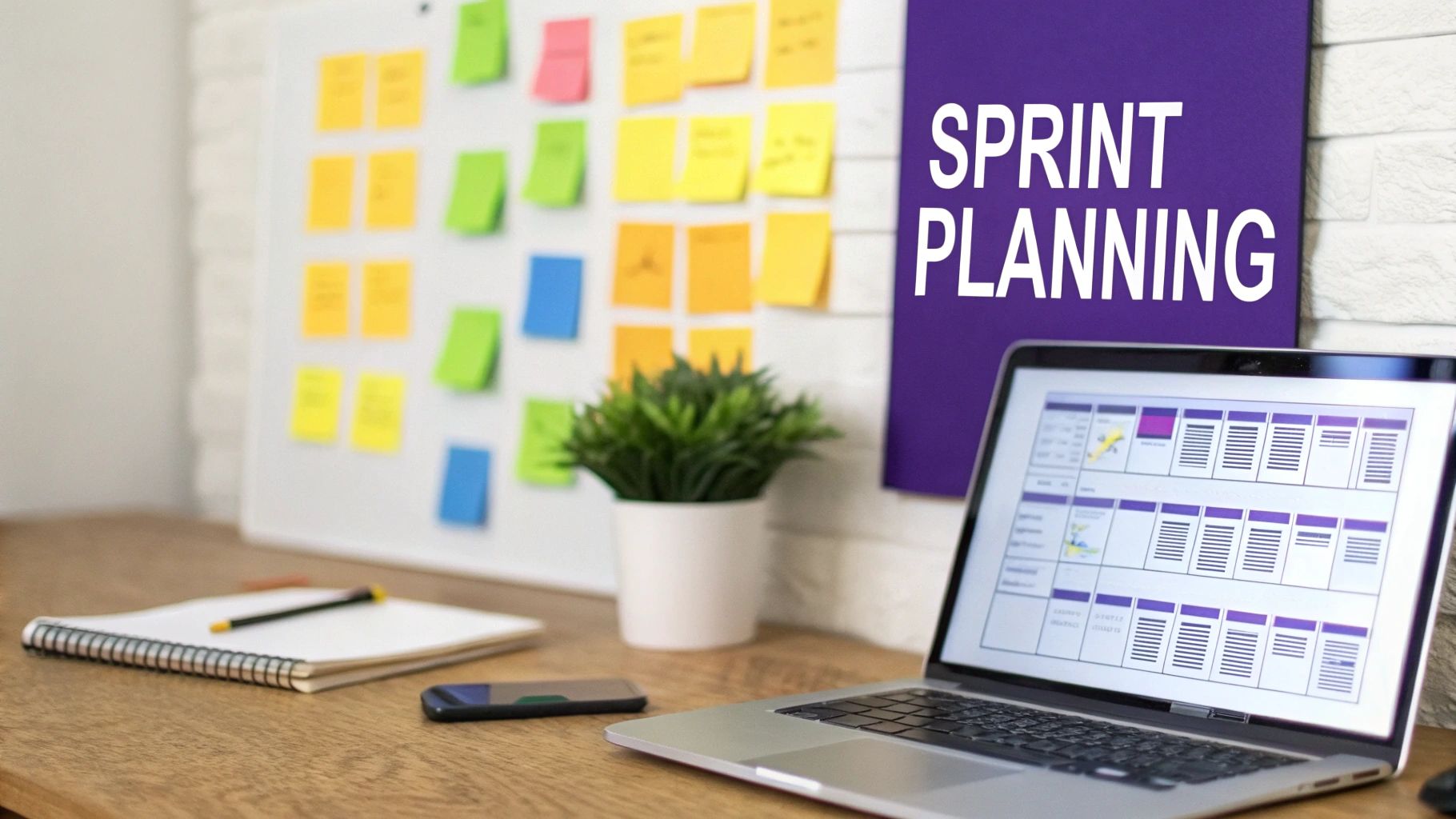
Agile is a project management philosophy centered on iterative development, constant feedback, and adaptive planning. Scrum, its most popular framework, breaks large projects into short, focused work cycles called "sprints." This structure of repeated planning, execution, and review is one of the most powerful continuous improvements examples for product development.
Instead of a single, long development cycle, Agile teams deliver work in small increments. This allows for regular reflection and adaptation, ensuring the final product aligns with user needs and market changes.
Why It Works for Remote Teams
For remote teams, Agile and Scrum provide an essential operating rhythm. The framework's defined events, like daily stand-ups and sprint retrospectives, create predictable touchpoints that foster alignment and proactive problem-solving across different time zones. It transforms complex projects into manageable, transparent workflows.
Spotify is a well-known example, organizing its distributed engineering teams into "squads" that operate like mini-startups using Agile principles. Similarly, remote-first companies like Automattic rely on Agile to continuously ship improvements for WordPress.com, adapting to user feedback in near real-time.
How to Implement Agile and Scrum Remotely
- Define Sprint Cycles: Establish a consistent sprint length (e.g., two weeks) to create a predictable rhythm for planning, building, and reviewing work. Mastering this cadence is key, and you can explore more sprint planning best practices to optimize your process.
- Run Structured Ceremonies: Use video conferencing for key ceremonies like Sprint Planning, Daily Stand-ups, and Sprint Retrospectives. Use digital whiteboards and project management tools to keep everyone engaged and on the same page.
- Prioritize the Backlog: Maintain a clear, prioritized product backlog. This single source of truth ensures that even without constant oversight, everyone knows what the most important tasks are.
- Embrace the Retrospective: The sprint retrospective is the core of Agile's continuous improvement engine. Dedicate this time to openly discussing what went well, what didn't, and what specific actions the team will take to improve in the next sprint.
Strategic Takeaway: Agile and Scrum institutionalize continuous improvement by embedding feedback loops directly into the work cycle. For remote teams, this framework provides the structure and discipline needed to build, measure, and learn in a distributed environment, ensuring a constant state of productive evolution.
4. Design Thinking (Human-Centered Problem Solving)
Design Thinking is a human-centered methodology for solving complex problems through innovation. It focuses on understanding the user's needs first and foremost, then moving through stages of ideation, prototyping, and testing to arrive at optimal solutions. This iterative process places empathy at its core, ensuring the final product or service genuinely meets user expectations.
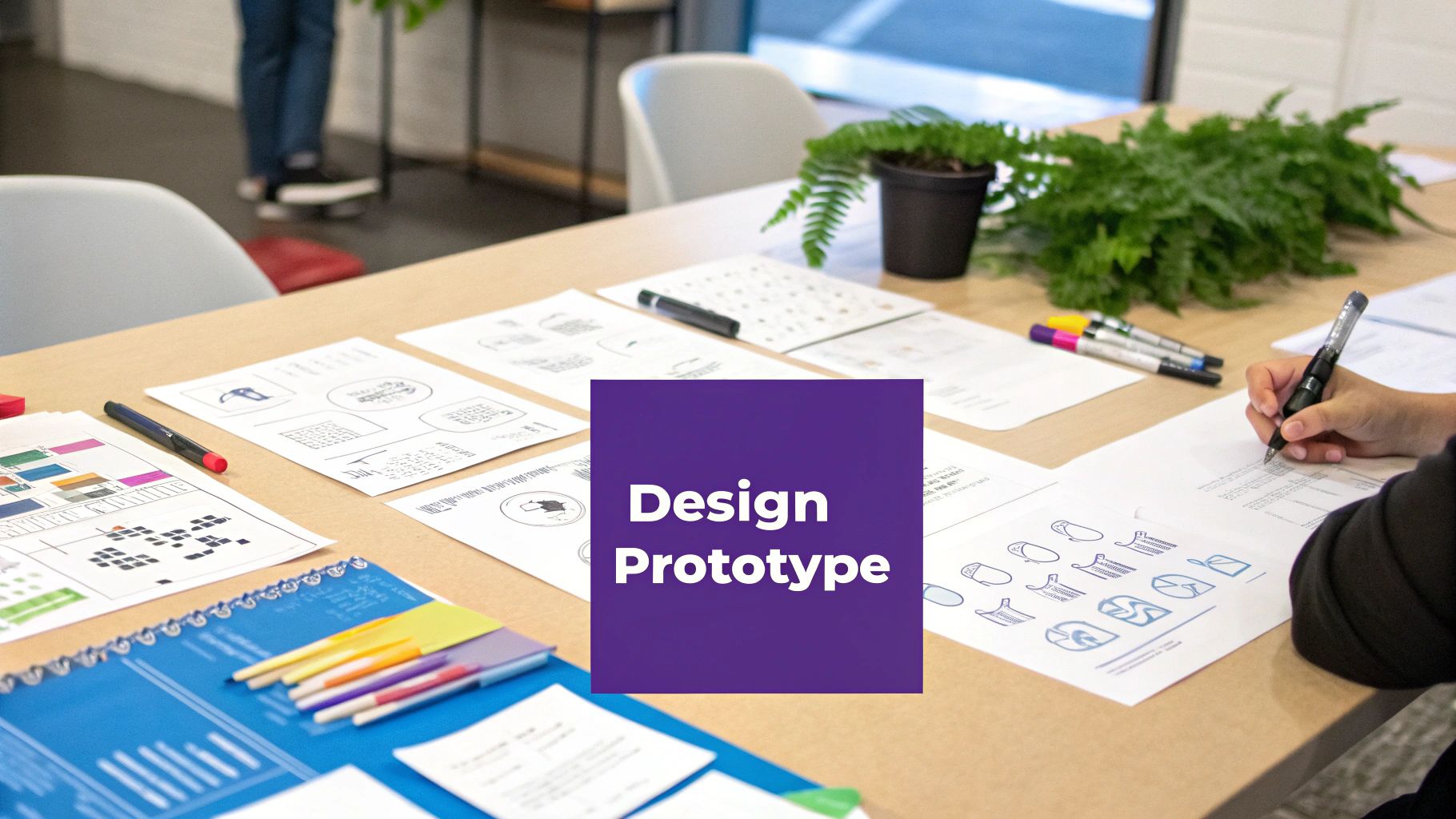
This method is a powerful example of continuous improvement because it builds feedback and iteration directly into the creative process. It encourages teams to fail fast and learn quickly, refining ideas based on real-world user interaction rather than internal assumptions alone.
Why It Works for Remote Teams
For distributed teams, Design Thinking offers a structured yet flexible framework for collaborative innovation. Its distinct stages provide clear signposts for remote workshops, ensuring everyone contributes effectively regardless of location. This structured approach helps bridge communication gaps and aligns diverse perspectives toward a common, user-focused goal.
Companies like IBM and Google have successfully scaled Design Thinking across global remote teams to build enterprise software and consumer products. They use these principles to ensure that even with distributed talent, the end user's voice remains the central guide for every development decision. You can learn more about the five distinct design thinking process steps to better understand its structure.
How to Implement Design Thinking Remotely
- Run Structured Empathy Sessions: Use digital whiteboards like Miro or Mural for collaborative empathy mapping exercises. Dedicate sessions to building user personas based on research and customer interviews.
- Facilitate Digital Ideation: Employ techniques like "How Might We" questions in a shared document or brainstorming tool to generate a wide range of ideas. Use virtual breakout rooms to encourage smaller group discussions.
- Prototype with Digital Tools: Create low-fidelity prototypes using tools like Figma or Balsamiq. These are easy to share and allow for quick, asynchronous feedback from team members and test users.
- Conduct Remote User Testing: Use video conferencing tools with screen-sharing capabilities to observe users interacting with your prototype. Record sessions to analyze feedback and identify areas for improvement.
Strategic Takeaway: Design Thinking anchors innovation in human empathy, ensuring your team solves the right problems for the right people. For remote teams, it provides a unifying framework that transforms diverse perspectives from a challenge into a strategic advantage for creating user-loved products.
5. OKRs (Objectives and Key Results)
Objectives and Key Results (OKRs) is a powerful goal-setting framework designed to create alignment and engagement around measurable goals. The framework pushes teams to set ambitious, qualitative Objectives (what we want to achieve) and define 3-5 quantitative Key Results (how we'll know we achieved it). This structure turns broad company missions into focused, actionable priorities.
This framework is one of the most effective continuous improvements examples because it creates a quarterly cycle of setting, tracking, and reflecting on goals. It forces teams to continuously reassess their priorities and adapt their strategies based on measurable outcomes, fostering a culture of accountability and results-driven progress.
Why It Works for Remote Teams
For remote teams, OKRs provide a critical "source of truth" for priorities, ensuring everyone is pulling in the same direction without constant supervision. The framework's emphasis on outcomes over output empowers team members with the autonomy to figure out how to achieve their goals, which is essential in an asynchronous environment.
Google famously used OKRs to scale from 40 employees to over 100,000, aligning its global workforce on moonshot goals like building Chrome. Similarly, Atlassian uses a transparent OKR system to keep its distributed product teams synchronized, ensuring that individual team efforts contribute directly to broader company objectives.
How to Implement OKRs Remotely
- Define Objectives Collaboratively: Use a workshop or brainstorming session at the start of each quarter to set ambitious, inspiring objectives. Ensure they align with high-level company strategy.
- Create Measurable Key Results: For each objective, define 3-5 specific, time-bound, and measurable key results. These should be outcomes, not tasks (e.g., "Increase user retention from 20% to 25%" instead of "Launch three new features").
- Conduct Regular Check-ins: Schedule weekly or bi-weekly check-ins to track progress on key results. This creates a regular feedback loop for identifying roadblocks and adapting tactics.
- Hold Quarterly Reviews: At the end of the quarter, score the OKRs and conduct a retrospective. Discuss what was learned, what went well, and what could be improved for the next cycle.
Strategic Takeaway: OKRs institutionalize a rhythm of strategic focus and reflection. By clearly defining success and regularly measuring progress, remote teams can maintain tight alignment and momentum, turning ambitious goals into tangible business improvements every quarter.
6. Retrospectives and Post-Mortems
Retrospectives and post-mortems are structured meetings for teams to reflect on past events, such as a project cycle, a sprint, or an unexpected incident. A retrospective focuses on what went well, what could be improved, and what actions to take moving forward. A post-mortem specifically analyzes a failure or incident to understand its root cause and prevent it from happening again.
These practices are powerful continuous improvements examples because they embed learning directly into a team's workflow. Instead of repeating mistakes, teams systematically identify weaknesses and create concrete action plans, turning every experience, good or bad, into a growth opportunity.
Why It Works for Remote Teams
For remote teams, these structured feedback loops are vital for maintaining alignment and resolving process friction that might otherwise go unnoticed. They provide a dedicated forum to discuss challenges and celebrate successes, strengthening team cohesion and psychological safety. A key principle, especially in post-mortems, is the concept of "blamelessness," popularized by Google's SRE culture, which focuses on systemic issues rather than individual errors.
GitLab, a remote-first company, excels at this by conducting asynchronous retrospectives, allowing team members across different time zones to contribute thoughtfully. This approach ensures all voices are heard, not just the loudest or those in a convenient time zone.
How to Implement Retrospectives Remotely
- Set a Clear Agenda: Before the meeting, share a structured agenda (e.g., What went well? What didn’t? What will we change?). This allows team members to prepare their thoughts.
- Use a Collaboration Tool: Employ a digital whiteboard or a specialized tool to gather ideas anonymously and vote on discussion priorities. This prevents dominant voices from steering the conversation.
- Focus on Actionable Outcomes: The goal is not just to discuss but to act. End every session by defining clear, measurable, and assigned action items with deadlines.
- Conduct Blameless Post-Mortems: When an incident occurs, focus the analysis on the "how" and "why" of the system failure, not "who" made a mistake. This encourages honest and open investigation.
Strategic Takeaway: Regular retrospectives transform a team from being reactive to proactive. By institutionalizing reflection, organizations build a resilient culture that learns from both its wins and its failures, ensuring that every project cycle makes the team smarter and more efficient.
7. Peer Feedback and 360-Degree Reviews
Peer feedback and 360-degree reviews are structured systems for gathering performance insights from multiple perspectives, including managers, direct reports, and colleagues. Instead of relying solely on top-down evaluation, this method provides a well-rounded view of an individual's strengths and areas for development. It fosters a culture of accountability and shared growth.
This system is one of the most powerful continuous improvements examples for individual and team development. It democratizes the feedback process, moving it from a once-a-year event to an ongoing dialogue that drives personal and collective improvement, which is vital for high-performing teams.
Why It Works for Remote Teams
In a remote setting, visibility into a colleague's contributions and challenges can be limited, making traditional performance reviews less effective. 360-degree feedback bridges this gap by sourcing insights from those who collaborate with the individual daily. This comprehensive view helps identify blind spots and provides actionable data for professional growth.
Companies like Buffer and Google have famously used variations of this model. Buffer implements transparent feedback cycles to enhance its remote culture, while Google's peer-based performance reviews are central to its talent development and promotion processes, ensuring fairness and depth in evaluations.
How to Implement Peer Feedback Remotely
- Establish Psychological Safety: Before launching, run workshops to train the team on giving and receiving constructive feedback. Emphasize that the goal is growth, not criticism, to build trust.
- Define Clear Competencies: Use a collaborative tool to brainstorm and define the specific skills and behaviors that will be evaluated. This ensures feedback is consistent, relevant, and fair.
- Use a Dedicated Tool: Implement platforms like 15Five or Lattice to streamline the process of requesting, collecting, and analyzing anonymous or attributed feedback.
- Schedule Regular Cycles: Move away from annual reviews. Implement quarterly or bi-annual feedback cycles to make improvement a continuous, iterative process rather than a stressful, infrequent event.
Strategic Takeaway: 360-degree feedback transforms performance management from a top-down mandate into a collaborative, team-driven process. For remote teams, it provides the multi-dimensional visibility needed to foster genuine growth, build stronger relationships, and align individual development with team goals.
8. Experimentation and A/B Testing
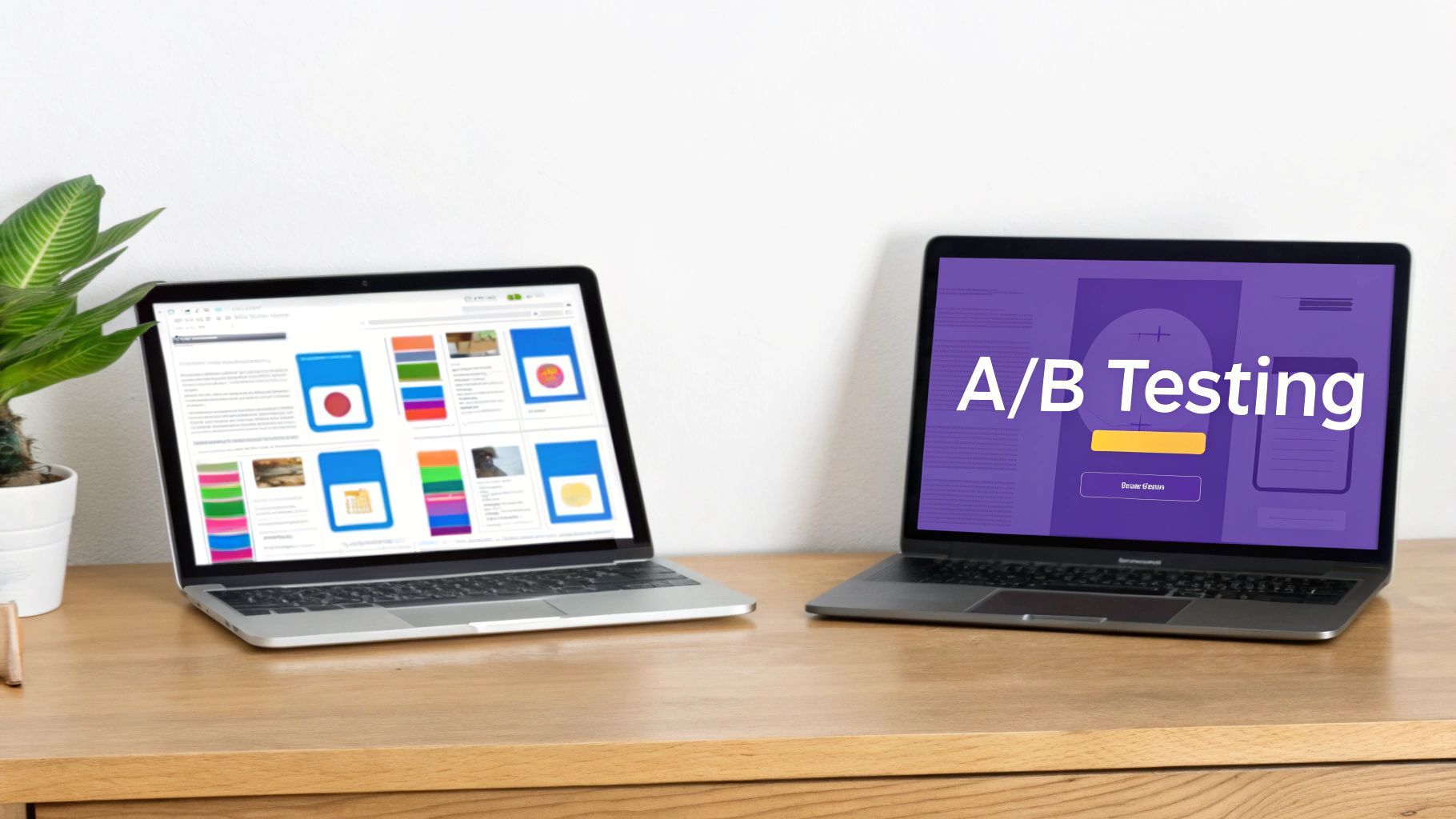
Experimentation and A/B testing are methodologies that enable data-driven decision-making by methodically testing hypotheses. A/B testing, its most common form, compares two or more variations of a webpage, feature, or email to determine which one performs better against a specific goal. This scientific approach removes guesswork and grounds decisions in user behavior.
This method is one of the most powerful continuous improvements examples because it provides quantifiable evidence for what works and what doesn’t. For companies like Amazon and Netflix, relentless experimentation is the engine of innovation, allowing them to optimize everything from button colors to recommendation algorithms.
Why It Works for Remote Teams
For remote teams, an experimentation culture creates alignment and objectivity. When opinions differ on the best path forward, a well-designed test can provide a definitive, data-backed answer, reducing conflicts and lengthy debates. It fosters a culture of curiosity and learning, where failures are seen as valuable insights rather than mistakes.
Google famously runs hundreds of experiments simultaneously to optimize search results and ad performance. This mirrors how distributed teams can test smaller process changes, such as a new meeting format or a different project management tool, with a small group before rolling it out company-wide, minimizing disruption and risk. This approach shares principles with building a minimum viable product, where you validate ideas on a small scale before committing significant resources.
How to Implement Experimentation Remotely
- Generate Strong Hypotheses: Use a collaborative tool to brainstorm what to test. A strong hypothesis should be specific and measurable, such as: "Changing the checkout button color from blue to green will increase conversions by 5%."
- Define Success Metrics First: Before launching an experiment, clearly define what success looks like. Is it click-through rate, time on page, or user sign-ups? This ensures the results are interpreted correctly.
- Document Everything: Create a central repository to document every experiment: the hypothesis, the variations, the results, and the key learnings. This builds organizational knowledge and prevents re-testing the same ideas.
- Analyze and Iterate: Hold a post-mortem after each experiment to discuss the results. Brainstorm next steps and new hypotheses based on what was learned, ensuring the improvement cycle continues.
Strategic Takeaway: Building an experimentation culture empowers your team to make smarter, faster decisions based on evidence, not assumptions. It turns product and process development into a scientific discipline, driving predictable growth and continuous innovation.
9. Customer Feedback and User Research Integration
Integrating customer feedback and user research is the practice of systematically embedding user insights into every stage of the product development lifecycle. It involves actively collecting, analyzing, and acting upon feedback from various channels like surveys, interviews, analytics, and support tickets. This ensures that development efforts are aligned with real user needs and pain points.
This method is one of the most powerful continuous improvements examples because it creates a direct line between the people using the product and the team building it. It transforms product development from a process based on assumptions into one driven by evidence, leading to more user-centric and successful outcomes.
Why It Works for Remote Teams
For remote teams, a structured feedback integration process is essential for maintaining customer empathy and alignment. Without the spontaneous in-person interactions of an office, remote teams must be deliberate about creating channels for user insights to flow directly to developers, designers, and product managers. This prevents teams from operating in a vacuum and losing touch with their user base.
Slack famously exemplifies this by obsessively monitoring user feedback through various channels, which directly informs their product roadmap and feature refinements. Similarly, Figma’s remote product teams run continuous feedback sessions and user interviews, ensuring their design tool evolves in lockstep with the needs of its community.
How to Implement It Remotely
- Establish Diverse Feedback Channels: Set up multiple avenues for feedback, such as NPS surveys, in-app feedback widgets, a dedicated customer community, and regular user interviews conducted over video calls.
- Centralize and Synthesize Insights: Use a central repository like a Notion database or a dedicated tool to aggregate all feedback. Schedule regular "synthesis sessions" where the team collaboratively reviews findings to identify key themes and root causes.
- Create a Feedback-to-Action Loop: Formalize the process of turning insights into action. Link specific customer feedback directly to backlog items or feature requests to ensure development work is tied to a validated user need.
- Communicate Back to Users: Close the loop by informing customers how their feedback has influenced product changes. This builds loyalty and encourages further engagement.
Strategic Takeaway: Integrating user feedback moves teams from building for customers to building with them. This customer-centric approach minimizes wasted effort on features nobody wants and ensures every improvement delivers tangible value, creating a loyal user base that feels heard and valued.
10. Psychological Safety and Inclusive Team Culture
Psychological safety, a concept popularized by Harvard's Amy Edmondson, is the shared belief that a team is safe for interpersonal risk-taking. It’s the foundation that allows team members to admit mistakes, ask questions, and challenge the status quo without fear of punishment or humiliation. This environment is crucial for innovation and growth.
This concept is one of the most vital continuous improvements examples for team dynamics. It directly enables honest feedback and creative problem-solving by removing the fear that often stifles great ideas, making it a prerequisite for many other improvement methodologies to succeed.
Why It Works for Remote Teams
For remote teams, psychological safety isn't just a nice-to-have; it's a necessity. Without the non-verbal cues and spontaneous interactions of an office, trust can erode quickly. A culture of psychological safety ensures that team members feel connected and empowered to speak up in virtual meetings, challenge ideas in a Slack channel, and admit when they need help, preventing misunderstandings and isolation.
Google's famous "Project Aristotle" identified psychological safety as the single most important factor in high-performing teams. Similarly, Netflix's culture of radical transparency allows for direct feedback and ambitious bets, which can only happen when employees feel secure enough to take risks and learn from failures.
How to Implement Psychological Safety Remotely
- Model Vulnerability: Leaders should be the first to admit mistakes, share their learning processes, and ask for help. This behavior sets the standard for the entire team and shows that it's safe to be imperfect.
- Establish Clear Communication Norms: Create explicit guidelines for giving and receiving feedback. Use structured formats, like retrospectives, where critique is focused on the process, not the person.
- Ensure Equal Voice: Use tools and facilitation techniques that prevent a few dominant voices from controlling the conversation. Asynchronous brainstorming and round-robin feedback sessions in meetings can help.
- Celebrate Learning from Failure: Frame unsuccessful experiments as valuable learning opportunities. Publicly recognize the effort and insights gained, not just the successful outcomes.
Strategic Takeaway: Psychological safety is the bedrock upon which all other continuous improvement efforts are built. Without it, even the best frameworks will fail because teams will be too hesitant to contribute the honest feedback required to drive meaningful change. Building this trust is a continuous process that unlocks a team's full potential. To learn more, see these resources for building high-performance teams.
10 Continuous Improvement Approaches Compared
| Approach | 🔄 Implementation Complexity | ⚡ Resource Requirements | 📊 Expected Outcomes | Ideal Use Cases | ⭐ Key Advantage / 💡 Quick Tip |
|---|---|---|---|---|---|
| Kaizen (Continuous Improvement) | Low–Medium; cultural shift and sustained cadence required | Low; regular short meetings and documentation | Incremental efficiency gains, improved processes and ownership | Ongoing process refinement, sprint retrospectives, distributed teams | Builds team ownership and steady improvement / Celebrate small wins to sustain momentum |
| Lean Six Sigma (Process Optimization) | High; requires disciplined DMAIC and statistical rigor | High; training, analytics tools, and dedicated time | Measurable defect reduction, cost savings, consistent quality | Complex processes, operations optimization, scaling remote workflows | Data-driven, long-term ROI / Start with targeted pilots and train leaders |
| Agile & Scrum (Iterative Development) | Medium; requires ceremony discipline and skilled facilitation | Medium; tooling (backlogs), coaching, sprint cadence | Faster iterations, clearer visibility, rapid feedback loops | Product development, distributed engineering teams, time-boxed work | Rapid adaptation and transparency / Use asynchronous practices for time zones |
| Design Thinking (Human-Centered) | Medium–High; needs research, facilitation, prototyping cycles | Medium–High; user research, prototyping resources, cross-functional time | User-centered innovation, validated concepts, reduced risk before build | New product features, complex user problems, creative campaigns | Encourages empathy-driven solutions / Prototype early and iterate rapidly |
| OKRs (Objectives & Key Results) | Medium; disciplined planning and regular tracking required | Low–Medium; goal-tracking tools and alignment meetings | Organizational alignment, focused priorities, measurable progress | Company-wide alignment, quarterly planning, remote orgs seeking clarity | Clarifies priorities and motivates teams / Limit objectives (3–5) and review mid-quarter |
| Retrospectives & Post-Mortems | Low–Medium; effective facilitation and psychological safety needed | Low; meeting time and documentation | Actionable improvements, learning culture, fewer repeat errors | Sprint ends, incident reviews, project closures in distributed teams | High impact at low cost / Keep blameless and track action-item completion |
| Peer Feedback & 360° Reviews | Medium; structured cycles and anonymity options help quality | Medium; feedback platforms and rater training | Holistic performance insights, identified blind spots, development plans | Performance growth, leadership development, remote teams lacking informal feedback | Reveals multidimensional development areas / Provide training and clear frameworks |
| Experimentation & A/B Testing | High; needs rigorous design, statistical validity and controls | High; analytics platforms, enough sample traffic, engineering effort | Validated decisions, reduced rollout risk, faster learning | Product UX changes, feature validation, marketing optimizations | Evidence-based decision-making / Define metrics and ensure sufficient sample size |
| Customer Feedback & User Research Integration | Medium–High; systematic collection and synthesis required | Medium–High; interviews, surveys, analytics, synthesis time | Customer-centric product decisions, improved product-market fit | Roadmap prioritization, feature validation, continuous improvement loops | Anchors decisions to real user needs / Synthesize themes and act on top signals |
| Psychological Safety & Inclusive Culture | High; long-term leadership commitment and modeled behavior | Medium; training, facilitation, ongoing reinforcement | Increased innovation, higher engagement, better idea quality | Foundation across all teams, critical for high-performing remote teams | Enables all other practices to succeed / Leaders should model vulnerability and enforce norms |
From Examples to Action: Start Your Improvement Journey Today
Throughout this guide, we've dissected a powerful collection of continuous improvements examples, moving far beyond surface-level descriptions to uncover the strategic frameworks that drive real-world success. From Toyota’s foundational use of Kaizen to Spotify’s iterative approach with Agile and Scrum, a single, unifying principle emerges: sustained growth is not accidental. It is the direct result of a systematic, intentional commitment to getting better every day.
The most innovative and resilient organizations treat improvement as a core business function, not an occasional project. They build learning into their operational DNA, creating a culture where curiosity is rewarded and adaptation is constant. For remote and hybrid teams, this mindset is a non-negotiable requirement for success. Structured processes like retrospectives and peer feedback loops are the very things that bridge physical distances, ensuring alignment, psychological safety, and a shared sense of purpose.
Your First Step: Choosing a Framework
The sheer number of methodologies can feel overwhelming, but the journey toward continuous improvement starts with a single, manageable step. The key is not to implement everything at once but to choose the one framework that addresses your team's most pressing challenge right now.
- Is your team struggling with workflow inefficiencies? Start with a simple Kaizen event focused on one specific, recurring bottleneck in your process.
- Are you disconnected from your users? Implement a lightweight Customer Feedback Loop or a Design Thinking discovery session to regain that crucial connection.
- Do team meetings feel unproductive or repetitive? Introduce a structured Agile Retrospective to transform complaints into actionable improvement items.
The goal is to build momentum. A small, well-executed win in one area creates the confidence and buy-in needed to tackle larger, more complex challenges later. By focusing on one of these continuous improvements examples, you are not just fixing a problem; you are teaching your team how to solve problems systemically.
The Power of Incremental Gains
One of the most important takeaways from these examples is the profound impact of small, consistent changes over time. An A/B test that increases conversions by a mere 2%, a retrospective that saves each team member 30 minutes a week, or a revised OKR that brings laser focus to a key objective might seem minor in isolation.
However, when compounded over weeks, months, and years, these incremental gains create a powerful competitive advantage. This is the essence of building a learning organization. You shift from a culture of reactive firefighting to one of proactive, data-informed evolution. This strategic shift empowers your team, reduces waste, and directly contributes to a healthier, more sustainable bottom line.
Strategic Insight: The most effective improvement initiatives are not grand, top-down reorganizations. They are small, team-led experiments that are measured, iterated upon, and scaled. This empowers individuals and makes improvement a shared responsibility.
Your organization's future success depends on its ability to learn and adapt faster than the competition. The frameworks and examples we've explored provide the roadmaps, but your team must take the first step. Don't wait for the perfect moment or a major crisis to begin. Select your starting point, gather your team, and commit to making your first small improvement today. The journey is long, but the rewards are transformative.
Ready to turn these examples into your team's reality? Bulby provides the structured, AI-powered toolkit your remote team needs to run effective workshops for retrospectives, brainstorming, and strategic planning. Stop guessing and start improving with guided processes that drive real results by visiting Bulby today.