
Making a decision as a group is all about a bunch of people coming together to hash out problems and pick a path forward. It's different from going it alone because you get to tap into a wider pool of knowledge and perspectives. The hope is that this leads to smarter, more solid choices. But, as anyone who's sat through a painful meeting knows, the human element can make things… complicated.
The Power and Pitfalls of Group Decisions
Ever wondered why some teams just click and consistently come up with brilliant ideas, while others get stuck spinning their wheels? The answer is a paradox. Groups have massive potential for smart decisions, but they're also vulnerable to common traps that can derail even the sharpest minds.
It’s a bit like a symphony orchestra. When every musician is in sync and following the conductor, the result is incredible. But if one person is off-key or a section drowns everyone else out, the whole thing falls apart. Decision making by groups works the same way.
The Double-Edged Sword of Collaboration
When it works, group collaboration is a huge plus. You get a mix of viewpoints that one person would almost certainly miss, and research consistently shows that diverse teams are better at creative problem-solving. But this collective genius doesn't just happen on its own.
The very dynamics that can create brilliance can also lead to disaster. Just look at historical examples like the high-stakes choices made during the Cuban Missile Crisis conflict—it shows how critical getting it right can be. The pressure to agree, a few loud personalities, or a messy process can quickly sink what started as a great discussion.
Here are a few of the most common pitfalls:
- Groupthink: This is when everyone’s desire to get along and agree overrides their ability to think critically, leading to a bad call. You can learn more about it in our deep dive on what groupthink is and how to avoid it.
- Analysis Paralysis: The team gets so buried in data and what-ifs that they can't make a decision at all.
- Dominant Voices: One or two assertive people take over, and the quieter (but often insightful) members never get a chance to speak up.
The challenge isn't just to bring people together; it's to create an environment where their collective intelligence can actually thrive. A structured process is the framework that allows this to happen.
Why Structure Unlocks Creativity
Getting good at group decision-making is a must-have skill for any leader, especially now with so many remote and hybrid teams. A lot of managers worry that putting a process in place will kill creativity, but it’s usually the exact opposite.
A solid framework doesn't limit ideas—it makes sure every idea gets heard, which leads to better, more innovative results. By setting clear ground rules, you make people feel safe. That psychological safety is what encourages your team to share those wild, out-of-the-box ideas that often turn into the best decisions.
Understanding How Teams Think Together
When people get together to make a decision, their individual thoughts don't just add up—they change completely. The psychology behind how groups make choices is a wild mix of social pressure, shared biases, and hidden dynamics that can either lead to a brilliant breakthrough or a total disaster. If you want to build a better decision-making process, you first have to understand these forces.
A group isn't just a collection of minds. It’s a new, single entity with its own personality and blind spots. Think of it like baking a cake. You have flour, sugar, and eggs, and they're all distinct. But once you mix them together and pop them in the oven, they become something entirely different. The same thing happens when individual perspectives merge in a group; you get a collective thought process that can be incredibly powerful but also surprisingly flawed.
The Powerful Pull of Conformity
One of the strongest forces at play in any group is the pressure to just go along with everyone else. We’re social animals, and that deep-seated need to fit in can be so strong that it makes us question what we see with our own eyes. This isn’t just a hunch; it's a proven psychological phenomenon.
The famous Asch conformity experiments in the 1950s showed this in stark relief. In the study, people were asked to do something simple: match the length of a line to one of three other lines. It was an easy, obvious task. But when they were put in a room with actors who all intentionally picked the wrong line, something fascinating happened.
In these experiments, nearly 75% of subjects went along with the group's wrong answer at least once, even when it was painfully obvious they were incorrect. This tells us something crucial about group decisions: our fear of sticking out can easily override our own good judgment.
This happens in meeting rooms every single day. An engineer spots a potential flaw in a new product plan but stays quiet because everyone else seems so excited. That hesitation to "rock the boat" isn't a character flaw—it's a perfectly normal human response to social pressure.
How Agreement Can Lead to Extremes
Beyond just conforming, something else weird happens when a group of like-minded people get together to talk about an issue. Their shared beliefs don't just get stronger; they often become much more extreme. This is a cognitive trap known as group polarization.
For instance, picture a product team that feels moderately cautious about a new feature launch. After they all sit down and discuss the potential risks together, they don't just stay cautious. They might become intensely risk-averse and decide to shelve the launch entirely. The group discussion acts like an amplifier, taking their initial shared feeling and cranking it up to a level no single person would have reached on their own.
This isn't just a hypothetical. One study of US federal judges found that when ruling alone, they opted for extreme decisions only 30% of the time. But when they sat on a panel of three, that number shot up to 65%. It's a clear example of the amplifying effect of group polarization. You can discover more insights on how group dynamics affect decisions on Bain.com.
The Problem of Social Loafing
Finally, we have to talk about accountability. When you’re working on something by yourself, all the pressure to succeed is on you. But in a group, that responsibility gets spread out, and that can lead to a behavior called social loafing.
This is the classic "someone else will pick up the slack" mindset. It's the tendency for people to put in less effort when they're part of a team than when they're working alone. We've all seen it: a few people on a project carry all the weight while others hang back, assuming their lack of contribution will get lost in the noise.
To fight back against these natural tendencies, good intentions aren't enough. Teams need structured processes that actually encourage healthy debate, account for the risk of polarization, and make sure everyone feels a sense of individual ownership. It all starts with recognizing that even the smartest people can fall into these hidden social traps. By simply making your team aware of these dynamics, you're taking the first big step toward making better choices together. You may also be interested in our guide on what is cognitive diversity and why it's a powerful antidote to these common traps.
Choosing the Right Decision Making Method
Knowing the psychology behind group dynamics is one thing, but actually putting it to work requires a practical toolkit. Let’s face it, not all decisions are created equal. The method you use shouldn't be a one-size-fits-all solution, either. It’s like a carpenter selecting the right tool for the job—you wouldn't bring a sledgehammer to hang a picture frame.
Picking the right method can turn a potentially chaotic debate into a structured, productive process. It ensures the time and energy you pour into a decision actually leads somewhere clear, rather than just more confusion.
Consensus: The Path to Full Agreement
Consensus is often seen as the gold standard, especially for the big, hairy, audacious decisions. Reaching consensus doesn't mean everyone is thrilled with the final choice. What it does mean is that every single person can honestly say, "I can live with this, and I will support it."
Getting there is an intensive process. It involves a lot of discussion, negotiation, and a real commitment to finding common ground. This makes it perfect for those critical, bet-the-farm choices like defining company values or launching a flagship product, where you absolutely need everyone on board. The big drawback? It takes a lot of time. Trying to force consensus on minor issues will just lead to burnout.
Voting: A Tool for Speed and Efficiency
Voting is the method we all know. When you need a decision quickly and complete agreement isn't the main goal, a simple majority vote is incredibly efficient. It’s a great fit for lower-stakes choices, like picking a new project management tool or deciding on a meeting time.
The biggest win for voting is speed. It puts an end to the debate and lets the team move on. The risk, however, is that it can easily create a "winner vs. loser" dynamic. This can leave a chunk of your team feeling like their opinions were dismissed, which hurts engagement down the road. You can learn more about various decision making frameworks in our comprehensive guide.
This chart offers a simple way to think about which path to take, depending on how much buy-in or expert input you really need.
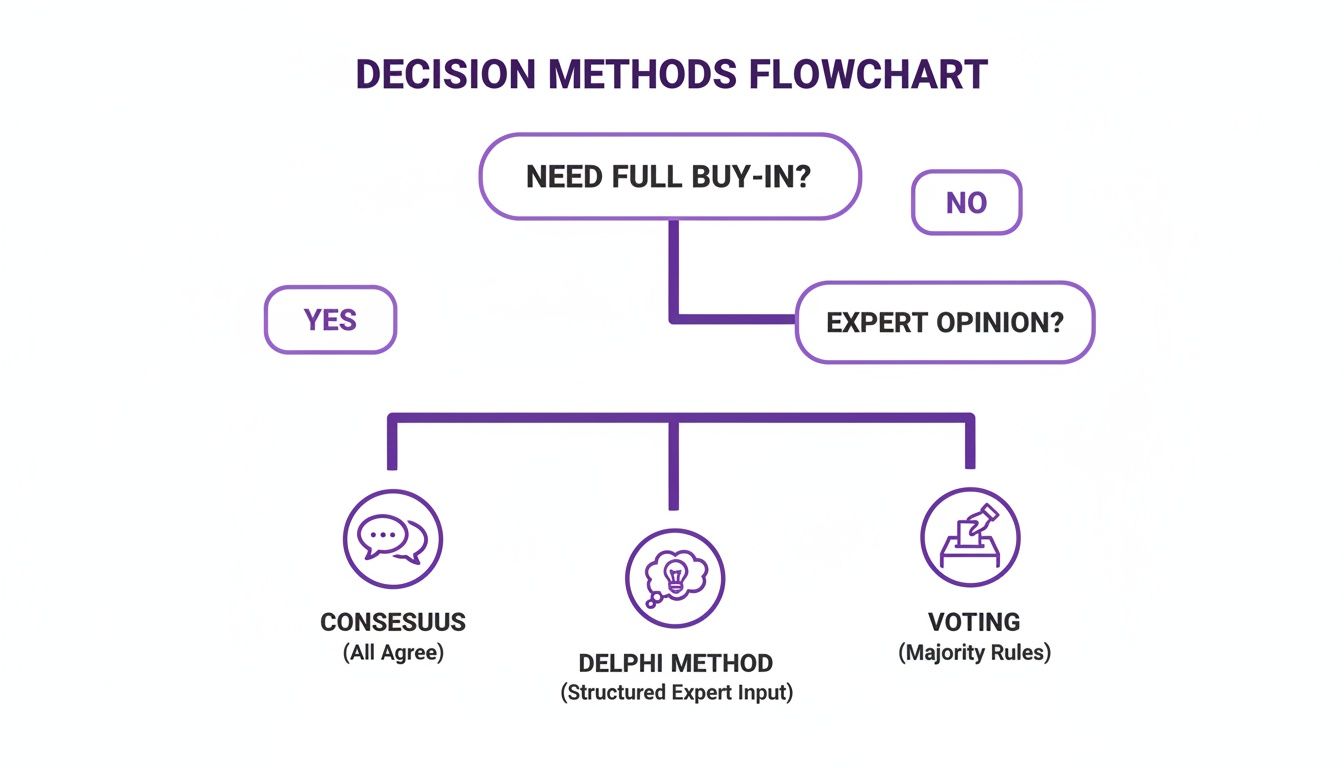
As you can see, if total team support is a must-have, consensus is your best bet. For other situations, different methods will serve you better.
The Delphi Method: Tapping into Expert Wisdom
What if your decision hinges on specialized knowledge, and you need to avoid the classic problem of dominant personalities hijacking the conversation? That's exactly what the Delphi Method was designed for. It’s a structured, multi-round process that gathers anonymous input from a panel of experts.
Here’s the gist of how it works:
- A facilitator sends a questionnaire to a hand-picked group of experts.
- The experts answer anonymously and send their responses back.
- The facilitator compiles and summarizes all the responses, then sends that summary back to the experts, who can revise their opinions based on what they see.
- This cycle repeats a few times until the experts' opinions start to converge around a clear answer.
This method is fantastic for forecasting, assessing risk, and tackling complex problems where objective expertise matters more than group harmony. Because it’s anonymous, people feel free to give their honest feedback without social pressure. Making smart choices also involves understanding your team's dynamics, which is where leveraging workplace culture data for better decision-making can be a game-changer.
Nominal Group Technique: Structured Brainstorming for Equal Voices
The Nominal Group Technique (NGT) is a brilliant hybrid. It gives you the best of independent brainstorming and the clarity of group voting, all while making sure every participant has an equal say. In short, it’s a great way to neutralize the loudest voices in the room.
The core idea of NGT is simple but powerful: generate ideas silently and individually first, then discuss and rank them as a group. This structure ensures a wider range of ideas is considered before the debate begins.
The process itself is quite straightforward:
- Silent Generation: Everyone on the team quietly writes down their ideas on the topic. No talking.
- Round-Robin Sharing: Each person shares one idea at a time, which gets recorded on a whiteboard or shared doc. There’s no discussion or criticism at this stage.
- Group Clarification: The group goes through the list of ideas to discuss them and make sure everyone understands what they mean.
- Voting and Ranking: Participants privately vote or rank the ideas. The results are then tallied to reveal the group's final decision.
NGT is incredibly effective for coming up with creative solutions and setting priorities while keeping participation high and fair. It gives you the best of both worlds—individual creativity and collective judgment.
A Quick Guide to Group Decision Making Methods
Feeling a bit overwhelmed? This table breaks down the four common techniques to help you pick the right approach for what your team needs right now.
| Method | Best For | Key Advantage | Potential Drawback |
|---|---|---|---|
| Consensus | High-stakes decisions where 100% buy-in is critical (e.g., company mission). | Builds maximum commitment and support for the final decision. | Very time-consuming; can lead to decision fatigue if overused. |
| Voting | Quick, low-impact decisions where speed is more important than full agreement. | Fast and simple; brings quick closure to a discussion. | Creates a "winner/loser" dynamic, potentially disengaging the minority. |
| Delphi Method | Complex problems requiring objective expert opinion (e.g., market forecasting). | Mitigates groupthink and social pressure by using anonymous feedback. | Slower, more formal process; relies heavily on a skilled facilitator. |
| Nominal Group Technique | Idea generation and problem-solving where all voices need to be heard equally. | Ensures balanced participation and generates a wide range of ideas. | Can feel overly structured; less suited for simple, quick choices. |
Ultimately, there's no single "best" method. The key is to match your approach to the decision at hand. By having a few different tools in your back pocket, you can guide your team to smarter, better-supported outcomes every time.
Why Good Teams Make Bad Decisions
It’s a frustratingly common story: a team of smart, talented people gets together and somehow makes a terrible decision. How does this happen? It’s rarely about a lack of intelligence or effort. The real culprits are the hidden psychological traps that spring up whenever we try to think together.
These aren't obvious blunders. They're subtle, powerful dynamics that can turn a team's collective brainpower from an asset into a liability. The first step to avoiding these traps is simply knowing they exist. Once you can spot them, you can build a process that protects your team from its own worst instincts.
The Allure of False Harmony
One of the most notorious traps is Groupthink. This is what happens when the pressure to agree becomes so strong that it silences critical thinking. Dissent is quietly smoothed over, and people start valuing harmony more than finding the right answer. The result is an irrational rush to consensus, often driven by a desire to please a leader or just go with the flow.
The 1986 Space Shuttle Challenger disaster is a tragic, real-world example. Engineers knew there were serious safety concerns with the O-rings, especially in cold weather. But they were up against immense pressure to launch and a culture that didn't welcome bad news. Those critical warnings got watered down and ignored. The drive for group unity led directly to a catastrophe.
Groupthink is the illusion of agreement. It feels like you’ve reached a productive consensus, but what you’ve really found is a collective blind spot where the fear of making waves is stronger than the will to find the best solution.
This isn't just for NASA engineers. It’s in the boardroom where everyone nods along with a flawed strategy because no one wants to challenge an enthusiastic CEO.
The Misery of Unwanted Agreement
A close cousin to groupthink, with a bizarre twist, is the Abilene Paradox. This is when a group decides on a course of action that not a single person in the group actually wants. It sounds crazy, but it happens all the time. Everyone just assumes their own preferences are out of step with the group's, so they keep quiet to avoid being difficult.
Think of a team talking about adopting a new, complex piece of software. The manager suggests it, assuming the team is excited about new tech. A senior developer thinks it’s a clunky nightmare but figures the junior members must want it for their resumes. The junior members are intimidated by it but assume the senior dev sees some strategic value they’re missing.
So what happens? Everyone politely agrees. The team wastes months on a tool nobody wanted, drains the budget, and ends up with a workflow everyone secretly hates. They all just took a long, miserable trip to Abilene when they would have rather stayed home. It’s a perfect storm of bad assumptions leading to a completely avoidable failure.
Overvaluing What Everyone Already Knows
Finally, there’s the Common Knowledge Effect. This is our natural tendency in a group to spend way too much time discussing information that everyone already shares. We stick to the familiar stuff, while the unique, critical information held by only one or two people gets ignored.
Picture a hiring committee. Everyone has the candidate’s resume—that’s the common knowledge. The meeting will probably revolve around those shared talking points. But what if only one interviewer caught a huge red flag during the technical screen? Because the conversation is dominated by what everyone already knows, that crucial, unshared insight might never surface.
This bias starves the decision of what it needs most: diverse perspectives and new information. It leads to choices based on an incomplete, skewed picture.
These group dynamics are fueled by deep-seated psychological tendencies. To dig deeper, check out our guide on the role of cognitive bias in decision making. By learning to recognize these patterns—Groupthink, the Abilene Paradox, and the Common Knowledge Effect—you can start to build the kind of team where good people can make truly good decisions.
How to Facilitate Better Remote Decisions

Knowing the psychological traps groups fall into is one thing. Actually steering your team around them is where the real work begins. This is especially true when your team is remote or hybrid, where the usual social cues are missing, making it easier for loud voices to take over and others to tune out.
Good facilitation isn't about controlling the conversation. It's about building a framework that lets the best ideas rise to the top, no matter who they came from. Making great decisions as a distributed team doesn't just happen—it takes a deliberate, structured approach that gives everyone a chance to contribute meaningfully.
Setting the Stage Before the Meeting
Believe it or not, the most important work in decision making by groups often happens before anyone even joins the video call. An unstructured meeting is a perfect recipe for a rambling discussion that goes nowhere, usually dominated by the quickest thinkers or loudest personalities.
To prevent that, you have to prepare the ground. Start by using asynchronous tools to get the ball rolling. Send out a crystal-clear agenda with the main question you need to answer and any background info. Even better, create a space—like a shared doc or a dedicated Slack channel—for people to drop their initial thoughts, either with their name on it or anonymously.
This pre-meeting brain dump is a powerful antidote to Groupthink. It gives quieter, more reflective team members the space to shape their ideas without the pressure of thinking on their feet, which brings a much richer set of perspectives to the table.
By gathering ideas beforehand, you level the playing field. The meeting itself can then be about discussing and refining these ideas instead of just starting from scratch. This makes your time together infinitely more valuable. You can find more practical tips in our guide on remote facilitation best practices.
Structuring the Conversation for Clarity
Once the meeting starts, structure is your best friend. A good facilitator guides the team through a clear process, keeping everyone focused and included.
Here are a few simple but powerful techniques:
- Assign a "Devil's Advocate": Officially give one person the job of poking holes in the group's thinking. This makes it okay to disagree and forces everyone to stress-test the decision before committing.
- Use Round-Robin Sharing: Instead of a free-for-all, go around the virtual room one by one. Give each person an uninterrupted minute or two to share their thoughts. This simple move stops the usual suspects from dominating the entire conversation.
- Timebox Each Agenda Item: Put a time limit on each part of the discussion. This creates a bit of urgency and keeps the group from getting stuck on a single point for too long.
These tactics aren't meant to shut down conversation; they're designed to channel it. They turn a potentially chaotic mess into a focused, step-by-step process where every voice gets heard.
Using Technology to Enhance Group Decisions
The right tech can be a huge asset for remote teams, turning what could be a weakness into a major strength. Video calls are the standard, of course, but tools built specifically for structured collaboration can help you sidestep the biases we've been talking about.
This is where a solution like Bulby can make a real difference. It’s designed to tackle the unique challenges of remote brainstorming and decision-making head-on. Bulby uses AI-guided exercises to walk teams through a structured process, promoting psychological safety and making sure everyone participates equally. It helps create a space where ideas are judged on their merit, not on who said them the loudest.
Research actually shows that well-organized groups can process information with incredible efficiency. One study found that groups had a "supercapacity," meaning they were not just more accurate but also faster than individuals when you combine speed and accuracy. A well-facilitated group can get to a better answer when everyone’s input is pooled effectively. You can read the full research on group processing efficiency to see the science behind it.
By using guided tools, you can systematically avoid the common pitfalls and tap into your team's collective brainpower. It makes the process more accurate, more efficient, and turns your remote team into a smart, collaborative decision-making machine.
Got Questions About Group Decisions? We've Got Answers.
Even when you know the playbook, actually running a group decision can feel like herding cats. You've got the theory down, but then you're faced with real people, real dynamics, and real-world messiness.
Let's dig into some of the most common questions leaders and facilitators ask. These are the practical, on-the-ground challenges that can trip up even the most well-meaning teams.
How Do I Handle a Dominant Personality?
Ah, the classic. We've all been in that meeting where one person takes up all the oxygen in the room. Their voice can easily drown out quieter, more reflective thinkers and create a false sense of agreement.
The trick isn't to shut them down, but to change the rules of the game. You need to structure the conversation so that everyone is given a chance to contribute on equal footing. It's about shifting the dynamic from a battle of personalities to a more methodical exploration of ideas.
Here are a few proven tactics:
- Start with Silent Brainstorming: Before anyone says a word, give everyone five minutes to jot down their own ideas. This is a game-changer for introverts, as it allows them to formulate their thoughts without being steamrolled.
- Go Round-Robin: Go around the table (or the Zoom screen) and have each person share just one idea at a time. No interruptions. This simple turn-based structure guarantees every single person gets their voice in the mix.
- Give Them a Job: Channel that dominant person's energy for good. Ask them to be the official scribe, capturing all the ideas on the whiteboard. Or, assign them the role of "devil's advocate," tasked with constructively poking holes in every idea, not just their own. This makes them a helpful part of the process instead of an obstacle.
Ultimately, you want to build a system where the best idea wins, not the loudest one.
What’s the Ideal Group Size for Making a Decision?
When it comes to making good decisions, more isn't always merrier. It’s tempting to think that more people means more brainpower, but large groups quickly run into problems. Communication gets clunky, and people start to suffer from social loafing—that tendency to put in less effort when you feel like your individual contribution is lost in the crowd.
So, what's the magic number?
Research consistently shows that the sweet spot for most complex decisions is a group of three to eight people. It's big enough for diverse viewpoints but small enough that everyone can actually participate meaningfully.
If you absolutely have to involve a larger crowd, don't try to manage one giant, chaotic conversation. Break them into smaller discussion groups first. Then, have a representative from each small group report their key findings back to everyone. This way, you get the benefit of broad input without sacrificing the focus of a smaller team.
How Can I Make Sure Everyone Feels Heard in a Remote Meeting?
This is a huge challenge. On a video call, it's far too easy for people to fade into the background, check their email, and feel like their input doesn't matter. Without the normal non-verbal cues we rely on in person, you have to be much more deliberate about creating space for everyone.
The key is a smart mix of live and on-your-own-time collaboration. The work of making people feel included starts before the meeting even begins.
- Prep Work Before the Call: Use a shared doc or a tool like Bulby to let people add their thoughts and ideas ahead of time. This is perfect for different time zones and for those who like to think things through before speaking.
- Facilitate with Intention: During the meeting, use the tools at your disposal. Actively call on people who haven't spoken. Use the virtual hand-raise feature, run quick polls to gauge a-greement, and use breakout rooms for smaller, more focused chats.
- Close the Loop Afterward: Always follow up with a summary of what was decided and the main points of discussion. This reinforces the outcome and gives anyone who felt unheard a final chance to ask for clarification or voice a concern.
Despite the clear upside, it's amazing how few companies get this right. In a major global survey, only 18% of organizations reported making decisions in a truly collaborative way, with a whopping 39% still clinging to top-down commands. Yet, 69% of everyone surveyed believed their company would perform better if more people were involved. That's a huge gap between what we want and what we do. You can read the full BARC report on data-driven decision making for more on this.
By tackling these common problems with a few structured techniques, you can dramatically improve the quality of your team's decisions.
Ready to transform your team's brainstorming sessions? Bulby provides AI-guided exercises that eliminate bias and ensure every voice is heard. Start building better ideas today with Bulby.