
Most advice on creative team collaboration is wrong at the starting line. It tells you to add more voices, book a longer brainstorm, and hope chemistry shows up. That's how teams burn an hour, generate polite variations of the first safe idea, and leave with nothing assigned.
Good collaboration isn't a personality trait. It's a system. You design it with rules, roles, constraints, and rituals that make original thinking easier and sloppy group behavior harder.
If your team keeps saying, “We have smart people, so why are the ideas average?” the answer usually isn't talent. It's format. The room is doing exactly what you trained it to do.
Table of Contents
- Why More People in the Room Does Not Mean Better Ideas
- Diagnose Where Your Team Collaboration Actually Breaks Down
- Run a Facilitated Brainstorm That Beats the Freeform Version
- Define Roles and Rituals That Keep Collaboration Alive
- Neutralize the Biases That Quietly Kill Original Ideas
- Use AI as a Facilitation Layer Without Flattening the Team
- Measure Outcomes and Steal These Templates
Why More People in the Room Does Not Mean Better Ideas
The fastest way to wreck a brainstorm is to confuse attendance with contribution. More people in the room usually means more waiting, more self-editing, more repetition, and more deference to the first decent-sounding concept.
Classic brainstorming research still matters here. In a review of 34 studies, 24 found nominal groups generated more ideas, and the average effect size for group type versus number of ideas was 0.572, which favored individuals generating ideas independently before discussion first, then converging later (brainstorming review). That should end the debate about freeform group ideation as the default.
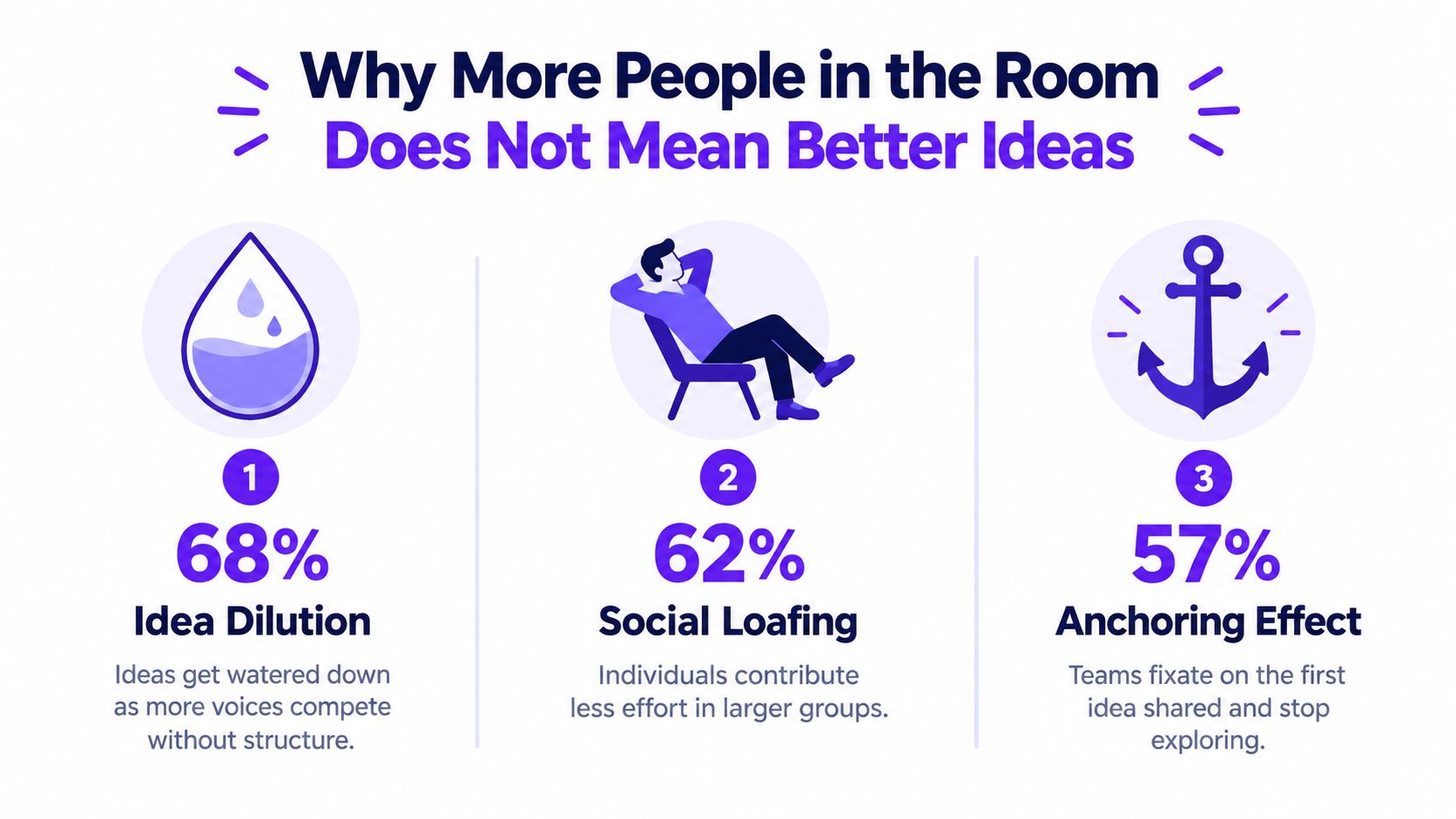
What usually goes wrong
A crowded brainstorm tends to fail in the same ways:
- Idea dilution: People start combining too early, which turns sharp concepts into soft compromises.
- Anchoring: The first plausible idea becomes the standard everyone reacts to.
- Social loafing: Some people coast because the group feels like shared cover.
- Dominant voice bias: One confident speaker narrows the field before the room has explored enough options.
If you've seen groupthink in psychology play out in meetings, you already know the pattern. The team mistakes agreement for progress and speed for clarity.
Treat collaboration like a production system
A creative session needs the same discipline you'd apply to a shoot or product sprint. You wouldn't put ten people on set with no call sheet, no shot list, and no owner. Stop doing the brainstorming equivalent.
Practical rule: Don't ask a group to create and evaluate at the same time.
The better model is simple. People generate ideas alone first. Then the group pools inputs. Then the room clusters, tests, and selects. That sequence works because it separates invention from social pressure.
This isn't about making collaboration colder. It's about making it useful. Teams don't need better vibes. They need a process that protects originality long enough for the best ideas to survive.
Diagnose Where Your Team Collaboration Actually Breaks Down
Trying to fix collaboration by talking about personalities is lazy. The breakdown usually sits in the workflow. Bad framing, fuzzy ownership, weak note capture, and meetings that pretend to be creative when they're really status updates.
Run a five-day diagnostic and look for evidence, not opinions.
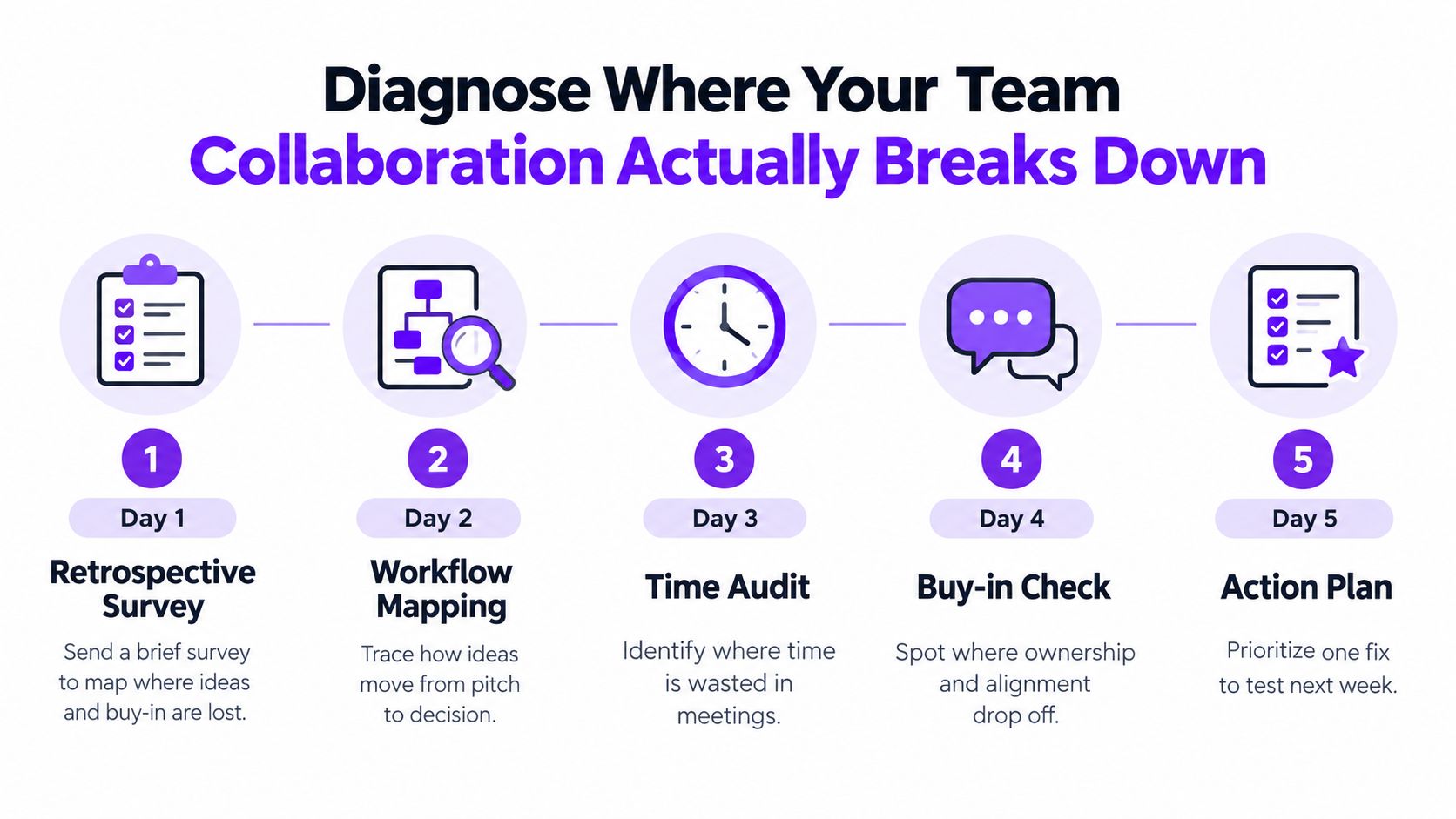
The five-day check
- Day one, send a short retrospective survey
Ask the team which recent meetings produced a real decision, which ones produced noise, and where ideas died. Keep it short enough that people answer truthfully.
Day two, map one idea from pitch to approval
Follow a single concept through the path it took. Where did it stall. Who weighed in late. When did the brief change. You're looking for friction, not blame.
Day three, audit meeting time
Review two weeks of team sessions and label each chunk as ideation, critique, decision-making, or status. Many teams discover they spend far more time discussing work than improving it.
Day four, identify repeated failure points
Look for patterns like unclear briefs, no decision owner, feedback spread across Slack and docs, or the same two people carrying every room.
Day five, pick two fixes only
Don't launch a collaboration transformation program. Pick two changes with the biggest effect on shipped work.
What to rank
Use impact on output as the filter. A meeting format that annoys people but still leads to decisions is less urgent than a polite process that kills momentum.
A useful ranking list looks like this:
- High impact: Unclear brief, no final approver, no post-session owner
- Medium impact: Tangents, uneven participation, feedback arriving too late
- Lower impact: Personal preferences about facilitation style or whiteboard layout
A collaboration problem you can observe is fixable. A collaboration problem described as “bad energy” usually isn't specific enough to solve.
What this reveals fast
You'll usually find one of three root issues:
- The team starts with a weak brief. People are solving different problems.
- The session lacks decision rules. Good ideas float, but nobody converts them into action.
- The handoff is broken. The room generates options, then the work disappears into a doc graveyard.
Creative team collaboration improves when you diagnose behavior. It stalls when you psychoanalyze coworkers.
Run a Facilitated Brainstorm That Beats the Freeform Version
A freeform brainstorm rewards speed, confidence, and interruption tolerance. That's a terrible way to get strong ideas. Use a facilitated format that separates thinking from talking.
Start with the visual process first.
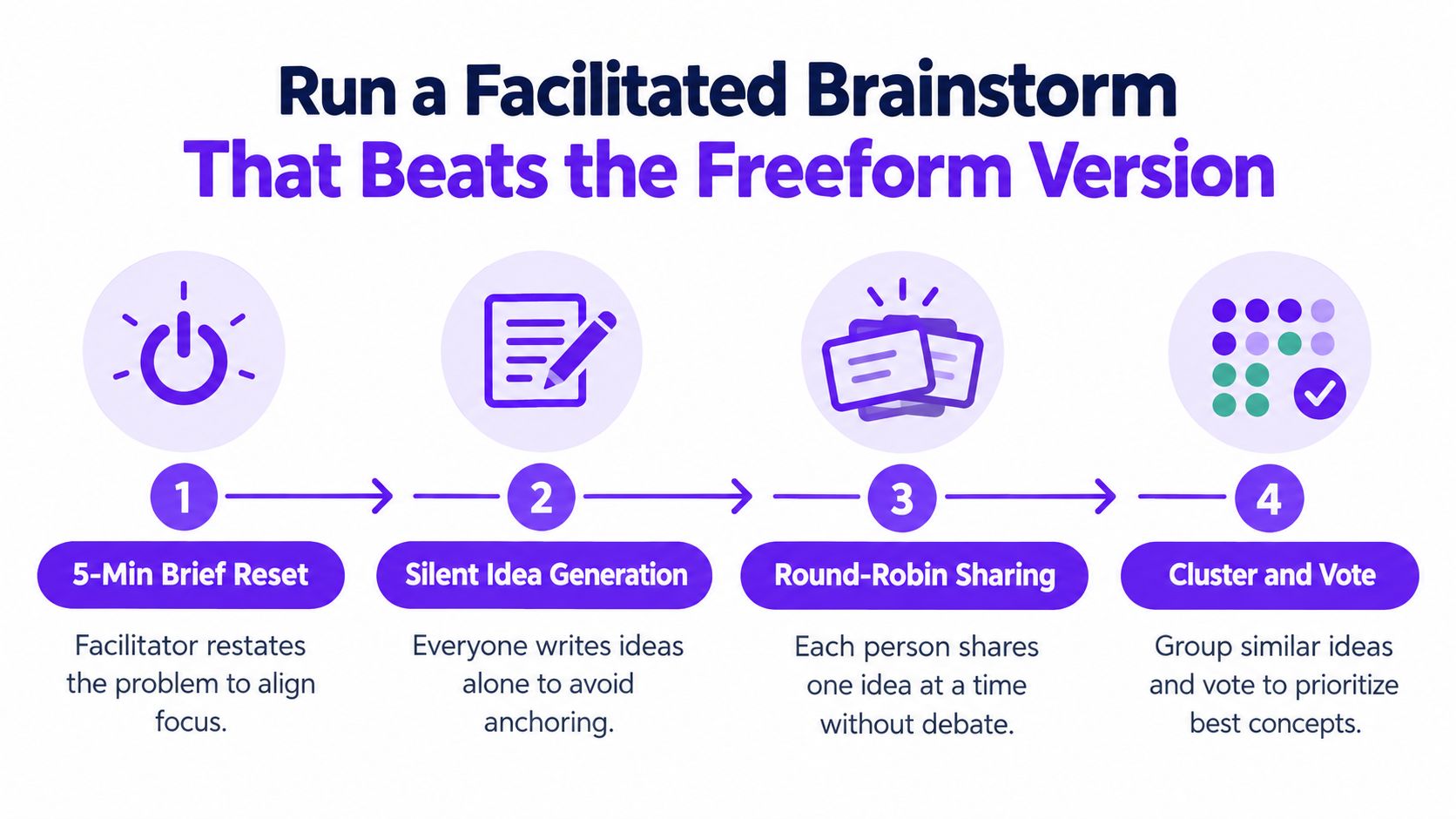
The 60-minute format that works
Use this sequence every time:
- Five minutes for the brief reset: The facilitator states the problem, the audience, the constraints, and the decision the room must make today.
- Ten minutes of silent ideation: Everyone writes alone. No talking. No reacting.
- Ten minutes of round-robin capture: Each person shares one idea at a time. The scribe logs them without debate.
- Ten minutes of clustering: Group similar ideas into themes and name the pattern.
- Ten minutes of challenge: Stress-test the strongest clusters against the brief.
- Ten minutes of forced ranking: Pick the top concept, a backup, and assign one owner.
- Five minutes to lock next steps: Define who will write, prototype, or present what.
If you want a broader reference for how to run a brainstorm session, use it as support, not as an excuse to improvise.
The prompts worth stealing
Use prompts with friction instead of dead prompts like “Any ideas?” That invites safe answers.
Try these:
- Audience flip: “What would make this irresistible to someone who usually ignores this category?”
- Constraint push: “If we had to make this idea simpler, sharper, and cheaper, what survives?”
- Worst idea exercise: “What's the most obvious, boring, overused approach?”
- Format shift: “If this had to live as a launch film, landing page, and social hook, what's the core thought?”
The worst-idea exercise matters because it lowers performance pressure. People loosen up, and better angles follow.
Here's a quick explainer before you run your next session.
The facilitator script
Don't wing the opening. Say this:
“We are not here to admire possibilities. We are here to leave with one direction worth building.”
Then enforce three rules:
- No critique during capture
- No defending half-formed ideas
- No leaving without an owner on the selected concept
A facilitated brainstorm works because it reduces social drag. It also makes the session repeatable. If the format depends on one charismatic creative director, the system is broken.
Define Roles and Rituals That Keep Collaboration Alive
A good brainstorm can still die on Tuesday. Teams get excited in the room, then drift because nobody knows who owns the next move. That's not a creativity issue. It's an operating issue.
Research on team creativity backs this up. A meta-analytic review found that structured process and task interdependence are among the strongest organizational predictors of collective creativity, while demographic diversity and team size were not consistently related to creativity or innovation (team creativity meta-analysis). That means your process matters more than your headcount.
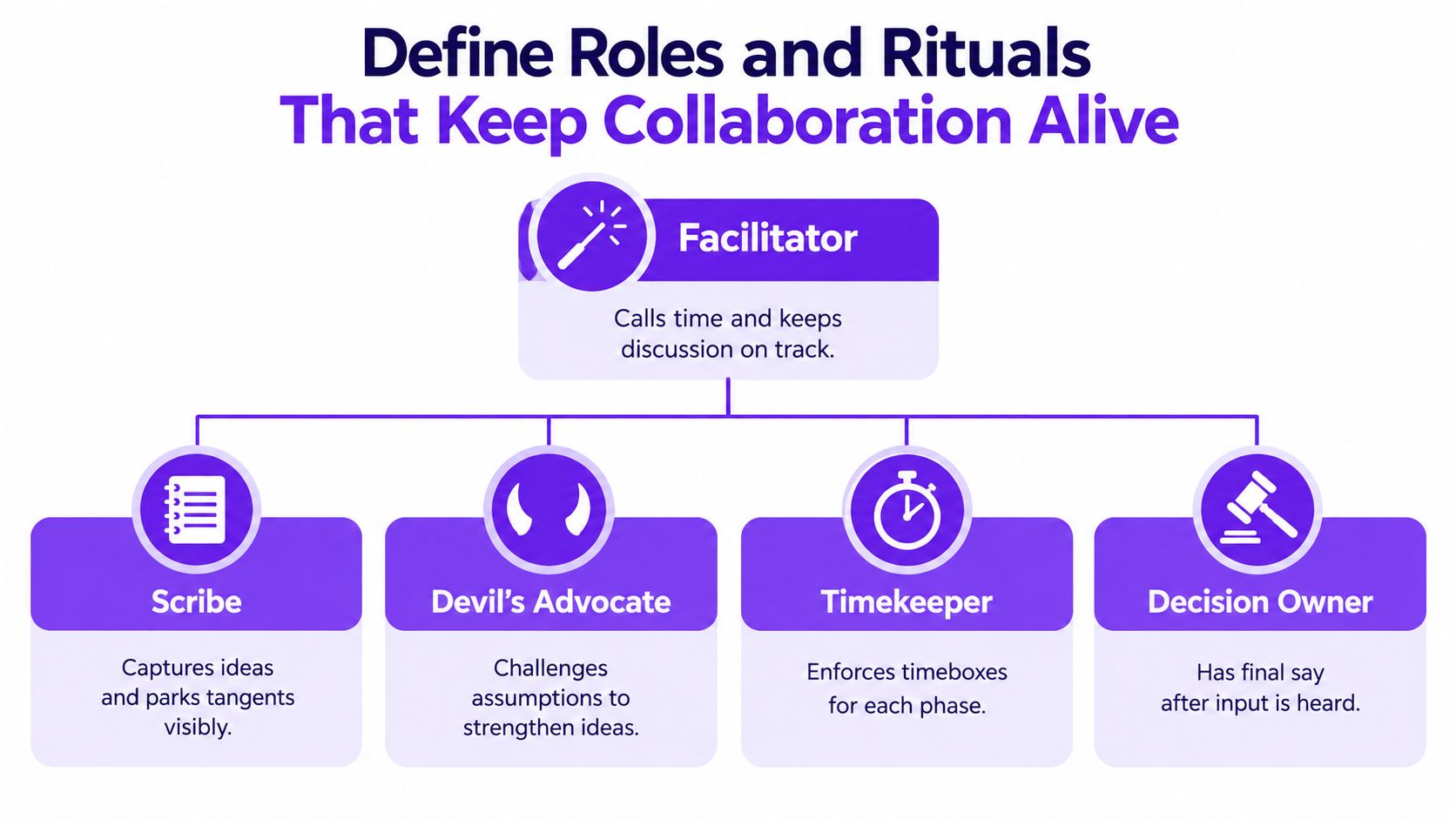
The five roles every session needs
Name the jobs. Don't assume people will self-organize.
- Facilitator: Keeps the room on the brief, calls transitions, stops derailments.
- Scribe: Captures ideas visibly and logs parked tangents.
- Devil's advocate: Challenges assumptions after ideation, not during it.
- Timekeeper: Protects pace and enforces timeboxes.
- Decision owner: Makes the final call after hearing input.
Rotate the facilitator every quarter. If one person always runs the room, the team starts adapting to that person's habits instead of the process.
The rituals that stop drift
Install a cadence and stop renegotiating how you work every week. A useful pattern looks like this:
- Monday framing meeting: Brief review, open questions, and success criteria
- Mid-week async critique thread: Focused feedback in one channel
- Friday decision roundup: Final direction, owners, and next deliverables
If you need help defining meeting cadence, the point isn't more meetings. It's clearer transitions between framing, making, critique, and sign-off.
Use a shared board with three columns only:
| Board column | What goes there | Owner behavior |
|---|---|---|
| In progress | Active concepts being shaped | Update with latest version and blocker |
| Parked | Ideas worth keeping but not advancing now | Leave a reason it was parked |
| Decided | Chosen directions and closed calls | Link the final asset or brief |
For teams standardizing this setup across departments, it helps to find the best creative tools for enterprise so your board, review flow, and approvals live in compatible systems instead of scattered apps.
Strong creative team collaboration feels loose in conversation and strict in handoff.
Build a one-page RACI for idea capture, evaluation, prototyping, and sign-off. Once that exists, half your recurring friction disappears.
Neutralize the Biases That Quietly Kill Original Ideas
Original ideas rarely die in dramatic fights. They die in tiny biased moves that feel normal at the time. Someone senior speaks first. The room nods at the clearest pitch. A recycled concept gets protected because people already spent time on it.
Those are not harmless habits. They narrow the work.
The four biases that show up most
Use this as a live checklist during sessions:
- Anchoring bias: The first idea shared becomes the reference point.
- Status bias: Senior voices carry extra weight before evidence shows they should.
- Fluency bias: Confident presenters make average ideas sound stronger than they are.
- Sunk-cost bias: The team keeps polishing an old direction because it already exists.
A practical primer on what cognitive bias means in team decisions is worth sharing with anyone who facilitates or approves creative work.
The counter-moves that work
Match each bias with one structural response.
| Bias | Counter-move |
|---|---|
| Anchoring | Two minutes of silent writing before anyone speaks |
| Status bias | Anonymous voting on the shared board |
| Fluency bias | Round-robin turns with equal airtime |
| Sunk-cost bias | “Kill the sequel” rule that forces one net-new route |
Use this script before discussion opens:
Before we react, each person writes down their gut reaction privately. Then we read them aloud.
That one line slows the room just enough to stop instant herd behavior.
For facilitators who need sharper questioning habits, these strategies for teaching deep analysis are useful because they push people past first-response thinking and into actual evaluation.
The minute-ten and minute-thirty checks
At minute ten, ask:
- Whose idea are we orbiting too early
- Who hasn't contributed yet
- Are we still generating or have we slipped into judging
At minute thirty, ask:
- Did confidence outrun substance
- Did we protect an old idea because it feels familiar
- Do we have at least one different direction
Log which bias showed up. Review the pattern monthly. If the same bias keeps appearing, don't lecture the team. Change the format.
Use AI as a Facilitation Layer Without Flattening the Team
AI can help creative team collaboration. It can also make the room worse if you use it as a substitute for human tension, dissent, and peer learning.
Recent research points to that tradeoff. One line of 2025 and 2026 research found generative AI can increase ideation speed, breadth, and novelty, but it can also reduce direct peer interaction. A 2026 study in that line reported broader creative repertoires alongside narrower independent ideation and weaker peer learning, with teams shifting toward triadic human-colleague-AI collaboration patterns (AI and collaboration research summary). Don't hand the session to the machine.
Give AI three jobs only
Treat AI like a junior producer. Useful, fast, and never the final voice.
| AI Facilitation Use Cases and Guardrails | Sample Prompt | Human Owns |
|---|---|---|
| Pre-seed prompts | “Give me ten unconventional angles on [brief] without using marketing jargon.” | Framing the problem |
| Cluster live inputs | “Cluster these ideas into four themes and label each theme.” | Deciding what themes matter |
| Surface blind spots | “Play the skeptic. Which of these ideas assumes the problem is already solved?” | Interpreting the critique |
Those are support tasks. They reduce admin. They don't replace human judgment.
The guardrails that matter
Use AI with rules or don't use it at all.
- Don't paste confidential client material into tools that aren't approved for it.
- Disclose AI-generated clustering so the team knows which labels came from a model.
- Keep final selection human-led even when the machine helps organize options.
- Preserve direct peer exchange by discussing before and after AI output, not only through it.
A simple stack works fine. Use a shared doc for raw capture, a model for clustering, and a voting layer for prioritization. If you want a structured option built specifically for agency-style ideation, Bulby lets teams run guided brainstorming exercises, collect ideas anonymously, and summarize outputs for next-step alignment. That's useful when you want AI support without turning the session into a chatbot free-for-all.
If your team is still debating whether AI can help with ideation at all, this piece on whether AI can generate ideas is a practical reference point.
A 20-minute test run
Don't overhaul the whole process. Run one short experiment this week.
- Use AI to generate prompt variations from a live brief.
- Let the team ideate silently without AI interference.
- Paste the resulting ideas into the model for clustering.
- Review the clusters and ask the room where the labels are wrong.
- Vote on themes and assign one concept owner.
AI should handle sorting and synthesis. Humans should handle disagreement, taste, and the final call.
That split keeps the speed without flattening the team's creative spine.
Measure Outcomes and Steal These Templates
If you don't measure collaboration, old habits come back fast. Teams will tell themselves the new process is “working” because the meetings feel energetic. Energy is not the metric. Output is.
Start with a short weekly dashboard. Keep it visible. Review it in the same slot every week.
The metrics worth tracking
Use a practical mix of throughput, decision quality, and team signal.
| Collaboration Metrics to Track Weekly | What It Signals | How To Capture | Target |
|---|---|---|---|
| Idea volume per session | Whether the format is generating enough raw options | Count ideas logged in the board or doc | Set a team baseline and improve from there |
| Idea-to-concept conversion rate | Whether the team can turn options into chosen directions | Track ideas generated versus concepts advanced | Rising consistency over time |
| Time-to-decision on critiques | Whether review sessions actually resolve issues | Note when critique starts and when a decision is recorded | Shorter cycles without rushed calls |
| Retro score from one question | Whether the team feels the process helped the work | Ask “Did this session improve the work?” | Mostly positive with clear comments |
If you're rebuilding the broader operating layer too, this marketing workflow software guide is useful for comparing systems that help teams centralize reviews, approvals, and handoffs.
Four templates to copy
Use these as-is and adjust later.
The 60-minute brainstorm agenda
- 00 to 05: Restate brief, audience, constraints, decision needed
- 05 to 15: Silent idea generation
- 15 to 25: Round-robin capture with no reactions
- 25 to 35: Cluster ideas and name themes
- 35 to 45: Challenge the top themes against the brief
- 45 to 55: Forced ranking and owner assignment
- 55 to 60: Confirm deliverables and deadlines
Decision rule: one primary route moves forward, one backup stays alive, everything else gets parked.
The roles one-pager
List five roles only: facilitator, scribe, devil's advocate, timekeeper, decision owner. Put one sentence under each role describing what that person must do during the session and what they must deliver after it.
Also add one line that matters: if a role is unassigned, the session doesn't start.
The post-session critique form
Ask these questions:
- What idea advanced
- What got parked and why
- What assumption needs validation
- What is the next artifact
- Who owns it and by when
Keep the form short enough that people complete it right after the meeting.
The quarterly collaboration health check
Use plain questions:
- Which ritual helps the work most
- Where do decisions still stall
- Which role is unclear in practice
- What bias keeps showing up
- What one process change should we test next quarter
Roll it out in two phases
In the first month, don't dump everything on the team at once.
- Phase one: Install the facilitated brainstorm format and assign roles.
- Phase two: Add the weekly dashboard, critique form, and recurring cadence.
That order matters. Teams accept measurement more easily after they've felt the process improve the work.
Bulby helps teams run structured brainstorming without the usual chaos. It gives agencies and creative teams a guided way to collect ideas, reduce bias through anonymous input, and turn a messy session into something the team can act on. If you want a tighter system for creative team collaboration, visit Bulby.