

In today's distributed workplace, fostering genuine connection and creative synergy is more critical—and challenging—than ever. The right games for teams at work are not just about having fun; they are a strategic tool for breaking down communication barriers, sparking innovation, and building a resilient, collaborative culture. Outdated concepts like the trust fall are no longer sufficient. If you are looking for fresh ideas for in-person events, you can explore engaging alternatives with these 9 Next-Level Corporate Team Building Activities to get started.
This guide moves beyond generic icebreakers to provide a practical roundup of 10 impactful games specifically designed for in-person, hybrid, and fully remote teams. Each activity is broken down with step-by-step instructions, facilitation tips, and clear use-cases, showing you how to transform simple play into a powerful catalyst for productivity and team cohesion. Whether you're warming up for a critical brainstorming session, onboarding new members, or simply want to inject more energy into your week, you'll find actionable ideas here to strengthen your team's bonds and boost its performance. We will cover everything from virtual scavenger hunts to collaborative digital whiteboarding challenges.
1. Virtual Scavenger Hunts
A Virtual Scavenger Hunt is an engaging digital game where remote team members race against the clock to find specific items in their home office or complete creative challenges. Participants snap a photo or take a quick video as proof, sharing their findings in a dedicated chat channel or video call. This activity transforms the remote workspace into a playful arena, encouraging spontaneity and offering a fun glimpse into each other’s daily lives. It's one of the most versatile games for teams at work, seamlessly connecting colleagues across different time zones.
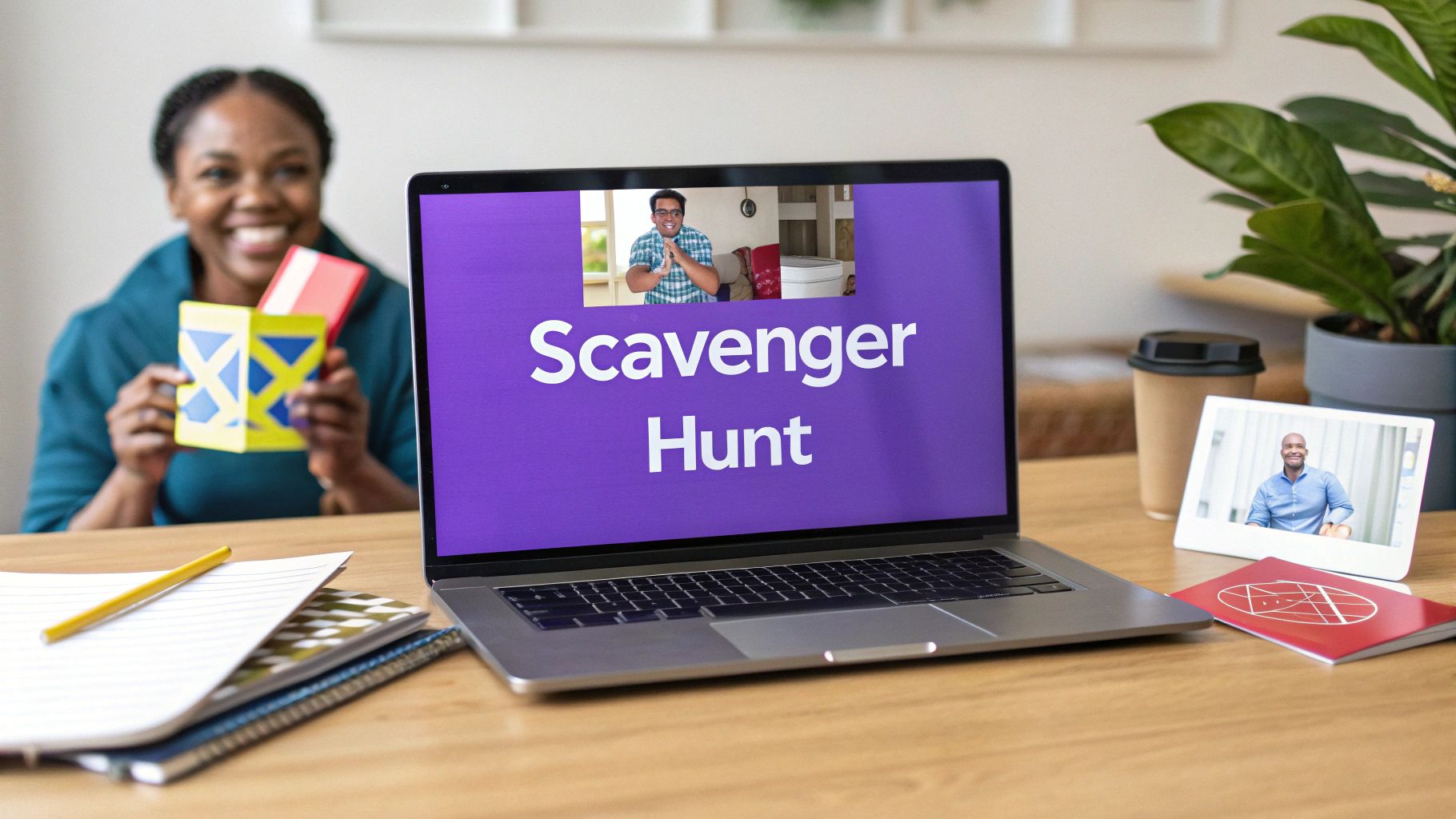
This game excels at breaking the monotony of back-to-back virtual meetings. Tech startups often use themed hunts, like "find something that represents our company value of 'innovation'," to reinforce culture during monthly all-hands meetings. Fortune 500 companies have also adopted this activity for remote onboarding, helping new hires feel connected and welcomed from day one.
How to Implement It
- Goal: To boost energy, encourage quick thinking, and foster lighthearted competition.
- Best For: Icebreakers, remote onboarding, or a fun break during long virtual workshops.
- Group Size: 4-50+ participants.
- Duration: 15-20 minutes.
- Materials: A video conferencing tool (Zoom, Teams) and a list of items or challenges.
Facilitator Tip: Create inclusive prompts that focus on concepts rather than specific possessions. For example, instead of "find a souvenir from Paris," ask for "find something that reminds you of a great trip." This ensures everyone can participate equally, regardless of their personal belongings or living situation. For more creative and inclusive challenge ideas, use a brainstorming tool like Bulby to generate a list with your team beforehand.
2. Online Trivia and Quiz Competitions
Online Trivia and Quiz Competitions are team-based contests held over video calls, where employees answer questions in real-time across various topics. Participants can compete individually or in groups, with questions ranging from pop culture and general knowledge to company-specific facts. These digital showdowns leverage interactive platforms with live scoring and leaderboards, transforming a simple Q&A into an exciting and competitive event. This format makes trivia one of the most popular games for teams at work, especially for connecting hybrid and remote colleagues.
This game is perfect for fostering friendly competition and reinforcing shared knowledge. Many tech companies host weekly trivia sessions covering industry news to keep skills sharp, while creative agencies use branded quizzes to reinforce company values and history during team-building events. Platforms like Kahoot! and Sporcle have become staples for corporate engagement, offering a structured yet fun way to boost morale.
How to Implement It
- Goal: To encourage teamwork, test knowledge, and spark friendly rivalry.
- Best For: Virtual team-building events, Friday afternoon socials, or department-wide competitions.
- Group Size: 5-100+ participants.
- Duration: 25-45 minutes.
- Materials: A video conferencing tool, a trivia platform (like Kahoot!), and a pre-made set of questions.
Facilitator Tip: Mix company-specific questions with general knowledge to keep everyone engaged. Instead of only asking about last quarter’s sales figures, include a round on "Guess the Movie from the Emoji." For truly unique rounds, use a brainstorming tool like Bulby with your team to generate original questions and themes that reflect your specific group’s inside jokes and interests. This personal touch makes the game more memorable and inclusive.
3. Breakout Room Games and Puzzle Challenges
Breakout Room Games and Puzzle Challenges use video conferencing features to divide a large group into smaller teams, each tasked with solving a collaborative problem. Teams work together against a timer to tackle riddles, logic puzzles, or virtual escape room scenarios, promoting focused communication and critical thinking. This method transforms a standard video call into an interactive arena, making it one of the most effective games for teams at work to build problem-solving skills remotely.
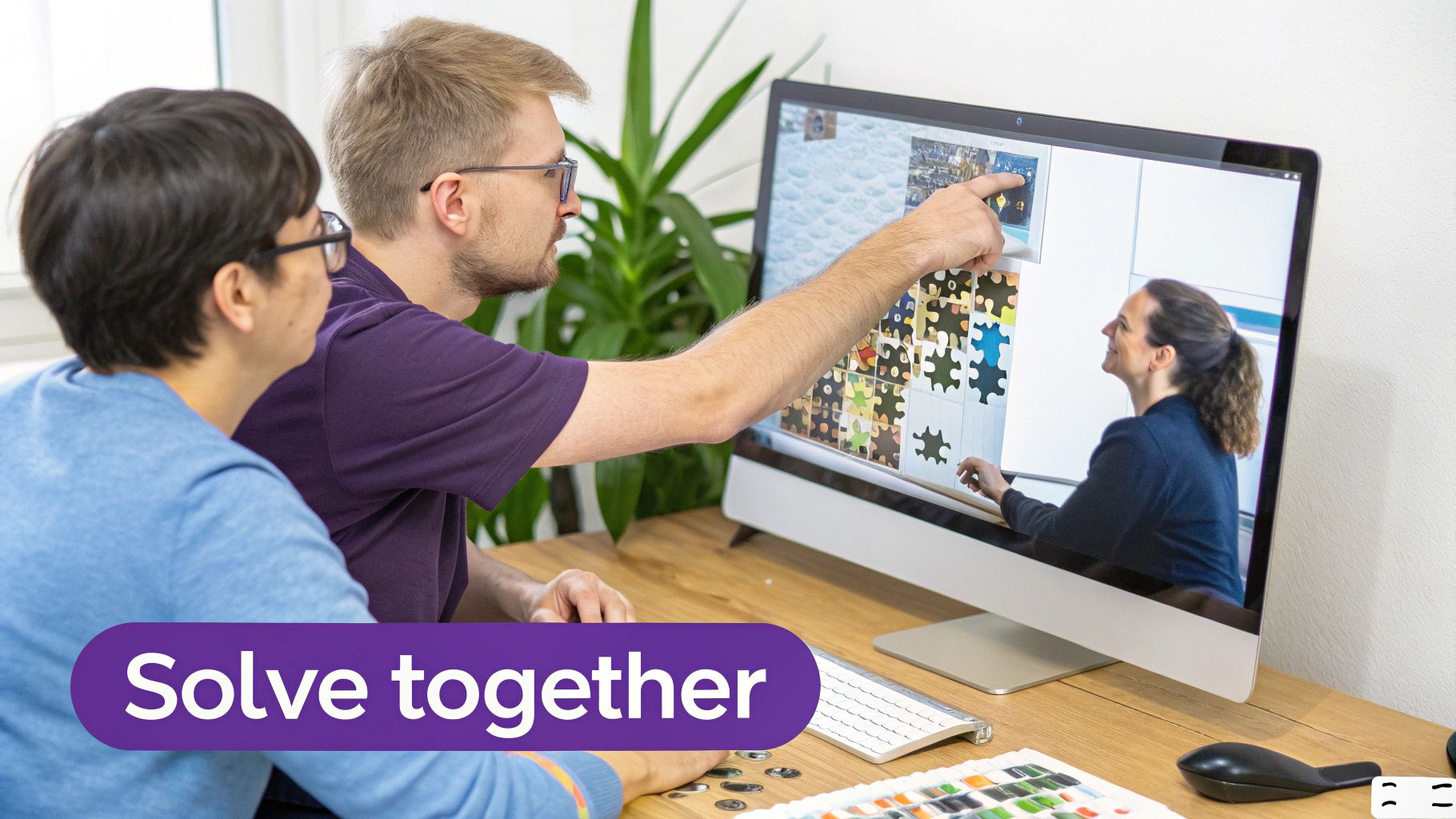
This activity excels at fostering deep collaboration in a short amount of time. Tech startups often use 10-minute puzzle challenges as a daily warm-up to get teams mentally engaged. Remote-first companies have adapted complex escape room concepts for their breakout rooms, using them for quarterly team-building events to strengthen bonds between colleagues who rarely meet in person. The contained, focused environment of a breakout room encourages every member to contribute.
How to Implement It
- Goal: To enhance collaborative problem-solving, communication, and critical thinking.
- Best For: Virtual team-building events, workshop warm-ups, or remote training sessions.
- Group Size: 8-100 participants (in small breakout groups of 3-5).
- Duration: 20-45 minutes.
- Materials: A video conferencing tool with breakout rooms (Zoom, Teams) and a pre-prepared set of puzzles or challenges.
Facilitator Tip: Ensure the puzzles are challenging but solvable within the given time. Vary the types of challenges (logic, visual, riddles) to cater to different thinking styles. Use a tool like Bulby to design structured puzzle challenges that can even be themed around your team’s real-world business problems, turning a fun game into a practical training exercise. Announce time checks and offer hints to keep the energy high and prevent frustration.
4. Two Truths and a Lie (Virtual Version)
Two Truths and a Lie is a classic icebreaker perfectly adapted for the virtual workspace. Each person shares three "facts" about themselves: two that are true and one that is a believable lie. Team members then guess which statement is the lie. This activity encourages personal storytelling and helps colleagues discover surprising and interesting things about each other, fostering deeper connections despite physical distance. It stands out as one of the simplest yet most effective games for teams at work to build rapport.
This game is a staple for remote agencies during new client kickoffs to humanize introductions and for distributed teams who play asynchronously in a dedicated Slack channel over a week. Tech startups also use themed rounds, like "Two work achievements and a lie," during all-hands meetings to celebrate wins in a fun, interactive way. The game's strength lies in its ability to spark genuine curiosity and follow-up conversations.
How to Implement It
- Goal: To build personal connections, encourage authentic sharing, and spark curiosity.
- Best For: Team introductions, icebreakers for virtual meetings, or asynchronous team bonding.
- Group Size: 3-20 participants.
- Duration: 10-25 minutes, depending on group size.
- Materials: A video conferencing platform or a chat tool like Slack or Teams.
Facilitator Tip: Encourage psychological safety by having a leader go first with a lighthearted and authentic example. Create themed rounds (e.g., travel, hobbies, or career firsts) to keep the game fresh. For more ideas on what to share, explore some group meeting ice breaker questions to inspire creative and engaging statements. Using a tool like Bulby to pre-collect statements can also streamline the process for larger groups.
5. Online Multiplayer Gaming Sessions
Online Multiplayer Gaming Sessions involve organized, casual gameplay using accessible, easy-to-learn titles like Among Us, Skribbl.io, or Mario Kart. Teams connect during scheduled breaks or after hours, turning a popular recreational activity into a powerful team-building exercise. This approach leverages modern gaming platforms that make it simple for anyone to join, spectate, and participate, regardless of their technical expertise or prior gaming experience. It's one of the most immersive games for teams at work for fostering informal connections.
This method shines at building camaraderie through shared, low-stakes fun. Companies like Google and Meta are known for hosting regular gaming tournaments to connect remote employees, while indie game studios use social deduction games like Among Us to strengthen communication and problem-solving skills. Creative agencies also use drawing games like Skribbl.io as a warm-up before brainstorming sessions to get the creative juices flowing.
How to Implement It
- Goal: To build informal relationships, encourage strategic thinking, and offer a fun, voluntary social outlet.
- Best For: Remote team social events, after-hours bonding, or as a reward for hitting a major milestone.
- Group Size: 3-20 participants.
- Duration: 30-45 minutes.
- Materials: A video conferencing tool for communication and access to a chosen multiplayer game (e.g., Skribbl.io, Among Us, Jackbox Games).
Facilitator Tip: Emphasize fun over winning to keep the atmosphere light and inclusive. Start with games that have a very low learning curve and create rotating teams for each session. This maximizes interactions between different colleagues and prevents cliques from forming. To find more ideas for different game types that suit your team, you can find a comprehensive list of virtual team building activities on remotesparks.com.
6. Speed Networking and One-on-One Rotation Sessions
Speed Networking is a structured virtual activity where team members rotate through a series of quick, one-on-one conversations. Using breakout rooms or specialized tools, participants are paired for short intervals (3-5 minutes) to discuss specific prompts or simply get to know each other. This game is incredibly effective for breaking down silos in large organizations, helping colleagues from different departments build valuable connections they wouldn't normally make. It's a powerful and efficient way to foster cross-functional collaboration and strengthen community bonds.
This method is used by large distributed companies to simulate the "water cooler" conversations that remote teams miss. For example, some tech firms schedule bi-weekly sessions to connect engineers with marketing staff, sparking new ideas and improving project alignment. Creative agencies also use this format to ensure designers, writers, and strategists understand each other's perspectives before a big project kickoff, making it one of the most strategic games for teams at work.
How to Implement It
- Goal: To strengthen cross-functional relationships and build a more connected company culture.
- Best For: Large teams, company-wide virtual events, onboarding new cohorts, and pre-project team building.
- Group Size: 10-100+ participants.
- Duration: 20-45 minutes.
- Materials: A video conferencing tool with breakout rooms (like Zoom or Teams) and a list of conversation starters.
Facilitator Tip: Prepare a set of inclusive and thought-provoking conversation starters to guide the discussions. Avoid simple yes/no questions and instead prompt deeper sharing with questions like, "What's a skill you're proud of that isn't on your resume?" or "What's a recent project that you found particularly rewarding?" This ensures conversations are meaningful, even in a short time frame. Use a tool like Bulby to generate prompts that encourage diverse perspectives and psychological safety.
7. Show and Tell / Skill Share Sessions
A Show and Tell or Skill Share Session is a dedicated time for team members to present a personal project, hobby, or area of expertise to their colleagues. In a short 5-10 minute presentation, participants can share anything from a musical talent to a DIY home project, celebrating individual passions beyond their job descriptions. This activity is one of the most personal games for teams at work, building deeper connections by revealing the diverse and often hidden talents within a team.
This game builds a culture of appreciation and can uncover valuable skills relevant to work. Companies like Zapier use internal skill-sharing webinars to foster continuous learning and identify cross-functional expertise. Creative agencies also leverage these sessions to discover hidden talents, like an accountant with a knack for graphic design, who can then contribute to client projects in unexpected ways.
How to Implement It
- Goal: To celebrate individuality, build psychological safety, and uncover hidden team talents.
- Best For: Team-building events, weekly team check-ins, or as a way to onboard new members.
- Group Size: 3-30 participants (can be split into smaller groups if larger).
- Duration: 30-45 minutes (allocating 5-10 minutes per presenter).
- Materials: A video conferencing tool and a sign-up sheet or schedule.
Facilitator Tip: Emphasize that presentations should be low-pressure and that "imperfect" or beginner skills are welcome and celebrated. Create a rotating schedule to give everyone a chance to participate without feeling forced. Afterward, you can use a tool like Bulby to brainstorm how a newly discovered skill might be applied to a current work challenge, connecting personal passions with professional innovation.
8. Virtual Escape Rooms and Mystery Games
Virtual Escape Rooms are immersive online experiences where teams collaborate to solve puzzles, decode clues, and 'escape' a themed digital room within a set time. These games require clear communication, logical thinking, and effective task delegation, transforming a video call into a high-stakes collaborative mission. They are powerful games for teams at work because they mirror complex project challenges in a fun, controlled environment, strengthening problem-solving skills under pressure.
This type of game has been widely adopted in the corporate world for its ability to simulate real-world problem-solving. Tech giants like Microsoft and Amazon have used custom-built escape rooms for department-wide team-building events, while creative agencies leverage branded mysteries for unique client engagement experiences. The structured challenge provides an excellent platform for observing and improving team dynamics.
How to Implement It
- Goal: To enhance collaborative problem-solving, communication, and strategic thinking.
- Best For: Team-building events, project kick-offs, or a fun quarterly activity.
- Group Size: 4-10 participants per room.
- Duration: 60-90 minutes.
- Materials: A video conferencing tool and a subscription to a virtual escape room platform (like The Escape Game or custom-built solutions).
Facilitator Tip: Assign specific roles before the game starts, such as a "Timekeeper" to track progress, a "Note-Taker" to organize clues, and a "Communicator" to ensure all voices are heard. After the game, hold a debrief session to discuss what strategies worked well and how those collaboration skills can be applied to upcoming work projects. You can find more structured team problem-solving activities to complement this experience.
9. Collaborative Digital Whiteboarding Challenges
Collaborative Digital Whiteboarding Challenges are real-time creative exercises where teams use platforms like Miro or FigJam to collectively draw, sketch, or design in response to a prompt. This activity turns a blank digital canvas into a shared playground for ideas, where participants might engage in quick drawing competitions, visual brainstorming, or mini design sprints. It's a fantastic way to unlock team creativity in a low-pressure, highly visual format, making it one of the most dynamic games for teams at work for hybrid and remote setups.

This game is perfect for warming up creative muscles before a major brainstorming or strategy session. Creative agencies often use FigJam for quick, collaborative sketching as a precursor to project kickoffs, while tech companies like Google have used Mural for internal innovation workshops. The resulting visual artifacts celebrate the team’s collective imagination and can serve as a fun, visual record of the session. For more ideas, you can explore other interactive whiteboard games.
How to Implement It
- Goal: To stimulate creativity, encourage visual thinking, and build collaborative energy.
- Best For: Creative warm-ups, brainstorming kickstarters, or a fun team-building activity.
- Group Size: 3-25 participants.
- Duration: 10-15 minutes.
- Materials: A digital whiteboarding tool (Miro, FigJam, Mural) and a list of creative prompts.
Facilitator Tip: Keep prompts simple and open-ended, such as "draw your mood today" or "visualize our team's superpower." Set a short timer (5-10 minutes) and play upbeat music to encourage spontaneity over perfection. Remember to celebrate all contributions equally to maintain a judgment-free atmosphere. The visual outputs can be saved and used as inspiration for deeper ideation sessions within a tool like Bulby.
10. Asynchronous Challenge Boards and Gamified Competitions
Asynchronous Challenge Boards are persistent digital spaces where team members post responses to ongoing prompts or competitions over several days or weeks. Using tools like Slack channels or dedicated platforms, these challenges can range from photo contests and caption competitions to creative problem-solving tasks. This format makes participation inclusive across different time zones and work schedules, while gamification elements like points and leaderboards keep engagement high. It stands out among games for teams at work because it fosters connection without requiring everyone to be online simultaneously.
This game is perfect for sustaining team culture and creative energy over the long term. Remote-first companies often use these boards for friendly competitions like "Meme of the Week" to maintain camaraderie. Creative agencies might set up design challenges to spark inspiration between projects. The key is its low-pressure, ongoing nature, which allows team members to contribute when they feel most creative. To see more ways this can benefit your team, learn more about asynchronous collaboration.
How to Implement It
- Goal: To sustain team engagement, encourage creativity, and build culture over time.
- Best For: Fully remote or globally distributed teams, and ongoing team-building initiatives.
- Group Size: 5-100+ participants.
- Duration: Ongoing (e.g., weekly or bi-weekly challenges).
- Materials: A shared digital space (Slack, Trello, Airtable) and a plan for challenges.
Facilitator Tip: Consistency is crucial for building momentum. Launch challenges on a regular schedule and use clear visual branding so team members instantly recognize them. Effective platforms for managing async updates are key to keeping participation smooth. Celebrate top submissions in a team-wide channel or meeting to give recognition and encourage future involvement.
Top 10 Workplace Team Games Comparison
| Activity | Implementation Complexity 🔄 | Resource & Tech Requirements ⚡ | Expected Outcomes 📊 | Ideal Use Cases 💡 | Key Advantages ⭐ |
|---|---|---|---|---|---|
| Virtual Scavenger Hunts | Low–Medium — simple setup; watch for time-zone coordination | ⚡ Low — video call, camera, shared submissions | 📊 High engagement; boosts creativity and rapport | Icebreakers, remote onboarding, large distributed teams | ⭐⭐⭐ Highly engaging, scalable, low cost |
| Online Trivia & Quiz Competitions | Low — straightforward facilitation; depends on question quality | ⚡ Minimal — quiz platform or slides, internet | 📊 Encourages friendly competition and learning | Weekly engagement, warm-ups, reinforcement of company knowledge | ⭐⭐ Educational, inclusive, live scoring |
| Breakout Room Games & Puzzle Challenges | Medium — needs strong facilitation and puzzle design | ⚡ Moderate — conferencing with breakout support, prepared puzzles | 📊 Improves collaboration and problem-solving skills | Small-group collaboration, workshops, skills practice | ⭐⭐⭐ Fosters teamwork, involves quieter members |
| Two Truths and a Lie (Virtual) | Very Low — minimal setup and facilitation | ⚡ Minimal — video or chat only | 📊 Builds personal connection and psychological safety | Short icebreakers, asynchronous introductions, all-hands openers | ⭐⭐ Simple, low-pressure, reveals diversity |
| Online Multiplayer Gaming Sessions | Low–Medium — coordinate platforms and schedules | ⚡ Low–Moderate — personal devices, games, voice chat | 📊 Strengthens social bonds and reduces isolation | After-work socials, informal bonding, cross-team socials | ⭐⭐⭐ Authentic fun, strong camaraderie |
| Speed Networking & One‑on‑One Rotations | Medium — scheduling and timed rotations require planning | ⚡ Moderate — breakout automation or scheduling tools | 📊 Creates cross-functional relationships and serendipity | Large org networking, onboarding, cross-team introductions | ⭐⭐⭐ Equitable interactions; builds network breadth |
| Show & Tell / Skill Share Sessions | Low — scheduling and presenter coordination | ⚡ Low — video conferencing; optional recordings | 📊 Reveals skills, inspires cross-pollination of ideas | Talent discovery, continuous learning, culture building | ⭐⭐ Humanizes colleagues; creates content library |
| Virtual Escape Rooms & Mystery Games | High — vendor coordination, facilitator/gamemaster needed | ⚡ High — dedicated platform, stable internet, facilitator | 📊 Deep collaboration, trust-building, strategic thinking | Intensive team-building, leadership exercises, high-engagement events | ⭐⭐⭐ Highly memorable; clear success metrics |
| Collaborative Digital Whiteboarding Challenges | Low–Medium — needs templates and facilitation to avoid chaos | ⚡ Moderate — Miro/FigJam/Mural access and internet | 📊 Produces visual artifacts and sparks creative ideation | Visual brainstorming, ideation preludes, remote design sprints | ⭐⭐⭐ Lowers creative barriers; shareable outputs |
| Asynchronous Challenge Boards & Gamified Competitions | Medium — setup and sustained moderation required | ⚡ Moderate — Slack/Teams integrations or custom platform | 📊 Ongoing culture-building and inclusive participation | Long-term engagement, distributed teams, time-zone friendly activities | ⭐⭐ Persistent engagement; inclusive and flexible |
Integrating Play into Your Workflow for Lasting Impact
The activities we've explored, from Virtual Scavenger Hunts to Collaborative Digital Whiteboarding Challenges, offer more than just a brief break from the daily grind. They represent a strategic toolkit for building a more connected, creative, and resilient team. Choosing the right games for teams at work is the first step, but the real transformation happens when these moments of play are intentionally woven into your team's regular workflow.
Think of these games not as isolated events, but as powerful catalysts. A quick round of Two Truths and a Lie can do more to foster psychological safety before a sensitive retrospective than any formal preamble. A fast-paced Breakout Room Puzzle can prime your team’s problem-solving skills right before a critical brainstorming session, warming up the exact mental muscles needed for innovation.
Turning Play into Progress
The ultimate goal is to build a culture where play is a natural part of how you work. This doesn't mean your office needs to become a playground. Instead, it means recognizing that structured fun is a highly effective tool for achieving serious business outcomes.
- For Onboarding: Use Show and Tell sessions to help new hires introduce themselves authentically, sharing a piece of their personality beyond their job title.
- For Creativity: Kick off an ideation meeting with a Digital Whiteboarding Challenge to get creative juices flowing in a low-stakes environment.
- For Connection: Schedule a recurring Online Trivia competition to bridge communication gaps between departments in a hybrid or remote setting.
By thoughtfully applying these games for teams at work, you move beyond simple team-building and start actively designing a more engaged and collaborative team environment. The key is consistency. Start small by committing to one activity this month. Observe the immediate effect on your team's energy and communication, gather feedback, and gradually build a library of go-to games that resonate with your unique team culture.
From Camaraderie to Concrete Innovation
The energy and camaraderie built through these activities create the perfect foundation for structured, high-impact innovation. When a team feels connected and psychologically safe, they are far more willing to share bold ideas and challenge the status quo. This is where the playful spirit you've cultivated can be channeled into tangible results.
When you successfully integrate play, you create a team that is not only happier but also more adaptable and innovative. The trust built during a Virtual Escape Room translates directly into more effective collaboration on complex projects. The confidence gained from a successful Asynchronous Challenge fuels individual initiative. Ultimately, you are building a team that doesn't just work together; they thrive together, turning shared moments of fun into a powerful engine for collective success.
Ready to channel your team's newfound creative energy into breakthrough ideas? Bulby provides a structured, AI-powered platform to guide your team from playful warm-ups to focused, actionable innovation. Transform the positive momentum from your team games into tangible outcomes by visiting Bulby to see how our guided brainstorming processes can elevate your next big project.