
Another brainstorming session is often the wrong prescription for stalled innovation. If your team already has promising concepts but can't get anything tested, approved, or used, producing more ideas adds work without removing the obstacle.
Table of Contents
- Why More Ideas Rarely Clear the Jam
- Seven Bottlenecks and the First Move
- How to Trace a Stall to Its Root Cause
- Idea Generation That Keeps Real Options Open
- Collaboration That Surfaces Quiet Expertise
- What the Implementation Dip Looks Like
- Measure Whether the Bottleneck Actually Moved
- Fund One Fix and Start This Week
Why More Ideas Rarely Clear the Jam
Say a workshop ends with a wall of sticky notes, an enthusiastic sponsor, and several campaign concepts everyone wants to pursue. Weeks later, nothing has reached customers. The creatives keep polishing the deck because nobody has approved a production test, and the account lead keeps asking for fresher thinking.
The team doesn't necessarily have a creativity problem. It has an innovation bottleneck, the constraint currently setting the pace of the whole effort.
The road into ideation is wide, but the route into delivery crosses a one-lane bridge. That bridge might be budget, specialist skills, the technology stack, or permission to change a workflow. Sending more cars toward it only lengthens the queue.

Distinguish a limit from the limit
These terms help you diagnose the problem without turning every inconvenience into a crisis:
- Constraint: Any limit on the work, such as a fixed budget or unavailable specialist.
- Bottleneck: The constraint that currently determines how much useful work gets through.
- Complementary asset: The cash, skill, data, process, decision right, or incentive an idea needs to work inside a real organization.
A team can face several constraints without needing to tackle them all immediately. An imperfect presentation template isn't the bottleneck if an approved concept is waiting for customer data access. Improving the template won't bring the test any closer.
Hold one initiative in mind
The common wrong start is to request a better brainstorm when the blockage sits downstream. That can make the situation worse: reviewers must compare more proposals, teams spread their attention, and nobody finishes the proof needed for a decision.
Practical rule: Before adding ideas, identify what prevents the strongest existing idea from taking its next meaningful step.
Choose a live campaign, feature, or client pitch. Keep its next decision in mind as you use the diagnostic table, trace the root cause, and examine idea variety, team participation, and execution capacity. You're looking for a specific change that would release work, not a general explanation for why innovation is difficult.
Seven Bottlenecks and the First Move
| Bottleneck | Where it shows up | Root cause | First move |
|---|---|---|---|
| Capital and cash timing | Promising concepts never reach a prototype or pilot | Spending comes before certain revenue; suitable finance is unavailable | Fund a small de-risking test rather than an undifferentiated build |
| Skills and management capacity | Nobody can research, prototype, or redesign the work | Missing talent, management capability, or training | Name owners for discovery, prototyping, and process change |
| Technology-stack foundations | Launches slip after concept approval | Legacy systems, weak data, and integration debt | Check data, integration, and legacy fit before committing |
| Diffusion and adoption | A workable idea stays unused | The organization lacks the capabilities or willingness to absorb it | Give implementation its own workstream |
| Commercialization valley of death | Pilots die between proof and scale | Weak customer evidence, commercial skills, partnerships, compliance readiness, and business models | Tie funding to buyer, technical, pilot, compliance, and unit-economics milestones |
| Homogenized ideation | Many concepts use the same mechanism | Dominant voices or AI-assisted sessions establish a narrow frame | Gather independent human options before shared patterns take over |
| Decision rights and incentives | Good ideas wait for permission | Nobody owns approval or allows for a temporary performance dip | Assign a pilot owner with authority and a dip budget |
Mark the row that best matches your initiative before deciding what to do. This is a diagnostic tool, not a checklist of everything your organization should improve.
Read the stall literally
Capital timing matters because innovation requires spending before revenue is certain. Research, specialists, prototypes, testing, equipment, and market development all need funding. A large eventual budget doesn't help if the team can't pay for the evidence needed now.
Skills and management capacity means more than hiring someone creative. You may need a researcher who can distinguish enthusiasm from purchase intent, or an operations lead who can translate a prototype into a repeatable process.
Technology foundations deserve an early check. In 2025, 57% of organizations said innovation was often delayed by foundational problems in their technology stack, according to Kyndryl's 2025 Readiness Report. A clever concept still waits if nobody can connect its data or integrate it with legacy systems.
For software initiatives, Grail Computer Labs' guide to AI agents across software development provides useful context for examining the delivery lifecycle rather than treating code generation as the whole job.
Choose the next release point
Adoption needs an implementation workstream, not another idea session. Commercialization needs coordinated proof that customers, partners, and approvers can evaluate. A regulated or safety-critical concept can be technically ready yet remain blocked by evidence and compliance, which belongs in the commercialization row.
For homogenized ideation, inspect differences in audiences, mechanisms, and assumptions instead of celebrating volume. For decision rights, name the person who can authorize a bounded pilot, not merely endorse the ambition.
If several rows look right, choose the one whose removal would let work move this month. Don't select the most fashionable problem or the department easiest to blame.
How to Trace a Stall to Its Root Cause
Start with observable work rather than a label such as poor innovation culture. A useful diagnosis should tell someone what evidence to gather and what decision that evidence will support.
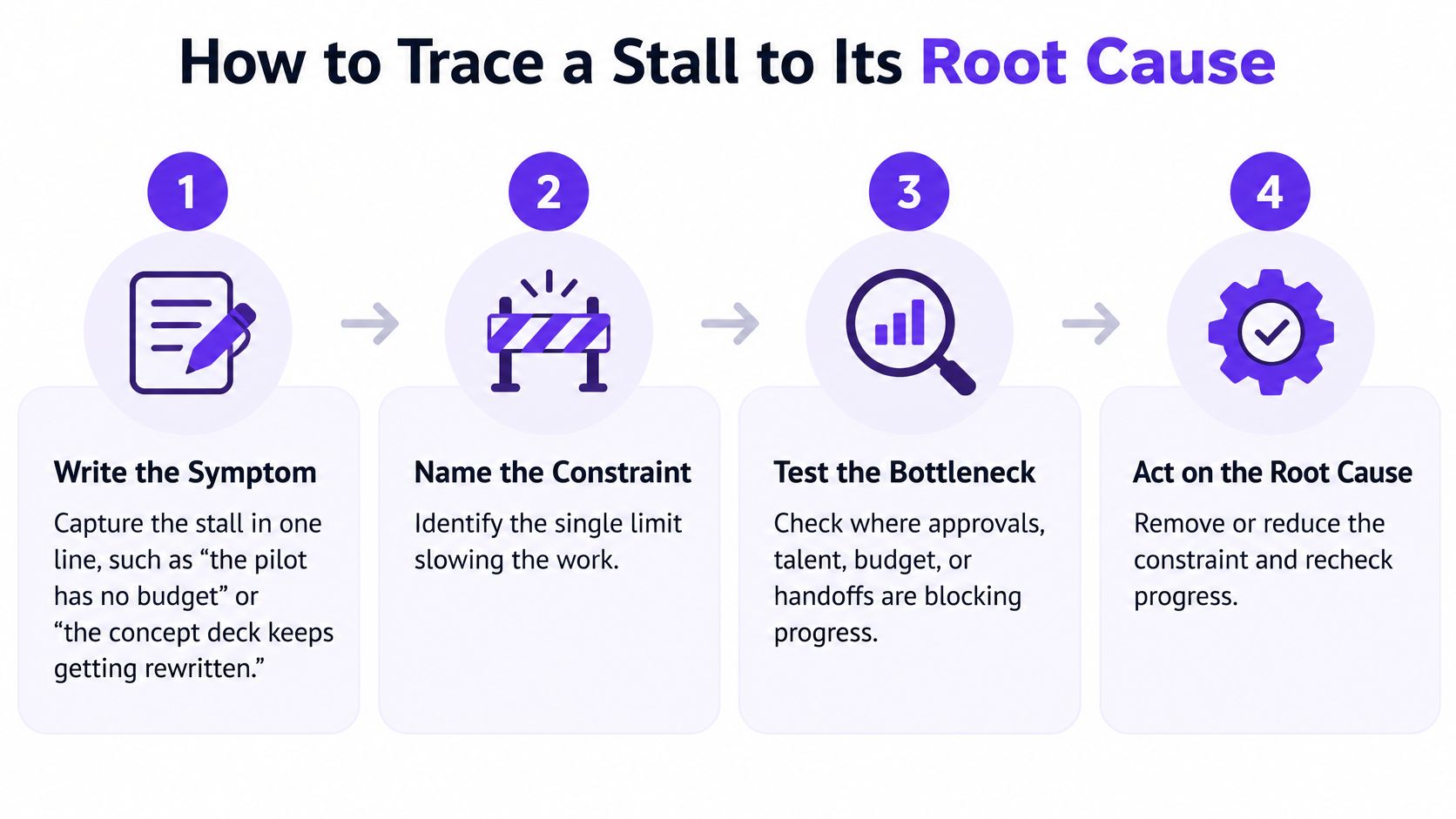
Use this visual as a compact reminder of the tracing routine.
Trace the missing condition
- Write the symptom. State something observable: the pilot has no budget, or the concept deck keeps getting rewritten. Avoid explanations until you've recorded what stops.
- Name the next-stage requirement. Ask what must be true before work can proceed. List the missing buyer evidence, technical test, compliance assessment, unit economics, or workflow owner.
- Separate rejection from inability. Does the decision-maker doubt the idea, or does the organization lack the data, skills, collateral, or authority to support it? Those problems require different responses.
- Follow the money complaint further. Ask why funding is unavailable and which missing proof would change that answer.
The last step deserves care. Weak customer evidence can raise perceived market risk; higher risk can restrict finance; missing finance can block prototypes, testing, certification, and production preparation. Without those proofs, buyers and backers remain unconvinced.
The commercialization discussion in the Journal of the Knowledge Economy describes interacting barriers of this kind. Treat the problem as a coordination failure, not an empty account: customer discovery, technical validation, compliance, and commercial partnerships need aligned owners.
Test the explanation
- Check whether financing conditions fit your firm. Across EU and OECD business surveys, 80% of firms with 10–49 employees reported lack of credit or private equity as a factor hampering innovation, according to the OECD's financing analysis. Limited collateral, information gaps, and lender transaction costs can make a promising proposal difficult to fund.
- Write a falsifiable diagnosis. Complete this sentence: This is stuck because ____, which we will accept as true if ____.
For example, test whether a buyer commitment would release prototype funding before commissioning another full concept deck. Funding a long research-and-development block without explicit evidence milestones can repeat the same financing loop.
Use process flow mapping to make waiting points and approval handoffs visible. Mark the person responsible for each transition, including transitions nobody currently owns.
For a supplementary visual walkthrough, use the video below alongside your initiative map.
Idea Generation That Keeps Real Options Open
Idea count is a weak measure of a successful session. A team can generate a polished collection while exploring only a narrow slice of the problem.
A 2025 meta-analysis of 28 experiments involving 8,214 participants, described in California Management Review's evidence review, found modestly higher novelty among people working with generative AI, alongside dramatic declines in idea diversity. Humans and models tended to converge on statistically likely answers.
That distinction matters in crowded categories. An agency doesn't gain much strategic choice from a collection of campaign lines that all target the same buyer through the same channel.
Inspect the portfolio, not just its best idea
Individual quality and collective variety aren't interchangeable. A strong-looking concept can improve the average quality of a shortlist while leaving the team with fewer different ways to succeed.
Use this review grid after a session:
| Axis | Question to ask |
|---|---|
| Audience | Who benefits, buys, or changes behavior? |
| Mechanism | How does the concept produce its result? |
| Assumption | What must be true for it to work? |
| Constraint | Which brand, budget, regulatory, or operational limit does it respect? |
Look for meaningful spread across multiple axes, not wording changes. As a working rule, require differences across at least a pair of axes before treating concepts as separate strategic options.
Say a product team proposes email reminders, push notifications, and text messages to improve onboarding. Those use different channels but may share the same assumption: users forget. A guided setup service tests a different assumption, that users need help rather than reminders.
Better phrasing doesn't create a different strategic option.
Protect independent thinking before adding assistance
Start with a challenge expressed in a single sentence. Ask participants to write alone before anyone speaks or shares a model-generated draft, then reveal those independent notes.
Only after that should you ask AI to extend unusual directions, identify weaknesses, or propose alternatives to the dominant mechanism. Don't let its opening answer define what everyone considers plausible.
A practical guide to idea generation for business can help you choose exercises that suit the challenge. For a broader organizational comparison, Founder Connects' discussion of UAE startup innovation practices offers another perspective on making experimentation part of team routines.
Reject the shortlist if every concept would require the same team, channel, and buyer. Keep the strongest concept, but reopen exploration around an untested assumption before committing the entire portfolio.
Speed becomes useful after you've preserved meaningful choice. Faster convergence isn't progress when the team converges before examining alternatives.
Collaboration That Surfaces Quiet Expertise
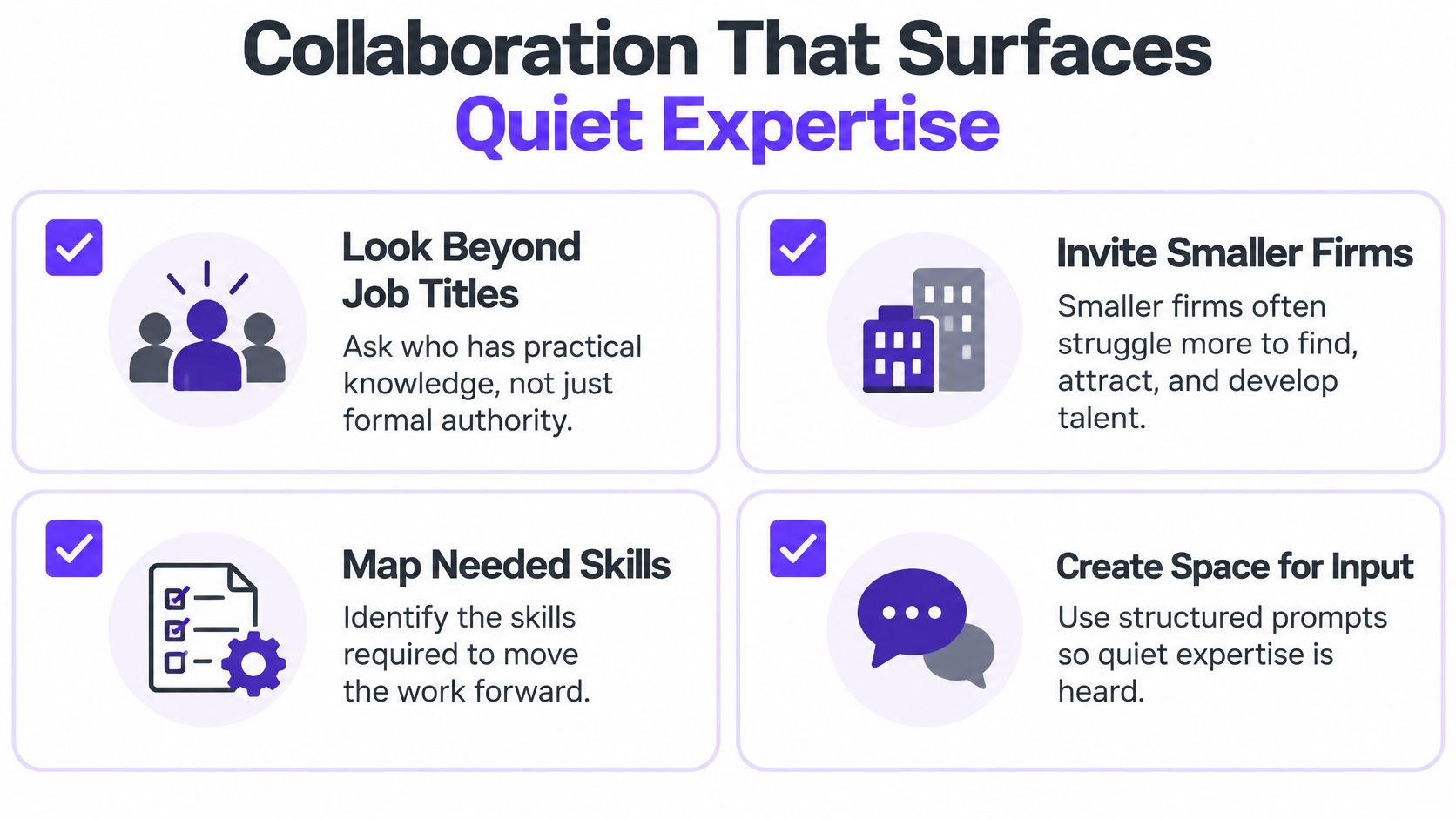
Some innovation bottlenecks begin with who can contribute, not what the group thinks of the ideas. The OECD SME and Entrepreneurship Outlook explains that smaller firms face greater difficulty identifying, attracting, and developing talent, while skills, management practices, and training affect their ability to innovate and absorb technology.
On a team, that gap can look deceptively ordinary. Everyone supports the concept, but nobody can interpret the customer evidence, manage the cross-functional handoff, build a rough prototype, or redesign the operating process.
Make expertise easier to contribute
- Write a self-contained challenge. Include the intended user, desired change, relevant constraints, and unresolved decision. A specialist who missed the kickoff should still be able to give useful input.
- Collect written responses first. Where status or client politics makes disagreement difficult, collect them without names. Anonymous input can keep an observation available for evaluation before colleagues react to its author's seniority.
- Invite the eventual operator. Include the person who will maintain the feature, deliver the campaign, or answer customer complaints after launch. They can identify practical requirements that a strategy-only group might miss.
These practices don't eliminate the need for discussion. They give participants something concrete to discuss and make it harder for the first confident speaker to define the whole problem.
Turn participation into delivery capacity
- Rotate facilitation. Don't require the same specialist to chair every conversation, answer every technical question, and approve every revision. Separate facilitation from subject expertise so that person can contribute without becoming another approval queue.
- Attach a skill requirement to each shortlisted idea. Mark it as present, borrowable, or missing. Borrowable means someone has agreed to contribute, not that their name appears in an organizational directory.
- Require a named contributor for the next proof. If the meeting ends with concepts but nobody responsible for producing evidence, pause selection and resolve the capability gap.
For remote and hybrid teams, silence isn't absence when participants have a genuine written round. Give people time to inspect the challenge and respond asynchronously; a verbal-only call can reproduce the same hierarchy as a conference room.
Use collaboration for innovation as a way to design participation around the work required, rather than around attendance. The output should include a person, a contribution, and the conditions that let them deliver it.
Better collaboration is a capacity fix, not a mood fix. A pleasant workshop still leaves the initiative stuck if no participant can perform the next essential task.
What the Implementation Dip Looks Like
A tool can work in a demonstration and still slow daily operations at first. Teams have to learn it, connect it, and change the surrounding work. Adoption behaves like renovating a kitchen while still cooking dinner in it: output dips before it improves, and the dip is part of the plan, not a sign the renovation failed.
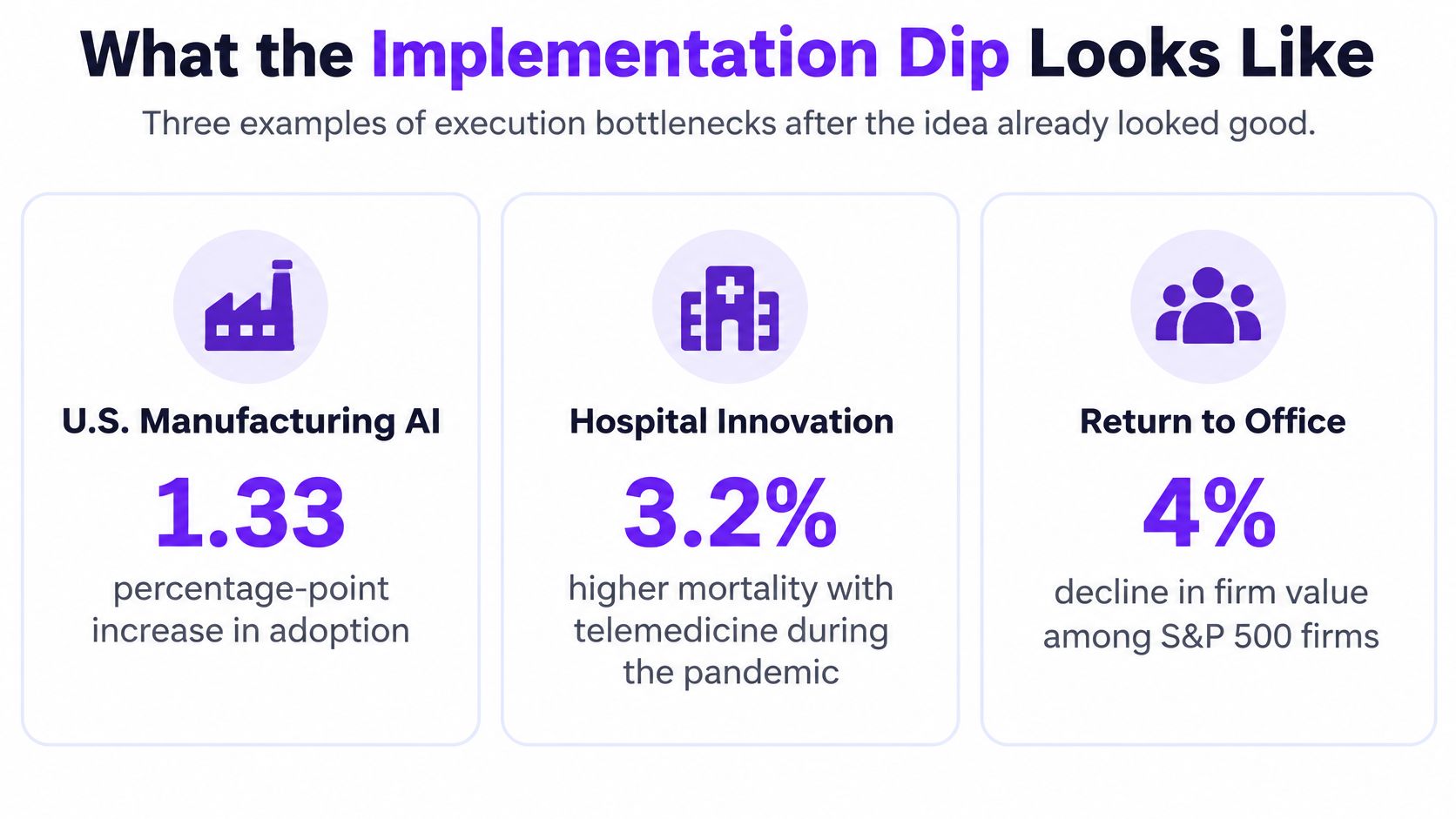
Research on U.S. manufacturing firms described by MIT Sloan found a 1.33-percentage-point short-run productivity decline associated with AI adoption. For planning purposes, treat the dip as real but bounded, and expect recovery to depend on the organizational work around the tool.
The explanation behind the decline wasn't employee resistance. Firms needed data infrastructure, training, workflow redesign, and integration with legacy processes. The missing budget lines were the organizational changes required to use the technology, rather than the technology purchase itself.
Recognize the execution gap
Two hypothetical cases show how the gap appears in practice.
A product team approves a feature because engineers confirm that it's technically feasible. During the pilot, nobody owns the revised process, employees have no scheduled training time, and managers still reward the old behavior. The feature sits unused; its budget should have included training hours, process redesign, and an accountable operator.
An agency leaves a pitch with several attractive campaign lines, all aimed at the same buyer through the same channel. In production, the team discovers that the client's systems can't deliver the proposed variation. The missing provisions were a diversity screen before production and integration time before launch commitments.
The graphic below illustrates execution-stage bottlenecks; the cases and the manufacturing finding above carry the evidence and planning detail.
Design a pilot that can absorb the change
Limit the experiment to a clearly bounded workflow. Before launch, record its current performance and agree on a time-to-adoption target, meaning when the intended users should be able to perform the work reliably.
Build an implementation ledger alongside the concept brief:
- Workflow changes: Document which tasks, approvals, and handoffs must change.
- Training burden: Reserve learning and supervised-practice time, not merely an introductory presentation.
- Integration dependencies: Name the systems, access permissions, and technical owners required.
- Realistic payback: Estimate value at expected usage, including support effort, rather than at demonstration-level performance.
The OECD's discussion of broadening and diffusing innovation treats adoption capabilities as distinct from invention. Technical feasibility alone doesn't establish organizational readiness.
Agree in advance how much disruption the pilot can tolerate and what would trigger a pause. A temporary drop counts as a measurement rather than an automatic failure when the team is completing the capability-building work and can show a credible recovery path.
Budget principle: Pay for learning, integration, and changed work alongside the concept itself.
A structured idea-to-implementation handoff keeps those commitments visible after the workshop ends. Removing an adoption constraint creates more value than adding concepts to a pipeline the organization cannot absorb.
Measure Whether the Bottleneck Actually Moved
Record a baseline before the fix starts, beside the root-cause sentence. Track signals connected to your chosen constraint rather than using workshop satisfaction as a substitute for progress.
- Time to next proof: Measure elapsed time from approval to the buyer test, technical check, or pilot start. Compare it with the previous initiative and note differences in scope.
- Contributors per stage: Count distinct people who wrote, reviewed, or built something. Check whether junior contributors remain involved when the team produces evidence.
- Option spread: Assess differences in audience, mechanism, assumption, and constraint. Record substantive differences, not cosmetic variations.
- Absorption: Track completed workflow changes, booked training, closed integration dependencies, and whether the pilot owner still controls the budget at midpoint.
Make the review decision explicit
Arch's guidance to measure product outcomes instead of activity is useful context for keeping reports focused on meaningful change. Combine that discipline with a consistent approach to measuring innovation, using the same definitions throughout the funded quarter.
Log temporary performance drops alongside implementation work completed. Don't excuse continuing deterioration merely because a pilot is new.
If time to next proof hasn't improved after a full test cycle, stop the pilot and reassess the diagnosis before extending funding. Put the signals on a single page so the next funding decision rests on observable progress rather than how energetic the workshop felt.
Fund One Fix and Start This Week
Fund the first move for the row you selected, not a company-wide transformation program. Give it a quarter, an accountable owner, and a milestone expressed as evidence.
The owner should control the relevant budget or have explicit delegated authority. A senior sponsor who can encourage everyone but approve nothing won't resolve a spending or permission bottleneck.
Write a bounded commitment
Use a short action list:
- The constraint: State what is preventing the next meaningful step.
- The funded move: Specify the buyer test, integration check, training block, or approval arrangement.
- The decision: Name what you'll continue, change, or stop when the evidence arrives.
Reject a plan that promises to fix ideas, culture, and the technology stack in the same month. That's a wish list, not an executable commitment.
If the blockage really is brainstorming, Bulby offers a structured path for generating and summarizing ideas. It doesn't replace an adoption budget or give the team authority to implement its output.
This week, book the smallest test that could prove or disprove your root-cause sentence. Put the owner and funding decision in the invitation so the result can lead directly to action.
Bulby combines structured brainwriting, anonymous contributions, and AI-powered inspiration to help teams develop and summarize ideas. If your bottleneck is getting beyond predictable thinking, visit Bulby and try its public demo without logging in, then pair your strongest direction with a funded next proof.