
An innovation diagnostic is a structured, repeatable assessment that measures an organization's capability to generate, develop, and deliver new ideas, not just its R&D spending or idea count.
Your team may already have a backlog full of concepts, a calendar full of workshops, and a leadership team asking why nothing reaches customers. The useful question isn't whether people are creative. It's where their work gets stuck, whose experience explains the blockage, and who has the authority and resources to remove it.
Table of Contents
- What an Innovation Diagnostic Is and Why Teams Use One
- Where Innovation Diagnostics Come From
- The Key Areas an Innovation Diagnostic Assesses
- How to Interpret Your Diagnostic Results
- Real-World Examples of Innovation Diagnostics in Action
- Choosing Tools and Turning Findings Into Action
- Your Innovation Diagnostic Takeaways and Next Step
What an Innovation Diagnostic Is and Why Teams Use One
The campaign workshop ends with enthusiastic agreement. Strategists have directions to explore, creatives have concepts to develop, and account managers promise to clarify the client's priorities. At the next review, everyone brings more ideas, but nobody brings a decision.
An innovation diagnostic helps you investigate that situation without assuming the team needs another brainstorm. You examine how people frame problems, access evidence, select ideas, and move work toward delivery. You also examine the conditions around those activities, including permission, ownership, and available time.

Activity isn't the same as capability
Think of a diagnostic as a health check rather than a count of gym visits. Attendance tells you that someone showed up. It doesn't tell you whether their training suits their needs or whether they can recover between sessions.
The same distinction applies to innovation:
- Activity describes what people do, such as conducting interviews, generating concepts, or testing prototypes.
- Capability describes whether people can do that work reliably, with suitable skills, access, and decision support.
- Outputs describe what they deliver, such as a revised service, campaign proposition, or working product improvement.
- Conditions describe what helps or prevents progress, including incentives, approval requirements, and protected time.
Suppose a product manager can organize discovery sessions but can't recruit relevant customers. The activity exists, but the supporting capability is incomplete. Asking that manager to schedule more sessions won't resolve the access problem.
Practical rule: Diagnose the point where work stops, not just the activity immediately before it.
Start with a decision you need to make
Keep the assessment focused on a practical question. An agency might ask why promising concepts fail client review. A product team might ask why experiments rarely influence roadmap decisions.
Then collect evidence that could change your explanation: recent briefs, research notes, approval histories, and accounts from the people doing the work. If people describe a fear of challenging senior stakeholders, an organizational culture assessment can complement the diagnostic.
The distinction matters because not every innovation problem calls for training. Sometimes the team needs stronger skills. Sometimes capable people need a clearer brief, access to customers, or permission to stop low-value work.
Where Innovation Diagnostics Come From
Research spending is an understandable starting point for measuring innovation. It's identifiable and can be compared with other financial inputs. But it's an incomplete way to understand how an agency develops a new positioning method or how a product team improves a customer journey.
The OECD has played a central role in developing the Oslo Manual, the international guidance used to define and measure business innovation. Its business innovation indicators cover activities and outcomes, including new or improved products and business processes, rather than treating research expenditure as the whole picture.
From spending measures to direct questions
A useful historical milestone came with the OECD's November 2023 data release. The organization reported stronger international comparability partly because more countries collected innovation information through dedicated surveys instead of asking firms primarily about R&D. Its database also supports analysis by enterprise size, industry, and R&D status, as described in the OECD's business innovation statistics and indicators.
The practical change is straightforward. Instead of inferring innovation from what organizations spend on research, assessors can ask what organizations attempt, introduce, and struggle to complete.
| A narrow question | A more useful diagnostic question |
|---|---|
| How much did we spend on research? | What evidence did teams need, and could they obtain it? |
| How many ideas did we generate? | Which ideas became testable propositions? |
| How many launches did we complete? | What prevented other worthwhile projects from progressing? |
| Do we have innovation tools? | Can people use those tools within their actual workflow? |
Why this matters outside a laboratory
For an agency, consider a proposed change to campaign development: strategists and creatives review customer evidence together before writing concepts. You wouldn't assess that change by looking for a patent. You'd examine whether the process was meaningfully improved, implemented, and useful.
That example also shows why a diagnostic needs boundaries. A new workshop format may be an interesting experiment, but announcing it doesn't establish that the organization has improved its innovation capability.
Use the broader measurement tradition as a design principle: examine capabilities, activities, outputs, and barriers together. Don't turn it into a claim that every new internal practice is automatically a successful innovation. The assessment should help you distinguish an intention, an attempt, an implemented change, and a valuable result.
The Key Areas an Innovation Diagnostic Assesses
A useful assessment separates different causes of poor performance. Otherwise, a team with unclear priorities can receive the same recommendation as a team with strong priorities but no delivery resources.
The OECD Capacity for Innovation Framework organizes diagnosis around purpose, potential, capacity, and impact. It emphasizes a context-specific approach that remains measurable, comparable, and repeatable, as outlined in the OECD's explanation of innovative capacity.
The Four Layers of an Innovation Diagnostic
| Layer | What It Measures | Example Signals |
|---|---|---|
| Purpose | Why innovation is pursued and how choices connect to objectives | A shared problem statement, explicit decision criteria, clear exclusions |
| Potential | Whether conditions encourage people to attempt change | Leadership sponsorship, protected time, incentives that support exploration |
| Capacity | Whether people have the resources and routines to execute | Customer access, relevant skills, experimentation tools, usable governance |
| Impact | How teams assess results and use them in later decisions | Adoption evidence, commercial or user value, documented learning |
Start with purpose by asking participants what the work is supposed to change. If an account lead wants a distinctive pitch while the strategist wants to validate a customer problem, both may be working hard toward different outcomes.
Potential requires a different question: can people realistically attempt the work? A sponsor who praises experimentation but assigns every available hour to delivery hasn't created usable space for it.
Look for evidence in ordinary work
Capacity becomes visible when someone needs help. Can the strategist retrieve relevant customer evidence? Can a designer involve engineering before committing to a concept? Does someone know who can authorize a test?
Impact requires looking beyond presentation approval. For a campaign proposition, that might mean documenting what audience testing changed. For a product improvement, it might mean checking whether intended users adopted it and whether the team used that evidence in its next decision.
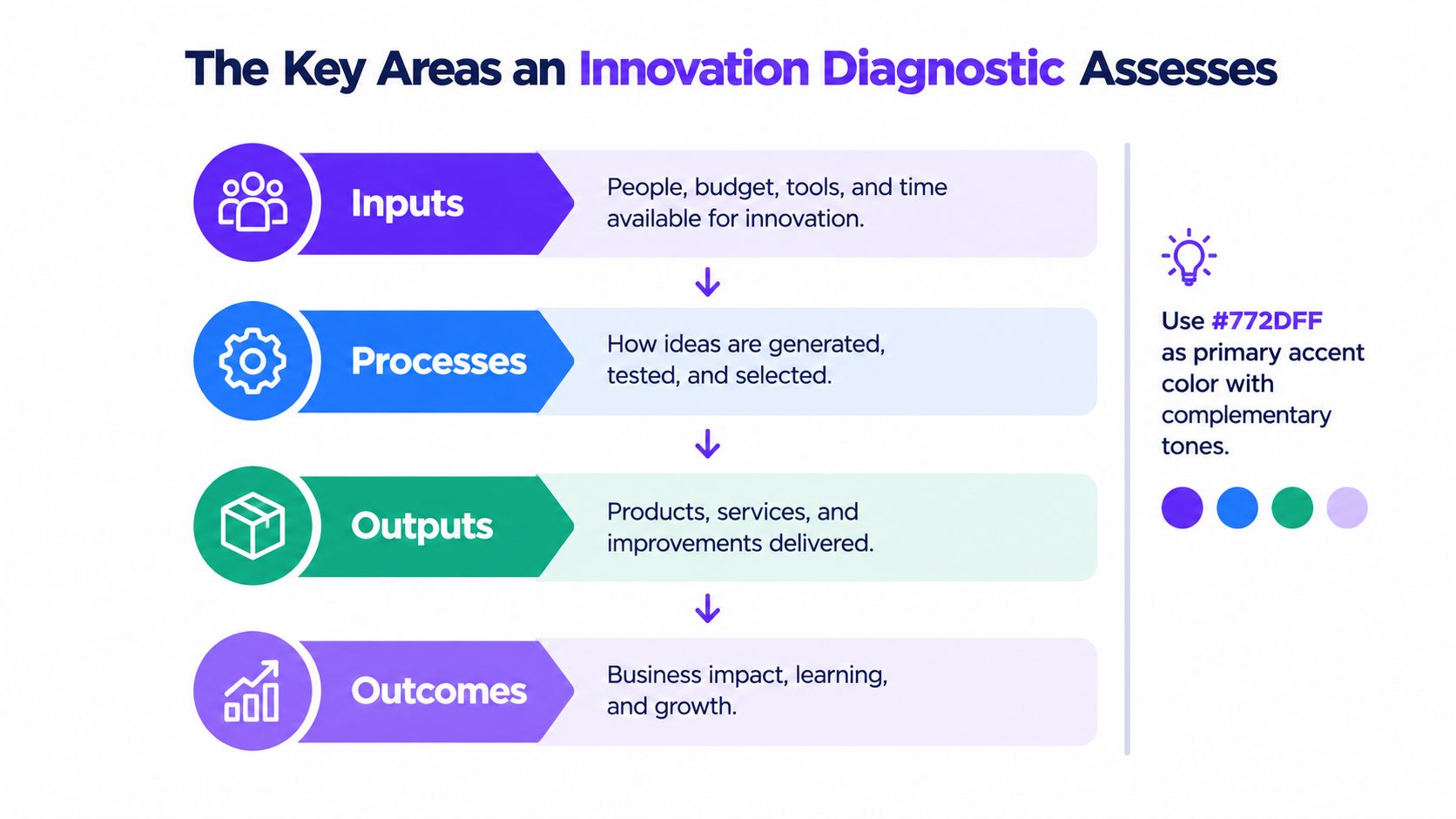
The following visual offers a complementary view of the delivery chain. Inputs, processes, outputs, and outcomes aren't substitutes for the OECD layers. They help you trace where evidence for those layers might appear.
Build your innovation survey questions around observable practices, then ask respondents for an example. Replace a broad confidence question with a request to describe the latest occasion when customer evidence changed an idea.
Keep the scoring rubric consistent, but interpret it against the team's work. An agency and a product team can both need strong research access without needing identical research methods. That balance preserves comparability without pretending their operating conditions are interchangeable.
How to Interpret Your Diagnostic Results
A positive average can conceal a difficult disagreement. Leaders may believe experimentation is encouraged while delivery staff believe that an unsuccessful test will damage their standing. Averaging those responses doesn't resolve the difference.
The first interpretation question should therefore be whose experience does this score represent? Separate responses by role, seniority, function, geography, and project stage where participation and confidentiality allow it. Don't publish identifiable subgroup results just to make a more detailed chart.
Read differences before rankings
Innovation-assessment reporting cited organizational silos among 42% of Status Quo organizations and 36% of Traditionalists, approximately twice the level among more advanced groups, while resource constraints were the leading barrier overall. The research on innovation assessment and stakeholder perspectives supports examining different perspectives rather than relying on a single confidence score.
Treat those categories as context, not as a ready-made benchmark for your agency. A published finding can suggest a question to investigate without establishing what your own team's score should be.
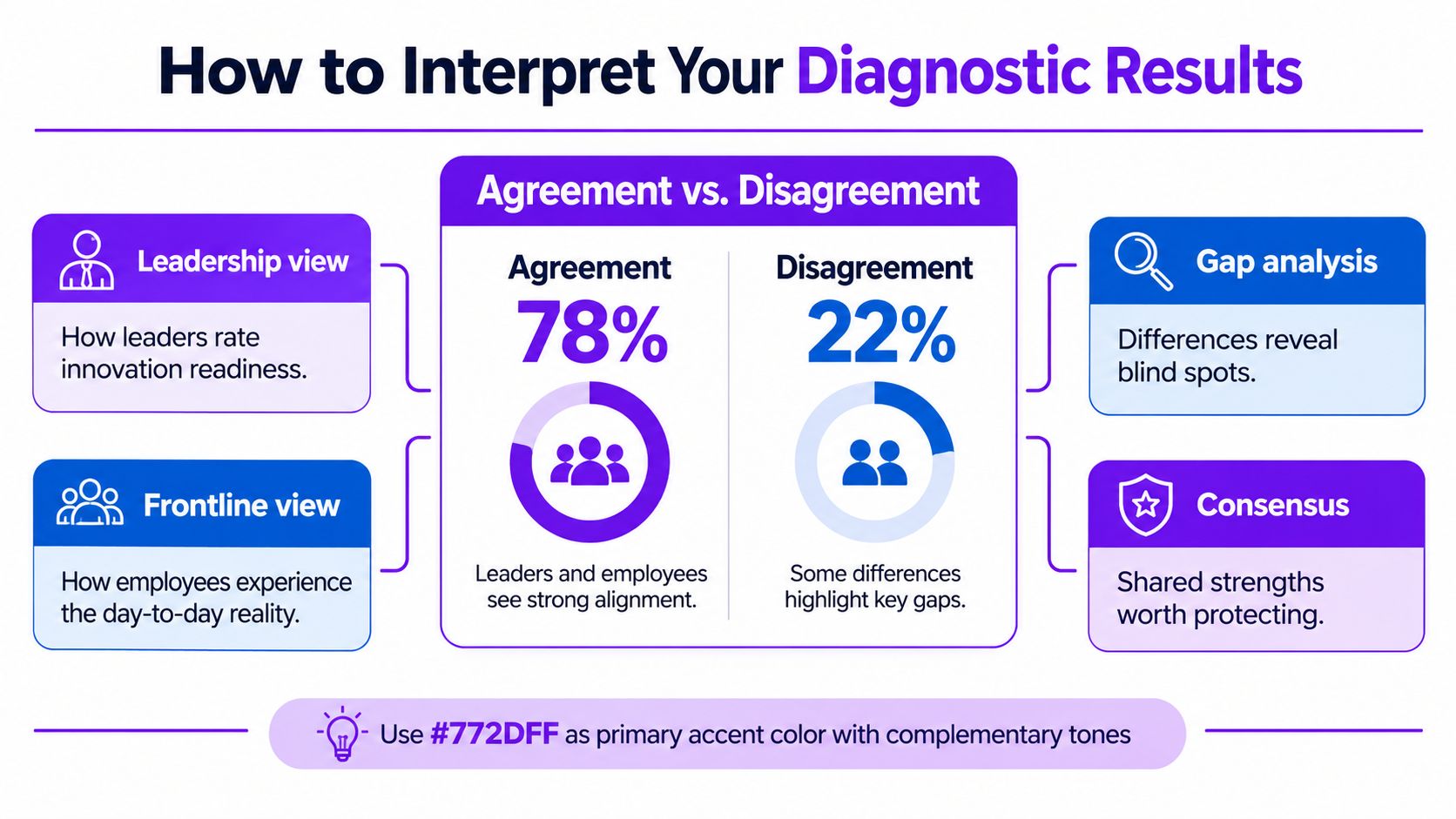
The illustration below shows the distinction between agreement and disagreement. Its displayed percentages are illustrative, not verified findings or benchmarks for your organization.
Use a reading protocol
- Find consequential gaps. Compare current practices with the target needed for the team's objective, rather than chasing an impressive overall rating.
- Find disagreement. Identify where sponsors, managers, and contributors describe different working conditions.
- Check the evidence. Compare responses with project records, actual resource commitments, and recent decisions.
- Test the explanation. Ask whether the problem is missing skill, missing permission, or missing resources before recommending a fix.
A lower score may indicate greater candor rather than weaker capability. Equally, agreement can reflect shared optimism rather than a dependable execution process.
Disagreement isn't something to smooth out before presenting the findings. It may be the finding that leaders most need to understand.
When deciding how to measure innovation, keep perception measures separate from observed behavior. If people say they have protected experimentation time, check whether that time survived the latest delivery deadline. The discrepancy gives you a specific conversation to have, not a reason to dismiss either perspective.
Real-World Examples of Innovation Diagnostics in Action
Two teams can earn identical diagnostic scores and need completely different interventions. The scenarios below are illustrative, not documented client case studies. They show how the same assessment leads to different decisions depending on where a team gets stuck, whose perspective the results reflect, and who ends up owning the fix.
An agency with concepts but no testable proposition
A creative agency's workshop records show varied concepts and broad participation. At first glance, ideation looks healthy. Then the team examines recent briefs and cannot identify the customer behavior each campaign was meant to change.
The diagnostic points toward problem-framing rather than idea generation. A sensible intervention would require the account lead and strategist to agree on the audience, available evidence, and intended change before the next creative session. Give that fix a named owner and a 30-day check on whether the new brief format is in use. Otherwise the finding sits in a slide deck.
The next assessment would examine whether the brief exists and whether teams use it to select concepts. Adopting a new template alone proves nothing.
A product team with tools but no direction
A product team has prototype software, analytics access, and an established testing routine. Members can run experiments, but each describes a different reason for doing so.
Adding another experimentation tool would miss the problem. The product lead should clarify the business objective and the customer uncertainty that matters, then require proposed tests to connect to that objective. A 90-day review can check whether experiment proposals now cite that objective before approval.
For practical examples of actionable insights, use this distinction: an observation describes what's happening, while an actionable finding identifies a decision someone can make. "Teams disagree about priorities" becomes useful when the product lead must resolve those priorities before approving further experiments.
| Scenario | Tempting response | Better response |
|---|---|---|
| Agency concepts stall | Run another brainstorm | Improve the brief and evidence requirements |
| Product experiments scatter | Buy more testing tools | Establish a shared objective and selection criteria |
Perspective matters at national scale, too. Eurostat has run the EU's Community Innovation Survey since 1993, with 1992 as the first reference year, and the survey remains the reference measure for enterprise innovation in Europe. In the most recent wave, 51.4% of EU enterprises reported innovation activity during 2020–2022, according to Eurostat's Community Innovation Survey indicators.
Earlier waves of the same survey show why comparison groups matter. During 2018–2020, Eurostat reported that 74% of large enterprises introduced an innovation, compared with 60% of medium-sized enterprises, and reported country figures ranged from 73% in Greece to 11% in Romania. Those numbers capture what enterprises report about themselves, across different sizes, countries, and periods. Comparing your team's score to a national average without matching those conditions works like comparing race times recorded on different courses.
The practical lesson: choose relevant comparison groups before deciding what a result means, and treat self-reported activity as one perspective rather than proof of capability. A diagnostic earns its keep when each finding has an owner, a budget line, and a review date within 180 days.
Choosing Tools and Turning Findings Into Action
The right assessment method depends on the decision in front of you. A diagnostic run to justify next year's budget needs different evidence than one run to find out why concepts stall before testing. Define the decision first; the tooling follows.
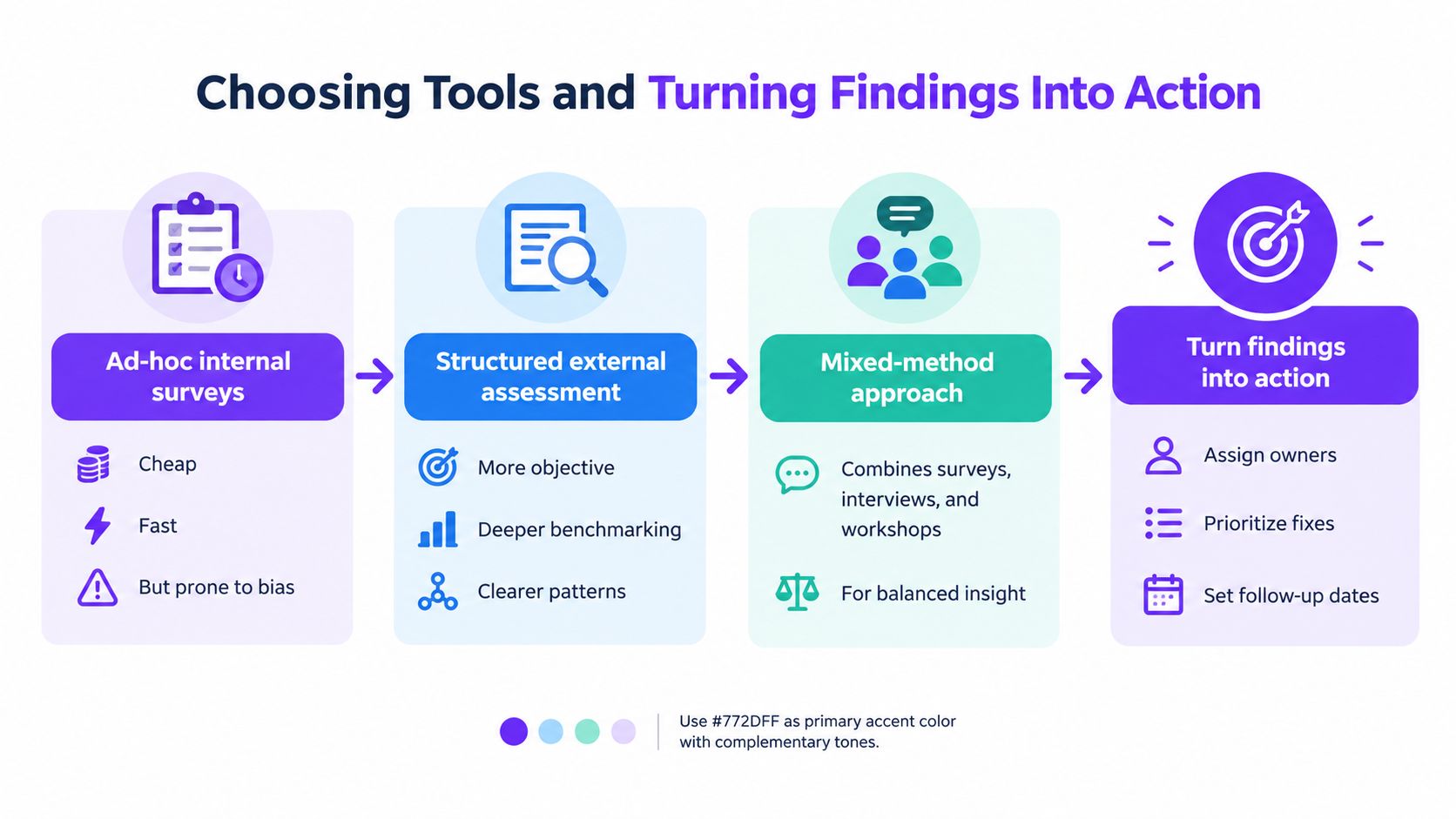
An internal survey is a low-cost starting point, but someone still has to design questions people can answer candidly and interpret responses that contradict each other. A consultant-led assessment adds independent challenge, though cost, timing, and sector fit need checking before you commit. A third route is structured sessions scored against an outside rubric: Bulby provides guided, AI-assisted brainstorming for collaborative idea work, and a facilitated session can double as evidence if you assess participation, problem-framing, and follow-through separately. Treat the session report as raw material. It shows how people worked together, not whether the organization is set up to repeat that performance.
| Approach | Useful when | Check before committing |
|---|---|---|
| Internal survey | You need an initial view of perceived barriers | Question quality, anonymity, repeatability |
| Consultant-led assessment | Independent facilitation or deeper investigation matters | Method, relevant experience, usable deliverables |
| Structured sessions with evidence review | You want to inspect how work happens | Scoring consistency and connection to delivery records |
Whichever route you pick, someone will ask what it costs. When the shortlist includes paid survey or workshop software, weigh pricing against the requirements you defined for the assessment rather than treating a pricing page as evidence of quality; a team scoping subscription options might explore ProdSnap subscription plans alongside other vendor quotes.
Turn each gap into a resourced decision
Before acting on any score, check whose perspective produced it. An OECD summary of reported innovation barriers_0.pdf) reflects that split: leadership respondents name structural constraints such as regulation and procurement capability, while staff respondents name time, budget, and culture. The same gap appears inside a single organization. A low score on "time to test ideas" means one thing if executives answered and another if the delivery team did, so read results by respondent group before assigning fixes.
From there, set a review rhythm the team can hold. Thirty, ninety, and one hundred eighty days works because it maps to how teams budget, staff projects, and renew commitments: near enough to keep attention, long enough to run a real experiment. Use each checkpoint as a decision point rather than a promised milestone.
- By day 30, confirm the priority gap with the people closest to the work, name an accountable owner, and get an explicit resource commitment. For weak client briefs, the account director might authorize strategist time and customer-research access.
- By day 90, run a bounded experiment and review what it produced. Trial the revised briefing process on a few live projects and record whether reviewers can assess concepts against agreed criteria.
- By day 180, adopt, revise, or stop the change, and confirm the team has capacity to sustain it. Practices worth keeping should be written into the wider innovation management process so they survive personnel changes.
Define the pass condition before the experiment starts. "Reviewers scored the concept against agreed criteria within one briefing cycle" is testable. "Briefs feel stronger" is not.
Funding test: If nobody can name what time, money, or competing work will be reassigned, the action isn't yet resourced.
Your Innovation Diagnostic Takeaways and Next Step
A useful diagnostic should change a management decision. If the assessment ends with a polished presentation but leaves priorities, permissions, and resource commitments untouched, the team has completed an assessment exercise rather than an improvement process.
The strongest output isn't necessarily a higher score. It may be a more precise explanation: the team can develop concepts, but client approval criteria arrive too late; or people can test ideas, but nobody has authority to act on the results.
Check the assessment before trusting it
Use this checklist when building a diagnostic or reviewing a proposed method:
- Does it measure more than R&D? Look for evidence about how people work, not just what the organization spends.
- Does it separate capability from output? A delivery record and the ability to repeat that delivery deserve different questions.
- Does it capture multiple perspectives? Check who participated, who couldn't participate, and whether anyone's responses were averaged out of view.
- Does it produce dimension-level gaps? You should be able to identify a specific practice that needs to change.
- Does it end in owned actions? Require a named decision-maker, committed resources, an observable outcome, and a review date.
Be cautious if the method promises certainty from self-report alone. Be equally cautious if it demands so much evidence that the team can't maintain it. A practical assessment needs enough rigor to support a decision and enough simplicity to repeat.
Start with a live piece of work
Run a structured session this week around an actual client brief, product uncertainty, or campaign challenge. Before the session, write down what evidence you'll collect against purpose, potential, capacity, and impact.
Afterward, compare the participants' views with what happened. Did the group agree on the problem? Could contributors access relevant evidence? Who could authorize the proposed next step?
Choose the most consequential gap and discuss it with the person who can remove it. Don't ask the whole team to improve everything at once. Ask for a concrete decision, record the resource commitment, and schedule the review before everyone returns to delivery work.
Bulby offers AI-guided, structured brainstorming exercises for teams developing campaign concepts, messaging, positioning, and creative strategies. Visit Bulby to run a collaborative session, then use the diagnostic questions above to identify a gap and agree on an owned next action.