
A product team has 400 ideas in a shared spreadsheet. Someone bolded the promising ones back in March. That person has since moved to another company, and nobody can tell which ideas were evaluated, who scored them, or what happened to the runner-up that the marketing lead wanted to test.
That spreadsheet isn't a failure of ambition. It's a failure of fit. Innovation management software covers at least four distinct jobs: running a guided brainstorm that produces better raw material, building a pipeline that carries ideas to a decision, running an enterprise program with campaigns and governance, and governing a portfolio of funded bets. Buy for the wrong job and you'll pay enterprise prices for a brainstorming canvas, or try to run a Thursday workshop in a tool that wants a program owner and a six-week rollout.
Most comparison lists rank tools by feature count. That tells you nothing about whether the thing fits your team this quarter. I'd rather sort by the work: who the tool suits, where it stops being useful, and what it costs you in process. If you want a broader lens on evaluating software in general, this productivity tool comparison guide covers the buying questions that apply to any category.
Table of Contents
- 1. Bulby for Guided Brainstorming
- 2. Ideanote for Idea Pipelines
- 3. Viima for Lightweight Idea Workflows
- 4. Brightidea for Enterprise Programs
- 5. Qmarkets for Program Governance and Foresight
- 6. HYPE Innovation for Strategic Innovation Systems
- 7. Wazoku for Open and External Innovation
- 8. IdeaScale for Crowdsourcing at Scale
- 9. ITONICS for Strategic Portfolio Work
- 10. Strategyzer Innovation Platform for Testing Business Ideas
- How the leading innovation management software options differ on best use, free options, and pricing visibility
- Matching the Tool to the Work Your Team Actually Does
1. Bulby for Guided Brainstorming
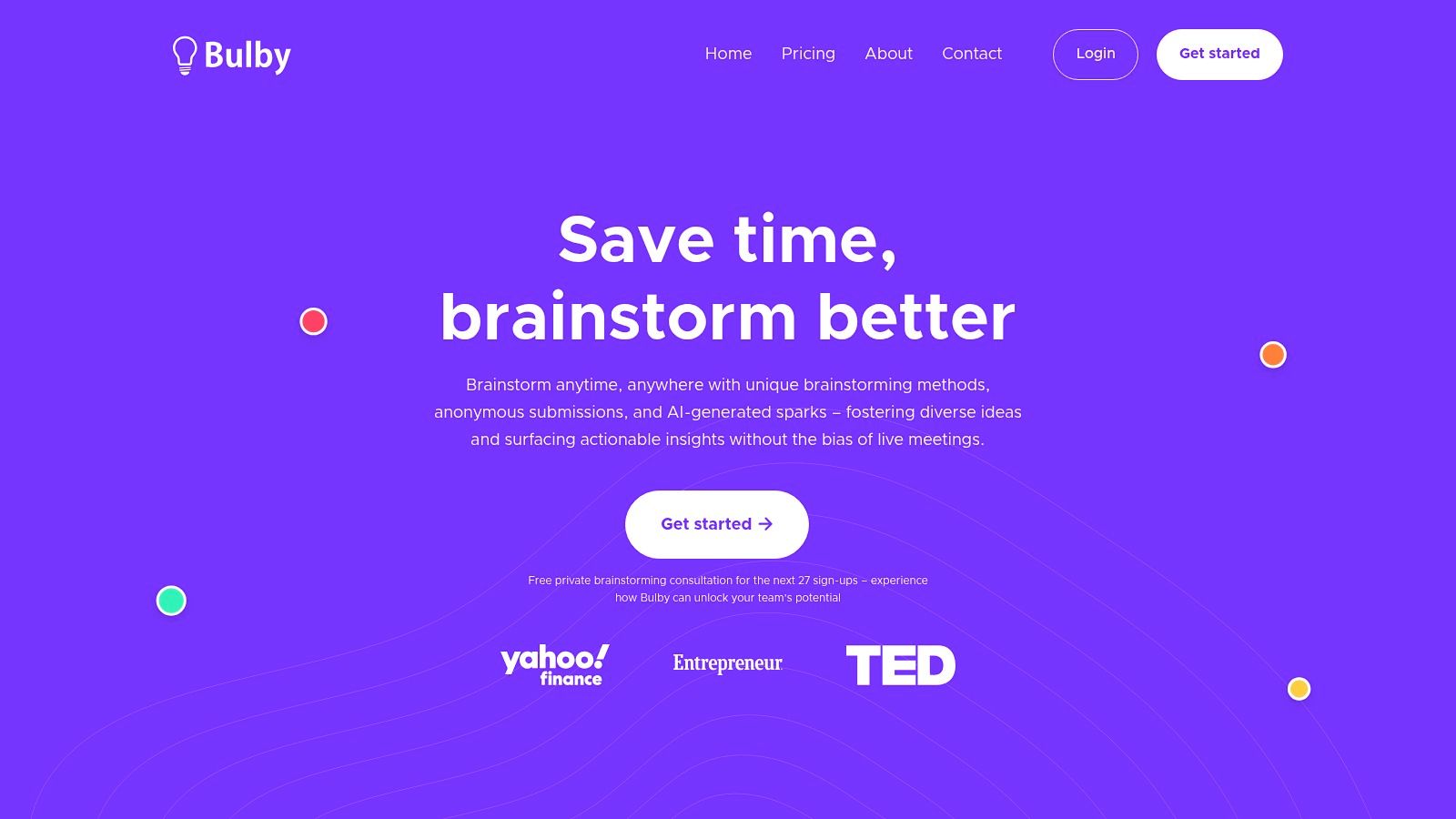
Teams do not lack ideas; they struggle with quality. The same safe concepts appear in every session because the first confident voice sets the direction and everyone else builds around it.
Bulby is built for that specific job. You enter a challenge, invite participants with one link, and each person receives a unique random exercise. Ideas are written and shared anonymously with AI-powered inspiration alongside, then the platform collects and summarizes everything into a report with suggested next steps. Six steps, from challenge to shareable output.
The anonymity carries most of the weight. Junior strategists submit the idea they'd normally self-censor, and account leads can't anchor the room on a client-safe direction before anyone has thought. The AI layer does the second job: it surfaces diverse and unexpected suggestions so the group moves past habitual patterns, and it turns a wall of raw notes into something a client can read.
Where it earns its fee: campaign concepts, messaging angles, positioning work, and pitch development, the front end of creative work where the cost of a predictable idea is highest.
Keeping AI-assisted sessions defensible
When ideas come partly from a model, keep provenance in the room. In an EY Europe West survey, 70% of organizations lacked well-defined AI governance models, according to EY's technology risk research. A one-line note per session, covering what tool was used, what inputs went in, and who reviewed the output, costs nothing and settles the ownership argument months later.
Pricing is published, which is rarer than it should be here. The Standard plan is $59 per month billed annually with up to 50 participants per session and 30 summary reports a year. Premium is $99 per month billed annually with up to 300 participants and 50 reports. Both include every brainstorming method and the AI Ideas Assistant, and there's a 14-day free trial plus custom plans for organizations with unusual needs.
The honest limit is scope. This is a session tool, not an idea pipeline. Once a concept leaves the workshop it needs somewhere to live, get scored, and get funded, so teams running a formal program pair it with a tracker rather than replacing one. Solo brainstorming works too, which helps when the pitch lands on a Friday.
2. Ideanote for Idea Pipelines
The second job is turning a pile of submissions into a decision. Ideanote handles that full run: collections for intake, team spaces for discussion, evaluation scoring, and impact measurement after the fact. Where it separates from lighter boards is automation, which moves ideas between stages without someone manually updating a tracker every Friday.
The category itself is still half-empty, which changes how you pitch an internal rollout. A 2021 study of 199 innovation managers in German firms found that 45% used innovation management software while 55% did not, and that adoption was positively associated with new-product-development efficiency, with idea-management functionality and ongoing update services ranking as important drivers, according to the peer-reviewed study published by Springer. Half your stakeholders have never used a system like this, so the first win is reducing coordination cost, not proving creativity.
What works. A free plan covers up to 10 users, and lower tiers publish pricing, so a pilot doesn't need a procurement cycle. Embeddable collection tools and custom-domain options matter more than they sound: an embedded form on a branded page gets client or customer participation that an internal portal never will.
Where it falls short. Free and lower tiers cap users, collections, and automation. SSO, SCIM, audit logs, and data-residency choices sit behind the enterprise tier, so regulated teams end up in a sales conversation anyway. And it structures ideas rather than generating them, so pair it with a session format. This guide to building an idea management system covers the process side.
3. Viima for Lightweight Idea Workflows
Not every team needs an innovation suite. Some need a place where a submitted idea goes somewhere instead of into a shared inbox. Viima's configurable boards collect, discuss, score, and advance ideas through a defined workflow, which makes it the lightest credible option in this category.
The board metaphor does real work. A bubble view lets a group cluster and compare at a glance, list view sorts for review, and Kanban shows what's moving. Similar-idea search catches the duplicate-submission problem that kills participation in a busy program. Jira and Microsoft Teams integrations on eligible plans mean an approved idea can become a ticket in the system your delivery team already uses.
What works. Public pricing and a free tier let you evaluate without a demo call. Board templates give a team a process on day one instead of a blank canvas and a debate about how to run the debate.
Where it falls short. Free and entry plans limit users, boards, or automation, so a growing program hits the ceiling fast. Advanced governance, deeper integrations, and better support sit on higher plans. And like everything in the workflow category, it organizes ideas rather than producing them. If the raw material is thin, a better board won't fix it. Run the exercises first, using these innovation management best practices as a starting structure, then move the output into the board.
4. Brightidea for Enterprise Programs
Brightidea is what a company buys when innovation becomes a program with a budget and a headcount attached. It covers idea challenges, idea boxes, hackathons, and innovation labs in one place, with configurable submission, review, and routing workflows and progress tracking from submission toward implementation and business impact.
Cloud delivery is the default in this bracket. Emergen Research's innovation management market analysis puts cloud-based deployment at roughly three-quarters of the global market. That share shapes procurement expectations: browser-based access, tenant isolation, role-based permissions for external participants, and auditability come as baseline requirements.
What works. One platform covers several types of innovation activity, so a hackathon and a year-round challenge program don't need two vendors. G2 reviewers describe useful customization and responsive support, and Gartner Peer Insights reports a 4.4/5 average across 38 reviews. For a program with a dedicated manager, that breadth saves real coordination time. It suits enterprises running multiple innovation formats under one budget owner.
Where it falls short. Pricing is quote-based, so you can't budget without a sales call. Multiple products and configuration options add administrative overhead, and some reviewers have raised concerns about price and reporting flexibility. If your actual need is collaborative ideation rather than a managed program, this guide to collaborative innovation software will help you separate the two.
5. Qmarkets for Program Governance and Foresight
The moment an innovation program has to answer to a CFO, the questions change from how many ideas were collected to which bets are funded and why. Qmarkets is built around that second set, with modular product families covering idea management, continuous improvement, foresight and trend monitoring, and portfolio views.
Modularity is the practical advantage. A team can start with challenges and workflows, add technology scoping later, and avoid paying for foresight modules nobody opens. Its AI features aim at pattern detection across programs, which is more useful than a chat box bolted onto a submission form.
The category is also moving beyond its traditional center. One estimate valued the global market at about USD 1.45 billion in 2024 with a compound annual growth rate of 6.0% projected through 2031, and forecast Asia-Pacific growth at 9.8% against 4.2% in North America over the same period, according to Cognitive Market Research. Programs are being stood up in more places, often without an inherited process to copy from a US headquarters.
What works. Structured challenges, configurable workflows, and evaluation match how a governed program operates, and teams with a dedicated program owner tend to get the most out of that structure. Foresight and trend monitoring sit in the same system as the idea pipeline, so signals picked up in scouting can feed new challenges instead of living in a separate slide deck.
Where it falls short. Pricing depends on products, users, integrations, and add-ons, so there is no number until you talk to sales. The wider suite is excessive for a small team that wants collaborative ideation, and configuration plus governance need a named owner or the program drifts into a public idea inbox.
6. HYPE Innovation for Strategic Innovation Systems
HYPE sells a system rather than a portal. Employee and stakeholder campaigns sit alongside visual boards for team-led innovation, phase-gate processes for structured projects, trend and technology management, portfolio reporting, and AI-supported tools layered across them.
That combination answers a specific complaint I hear from innovation leads: ideas get selected and then vanish. Phase-gate processes give an approved concept a route with checkpoints, and portfolio reporting shows whether the funded mix is shifting or just accumulating. The boards give teams a lighter path for work that doesn't need a gate review yet.
Buyers in this bracket are paying for a platform they intend to run for years, and the market reflects it. Software represented approximately 64.2% of the global innovation management market in 2024, while cloud deployment accounted for 60%, according to Market.us. That's a software purchase decision, not a consulting engagement, which is why implementation planning matters as much as the feature list.
What works. Ideation connects to projects and to strategic portfolio work in one system. Vendor documentation describes Microsoft integrations and deployment options that include on-premises, which matters in regulated industries.
Where it falls short. An enterprise focus means a sales conversation and implementation planning before you see value. Standard pricing isn't listed on the product page, so internal budget approval gets harder before you've compared anything. And the scope is more than a small team needs when the actual job is a better brainstorm on Thursday.
7. Wazoku for Open and External Innovation
Wazoku is aimed at organizations that treat innovation as a network activity, not an internal suggestion box. Challenge workflows handle gathering, assessing, and developing ideas, portfolio views track and prioritize initiatives, and collaboration extends to partners and external communities rather than stopping at employees.
The appetite for that is long established. A 2013 survey of 125 large companies in the United States and Europe, each with annual sales above USD 250 million, found that 78% practiced open innovation, 71% reported increasing top-management support, and 82% said they practiced it more intensively than three years earlier, according to UC Berkeley's corporate innovation research. Inbound activity outpaced outbound, with customer co-creation, informal networking, and university grants among the leading practices.
Opening the front door is easy. Deciding what to do with 900 external submissions is the hard part, and that's the workflow problem this category actually solves.
What works. Internal and external participation sit in one system, and portfolio-level visibility goes further than counting intake. AI-supported discovery and content surfacing help when submission volume outpaces reviewer attention.
Where it falls short. Buying is demo-led, and public standard pricing wasn't available in the material I reviewed. The scope is broad enough that a team running a single brainstorming process will spend more time configuring than creating, so match the commitment to the program you can staff.
8. IdeaScale for Crowdsourcing at Scale
IdeaScale is the option I'd point to for public-sector teams and large organizations running structured crowdsourcing, where an auditable process matters as much as a good idea. Campaigns collect submissions from a defined community, configurable evaluation stages move them through review, and reporting plus portfolio tracking show where each one landed.
The buyer base explains why these platforms look the way they do. Large enterprises accounted for more than 58% of innovation management software market revenue in 2024, according to Growth Market Reports. Products built for that segment optimize for governance, roles, and records, not for the feeling of a good workshop.
What works. The journey from a campaign submission to project planning stays inside one system. Workflows can be configured for different evaluation processes instead of forcing one path, official materials describe government and enterprise use cases, and Microsoft Teams and Slack integrations keep notifications where people already work.
Where it falls short. It's the wrong tool for an informal team brainstorm, and the setup reflects that. Pricing is sales-led rather than clearly listed, so budgeting takes longer than it should. Configuration and administration need a program owner. Without one, the campaign runs once, produces a report, and goes quiet.
9. ITONICS for Strategic Portfolio Work
Strategy teams have a different problem from product teams. They're deciding which technologies and markets deserve investment before there's an idea to collect. ITONICS connects trend and technology monitoring to idea collection, prioritization, and portfolio and roadmap management, so one system holds both the external signal and the internal bet.
That link is rarer than it sounds. Most tools start at submission, which means the strategy work that should set the evaluation criteria happens in slides somewhere else, and the two never reconcile.
Measurement is where these programs usually lose credibility with leadership. A 2025 survey by the Governance Institute of Australia found that 93% of respondents could not effectively measure AI return on investment, while 88% struggled to integrate generative AI with legacy systems. A portfolio view only helps if you decided in advance what evidence would count as progress.
What works. Foresight intelligence, ideation, and execution connect, and modular capabilities let a team add scope over time rather than buying the whole stack on day one. R&D, strategy, and innovation teams are the vendor's stated core users.
Where it falls short. Enterprise orientation means pricing and implementation details need a vendor conversation. The breadth is wasted on a team that only needs idea collaboration, so scope the modules before you evaluate the full platform. If measurement is your weak point, fix the method for how to measure innovation before buying the reporting layer.
10. Strategyzer Innovation Platform for Testing Business Ideas
Strategyzer attacks a different failure mode. Teams rarely run out of ideas. They commit to one before testing whether anyone wants it. The platform pairs project tracking with the Business Model Canvas and Value Proposition Canvas, plus guidance for experiments, customer discovery, and idea validation.
The frameworks are the spine of the product, and they earn their place because they force a written assumption. Filling in a value proposition canvas makes it obvious when a concept rests on a guess about customer behavior that nobody has checked.
What separates it: a submission portal records what someone hopes will happen. This records what you're going to test, and what happened when you did.
What works. It emphasizes evidence over enthusiasm and provides a repeatable structure for developing concepts, which suits product strategy and new-business-model work rather than an internal idea contest. Training and expert support options exist when a team needs the method taught rather than just the software.
Where it falls short. It isn't focused on enterprise-wide crowdsourcing or employee suggestion programs, so don't buy it to run a 2,000-person campaign. Expert support and corporate training may involve additional cost. Teams that want an open-ended visual canvas to think in will find it process-led. If you're still mapping the category, this overview of product innovation software helps separate strategy tools from collection tools.
How the leading innovation management software options differ on best use, free options, and pricing visibility
Sorted by job rather than feature count, the ten options show a clear split: brainstorming and pipeline tools publish prices, enterprise programs quote.
| Item | Best for | Free option | Pricing visibility |
|---|---|---|---|
| Bulby (Recommended) | Guided, AI-assisted team brainstorming | 14-day free trial, plus a no-login public demo | Standard $59/month, Premium $99/month, billed annually |
| Ideanote | Flexible idea collection and management | Free plan for up to 10 users | Lower-tier pricing published |
| Viima | Board-based idea workflows and follow-through | Free tier available | Pricing published |
| Brightidea | Organization-wide innovation programs and hackathons | None published; evaluation runs through sales | Quote-based; contact vendor |
| Qmarkets | Enterprise idea management and portfolio governance | None published; evaluation runs through sales | Quote-based; contact vendor |
| HYPE Innovation | Strategic innovation programs from ideation to execution | None published | Standard pricing not listed |
| Wazoku | Coordinating enterprise innovation across teams and communities | None published | Standard pricing not publicly available |
| IdeaScale | Structured crowdsourcing and auditable evaluation | None published | Sales-led; pricing not clearly listed |
| ITONICS | Connecting foresight, ideas, and innovation portfolios | None published | Contact vendor for pricing |
| Strategyzer Innovation Platform | Testing and developing business ideas | None published | Pricing not specified |
Matching the Tool to the Work Your Team Actually Does
The most common buying mistake isn't a bad product. It's a good product bought for a job the team doesn't have yet. An enterprise suite purchased to fix a boring brainstorm becomes shelfware in two quarters, and everyone concludes that software can't help with creativity.
Start with the job, not the feature comparison.
- Guided brainstorming: you need better raw material from a group, fast, and the output feeds a pitch, a campaign, or a product discovery session.
- Idea pipeline: submissions exist and keep disappearing. You need intake, scoring, and a visible status for every idea.
- Enterprise program: multiple departments, recurring campaigns, governance requirements, and someone whose actual job is running it.
- Strategic portfolio: the question is where to invest, which bets to kill, and how to justify the mix to leadership or a board.
Then set a budget range before you take any demos. Published pricing tools let a small team start without procurement, while quote-based platforms carry implementation and administration costs that never appear on a price sheet. Knowing your ceiling keeps you from sitting through a two-hour enterprise demo for software you were never going to sign.
Run the same real challenge through two shortlisted tools in the same week. Use a live problem, not a demo scenario, and score both on time to first contribution, how many people participated without being chased, and whether the output was presentable without a rewrite. A tool that needs a champion to babysit every session will fail the first busy month.
Before you sign anything: confirm who will own configuration, what the participant and user limits actually are, how you export your data, and what happens when the person who championed the purchase changes teams.
Check pricing transparency, seat versus participant limits, and whether reporting answers the question your leadership will ask in six months. The reporting that matters is rarely a submission count. If you're also rethinking the delivery side of the work, this list of project management platforms for 2026 covers the tools that pick up where ideation ends.
If the job in front of you is a room full of people and a challenge nobody has cracked yet, Bulby is built for exactly that, with a guided six-step session, anonymous brainwriting that pulls the quiet voices forward, and AI-generated sparks that push a group past its first predictable answers. You can start a 14-day free trial by creating an account, or try the public demo session around the question "How might we improve team meetings to save time?" before committing to anything. Bring one real client challenge and see what your team produces.