
Most advice on leadership alignment sounds tidy. Get everyone in a room, agree on the vision, and walk out aligned. That advice fails the moment leaders go back to their own calendars.
A shared slide is not the same thing as a shared choice. Sales protects revenue. Product protects the roadmap. Creative protects the brand. Each call can be reasonable and still send the company in three directions.
Think of a kitchen in a dinner rush. Everyone wants a good meal. If the chef, the server, and the manager disagree on whether speed or plating matters more, plates still leave the pass, and guests get different experiences.
This piece treats alignment as a working mechanism, not a mood in the room. You'll get a plain definition, the signs that priorities have split, and a short test you can run before the next planning session.
Table of Contents
- Why Leadership Alignment Matters More Than Agreement
- Understanding the Parts of Leadership Alignment
- Recognizing the Signs of Misalignment
- Building Shared Priorities Through Explicit Trade-offs
- Communicating Consistent Priorities Across Every Layer
- Comparing Approaches and Choosing What Supports Alignment
- Your Next Step Toward Stronger Alignment
Why Leadership Alignment Matters More Than Agreement
A leadership team can leave a meeting saying they are aligned and still split the work the next morning. Agreement is what people say while they sit together. Leadership alignment is what they choose when nobody is watching.
That difference shows up in performance, and it is easy to overread. A 2025 McKinsey study of 354 top-team members across 28 major companies found that companies whose top executive teams were aligned and worked effectively together were almost twice as likely to achieve above-median financial performance. The same research put the average Team Health Net Effectiveness Score at 44 out of 100. McKinsey is careful. The link is an association, not proof that alignment alone causes better results.
What a low score actually means
A score of 44 means many senior teams still have a long way to go on shared purpose, decisions, collaboration, accountability, and conflict. Nodding is cheap. Making the same trade-off twice, without a facilitator in the chair, is the harder test.
Product, innovation, marketing, and agency leaders feel the split faster than a single-function team. A campaign, a roadmap, and a client promise can all be called "the priority." When those leaders optimize for different outcomes, the company pays in duplicated work, slower calls, and mixed messages to teams or clients.
Smoothing every debate into a polite yes can look like unity and still hide the choice. If your group treats disagreement as something to paper over, it helps to see how consensus decision making differs from a named owner and a recorded trade-off.
What you leave with
You don't need another offsite to start. You need a definition you can test, a short list of warning signs, and a way to rank priorities before creative or product work begins.
Understanding the Parts of Leadership Alignment
Picture a rowing crew. Everyone in the boat agrees the race is worth winning. That shared goal does not keep the shell straight. If rowers disagree on stroke pace, or the coxswain and the stroke seat read the course differently, the boat still moves. It just wastes energy.
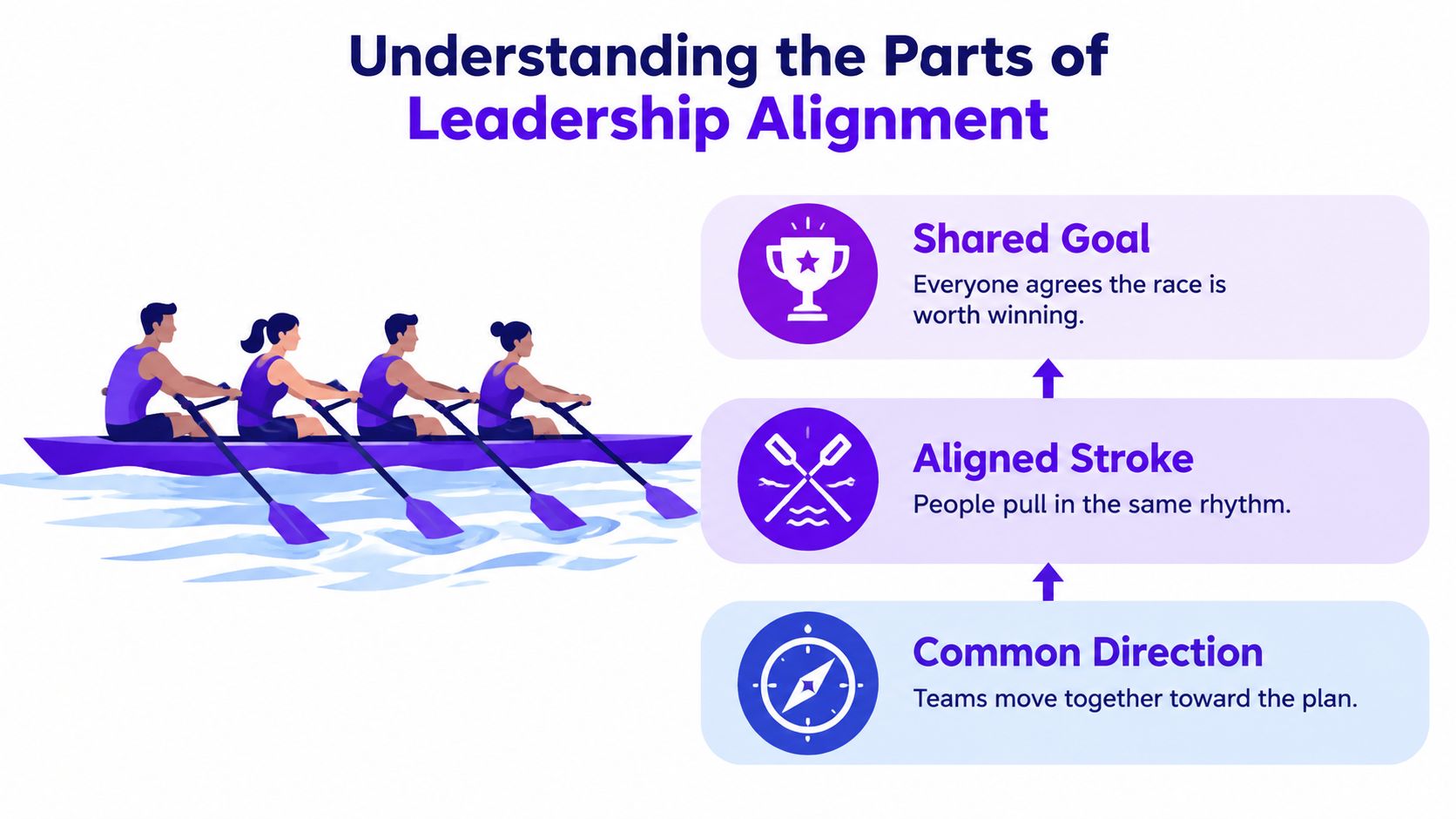
Leadership alignment has four working parts. A broad vision is only the first layer, and each part can fail on its own.
Shared priorities name what wins this quarter, and what loses. Clear decision rights name the single person who owns the call. Consistent interpretation means leaders describe the same goal with the same success measure. Coordinated execution means budgets, calendars, and handoffs follow that choice, not a private version of it.
Where the story and the choice split
Recent executive research shows a sharp perception gap. 80% of CEOs believe their executives can make enterprise-wide trade-offs, but only 30% of other C-suite leaders agree, according to Pearl Meyer's look at how executives actually decide. "We are aligned" often means leaders share a strategy story while they still disagree on priorities, resources, risk, or who decides.
That gap is the useful part of the topic. Hidden disagreement is cheaper to surface before a brief goes to a creative team or a product squad. Once concepts are built, the same disagreement shows up as late revisions.
Leadership alignment is the ability to make the same trade-offs, and to revisit them on purpose, even when the room has emptied.
A vision statement can't do that job. A recorded choice can.
Recognizing the Signs of Misalignment
Misalignment rarely announces itself as a fight. It shows up as ordinary friction that leaders learn to live with.
McKinsey's research on strategic planning makes the pattern hard to dismiss. Fewer than half of respondents were satisfied with how their companies made strategic decisions. 28% said their plan reflected organizational goals and challenges but was not effective. 14% said strategy and execution plans were not necessarily aligned. Only 56% said their companies tracked whether strategic initiatives were carried out.
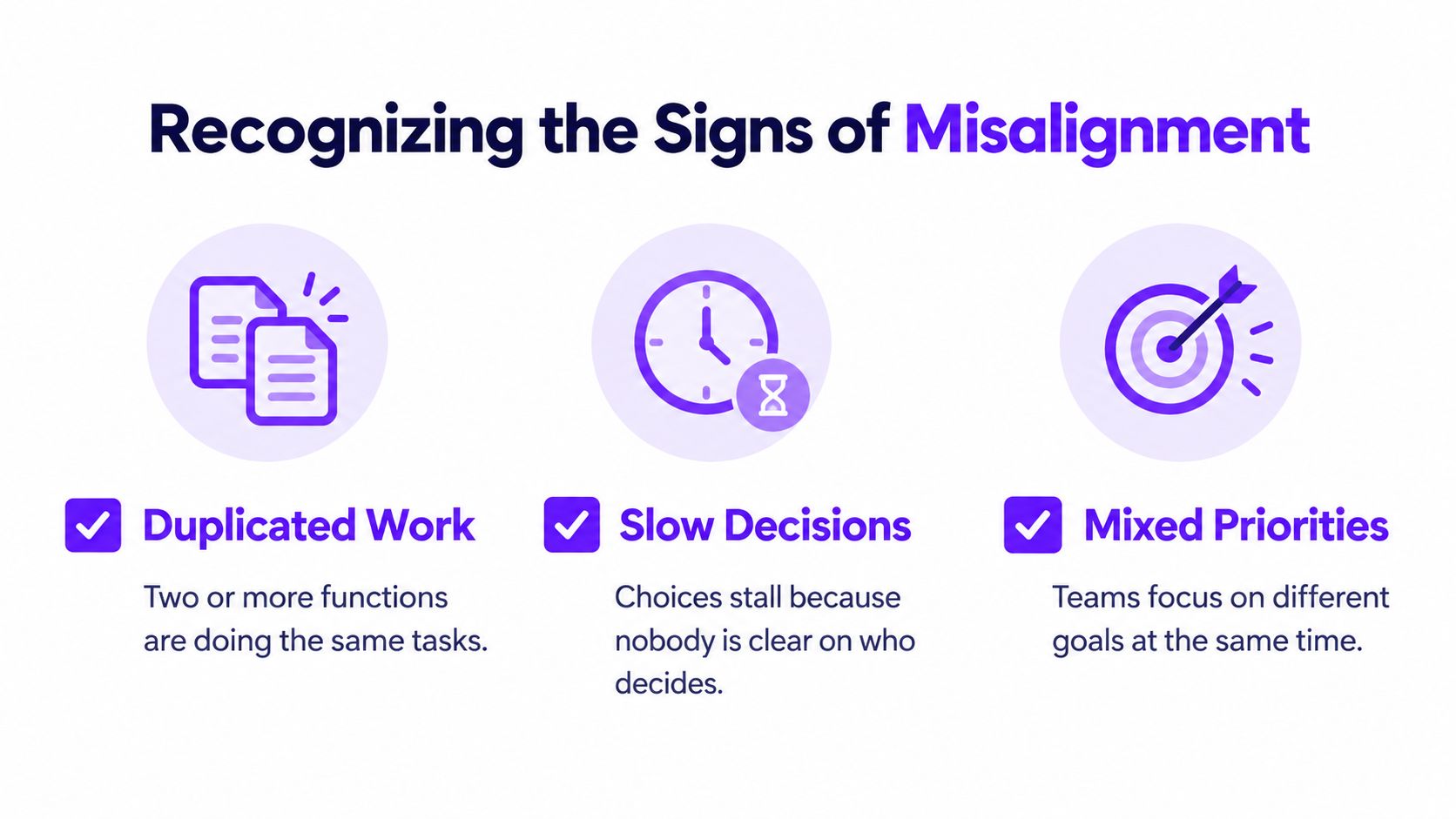
Three signs you can check this week
Duplicated work: Two functions build the same deck, research the same customer, or write two versions of the same brief. Ask who was told this was theirs. If both names come back, ownership was never settled.
Slow decisions: A choice sits in Slack because each leader thinks someone else will call it. The meeting ends with "let's circle back." Circle back is not a decision right.
Mixed messages: A client hears "brand safety first" from the account lead and "ship more variants" from the creative lead. Both heard the same senior goal. They kept different scoreboards.
Practical rule: If three leaders can't name the same top three priorities, and the same thing they will stop doing, you don't have a communication problem yet. You have an unsettled trade-off.
These signs are behavioral, so you can spot them without a survey. Sit with one live project. Write who decides, what "done" means, and which work would be dropped if time ran out. Compare the answers before the next stand-up. Teams that already juggle several functions will recognize this faster if they look at how they are managing cross-functional teams day to day.
Building Shared Priorities Through Explicit Trade-offs
Alignment is a fit problem, not a feelings problem. Decision rights, risk tolerance, how people talk, and the operating cadence have to match the strategy you chose.
Research that tested the Miles and Snow strategic typology across three industries found that the match between managers and strategy explained more performance variance than industry, age, or firm size. Firms with a stronger strategy-manager match outperformed firms that lacked it.
Match the leaders to the posture
An exploratory innovation strategy needs leaders who can sit with ambiguity, protect a test, and judge an option by what it teaches. A scale or efficiency strategy needs tighter ranking, repeatable steps, and stronger delivery controls. Putting a "ship it clean" operator in charge of a learning bet, or a wide-open experimenter in charge of a cost program, is a fit miss. The ideas may be good. The scoreboard is wrong.
Before a collaborative ideation session, ask each leader to do three things on one page.
- Rank the top three priorities for the next quarter, in order.
- Name the trade-off they will accept, including what will not be pursued.
- Name the single owner of the call, plus the assumption behind it.
Then compare the pages. Convergence is the point, not a longer discussion. Disagreement you can see on paper is cheaper than contradictory briefs later. If ranking itself is the stuck point, a short pass through prioritization techniques gives the group a shared method instead of a louder debate.
A matrix you can score
Use one row per objective. Review it quarterly, not when a project is already late.
| Strategic objective | Accountable leader | Decision threshold | Observable evidence of progress |
|---|---|---|---|
| Launch one tested offer | Product lead | Kill options that don't teach in 30 days | One live test with a written learning note |
| Hold brand risk on client work | Account lead | No asset ships without the safety check | Zero unapproved variants in market |
| Cut cycle time on delivery | Operations lead | Scope drops before dates slip | Cycle time logged on every active job |
Score fit, not vibes. If the evidence column is empty, the objective is still a wish.
Communicating Consistent Priorities Across Every Layer
A priority can be clear in the executive room and mean two different jobs one floor down.
A senior team agrees the quarter is about a careful product launch. The creative lead hears a volume target and starts more variants. The client lead hears a brand-safety rule and slows every review. Both are trying to help. Neither is wrong on their own reading. The launch still slips because the same sentence licensed opposite behavior.

Confidence is not the same as a clear sentence
Pearl Meyer's 2026 poll found that 66% of C-suite executives did not believe they were functioning as an effective enterprise team. 75% said leaders translated decisions into priorities and accountabilities. Only 63% said top strategic priorities were explained clearly and consistently. Translation can be underway while the explanation is still fuzzy.
Cascade models assume that more telling creates more understanding. It doesn't. A middle manager, a designer, and a frontline contributor can repeat the official line and still be unsure whether they may challenge it. When people don't feel safe to reinterpret a priority, or to treat a failed test as learning, alignment turns into groupthink. The useful question is whether someone can disagree and improve the plan without being labeled difficult.
A three-person restatement
Pick one live priority. Ask three people at different levels to restate it in their own words, including what they would stop doing because of it. Read the three answers side by side.
- Same verbs and same stop-doing: the priority traveled.
- Same slogan, different stop-doing: you have a story, not a choice.
- Silence or a softer version: people may be protecting themselves, not the plan.
If the answers diverge, fix the sentence before you add another all-hands. Teams that already struggle to hear each other will get more from this test if they also work on how to improve team communication between the layers, not only inside the leadership meeting.
Comparing Approaches and Choosing What Supports Alignment
Once you can see the trade-off, you still have to pick a way to keep it visible. Three common approaches do different jobs.
A periodic leadership offsite puts senior people in one place and gives them time to wrestle. It includes few people, surfaces disagreement if the CEO insists on it, and records decisions only if someone writes them down. It is weak for remote teams, and the effect fades when weekly work pulls leaders back into their functions.
A quarterly alignment matrix, like the one above, is narrower and more durable. It includes the owners of each objective, surfaces disagreement as mismatched rows, and records the threshold and the evidence. Distributed teams can fill it asynchronously. It will not generate new options. It only keeps the chosen ones honest. That is closer to strategic versus tactical planning than to a brainstorm. Strategy picks the trade-off. Tactics fill the week.
A structured collaborative session sits between those two. It includes a wider group, including creatives and delivery leads, before execution starts. Anonymous input makes a quiet disagreement easier to see. A written summary records options and next steps. A single link works for people who are not in the same office.
We built Bulby for remote teams, future-focused leaders, coaches, and facilitators who want a group's creativity to rise without a free-for-all. The process has six steps. You put in the challenge, invite the team with one link, and each person gets unique random exercises. People write and share ideas anonymously with AI-powered inspiration. The session collects and summarizes those ideas, surfaces the strongest ones with actionable next steps, and shares an AI-generated report.
The tool supports the conversation. It does not make the strategic call. Leaders still rank the trade-off, name the owner, and decide what will not be pursued. If you want the human side of that stance, Jan Kutschera's note on how to coach your team without micromanaging is a useful companion. Coaching keeps ownership with the person closest to the work. A matrix and a structured session do the same for the choice itself.
Your Next Step Toward Stronger Alignment
Three ideas are worth keeping, and none of them require a new slogan.
Alignment means leaders make the same trade-offs, then revisit them when the facts change. Misalignment shows up in duplicated work, stalled calls, and mixed messages, not in a lack of enthusiasm. A priority is only real when people at different layers restate it the same way, including what they will stop.
Before your next planning session, run a side-by-side check. Each leader writes their top three priorities and the trade-off they will accept. The group compares the pages in silence first, then talks only about the rows that don't match. Twenty minutes is enough to see whether you have a choice or a story.
If you want to see how a structured session feels before you run one with your own team, Bulby's public demo needs no login. You can try a brainstorm on the question "How might we improve team meetings to save time?" and watch ideas turn into a short set of next steps.
Don't ask whether people feel aligned. Ask whether they would drop the same work.
Bulby gives remote and cross-functional teams a structured way to surface options, trade-offs, and next steps before creative or product work starts. If your leaders share a strategy story but still split on what to stop, a guided session can make that disagreement visible while it is still cheap to fix. Visit Bulby and try the public demo with your own priority question.