
A client has asked for a marketing campaign proposal by Friday. The brief is familiar, the team has strong ideas, and the first draft already looks polished. Yet the ultimate decision is rarely made by the person who reads every page. Senior stakeholders skim for the answer, finance tests the assumptions, legal looks for exposure, and the marketing lead wants to know whether your team can turn an attractive concept into controlled execution.
A winning proposal is therefore more than a sales document. It's a persuasion tool that also functions as the first working plan. The client should understand what you recommend, why it fits their business, what it will require from them, and how both sides will judge the result before the proposal becomes a contract.
Table of Contents
- The Proposal Your Client Actually Reads
- Setting Up the Brief, Goals, and Audience
- Building the Strategy and Creative Narrative
- Writing the Creative, Timeline, and Budget Sections
- Making Measurement and Reporting Credible
- Closing the Gaps That Lose Pitches
- Pre-Submission Checklist and Presentation Tips
The Proposal Your Client Actually Reads
The strongest proposals put the client's decision near the front. An executive wants to know whether the recommendation addresses the business problem, what the agency will deliver, what it will cost, and why this team is qualified. They're not looking for a chronological account of every workshop, internal debate, or creative variation that led you there.
Structure the document around the client's decision path:
- Start with the answer: Summarize the problem, proposed solution, expected contribution, scope, investment logic, and next step.
- Make scanning easy: Use descriptive subheads, short paragraphs, clear tables, and restrained visual hierarchy. A useful PowerPoint presentations outline can help the team organize the story before design begins.
- Support the recommendation: Place relevant proof close to the claim it supports, rather than hiding case studies in an appendix.
- Name the owner: Give the client a clear point of contact and show who will lead strategy, creative, production, media, and reporting.
What decision-makers check first
Clients look for relevance before volume. A long list of services doesn't demonstrate understanding. A case study from a similar category, audience, or commercial challenge usually carries more weight than several pages of generic credentials. If the example isn't directly comparable, explain what transfers and what doesn't.
Team composition also signals judgment. Show the actual people assigned to the work, their responsibilities, and where specialist support enters the process. Clients notice when a proposal promises senior involvement but only names senior people on the cover.
Budget clarity is another early credibility test. A client can accept a provisional figure when the assumptions are visible. They become suspicious when a polished proposal presents a total without explaining production scope, media treatment, review rounds, or client responsibilities.
Practical rule: If a client can't explain your recommendation to another stakeholder after skimming the opening pages, the proposal is organized around your agency, not their decision.
Common failures are predictable. The answer gets buried beneath agency history, the document is over-designed until key information disappears, or the language describes what the team wants to make instead of what the client needs to approve. Treat the proposal as a test of strategic judgment. Before you discuss tactics, show that you know how to choose, prioritize, and manage trade-offs.
Setting Up the Brief, Goals, and Audience
The opening pages should prove that you understood more than the written request. Restate the business problem in the client's language, then add the context surfaced in meetings. That may include an internal approval concern, a sales objection, a brand perception issue, or a deadline that wasn't obvious in the RFP.
A useful brief recap answers three questions:
- What needs to change in the business?
- What must the campaign change in the market or customer journey?
- What conditions could limit the recommendation?
Then define objectives in a hierarchy. The primary business outcome might be revenue, retention, qualified demand, or adoption. The marketing objective translates that outcome into a change in awareness, consideration, preference, or action. Campaign targets describe the measurable movement the work is expected to create.
Use client-approved baselines rather than attractive but undefined targets. A goal such as “increase qualified enquiries” is incomplete until the proposal states what counts as qualified, where the baseline comes from, who owns validation, and when the result will be assessed. A SMART goal survives scrutiny because the client can test its meaning before launch.
| Tier | Example | Metric | Timeframe |
|---|---|---|---|
| Business outcome | Grow contribution from the priority offer | Agreed commercial measure | Client-approved assessment window |
| Marketing objective | Increase consideration among the defined audience | Brand or demand measure with baseline | Campaign measurement period |
| Campaign target | Generate qualified responses from selected channels | Validated response definition | Launch through reporting close |
Audience definition should be proportionate to the assignment. Start with first-party data such as CRM segments, customer interviews, site behavior, sales notes, or existing research. Then explain the segmentation logic. A segment should exist because its need, behavior, value, or response to the proposition differs, not because the team wants more labels.
Personas only help when they change decisions. Describe the trigger, barrier, context, preferred information source, and action threshold that affect the campaign. Connect those insights to media behavior without pretending that a demographic description proves channel fit. Each channel recommendation should carry a short evidence sentence based on client analytics, audience research, or an explicit test assumption. The guidance in these top campaign brief examples is useful when checking whether the brief contains enough decision-ready detail.
Before moving into strategy, confirm that:
- Brief alignment: The business problem and political context are accurate.
- Goal specificity: Every objective has an owner, definition, baseline, and review point.
- Audience evidence: Segment choices connect to observed behavior or a stated research gap.
- Decision readiness: The client knows what it must approve and what remains to be validated.
A clear campaign development process can support this discipline, but the proposal itself must show the reasoning. A framework won't rescue an audience that has been selected for convenience or a goal that can't be measured.
Building the Strategy and Creative Narrative
The strategy should give the client a sentence they can repeat internally without losing the point. Build it from one positioning statement and one central idea. The positioning statement explains the role the brand intends to occupy for the priority audience. The big idea turns that position into a campaignable thought that can guide messages, formats, and experiences.
The bridge between insight and idea is where many proposals become vague. Write it as a chain:
Observed audience tension, brand truth, strategic choice, creative expression.
For example, a retail brand may know that customers want to make a more considered purchase but feel overwhelmed by product comparison. The brand truth is that its specialists can simplify the decision. The strategic choice is to make expert guidance feel accessible rather than intimidating. The campaign idea could turn common shopping questions into clear, useful recommendations.
That reasoning does more work than a page of adjectives. It tells the client why the idea belongs to the brand and why it should matter to the audience.
Separate why from how
The strategy section answers why this direction should work. The creative section answers how the audience will encounter it. Keep those jobs distinct, then connect them with explicit references to the brief.
For the retail example, the expression might include:
- Short video: A specialist answers one practical question in a concise product demonstration.
- Search content: Landing pages organize comparison questions around the decision barriers identified in research.
- In-store activation: Staff use the same plain-language framework to guide shoppers.
- Email follow-up: Customers receive a recommendation pathway based on the category they explored.
The channel mix isn't justified because the channels are popular or familiar. It's justified because each one performs a different role in the audience journey. Search can capture active questions, video can make expertise tangible, and in-store activity can reduce the final barrier to purchase. If the client lacks evidence for one channel, label it as a test rather than disguising an assumption as strategy.
Tone matters too. A premium brand may need restraint and authority, while a challenger may benefit from directness and useful provocation. Competitive whitespace should sharpen the choice. Don't claim that no competitor owns an idea unless the review supports it. Say what the brand can credibly do differently, then show how the creative system expresses that difference.
Teams working across organic and paid social may also benefit from a practical guide on how to run a flawless campaign social media, especially when the proposal needs to connect content planning with publishing and coordination.
Retellability test: Ask a senior stakeholder to explain the campaign without looking at the document. If they remember the tactic but not the audience problem or brand role, the narrative isn't finished.
A strong creative strategy template can provide useful prompts, but templates should never replace a specific insight-to-idea argument. The proposal wins when the client can see one coherent decision flowing from audience evidence to strategic position to execution.
Writing the Creative, Timeline, and Budget Sections
Clients often decide whether the work feels distinctive on the creative concept page. Give the idea enough room to breathe, then show how it can behave in different executions. One central idea with a small set of clearly differentiated routes is more persuasive than a gallery of disconnected concepts.
Each route should state the audience tension it addresses, the message, the format, and the production implication. Avoid presenting finished-looking mockups that hide the true scope. If the client sees a polished film, a landing page, and a social system, they need to know whether those are illustrative examples or included deliverables.
Make scope countable
List deliverables by channel and format. “Social campaign” is not a scope. “Concept development, platform copy, short-form assets, paid variations, community guidance, and reporting inputs” gives both sides something to approve. State the number of review rounds only when it has been agreed, or describe the included review process without inventing a limit.
Build the timeline around the launch date, not around internal activity. Show when the client supplies information, when legal reviews claims, when brand signs off, and when procurement or a third-party supplier must respond. Approval gates deserve as much visibility as agency milestones.
| Week | Phase / Milestone | Budget Line | Amount (USD) | Assumption |
|---|---|---|---|---|
| Pre-launch | Brief confirmation and strategy approval | Strategy fees | To be confirmed | Client provides approved brief and data access |
| Pre-launch | Creative development and production planning | Production fees | To be confirmed | Selected route uses agreed formats |
| Launch preparation | Asset production, QA, and trafficking | Production or platform costs | To be confirmed | Required specifications are supplied on time |
| Launch and optimization | Media activation and campaign management | Media spend and management fees | To be confirmed | Media allocation follows approved channel plan |
| Reporting close | Analysis, readout, and recommendations | Reporting fees | To be confirmed | Client data sources remain accessible |
Explain every budget line
Separate media spend, production, agency fees, third-party costs, and applicable taxes or pass-through expenses. Under each line, state the assumption behind the amount. That lets the client challenge the model instead of challenging an unexplained total.
A useful flexibility device is a pre-approved adaptation that can absorb a modest scope change without reopening the entire creative concept. For example, define a shorter edit, alternate copy route, or format adjustment that can be activated if the platform or production requirement changes. Call out what it includes and what it excludes.
Finish with ownership and handoff terms. Specify who owns final assets, which formats the client receives, what source files are included, how usage rights are handled, and what must be supplied at launch. These details make the proposal feel executable rather than aspirational.
Making Measurement and Reporting Credible
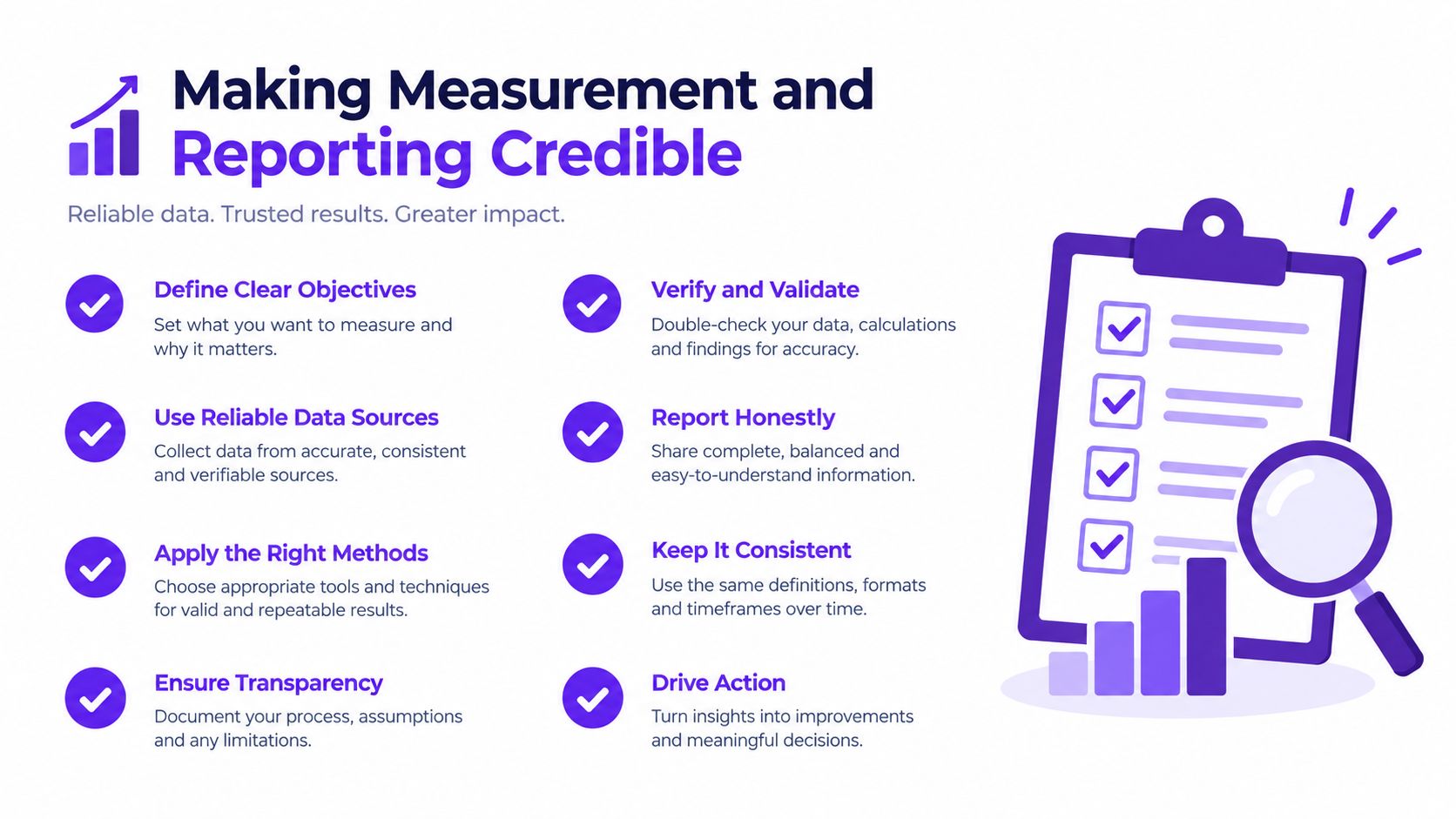
Measurement earns trust when it shows judgment. Choose one primary KPI that directly reflects the campaign goal, then select supporting metrics that explain movement toward it. Don't present a menu and leave the client to decide what success means after launch.
The proposal should also explain what you rejected. If the campaign aims to generate qualified demand, impressions may be useful for delivery context but shouldn't become the headline measure. If the client asks about assisted conversions, explain the attribution limitation and the role that metric can play as supporting evidence. If branded search lift is proposed, define the comparison, timeframe, and factors that could influence the result beyond the campaign.
Use data sources the client already trusts where possible. Name the analytics platform, CRM, ad platforms, survey source, or sales system that will provide each measure. Then specify the measurement window, attribution approach, data owner, and reporting cadence. A client is more likely to accept an imperfect measure when the limitations are visible.
Build the report around decisions
A useful report doesn't reproduce every platform export. It answers:
- What happened: Performance against the agreed goal and supporting measures.
- Why it happened: Audience response, creative patterns, channel behavior, delivery conditions, and data limitations.
- What changes next: Specific recommendations, open questions, and tests for the next cycle.
Clients may challenge view-through attribution, assisted conversions, or branded search lift because those measures can be influenced by activity outside the campaign. Defend them with a counter-question: what decision would this metric help the client make, and what evidence would make the metric unreliable? If the answer is unclear, remove it.
An explanation of what attribution modeling means can help stakeholders understand why different models assign credit differently, but the proposal still needs to choose an approach appropriate to the available data.
Define success and failure before launch. Success means the primary KPI reaches the agreed threshold within the stated measurement conditions. Failure doesn't just mean a missed target. It may reveal weak audience fit, poor creative relevance, limited delivery, or a measurement problem. That distinction turns reporting into learning rather than post-campaign defense.
Closing the Gaps That Lose Pitches
A clever idea can lose approval because nobody checked whether the organization can deliver it. Legal may need to review claims, talent may require usage agreements, stock assets may need licensing, and a platform may reject a format or message. A third-party production partner may also have lead times that don't fit the proposed launch.
Map the approval chain before you finalize the timeline. Name the checkpoints for marketing, brand, legal, procurement, sales, and senior leadership where they apply. Give each checkpoint an input, an approver, and an action. “Client review” is too vague to manage. “Brand lead approves visual system and legal reviews product claims” creates accountability.
Label the assumptions
Every uncertain input should be classified:
- Confirmed: The client has approved the budget range, audience, timing, or data source.
- Indicative: The proposal uses a working assumption that will be refined during discovery.
- Pending: The team needs a decision before scope, cost, or timing can be finalized.
Capacity deserves the same treatment. Ask whether the client can supply subject-matter experts, feedback, product information, and approvals during the proposed window. On the agency side, show that the required skills are available, including production, performance media, analytics, design, copy, and specialist compliance support.
Add a short risk register to the proposal. For each risk, state the impact, owner, early warning sign, and mitigation. A delayed legal review might trigger an earlier claims workshop. Limited client bandwidth might require a single decision-maker and consolidated feedback. A platform constraint might call for an approved alternate format.
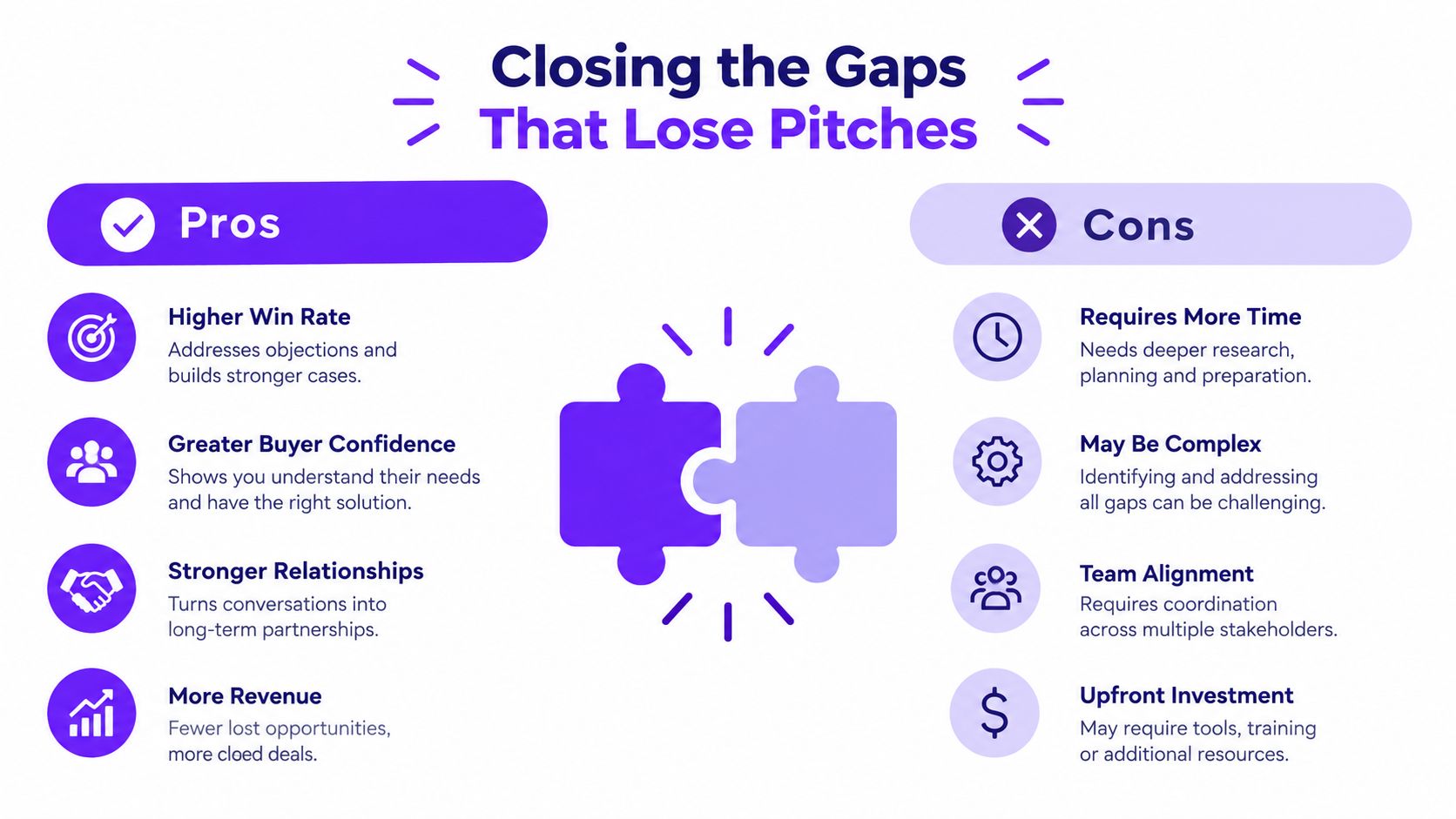
End with a one-page terms summary covering scope, responsibilities, assumptions, payment structure, usage, approval process, and next action. This isn't legal language, but it signals that the commercial path is understood. Clients move faster when the proposal doesn't force them to discover operational questions after they have already approved the idea.
Pre-Submission Checklist and Presentation Tips
A proposal becomes easier to sign when the final review catches small signals of disorder. Run a practical quality check before submission, then read the document aloud with the people who will present it. Spoken language exposes repeated points, awkward transitions, inconsistent numbers, and claims that sound stronger than the evidence supports.
The final document check
Use a shared checklist covering:
- File and naming: Correct client name, consistent file naming, final version clearly identified, master file archived, and draft files removed from the delivery folder.
- Version control: Tracked changes accepted, comments resolved, cross-references refreshed, hyperlinks tested, and the final PDF compared with the approved working version.
- Layout and legal: Page numbers run correctly, footer copy is present, logos are accurate, image credits are included, and disclaimers are readable.
- Content integrity: Scope matches the budget, timeline matches the approval path, assumptions are labeled, and every important claim has an owner or source.
- Read-aloud quality: The opening answer is clear, transitions sound natural, numbers are described consistently, and likely questions have prepared responses.
For the presentation, lead with the client's decision rather than walking through the document page by page. A short agenda should reserve time for the recommendation, rationale, creative, delivery model, investment, measurement, and discussion. The insight slide should make the audience problem and strategic opportunity unmistakable. The budget summary should make the investment logic and assumptions easy to challenge.
Expect questions about fit, cost, and risk. Be ready to answer why this audience, why these channels, what changes if the budget or timing shifts, and what the client must provide. Don't hide uncertainty. State what is known, what is assumed, and what decision would reduce the uncertainty.
A creative strategy presentation can help teams think about the narrative and delivery together. After submission, maintain momentum with a clear follow-up sequence: confirm receipt, answer open questions in one place, send agreed clarifications, and propose the next decision rather than sending repeated “just checking in” messages.
If the client signs, the first-day handoff should include a kickoff agenda, RACI chart, approved brief, working timeline, contact list, access requirements, and first deliverables. Bulby can help marketing and creative teams structure brainstorming sessions, generate campaign angles and messaging directions, and organize next-step summaries that feed into proposal development.
Bulby gives agencies and brand teams a structured way to move from scattered brainstorming input to focused campaign concepts, messaging directions, and next steps. Use Bulby when your proposal needs a stronger idea pipeline and a clearer bridge from collaborative thinking to client-ready strategy.