
A client kickoff starts in ninety minutes. Three research tabs are open, the brief is half-formed, and a blank document is waiting for someone to decide what matters. The team doesn't need another polished deck. It needs a clear route from business problem to audience belief, message, concept, channel, and proof of progress.
A practical creative strategy template gives the team that route. It isn't a form to complete and archive. It's a shared decision tool that keeps strategists, creatives, account leads, and clients working from the same argument while the work develops.
Table of Contents
- Why Most Strategy Decks End Up Unused
- The Core Sections of a Creative Strategy Template
- A Walkthrough of a Completed Template
- Building Messaging Pillars That Actually Differentiate
- Mapping Channels and KPIs to the Strategy
- Adapting the Template for AI-Augmented Ideation
- Quick Checklist and Common Mistakes to Avoid
Why Most Strategy Decks End Up Unused
It's Monday morning at a fictional mid-size agency. A senior strategist has ninety minutes before the kickoff for a new direct-to-consumer beverage client. Market research sits in one tab, customer reviews in another, and a competitor audit fills a third. The blank Google Doc looks harmless, but it creates a familiar trap: start outlining before deciding what the team actually needs to know.
That's where many strategy decks begin to fail. The strategist adds category context, audience observations, competitor screenshots, trend slides, and carefully written transitions. The deck becomes an impressive record of effort, but the creative team still can't answer the working questions: Who are we trying to move? What should they believe? Why should they believe it? What kind of work follows?
A deck can explain everything and direct nothing
A long narrative often confuses evidence with strategy. Research is useful when it changes a decision. It becomes decoration when every observation receives a slide but no clear implication.
Talking points create the same problem. “The audience values convenience” may be accurate, but it doesn't tell a writer what tension to dramatize or a designer what visual territory to explore. A strategy needs a point of view, not a larger pile of information.
Teams can use a practical content strategy steps resource to organize research and production thinking, but the same discipline applies to campaign strategy: every input should earn its place by influencing an objective, audience definition, message, channel, or measurement decision.
A fixed template acts as a forcing function. Instead of inventing a new structure for every client, the strategist starts with a tested skeleton:
- Objective: What business outcome needs to change?
- Audience: Whose belief, behavior, or preference matters?
- Message: What single idea should they retain?
- Channels: Where can that idea earn attention?
- KPIs: What evidence will tell us whether the strategy is working?
The template should be opinionated about what belongs on each line. That prevents scope creep, limits justification slides, and makes gaps visible before the client meeting. A useful creative strategy presentation should help the room make decisions, not merely admire the strategist's research process.
Practical rule: If the creative team can't use the strategy on day two, the document is a presentation, not a working tool.
The best version may still become a client-facing deck, but its real test happens afterward. Can a copywriter brief the next concept from it? Can an art director reject an attractive idea that doesn't fit? Can an account lead explain why a channel belongs? If not, reduce the deck until the argument becomes usable.
The Core Sections of a Creative Strategy Template
Fill the template in sequence. Each field should narrow the next decision rather than invite another research project.
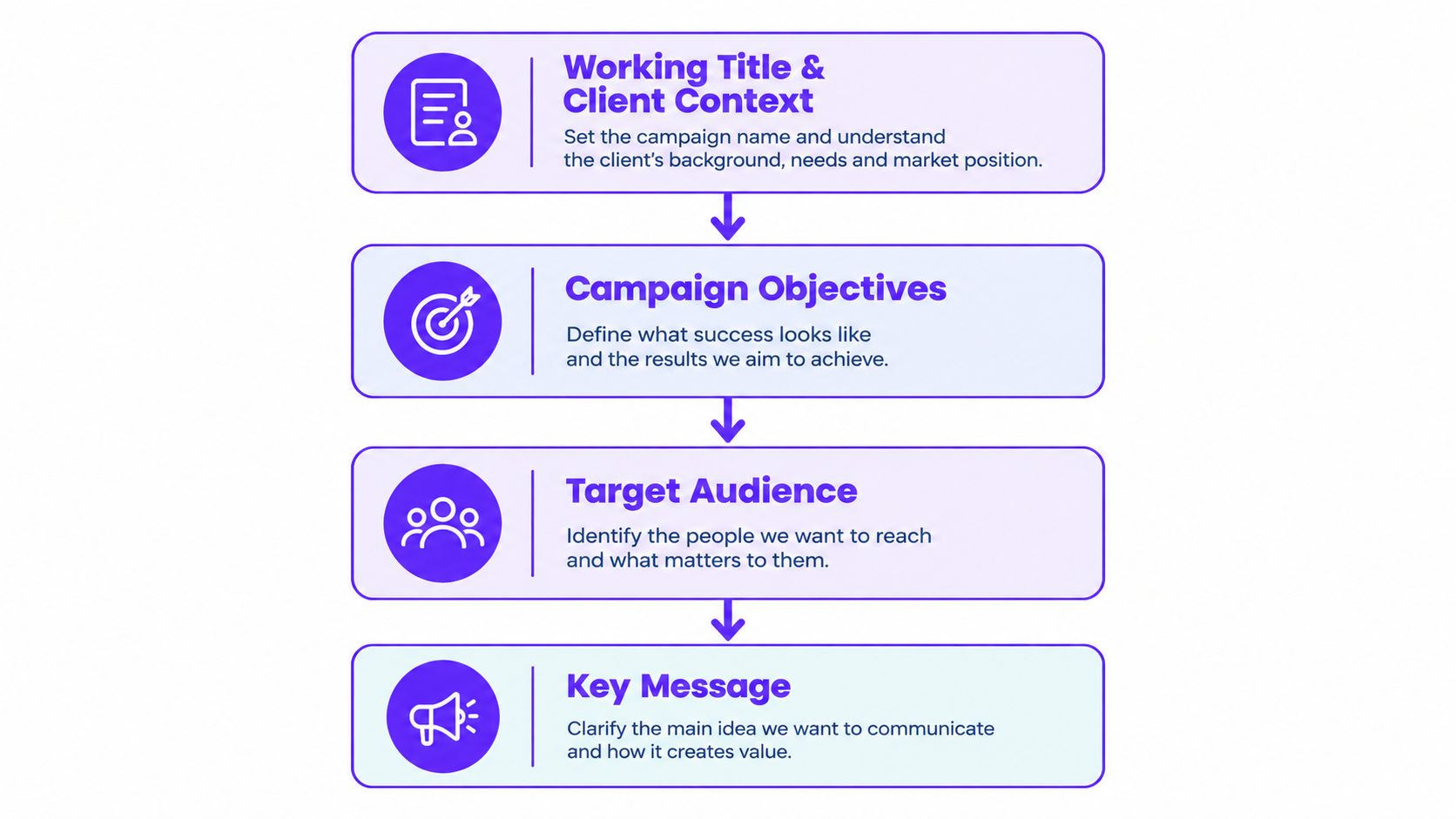
1. Working title and client context
Give the work a temporary name and add the context needed to orient the team. Include the product, market situation, business constraint, and decision owner. Keep this short. The purpose isn't to document the client relationship. It's to make the problem legible.
Prompt: What situation has created the need for this work now?
2. Campaign objective
Write the objective as a business outcome, not as a list of deliverables. “Launch a video campaign” describes activity. “Increase consideration among qualified category buyers” describes the change the work is expected to create.
Prompt: What does success look like in revenue, retention, qualified demand, or another business result, not impressions?
3. Audience snapshot
Describe the audience through behavior, motivation, category belief, and friction. Demographics can provide context, but they rarely provide a creative direction on their own. The critical line is the belief that currently keeps the audience from choosing, trying, trusting, or returning.
Prompt: What is the one belief we need to shift?
4. Customer insight
State the tension in plain language. A useful insight explains why the audience might care, not just what they do. Support it with customer language, reviews, interviews, sales conversations, or observed behavior.
5. Core message and supporting pillars
Write one message as a complete sentence. Then add three supporting pillars, each with its own proof point and creative implication. If two pillars could be merged without losing meaning, they probably aren't distinct enough.
6. Channel mix
Choose channels because they fit the audience moment and the role of the message. A channel earns a place when it offers a particular advantage, such as explanation, discovery, demonstration, trust, or conversion.
For teams planning video, a proven video marketing framework can help connect format choices to audience behavior. The strategy should still make the final channel decision.
7. KPIs, timeline, and guardrails
Assign each channel a primary signal and define the business outcome it supports. Add a timeline for production, launch, and review. Finish with guardrails: what the brand will do, what it won't do, and which compromises are unacceptable.
A useful creative strategy process keeps these fields connected. The KPI shouldn't appear as an afterthought. It should influence the objective, channel choice, and creative testing plan from the beginning.
The finished template can be short, but it shouldn't be vague. Each line needs enough specificity to help someone make or reject a piece of work.
A Walkthrough of a Completed Template
Consider Halo Lab, a fictional direct-to-consumer skincare brand selling clinical-grade products to women aged 28 to 42. Its audience distrusts influencer marketing and wants stronger dermatologist validation. The initial business problem is strategic, not merely creative: founder-led content has built familiarity, but the brand needs authority and a stronger reason for customers to return.
The completed entries below show how the fields reinforce one another.
| Template Section | Completed Entry |
|---|---|
| Working title and client context | Halo Lab Authority System, a clinical skincare brand moving beyond founder-led communication |
| Campaign objective | Shift from founder-led content to authority-led content and grow repeat purchase rate from 22% to 35% in two quarters |
| Audience snapshot | Women aged 28 to 42 who want effective skincare but distrust influencer recommendations and look for credible professional validation |
| Customer insight | Skincare feels crowded with rituals and aesthetic promises, while the audience wants a process they can understand and trust |
| Belief shift | From “skincare is aesthetic” to “skincare is protocol” |
| Core message | Your skin has a job; this is its system |
| Supporting pillars | Clinical without cold, results not rituals, expertise over aspiration |
| Channel mix | YouTube long-form with a dermatologist co-host, a searchable blog built for AI answer engines, and a tightly edited email sequence |
| Measurement logic | YouTube supports assisted brand search, the blog aims to earn visibility in AI-generated answers, and email owns repeat purchase rate |
| Guardrails | No borrowed influencer authority, no exaggerated promises, no beauty language that makes the product feel ornamental |
The objective determines the audience problem. Halo Lab isn't just trying to reach skincare buyers. It needs to reposition the brand from personal founder recommendation toward credible expertise, while supporting repeat behavior.
That makes the belief shift more useful than a broad persona description. “Women aged 28 to 42” identifies a group. “Skincare is protocol” gives the creative team a territory. It suggests routines, systems, diagnosis, consistency, and professional guidance.
The pillars then give the team different routes into that territory:
- Clinical without cold creates room for warm, human storytelling around serious expertise.
- Results not rituals challenges elaborate routines and keeps the focus on useful outcomes.
- Expertise over aspiration gives the brand permission to replace polished lifestyle cues with explanation and evidence.
The channel plan follows the strategy rather than preceding it. Long-form YouTube can accommodate dermatologist-led explanation. Searchable content can answer questions in a format that people and AI discovery systems can interpret. Email can reinforce the protocol after purchase and support repeat behavior.
A focused AI-powered marketing blog can offer useful context for teams thinking about discovery beyond traditional search. Halo Lab's strategy still needs human review, because visibility in an answer engine is not the same as authority with a customer.
Building Messaging Pillars That Actually Differentiate
Messaging pillars become useful when they create different creative arguments. “Quality,” “innovation,” and “customer-centric” don't pass that test. They describe desirable brand traits, but they don't tell a creative team what to make.
Start with raw customer language. Pull observations from interviews, reviews, support conversations, and sales call transcripts. Then cluster the material into tensions, desires, and unspoken objections. The point isn't to produce a larger insight document. It's to find recurring friction that the brand can answer truthfully.
For a fictional performance sneaker brand, the raw material might cluster around these observations:
- Runners want speed but dislike shoes that feel aggressive or unstable.
- Daily commuters need comfort that survives a full day, not just a workout.
- Buyers are tired of technical claims they can't translate into a real experience.
Draft candidate pillars as a tension plus proof point:
| Candidate pillar | Tension | Proof point | Pressure-test |
|---|---|---|---|
| Fast without forcing it | Runners want performance without a punishing ride | The shoe is designed for responsive movement that still feels controlled | More distinctive than generic speed language, if the product experience supports it |
| Built for the whole day | Wearers move between training, commuting, and ordinary tasks | The design supports use beyond a single workout context | Flexible enough for rational comfort and emotional freedom |
| Technology you can feel | Buyers don't trust specifications they can't experience | Every technical feature is explained through a clear physical benefit | Strong only if the product team can demonstrate the benefit honestly |
A weak version of the first pillar would be “high-performance comfort.” It says what every competitor says and creates no productive tension. “Fast without forcing it” gives a writer a contrast, an art director a visual idea, and a strategist a clear reason to reject imagery that equates performance with suffering.
Pressure-test every surviving pillar against three filters:
- Competitive novelty: Does the angle sound meaningfully different from the two competitors the audience already knows?
- Internal truth: Can the product, service, or customer experience prove it?
- Creative elasticity: Can the idea support both a rational demonstration and an emotional expression?
The right pillar is narrow enough to create a point of view and broad enough to support more than one execution.
Keep the pillars separate. If every pillar leads to the same headline, visual, and proof point, you're looking at one idea wearing different labels. A useful messaging strategy explanation can help clarify the distinction between a message hierarchy and a collection of interchangeable claims.
Mapping Channels and KPIs to the Strategy
Channel selection should begin with the objective and work backward. If the job is category entry, prioritize discovery surfaces such as search, AI answer engines, and curated newsletters. If the job is conversion, give more weight to paid social, retargeting, creator partnerships, product pages, and direct response environments.
The important shift is to treat each channel as a strategic role, not a row in a media plan. AI-native discovery also changes the brief. Content must be clear enough for people to use and structured enough for machine selectors to interpret, while still offering a distinct brand point of view.
| Objective | Primary Channel | Primary KPI | Guardrail Metric |
|---|---|---|---|
| Build category discovery | Searchable editorial content and AI answer engine surfaces | Qualified discovery actions | Branded search quality |
| Explain a complex product | Long-form YouTube | Meaningful viewing behavior | Brand recall or assisted search |
| Convert interested prospects | Paid social and retargeting | Qualified conversion actions | Cost per add-to-cart |
| Support retention | Email sequence | Repeat purchase rate | Unsubscribe and complaint signals |
| Build trust through people | Creator or expert partnerships | Qualified engagement | Audience fit and comment quality |
Don't force every channel to prove itself through last-click revenue. A YouTube video may influence a later search. An email may receive the final click after several earlier interactions. A practical measurement view combines platform-reported results with broader modeling and incrementality inputs where the organization has those capabilities.
The strategist's job is to make the logic visible in client reviews. Explain why a channel exists, what it is expected to do, and which metric would make you change the plan. A marketing campaign planning guide can help teams formalize that connection between objectives, activity, and evaluation.
Review the mix regularly rather than treating kickoff decisions as permanent. New audience behavior, creative results, search visibility, and commercial feedback should all have a route back into the template.
Adapting the Template for AI-Augmented Ideation
A static template becomes more useful when every field can act as a prompt. Feed the tool the audience, tension, message, proof points, channel role, and guardrails. Then ask for options that stay inside those boundaries.
For Halo Lab, a strategist could give Bulby this starting prompt:
Generate campaign directions for women aged 28 to 42 who distrust influencer skincare advice. Use the belief shift from “skincare is aesthetic” to “skincare is protocol,” and build from the pillar “results not rituals.” Avoid aspiration-led beauty imagery and unsupported clinical claims.
The next prompt should extend the strongest territory, not restart the brainstorm:
Take the most specific direction and create three versions for long-form YouTube, each featuring a dermatologist explaining one decision in a skincare system. Keep the tone warm, direct, and practical.
Then pressure-test it:
Identify where these concepts become generic skincare education. Rewrite the weakest direction so the message “Your skin has a job; this is its system” remains visible without sounding like a product brochure.
A final remix can adapt the idea to another channel:
Convert the strongest YouTube direction into an email sequence that supports repeat purchase. Preserve the protocol idea, remove anything that depends on video, and state the proof point each email must carry.
This process works better than asking for “creative campaign ideas” without context because the tool is solving a defined strategic problem. Bulby can support structured brainstorming, anonymous input, AI-generated sparks, and a summary with next steps. It should sit beside the agency process, not replace the strategist's judgment.
A useful AI for marketing strategy resource can help teams think through where automation belongs in the wider planning workflow. The guardrails remain simple: the template defines what good must satisfy, the strategist decides whether an output is good, and AI never edits the brief itself.
Add a provenance prompt to the session:
Log the source material behind every strategic input, including interview notes, review excerpts, customer objections, and approved product facts. Separate source-backed observations from generated hypotheses.
That record protects the team from treating fluent output as evidence. AI can expand the search space, but the brief remains the source of truth.
Quick Checklist and Common Mistakes to Avoid
Two minutes before sending the template to the creative director, check whether each line can guide a decision. If a field sounds polished but doesn't change the work, rewrite it.
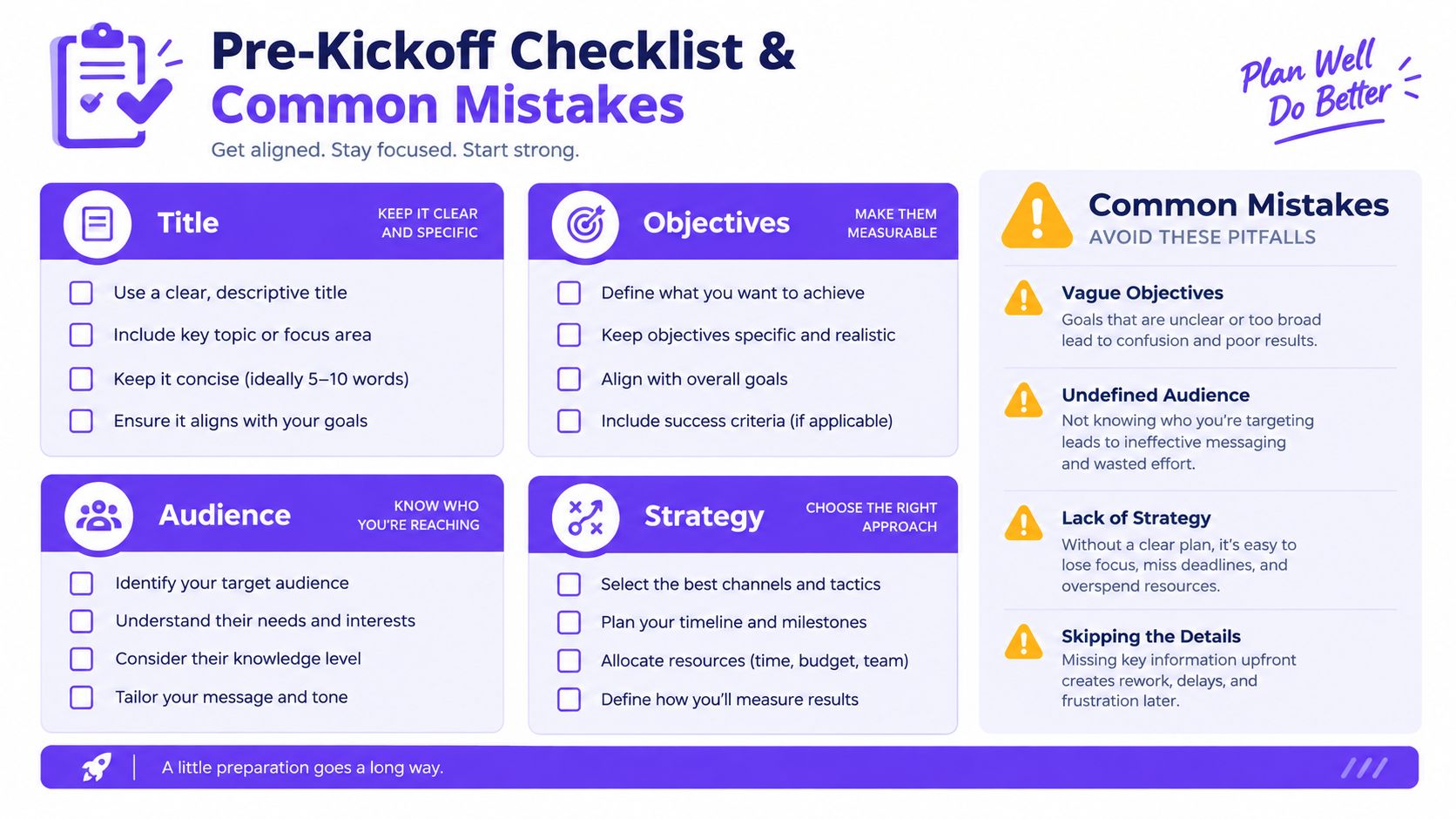
- Context is useful: The working title names the business situation without becoming a history lesson.
- The objective is commercial: It describes an outcome, not a campaign asset or activity.
- The audience has tension: The definition includes what people currently believe and what blocks movement.
- The message is singular: The team can repeat the intended belief in one sentence.
- The pillars are distinct: Each pillar opens a different creative route and has a credible proof point.
- The channels have jobs: Every channel exists for a reason tied to audience behavior.
- The KPIs connect: Each primary metric supports the objective, with a guardrail that prevents misleading optimization.
- The guardrails are explicit: The team knows what the brand won't chase.
The recurring mistakes are predictable.
Deliverables disguised as objectives fail because activity can increase without changing the business. Rewrite “produce a video series” as the outcome the series is meant to support.
A vague audience definition fails because “women 25 to 54” doesn't reveal a belief, tension, or decision context. Add the category frustration and the shift the work needs to create.
Channels chosen by habit fail because presence isn't strategy. State the audience moment each channel owns and what the format makes possible.
Three versions of one pillar fail because they give the team the appearance of choice without real strategic range. Force each pillar to use a different tension, proof point, or creative behavior.
A missing KPI link fails because nobody can evaluate the strategy later. Connect each channel metric to the business objective before concept development begins.
The last test is practical: hand the page to someone who wasn't in the kickoff. If they can explain what the work should make people believe, the template is doing its job.
Bulby gives marketing and creative teams a structured space to turn a defined challenge into guided brainstorming, shared input, AI-generated sparks, and actionable next steps. Use it alongside your creative strategy template to move from a clear audience tension to more focused concept directions, then visit Bulby to explore the workflow.