

A team spends weeks building something good. The product solves a real problem. The campaign looks polished. The landing page is clean. Then launch day comes, and the response is flat.
Not because the idea was weak. Because people didn't quickly understand why it mattered to them.
This happens in product teams, agencies, and startups constantly. A homepage talks about features when buyers need outcomes. An ad sounds clever but hides the point. A sales deck promises everything to everyone, so nobody remembers anything. Each asset may look fine on its own, but together they create friction. The audience has to work too hard to connect the dots.
That's the gap messaging strategy is supposed to close.
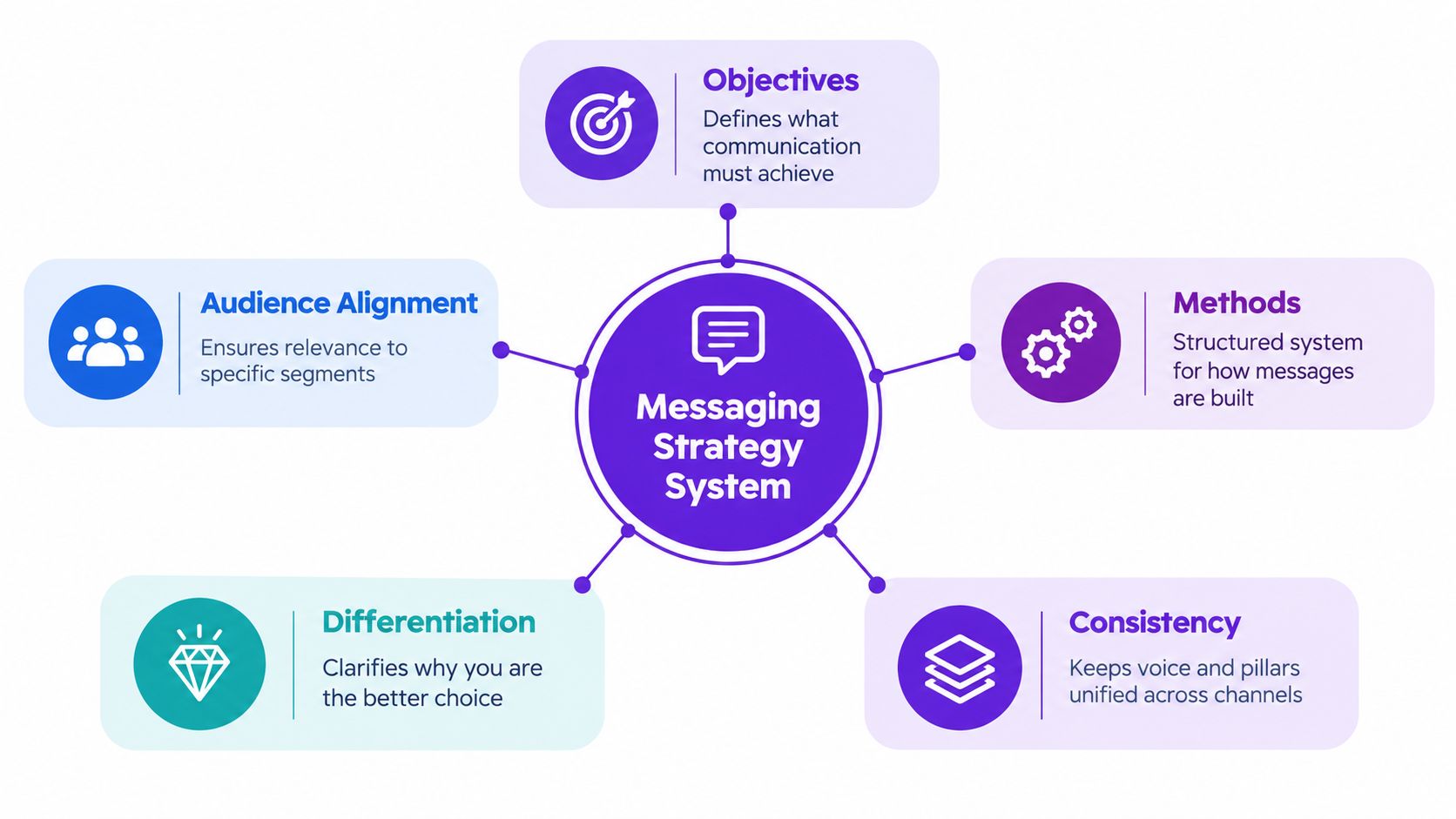
When people ask, what is messaging strategy, they often expect a simple answer like “your brand voice” or “the words you use to describe your company.” That's part of it, but it's much too small. Messaging strategy is the system that helps a team decide what to say, to whom, in what form, and for what outcome.
Without that system, strong ideas get translated badly. Product teams describe capabilities instead of use cases. Agencies present concepts that sound fresh internally but land vaguely in market. Sales, product, paid media, and content all tell slightly different stories. Over time, that inconsistency turns into confusion.
Good messaging doesn't happen because a smart copywriter had a good day. It happens when the team makes a series of deliberate choices, then tests whether those choices work.
Table of Contents
- Introduction Why Great Ideas Fail Without Clear Messaging
- What Messaging Strategy Really Means Beyond Words and Voice
- Core Components That Make a Messaging Strategy Work
- Messaging Frameworks and Approaches You Can Actually Use
- How to Create and Test Messaging That Resonates
- Measuring Success and Keeping Messaging From Drifting
- Putting Your Messaging Strategy Into Action
Introduction Why Great Ideas Fail Without Clear Messaging
A common scene goes like this. The product manager says the new feature saves time. The founder says the company is redefining the category. The ad team writes a campaign around confidence and control. Sales leads with price. Customer success explains it as ease of adoption.
Nobody is wrong. But nobody is aligned.

The audience feels that misalignment immediately. They see one promise in an ad, another on the website, and a third in the demo. That doesn't just weaken persuasion. It makes the buyer do interpretive work your team should have done first.
Where good work breaks down
Most failed messaging isn't obviously bad. It's usually almost right.
A B2B software company might say, “We streamline cross-functional workflows with intelligent automation.” That sounds polished, but it asks too much from the reader. What kind of workflow? For whom? Why should they care now? The sentence has language, but it doesn't yet have a message.
An agency campaign can fail the same way. The creative idea may be sharp, but the audience doesn't know whether the brand is trying to explain, differentiate, reassure, or provoke action. The work becomes memorable in the room and muddy in the market.
Good messaging reduces the number of mental steps a customer has to take before they understand the value.
What teams actually need
They don't need a longer list of adjectives. They need a practical decision system.
That system should answer questions like:
- Audience: Who exactly are we talking to?
- Problem: What tension, need, or desire are they already feeling?
- Value: What are we promising that matters in their context?
- Proof: Why should they believe us?
- Outcome: What should this message cause them to think, feel, or do next?
When teams can answer those clearly, copy gets easier. Campaigns get tighter. Internal debates get shorter. Testing gets smarter because you're comparing strategic choices, not just random lines.
That's what this guide is really about. Not writing prettier words, but building a messaging strategy that can travel across product pages, ads, sales decks, launch plans, and lifecycle campaigns without losing the plot.
What Messaging Strategy Really Means Beyond Words and Voice
People often confuse messaging strategy with three related things: positioning, tone of voice, and copywriting. They overlap, but they aren't the same job.
Positioning defines your place in the market. Tone of voice shapes how you sound. Copywriting turns ideas into actual sentences. Messaging strategy sits above all three and connects them.
Think of it like a navigation system
A map shows roads. A navigation system helps you choose the route based on destination, traffic, and constraints.
Messaging strategy works the same way. It doesn't just list approved phrases. It helps a team decide:
- what the message needs to achieve
- which audience it's for
- which angle to lead with
- what proof should support it
- what action should follow
That's why the research view matters. In the literature, messaging strategy is treated as a structured system that specifies both objectives and methods, not just a voice guide, as discussed in this academic proceedings paper on message strategy.
Why voice alone isn't enough
Teams love talking about tone because it feels concrete. Friendly or formal. Bold or calm. Smart or playful.
Tone matters, but it can't rescue strategic fuzziness. You can have a beautifully written message in a consistent voice that still fails because it's aimed at the wrong audience need or trying to do too many jobs at once. That's why a tone guide and a messaging strategy are different tools. If you need help separating the two, this guide to tone of voice guidelines is useful background.
A practical way to explain the difference inside a team is this:
- Positioning says: where we fit
- Messaging strategy says: what we'll emphasize
- Tone says: how we'll sound
- Copy says: the final words
Messaging strategy is about choice
The strongest strategies force decisions. They stop teams from saying everything at once.
For example, a launch message might need to do one of these jobs:
- Explain: help a new audience understand the offer
- Persuade: change preference between similar options
- Differentiate: clarify why this brand is distinct
- Trigger action: get a click, signup, reply, or request
Those are not the same task. A message built for understanding often looks different from one built for immediate response.
Practical rule: If your team can't name the job of the message, you're still discussing language too early.
That's also why many teams benefit from a structured workshop process rather than an open-ended brainstorm. Resources such as The Social Search offer services can be useful examples of how teams formalize offer and messaging decisions before they jump into campaign execution.
Core Components That Make a Messaging Strategy Work
A messaging strategy is easier to build when you treat it like a stack. Each layer answers a different question. If one layer is weak, the ones above it wobble.
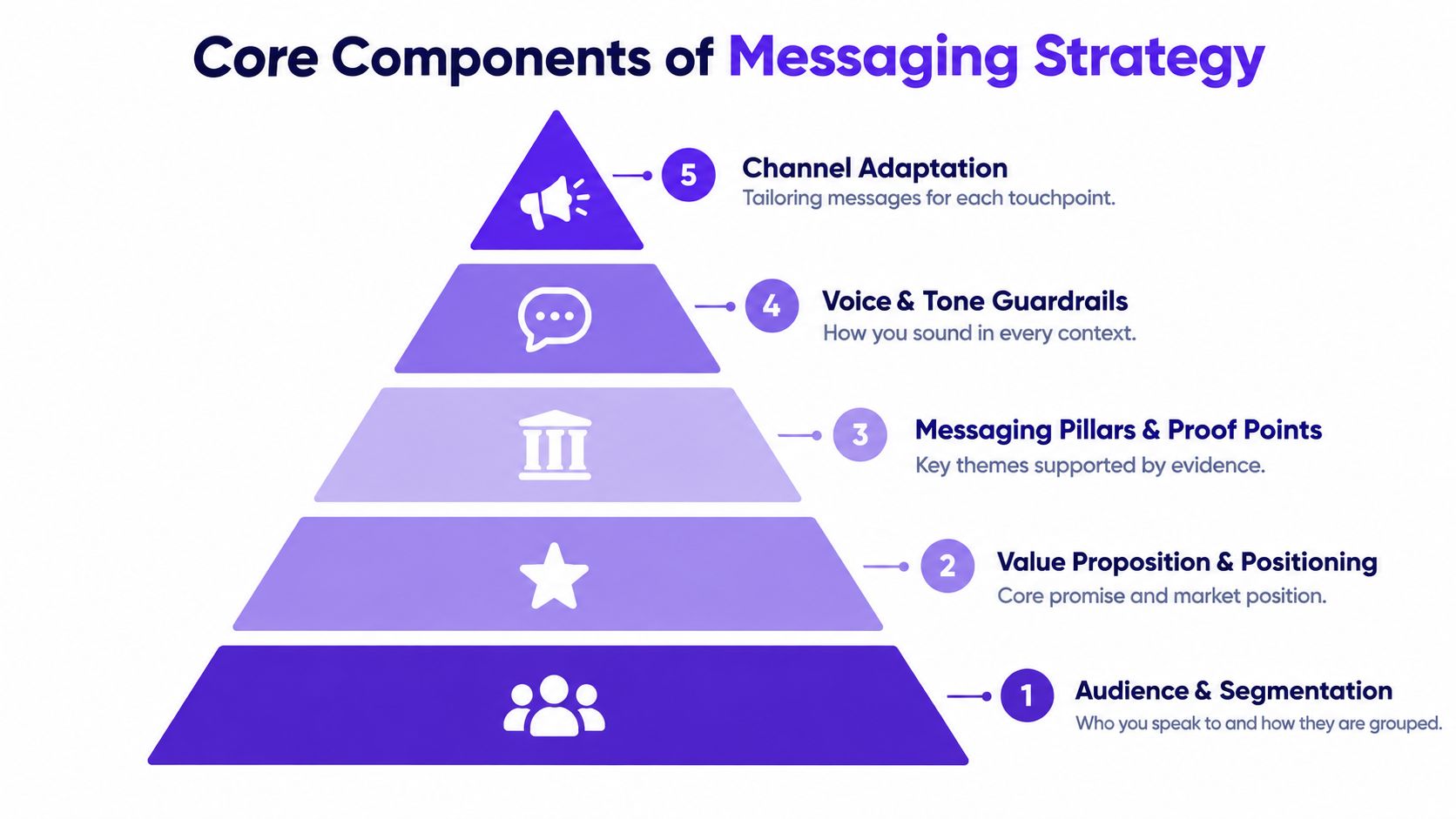
Audience and segmentation
This is the base layer because messages only make sense in relation to a listener.
“Marketers” is rarely a useful audience definition. “Lifecycle marketers at B2B SaaS companies trying to improve trial-to-paid conversion” is much more usable. The narrower definition gives you better language choices, better examples, and better proof.
Good segmentation doesn't just sort by industry or role. It can also sort by context. New prospects need explanation. Active users may need reassurance or feature discovery. Existing customers evaluating renewal need proof of ongoing value.
Value proposition and positioning
Once the audience is clear, the next question is simple: why should this audience care?
Many teams drift into internal language. They describe what they built instead of the meaningful change it creates for the customer. A strong value proposition links the offer to a problem, outcome, or advantage the audience already recognizes. If your team needs a refresher on this layer, this piece on how to write a value proposition is a useful companion.
Here's the test. If someone reads your core message and replies, “So what?” your value layer isn't strong enough yet.
Messaging pillars and proof points
Pillars are the themes you want to consistently reinforce. Proof points are what keep those themes from sounding generic.
A simple example:
| Pillar | What it means | Supporting proof |
|---|---|---|
| Ease | Fast to understand and use | Clear onboarding flow, intuitive setup, responsive support |
| Control | Teams can customize how they work | Flexible settings, approval paths, integrations |
| Confidence | Decisions feel safer and clearer | Visibility, reporting, auditability, reliable performance |
Without proof, pillars become slogans. Without pillars, proof becomes a list of disconnected facts.
Voice and tone guardrails
This layer shapes expression, not strategy itself. It matters because even strong strategic messages can feel inconsistent when different teams phrase them in wildly different ways.
Useful guardrails are concrete. They don't say “be human.” They say things like:
- Sentence style: Prefer short declarative sentences over stacked abstractions
- Vocabulary: Use buyer language before internal terminology
- Emotional range: Sound confident, not theatrical
- Context shift: Product UI copy should be calmer and clearer than campaign headlines
Channel adaptation
The final layer asks whether the message fits the touchpoint.
A homepage hero has one job. A sales deck has another. An onboarding email, a paid social ad, and an in-app tooltip each need different levels of detail, urgency, and context. The strategy should stay stable, but the expression should adapt.
A message shouldn't be copied unchanged across channels. It should be translated while keeping the same strategic intent.
When this stack is complete, teams stop improvising from scratch each time they need an asset. They work from a shared system.
Messaging Frameworks and Approaches You Can Actually Use
Once the foundations are clear, teams need a way to choose the right message architecture. Many strategy documents go soft. They define the brand nicely, then leave the team with no practical way to shape real messages.
A more useful approach is to choose a frame based on the response you want.
Academic work on branded content and social messaging argues that message strategy works by aligning what marketers want to say with what consumers need to hear, and it also distinguishes direct sales or marketing messages from indirect or conversational messages in this research on branded content and social messaging.
Three frames most teams need
Some messages are primarily informational. They help people understand functional benefits, features, or practical differences.
Some are transformational. They connect the brand to emotional or psychological outcomes such as confidence, status, relief, momentum, or belonging.
Others are conversational. They are less about immediate persuasion and more about creating an ongoing relationship through interaction, response, and relevance.
Here's a simple way to compare them.
| Message Frame | Best For | Expected Outcome |
|---|---|---|
| Informational | Explaining features, pricing, workflow, process changes | Clarity and easier evaluation |
| Transformational | Brand campaigns, differentiation, emotional preference | Stronger meaning and memorability |
| Conversational | Community building, lifecycle engagement, social interaction | Continued attention and relationship depth |
Direct versus conversational messaging
A product launch email might need directness. An online community prompt needs a different posture.
Direct messaging usually works best when the audience needs a clear argument or instruction. Conversational messaging works better when the goal is sustained engagement over time. Teams often blur the two and end up with copy that is too soft for conversion and too sales-heavy for relationship building.
That's why shared frameworks help. They let a team say, “This asset is meant to explain,” or “This sequence is meant to nurture,” before anybody starts wordsmithing.
For teams comparing market narratives, these brand positioning frameworks can help clarify which strategic frame should sit underneath the messaging.
Classic tactic categories still help
Older message-strategy thinking also remains practical. Categories like promotion, curiosity, image, and straight sell may sound old-school, but they're useful because they create testable variations.
For example:
- Promotion: “Get started with faster setup”
- Curiosity: “Why do some teams launch in half the time?”
- Image: “Built for teams that hate messy handoffs”
- Straight sell: “Project management software for distributed product teams”
These are not final lines. They're strategic starting points.
If your team debates copy without naming the frame first, you'll keep arguing taste instead of purpose.
How to Create and Test Messaging That Resonates
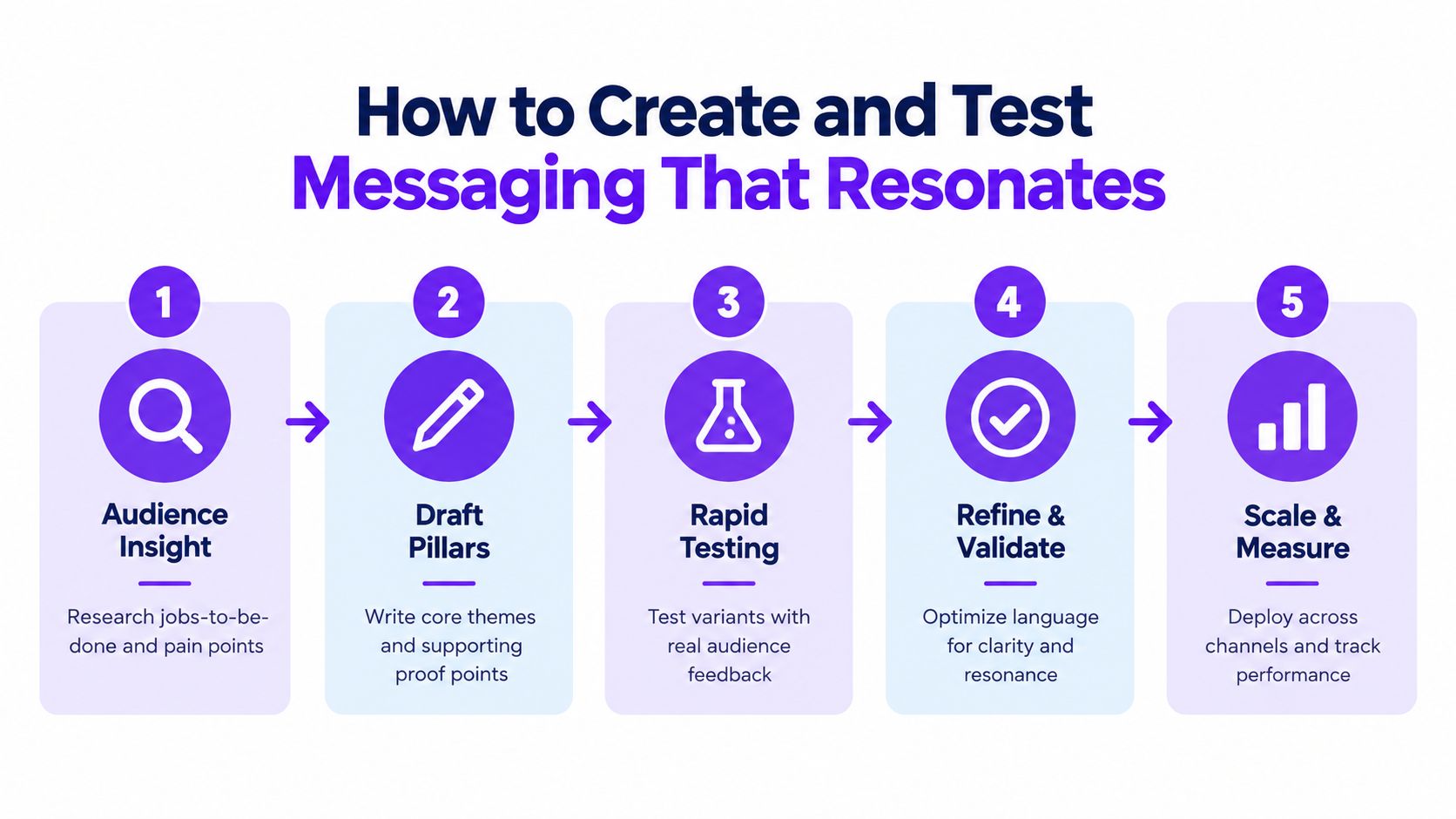
A strong messaging strategy doesn't start with writing. It starts with diagnosis. You need to know what job the audience is trying to get done, what friction they feel, and what change they're hoping for.
Start with audience tension
Don't ask only, “What do we want to say?”
Ask:
- What situation is the audience in right now?
- What are they trying to achieve?
- What's making that harder than it should be?
- What kind of promise would feel relevant and believable?
Those questions produce better inputs than a blank page does. They also stop teams from filling strategy documents with internal aspirations that customers never asked for.
Draft pillars, then write variants
Once the audience tension is clear, draft a small set of message pillars and supporting proof. Then turn each pillar into multiple message variants.
For example, if one pillar is speed, your variants might emphasize:
- getting started faster
- reducing back-and-forth
- shortening approval cycles
- removing setup friction
Now you have something testable.
A practical testing workflow is to compare a few strategic versions before polishing copy too heavily. Teams running lean can do this through ad variants, landing page tests, email subject lines, sales call feedback, or structured stakeholder review tied to audience objections. If you need a working process, this guide on how to conduct A/B testing can help frame the mechanics.
Calibrate the language, don't just simplify it
A useful academic milestone arrived in 2023. Researchers analyzing field data and randomized field experiments across contexts found that message effectiveness follows an inverted U-shape. Medium syntactic surprise performs best, while language that is too predictable or too surprising performs worse, according to this University of Bristol publication on effective marketing messages.
That finding matters because it explains a mistake many teams make. They assume the choice is between plain and clever. It isn't. The task is calibration.
Too predictable, and the message disappears into category wallpaper. Too surprising, and the reader has to decode it. The best messages often feel clear first and fresh second.
Working heuristic: If a line sounds obvious, sharpen it. If it sounds like a riddle, simplify it.
A short explainer can help teams think visually about how this process works in practice.
Test before rollout
Message testing has become a standard research method because teams need proof of concept before launch. The point isn't to discover one magical sentence. It's to reduce risk by learning which direction creates the right response.
That can be lightweight. You might test:
- homepage headline variants
- ad hooks for different audience segments
- email framing by use case
- feature launch messages framed around outcome versus capability
The discipline matters more than the tooling. Strong teams don't guess what will resonate. They create options, compare them, and refine based on response.
Measuring Success and Keeping Messaging From Drifting
Creating messaging is only half the job. The harder part is keeping it accurate and useful as products, audiences, and channels change.
Teams experience messaging drift slowly. A company starts with a sharp value proposition. Then new features ship, new segments appear, sales adds custom language, lifecycle marketing personalizes heavily, and different channels begin telling slightly different stories. Months later, the market's understanding no longer matches what the company does best.
What to measure
Messaging should be evaluated in the context of the channel and the job of the message.
A click-focused paid ad and a product onboarding message shouldn't be judged the same way. One is trying to earn attention. The other is trying to guide understanding and action inside a product experience. The important question is always, “Did this message help the user take the intended next step?”
One multichannel messaging study covering 2021 to 2023 found email generated a 19.90% open rate versus 11.40% for SMS, and email also outperformed SMS in purchase behavior and customer perception, as described in this summary of brand messaging research. The practical lesson isn't that one channel always wins. It's that channel affects message performance, so teams shouldn't assume the same language will behave the same way everywhere.
Why operations matter now
Messaging strategy used to be treated mostly as a planning exercise. It now also has a systems layer.
In a 2026 global survey, 99% said omnichannel communication matters to growth, yet only 43% had expanded beyond email and SMS into real-time or conversational channels, and only 11% reported full integration between messaging platforms and CRM or business systems, according to this 2026 digital customer communication survey report.
That gap changes how we should think about strategy. If your channels, CRM, lifecycle platform, and product signals aren't connected, even a strong message can arrive at the wrong moment or in the wrong form.
Signals that your messaging is drifting
You don't need a formal crisis to know the strategy is slipping. Watch for patterns like:
- Sales keeps rewriting the story: Reps don't trust the official message to answer real objections.
- Different channels emphasize different value: Ads promise one thing, product pages another.
- New features crowd out the core promise: The message becomes a catalog instead of a point of view.
- Audience language changes first: Customers describe their needs differently than your site does.
- Personalization outpaces strategy: Teams tailor messages constantly, but no one maintains the underlying narrative.
For teams that want better visibility into how a brand is appearing and shifting across digital surfaces, tools and practices related to AI brand visibility monitoring can help spot inconsistency earlier.
A messaging system needs ownership. It also needs review points. The broader discipline of brand strategy and management is what keeps messaging from becoming a forgotten workshop artifact.
Putting Your Messaging Strategy Into Action
The simplest answer to what is messaging strategy is this: it's a repeatable system for choosing what to say, to whom, and why, then testing whether it works.
That's much more useful than treating messaging as a list of approved phrases.
A practical one-page template
If you need a working draft for your next workshop or sprint, keep it this simple:
- Audience: Which specific group is this for?
- Situation: What are they trying to do right now?
- Tension: What problem, doubt, or desire is active?
- Objective: Should this message explain, persuade, differentiate, or trigger action?
- Core promise: What change or value are we offering?
- Pillars: What two to four themes will support that promise?
- Proof: What makes each pillar believable?
- Voice guardrails: How should this sound, and what should it avoid?
- Channel fit: How should the message adapt by touchpoint?
- Test plan: Which variants will we compare before scaling?
Common mistakes to avoid
Some teams stop at tone. Others write a brand manifesto and mistake that for usable messaging. Others create good core language once, then never revisit it as the product and market evolve.
The better path is more disciplined and less dramatic. Build the strategy. Translate it into variants. Test it. Update it when the audience, product, or market reality changes.
A 2026 survey of 750+ marketers, product managers, growth leaders, and engineers found the top priorities in customer messaging were improving personalization at 28% and scaling AI adoption at 19%, according to Customer.io's 2026 customer messaging report. That's a useful signal. Teams aren't treating messaging as a fixed brand document anymore. They're treating it as a living adaptation layer.
That's the right mindset.
If your team can turn messaging from opinion into system, you'll write better copy, launch clearer campaigns, and spend less time debating lines that were never strategically grounded in the first place.
Bulby helps agency and product teams do this kind of work faster by turning messy brainstorming into structured messaging development. If you're building campaign angles, offer language, positioning directions, or message variants to test, Bulby gives your team a guided way to generate stronger ideas and move them toward usable strategy.