
Breaking every silo is bad advice if it means weakening the expertise your organization needs. The better question is whether specialists can bring their knowledge together when a decision depends on it. Understanding organizational silos and innovation starts with separating useful boundaries from the barriers that keep ideas, evidence, and concerns trapped inside them.
Table of Contents
- The Numbers Behind Siloed Innovation
- When to Bridge Redesign or Keep a Silo
- Specialization Until the Shared Chart Disappears
- When Expertise Never Reached the Decision
- How to Run a Boundary Encounter
- When AI Speeds One Team and Isolates the Rest
- Run One Boundary Session This Month
The Numbers Behind Siloed Innovation
A boundary works like a door with a lock. It can protect careful work, and it can also keep the wrong people outside when a decision needs them. The useful question is whether knowledge can cross when the problem calls for it.
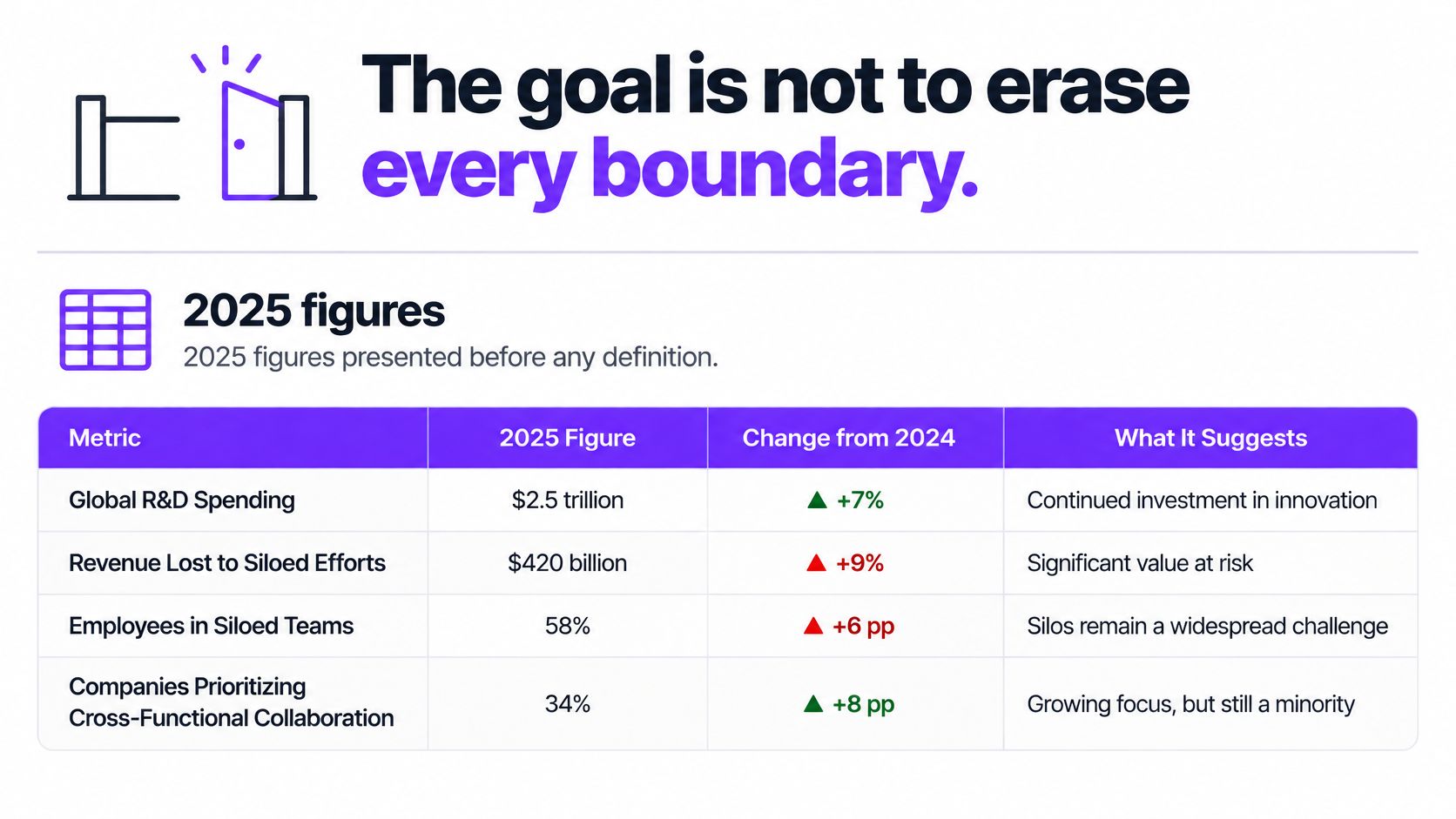
What the 2025 surveys report
| What people reported | Share | Who was asked | Source |
|---|---|---|---|
| Information spread across fragmented tools because of silos | 63% | 6,148 knowledge workers, eight global markets | Miro Momentum at Work 2025 |
| Functional silos impede cross-functional collaboration | 51% | Same knowledge-worker sample | Miro Momentum at Work 2025 |
| Improving collaboration is key to organizational goals | 89% | 518 global business leaders | Miro Collaboration is AI's Biggest Opportunity 2025 |
| Improving collaboration is critical to those goals | 42% | Same global business-leader sample | Miro Collaboration is AI's Biggest Opportunity 2025 |
| Siloed departments block collaboration | 83% | Surveyed enterprises | Sigma State of BI 2025 |
| Resistance to change is a major barrier to innovation | 75% | Same surveyed enterprises | Sigma State of BI 2025 |
Read those rows as three lenses, not one scoreboard. Knowledge workers describe daily friction, business leaders describe ambition, and enterprises describe structural barriers. Add them together and the result becomes misleading. Put them side by side and a practical tension appears: leaders value collaboration while workers and enterprises report barriers to doing it.
An organizational silo becomes harmful when a team's boundaries prevent relevant knowledge from reaching people who need it. A department is not automatically a silo. Frequent meetings are not proof that knowledge moves, because attendance can look busy while evidence stays in the original room.
Watch for three distinct losses. Trapped ideas appear when a promising concept never leaves its originating function. Incomplete decisions appear when customer evidence or technical concerns never reach the decision-maker. Disconnected output appears when teams work faster separately but cannot assemble a coherent shared concept.
Choose measures that reveal those losses rather than counting activity. A practical guide to measuring innovation can help distinguish useful progress from a busy idea pipeline.
Start the diagnosis with the cause of the boundary, not a general demand for better culture.
When to Bridge Redesign or Keep a Silo
Not every silo should be dismantled. Some need a bridge, some need changes to incentives and authority, and some should remain separate with deliberate points of contact.
A California Management Review analysis distinguishes systemic, elitist, and protectionist silos and proposes evaluating both how frequently groups interact and how those interactions affect performance. Those distinctions matter because the same workshop can help one team and leave another unchanged.
Which silo you have and the move that fits
| Silo type | What drives it | What innovation loses | Move to make |
|---|---|---|---|
| Systemic | Misaligned goals across functions | Local targets get met while the customer problem falls between teams | Bridge with one shared challenge and one objective |
| Elitist | Hoarding or a belief that one craft is superior | Ideas and evidence stay inside the high-status group | Redesign credit and status so contribution is visible |
| Protectionist | Fear of losing control, status, or job security | Risk and dissent never reach the decision | Change safety, incentives, and decision rights before any workshop |
| Useful separation | Deep craft, regulation, or clear accountability | Nothing, if knowledge still recombines in time | Preserve the specialty and schedule a targeted boundary encounter |
Match the intervention to the cause
Say an agency's account team promises quick delivery, its creative team prioritizes originality, and analytics wants reliable evidence before approving a direction. Nobody needs to be selfish for these goals to conflict. This is a systemic problem: managers need to establish what a successful customer outcome means and how trade-offs will be resolved.
An elitist pattern looks different. A senior creative group might dismiss research contributions before examining them, or a technical team might treat commercial questions as uninformed interruptions. Inviting everyone to contribute won't help if only one group receives credit and controls selection.
Protectionist behavior requires greater care. Someone who expects punishment for exposing a weakness may remain silent even when a facilitator explicitly welcomes dissent. Leaders need to clarify who can challenge a decision, who must respond, and how raising a concern will affect the person's standing.
Practical rule: Don't ask people to collaborate against the incentives their managers still enforce.
Preserve boundaries that serve a purpose
A specialist shouldn't need a permanent committee to exercise their craft. Regulatory review, technical assurance, and deep creative development can require independent judgment and protected attention.
Before changing the structure, map who holds the knowledge, what isn't being shared, which objectives conflict, and when another function needs access. Then ask whether contact should be continuous or limited to a decision point.
For example, a research lead may need to challenge a campaign brief before concept development, not attend every design discussion. Guidance on cross-functional team management is most useful when it clarifies these responsibilities rather than adding coordination for its own sake.
Keep the specialty. Create a targeted encounter with a named output, a shared measure of success, and someone accountable for using the result.
Specialization Until the Shared Chart Disappears
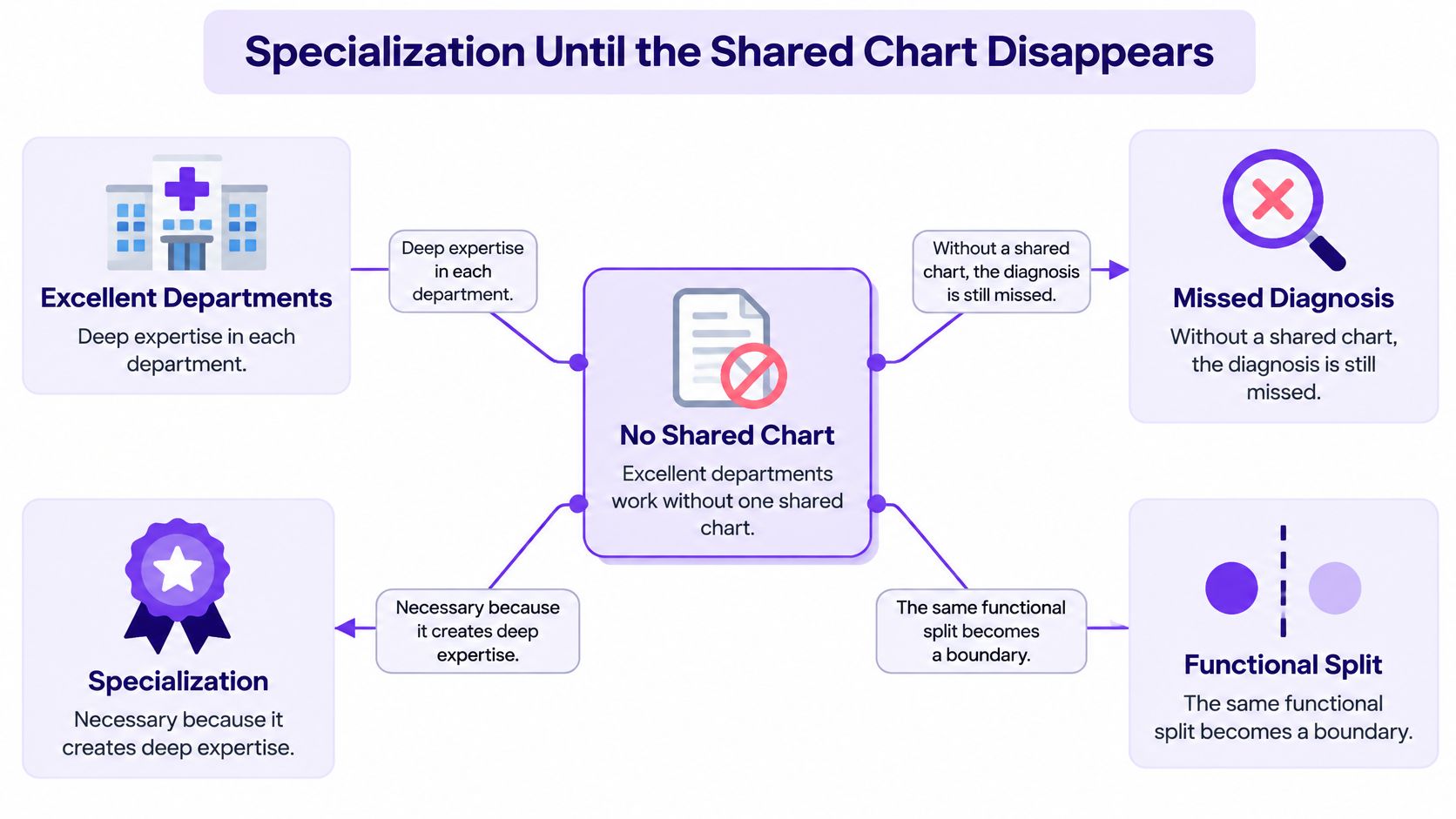
Think of a hospital whose departments are excellent but don't share a patient chart. Each specialist can interpret their own findings correctly while nobody assembles the full picture. The missing connection matters as much as the quality of the individual judgments.
The same distinction applies to product and agency work. A strategist can understand the audience, an engineer can understand feasibility, and an account lead can understand the client's constraints without anyone producing a concept that respects all of them.
Give specialists something concrete to share
A review of 87 academic papers on boundary objects and knowledge integration describes the central paradox: specialization creates deep expertise, but functional separation can also prevent people from integrating that expertise.
A boundary object is a shared artifact that different specialists can interpret without abandoning their own technical language. Useful examples include:
- Problem statement: The customer difficulty the team intends to resolve.
- Customer insight map: Observations, needs, and uncertainties organized for joint interpretation.
- Opportunity brief: The opening worth pursuing and the constraints around it.
- Prototype: A concrete expression that people can test or challenge.
- Messaging architecture: The relationship between the central promise, supporting claims, and evidence.
- Experiment scorecard: The hypothesis, test conditions, findings, and decision.
These aren't interchangeable documents. Choose the object that makes the current uncertainty visible. A prototype helps when people disagree about an experience; a problem statement helps when they're solving different problems.
Make the artifact dependable
Every shared object needs explicit operating fields.
| Field | What to write |
|---|---|
| Owner | The person responsible for keeping it current |
| Decision criteria | What makes an option acceptable or worth testing |
| Required evidence | What each function must contribute or verify |
| Revision cadence | When updates happen and what triggers an earlier review |
Say a team is designing a customer onboarding experience. Research adds where customers become confused, engineering marks technical constraints, and commercial leads identify promises that sales staff must explain accurately. Everyone challenges the same representation instead of circulating incompatible versions.
That's knowledge integration through a stable interface, not more conversation. In a large meeting without such an interface, participants can leave with different interpretations of what was agreed.
An artifact without an owner becomes another abandoned slide deck. Apply knowledge management practices to its location, access, and revision history so people can find the current version and understand why it changed.
The document doesn't replace specialist judgment. It gives specialists a dependable place to connect it.
When Expertise Never Reached the Decision
The Challenger disaster illustrates the stakes of knowledge that exists but doesn't shape the final decision. The shuttle was lost on January 28, 1986, and the Rogers Commission report, published in June 1986, identified communication failures, flawed reporting, inadequate trend analysis, and the misrepresentation or suppression of technical concerns.
NASA's Marshall, Kennedy, and Johnson centers operated with substantial independence and weak communication across organizational boundaries and upward to leadership. Engineers at Morton Thiokol had raised concerns about solid-rocket-booster O-rings in unusually cold conditions, but those concerns didn't become a decision to stop the launch.

The failure wasn't a shortage of expertise
The organization had advanced technical capabilities and specialists who understood important parts of the risk. Schedule pressure and fragmented authority prevented engineering, management, and contractor knowledge from forming an adequate shared picture.
That distinction matters. Hiring more knowledgeable people doesn't resolve a process in which their concerns lose force as they travel upward.
A concern hasn't reached the decision merely because someone recorded it.
For everyday product work, records still matter. Teams comparing ways to preserve questions, disagreements, and commitments can use meeting notes tools from Creators Toolbox as a starting resource. But documentation is only a record, not proof that an authorized person considered the concern and acted on it.
The Challenger case shouldn't be treated as equivalent to a disappointing campaign or unsuccessful feature. Its relevance is the organizational mechanism: specialists can possess essential knowledge while decision-makers receive an incomplete account.
Connected expertise and invention quality
There's also evidence connecting less compartmentalized collaboration with stronger inventions. A 2026 Strategic Management Journal study, described by Phys.org, examined 783 U.S. high-technology firms from 1976 through 2017, using state adoption of the Uniform Trade Secrets Act as a natural experiment; following adoption, inventor networks became 4.2% less modular relative to the sample mean, with the structural change appearing approximately two years later, and reduced compartmentalization was associated with a 15.9% increase in technological impact relative to the sample mean.
Less modular means inventors had broader connections rather than remaining in tightly separated collaboration clusters. Technological impact measured the influence of inventions on subsequent technology, not how many patents a firm produced.
This isn't a promise that merging departments will produce the same improvement. It's evidence about a particular setting and organizational network.
Taken together, the cases make a narrower, useful point: the value of expertise depends partly on whether other people can use it. Product and creative specialists can remain specialized while contributing to work that reaches beyond their home group.
How to Run a Boundary Encounter
A boundary encounter works like a small workshop with a job to do. People bring different kinds of knowledge, put them around one live problem, and leave with something the group can test, revise, or hand on. The point is not a warm feeling that everyone was consulted. It is a visible change in the work.
A 2025 study of 869 employees across 11 UK organizations found positive relationships between silo-busting techniques, high-performance-organization factors, and internal collaboration. That is reason to treat collaboration practices as design choices you can examine and improve, while staying careful about expecting any single session to solve a structural problem.
Work through a single challenge
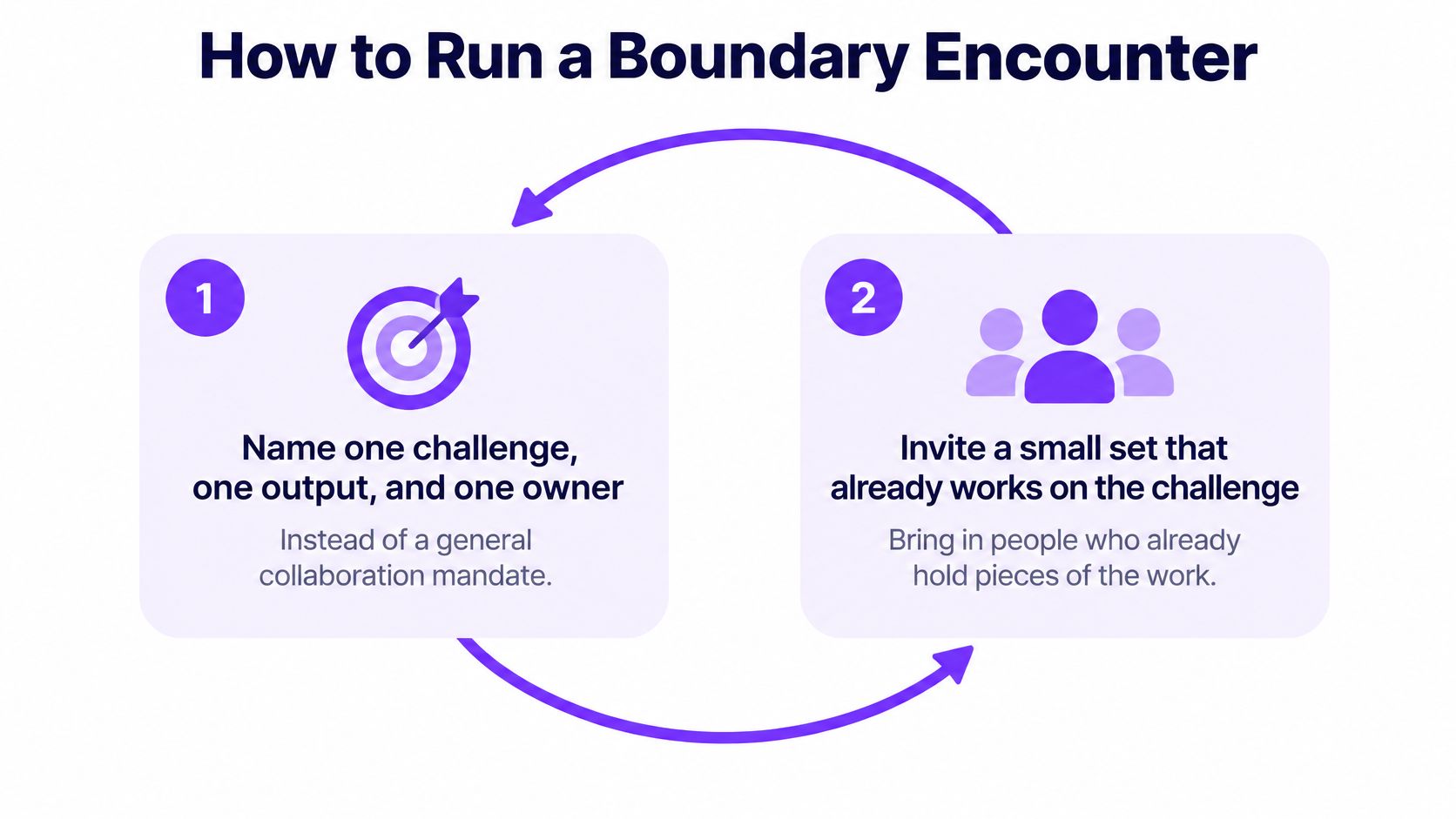
Name the challenge, output, and owner. Replace a broad request to improve collaboration with a specific problem, such as customers abandoning onboarding because the next action is unclear. Specify the output, perhaps a testable onboarding concept, and name who will use it. A tight brief acts like a table top. It keeps objects from sliding in every direction.
Invite people who hold different pieces. Bring strategy, creative, account, and the relevant product, research, or analytics perspective. Include the person who will implement or approve the result. Select participants for their knowledge and responsibilities, not to give every department a seat. Specialist boundaries can stay intact when the right knowledge reaches the shared table.
Open the shared object. Use a problem statement, prototype, or experiment scorecard. Write the decision criteria before discussing favored solutions, then identify the evidence each function needs to add. A guide to planning workshops can help turn this preparation into a workable session rather than an open-ended discussion. The shared object gives people something to examine together, instead of speeches they can agree with politely.
Set revisions and an escalation path. Require participants to add or challenge information in the same workspace. Record unresolved concerns, who must respond, and where a concern goes if the owner can't resolve it. For distributed participants, AONMeetings' guide to integrated communication tools for growing businesses offers context for coordinating the conversation; keep the shared decision record accessible beyond the call. A boundary encounter fails when the decision moves into a private chat after the meeting.
Track knowledge movement before final results. Record cross-functional participation, knowledge transfers, time from insight to concept, and ideas another team reuses. Define a transfer concretely, such as research evidence causing a designer to change the proposed experience. Later, connect the work to campaign effectiveness or product adoption when those outcomes become available. These measures show whether knowledge crossed a boundary and got used, which is more informative than counting attendance.
Check whether the encounter changed anything
Attendance alone tells you who showed up. It doesn't tell you whose evidence changed the concept, which concern altered the decision, or whether another team could use the result. Ask what changed in the object, what stayed contested, and who can act on the version now available.
Don't run this routine as a substitute for addressing protectionist conditions. If people still expect consequences for contradicting a manager, a shared workspace won't make their contributions candid. In that case, the useful boundary is around behavior and decision rights, not around another calendar invite.
Completion test: Leave with an updated object, a traceable decision, and a date for the next revision.
Keep a record of what remained uncertain, too. A useful encounter can conclude that the team needs more evidence rather than forcing agreement around an attractive but unsupported idea. That outcome is still progress when the uncertainty is named, owned, and small enough to test.
When AI Speeds One Team and Isolates the Rest
Using AI doesn't automatically break silos. A private assistant can help someone produce a polished departmental answer faster while leaving other teams' knowledge out of the work.
A 2026 Forbes Tech Council account of a global SAS survey reported that more than one-third of small and midsize businesses were exploring AI in isolated, unconnected ways. The account also describes cross-functional findings in which R&D professionals without AI produced more technical proposals and commercial professionals produced more commercial proposals, while AI helped both groups produce more balanced proposals.
Balanced proposals aren't necessarily better ideas
Balance doesn't establish originality, strategic fit, or client value. An apparently well-rounded proposal can still depend on an untested customer assumption or overlook a delivery constraint.
Say strategy uses AI to draft positioning, creative uses it to generate campaign concepts, and account management uses it to summarize client expectations. Each output may look complete. When combined, however, they may describe different audiences, conflicting promises, or incompatible levels of ambition.
Human-to-human, human-to-agent, and agent-to-agent exchanges all need a common context. Otherwise, people discover disagreements only when they try to assemble the final recommendation.
Evaluate collective quality
Apply these checks to a shared session:
- Concept diversity: Compare the starting ideas with the final set. Look for meaningfully different approaches, not wording variations.
- Cross-functional contribution: Track the share of ideas that incorporate knowledge from more than one function. Make contributors identify the actual input.
- Evidence reuse: Check whether participants used another team's findings and whether that evidence changed a proposal.
- Decision traceability: Ask someone who wasn't present to explain why the team selected an idea, using the session record.
- Progress into testing: Calculate the percentage of generated ideas that become tested concepts, using a consistent definition of a test.
Speed and output volume can remain useful operational measures, but they don't answer these questions. Compare similar challenges and retain examples of rejected ideas so you can inspect the judgment behind selection.
For teams considering shared AI workflows for creative teams, the key evaluation question is whether participants can work from common evidence and inspect how ideas develop. Treat AI-driven innovation as a collective process, not the sum of separate prompt histories.
AI belongs in a shared coordination role. People still need to challenge assumptions, decide which evidence matters, and take responsibility for the result.
Run One Boundary Session This Month
Pick a live challenge where different functions already hold information the other needs. Don't begin with a company-wide silo program. Choose a decision close enough to real work that participants can use the result.
If people fear losing control or status, change the conditions for speaking up before sending invitations. If specialist independence serves the work, preserve it and arrange a time-boxed exchange with a named output, shared measure, and accountable owner.
Put the exchange into practice
For a team that wants a structured shared session rather than another private AI tab, our Bulby process follows these moves:
- Enter the challenge the team needs to address.
- Invite participants with a single link.
- Give participants unique random exercises to prompt different approaches.
- Write and share ideas anonymously, with AI-powered inspiration.
- Collect and summarize ideas automatically, with AI surfacing the best ideas and actionable next steps.
- Share the AI-generated report with the team.
Anonymous submission helps counter biases that favor familiar voices or particular perspectives. That's relevant when participants habitually defer to a high-status function, although anonymity doesn't replace changes to recognition or authority.
Start with a low-stakes rehearsal
Our public demo requires no login and lets participants try the question, “How might we improve team meetings to save time?” Use it to understand the session format before bringing a live customer or product challenge.
Judge the work by diversity, cross-functional input, evidence reuse, traceable decisions, and progress into testing. A long list of typed ideas isn't enough.
Bulby offers structured, AI-powered brainstorming that helps different functions contribute to the same creative challenge. Visit Bulby to try the public demo, then choose a live challenge where a shared session could turn separated knowledge into a testable concept.