
A strategy lead wraps a two-hour brainstorm, asks, “Did you enjoy it?” and gets five happy nods. A week later, nobody can point to a usable idea, a changed brief, or a next action. The session felt good, but the feedback didn't explain whether it created value.
The wrong post survey questions produce comfortable answers. The right ones show whether people found the session useful, felt able to contribute, overcame friction, discovered a new angle, or intend to act. This list gives you ten practical questions, each tied to a decision: loyalty, experience, friction, output, inclusion, safety, adoption, or usability.
You probably shouldn't ask all ten after every session. Most agency, product, and innovation teams need three or four questions that match the decision they need to make next. Keep the survey short, follow up on important answers, and use the results to change the next session. For more ready-to-use formats, browse this survey template library for teams.
Table of Contents
- 1. Net Promoter Score NPS Question
- 2. Post-Session Customer Satisfaction CSAT Question
- 3. Customer Effort Score CES Question
- 4. Ideas Usefulness Rating Question
- 5. Most Valuable Moment Open-Ended Question
- 6. Participation Equity Question
- 7. Psychological Safety Question
- 8. Intent to Apply Question
- 9. Perspective Diversity Question
- 10. System Usability Scale SUS
- 10 Post-Survey Questions Comparison
- Turn Survey Answers Into Better Next Sessions
1. Net Promoter Score NPS Question
Decision informed: loyalty and advocacy
Use NPS when you need to know whether participants would champion the session or platform inside their team. Ask:
How likely are you to recommend this session or tool to a colleague?
Use a 0 to 10 scale, where 0 means “Not at all likely” and 10 means “Extremely likely.” Group scores of 9 and 10 as Promoters, 7 and 8 as Passives, and 0 through 6 as Detractors. Calculate NPS by subtracting the percentage of Detractors from the percentage of Promoters. The method became widely known after Fred Reichheld's Harvard Business Review article on NPS, so it also gives leadership a familiar benchmark.
NPS is useful for tracking advocacy across repeated sessions. A strategist might recommend Bulby because it helps a team escape predictable ideas, while an account lead might give a lower score because the output wasn't ready for client presentation. The single score won't tell you which explanation is true.
Add the reason behind the score
Follow with:
What is the main reason for your score?
Keep this open text field optional. Compare answers by role, such as strategist, creative, and account lead. A low score from account teams may signal a packaging problem, while a low score from creatives may point to the exercises themselves.
Don't treat NPS as immediate satisfaction. Someone may enjoy a session but still hesitate to recommend it after seeing whether the ideas survive client review. If you want a broader collection of practical formats, review these great survey examples.

2. Post-Session Customer Satisfaction CSAT Question
Decision informed: immediate experience
CSAT tells you how participants felt about a specific session while the experience is still fresh. Ask:
How satisfied were you with today's brainstorming session?
Use a 1 to 5 scale, from “Very dissatisfied” to “Very satisfied.” A 1 to 7 scale can work too, but consistency matters more than choosing between the two. Don't switch scales between sessions if you want a useful trend.
Ask the question immediately after the session, before participants discuss their ratings with one another. Anonymous collection helps junior team members rate the experience candidly, especially when a senior facilitator led the session. A participant may have disliked the pacing but avoid saying so aloud in a group debrief.
Separate enjoyment from output
CSAT measures reaction, not necessarily usefulness. Pair it with a distinct question:
How useful was this session for advancing your current brief?
That separation matters. A fast, energetic workshop can earn high satisfaction while producing weak ideas. A demanding session may receive a lower immediate rating but create concepts the team really uses.
Practical rule: Use CSAT to improve the experience, not as proof that the session delivered business value.
Ask about the specific experience you can change, such as facilitation, pacing, or clarity. These survey question examples can help you adapt the wording to different audiences without turning the survey into a generic satisfaction battery.
3. Customer Effort Score CES Question
Decision informed: friction
A session can be valuable and still require too much effort. CES isolates that friction. Ask:
How easy was it to get the ideas you needed from this session?
Use a 1 to 7 scale, from “Very difficult” to “Very easy.” Ask after a defined task, such as setting up a brainstorm, completing an exercise, or reaching a shortlist of concepts. “How easy was the session?” is too broad. Participants may think about the meeting link, the facilitator, the platform, or the quality of the ideas.
CES is especially useful when a team is adopting a guided brainstorming tool. New users may struggle with navigation or prompts, while experienced users may move quickly and notice different problems. Segment the answers by experience level and session type instead of relying only on an overall average.
Find the source of effort
Follow a low score with:
What made it difficult?
Offer optional categories if you already know the likely friction points:
- Finding the next step: The exercise flow wasn't clear.
- Using the platform: Navigation or controls slowed the session.
- Developing ideas: The prompts didn't fit the brief.
- Working with the team: Participation or decision-making caused delay.
A short open response can reveal friction that analytics can't. For example, a participant may report that the team kept rewriting the brief because the opening prompt was too abstract. Guidance on Likert scales and response design can help you keep the anchors clear and consistent.
Don't use CES to ask whether people liked the session. Use it to find the extra steps, uncertainty, or cognitive load that prevents useful work.
4. Ideas Usefulness Rating Question
Decision informed: output quality
Satisfaction describes the room. This question evaluates what the room produced:
How useful were the ideas generated in this session for your current project?
Use a 1 to 5 scale, from “Not at all useful” to “Extremely useful.” Make the project explicit when possible. “For the Acme launch brief” produces a more grounded answer than “for your work.”
A creative team may generate many ideas and still leave without a concept that fits the audience, channel, or client constraint. Usefulness forces participants to judge the output against the brief. Ask a follow-up:
Which idea has the most potential, and why?
That question connects the rating to a specific concept. It also shows whether participants share a view of quality. If one person selects a sharp positioning angle and another selects a safe visual execution, the team may need a clearer decision criterion.
Measure usefulness at two moments
Ask the rating immediately, then ask it again after the concept has been presented, tested, or reviewed by a client. Immediate ratings capture perceived promise. Later ratings capture whether the idea held up against real constraints.
Compare usefulness by exercise, brief type, and team composition. One Bulby exercise may create original campaign territories, while another may work better for messaging variations. Keep the wording stable so changes reflect the work, not a changing measurement method.
5. Most Valuable Moment Open-Ended Question
Decision informed: what to protect and repeat
Open text works best when it asks for one concrete memory, not a general opinion. Use:
What was the single most valuable moment or idea from this session?
This prompt shows what participants remember after the activity ends. One person may mention a surprising customer insight. Another may point to a silent ideation exercise that gave quieter contributors room to think. A third may identify the moment when the team connected two unrelated ideas.
Ask for an action, not applause
For more useful answers, use this version:
What idea or moment will you use this week?
It turns reflection into evidence of practical value. The answers can also help facilitators protect the parts of the session that work. If participants repeatedly mention the same prompt, example, or discussion format, don't remove it just because it takes time.
Open-ended responses take longer to analyze than ratings. Tag them into a small set of themes, such as “brief clarity,” “idea quality,” “facilitation,” or “team contribution.” Then compare themes with the closed-ended scores. A low usefulness rating paired with praise for the facilitator points to output quality, not session management.
Use open-ended questions in research as a reference when adapting the prompt. If you want to use a participant's words in a case study or marketing asset, ask for permission first. Honest feedback shouldn't become public-facing content without clear consent.
6. Participation Equity Question
Decision informed: inclusion
A session may produce strong ideas while still giving too much influence to the loudest or most senior people. Ask:
Did you feel everyone on the team had an equal opportunity to contribute ideas?
Use a 1 to 5 scale, from “Strongly disagree” to “Strongly agree,” with an optional “Not sure” response. The “Not sure” option prevents people from guessing about colleagues' participation.
Ask anonymously. A junior creative may not say that a department head dominated the discussion if names are visible. Review results by role and seniority, but protect small groups from identification. A low score among strategists and a high score among directors tells you that participation was not experienced equally.
Pair the score with a concrete diagnosis
Follow with:
What would have made it easier for you to contribute?
You can also test a specific intervention in the next session. Begin with a silent idea-generation phase, collect written input before discussion, or invite each person to build on someone else's contribution. Then ask the same equity question again.
The point isn't to make every person speak for the same amount of time. It is to make sure valuable information isn't excluded because someone is quiet, junior, remote, or less comfortable interrupting. Compare this feedback with the team's approach to diagnosing culture beyond engagement surveys, especially when participation problems appear across repeated sessions.
7. Psychological Safety Question
Decision informed: candour and originality
Creative work depends on people offering ideas that may sound unfinished, strange, or unpopular. Ask:
How comfortable did you feel sharing an idea that was different from the group's?
Use a 1 to 5 scale, from “Very uncomfortable” to “Very comfortable.” This wording focuses on a specific interpersonal risk. It doesn't ask participants to rate the whole culture, which makes the answer easier to connect to the session.
A low score may explain why the team produced familiar ideas. People often protect their standing by offering safe variations rather than challenging the brief. A high score doesn't guarantee good output, but it creates better conditions for exploration.

Turn low scores into a facilitation change
Follow with:
What would have made it easier to speak up?
Don't ask this question and then leave the result in a report. Set explicit norms before the next session, such as separating idea generation from evaluation, asking leaders to speak later, and treating early concepts as material to develop rather than judge. Guidance on creating psychological safety can support that facilitation work.
Ask the question at the beginning and end of a multi-session engagement if you need to see whether the environment changed. Keep the answers confidential. Psychological safety questions lose value when participants believe a manager can trace a critical response back to them.
8. Intent to Apply Question
Decision informed: adoption
A useful idea has no business value if nobody carries it into the next deliverable. Ask:
How likely are you to use the ideas from this session in your next client deliverable?
Use a 1 to 5 scale, from “Very unlikely” to “Very likely.” If the audience isn't client-facing, replace “client deliverable” with “next product decision,” “next campaign,” or “next roadmap discussion.”
Intent is a leading signal, not proof of adoption. A participant may leave enthusiastic but face approval limits, missing resources, or a changed brief. Make the answer more concrete with:
What is the first step you'll take?
A response such as “I'll add the audience tension to tomorrow's concept deck” is more actionable than “I'll think about it.”
Check intent against behavior
Follow up after the team has had time to work. Ask:
Did you use any idea from the session?
Give respondents a simple choice, such as “Yes,” “Partly,” or “No,” followed by an optional explanation. Compare this with the original intent rating. High intent and low later use usually signals an implementation barrier. Low intent and later use may indicate that the team underestimated the session's value.
Keep a record of the owner and next action. A survey becomes a feedback loop only when someone can point to the decision it changed.
9. Perspective Diversity Question
Decision informed: breadth and originality
Predictable brainstorming often happens because everyone starts from the same assumptions. Ask:
Did this session surface perspectives or angles you hadn't considered before?
Use a 1 to 5 scale, from “Not at all” to “To a great extent.” This question doesn't ask whether the ideas were good. It asks whether the session expanded the team's frame of reference.
Follow with:
What was the most surprising perspective or angle?
The answer can reveal what the process added. A planner may mention a customer perspective that the team had overlooked. A designer may identify a commercial constraint that changed the concept. A product manager may point to a use case outside the original target audience.
Use the result to shape the next room
Compare sessions with different prompts, participant mixes, or facilitation methods. If diversity scores stay low, invite people who hold relevant knowledge the current team lacks. That could mean a customer-facing account lead, a researcher, a market specialist, or someone from another product area.
Don't treat “diversity” as a vague claim about creativity. Link it to a decision. If the team needs new campaign territories, look for new audience tensions. If it needs product opportunities, look for overlooked jobs and contexts. The follow-up should name what changed in the team's understanding.
10. System Usability Scale SUS
Decision informed: platform usability
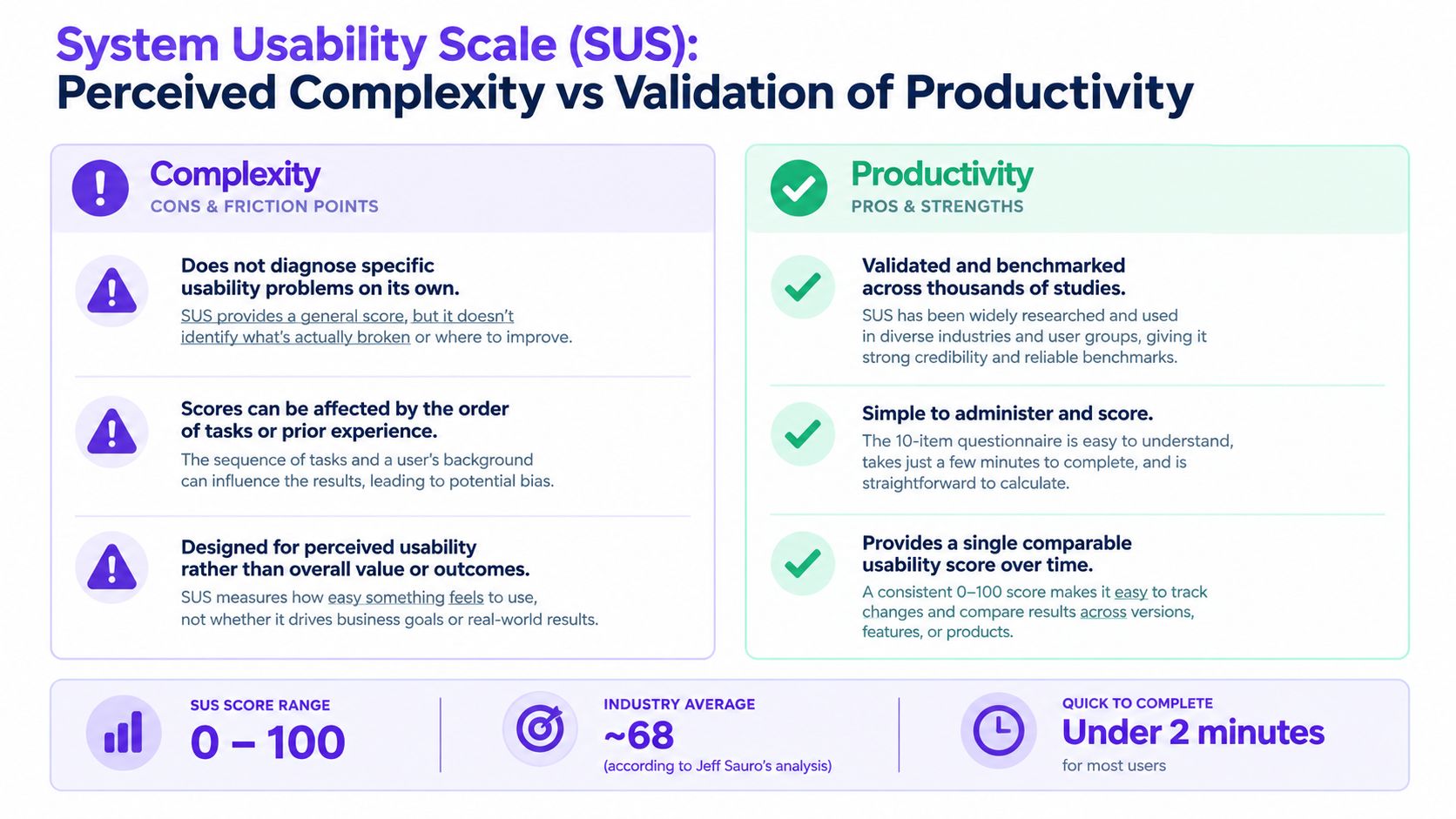
When the question concerns a digital brainstorming platform, a general satisfaction score may hide the problem. The System Usability Scale gives you a standardized instrument. It uses 10 statements, alternating positive and negative wording, rated on a 5-point scale from “Strongly disagree” to “Strongly agree.” Example statements include:
- I think that I would like to use this system frequently.
- I found the system unnecessarily complex.
SUS responses are converted into a 0 to 100 usability score. The scale was developed by John Brooke while working at Digital Equipment Corporation, and UX teams use it to compare perceived usability across releases and tasks.
Administer it after a realistic task
Ask participants to complete a full activity, such as creating a brief, running a brainstorm, and organizing the resulting ideas. Then administer SUS while the workflow is still fresh. Pair the score with a few focused questions:
Which step was hardest to complete?
What would you change first?
What did you expect to happen but didn't?
A usability score tells you that friction exists. The task-specific follow-up helps you find where to remove it.
Track the score after product changes, but don't rely on it alone. A release can improve navigation while making the core ideation flow more confusing. Include task completion observations and open comments. This SUS explainer video provides a concise introduction to the method.
10 Post-Survey Questions Comparison
| Method | 🔄 Implementation Complexity | ⚡ Resource requirements | ⭐ Expected outcomes | 💡 Ideal use cases | 📊 Key advantages |
|---|---|---|---|---|---|
| Net Promoter Score (NPS) Question | Very low, single 0–10 item | Minimal time; works with small surveys but needs sample for stability | ⭐⭐⭐, trendable loyalty/advocacy signal; not diagnostic | Benchmarking across sessions; stakeholder reporting | Standardized benchmark; high response rate; predicts word‑of‑mouth |
| Post-Session Customer Satisfaction (CSAT) Question | Very low, single 1–5/1–7 item | Minimal; asked immediately after session | ⭐⭐, quick quality check of immediate experience | End-of-session quality checks; facilitator comparison | Simple, intuitive, fast to compare across sessions |
| Customer Effort Score (CES) Question | Low, single task‑specific item | Minimal but must target a specific task or step | ⭐⭐⭐, pinpoints friction that affects repeat use | Onboarding, navigation, facilitation flow evaluation | Actionable for process fixes; correlates with loyalty |
| Ideas Usefulness Rating Question | Low–Medium, rating of outputs; best with follow‑up | Moderate if you collect delayed follow-up to measure real value | ⭐⭐⭐⭐, measures perceived business value of outputs | Prioritizing ideas; validating which concepts to develop | Directly ties sessions to business outcomes; informs technique selection |
| Most Valuable Moment (Open‑Ended) | Medium, qualitative free text | Higher analysis effort (coding or manual review) | ⭐⭐⭐, rich, specific insights and memorable highlights | Qualitative learning, testimonials, refining facilitation | Surface unexpected insights; provides quotable evidence |
| Participation Equity Question | Low, single agreement item | Minimal; anonymity recommended for candor | ⭐⭐, flags dominance and inclusion gaps | Improving group dynamics; ensuring diverse contribution | Highlights imbalance; guides facilitation and role invites |
| Psychological Safety Question | Low–Medium, sensitive wording benefits from repeats | Minimal per survey; best measured longitudinally | ⭐⭐⭐, indicates readiness for risky/novel ideas | Team development, creativity interventions, multi‑session work | Linked to originality; identifies teams needing stronger norms |
| Intent to Apply Question | Low, forward‑looking likelihood item | Minimal initially; follow‑up recommended to verify action | ⭐⭐, leading indicator of adoption but can overstate follow‑through | Prioritizing ideas for next deliverables; measuring momentum | Connects session to expected action; easy to track over time |
| Perspective Diversity Question | Low, yes/no or scale item | Minimal; benefits from paired qualitative follow-up | ⭐⭐, shows exposure to new viewpoints; needs baseline | Testing bias‑reduction methods; cross‑functional sessions | Validates that sessions broaden thinking; guides participant mix |
| System Usability Scale (SUS) | Medium, 10 standardized items and scoring | Low–Moderate; quick to complete but requires score conversion | ⭐⭐⭐⭐, validated 0–100 usability benchmark for software | Platform usability testing (e.g., Bulby); release comparisons | Widely validated and benchmarked; quick comparable usability score |
Turn Survey Answers Into Better Next Sessions
A post-session survey should lead to a change. If the results only sit in a dashboard, participants learn that giving feedback has no practical effect.
Start with three questions that match a clear decision. For example, use NPS to measure whether people would advocate for the session, CES to find workflow friction, and Intent to Apply to test whether ideas will move into real work. Keep the wording and scales stable after each comparable session so the results remain useful over time.
Review results by role and session type. A single overall score can hide a serious pattern. Strategists may find the ideas useful while account teams struggle to turn them into client-ready material. Experienced users may report low effort while new users get lost during setup. Those differences tell you where to act.
Choose one change based on the lowest meaningful result. If CES is weak, simplify an exercise or remove a confusing step. If equity scores are low, add silent ideation before group discussion. If intent is high but later adoption is low, assign owners and agree on the first action before the session ends. Don't make five changes at once, because you won't know which one helped.
Use follow-up carefully. A systematic review found that reminder letters and telephone contact produced a combined odds ratio of 3.7, with a 95% confidence interval of 2.30 to 5.97 and p < 0.00001, while more intensive reminders increased response by an average of 24% (systematic review of postal questionnaire methods). The practical lesson is simple: a thoughtful reminder can bring more people into the dataset.
But a higher response rate doesn't automatically mean better data. A review of nonresponse follow-up found higher item-nonresponse rates among respondents requiring more follow-up attempts on approximately 75% of 64 reported survey items, and late respondents sometimes gave less accurate or more variable answers (research on nonresponse follow-up). Review late responses separately when the decision is important.
Keep the instrument short. Evidence from 25,080 real-world web surveys found that completion rates declined as survey length and question difficulty increased, with the first question's type and length also affecting completion (web survey completion research). Put the easiest question first, avoid asking for demographics before participants can answer about the session, and track invitation-to-start rate, start-to-completion rate, median completion time, and item missingness.
A strong default for Bulby sessions is a four-question core: a usefulness rating, an ease-of-use rating, an intent question, and one optional diagnostic comment. Guidance commonly recommends roughly 70% to 80% closed-ended questions and 20% to 30% open-ended questions, while reporting substantially higher item nonresponse for open-ended items, about 18% compared with approximately 1% to 2% for closed-ended items (survey design guidance). Use open text to diagnose, not to replace every measurable question.
Prioritize the uncertainty with the highest decision value. Research on follow-up design found that presenting five or seven follow-up questions reduced response accuracy compared with presenting three, while grayed-out or unfolding designs performed better than a next-page design (Census survey methodology resources). Three focused follow-ups can reveal more than a long satisfaction battery.
Treat each survey as part of the facilitation. Share the change made from the previous round, ask the smallest set of questions that can guide the next decision, and review the answers before planning the next session. The best teams don't use feedback as a report card. They use it as a repeatable improvement loop, much like running a post mortem.
Bulby helps marketing agencies, creative teams, and brand strategists run structured brainstorming sessions that turn scattered input into stronger campaign concepts, messaging angles, and creative strategies. Use the post survey questions above to measure usefulness, friction, inclusion, and adoption after a real session, then visit Bulby to give your team a clearer path from ideas to action.