
A team has a pitch deadline, a client asking for something fresh, and a whiteboard covered in familiar answers. There's the influencer video, the discount carousel, the emotional brand film, and the product demo with a new headline. None is necessarily bad. The problem is that none gives the team a clear reason to believe it will work for this audience, on this channel, with this budget.
Strong campaign ideas rarely stall because an agency lacks talent. They stall because the process produces options without enough structure, fresh inputs, or a practical route from raw thought to finished execution. A good idea needs more than a clever line. It needs an audience trigger, a channel fit, a production logic, and a first test.
The ten campaign ad ideas below are designed as brief-ready starting points. Each one connects strategic thinking to a real campaign decision. Use them to shape a pitch, focus a workshop, or challenge a predictable creative route before the team invests in production.
Table of Contents
- 1. Structured Brainstorming Frameworks
- 2. AI-Assisted Insight Generation
- 3. Cross-Functional Collaborative Workshops
- 4. Consumer Persona-Driven Ideation
- 5. Multi-Channel Campaign Ecosystems
- 6. Rapid Iteration and Testing Frameworks
- 7. Constraint-Based Creative Problem Solving
- 8. Emotional Mapping and Brand Story Architecture
- 9. Trend Forecasting and Cultural Relevance Integration
- 10. Data-Driven Creative Strategy Alignment
- 10-Point Campaign Ad Ideas Comparison
- Turn These Campaign Ideas Into Your Next Pitch
1. Structured Brainstorming Frameworks
Unstructured brainstorming tends to reward the fastest speaker and the most familiar answer. A structured session gives the team a sequence, a shared brief, and permission to explore before anyone judges the work. That matters when a client wants something new but the team is working from the same category references.
Start with a consumer tension, not a request for slogans. For example, a meal-delivery brand might ask why busy professionals still avoid ordering on demanding evenings. The team can first collect observed behaviors, then define the job the service helps customers complete, then generate territories around relief, control, or spontaneity.
A facilitator should separate divergent thinking from selection. Early ideas can be rough. Later, the group can score them against the brief, brand fit, audience relevance, and channel potential. A smaller team often works best for the first session, especially when the agency is still learning how to use the framework.
For a practical guide to structured brainstorming methods, document the prompts, decisions, and rejected routes. That record helps the account team explain the creative logic to a client rather than presenting a mysterious “big idea.”
Practical rule: Don't ask a workshop to produce a finished campaign. Ask it to produce several strong territories, then develop the best route separately.
A first test might be simple. Turn three territories into rough social hooks and ask a small internal review group to identify which one is clearest, most distinctive, and easiest to adapt into video, display, and landing-page copy. You can also use the resulting territories to build creator content ideas for sponsorship growth when the campaign includes partnerships.

2. AI-Assisted Insight Generation
AI can shorten the distance between a messy research folder and a useful creative brief. It can organize customer comments, competitor messaging, search behavior, reviews, and social conversations into themes that a team can investigate. It shouldn't decide what the brand believes or turn an unverified pattern into a campaign claim.
Suppose a financial app wants to reach people who avoid investing because the language feels intimidating. An AI-assisted research pass could cluster customer questions around risk, trust, time, and complexity. The strategist still needs to check the underlying comments, confirm the audience tension through research, and decide whether the brand has permission to address it.
Use AI to create inputs for thinking, not conclusions. Ask for several audience hooks, message hierarchies, objections, and creative territories. Then record the source behind each useful insight so the client can see how the team reached the recommendation.
The opportunity is practical because AI adoption in advertising remains incomplete. The IAB's 2025 State of Data report says only 30% of agencies, brands, and publishers report full AI integration across the media-campaign lifecycle, while roughly half of organizations that haven't fully integrated AI expect to do so by 2026, a projection noted in the same source.
Use that gap to start with contained tasks:
- Cluster evidence: Group reviews, comments, and search themes before writing concepts.
- Expose assumptions: Ask the system to identify what the evidence doesn't prove.
- Compare routes: Generate distinct territories rather than many versions of one generic idea.
- Preserve traceability: Keep approved inputs, sources, and human decisions in the working brief.
A first test is to give the team one verified audience problem and ask for five different hooks. Have strategists reject any hook that can't be supported by the evidence. Platforms such as PostSyncer's AI ad creator can support production exploration, while the agency remains responsible for judgment and validation. Further guidance on AI for marketing strategy can help teams define where research ends and creative interpretation begins.

3. Cross-Functional Collaborative Workshops
A campaign can look excellent in a creative review and still fail in the media plan, sales process, or approval chain. Bring the strategist, creative lead, account manager, channel specialist, and relevant client stakeholders into the concept stage. Each person sees a different risk and a different opportunity.
The audience trigger should come from a real business problem. A software company might need to move buyers from awareness to a product trial, while the sales team knows prospects don't trust broad claims. The creative team can turn that objection into a demonstration idea, and the media team can identify where search, social, and retargeting should carry different parts of the story.
Create something visible during the workshop. A message ladder, journey map, rough storyboard, or channel sketch makes disagreement easier to resolve because people can respond to the work rather than to abstract preferences. Anonymous idea collection can also help quieter participants contribute before senior voices shape the room.
Use a focused marketing strategy workshop when the brief is unclear or several teams are pulling in different directions. The session should finish with named owners, open questions, and a decision on what the client will see.
A useful workshop doesn't eliminate disagreement. It makes the disagreement specific enough to resolve.
Follow up quickly. Send the selected territory, the reason it won, the unresolved evidence gaps, and the first production actions while the discussion is still fresh. For a campaign aimed at multiple stakeholders, include the customer voice through research excerpts, support tickets, sales calls, or carefully selected representatives rather than relying only on internal opinion.
A first test is a short workshop around one live client brief. Ask each function to produce one contribution, such as an audience tension, a platform role, a proof point, or a production constraint. Combine the outputs into one rough campaign route before investing in polished layouts.
4. Consumer Persona-Driven Ideation
A persona should change the work, not decorate a slide. If the team can't explain how a persona affects the hook, proof point, visual treatment, or call to action, it isn't doing strategic work.
Take a home-fitness service with two audiences. A time-poor beginner may need reassurance that the service won't make them feel judged. An experienced user may want progression, variety, and evidence of challenge. One generic ad can mention both, but it may motivate neither. Separate concepts can keep the central brand promise consistent while changing the audience trigger.
Build personas from real customer evidence. Include the desired outcome, the current workaround, the emotional barrier, the purchase objection, and the moment when the person is most likely to act. Give each persona a memorable name and visual reference, then make the team use those labels during concept reviews.
The persona should guide channel choice as well. A practical product demonstration may work in search and retargeting, while a confidence-building story may earn attention in short-form video. The landing page should continue the same argument rather than forcing every audience into identical copy.
Use a dedicated persona creation workshop to challenge assumptions before the creative team begins. Don't invent a precise persona just because it sounds realistic. Mark uncertain details as hypotheses and decide how the campaign will test them.
Turn the persona into a brief
Write a one-page card with four fields:
- Audience trigger: What situation creates urgency or curiosity?
- Desired change: What should feel easier, safer, faster, or more rewarding?
- Reason to believe: What evidence can the brand provide?
- First action: What should the person do after seeing the ad?
A first test is to write one social video opening and one paid-search ad for each priority persona. Ask a sales or customer-service colleague whether the language sounds like a real customer, not an agency description. Then compare which objections remain unanswered.
5. Multi-Channel Campaign Ecosystems
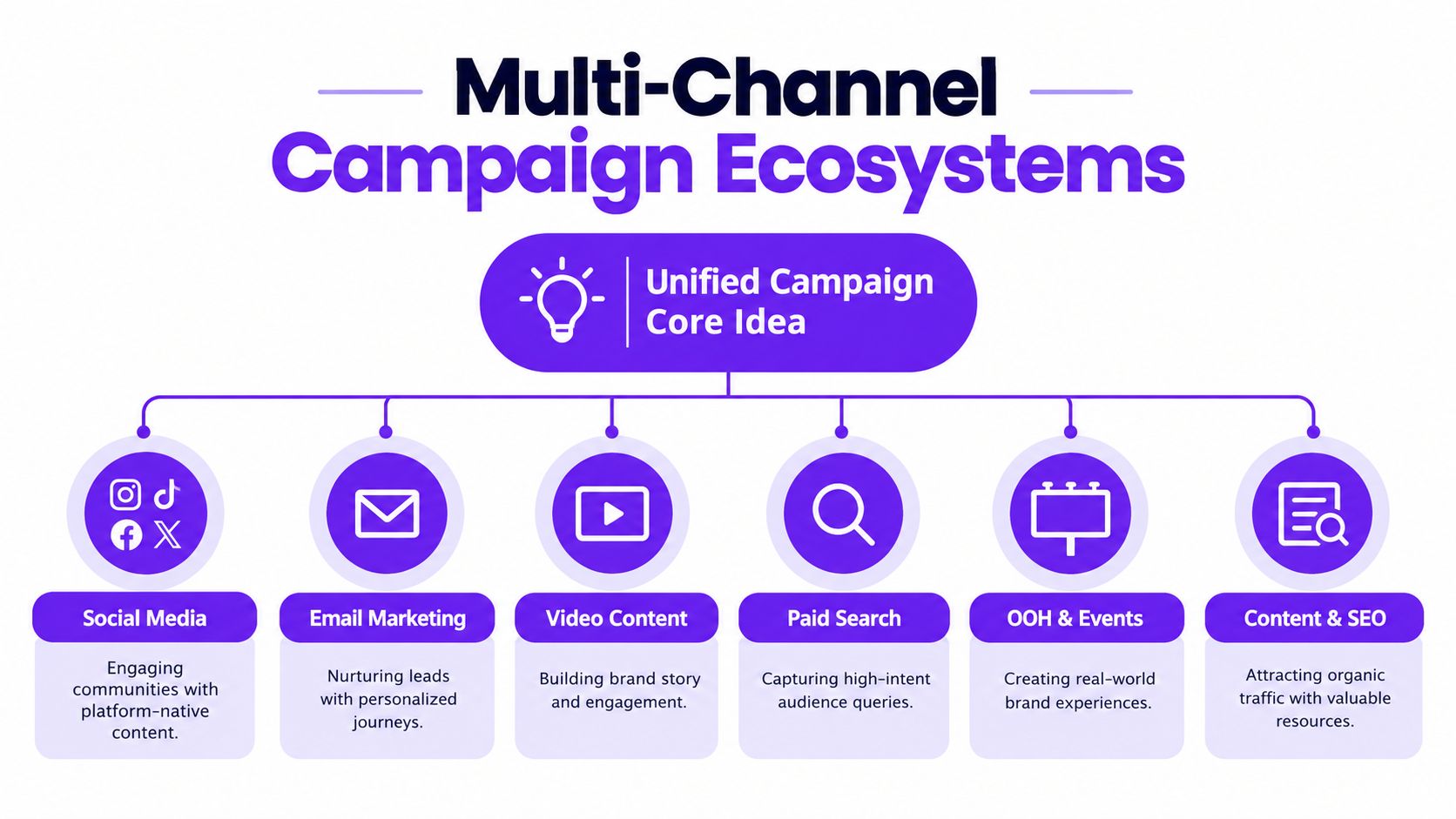
A campaign ecosystem begins with one recognizable idea and gives each channel a useful job. It doesn't copy the same asset everywhere. A social video may create curiosity, a search ad may capture active demand, email may provide proof, and an out-of-home placement may make the idea visible in a specific location.
The audience trigger should remain stable while the execution changes. A grocery brand could build a campaign around helping people decide what to cook when energy is low. Short video can dramatize the decision moment, search can answer immediate meal questions, retail media can connect the idea to available products, and email can turn previous behavior into a relevant suggestion.
This channel discipline matters because advertising investment is spread across different digital environments. WARC forecast global advertising expenditure at $1.17 trillion in 2025, with 7.4% year-over-year growth. The forecast projected social media to attract 40.6% of new gross advertising dollars, non-retail search 22.2%, and retail media 21.5%. Social advertising alone was projected to grow 14.9% to $306.4 billion, while retail media was projected to reach $175 billion. These are projections from WARC's 2025 global forecast update, not guarantees for any individual campaign.
Channel decision: Choose the core idea first, then ask what each channel can do that the others can't.
Map the customer journey before creating assets. Define the role, message, format, owner, and KPI for every touchpoint. Keep the visual system consistent, but let platform behavior shape length, pacing, interaction, and CTA.
A first test is to sketch one idea across three stages, discovery, consideration, and action. Write one asset for each stage and check whether a customer can understand the connection without seeing every execution. A practical omnichannel marketing strategy should make the journey clearer, not merely increase the number of placements.
6. Rapid Iteration and Testing Frameworks
A polished concept can still contain a weak opening, an unclear benefit, or a call to action that asks too much. Test the fragile part before the agency commits to a full production route. A rough storyboard, static mock-up, voiceover draft, or landing-page wireframe can reveal problems early.
For a streaming service, the first test might compare two opening tensions. One could lead with a specific viewing problem, while the other leads with a character or cultural moment. Keep the product promise and audience constant. If the team changes the hook, visual, offer, and CTA together, the result won't explain what drove the response.
Set the success metric before the test runs. Awareness work may need attention or recall signals, while a conversion route may focus on qualified visits, completed trials, or purchases. The right measure depends on the campaign job. A high click rate doesn't rescue an ad that attracts the wrong audience or creates a poor post-click experience.
Use testing to learn, not to decorate a dashboard
Run a controlled comparison with a clear hypothesis:
- Hypothesis: A direct audience tension will create more qualified interest than a feature-led opening.
- Variable: Change the first scene or first line only.
- Audience: Keep the intended audience and placement consistent.
- Decision: Define in advance what result would justify further development.
Avoid declaring a winner from a noisy early signal. The team needs enough evidence for the decision it is making, and it should record what happened, what remains uncertain, and what to test next. Speed helps only when the learning is interpretable.
A first test is to produce three low-cost variations of the same concept. Compare the opening hook, proof point, and CTA in separate rounds rather than changing all three at once. This protects the creative idea while showing which executional choices deserve production investment.
7. Constraint-Based Creative Problem Solving
Constraints can make a campaign sharper. A small production budget, a fixed platform format, a short approval window, or a strict legal requirement forces the team to choose what the idea really needs.
A local repair service might not afford a brand film, but it could own a repeatable “before the problem gets worse” format. Each short ad shows a familiar warning sign, a quick expert explanation, and one action the viewer can take. The limitation becomes the campaign device. It creates consistency without pretending the brand has the resources of a national advertiser.
Write the constraints at the top of the brief. Include media formats, available footage, legal restrictions, audience exclusions, production time, and the action the customer must take. Ask the team to turn each limit into a creative question. “How can we make this work without sound?” is more useful than “We can't rely on dialogue.”
Keep feasibility review separate during the first burst of ideation. If the producer rejects every unusual route immediately, the team will return to safe executions. Bring feasibility into the shortlist stage, when the creative group can protect the central insight while adapting the production method.
The strongest constraint is often the one that gives the audience a reason to recognize the campaign.
A first test is to brief the team with one real limitation and ask for three concepts that use it visibly. For a short-form campaign, require a complete idea in one location. For paid search, require the concept to survive in concise copy and a landing-page headline. For out-of-home, require the message to work at a glance.
8. Emotional Mapping and Brand Story Architecture
Features explain what a product does. Emotional architecture explains why the audience should care now. It gives the campaign a beginning, a change, and a resolution without making the brand the hero of every scene.
Start with the audience's emotional movement. A cybersecurity brand might take the audience from quiet worry, to recognition of a hidden risk, to confidence in a practical next step. The product should earn its place as the tool that enables the change. A list of technical features alone won't create that arc.
The protagonist is usually the customer. The brand can act as guide, proof provider, or enabler. This keeps the story grounded and reduces the risk of self-congratulation. A customer story, creator demonstration, or day-in-the-life execution can each carry the same emotional structure if the central change remains clear.
Historical creative research supports the value of emotional territory. A study of 175 campaigns from major brands compared creative-award performance with commercial outcomes between 2000 and 2008. Creatively awarded campaigns were, on average, 11 times more efficient than non-awarded campaigns when measured by business effects relative to excess share of voice. The research also found that 35% of consumers rated award-winning campaigns as highly liked, compared with 20% for non-awarded work, and that 44% of awarded campaigns were classified as emotional, compared with 19% of non-awarded campaigns. The findings are described in Marketing Week's report on advertising creativity.
Treat those findings as a reason to explore emotional ideas, not as a promise of performance. The historical sample also had television at its center, so a current team should adapt the principle to the channels and behaviors in its brief.
A first test is to write the campaign as three sentences: the audience's starting feeling, the moment of change, and the action that follows. If the product doesn't help create the change, the idea is probably relying on emotion without a credible brand role.
9. Trend Forecasting and Cultural Relevance Integration
A cultural moment can give a campaign energy, but relevance isn't the same as speed. A brand that reacts to every visible trend can sound opportunistic. A brand that monitors shifts early can choose fewer moments and prepare work that has a genuine connection to its role.
Separate enduring changes from temporary formats. A shift in how people think about privacy, work, identity, or value may support a platform-level campaign. A meme may support a short response, but it rarely deserves a brand strategy on its own. The strategist's job is to decide whether the trend changes the audience's problem or merely changes the language around it.
Use a cultural map with three columns: what is changing, who is affected, and why the brand has permission to respond. Then identify the proof the brand can provide. An inclusive message without changes in the customer experience will be challenged quickly. A sustainability idea without evidence can weaken trust rather than strengthen it.
Build relevance without losing control
A trend-led campaign needs a faster approval path than a conventional brand platform. Pre-approve tone, visual boundaries, legal guidance, and escalation rules. Prepare modular assets that can be adapted when timing moves. Keep the core idea broad enough to survive a change in the cultural calendar.
For example, a travel brand could build around the tension between planning and spontaneity, then adapt the expression to a relevant cultural moment without pretending the brand owns that moment. A financial brand might respond to a public conversation about cost pressures by offering useful guidance rather than a forced joke.
A first test is to choose one emerging shift and create two routes. One should address the shift directly. The other should use the underlying audience tension without naming the trend. Present both to the client. The comparison reveals whether the cultural reference adds meaning or only adds topical decoration.
10. Data-Driven Creative Strategy Alignment
Data should sharpen a creative decision, not replace one. A campaign team might see that a product page attracts interest from several use cases, but the numbers won't tell the team which human problem deserves the central idea. Combine behavioral evidence with interviews, customer language, and channel context.
Start with a baseline. Define the business goal, audience, current behavior, and creative question before the campaign launches. If the goal is qualified trial, don't optimize the concept only for cheap attention. If the goal is brand consideration, don't force every early execution to behave like direct response.
Creative quality deserves a place in that decision. Analysis covering nearly 450 digital and television campaigns reportedly found that creative quality contributed 49% of incremental sales lift, exceeding the combined influence of reach, targeting, recency, and brand equity. Separate digital advertising research cited in the same synthesis attributes 56% of purchase-intent impact to creative quality. These figures come from the summary of ad creative performance statistics, so teams should inspect the underlying methodology before treating them as a universal planning rule.
Turn the principle into a scoring rubric. Rate each concept for proposition clarity, distinctiveness, emotional relevance, brand linkage, audience tension, proof, and CTA strength. Use the rubric to rank concepts before production, then test one variable at a time.
A first test is to score three creative routes with both the creative team and the performance team. Discuss the largest gaps rather than averaging them away. If a concept is distinctive but weakly linked to the brand, fix the linkage before buying more media. If it is clear but interchangeable, search for a stronger device or audience tension.
10-Point Campaign Ad Ideas Comparison
| Method | 🔄 Implementation complexity | ⚡ Resource requirements / speed | 📊 Expected outcomes | ⭐ Key advantages | 💡 Quick tip |
|---|---|---|---|---|---|
| Structured Brainstorming Frameworks | Medium, needs training and facilitation | Medium, facilitator, templates, time; moderate speed | High, higher-quality, equitable ideas and clear process | Increases idea quality, reduces bias | Start with small teams; time-box stages |
| AI-Assisted Insight Generation | Medium–High, integration and tooling setup | High, data sources, tools, analyst oversight; very fast outputs | High, rapid, data-backed insights if validated | Scales research, uncovers non-obvious patterns | Always validate AI outputs with human review |
| Cross-Functional Collaborative Workshops | High, coordination and skilled facilitation required | High, multiple stakeholders, time-intensive; moderate speed | High, comprehensive concepts and early alignment | Breaks silos; reduces revision cycles | Establish psychological safety and clear roles |
| Consumer Persona-Driven Ideation | Medium, research-heavy but repeatable | Medium–High, research effort and maintenance; moderate speed | High, more relevant targeting and messaging | Produces emotionally resonant, testable direction | Base personas on real research; update regularly |
| Multi-Channel Campaign Ecosystems | Very High, complex orchestration across channels | Very High, production, media, PM systems; slower to launch | Very High, broad reach, synergy; attribution complexity | Maximizes reach and reinforcement across touchpoints | Build a flexible core idea and master campaign calendar |
| Rapid Iteration and Testing Frameworks | Medium, process and analytics setup | Medium, testing audiences and tools; fast cycles | High, validates winners, reduces production risk | Fast learning loops; reduces wasted spend | Define metrics early; test one variable at a time |
| Constraint-Based Creative Problem Solving | Low–Medium, set constraints and facilitation | Low, uses limits to reduce resource needs; often fast | Medium–High, inventive, feasible ideas under limits | Sparks creative innovation within limits | Make constraints visible and separate feasibility checks |
| Emotional Mapping & Brand Story Architecture | High, needs storytelling and psychological insight | Medium–High, research and creative time; moderate speed | High, deep resonance and long-term loyalty (harder to quantify) | Builds memorable emotional connections | Map protagonist arc; test for authenticity |
| Trend Forecasting & Cultural Relevance Integration | Medium–High, ongoing monitoring and foresight | Medium–High, listening tools and analysts; enables timely activation | Medium–High, increased relevance and earned media when timed well | Positions brand as culturally aware and proactive | Differentiate fads vs. enduring trends; plan 6+ months ahead |
| Data-Driven Creative Strategy Alignment | High, analytics integration and modeling | High, data teams, dashboards; supports efficient optimization | High, measurable ROI and repeatable success patterns | Reduces guesswork; enables confident recommendations | Combine quantitative data with qualitative insight |
Turn These Campaign Ideas Into Your Next Pitch
Don't take all ten ideas into the client meeting. Choose two or three based on the client's objective, audience, channel mix, production capacity, and budget. A brand with an unclear audience problem may need a structured workshop or persona-led route. A campaign with many placements may need an ecosystem model. A mature performance program may benefit more from rapid testing and a creative scoring rubric than from another broad ideation session.
Use the client brief to make the choice explicit. Write down the business problem, the audience trigger, the channel where the idea should first appear, and the proof the brand can provide. Then identify the trade-off. A creator-led concept may feel native and credible but require stronger measurement design. A culturally relevant idea may earn attention but need stricter approval rules. A highly emotional platform may build memory but still need a clear conversion path.
Run a short workshop before the pitch. Ask the team to turn each selected route into one audience-facing execution, one channel adaptation, and one testable hypothesis. Keep the work rough. The point is to discover which idea survives contact with real decisions, not to spend the pitch budget before the client has chosen a direction.
A repeatable campaign template system can help teams capture the brief, audience, message, channel roles, evidence, owners, and tests in one place. Bulby is another option for structured, collaborative brainstorming. It can guide teams through idea generation, collect and summarize contributions, surface promising concepts, and turn selected thinking into actionable next steps.
Choose one idea this week. Assign one owner, define one success metric, and draft the first-round concept in the format the audience will see. If the team can't produce that first version, the idea isn't ready for the pitch.
Bulby helps agencies and creative teams structure collaborative brainstorming for campaign territories, messaging angles, audience insights, and pitch development. Visit Bulby to turn a campaign brief into a guided session with clearer concepts and practical next steps.