
A client campaign can look excellent in isolation and still feel broken to the customer. The paid social creative is polished, the email sequence has a clear offer, and the retail team has received its launch materials. Yet the social ad promotes a product the store team can't explain, the email ignores a completed purchase, and customer service has no visibility into either interaction.
That gap is where many agency campaigns lose momentum. An omnichannel marketing strategy connects the journey, not just the media plan. It gives strategists, creatives, account teams, media specialists, CRM managers, and client stakeholders a shared way to decide what the customer should experience next.
Table of Contents
- When Your Campaign Ideas Feel Disconnected
- What Makes Omnichannel Strategy Different
- Mapping Customer Journeys for Agency Campaigns
- Selecting and Integrating the Right Channels
- Building the Tech Stack and Measurement Framework
- Governance, Optimization, and Scaling Success
When Your Campaign Ideas Feel Disconnected

A typical agency brainstorming session starts with energy. The creative team develops a strong central idea, the media team identifies useful placements, and the account director shapes the presentation around a compelling business outcome. The trouble starts when each team turns that idea into its own channel deliverable.
The paid social team builds awareness assets. The email team writes a promotion. The ecommerce team changes landing pages. Retail receives point-of-sale materials later in the process. Nobody has deliberately designed the handoff between those experiences, so the customer has to do that work alone.
This is more than an operational inconvenience. Harvard Business Review's analysis of 46,000 shoppers found that 73% used multiple channels during their purchase journey, and omnichannel shoppers spent approximately 9% more than single-channel shoppers, as reported in this summary of the Harvard Business Review omnichannel retail finding. Coordinated planning therefore addresses the behavior of most shoppers, rather than a narrow audience segment.
The agency problem behind the customer problem
An agency's structure often reinforces fragmentation. Specialists are rewarded for channel performance, client contacts are divided by discipline, and campaign timelines move through handoffs rather than shared working sessions. A campaign can be internally efficient while externally confusing.
The practical shift is to stop asking, “What should we publish on this channel?” Start with, “What does the customer know, need, or expect at this point in the journey?” That question changes the brief. Social may create recognition, search may resolve uncertainty, email may recover intent, and service may protect trust after purchase. Each touchpoint has a job, and that job depends on what happened before.
A stronger campaign development process makes those dependencies visible before creative production begins. The campaign development process should include a shared journey view, not only a creative brief and a channel checklist.
Practical rule: If two teams can launch their work without knowing what the other team is promising, the campaign isn't being planned as an omnichannel experience.
What changes in the workshop
An agency workshop should produce more than a theme or a list of executions. It should leave the team with:
- A journey narrative: The customer's movement from first exposure through evaluation, purchase, service, and advocacy.
- A channel role map: The specific contribution each channel makes at each stage.
- A context handoff: The information the next touchpoint must retain, such as viewed products, stated preferences, or unresolved problems.
- A client decision log: The choices the client must make about data, offers, approvals, service rules, and measurement.
- A friction register: The points where inconsistent messages or repeated requests could cause abandonment.
This approach makes ideation more useful. Creative teams still generate distinctive concepts, but those concepts are tested against the customer journey. Account teams can present a coherent operating model instead of promising that every channel will “work together” without explaining how.
What Makes Omnichannel Strategy Different
A customer sees a paid social ad, searches for the product later, receives an email, and then contacts support with a question. If each agency or client team treats those interactions as separate campaigns, the customer has to rebuild the context at every step. Omnichannel marketing asks the brand to remember what happened in one place when the customer moves to another. That changes the brief, workflow, technology requirements, and definition of success.
A multichannel campaign may run email, paid social, search, a website promotion, and an in-store activation at the same time. Each execution can be well made, yet the messages may conflict, audience rules may differ, and a customer who has already converted may continue receiving acquisition advertising. Omnichannel planning adds shared context, coordinated sequencing, and rules for what should stop as well as what should start.
For agencies, the difficult work often happens before launch. Media, CRM, creative, analytics, and account teams may each hold part of the customer picture. A structured workshop, supported by platforms such as Bulby, can turn those separate inputs into one campaign idea and one client-facing logic. The platform does not solve ownership or data gaps. It gives teams a practical place to test concepts, expose contradictions, and agree on decisions before production.
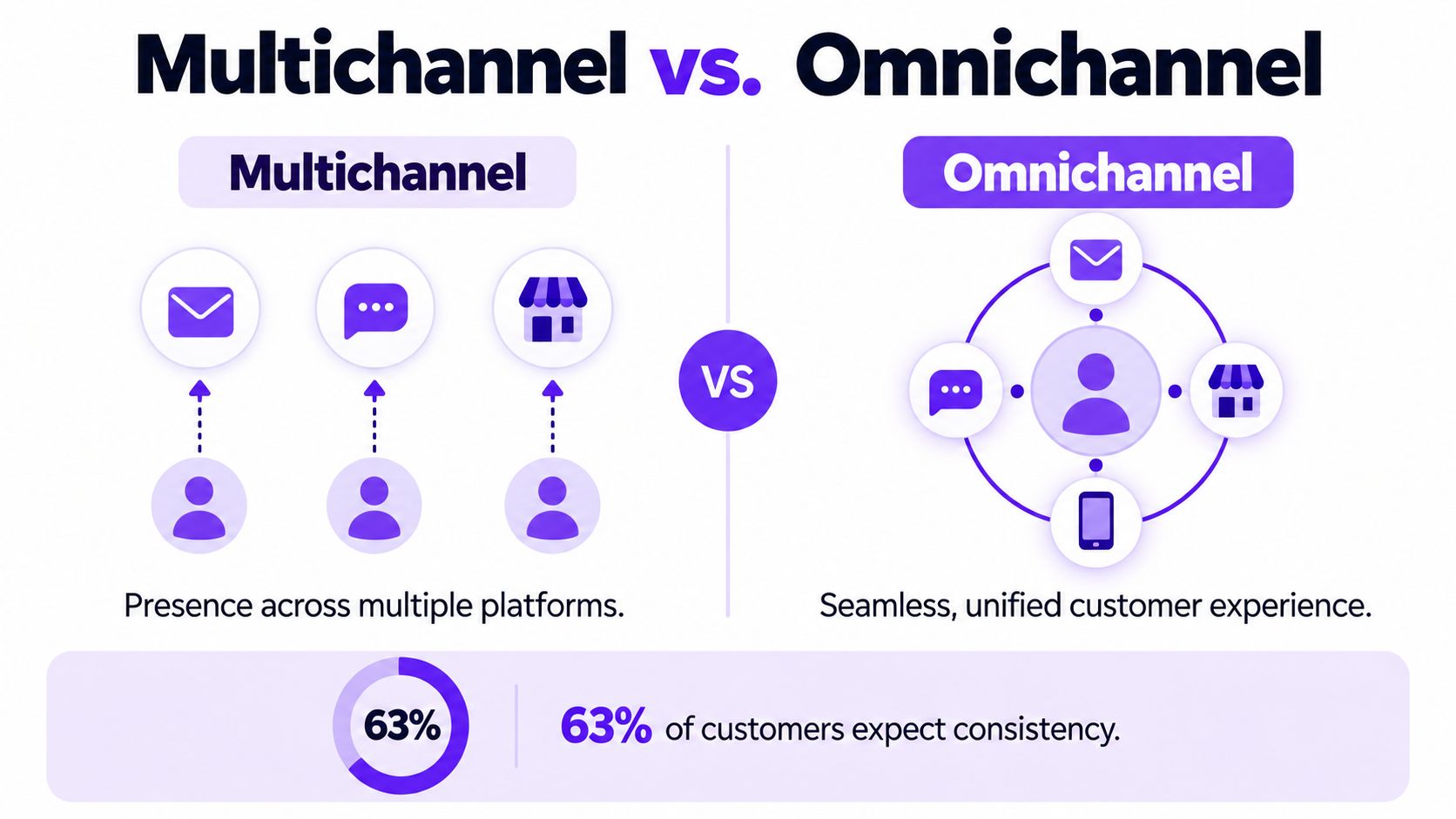
The difference is operational
A useful distinction for client conversations is this:
| Multichannel approach | Omnichannel approach |
|---|---|
| Each channel has its own plan | Channels support a shared journey |
| Audience definitions vary by platform | Eligibility and suppression rules are coordinated |
| Messaging is adapted independently | The core promise and customer context persist |
| Reporting focuses on channel outcomes | Measurement includes journey and incremental outcomes |
| Handoffs depend on manual communication | Handoffs are defined in the operating model |
Omnichannel planning introduces shared context, coordinated sequencing, and clear messaging rules. Our messaging strategy guide explains how to define the core promise that must survive every channel handoff.
The performance evidence used to support coordinated execution is directional, not a guarantee. One widely cited analysis reported that campaigns using three or more channels generated a 287% higher purchase rate than single-channel campaigns. Other summaries of the same vendor-platform evidence reported an order-rate increase of up to 494% for multi-channel activity compared with single-channel efforts. Those figures appear in this overview of omnichannel marketing performance data. Results vary with audience, category, offer, creative, attribution method, and channel mix.
The practical lesson is not to add channels for their own sake. Connected sequencing can outperform parallel activity when each interaction supports the next. Sending the same creative everywhere is not integration. A video can introduce a problem, search can answer it, email can support evaluation, and service can resolve an objection.
Four foundations agencies must define
Identity resolution determines whether the organization can recognize a customer across relevant interactions while respecting consent and data limitations. An agency should document which identifiers are reliable and where the journey becomes anonymous, rather than promise a perfect universal profile.
Event standardization gives teams shared meanings for actions such as product view, application started, purchase completed, case opened, or preference changed. Without common definitions, CRM, analytics, media, and creative teams may optimize different versions of the same event.
Journey rules define eligibility, suppression, priority, and frequency. After conversion, acquisition messaging may need to stop. An unresolved service case may pause a promotional sequence. A change in inventory may require the promise shown in an ad to change as well.
Cross-functional ownership assigns people to decisions. The strategist owns journey logic, the client owns commercial priorities, the CRM or lifecycle team owns activation rules, and analytics owns measurement design. Creative and media then work from the same source of truth, with account teams able to explain the trade-offs clearly.
Omnichannel strategy isn't a bigger channel plan. It's a shared operating model for customer context.
Mapping Customer Journeys for Agency Campaigns
Journey mapping works when it describes what the customer is trying to accomplish, not merely where the brand publishes content. Start with one priority audience and one business problem. A campaign for new customer acquisition will require different handoffs from a post-purchase onboarding journey or a service-recovery program.
Build the map in a working session
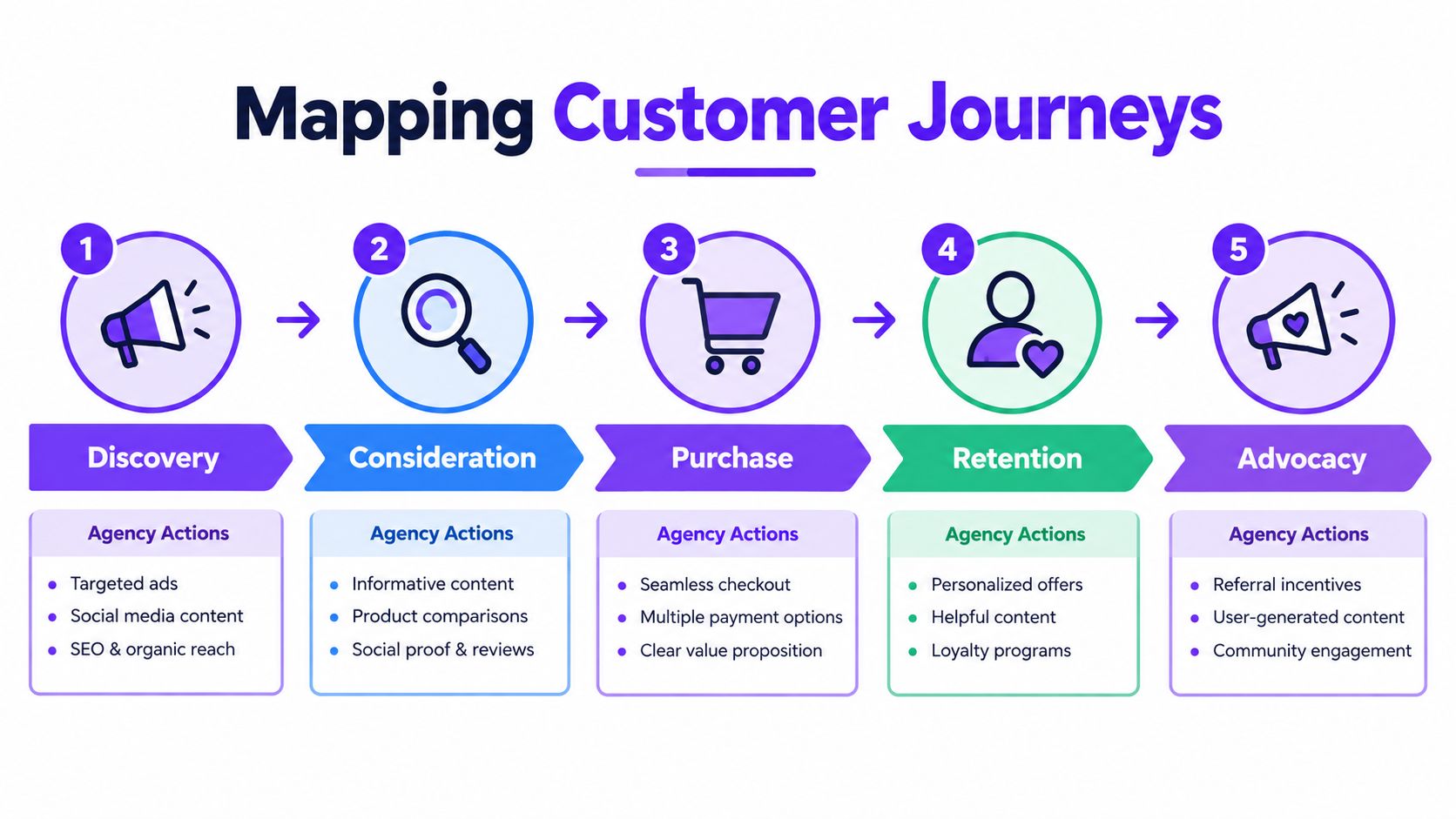
Put the journey stages across a shared board, then ask the team to describe the customer's state at each stage.
- Discovery: What problem, desire, or trigger brings the customer into contact with the brand? Identify the role of paid media, organic search, social content, partnerships, events, or physical visibility.
- Consideration: What uncertainty blocks progress? Map the proof, education, comparison tools, reviews, demonstrations, and human support that can reduce that uncertainty.
- Conversion: What action counts as progress, and what could interrupt it? Include the landing page, checkout, sales conversation, store visit, application flow, or appointment process.
- Fulfillment and onboarding: What does the customer need immediately after conversion? Define confirmation, delivery information, setup guidance, access instructions, and service expectations.
- Retention and advocacy: What reason would bring the customer back or encourage a recommendation? Connect lifecycle content, support, loyalty, replenishment, feedback, and referral experiences.
At every stage, capture five fields: customer intent, available evidence, channel role, next-best action, and failure condition. The failure condition is particularly valuable. It may be a contradictory offer, missing stock information, a support case that isn't visible to marketing, or a form that asks for information the customer already provided.
Teams that need broader mapping prompts can use this guide to omnichannel strategy as a reference while adapting the exercise to the client's systems and customer behavior.
Turn the map into campaign ideas
Once the journey is visible, ask each discipline to contribute against the same moment rather than producing ideas in separate channel lanes. A strategist can define the behavioral trigger, a copywriter can develop the message, a designer can show the experience, and a CRM specialist can specify the rule that determines who receives it.
For example, a consideration-stage idea might require a comparison page, a search message, an email follow-up, and a sales enablement asset. The workshop should decide whether those assets share a proof point, how a customer moves between them, and what changes if the customer has already spoken to sales.
A good map also exposes where research is missing. Customer interviews, support transcripts, usability sessions, search behavior, and account-team observations can reveal motivations that analytics alone won't show. A structured customer research approach helps the agency separate assumptions from evidence before it commits to a journey narrative.
Use a simple matrix after the workshop:
| Journey question | Agency output |
|---|---|
| What does the customer know now? | Message and content requirement |
| What should they know next? | Educational or proof asset |
| What action should follow? | Conversion or service path |
| What data confirms the action? | Event definition |
| What should stop afterward? | Suppression rule |
A journey map shouldn't become a decorative deliverable. The account team should use it in client approvals, the creative team should use it in concept development, and the analytics team should use it when defining outcomes.
The organizational challenge is substantial. Research cited by CX Network found that only 16% of 282 CX practitioners had a fully implemented omnichannel model, while 35% had multichannel operations with fragmented connections, as documented in this CX Network and Freshworks research resource. For agencies, the implication is clear: the workshop must align people and decisions, not just generate campaign language.
Selecting and Integrating the Right Channels
The best channel mix is rarely the largest one. Agencies should choose channels by customer behavior, journey responsibility, technical readiness, client capacity, and the cost of inconsistency. A channel that looks attractive in a media plan may be a poor choice if the client can't maintain its content, respond to leads, or pass useful context into the next interaction.
Use a decision grid rather than a popularity contest. For every candidate channel, ask:
- Customer relevance: Do priority customers already use this channel for the task at hand?
- Journey purpose: Does it create awareness, resolve doubt, convert intent, deliver the product, support the customer, or encourage return?
- Context available: Can the channel receive enough information to make the interaction relevant?
- Operational readiness: Can the client supply content, inventory, approvals, service coverage, and reporting?
- Risk of contradiction: Could this channel show an outdated offer, repeat a message, or continue after a conversion?
- Measurement quality: Can the team observe outcomes, or will it require testing to estimate impact?
Compare integration approaches honestly
A shared campaign calendar is the lightest starting point. It helps teams see launches, promotions, and major messages together, but it doesn't create real-time customer rules. It works for coordinated editorial planning and fails when individual behavior should change the next interaction.
A centralized audience and content model goes further. Teams define common segments, reusable message components, product information, and approval standards. This reduces contradictions across email, web, paid media, and sales materials, though it requires agreement about ownership.
A journey orchestration layer can activate behavior-based sequences across connected systems. It supports triggers, suppression, prioritization, and frequency management, but it also introduces integration work, data governance, testing requirements, and dependency on the client's technical team.
A customer data platform may help unify profiles and events, but it isn't a shortcut around poor definitions or weak processes. If teams disagree about what “converted,” “active,” or “at risk” means, a new platform can just make inconsistent decisions faster.
Protect the experience before expanding the mix
NICE's 2022 Digital-First Customer Experience research reported that 41% of customers would consider moving to a competitor after two poor digital experiences, while only 25% of businesses expected customers to leave that quickly, according to this summary of the NICE customer experience research. Agencies should treat inconsistency as a commercial risk, not a minor brand issue.
Start with the channels that can support a complete handoff. A useful pilot might connect paid discovery, a product or service page, email follow-up, and customer support. Add retail, mobile messaging, direct mail, or social retargeting only when the team can explain what each channel contributes and what information it receives.
Before launch, test the experience as a customer:
- Does the promise in the ad match the landing page?
- Does the customer receive a different message after taking the intended action?
- Can service staff see relevant marketing or purchase context?
- Does the offer remain valid across the chosen touchpoints?
- Can the client pause or suppress communications when circumstances change?
Ambition matters, but a smaller journey that works is more valuable than an impressive channel diagram that the client can't operate.
Building the Tech Stack and Measurement Framework
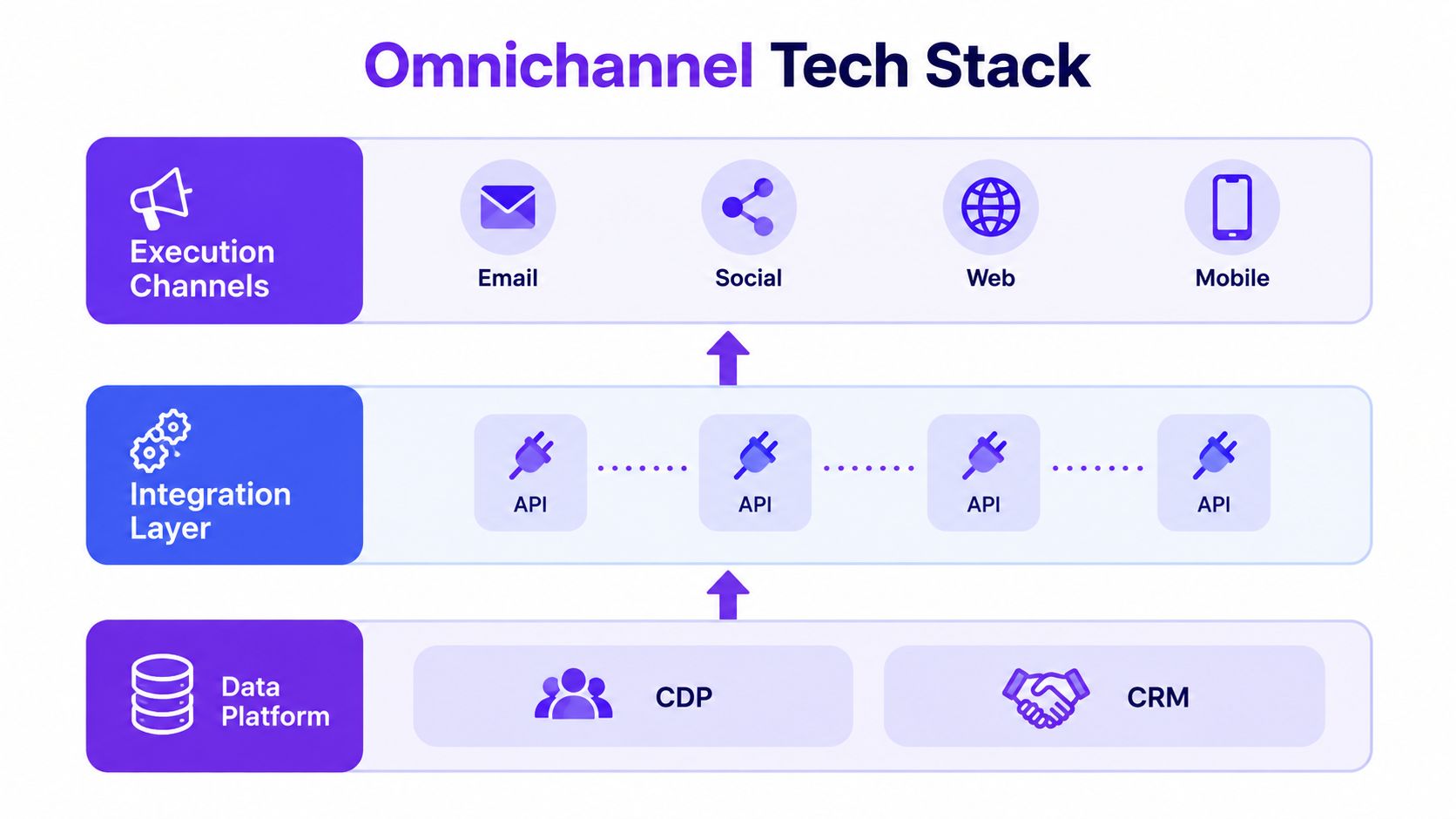
Technology should support the journey decisions made in the workshop. It shouldn't dictate the strategy. A practical stack usually needs a data foundation, an integration layer, activation tools, analytics, consent controls, and a clear owner for each connection.
Design the operating layers
At the foundation, the client may use a CRM, customer data platform, commerce system, service platform, loyalty database, or analytics environment. The agency should document what each system knows, how current that information is, and whether the client has permission to use it for the intended purpose.
The integration layer connects events and decisions. APIs, warehouse workflows, server-side processes, or vendor connectors can move information between systems, but the technical method matters less than the contract around it. Define event names, required fields, update timing, consent status, and failure handling before activation begins.
The execution layer includes email, mobile messaging, website personalization, paid media, social, retail systems, sales tools, and service channels. Each channel needs a role, a priority, a frequency rule, and a clear response when another channel records a more important event.
Measure the journey, not just the touchpoint
Channel metrics still have a role. Clicks, reach, engagement, delivery, and conversion data can help teams diagnose creative or placement problems. They become misleading when the agency presents them as proof that a channel caused the outcome.
A stronger measurement framework combines:
- Incremental conversion: The additional outcome caused by exposure compared with a credible control.
- Assisted conversion: A descriptive view of interactions that appeared in the path, without treating presence as causal proof.
- Repeat purchase and retention: Evidence that the journey supports an ongoing relationship.
- Cost per retained customer: A more durable efficiency view than acquisition cost alone.
- Time to resolution: A service measure that reveals whether marketing and support are working together.
- Failure metrics: Duplicate contacts, conflicting offers, repeated explanations, opt-outs, unresolved-case recurrence, and channel switching after friction.
Privacy and platform changes have made this discipline more important. Recent analysis estimates that 30–40% of previously trackable conversions have been eliminated from observable reporting, which means a polished journey dashboard can still give an incomplete picture, as discussed in this analysis of privacy-related measurement loss.
Attribution isn't incrementality
Attribution assigns credit within the interactions a reporting system can observe. It doesn't answer the causal question, which is whether the conversion would have happened without the marketing activity. Agencies should pair attribution with randomized holdouts, geo-based experiments, or matched-market designs when the client can support them.
Small and mid-sized teams can still test responsibly. Choose one priority journey, define the outcome before launch, prevent treatment contamination where possible, and document what the test can't establish. If conversion volume or offline sales data limits confidence, present the result as directional evidence and connect it to a budget decision rather than dressing uncertainty up as precision.
A 90-day operations roadmap can help translate the design into staged ownership, implementation tasks, and review points. Agencies should also explain attribution modeling to clients as a diagnostic tool, not a replacement for controlled measurement.
Governance, Optimization, and Scaling Success
Omnichannel programs usually fail in execution before they fail in strategy. A client approves the journey, then teams change the offer, omit a suppression rule, miss an approval, or optimize their own channel without checking the customer's next experience.
Governance prevents those breakdowns when it stays practical. Assign a journey owner, channel owners, data owners, creative approvers, and a measurement lead. Keep a shared decision log that records the active promise, eligibility rules, consent requirements, customer-state changes, and escalation path.
Keep optimization connected to reality
Run regular journey audits from the customer's point of view. Review a new prospect, a returning customer, a recent purchaser, and someone with an unresolved service issue. Check what each person receives, what the organization knows, and whether the next action makes sense.
Use experiments to improve one decision at a time. Test message order, offer eligibility, channel timing, suppression rules, preference collection, or service handoff. Don't let a channel team optimize short-term engagement by creating a worse experience elsewhere.
Privacy should shape the design, not appear as a late approval step. Collect only necessary information, explain the value of personalization, provide preference controls, and allow the journey to degrade gracefully when identity signals are incomplete. A coherent experience doesn't require every interaction to be personalized.
For retention-focused programs, agencies can draw on practical retention strategies for ecommerce while adapting the recommendations to the client's category, service model, and consent environment. Document what worked, why it worked, and where the result depends on a specific client capability before applying the lesson to another account.
Start with one journey
The strongest scaling argument is operational, not technological. A focused pilot gives the agency a concrete way to align teams, expose data gaps, test client communication, and create reusable workshop materials. From there, the team can scale operations by standardizing briefs, decision rights, event definitions, journey audits, and reporting templates.
The alternative is to remain multichannel while describing the work as omnichannel. That leaves customers to reconcile conflicting promises and leaves agencies responsible for outcomes they can't control. Start with one priority journey, make the handoffs explicit, measure what the test can genuinely prove, and use those learnings to earn the next stage of investment.
Bulby helps agencies turn scattered campaign input into structured, collaborative thinking across strategy, creative, account, and brand teams. Use Bulby to run focused brainstorming sessions that connect campaign ideas to customer journeys, messaging, and actionable omnichannel execution.