
The most popular advice in campaign creative is also the least reliable: find one brilliant concept and trust your instincts. A sharp line, polished visual, or emotionally satisfying idea can help, but none of those qualities proves that people will understand the message, believe it, or change their behavior because of it.
A stronger campaign messaging strategy treats every message as a testable hypothesis. The team makes an informed bet about what a specific audience might value, then validates that bet before committing the full creative and media budget. The process is less glamorous than choosing a favorite headline, but it produces decisions you can defend.
Table of Contents
- Why Most Campaign Messages Fail Quietly
- Mapping Your Audience to Message Hypotheses
- Building Your Message Hierarchy and Tailoring It to Channels
- Testing Messages Before You Commit the Budget
- Personalization Without Surveillance
- Framing Choices and the Mistakes That Sink Good Campaigns
- Turning the Framework Into a Team Workflow
Why Most Campaign Messages Fail Quietly
Campaign messages rarely fail with an obvious crash. They fail when an audience notices the ad but doesn't remember the proposition, understands the claim but doesn't believe the source, or agrees with the idea without taking the intended action. The campaign may collect impressions, clicks, or compliments from internal stakeholders while producing little meaningful movement.
Experimental evidence explains why intuition struggles here. A 2020 study of professional political advertising examined 49 advertisements through 59 randomized experiments involving roughly 34,000 participants. Advertising increased candidate favorability by an average of only 0.05 points on a five-point scale, while the average effect on vote choice was 0.7 percentage points. The effects also varied across individual advertisements.
That result isn't an argument against creativity. It's an argument against treating creativity as proof. Small average effects can still matter, especially when a campaign operates in a close contest, but the team has to identify which message earns those effects rather than assuming every polished execution will perform equally.
Strategic rule: A message isn't valuable because the team can explain why it should work. It's valuable when a relevant audience responds to it in a measurable way.
The cost of betting on one idea
A single-concept process creates several risks at once. If the proposition is wrong, the creative team may spend days improving the wrong idea. If the proof lacks credibility, more dramatic language won't repair it. If the audience doesn't recognize the problem, a stronger call to action may only make the message feel more aggressive.
Teams also confuse agreement with persuasion. Stakeholders often prefer messages that sound distinctive, refined, or emotionally resonant. Buyers may need something more practical, such as a clear explanation of the problem, evidence that the product fits their situation, or a credible reason to act now.
Cognitive biases can make this judgment even harder, especially when internal reviewers prefer information that confirms their existing view. A useful primer on cognitive bias in marketing can help teams identify where personal preference is shaping a supposedly objective creative decision.
The five decisions a disciplined process makes
A practical campaign messaging strategy answers five questions:
- Audience insight: What language, motivations, barriers, and misunderstandings appear in real conversations?
- Proposition: What single promise could connect the audience's situation to the desired behavior?
- Hierarchy: Which proof points support that promise, and what must remain consistent across channels?
- Testing: What comparison would distinguish a strong hypothesis from a familiar opinion?
- Refinement: What should change after the evidence arrives, and what should remain untouched?
The rest of the framework follows that order. The purpose isn't to eliminate judgment. It's to place judgment where it creates the most value, before production, during test design, and when interpreting evidence.
Mapping Your Audience to Message Hypotheses
A useful audience segment is defined by a decision tension, not a job title. Before anyone writes campaign copy, formative research should reveal how people describe their problem, the outcome they want, the objections that stop them, and the unintended meaning a proposed message might carry. Interviews, customer-support conversations, sales-call notes, product reviews, and open-ended research can expose language a team will not generate in a conference room.
Poor or missing formative research was ranked as the most consequential process failure in a mixed-methods study of mass-media campaigns, as described in the study on campaign development and evaluation. Use segmentation alongside a practical email marketing guide when selecting audiences and channels, but keep the research question specific to the decision the campaign must influence. Start with raw audience language, then turn it into propositions that can be tested.
Start with the audience's actual tension
Suppose an agency sells a reporting platform to marketing teams. “Marketing professionals” is too broad to guide a message. Research could reveal several distinct tensions:
- A manager wants faster reporting but worries that automation will hide important context.
- An analyst wants fewer manual tasks but needs to preserve control over definitions.
- An agency lead wants to give clients clearer updates without creating another complicated workflow.
- A finance stakeholder wants evidence that marketing activity connects to business outcomes.
- A new team member wants a repeatable reporting process rather than a system dependent on one expert.
Each tension creates a message opportunity with its own proposition, proof requirement, and possible resistance. Treat the opportunity as a hypothesis about what may change the audience's response. The expected effect may be small, and it may vary by segment, situation, or execution, so the team needs a clear comparison rather than confidence in a polished idea.
For the agency lead, the hypothesis might be: “A reporting workflow that turns campaign data into client-ready explanations helps the team spend more time advising clients.” Supporting evidence could include workflow visibility and reusable reporting formats. The risk is that “automation” may sound impersonal or reduce the perceived value of agency expertise.
The analyst requires a different proposition: “Standardized reporting reduces repetitive assembly while keeping definitions and review in the analyst's hands.” The product stays the same. The tension, reason to believe, and likely resistance change.
Research and planning resources can help teams preserve those distinctions. A persona creation workshop can turn scattered observations into audience-specific assumptions that the team later validates through message testing. Keep the persona useful by linking each assumption to a behavior, objection, or piece of evidence.
Change one strategic dimension at a time
Five executions that change the headline, offer, visual style, audience, and call to action at once produce an ambiguous result. The team may see a difference without knowing which decision caused it. Hold the underlying proposition steady and vary one strategic dimension at a time.
For the agency segment, possible angles include:
- Efficiency angle: Reduce the repetitive work involved in preparing client updates.
- Clarity angle: Make campaign performance easier for clients to understand.
- Control angle: Standardize reporting without removing expert review.
- Advisory angle: Give strategists more time to interpret results and recommend action.
- Trust angle: Make reporting more consistent across accounts and teams.
Each angle remains a hypothesis until an audience responds to it. Stated preference can identify confusion or strong objections, but it should not be the only success measure. Connect the message to an observable outcome such as a qualified response, product trial, retention, or incremental conversion. A favored angle that earns compliments but no meaningful action has produced a creative reaction, not evidence of campaign effectiveness.
Document the hypothesis before testing
Record the strategic reasoning before production. This prevents the team from rewriting its expectations after results arrive and gives creatives a clear explanation of what the execution must communicate.
| Field | What to Record | Example Entry |
|---|---|---|
| Audience segment | The specific group and situation | Agency leads managing recurring client reporting |
| Desired behavior | The action the campaign should influence | Request a product demonstration |
| Proposition | The promise being tested | Spend less time assembling updates and more time advising clients |
| Supporting evidence | The reason the audience should believe it | Reusable reporting workflow and review controls |
| Reactance or stigma risk | The unintended interpretation to watch | Automation may make agency expertise seem less valuable |
| Success metric | The observable outcome tied to the objective | Qualified demonstration requests |
Write the hypothesis in plain language before turning it into copy. State the audience, expected behavior, proposition, supporting evidence, and risk. If the team cannot agree on what the message is supposed to change, it cannot design a clean test or interpret a modest, variable result responsibly.
Building Your Message Hierarchy and Tailoring It to Channels
A list of promising hypotheses isn't a campaign architecture. Once the team selects concepts for development, it needs a structure that keeps the central idea intact while allowing each channel to do its job.
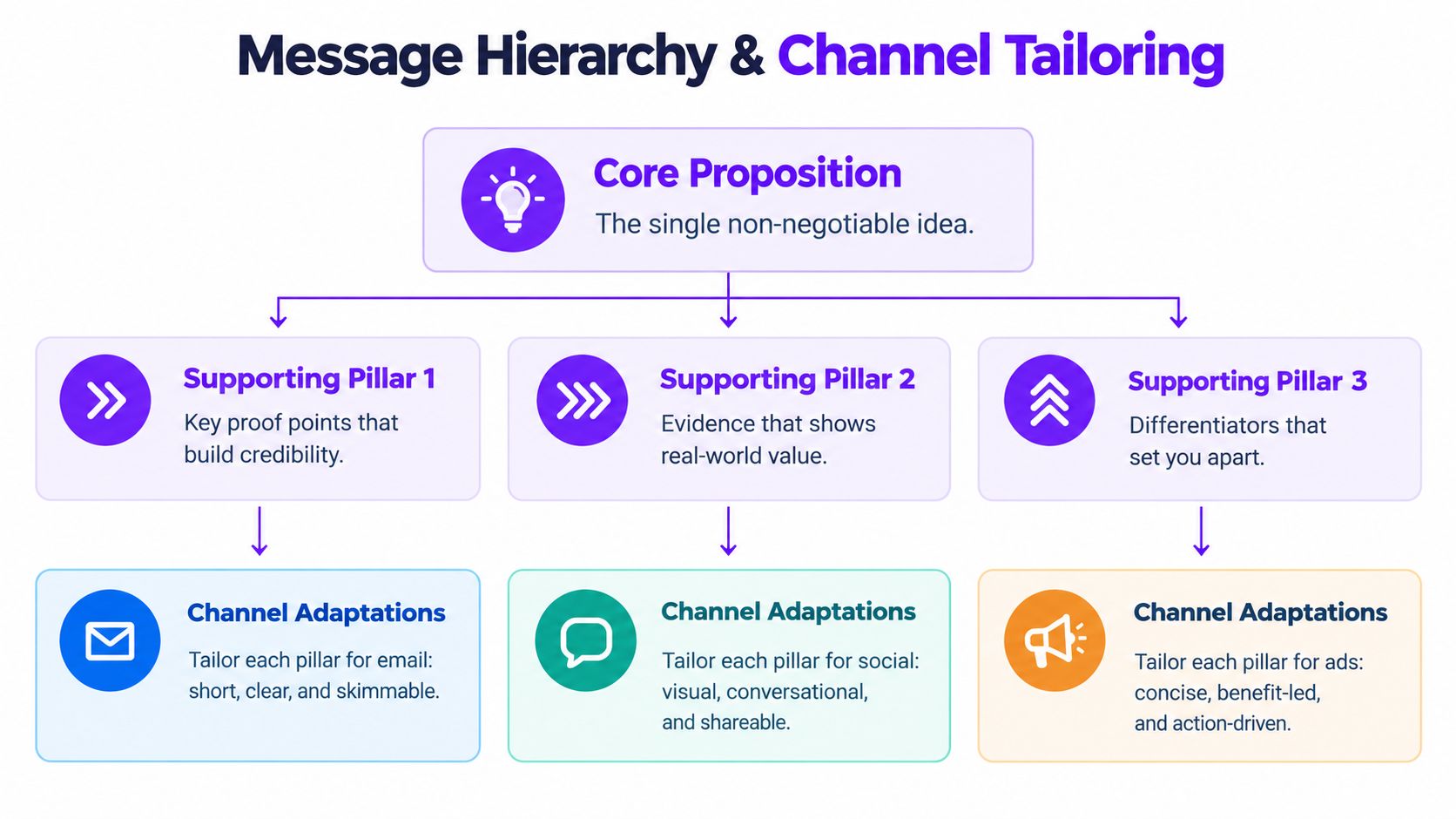
Build from the top down. Start with one core proposition, add a small set of supporting pillars, then adapt those pillars to the channel, audience context, and stage of the decision. This order prevents paid social, email, landing pages, and sales materials from becoming separate interpretations of what the campaign means.
Put one idea at the top
The core proposition should be short enough for every team member to repeat and specific enough to guide a creative decision. For the reporting platform example, it could be: “Turn campaign data into clear client decisions without rebuilding every report from scratch.”
That sentence isn't final ad copy. It's the central idea. A social ad might compress it into a sharp benefit. An email might explain the operational problem. A landing page might give the proposition more context and connect it to proof. A sales deck might translate it into implications for the buyer's workflow.
Under the proposition, add supporting pillars. One could establish the efficiency benefit. Another could explain control and review. A third could demonstrate the quality of the client-facing output. Keep each pillar tied to evidence the audience can evaluate.
Tailor expression, not meaning
A paid social execution has limited attention and needs an immediate reason to continue. Email can use subject-line relevance and a more developed explanation. A landing page can answer objections in sequence. Sales enablement can equip a representative to connect the proposition to a prospect's existing process.
The core stays stable, but emphasis changes:
| Channel | Primary job | Useful adaptation |
|---|---|---|
| Paid social | Earn attention and create relevance | Lead with the audience tension and one clear benefit |
| Develop interest | Use a specific operational problem, then introduce the proposition | |
| Landing page | Resolve uncertainty | Connect the promise to proof, objections, and the next action |
| Sales enablement | Support a conversation | Give the team evidence, questions, and approved language |
A campaign can travel across channels without repeating identical copy. It should repeat the same strategic meaning. When a team repurposes material, tools and workflows such as automated content repurposing for developers can help preserve the source idea while adjusting the format for a new environment.
Add source credibility to the hierarchy
A credible proposition can still fail when the audience doesn't trust the messenger. Research on 1992 U.S. Senate advertising found that identical messages could perform differently depending on the sponsoring candidate and issue because audiences assigned different levels of credibility to the sources, as discussed in the research on source credibility and political advertising.
The principle applies beyond politics. A technical claim may need an engineer, customer, or independent proof point. A cost claim may need transparent explanation. A behavioral promise may need a demonstration rather than a polished assertion.
Put source fit beside proposition and proof in the message document. Also define the language boundaries that keep adaptations recognizable. A set of tone of voice guidelines can help different contributors flex the message without changing its character.
Testing Messages Before You Commit the Budget
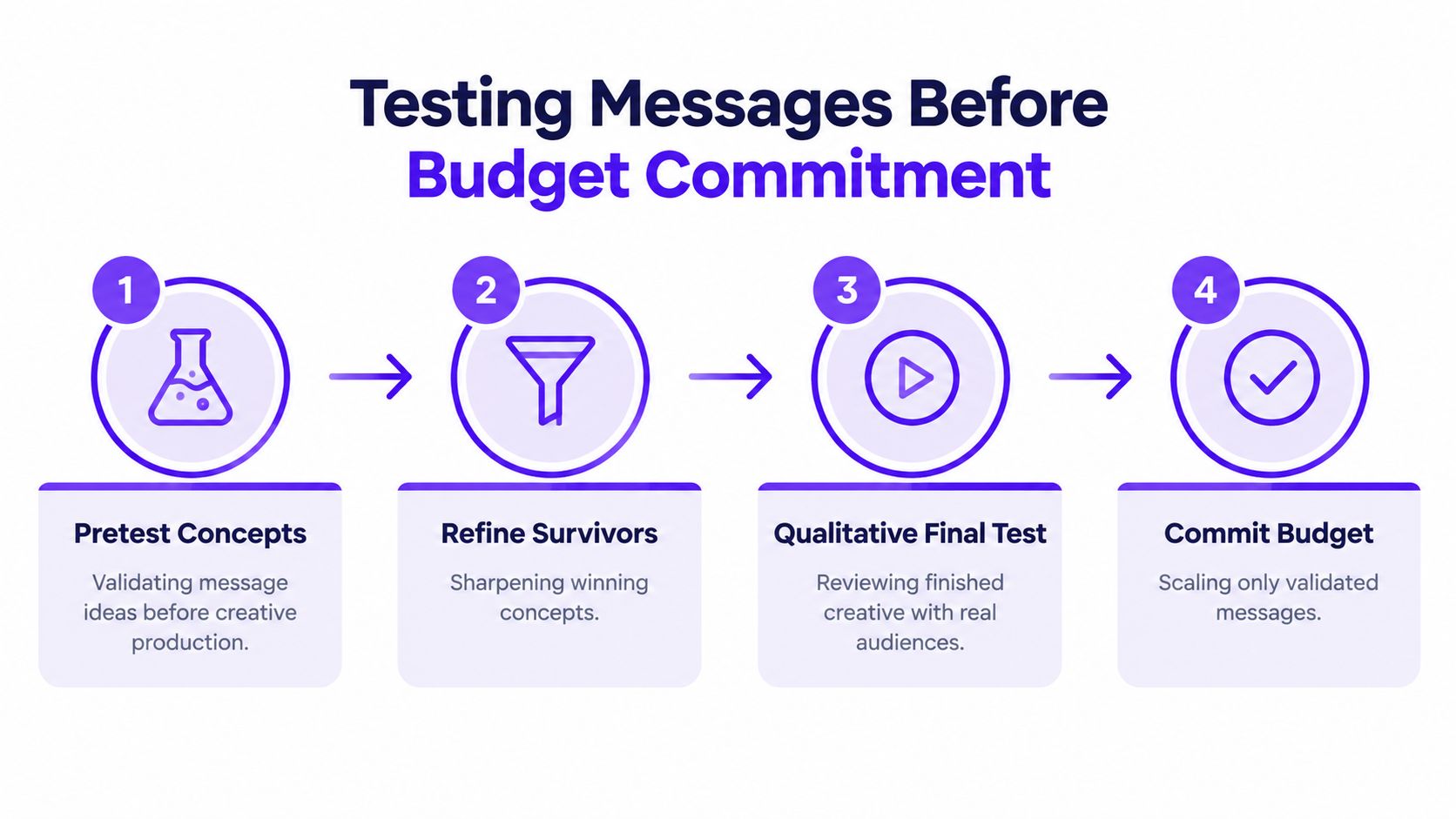
Pretesting is where a campaign messaging strategy earns its keep. The team should validate the concept before it pays to produce finished assets, then examine the completed creative before it scales. This sequence protects the budget from a familiar failure: polishing an idea that sounded strong in the brief but created confusion or indifference in the audience.
Pretest the message before the execution
Show audiences the proposition, supporting proof, and intended action before investing in production. Ask whether they understand the claim, what they think the product does, what feels credible, and what makes them hesitate. Compare multiple hypotheses rather than asking people whether they like one concept in isolation.
The evidence supports this discipline. An archive of 146 experiments involving 617 advertisements, 51 campaigns, and more than 500,000 respondents found that effects varied across advertisements. Average immediately measured effects on vote choice were 2.3 percentage points for 2018 down-ballot races, 1.2 points for 2020 down-ballot races, and 0.8 points in the 2020 presidential context, according to the archive of campaign experiments. The lesson isn't that one context predicts another. It's that theory alone has limited power to identify the winning execution in advance.
Refine survivors, then test finished creative
A concept that survives pretesting still needs scrutiny. Visual hierarchy, pacing, wording, format, and surrounding context can change what people notice. Conduct a qualitative review of the final creative to identify missed information, unintended interpretations, and reasons an audience might ignore the message.
Use randomized field testing where feasible. Keep the audience definition consistent, expose groups during the same period, and isolate the variable you intend to compare. A control group provides a useful reference when the objective is incremental behavior rather than response among people who were already likely to act.
Before launch, verify the following:
- Hypothesis: The team has written what should change and why.
- Comparison: The variants differ on a defined strategic dimension.
- Audience: Each group meets the same eligibility definition.
- Timing: The test periods run under comparable conditions.
- Outcome: The primary metric reflects behavior, not just approval.
- Record: Null results and weaker concepts remain documented.
A/B testing guidance can help teams think through how to conduct an A/B test without changing too many variables at once.
A test result is only useful when the team knows what it can support. A message that earns preference may deserve further development, but preference isn't the same as trial or retention. Define the behavioral outcome before anyone sees the result, and don't swap it for a more flattering metric afterward.
The following video provides a visual explanation of the testing sequence and the decisions that belong at each stage.
Personalization Without Surveillance
Personalization can make a campaign less trustworthy before it makes it more relevant. Teams often respond to weak performance by adding segments, behavioral signals, and individualized creative. That approach may improve fit, but it also increases production demands, fragments the proposition, and relies on information people may never have knowingly provided.
Research on political microtargeting offers a useful warning. In an advocacy scenario, targeted messages showed an advantage over several alternative approaches. Against one strong, pretested advertisement shown to people who shared the same broad policy attitude, however, microtargeting did not produce a stronger persuasive effect. The practical lesson is clear: personalization deserves a test, not automatic priority. A well-developed message with broad relevance can outperform a more elaborate targeting system.

Relevance can come from context
Build relevance around information the audience can see, understand, or choose to share. Instead of creating a different argument for every person, test which context makes one strong argument more useful.
Useful inputs include the page someone is reading, the problem they selected, a preference they declared, or the stage they reached in an owned-channel journey. Behavior within your own channels can guide timing and emphasis without asking an opaque model to infer sensitive personal traits.
A privacy-safe campaign can test several angles:
- Contextual fit: Connect the benefit to the content or task already in front of the audience.
- Declared preference: Let people choose the problem, format, or outcome they want addressed.
- Owned behavior: Use meaningful interactions with your product or content to guide follow-up.
- Broad tension: Address a recognizable problem without implying knowledge the person never shared.
Teams building this system can use an AI-driven personalization playbook as an operational reference. Keep the value exchange visible, and test whether the added relevance justifies the extra rules, content, and data handling.
Make the value exchange explicit
Privacy becomes part of the message whenever a customer must provide information. State what you are requesting, explain how it improves the experience, and show what the person receives in return. A preference center, product configuration tool, or useful diagnostic can create relevance without making the audience feel watched.
A practical test is simple: would a reasonable customer understand why the brand knows what it knows? If the answer is no, internal targeting precision may be costing more trust than it creates value.
A clear behavioral segmentation definition helps teams separate observable actions from assumptions about identity or intent. Strong privacy-safe messaging remains persuasive when the audience is anonymous, consent is limited, and targeting signals are incomplete. That resilience makes the message easier to scale and gives testing a cleaner question: did the context improve response, or did the data merely make the campaign harder to operate?
Framing Choices and the Mistakes That Sink Good Campaigns
Framing is not a choice between being positive and negative. It's the decision to present the same underlying offer through a particular consequence, benefit, risk, or interpretation. A disciplined test keeps the offer constant and changes the frame so the team can learn whether the way of presenting the idea affects response.
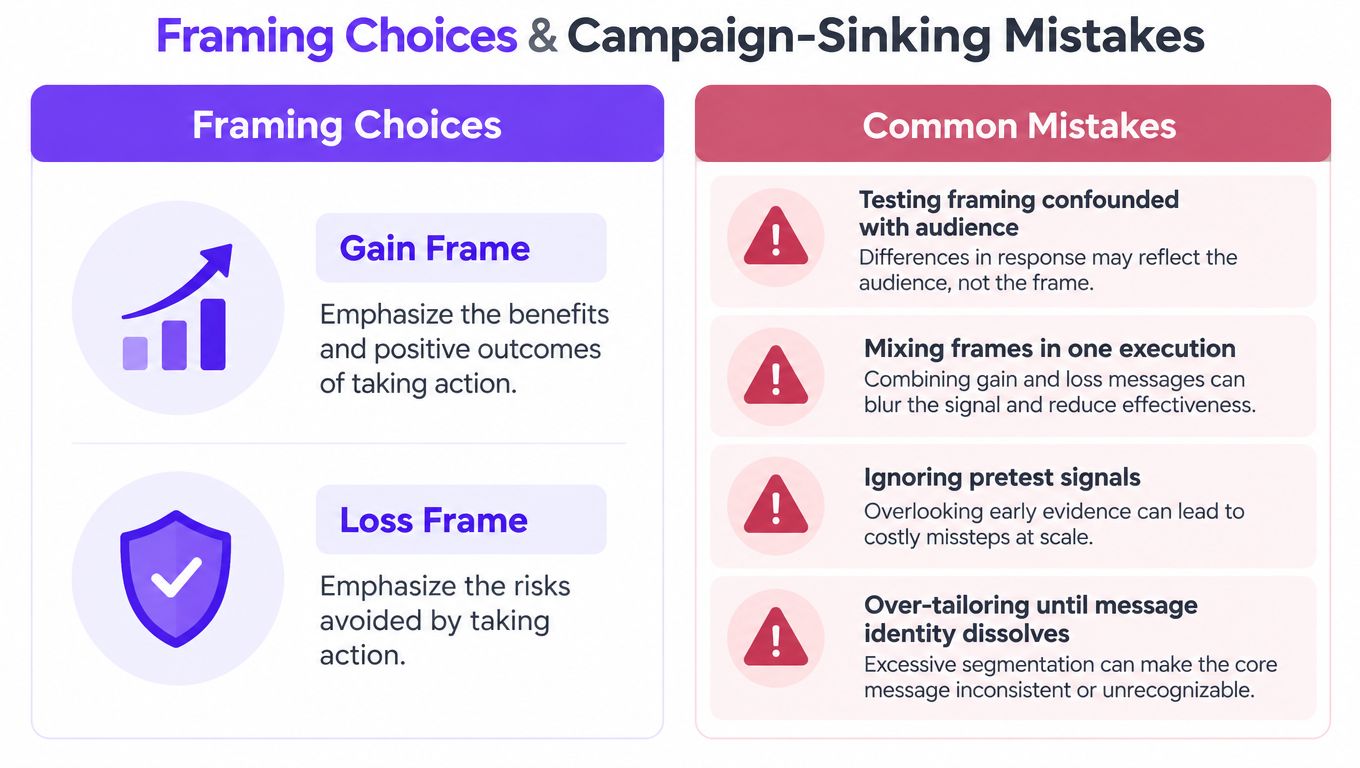
A gain frame specifies what improves when the audience acts. A loss or risk frame specifies what may continue or be missed when the audience doesn't act. For a reporting platform, the first might emphasize more time for client advice. The second might emphasize the cost of continuing to rebuild reports manually. Both should preserve the same product, offer, audience, and action.
One content analysis of 2,864 U.S. magazine advertisements found framing in 92.1% of ads, and 99.9% of advertisements using pure attribute framing used positive framing, according to research on message framing. Experimental evidence still indicates that positive framing's advantage depends on audience orientation and product type. Positive isn't automatically persuasive, and negative isn't automatically motivating.
Four failure patterns deserve a hard stop
Positive tone mistaken for effectiveness. Friendly language can make a message pleasant without making it relevant or credible.
Fix: Measure attention and understanding before interpreting persuasion.
Engaged respondents treated as the whole market. People who volunteer for research or actively follow a brand may process messages more carefully than less engaged audiences.
Fix: Include the audience most likely to encounter the campaign under ordinary conditions.
Everything changed in one variant. A new headline, visual, offer, audience, and landing page make an impressive comparison but a poor experiment.
Fix: Change one strategic variable at a time and document the rest.
Vanity metrics used as the verdict. Reach, reactions, and recall can diagnose exposure or interest, but they don't automatically demonstrate incremental behavior.
Fix: Tie the primary measure to the campaign objective, such as a qualified response, trial, retention, or conversion.
A message that persuades people who pay close attention can still fail in the market if ordinary audiences never notice it.
The team should also watch for over-tailoring. When every segment receives a different promise, the campaign loses a recognizable identity and the learning becomes difficult to transfer. Tailor emphasis and proof where the evidence supports it, but protect the proposition that gives the campaign a coherent center.
Turning the Framework Into a Team Workflow
A repeatable campaign messaging strategy needs a working rhythm, not just a planning document. The team should move from evidence to hypotheses, from hypotheses to controlled comparisons, and from results to a shared record of what it learned. That record becomes more valuable when it includes failed concepts and null results, not only the variants everyone wants to celebrate.
Run a compact message sprint
A practical cadence can look like this:
- Research review: Bring customer language, objections, support themes, sales observations, and product evidence into one working session.
- Hypothesis generation: Ask strategists, creatives, account leads, and subject-matter experts to propose distinct angles.
- Concept selection: Remove ideas that lack a clear audience, behavior, proposition, proof, or measurable outcome.
- Pretest design: Choose the comparison, audience definition, success measure, and control approach before exposure.
- Learning review: Record what changed, what didn't, and which assumptions the result weakened.
Structured collaborative brainstorming is most useful at the hypothesis stage. It can give contributors a clear way to develop alternatives instead of allowing the loudest opinion or first acceptable headline to define the campaign.
Use one preflight document
Before a concept enters production, confirm that the team can answer these questions:
- Who is this message for?
- What behavior should it influence?
- What proposition does it make?
- What evidence supports the proposition?
- What might the audience misunderstand or resist?
- Which strategic variable will the test isolate?
- What result would justify refinement, rejection, or further testing?
This discipline protects creative quality rather than restricting it. Writers and designers still make consequential choices, but those choices are connected to an explicit job and can be evaluated without relying on personal taste.
The goal isn't to discover one perfect message. It's to build a system that reliably finds stronger messages, learns from weak ones, and carries validated ideas across channels without diluting them. Every campaign can add evidence to the next briefing when the team records the reasoning behind each decision.
Bulby helps marketing and creative teams turn scattered input into structured, testable campaign concepts through guided brainstorming. Use Bulby to develop stronger message hypotheses with your strategists, creatives, and account teams before you commit the production and media budget.