
Creative quality can drive up to 80% of campaign effectiveness, according to the Nielsen finding. Creative thinking in marketing matters because the idea itself can influence business results, not just how attractive a campaign looks.
That changes the brief for marketers. Creativity isn't a decorative layer added after the strategy, and it isn't a mysterious talent reserved for people with unusual personalities. It's a practical way to find a relevant problem, see it from a fresh angle, connect ideas that normally stay separate, and turn the resulting thought into work people notice and remember.
The challenge is that many teams say they want original ideas while building approval systems that remove anything unfamiliar. Strong creative work needs both sides of the equation: a disciplined method for generating ideas and a culture willing to recognize a worthwhile risk.
Table of Contents
- What Creative Thinking Actually Means in Marketing
- The Risk-Averse Culture Blocking Your Best Ideas
- Research-Backed Frameworks That Actually Improve Originality
- How AI Changes Creative Thinking Without Replacing It
- Why Some Creative Campaigns Outperform Others Every Time
- Practical Steps to Build Creative Thinking in Your Team
- Creative Thinking in Marketing, What to Remember
What Creative Thinking Actually Means in Marketing
Nielsen reported that creative quality drives up to 80% of in-market success in traditional TV and 89% in digital advertising, while another Nielsen summary of Project Apollo attributed 65% of a brand's advertising sales lift to creative (Nielsen findings summarized by the ANA). The practical lesson isn't that media strategy doesn't matter. It's that targeting, reach, and placement work harder when the central idea gives people a reason to pay attention.
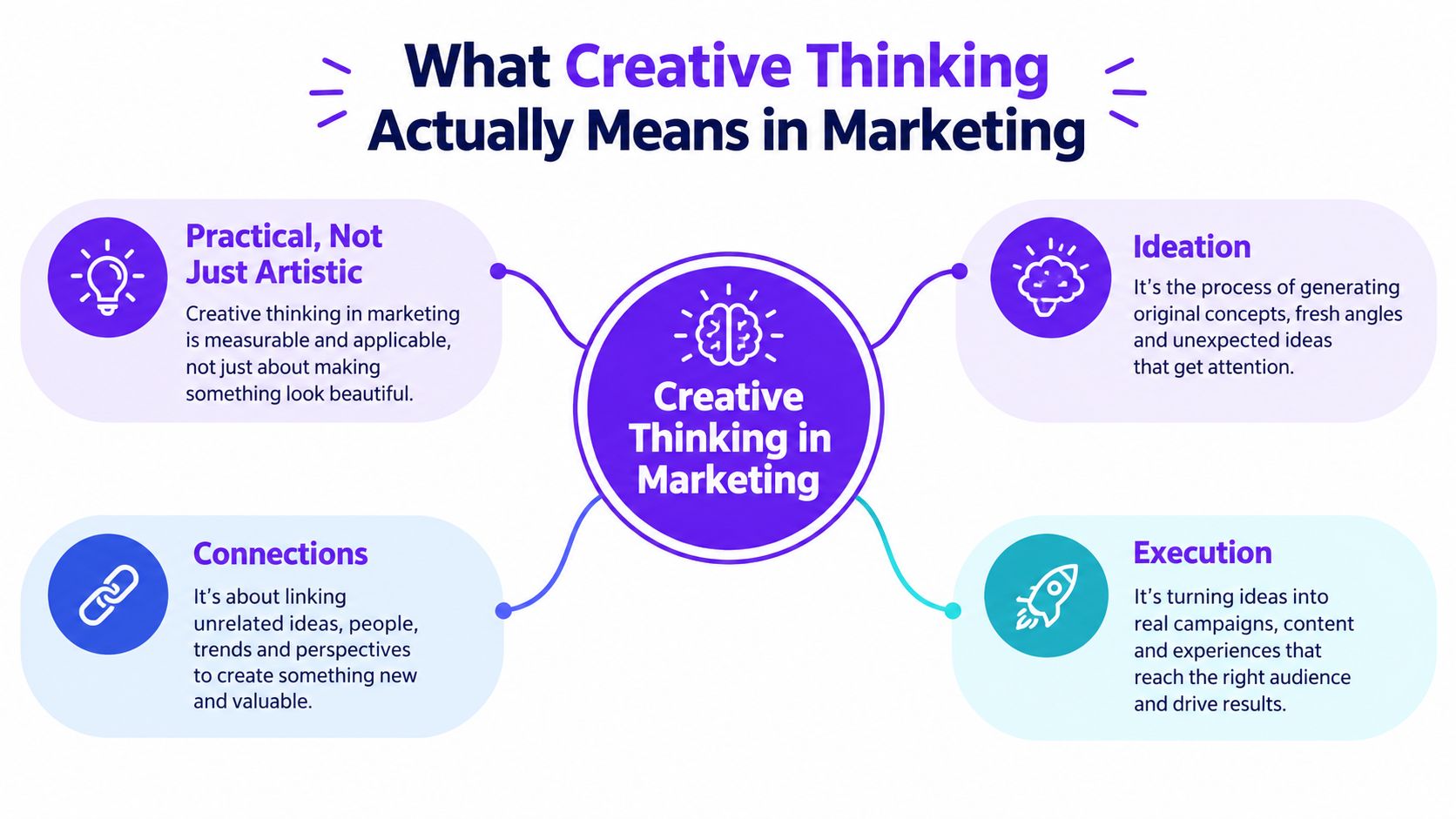
Creative thinking in marketing is the ability to produce an idea that is new enough to be noticed and relevant enough to work. Consider a familiar brief for a meal-delivery brand: “We need to increase trial among busy professionals.” A conventional response might list convenience benefits and show a polished product shot. A creative response might ask what busy customers are really protecting when they order dinner. Perhaps it isn't time. Perhaps it's the small feeling of control they regain at the end of a chaotic day.
That shift creates more useful territory for the campaign. The team can explore messages about reclaiming the evening, removing decisions, or making a demanding day feel finished. The idea remains tied to the product, but it no longer sounds like every other convenience claim.
Train the muscle, then apply the brief
Treat creativity like a muscle. You strengthen it by practicing observation, reframing problems, making connections, and editing ideas against a clear objective. A brainstorming session isn't successful because the room feels energetic. It succeeds when the team leaves with concepts that can guide a headline, experience, film, product feature, or channel plan.
The distinction between novelty and creative usefulness matters. A strange idea may be original, but if nobody understands it or it doesn't support the brand's promise, it becomes an expensive distraction. Strong marketing ideas usually sit at the intersection of three questions:
- Is it distinctive? Would the audience notice and remember it?
- Is it meaningful? Does it connect with a real tension, desire, or behavior?
- Is it usable? Can the team execute it consistently across the required channels?
Workshop rule: Don't ask whether an idea is “creative” in isolation. Ask what it helps the audience notice, feel, understand, or do.
Free-form brainstorming often fails because teams generate disconnected jokes, visual treatments, and slogans without agreeing on the problem they're solving. A structured creative process gives people freedom inside useful boundaries. The brief supplies the destination. Creative thinking finds a less predictable route.
The Risk-Averse Culture Blocking Your Best Ideas
Many marketing teams don't have an originality problem first. They have an approval problem. People may generate bold concepts in a workshop, then soften them during internal reviews until the final campaign is polished, familiar, and easy to approve.
The gap is visible in the 2025 LIONS survey of more than 1,000 marketers and creatives. Only 13% of respondents saw their companies as risk-friendly, while 29% described their brands as highly risk-averse. The report identified an “insight famine” and weak cultural agility as major barriers (LIONS State of Creativity 2025).
Those findings give teams better language for a problem they often describe vaguely. If a client says, “We want something unexpected, but it must feel familiar,” the issue may not be a lack of creative skill. The organization may lack a shared definition of acceptable risk.
Find the hidden safety rules
Risk aversion often appears through ordinary comments:
- “Can we make it more professional?”
- “Will everyone understand this immediately?”
- “Can we use the same approach as last time?”
- “The leadership team might not like it.”
- “Let's show the safe version first.”
Each comment can be reasonable. Together, they can eliminate the tension that makes an idea memorable. Teams also create risk through unclear ownership. If nobody knows who can approve an unconventional route, creatives learn to avoid proposing one.
The solution isn't to demand reckless work. It's to separate idea evaluation from idea generation. During the first phase, the team should expand possibilities without asking every concept to prove its business case immediately. During the second, decision-makers can test each route against the audience, brand, feasibility, and objective.
A psychologically safer environment helps people contribute before they know whether their idea will survive. Teams looking for practical ways to support that behavior can use this guide to create psychological safety as a starting point.
Diagnose the real blockage
Ask three questions before scheduling another brainstorm:
- Do we lack insight? The team may not understand the audience's lived problem well enough.
- Do we lack permission? People may know what to explore but expect punishment for being wrong.
- Do we lack decision speed? A culturally relevant idea may lose its value while stakeholders debate it.
This diagnosis changes the intervention. More ideation techniques won't solve a brief with no audience tension. A new AI tool won't fix a review process that rewards sameness. Creative leadership means improving the conditions around ideas, not merely demanding more of them.
Research-Backed Frameworks That Actually Improve Originality
The most useful creative frameworks don't tell teams to “think outside the box.” They give people a repeatable way to move beyond the first obvious answer while keeping the brief in view.
A 2025 study of professional advertising development found that a Templates approach improved originality in two studies judged by industry experts. It also avoided a trade-off found with some other interventions. Increasing domain knowledge through consumer insight and increasing intrinsic motivation both raised originality, but made the resulting work less aligned with the strategy (study details).
That finding is useful because marketers often assume more information automatically produces better ideas. Information can sharpen relevance, but it can also pull a team toward predictable category conventions. A structure can create room for originality without losing strategic discipline.
Use a four-part ideation sequence
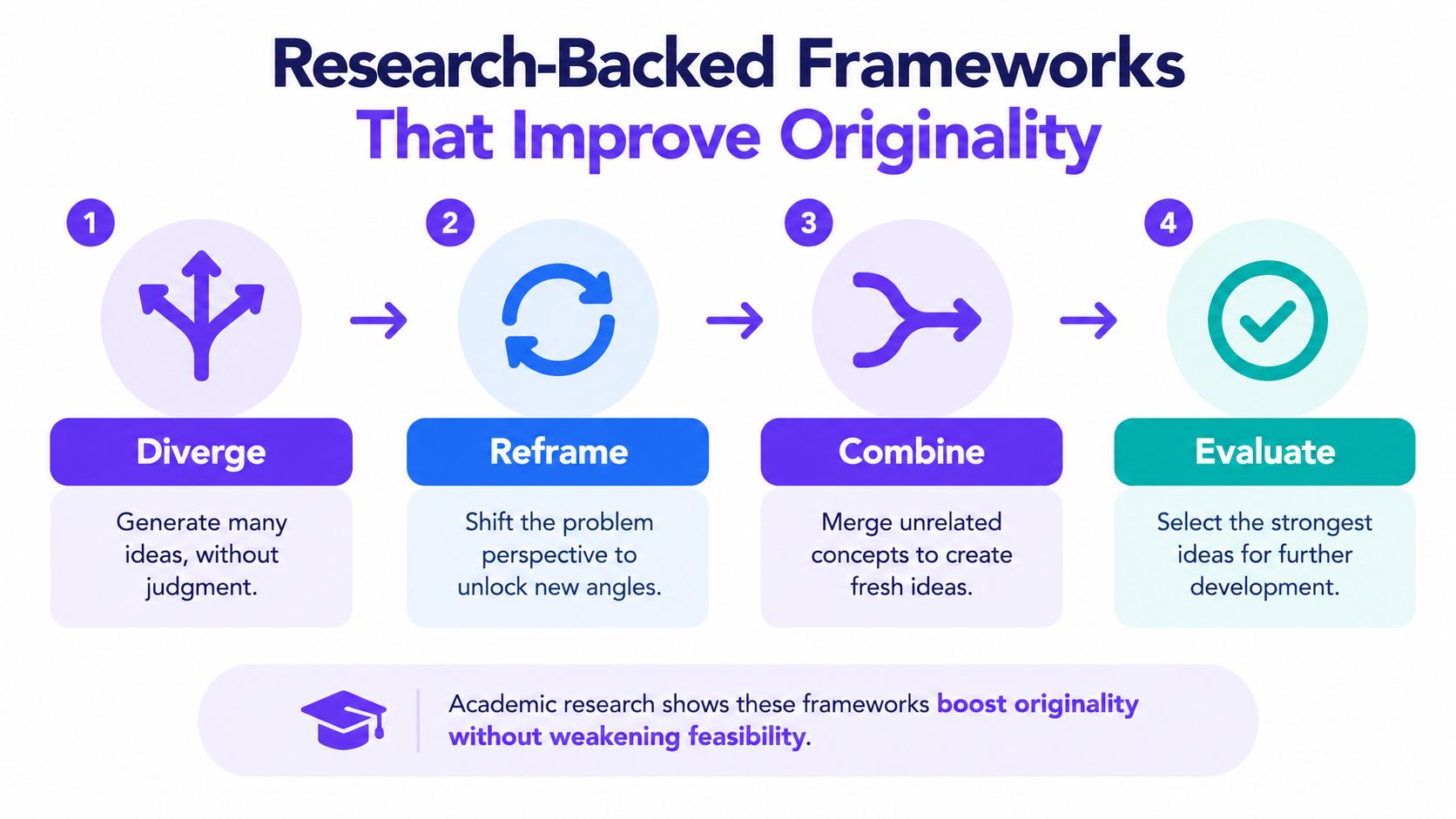
Diverge. Start with the brief, then generate many possible answers without judging them. Change the verb in the brief to create movement. “Promote,” “reassure,” “challenge,” “reward,” and “reveal” produce different creative directions from the same product fact.
Reframe. Replace the category question with a human question. Instead of asking, “How do we sell a budgeting app?” ask, “Why do people avoid looking at their finances?” The emotional and behavioral territory becomes more specific.
Combine. Put two unrelated references beside the brief. A financial service might borrow the transparency of an open kitchen and the ritual of a fitness coach. The point isn't to copy either reference. It's to discover a fresh behavior, format, or visual language.
Evaluate. Choose ideas using agreed criteria, not seniority or personal taste. Score each route for distinctiveness, audience relevance, brand fit, and execution potential. Keep the scores as conversation prompts, not as fake precision.
A simple journal can make this practice easier between workshops. For teams that want a lightweight place to capture prompts, observations, and emerging directions, journal a ideas log can support the habit without turning every thought into a formal presentation.
Keep templates flexible
A template should constrain the type of move, not dictate the final answer. Try prompts such as:
- “Make the invisible cost of this problem visible.”
- “Turn the product benefit into a social ritual.”
- “Show the opposite of what the category normally shows.”
- “Let the audience discover the message instead of hearing it.”
Use the framework to produce options, then use the strategy to remove options that don't belong. A team can also review practical brainstorming research when designing sessions for different creative challenges.
How AI Changes Creative Thinking Without Replacing It
AI changes the speed and range of ideation, but it doesn't decide which idea deserves to represent a brand. That judgment still depends on human understanding of the audience, cultural context, emotional nuance, and the strategic risk the organization can responsibly take.

A 2026 study with 98 advertising professionals found that participants who used GenAI after prompt training generated significantly more ideas than participants who used GenAI without training or didn't use it. Their perceived creativity didn't change (study details). The finding points to a practical distinction: AI can increase the quantity of exploration, while prompt literacy improves how effectively people steer that exploration.
Give AI the right job
Use AI early, when the team needs range. Ask it to produce alternative audience tensions, opposing interpretations of a brief, unusual combinations, or routes in deliberately different tones. Don't ask for “a creative campaign” and accept the first polished answer. That usually produces category language because the prompt contains no meaningful constraint.
A stronger workflow looks like this:
- Human framing: Define the audience, business problem, brand truth, and unacceptable clichés.
- AI expansion: Ask for contrasting territories, questions, metaphors, and rough directions.
- Human selection: Identify the few ideas that contain a real tension or distinctive point of view.
- Human development: Write the proposition, build the execution, and check cultural and brand fit.
- Testing and refinement: Use feedback to improve the work without sanding away its central character.
AI can also help teams visualize an early thought before production begins. If a concept needs a rough moving prototype, resources about how to launch new products with AI video can help marketers explore the format before committing to a finished asset.
Here is a useful demonstration of how creative teams can think about AI-assisted development:
Protect the human filter
AI can generate plausible ideas without understanding why a particular audience might reject them. It can reproduce familiar conventions, flatten cultural differences, and make every brand sound fluent in the same neutral voice. Human reviewers must check the idea's source, assumptions, implications, and relationship to the brand promise.
Teams can also use AI to challenge their own thinking. Ask it to identify the most predictable part of a concept, argue against the strategy, or describe how a skeptical customer might interpret the message. Tools can widen the search, but people must choose the direction. For a grounded discussion of the question, teams can review whether AI can generate ideas while keeping authorship and judgment with the people doing the work.
Why Some Creative Campaigns Outperform Others Every Time
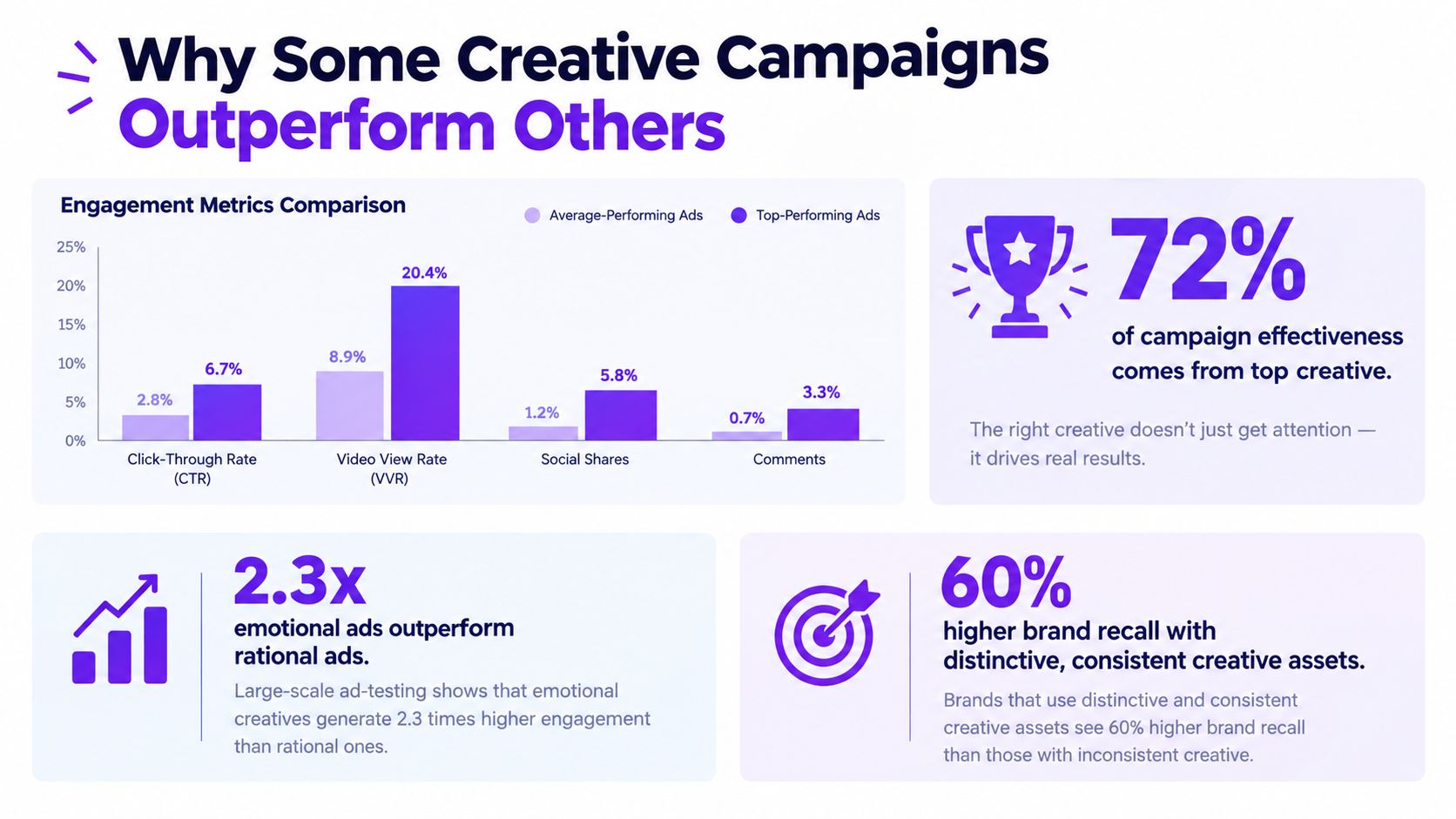
A 2020 meta-analysis covering 93 datasets from 67 papers and 878 effect sizes found that advertising creativity positively affects consumer response. The effect was stronger for reactions to ads than for reactions to brands, and generally larger for attitudes than for memory (meta-analysis). For an agency team, the lesson is practical: creative work must earn an immediate response while building associations that remain after the placement disappears.
Campaign-defining work usually combines three qualities teams often separate: distinctiveness, emotional relevance, and strategic appropriateness. A funny idea can remain disconnected from the product. An emotionally intense execution can leave people remembering the story but not the advertiser. A concept can follow the brief perfectly and still feel too familiar to earn attention.
Emotion gives the idea a route into memory
Kantar tested over 13,000 ads across 75 markets and reported that ads with high emotional impact were four times more likely to cut through and five times more likely to build long-term equity (Kantar ad-testing findings). Emotional impact does not require melodrama. Relief, recognition, curiosity, pride, delight, and productive discomfort can all make a message more involving.
The working test is simple: can the team name the feeling it wants to create, then connect that feeling to the brand's role? If the same emotional response could belong to any advertiser, the idea needs a clearer brand link. Emotion opens the door, while distinctive brand cues help people know who invited them in.
Measure the whole creative system
Among 65 award-winning campaigns tested in 2022 and 2023, Kantar reported that 97% ranked in the top 33% of its ad-testing database, 97% had high media impact, and 77% had short- or long-term sales impact (Kantar creative effectiveness research). Awards do not automatically create sales. The findings show how strong campaigns can connect attention, brand building, and commercial effect.
Review concepts across several questions:
- Does the audience notice the work?
- Can they identify the brand?
- Does the idea create a feeling or thought worth sharing?
- Does the execution make the product's role clear?
- Can the central asset survive adaptation across channels?
Teams can study campaign design examples to see how one strategic idea stays recognizable while changing shape across formats. Strong work is not merely interesting in one presentation. Its identity remains clear when people meet it in different contexts.
Practical Steps to Build Creative Thinking in Your Team
You don't need a new department to improve creative thinking in marketing. You need a better sequence of decisions, clearer briefs, and regular opportunities for people outside the usual creative circle to shape the work.
Start with the brief. Rewrite the problem as a human tension, then list the strategic boundaries that must remain true. “Increase awareness” is too broad to guide original thinking. “Help first-time buyers feel confident choosing a product they can't yet evaluate” gives the team a problem with emotional and behavioral substance.
Change the workshop mechanics
Try this working rhythm:
- Silent start: Give people time to write before discussion begins. This reduces the advantage held by the fastest or loudest speaker.
- Separate expansion from judgment: Collect ideas first. Discuss feasibility and risk after the room has produced a range of directions.
- Force a change of lens: Ask for the most literal idea, the most emotional idea, the most culturally specific idea, and the idea that would make the category uncomfortable.
- Invite different expertise: Include customer service, sales, product, analytics, and account teams when their experience can reveal a useful tension.
- Name the decision: End by choosing which routes deserve development, what evidence is missing, and who owns the next move.
Document the reasoning, not just the winning line. A short record of rejected directions can prevent the team from circling back to the same ideas later. It also helps stakeholders understand that creative development involves deliberate choices, not random inspiration.
Teams can build stronger habits through practical exercises about how to become more creative. For collaborative sessions, creative team collaboration is another useful area to examine, especially when strategists, designers, writers, and account leaders contribute at different stages.
A structured platform such as Bulby can guide teams through brainstorming exercises, support anonymous submissions, generate creative prompts, and summarize ideas into suggested next actions. Use it as a facilitator for wider participation, not as a replacement for the team's judgment.
Creative Thinking in Marketing, What to Remember
Creative thinking is not the search for a strange idea at any cost. It's the discipline of finding a distinctive way to solve a meaningful marketing problem, then developing that thought until the audience can recognize the brand's role.
The strongest teams treat creativity as both a performance variable and an operating practice. They write sharper briefs, gather real audience tensions, generate options before judging them, and use clear criteria to select work. They also understand that a bold idea needs protection. If every review round rewards familiarity, the organization will eventually produce safe work even when talented people are present.
AI adds a new layer to the process. It can widen the field of possibilities and help teams explore more routes, particularly when people know how to prompt and challenge it. It can't replace the human decisions that make a campaign culturally aware, emotionally credible, and unmistakably connected to the brand.
The practical model is simple:
- Start with a real tension, not a vague communication goal.
- Create distance from the obvious answer through reframing, combination, and structured prompts.
- Keep originality tied to strategy, so the idea has a job to do.
- Use AI for exploration, then let people judge relevance, taste, ethics, and brand fit.
- Build approval conditions that tolerate useful risk, because culture can block stronger work even when the process is sound.
- Evaluate the complete system, including attention, emotional response, brand association, and commercial usefulness.
A campaign doesn't outperform because it contains more creative decoration. It performs when the audience notices a clear point of view, feels something relevant, and understands why that point of view belongs to the brand.
Bulby helps marketing and creative teams run structured brainstorming sessions, bring more voices into the room through anonymous submissions, and turn scattered ideas into an AI-generated report with practical next steps. Visit Bulby to give your next campaign workshop a clearer path from raw thinking to usable creative direction.