
You walk into a client pitch with a polished deck, a rehearsed opening, and a team that knows the work inside out. By slide four, the marketing lead is taking notes, the finance director is checking the commercial model, and someone you've never met is asking about implementation. The presentation isn't failing because the idea is weak. It's failing because the room is trying to make several different decisions at once.
Learning how to prepare a pitch presentation means preparing more than slides. You need to understand who must approve the work, what evidence each person trusts, how much unpaid effort the opportunity deserves, and what decision you want at the end. The deck is only the visible layer of that system.
Table of Contents
- Why Pitch Preparation Actually Matters
- Research Before You Open a Single Slide
- Building Your Slide Structure and Narrative
- Designing for Committee Decision-Making
- Rehearsing for Real Conditions
- When a Pitch Is Not Worth Your Time
- Your Pitch Preparation Checklist
Why Pitch Preparation Actually Matters
A pitch can contain excellent strategy and still lose the room. Teams often spend their final days adjusting typography, polishing animations, and adding credentials, while the audience is asking more basic questions: What problem are you solving? Why this approach? Can we trust the team to deliver it? What happens next?
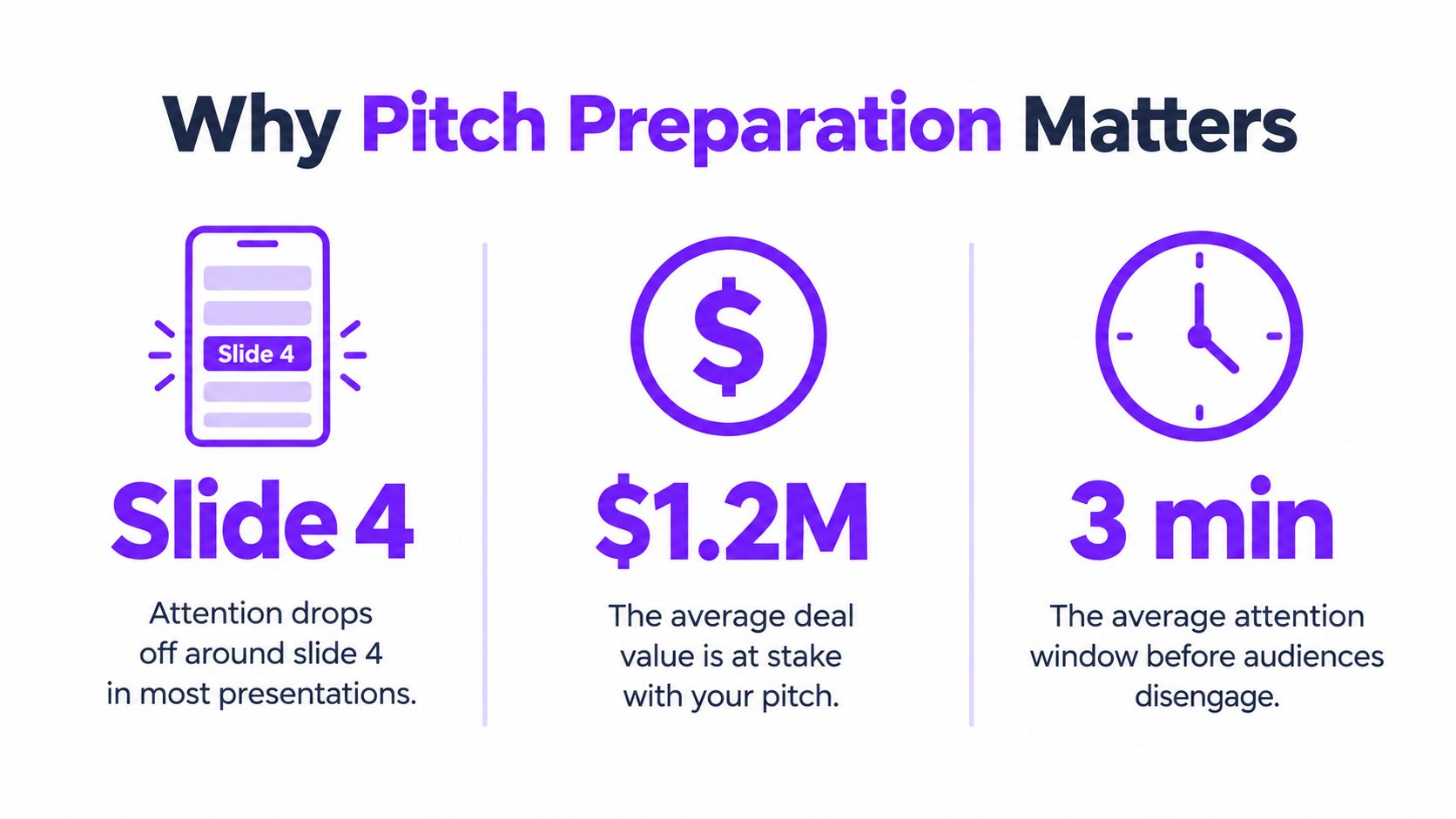
Attention is scarce, especially in investor and senior decision-maker settings. Investors typically spend roughly 2 to 4 minutes reviewing a pitch deck. One 2022 estimate measured an average review time of 2 minutes and 42 seconds, down from approximately 3 minutes and 32 seconds in 2021. The same analysis reports that only 45% of investors review decks of 30 to 45 slides from beginning to end (pitch-deck analysis).
Prepare for the decision, not the performance
The practical implication is simple. Your opening must establish the audience problem, proposed solution, target market, and reason the opportunity matters now before the room loses context. A long explanation can't rescue a vague first impression.
A useful preparation sequence is:
- Name the problem: State who experiences it and what the current situation costs in time, money, quality, or momentum.
- Show the solution: Explain the mechanism, not just the promise.
- Prove relevance: Use evidence, examples, or a workflow that lets the audience assess credibility.
- Make the ask: Specify the next decision, whether that's a pilot, a second meeting, approval, or investment.
Practical rule: If a new viewer can't explain your proposition after a short skim, the deck isn't ready for a live room.
Preparation matters more than polish because it determines what gets attention first. A restrained deck with a clear argument will usually outperform a beautiful catalogue of services that asks the audience to build the argument themselves.
Research Before You Open a Single Slide
An agency once received a brief from a large technology company and immediately split the work between strategy, creative, and design. The team researched the category, reviewed competitors, and built a compelling campaign platform. They discovered too late that the person who requested the pitch couldn't approve the budget. The procurement lead wanted implementation detail, the finance lead wanted commercial certainty, and the regional marketing team wanted proof that the idea could adapt across markets.
Another agency facing a similar prospect started with people rather than slides. It asked who would attend, who owned the budget, who could block progress, how success would be measured, and what had already failed. The resulting pitch contained less speculative creative work, but it answered more of the committee's actual concerns.
That distinction is central to how to prepare a pitch presentation. Research the decision system, not just the company website.
Build a stakeholder map
List every known participant and add the people who may influence the decision after the meeting. For each person, record:
- Role: What authority do they have?
- Priority: What outcome makes the pitch valuable to them?
- Risk: What could make them reject it?
- Proof: Which evidence will they trust?
- Action: What do they need to do after the meeting?
B2B decisions rarely belong to one person. Younger decision-makers involve an average of 6.8 participants, compared with 3.5 among older executives, and more than four-fifths of technology purchases include at least four stakeholders (B2B buyer insights). Buyers also look beyond the presentation. 77% read user reviews and 54% speak directly with current users, so your follow-up material and references may carry as much weight as your delivery.
Ask questions that expose the brief behind the brief:
- What decision must this presentation support?
- Who owns the final approval?
- What would make the project feel risky?
- Which alternatives are already under consideration?
- What evidence would change the audience's mind?
- What happens if no decision is made?
For broader meeting preparation, the guidance on how to maximize meeting outcomes in 2026 is useful because it treats preparation as an outcome-planning exercise, not a calendar ritual. You can also use this market research framework to organize category, competitor, customer, and internal evidence before drafting the narrative.
Research should change the pitch. If it doesn't alter your examples, proof, language, or requested next step, you probably haven't gone deep enough.
Building Your Slide Structure and Narrative
A pitch usually goes off course before anyone opens the deck. The team starts arranging slides, the story follows the template, and the audience is left to work out why any of it matters. Strong pitches are built the other way round. They start with a decision, then shape a narrative that helps a mixed room reach it.
Write the argument in plain text first:
We believe [audience] should take [action] because [problem] is important, [solution] is credible, and [evidence] reduces the risk.
That sentence gives the presentation its spine. It also exposes weak logic early. If the action is vague, the problem feels generic, or the proof does not lower perceived risk, no design pass will save the meeting.
Use assertion-led headlines throughout. “Our platform supports collaborative ideation” names a capability. “Your teams can turn fragmented input into one agreed campaign direction” gives the room a claim to test. Each slide should answer three questions: What is the point? What proves it? Why does it matter?
A practical sequence
A compact pitch usually works best when each slide earns its place:
- Audience problem: Show the costly or frustrating situation.
- Insight: Explain what others miss about the problem.
- Solution: Present your approach and how it works.
- Workflow: Make delivery tangible.
- Evidence: Use adoption, results, examples, or a demonstration where available.
- Differentiation: Explain why your approach fits better than the alternatives.
- Commercial model: Clarify how value becomes a viable engagement.
- Implementation: Reduce concerns about adoption, resourcing, and timing.
- Next step: Ask for one specific decision.
This sequence matters because committees rarely decide on enthusiasm alone. They look for a clear line from problem to action, with enough proof to defend the choice internally. Research on pitch quality also points to recurring factors such as idea definition, gap identification, clear goals, presenter preparedness, narrative, and visual presentation, as noted earlier.
| Slide purpose | What it must communicate | Common mistake to avoid |
|---|---|---|
| Problem | The audience's urgent, recognizable difficulty | Starting with company history |
| Solution | The change your approach creates | Listing features without outcomes |
| Evidence | Why the claim deserves belief | Showing unsupported superlatives |
| Differentiation | Why this option fits better | Attacking competitors vaguely |
| Ask | The action required now | Ending with “any questions?” |
Treat visuals as working evidence, not decoration. A process diagram should make the workflow easier to follow. A comparison should clarify a real choice. A customer example should show what changes after adoption. If a visual cannot help someone in the room repeat your case later, cut it.
Delivery still matters. The opening line needs to create attention and direction, which is why resources on video script hooks that drive action are useful beyond video. For the deck itself, a practical PowerPoint presentations outline helps you test the sequence, pressure-check the logic, and spot weak transitions before the design team spends time polishing slides.
Designing for Committee Decision-Making
The room looks aligned until the meeting ends. Then the real decision starts. One person is testing strategic fit, another is checking delivery risk, and someone quieter is already thinking about procurement, approval steps, and what they will need to justify the choice internally.

Give every stakeholder a route to confidence
Strong pitches are built for that reality. The live presentation needs a core narrative that is easy to follow in real time, but the underlying architecture sits underneath it. Committees rarely reject a pitch because a slide looked plain. They reject it because the person who liked the idea cannot answer the questions other stakeholders will raise later.
Build the deck in layers. Keep the main story concise, focused on the decision you want now. Put commercial detail, implementation mechanics, legal considerations, and delivery proof in the appendix, leave-behind, or follow-up email. That trade-off matters. If you load every answer into the main deck, discussion slows down and attention drops because people are forced to choose between reading dense slides and listening to the presenter.
A practical stakeholder mapping guide helps clarify who needs what before the meeting. Use it to pressure-test whether your evidence matches the people in the room:
- Strategic sponsor: Show strategic fit, business relevance, and the decision the work enables.
- Creative evaluator: Show originality, quality of thinking, and how the concept can develop.
- Finance lead: Show assumptions, cost logic, and what the investment enables.
- Procurement: Show scope, responsibilities, dependencies, and governance.
- Delivery owner: Show workflow, milestones, resources, and likely adoption barriers.
Many teams miss the mark here. They present one polished argument to everyone, even though committee members are carrying different risks. A confident recommendation usually needs multiple forms of reassurance. Strategic clarity for one stakeholder. Operational credibility for another. Clear ownership for the people who will live with the outcome.
Use Q&A to surface the actual blocker, not to defend every slide. Ask, “Which part would you need to validate before approving this?” Then answer that point directly and record anything you promised to send after the meeting.
The presentation should make the committee's next internal conversation easier. That is what gets a pitch heard after you leave the room.
Rehearsing for Real Conditions
A rehearsal that runs perfectly in an empty room proves very little. Real pitches include interruptions, late arrivals, questions that change the sequence, missing adapters, unfamiliar screens, and a presenter who suddenly loses the sentence they had memorized.
Use three rehearsal passes, each with a different purpose.
Pass one checks comprehension
Give the deck to someone outside the project team. Ask them to skim it without narration and write down the problem, solution, proof, differentiation, and next step. Don't explain anything while they review it. Their confusion is evidence that the deck depends too heavily on your live commentary.
Pass two checks time and pacing
Test the deck in timed conditions:
- Thirty-second skim: The proposition should be visible immediately.
- Three-minute review: The business logic should be understandable without every detail.
- Full rehearsal: The spoken story should fit the allotted meeting time, with space for questions.
Cut slides that repeat the script. Move technical detail into the appendix. Assign each presenter a clear handoff and a recovery line if the discussion moves ahead. A PowerPoint timer can help speakers see whether they are spending too long on context and rushing the ask.
Pass three tests pressure
Have a colleague interrupt with realistic objections:
- “Why should we change this now?”
- “What happens if adoption is slow?”
- “How does this differ from the option we already use?”
- “What evidence supports that assumption?”
- “What exactly are you asking us to approve?”
Prepare answers, not scripts. Storytelling was identified as the leading factor in presentation memorability, with statistics ranked second and visuals third (presentation research). Preparedness and command of the material also support cognitive legitimacy alongside authenticity and believability. You want to sound fluent enough to adapt, not so rehearsed that every interruption breaks the performance.
Keep a no-tech version of the argument. Each presenter should know the opening, the central proof, the objection responses, and the ask without relying on a screen. If the room changes, the narrative should still work.
When a Pitch Is Not Worth Your Time
More effort doesn't automatically create a better pitch. Sometimes it creates a more expensive way to participate in a weak buying process.
A 2025 survey of 70 agency pitches across 24 industries found that more than half took two to three months, some involved as many as 13 competing agencies, 66% required speculative work without compensation, and 77% did not use online tendering systems (2025 State of the Pitch report). The same report says European agencies spend more than €650,000 annually on pitching.
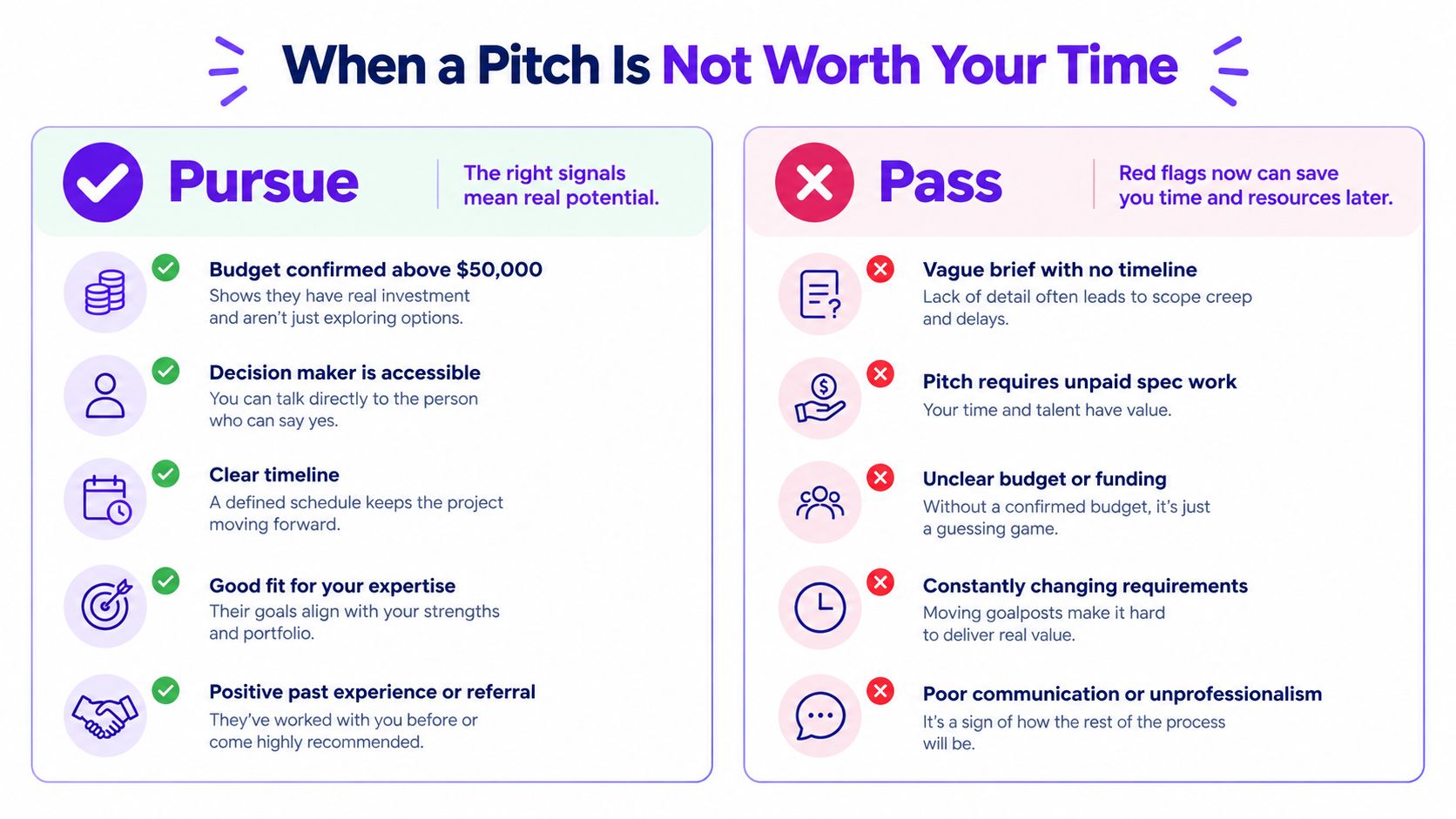
Qualify the opportunity before assigning a team. Ask for the budget range, decision process, evaluation criteria, number of agencies invited, expected scope of speculative work, access to decision-makers, and likely implementation path.
A strong opportunity usually gives you enough information to make an informed choice. A weak one demands original thinking while withholding the information needed to judge whether the work can be bought, approved, or implemented.
Use paid discovery when the client wants campaign-level thinking before agreeing to a relationship. Offer a focused workshop, strategic sprint, or concept development phase instead of producing a complete unpaid solution. You can still demonstrate capability without giving away the entire answer.
Walk away when the process is opaque, the brief keeps changing, the decision-maker is inaccessible, or the required speculative work exceeds the potential value. Protecting your team's creative energy is part of responsible pitch preparation.
Your Pitch Preparation Checklist
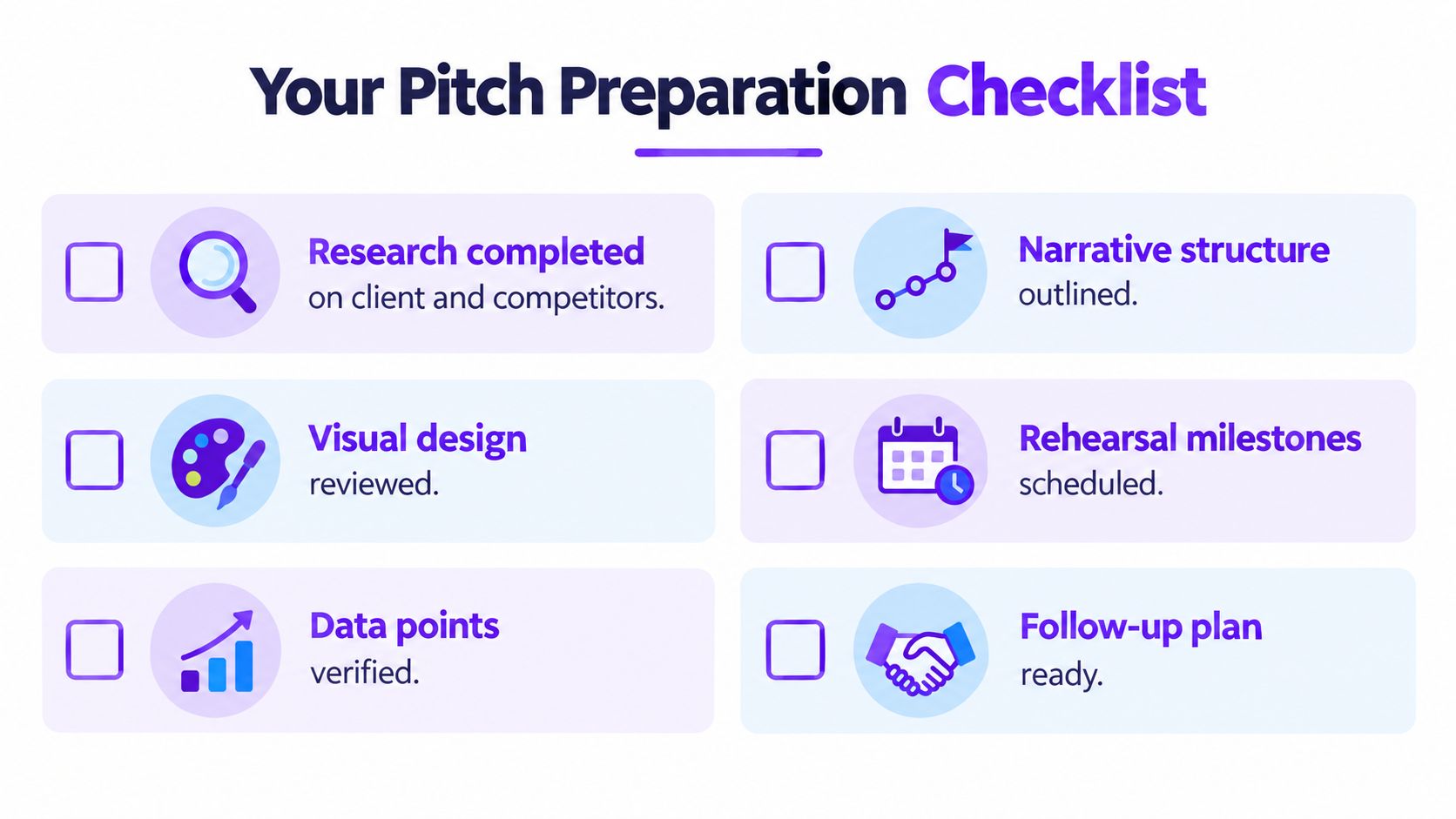
Use this checklist as a go or no-go review. A pitch is ready when the team can answer each question without inventing certainty.
Before building
- Research completed: You know the client's problem, current alternatives, decision process, and likely objections.
- Stakeholders mapped: You've identified the sponsor, approver, evaluator, blocker, and delivery owner.
- Opportunity qualified: The budget, timeline, competition, access, and speculative-work expectations justify participation.
- Decision defined: You can state the action you want at the end of the meeting.
Before designing
- Narrative outlined: The story moves from problem to insight, solution, evidence, differentiation, implementation, and ask.
- Claims verified: Every important assertion has a source, example, demonstration, customer result, comparison, or clearly stated assumption.
- Slides simplified: Each slide makes one point, uses an assertion headline, and gives the audience a visual reason to believe it.
- Appendix prepared: Commercial, technical, operational, and legal detail is available without crowding the core story.
Before presenting
- Rehearsal milestones scheduled: The team has completed a comprehension test, timed run, and pressure rehearsal.
- Questions assigned: Someone owns each likely objection, and presenters know when to hand over.
- Fallback ready: The story works without the deck, internet connection, or perfect room setup.
- Follow-up planned: The team knows what evidence to send, who will receive it, and when the next decision should happen.
A proposal should also make the next stage easy to understand. This guide to a marketing campaign proposal is useful when your pitch needs to translate strategic thinking into scope, responsibilities, and a concrete commercial path.
For collaborative teams, a structured brainstorming session can expose weak assumptions before they reach the client. It gives strategists, creatives, account leads, and delivery specialists a shared space to challenge the story and strengthen the evidence.
Bulby helps marketing agencies, creative teams, ad agencies, and brand strategists turn scattered input into stronger campaign concepts, messaging angles, and strategic directions through structured AI-guided brainstorming. Use Bulby with your team before the next pitch to test the problem, sharpen the narrative, and leave the room with a clearer idea of what you're asking the client to approve.