
The most popular advice on resistance to innovation is to explain the change again. Share the vision, list the benefits, and hold another meeting. If people still won't switch, the story becomes fear or a bad attitude.
That advice treats a readable signal as a personality flaw. A designer who keeps the old brief may be protecting a handoff that already works, a client who will judge the work, or a week with no spare hours. Silence after a kickoff is information. Quiet use of a tool the company never approved is information too.
A speech can name a change. It can't give someone a safer first step, a payoff they can point to, or a reason the extra effort will count. Read the behavior first. A clear no, a delay, a private objection, shallow use, and hidden use are different problems, and each one asks for a different first move.
Table of Contents
- What Resistance to Innovation Really Means
- How to Spot Resistance Nobody Announces
- Five Barriers and the First Move for Each
- Where Good Ideas Stall Before They Ship
- Hidden Use Beside Official Adoption
- How to Make a New Idea Safer to Try
- Test One Idea Before the Next Pitch
What Resistance to Innovation Really Means
Resistance to innovation is reluctance to accept a new product, process, or idea. It can appear when a change conflicts with familiar habits, seems to offer little value, challenges social norms, or carries perceived risk. A person may recognize a benefit and still hold back.
That hesitation can point to a practical obstacle. A new workflow may disrupt a routine that already gets the work done. It may demand effort before the payoff is clear, make someone worry about looking foolish in front of peers, or change who receives credit. A repeated objection, a delay, or quiet non-use can signal a mismatch in capability or incentives, not a personality flaw.
Common models name five barriers, usage, value, risk, tradition, and image, and resistance often takes three forms: rejection, postponement, or opposition. Someone might refuse an idea, ask to wait, or challenge it in a meeting or private conversation. Naming the form helps distinguish a firm no from a request for a safer chance to try.
Diffusion research summarized in a VTT publication reports that five perceived characteristics, relative advantage, compatibility, complexity, trialability, and observability, together explain approximately 49% to 87% of the variance in an innovation's adoption rate. Complexity and perceived risk generally slow diffusion. Compatibility, trialability, and visible benefits can help an idea spread. The pattern is like trying a tool before buying into it: people can judge it more easily when they can see how it fits and test it without a large commitment.

Three forms you can name
| Form | What it looks like | Early sign |
|---|---|---|
| Rejection | A clear no; the idea is dropped | Requests to go back to the old brief |
| Postponement | Not yet; the idea waits | Repeated 'next sprint' with no date |
| Opposition | Pushback in public or in private | Objections raised after the decision is made, or side conversations |
Low uptake alone does not show that an idea lacks value. It may feel complex, clash with the current workflow, be hard to observe, or seem unsafe to test. A sharp knife may stay in the drawer if it feels unsafe to hold. Identify the kind of resistance before deciding whether the idea has failed.
How to Spot Resistance Nobody Announces
A kickoff can be full and the new tool still empty. People nod, accept the login, then return to the old way of working. Quiet non-use is a signal to investigate, not proof of a bad attitude. It can point to a gap in skills, incentives, or how the new approach fits the work.
A review of employee behavior in organizational innovation describes resistance as active or passive, open or concealed. In evidence from nine public-transport companies summarized in a BazEkon record, resistant employees more often behaved passively and neutrally than showed visible opposition.
In an agency, the team might attend the kickoff but keep using its old brief template. People delay trying the tool, give one-word feedback, or use it only in a demo. Nobody objects aloud. The work carries on unchanged.
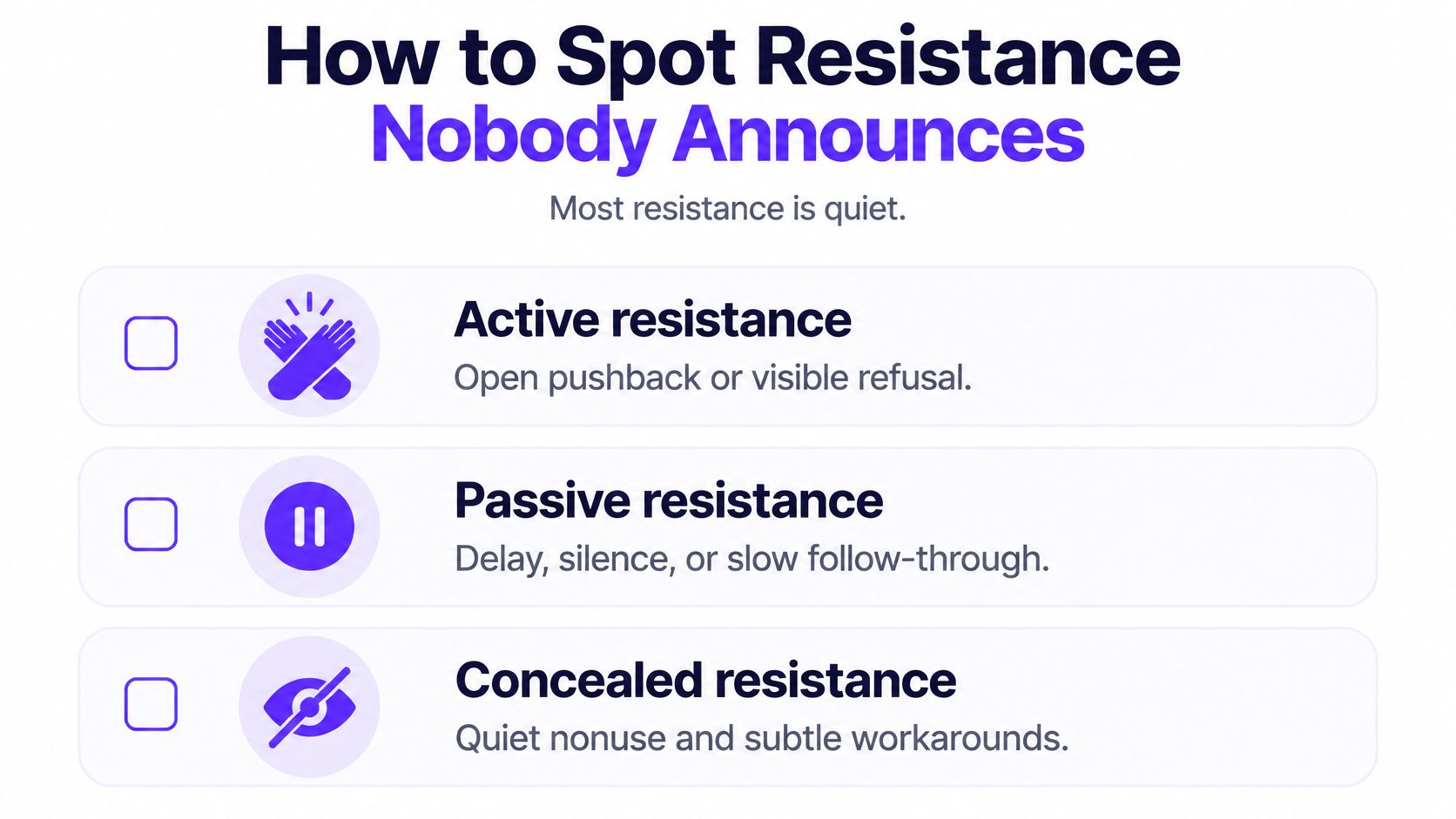
When old and new processes run side by side, work can split between them, and the team may never learn whether the new approach works on a real task. Look for what people do, not only what they say in a meeting.
Indicators past the attendance sheet
| Indicator | What it measures | Warning sign |
|---|---|---|
| Feature utilization | Which features people use in the new tool | Little use despite high attendance |
| Repeat usage | Whether people return after the kickoff | Use drops off after the first session |
| Workflow substitution | Whether the new process replaces the old one | The old template stays in use |
| Time to first useful result | How long it takes to produce usable work | The first result keeps getting delayed |
| Completion rate | Whether started tasks finish in the new flow | Tasks stop partway through |
| Legacy share | How much work stays on the old process | Work continues mainly on the old path |
Check a small set of indicators over a short period. High attendance with little repeat use suggests passive resistance, even if the kickoff felt positive. In a client-facing team, people may hesitate to challenge a senior colleague's idea. Status quo bias helps explain why a familiar template can remain in use after a promising demo.
Choose two indicators before introducing the next idea. That gives the team a concrete way to notice silence, rather than treating polite agreement as adoption. If you are assessing a creative format, compare AI video performance on social for context on that specific format, not as a test of whether quiet reactions mean resistance.
A short walkthrough of how concealed non-use shows up in daily work:
Five Barriers and the First Move for Each
Don't start with a speech. Start with the barrier that matches this week's behavior, then ignore the rest until that one moves.
Say a pitch team was told to draft angles in a shared board. By Thursday the board has two sticky notes, and the draft is still in last year's slide file. That's a usage problem, not a values problem. The new board adds clicks and breaks the handoff to the art director. The first move is to shrink the task to one reversible step, such as moving a single headline onto the board in the same meeting.
| Barrier | What you notice | First move |
|---|---|---|
| Usage | Extra steps or a broken handoff | Shrink the first task to one reversible step |
| Value | No one can name a concrete gain | Show a before-and-after on time, quality, or client reaction |
| Risk | People fear mistakes, blame, or skill loss | Run a small pilot with a written stop rule |
| Tradition | The idea clashes with how we already work | Keep one familiar ritual and change only the stuck part |
| Image | The method feels wrong for our role or status | Use proof from a peer, not a leadership slogan |
| Skill anxiety | People already use the tool but only for easy tasks | Protect practice time and coach one harder use |
| Unclear reward | Effort is extra and authorship is fuzzy | Say whose idea counts and how it shows up in reviews |
Value is the row where nobody can name a gain a client would notice. Put last month's deck beside a one-page test and mark time, quality, or the client's actual reaction. Abstract "faster innovation" doesn't move a producer who is already late.
Risk sounds like "if this flops, it's on me." Write a stop rule before the pilot. One client, one week, and a named person who can call it off without a postmortem.
Tradition isn't nostalgia. It's "this is how we do pitches." Keep the Monday critique. Change only the stuck part, such as how the first three lines get written.
Image is status. A strategist may treat a new method as unserious, or as something "not for people like us." A peer who used it on a live brief is better proof than a leadership slogan. If the room keeps returning to the same objections, the patterns in overcoming resistance to change are worth naming out loud so the objection isn't treated as rudeness.
Two rows sit outside the original five, and messaging-only advice skips both.
Skill anxiety shows up after people already use the tool, but only for the easy task. Searching is fine. Structuring a client argument is not. Protect an hour and coach that one harder use. Don't add another overview.
Unclear reward is extra effort with fuzzy authorship. Say whose name goes on the idea, and how the work shows up in the review. If credit stays with the loudest voice, rational people will save their best thinking for the old path.
Match the fix to the barrier, or the speech will miss the reason people are holding back.
Use one row this week. A second fix, piled on before the first one moves, just looks like another program.
Where Good Ideas Stall Before They Ship
A research deck can be full of useful findings while the next campaign still follows last year's pattern. The team has gathered knowledge, but hasn't turned it into action.
Resistance can interrupt the path from acquiring knowledge to using it. People may keep findings within their own teams, avoid testing new approaches, or leave implementation without a clear owner. The result is a capability gap: the organization has insights, but they do not become a service, process, or performance gain.
A full fridge isn't dinner
Ingredients need someone to turn them into a meal. In a marketing team, interview notes can sit unused because nobody owns the step from customer quote to tested message.
Track the move from insight to execution, not just the number of ideas. Mark where the last idea stopped: after research, after the workshop, or after the pilot. That stage points to the bottleneck. A workshop that ends with a good discussion still stalls if nobody leaves with a live test.
Clear content workflow roles and tools can make ownership at a handoff easier to see. A researcher, writer, and account lead should know who takes the next step, rather than waiting for someone else to act. The path from idea to implementation depends on connecting a stored insight to a trial that people can run.
Treat resistance as a signal about the pipeline, not a personality flaw. If knowledge is available but teams do not use it, examine whether they have the capability, ownership, and incentive to carry it forward. A stalled idea often reveals where the route from insight to action needs attention.
Hidden Use Beside Official Adoption
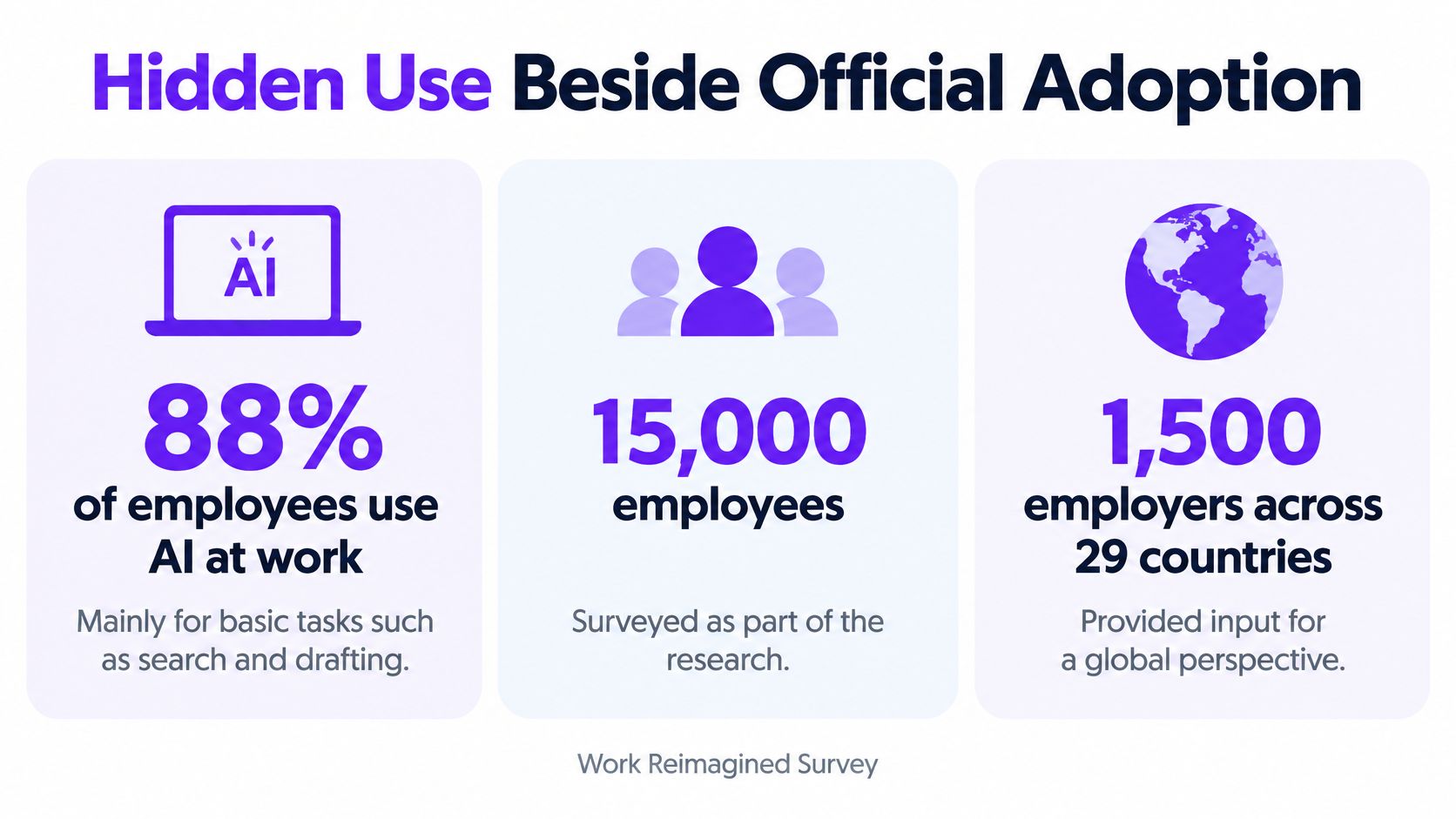
Widespread use isn't deep use. EY's 2025 Work Reimagined Survey of 15,000 employees and 1,500 employers across 29 countries found that 88% of employees use AI at work, yet mainly for basic tasks such as search and summarization. Only 5% use it to transform how they work.
The same survey found that 64% perceived increased workloads, 37% worried that overreliance could erode their skills, and only 12% received sufficient AI training. S&P Global reported that 54.5% of surveyed workers disagreed that they had received adequate AI training, while 34.7% expressed concern that AI could significantly alter or displace their jobs.
Shallow use can be self-protection
Picture a creative team that pastes a prompt for a first draft, then returns to the old process for anything a client will judge. Deeper use adds hours. It also puts authorship on the line. If the line is weak, the person looks less skilled, not more modern.
That holdback is rational when three things are missing. There's no protected time. There's no career benefit. There's a real chance the experiment makes someone's craft look thinner. Calling that technophobia sends you toward another announcement. The behavior is asking for practice time, a role that still needs judgment, and a review that rewards the harder use.
Separate the signals before you pick a fix:
- Skill anxiety: the person sticks to search because a client-facing draft feels beyond current skill.
- Workload resistance: the experiment sits on top of the old job, so the week gets longer.
- Status loss: craft and byline are how this role is valued, and the tool seems to erase both.
- Unclear rewards: nobody has said this effort counts in reviews or in who is seen as the author.
- Quality concerns: the output isn't good enough for the client, and checking it takes longer than writing it.
Each of those maps to a concrete change. Protected learning time, a redesigned task, evaluation criteria, and a real advancement path. A slogan doesn't cover any of them.
Hidden use beside the official tool
Official resistance can sit next to strong informal adoption. A 2025 global study by the University of Melbourne and KPMG, published in a KPMG executive summary, found that 58% of employees regularly use AI for work, while 66% rely on AI output without evaluating or validating it. 61% avoid revealing when they use AI, and 44% have used AI in ways that contravene organizational policies. Only 34% reported organizational guidance for generative-AI use, and just 60% of AI-using organizations provided responsible-AI training.
For an agency, that mix creates three practical risks. Quality becomes inconsistent because some drafts are checked and some aren't. Client material can leave the approved path. A few confident users shape the ideas, while others stay silent, so influence hides inside private chats.
The useful question isn't "How do we overcome resistance?" It's "What is this behavior signaling?"
If unofficial use is high and official use is low, the sanctioned workflow is probably slow, surveilled, poorly governed, or disconnected from the job. Measure shadow use, whether people disclose it, whether outputs get checked, where policy creates friction, and whether the new flow replaces the old one. Fix friction and trust before you schedule another launch.
How to Make a New Idea Safer to Try
Several barriers can be active at once: extra steps, limited trust, competing workload, or unclear value. That is why a pep talk alone rarely helps. Resistance is useful information about what the team can do and what the current incentives reward. A person may agree in the meeting and still avoid the new process afterward.
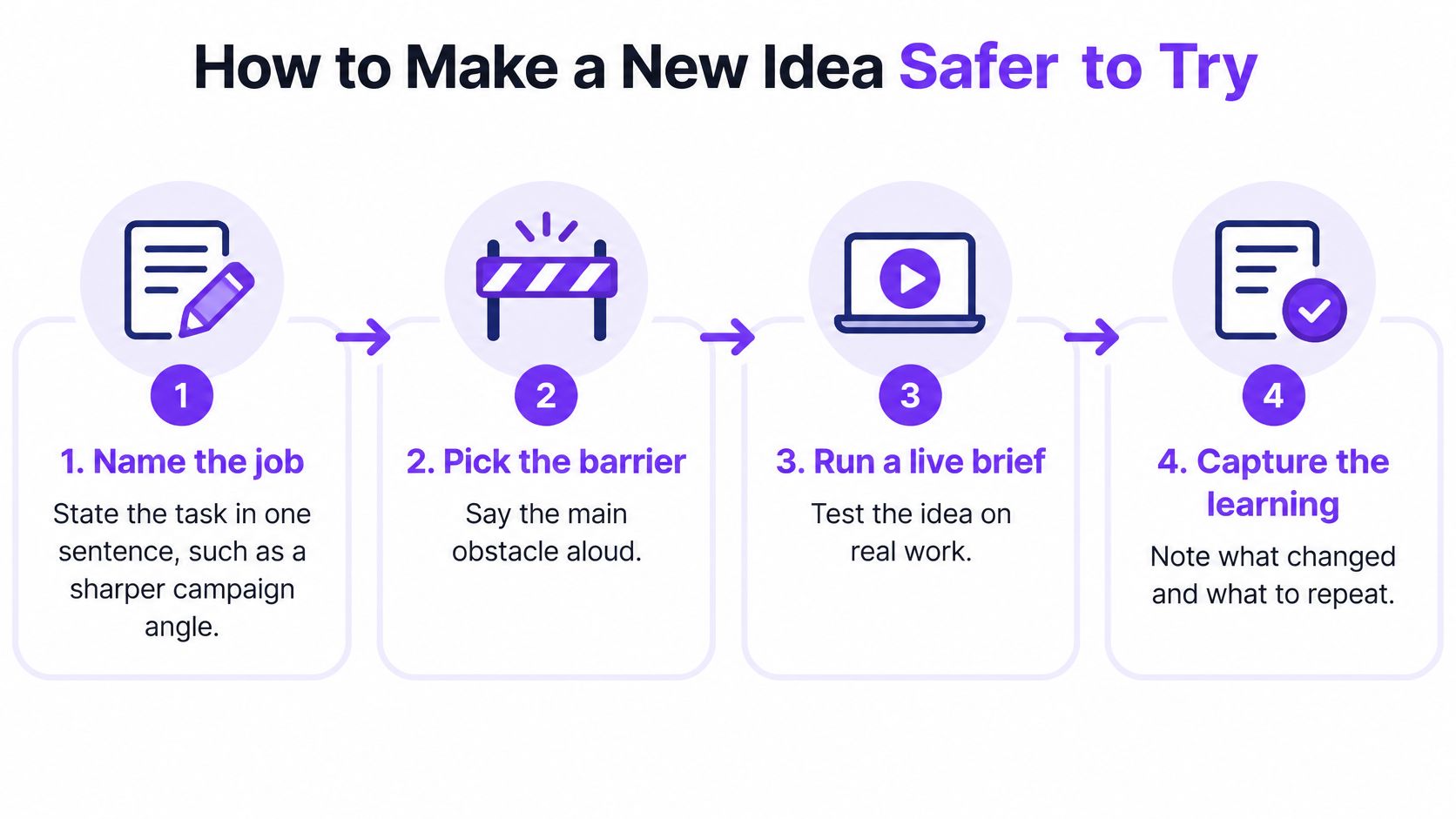
Use this sequence on a live brief. Treat each step as a small adjustment that makes a trial easier to attempt and easier to assess.
- Name the job in one sentence. “A sharper campaign angle for this client” gives the team a concrete task. “Try a new approach” describes a mood, not work people can act on.
- Pick the barrier and say it aloud. “The extra steps are the problem” shows the concern has been heard. Without that clarity, a fix can feel random and miss the obstacle.
- Shrink the test. Keep it reversible within one meeting or one week, and decide in advance when to stop. If people cannot see a safe way to exit, they may avoid starting.
- Protect the time. When the experiment sits on top of the old workload, postponing it makes sense. Put the time on the calendar and remove another task.
- Collect input before debate. Give people time to write notes before discussion, so the first senior voice does not set the direction. That only works if psychological safety at work makes it safe for a junior colleague to offer a different view.
- Check any AI-assisted output before it reaches a client. Skipping review sends a clear signal that speed matters more than the account.
- Decide in the room. Adopt, adapt, or stop, and name who owns the next action. “We should discuss” leaves the decision open.
- Review two usage indicators a week later. Check whether people used the new approach again and whether it replaced the old flow. A positive meeting mood does not show that the change fits the work.
Two mistakes can undo the trial. More persuasion adds noise when workload is the barrier. A broader rollout spreads uncertainty when nobody has judged the small test. Make the next step match the signal: adjust the task, time, or process, then check whether people use it.
Test One Idea Before the Next Pitch
Choose one upcoming brief and name the barrier you want the test to address. Keep the trial reversible, then judge it by whether the team uses the approach again, not by applause.
When status shapes an open debate, the loudest voice can steer the room while others stay quiet. Brainwriting gives people another route: they write ideas before discussion, so the first contribution does not set the direction. Bulby is an online AI brainstorming tool that uses brainwriting, anonymous submissions, and AI-generated sparks to help teams solve problems creatively. Its six-step process starts with a challenge and a team invitation link. Participants receive unique random exercises, then write and share ideas anonymously with AI-powered inspiration. Bulby collects and summarizes the ideas, surfaces promising ones and actionable next steps, and creates a report to share with the team.
Try Bulby's public demo, which requires no login, with the question, “How might we improve team meetings to save time?” A clear idea validation process helps distinguish a pleasant session from a test that produces an outcome. To judge business results, measure revenue impact from experiments rather than relying only on how people felt about the session.
If a workshop ends in nods but no trial, change the format before adding another meeting. Visit Bulby and try the demo with a question from your next pitch.