

An effective strategy for engagement is so much more than just scheduling a few virtual happy hours. It’s a deliberate, ongoing effort to weave connection and a sense of shared purpose into the very fabric of your remote team's daily work. This approach turns engagement from an afterthought into a central part of your company culture, boosting both morale and performance.
Why Your Remote Team Needs a Real Strategy for Engagement
Let's get real for a moment. Just hoping your remote team stays engaged is a surefire way to end up with a disconnected, siloed group. When you lose those spontaneous "water cooler" moments of an office, it's easy for people to drift apart. This can tank morale, kill innovation, and make everyone feel like they're working on an island. A formal strategy isn't just a "nice-to-have"; it's an essential blueprint for any distributed team that wants to thrive.

Thinking strategically shifts engagement from a random list of activities to a cohesive system designed to get real results. At its core, it's about building psychological safety—creating an environment where people feel valued, heard, and genuinely connected to the mission.
To get started, it helps to see the big picture. Here are the core pillars we'll be exploring throughout this guide.
Core Components of a Remote Engagement Strategy
| Component | Objective | Example Tactic |
|---|---|---|
| Clear Objectives | Define what success looks like and align engagement with business goals. | "Improve cross-departmental collaboration by 15%." |
| Audience Segmentation | Tailor activities to the specific needs of different teams or roles. | Running separate feedback sessions for engineering and sales. |
| Tactical Mix | Combine different types of interactions to keep things fresh and inclusive. | A mix of weekly async check-ins and monthly virtual socials. |
| Structured Ideation | Systematically gather and prioritize engagement ideas from the team. | Using a "How Might We" brainstorming session to solve a challenge. |
| Measurement & KPIs | Track progress and prove the value of your engagement efforts. | Monitoring eNPS scores and voluntary turnover rates. |
Each of these pieces plays a critical role in building a program that not only works but lasts.
The Hidden Costs of Disconnection
When you leave engagement to chance, the hidden costs start piling up fast. It’s not just about a dip in productivity; the ripple effects are huge. The worldwide employee engagement rate is a dismal 21%. That widespread apathy comes with a staggering price tag, costing the global economy an estimated $8.9 trillion a year—that's 9% of global GDP.
Ignoring this reality in your own team means you’re risking:
- Higher Turnover: People who feel disconnected are the first to start looking for a new job, which sends your hiring and training costs through the roof.
- Reduced Innovation: Real collaboration and creative problem-solving can't happen when people don't feel connected.
- Declining Quality: When employees are just going through the motions, their commitment wanes, and the quality of your product or service inevitably suffers.
A well-designed engagement strategy is one of the most powerful retention tools you have. It creates an environment where people want to stay, do their best work, and grow with you.
This isn’t about fluffy feel-good initiatives; it’s about building a resilient, high-performing team. Psychological safety is the bedrock of it all, creating a space for the kind of open communication and vulnerability that leads to true connection. If you want to dig deeper into this, check out our complete guide on building trust in remote teams. A clear strategy makes sure that every single person, no matter where they log in from, feels like they’re a crucial part of the team's success.
Defining Your Engagement Goals and Objectives
Before you even think about planning a virtual coffee chat or a team-building game, you have to ask one simple but crucial question: Why?
A truly effective engagement strategy isn’t just a random collection of fun activities. It’s built on clear, specific goals that tackle the real challenges your team is facing. Without a solid purpose, even the most well-intentioned efforts can feel like a waste of time—just more corporate busywork.
Your objectives are what give your strategy direction. Are you trying to cut through the isolation that so often creeps into remote work? Or maybe you need to tear down the communication walls between your engineering and marketing teams to get products out the door faster. The goal is never just "to engage people." It's to solve a real business problem by fostering better connections.
Start with a Simple Needs Assessment
To set goals that actually mean something, you first have to get a handle on where your team stands right now. This doesn't require a month-long, complex analysis. A few focused actions can give you all the insight you need.
- Pulse Surveys: Send out short, simple surveys with a mix of multiple-choice and open-ended questions. Ask things like, "On a scale of 1-10, how connected do you feel to your immediate team?" or "What's one thing that would help you feel more plugged into our company culture?"
- Informal One-on-Ones: Use your regular check-ins to dig a little deeper. Move beyond project updates and ask people how they're really feeling about team dynamics, communication, and whether they feel like they belong.
- Observe Communication Patterns: Take a look at your digital workspaces. Are some people always quiet in meetings but super active on Slack? Is collaboration between departments happening naturally, or does it feel forced and rare?
These simple steps give you a baseline. You'll move from vague guesses to objectives backed by real data, which is the most critical part of building an engagement strategy that genuinely works.
From Vague Ideas to Specific Objectives
Once you have that feedback, you can start turning those needs into specific, measurable goals. A goal like "improve morale" is fluffy and impossible to track. Instead, tie your objectives to real-world outcomes.
For example, if your software team feels siloed, a much better goal is: "Increase cross-functional collaboration by launching one joint mini-project between engineering and design each quarter."
The difference between an activity and a strategy is a clearly defined objective. An activity is a virtual happy hour. A strategy is using that happy hour to intentionally introduce new hires to tenured employees to accelerate their sense of belonging.
Getting this specific is everything. In the United States, employee engagement recently hit a decade-low, with only 31% of employees reporting they feel engaged. The fallout from this is huge. Highly engaged teams, on the other hand, achieve 10% higher customer loyalty, 18% greater productivity, and a whopping 23% increased profitability, according to research shared by YourThoughtPartner.com. A targeted strategy makes sure your efforts are directly driving these kinds of powerful business results.
To make your objectives even stronger, consider using a structured framework. For a closer look at how to build them, check out our guide on popular goal-setting frameworks for teams. This will help you craft goals that are specific, measurable, achievable, relevant, and time-bound—setting your engagement strategy up for success right from the start.
Choosing the Right Mix of Engagement Tactics
Let's be honest: you can't force team engagement with a single, mandatory weekly happy hour. A one-size-fits-all strategy is a recipe for failure, especially with a remote team. Your people have different personalities, work schedules, and time zones. The real secret is creating a thoughtful blend of activities that build connections without leading to total burnout.
This means mixing real-time, synchronous events with more flexible, asynchronous options. It’s how you cater to the extroverts who get energized by live interaction and the introverts who prefer to contribute on their own terms. Striking this balance is the key to dodging the dreaded Zoom fatigue while still making sure your team actually feels like a team.
Before you jump into picking activities, you need a solid foundation. It's a simple three-part process: assess what your team needs, define what you want to achieve, and then plan your tactics accordingly.
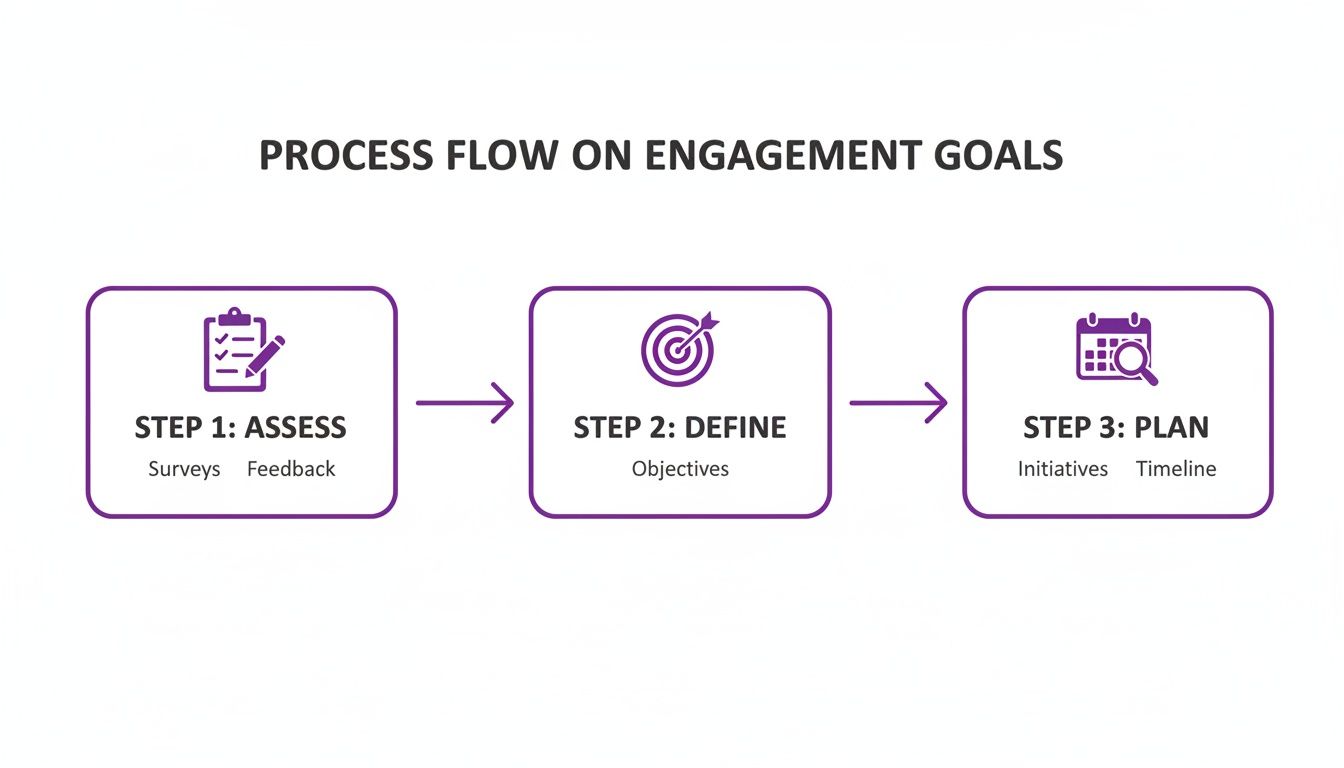
As you can see, choosing your tactics is the final piece of the puzzle, not the starting point. It all flows from a clear understanding of your team's unique situation and goals.
Balancing Synchronous and Asynchronous Activities
Synchronous engagement is anything that happens live. Think virtual coffee chats, collaborative brainstorming on a Miro board, or even a quick team game. These are fantastic for getting instant feedback, sparking spontaneous conversations, and creating that sense of shared, real-time experience.
On the flip side, asynchronous engagement doesn't require everyone to be online at once. This could be a dedicated Slack channel for sharing weekend wins, a running "kudos" thread, or a shared team playlist on Spotify. These activities are incredibly inclusive, respecting different schedules and giving people the space to engage when they're ready.
If you're looking for more ways to build strong connections, many community engagement best practices can be adapted for internal teams and offer some really valuable insights.
Expert Tip: A common pitfall is leaning too heavily on synchronous events. A truly great engagement strategy weaves asynchronous touchpoints into the daily fabric of work, making connection a continuous rhythm rather than just another scheduled meeting.
To help you decide what's right for your team, here’s a quick comparison of different tactics.
Synchronous vs. Asynchronous Engagement Tactics
| Tactic Type | Examples | Best For | Potential Pitfall |
|---|---|---|---|
| Synchronous | Virtual team lunches, live workshops, all-hands meetings, online games | Building immediate rapport, brainstorming, celebrating milestones together | Can exclude people in different time zones, contributes to screen fatigue |
| Asynchronous | "Water cooler" Slack channels, weekly update threads, peer recognition posts, collaborative documents | Deep thinking and feedback, accommodating flexible schedules, creating an inclusive environment | Can feel impersonal if not managed well, slower pace of interaction |
Ultimately, the goal isn't to pick one over the other but to create a rich mix that offers something for everyone.
A Balanced Approach in the Real World
Here’s a scenario I’ve seen play out. A fully remote tech company noticed their weekly brainstorming all-hands was a mixed bag. A few engineers dominated the conversation, while many others stayed silent, leading to uneven participation.
They decided to switch things up with a hybrid approach:
- "Focus Fridays" (Asynchronous): They blocked off Friday mornings for deep work—no meetings allowed. Instead, they encouraged quiet collaboration in shared Google Docs or Figma files.
- Optional "Coffee & Chat" (Synchronous): They kept a 30-minute, completely optional video call on Friday afternoons for anyone who wanted to hang out, chat, and wind down before the weekend.
This small change made a huge difference. The asynchronous time gave everyone space for deep, uninterrupted thinking. The optional call provided a low-pressure social outlet. It catered to both work styles and dramatically improved how people felt about their workweek. For even more inspiration, you can find a whole list of remote team engagement ideas to experiment with.
Don't Forget the Power of Recognition
One of the most critical—and often overlooked—elements of engagement is simple recognition. It’s not just a nice-to-have; it’s a powerhouse.
Globally, regions like South Asia report the highest employee engagement at 33%, and a strong culture of appreciation is a big reason why. When employees feel genuinely valued, they are 156% more likely to be highly engaged. Yet, fewer than seven in ten employees believe their organization truly cares about their well-being.
You don't need a complex program. Something as simple as a dedicated Slack channel for peer-to-peer shout-outs is a low-effort, high-impact tactic. Consistently celebrating wins, big and small, will make any engagement strategy exponentially more effective.
How to Run Engaging and Productive Virtual Sessions
The success of any virtual session comes down to one thing: facilitation. Without a solid plan and a thoughtful structure, even a meeting with the best intentions can turn into a mess of awkward silences or people talking over each other. Transforming these dreaded calendar blocks into valuable, interactive experiences is a cornerstone of any great strategy for engagement.
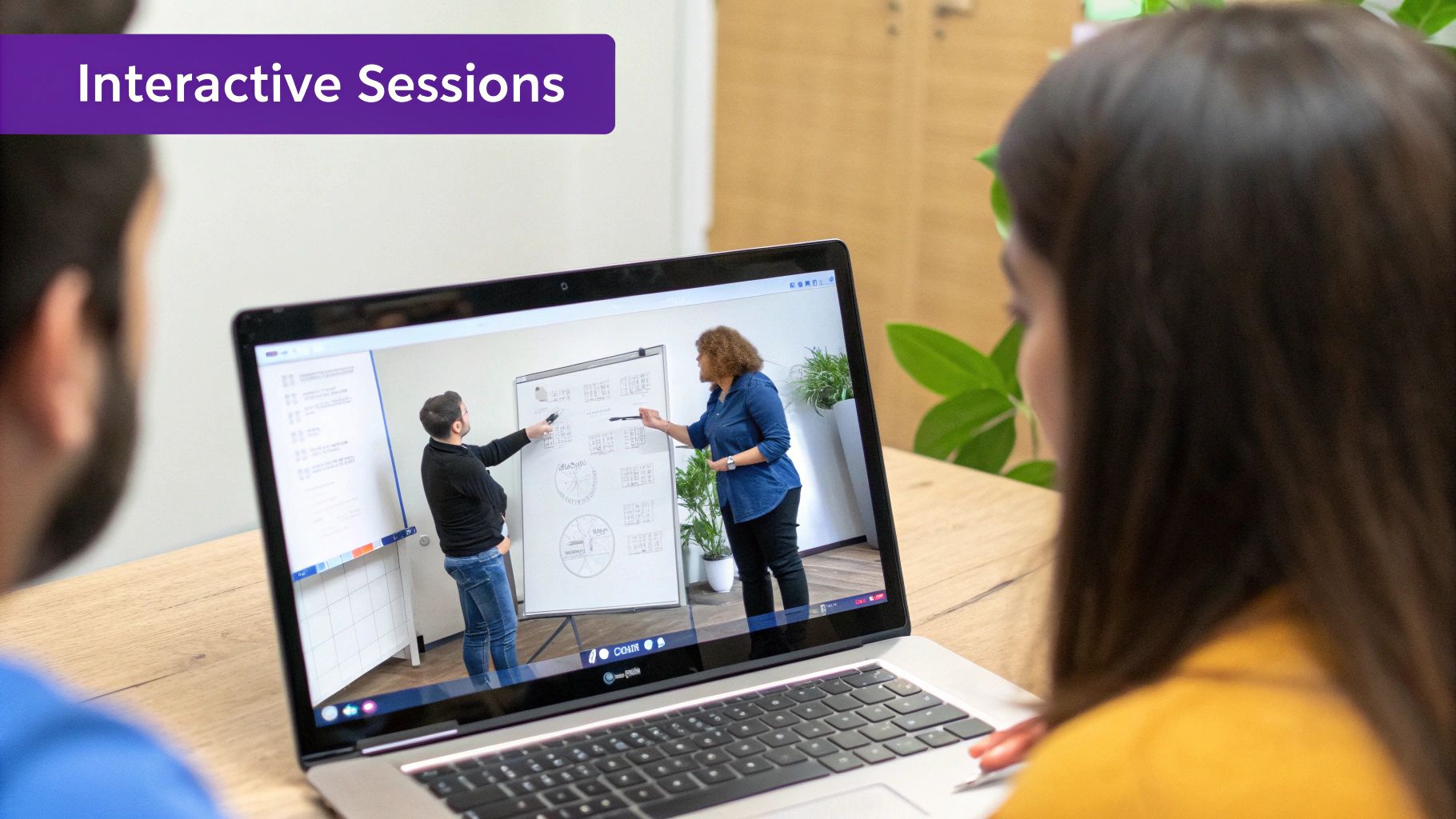
The trick is to design sessions that actively pull people in, making sure everyone gets a real chance to contribute. This means ditching the default "open floor" approach and using structured techniques that level the playing field.
Simple facilitation methods can completely change the dynamic. You don't need to be a professional workshop leader to use them, and the payoff in productivity and morale is immediate. If you're looking to go deeper, our guide on how to facilitate meetings effectively covers more advanced techniques.
Simple Techniques for Inclusive Brainstorming
To get real participation, you have to create a space where every voice is heard—not just the loudest ones. Two of my favorite methods for this are Round Robin and Silent Storming. They're incredibly simple and work wonders.
- Round Robin Brainstorming: This one is as straightforward as it sounds. You just go around the "virtual room," giving each person a turn to share one idea. It’s a great way to stop a few people from dominating the conversation and it gives more introverted team members a designated moment to speak up.
- Silent Storming: Before anyone says a word, give the team 5-10 minutes to quietly jot down their ideas on a shared digital whiteboard or document. This initial silence lets people think without the pressure of the group, which often leads to more thoughtful and diverse ideas.
These structured methods are the foundation of a productive session. They guarantee that good ideas don't get lost and that everyone feels like their input matters.
A Ready-To-Use Agenda for Your Next Session
The best way to see how this works is to try it. Here’s a simple but effective agenda for a 60-minute virtual workshop focused on collaborative problem-solving. It's built to maximize interaction and end with clear, actionable results.
Agenda Blueprint: 60-Minute Collaborative Problem-Solving Workshop
- Welcome & Icebreaker (5 mins): Kick things off with a quick, fun question to get everyone warmed up and comfortable.
- Frame the Challenge (10 mins): Clearly explain the problem you're all there to solve. Give some background and define what success looks like.
- Silent Storming (10 mins): Use a tool like Bulby or even a simple shared doc for individual idea generation.
- Idea Clustering & Discussion (20 mins): Start grouping similar ideas together. This is where you facilitate a conversation around the themes that are popping up.
- Dot Voting & Prioritization (10 mins): Give everyone 3-5 "dots" to vote on the ideas they think will have the biggest impact.
- Action Steps & Wrap-Up (5 mins): End by clearly defining the next steps and who owns what for the top-voted ideas.
You can also pull inspiration from other fields. For example, many of the same challenges exist in online education. You might find some fresh ideas in these effective tips for student engagement in online learning. A structured, well-facilitated approach can turn your virtual meetings from passive screen-staring into genuinely productive events that boost your team's connection and reinforce your entire engagement strategy.
Measuring Success and Adapting Your Strategy
So, you’ve rolled out a new engagement plan. How do you know if it's actually working? Without a clear way to measure success, you're essentially flying blind. A data-informed approach is the only way to prove the value of your efforts and make smart adjustments when things aren't hitting the mark.
This isn't about chasing vanity metrics, like how many people showed up to a virtual happy hour. Real measurement blends hard numbers with human feedback to give you a complete, honest picture of your team's health.
Combining Quantitative and Qualitative Data
To get the full story, you need to track two kinds of information. Quantitative data gives you the "what"—the objective, numerical insights into participation and sentiment. On the other hand, qualitative feedback provides the critical "why"—the context and personal experiences behind those numbers.
Here are a few key metrics I always recommend starting with:
- Participation Rates: What percentage of the team is actually engaging? Maybe you see low turnout for virtual lunches but high activity in an asynchronous book club. That's a clear signal telling you where to invest your energy.
- Employee Net Promoter Score (eNPS): Regularly asking, "How likely are you to recommend our company as a great place to work?" is a powerful way to benchmark overall satisfaction and track it over time.
- Voluntary Turnover Rate: A declining turnover rate is one of the strongest indicators you can have. It’s proof that your engagement efforts are making people want to stay.
While these numbers are crucial, they don't tell you everything. That's where the human element comes in.
Don’t just count heads; understand what’s in them. Anonymous, open-ended survey questions can reveal frustrations or brilliant ideas that numbers alone will never capture.
You can gather this feedback by looking for common themes in your one-on-ones or by analyzing the sentiment in open-ended survey responses. This dual approach ensures your strategy evolves based on what your team actually needs, not just what you assume they want.
Creating a Simple Feedback Loop
A continuous feedback loop is the engine that keeps your strategy relevant. One of the simplest and most powerful ways to create this is with a quarterly pulse survey.
This regular check-in helps you spot trends early and act on them quickly. For instance, if you notice a dip in eNPS scores for a specific department, you know exactly where to dig deeper to find the root cause and adjust your tactics. This iterative process of listening, learning, and adapting is what separates a good remote culture from a great one.
For teams ready to go a step further, conducting a comprehensive organizational culture assessment can provide a detailed roadmap for improvement. This deeper dive uncovers the underlying beliefs and behaviors shaping your team's experience. By systematically gathering data and adapting your approach, you build an engagement strategy that genuinely supports your team's well-being and performance.
A Few Common Questions About Remote Engagement
Even with the best-laid plans, a few questions always pop up when you're trying to build a more connected remote team. Let's tackle some of the most common hurdles I see managers run into. These are the things that can trip you up, but with a bit of foresight, they’re easy to navigate.
"How Can I Build an Engagement Strategy on a Shoestring Budget?"
This is probably the number one question I get. The good news? You don’t need a huge budget to create real connections. In fact, some of the most powerful drivers of engagement are completely free. It’s all about being consistent and genuine, not spending a ton on fancy perks.
Here are a few low-cost, high-impact ideas you can start with:
- Peer-to-Peer Recognition: Set up a dedicated Slack or Teams channel where people can give public shout-outs for great work. It costs absolutely nothing and builds an incredible culture of appreciation.
- Digital "Water Coolers": Create channels for non-work stuff—hobbies, pets, what you’re watching, weekend plans. This opens the door for the kind of casual, low-pressure chats that used to happen in the office kitchen.
- Simple Meeting Starters: Kick off meetings with a quick, non-work-related question. It gets everyone's voice in the room and helps people connect as humans first.
Remember, a bunch of small, authentic gestures of appreciation will always beat out a single, expensive event. Genuine connection is priceless.
"What's the Difference Between Team Building and Employee Engagement?"
This is such an important distinction, and it’s one that’s easy to mix up.
Think of it this way: team building is a tactic, while employee engagement is the outcome. They’re connected, but they aren't the same thing.
A team-building event—like a virtual escape room or a fun workshop—is a specific activity you do. It’s one tool in your toolkit. Employee engagement, on the other hand, is the emotional commitment and connection an employee feels to their work, their colleagues, and the company’s bigger picture.
A smart strategy uses team-building activities as just one of many ways to build that deeper, long-term sense of belonging. One is a moment in time; the other is a state of being.
"How Often Should We Be Doing Engagement Activities?"
Finding the right rhythm is more of an art than a science. There's no magic formula, and the ideal frequency really depends on your team’s culture, workload, and personality. The goal is to find a consistent cadence that feels natural, not forced.
Meeting fatigue is real, and burnout from too many "fun" events is just as damaging as the disconnection from too few.
A balanced approach might look something like this:
- Daily or Weekly Rituals: Small, asynchronous habits. A "good morning" GIF thread, a channel for sharing weekly wins, or a "question of the day" bot.
- Monthly or Quarterly Events: Bigger, more structured synchronous sessions. Think a virtual workshop, a catered team lunch over video, or an interactive online game.
You want to weave these moments of connection into the fabric of your workweek. The best way to find that sweet spot? Just ask your team. A quick pulse survey can give you all the feedback you need to figure out what frequency works for them.
Ready to supercharge your team's brainstorming sessions? Bulby provides the structure and AI-powered guidance to run workshops that are not only productive but genuinely engaging. Turn your great ideas into even better outcomes. Explore how Bulby can help your team.