
In today's remote and hybrid work environments, building genuine team connection is more challenging and crucial than ever. The right teams icebreaker games do more than just fill awkward silence; they are strategic tools for boosting energy, building psychological safety, and sparking the creative thinking needed for innovation. Moving beyond generic introductions, a well-chosen icebreaker sets a positive tone, encourages participation, and makes every team member feel seen and valued from the start of any meeting or workshop.
For teams working remotely or in hybrid setups, exploring different types of activities is key. Incorporating a variety of games to play long distance can be particularly useful for fostering connection and engagement, ensuring that distance doesn't create disconnect. These activities are essential for turning passive video calls into active, collaborative sessions. They lay the groundwork for more effective communication and stronger relationships, which are the cornerstones of high-performing teams.
This guide provides a curated list of 10 powerful and practical icebreakers designed for the modern workplace. We have categorized each activity by its primary goal, whether it's to energize the group, build trust, or spark creative ideas. You'll find detailed instructions, specific facilitation tips, and clear guidance on how to adapt them for virtual settings. Whether you need to jumpstart a sluggish Monday morning meeting or build deep trust within a new project team, you will find an activity here that transforms your virtual gatherings into dynamic, engaging experiences.
1. Two Truths and a Lie
A true classic among teams icebreaker games, "Two Truths and a Lie" is a simple yet powerful activity for uncovering surprising facts about colleagues. The premise is straightforward: each person shares three "facts" about themselves, where two are true and one is a carefully crafted lie. The rest of the team then guesses which statement is the lie, leading to fun reveals and shared laughter.
This game excels at building psychological safety by encouraging personal sharing in a structured, low-stakes way. It’s a favorite in onboarding sessions at companies like Google and is easily adapted for any virtual or hybrid setting.
How to Play
- Preparation: Ask each team member to prepare three statements about themselves in advance. Emphasize that the best statements are unique and not easily verifiable online.
- Sharing: One by one, each person presents their two truths and a lie in a random order.
- Guessing: After a person shares, the team discusses and votes on which statement they believe is the lie. For remote teams, this works perfectly with a polling feature in Zoom or Microsoft Teams, or simply by typing guesses into the chat.
- The Reveal: The presenter reveals the lie, often sharing a brief, interesting story behind one of the true statements.
Facilitator Insight: Model the game yourself first. Sharing a clever, well-disguised lie and two surprising truths sets a fun and creative tone for the rest of the group.
Why This Game Works for Teams
- Builds Connection: Moves beyond surface-level small talk to reveal hobbies, past experiences, and hidden talents.
- Sparks Curiosity: Encourages active listening and critical thinking as team members analyze each other's statements.
- Highly Adaptable: Works just as well for a quick 10-minute energizer as it does for a longer, more in-depth team-building session.
This activity is ideal for new teams getting to know each other or for established teams looking to deepen their bonds. For more ideas on crafting compelling statements, you can find inspiration from a variety of icebreaker quiz questions.
2. Human Bingo
An interactive and energetic classic, "Human Bingo" is one of the best teams icebreaker games for getting people out of their seats and mingling. The goal is to encourage participants to talk to as many colleagues as possible by having them find people who match specific prompts on a bingo card. Each square contains a characteristic or experience, such as "has visited 5+ countries" or "plays an instrument."
This game is brilliant for breaking down silos and promoting cross-departmental connections in a fun, low-pressure environment. It’s a staple at large-scale corporate events, including company retreats at Amazon and team integration activities at Salesforce, because it effectively transforms networking from a daunting task into an engaging challenge.

How to Play
- Preparation: Create bingo cards with a grid of unique prompts. Customize these to your team by including a mix of professional accomplishments and fun personal facts. Distribute a card and a pen to each participant.
- Mingle and Sign: Announce the start of the game. Players must walk around and talk to their colleagues to find someone who matches a square. When they find a match, that person signs their name in the corresponding box. A rule of thumb is that one person can only sign another’s card once or twice.
- Shout Bingo: The first person to complete a row, column, diagonal, or the entire card shouts "Bingo!"
- Verification: The facilitator quickly verifies the winner's card by asking them to introduce the people who signed each square, which adds another layer of connection.
Facilitator Insight: For remote teams, use breakout rooms to simulate mingling. Share a digital bingo card (like a Google Sheet or a Miro board) and have participants "sign" by typing their names into the squares of their colleagues' cards in a shared space.
Why This Game Works for Teams
- Encourages Interaction: The structure naturally pushes even the most introverted team members to initiate conversations.
- Fosters Discovery: Uncovers shared interests and unique life experiences that wouldn't normally come up in a work setting.
- Highly Scalable: Works effectively for groups of any size, from a small team of 10 to a company-wide event with hundreds of attendees.
Human Bingo is perfect for onboarding new hires, kicking off conferences, or simply re-energizing an established team. For more variations and bingo card ideas, explore these group ice breaking activities.
3. Speed Networking
Adapted from the popular speed dating format, Speed Networking is an energetic and efficient way for team members to have focused one-on-one conversations. Participants are paired up for short, timed chats (typically 2-3 minutes) before rotating to a new partner. This highly structured activity ensures everyone gets a chance to connect with multiple colleagues, making it a powerful tool for large groups or newly formed teams.
This icebreaker excels at breaking down silos and fostering cross-functional relationships in a short amount of time. Tech companies like HubSpot often use this method during onboarding to help new hires quickly build a network, and it's a staple at professional conferences for its effectiveness.

How to Play
- Preparation: Prepare 4-5 interesting, open-ended questions that will guide the conversations. Mix professional prompts (e.g., "What's a skill you'd like to develop this year?") with personal ones (e.g., "What's the best concert you've ever been to?").
- Pairing Up: Arrange participants into pairs. For virtual teams, this is seamlessly managed using breakout rooms in Zoom or Microsoft Teams.
- Conversation Rounds: Announce the first discussion prompt and start a timer for 2-3 minutes. When the time is up, use a clear signal (like a bell or a sound effect) to end the conversation.
- Rotation: Instruct one "line" or group of participants to move to the next partner, while the other stays put. In a virtual setting, the facilitator can automatically reconfigure the breakout rooms. Repeat for several rounds with new questions.
Facilitator Insight: To ensure everyone meets new people, keep one line of participants stationary while the other rotates in a set order. This prevents confusion and guarantees each person interacts with a fresh partner in every round.
Why This Game Works for Teams
- Maximizes Interaction: Guarantees that every participant connects with multiple colleagues, far more than in an unstructured mingle.
- Encourages Deeper Conversation: Guided prompts help bypass generic small talk and move directly to more meaningful discussions.
- Energy Booster: The fast-paced, timed nature of the game keeps energy levels high and participants engaged.
Speed Networking is one of the most effective teams icebreaker games for quickly building rapport in large groups or kicking off a workshop. For more tips on adapting this for a remote environment, explore these virtual icebreakers for teams.
4. The M&M or Skittles Game
A delightfully simple and engaging activity, "The M&M or Skittles Game" uses a bit of sweet randomness to spark conversation. The concept involves participants taking a handful of colorful candies, with each color corresponding to a specific question or prompt they must answer. It’s a low-pressure way to encourage sharing, turning a simple treat into a tool for connection.
This tactile game is a favorite in various settings, from Airbnb team-building events to classroom activities, because it’s so approachable. Remote teams can easily adapt it by using virtual candy dispensers or by mailing a small packet of candies to participants ahead of the meeting, making it an inclusive choice for any group.
How to Play
- Preparation: Create a key that assigns a prompt to each candy color. For example: Red = Favorite hobby, Green = A place you want to travel, Yellow = First job, Orange = A hidden talent, Blue = Favorite movie or book.
- Distribution: Each person takes a small, random handful of candies from a shared bowl (in-person) or is assigned random colors via a virtual tool.
- Sharing: Going around the circle, each person shares an answer for each candy color they have. If someone has three red candies, they can share three different hobbies or just one.
- Discussion: Encourage brief, fun follow-up questions after each person shares, keeping the atmosphere light and conversational.
Facilitator Insight: Prepare interesting and varied prompts that mix personal and light work-related topics. Avoid generic questions and instead opt for ones that might elicit surprising or funny responses.
Why This Game Works for Teams
- Low-Stakes Participation: The random nature of the candy colors removes the pressure of choosing a topic, making it easy for everyone to contribute.
- Encourages Spontaneity: It prompts team members to share information they might not normally volunteer in a typical conversation.
- Creates Positive Associations: Linking team bonding with a fun, tangible treat like candy helps create positive memories and a relaxed atmosphere.
This is one of the most versatile teams icebreaker games, perfect for kicking off a workshop or as a quick energizer during a long meeting. It’s particularly effective for groups that may be hesitant to share, as the game’s structure provides a clear and easy path to participation.
5. Common Ground
A powerful and unifying activity, "Common Ground" is one of the most effective teams icebreaker games for revealing hidden similarities and fostering a sense of belonging. The exercise involves dividing the team into smaller groups and tasking them with finding a list of uncommon things they all share. The goal is to move beyond superficial connections, like working for the same company, to discover shared experiences, hobbies, or values.
This game is fantastic for breaking down silos and building empathy across diverse teams. Companies like Zappos and Microsoft have used variations of this activity during culture integration and team-bonding sessions to highlight unity and encourage collaboration among employees from different backgrounds.
How to Play
- Form Breakout Groups: Divide your team into small groups of 3-5 people. For virtual teams, use the breakout room feature in your video conferencing tool. Intentionally mix people from different departments or with different tenure levels.
- Set the Challenge: Instruct each group to find and list at least five things they have in common. Encourage them to dig deeper than surface-level facts and aim for unique or surprising commonalities.
- Collaborate and Document: Groups discuss their backgrounds, interests, and experiences to identify shared threads. One person in each group should act as a scribe, noting down the commonalities in a shared document or virtual whiteboard.
- Share with the Team: After about 10-15 minutes, bring everyone back to the main group. Each small group then shares one or two of their most surprising or interesting findings with everyone else.
Facilitator Insight: Frame the activity by saying, "We're going to find out how we're all connected in ways we don't even realize yet." This sets a positive, curious tone and encourages groups to think creatively.
Why This Game Works for Teams
- Builds Empathy and Unity: Discovering shared life experiences or niche hobbies creates powerful bonds and helps team members see each other as multifaceted individuals.
- Encourages Deeper Conversation: The game requires active listening and encourages participants to share personal stories, moving conversations beyond typical work topics.
- Highlights Diversity and Inclusion: By finding commonalities among a diverse group, this activity reinforces the idea that unity can exist within diversity.
"Common Ground" is perfect for newly formed teams or for established groups needing to reconnect on a more human level. It effectively turns a group of individuals into a more cohesive and understanding unit.
6. Would You Rather
"Would You Rather" is a classic decision-making game that doubles as one of the most effective teams icebreaker games for sparking lighthearted debate and revealing team personalities. The facilitator presents a series of binary choices, forcing participants to pick a side on anything from the silly to the thought-provoking. The simple act of choosing and defending a position creates instant engagement and connection.
This game is a staple in fast-paced environments like tech companies, including Slack, to quickly energize virtual meetings. Its power lies in its simplicity and ability to generate memorable conversations with minimal setup, making it perfect for breaking the ice without high pressure.
How to Play
- Preparation: The facilitator prepares a list of 10-15 "Would You Rather" questions. These should range from fun and imaginative (e.g., "Would you rather have the ability to fly or be invisible?") to slightly more practical but still light.
- Posing the Question: The facilitator presents the first question to the group.
- Making a Choice: Participants choose one of the two options. For in-person teams, they can physically move to different sides of the room. For remote teams, a polling feature in Zoom or a tool like Miro works perfectly for instant visualization.
- Sharing the 'Why': The facilitator invites a few volunteers from each side to briefly explain their reasoning. This is where the real fun and insight happen, as team members share their perspectives and logic.
Facilitator Insight: Start with a universally silly question to get everyone comfortable. Then, gradually introduce questions that might reveal more about work styles or problem-solving approaches, but always keep it fun and steer clear of overly personal or controversial topics.
Why This Game Works for Teams
- Promotes Quick Decisions: Encourages team members to make a choice and articulate their reasoning, which is a great warm-up for creative problem-solving.
- Reveals Personality: The choices people make and the reasons they give offer a fun window into their personalities, values, and ways of thinking.
- Creates Shared Experiences: The humorous debates and surprising alignments create a shared social experience that strengthens team bonds long after the game ends.
"Would You Rather" is an excellent choice for a quick energizer before a meeting or a longer session designed to encourage open discussion and critical thinking. It is one of the most adaptable teams icebreaker games available.
7. Story Swap or Show and Tell
A deeply humanizing activity, "Story Swap or Show and Tell" invites team members to share a personal object and the story behind it. This simple act of sharing transforms everyday items into powerful symbols of personal history, values, and experiences, fostering a profound sense of connection among colleagues. It moves beyond job titles to reveal the whole person.
This game is exceptional for creating emotional bonds and psychological safety by showcasing vulnerability in a controlled, supportive environment. Non-profit organizations often use this icebreaker to align teams around a shared mission, while academic institutions use it to welcome new faculty and build a sense of community.
How to Play
- Preparation: Give team members at least one week's notice to select a meaningful personal item. This could be a physical object for in-office teams or a photo of an item for remote and hybrid teams.
- Set the Stage: Remind everyone of the time limit (usually 2-3 minutes per person) and emphasize that the goal is to share a story, not just describe an object.
- Sharing Circle: One by one, each person presents their item and shares its significance. Encourage the rest of the team to practice active listening.
- Engage and Appreciate: After each story, allow for a brief moment of appreciation or a single clarifying question. For virtual teams, a dedicated Slack channel or a collaborative digital whiteboard can be used to post photos of the items.
Facilitator Insight: Lead by example with your own compelling story. Sharing something authentic and meaningful sets a safe, open tone and gives others permission to do the same.
Why This Game Works for Teams
- Humanizes Colleagues: Reveals personal values, passions, and life experiences that rarely surface during typical work conversations.
- Builds Empathy: Listening to personal stories helps team members understand each other's backgrounds and perspectives on a deeper level.
- Fosters a Culture of Trust: Encourages vulnerability and creates a safe space where team members feel comfortable being their authentic selves.
This is one of the most effective teams icebreaker games for building genuine, lasting connections. It is particularly powerful for teams that need to rebuild trust or for newly formed groups aiming to establish a strong, empathetic foundation from the start.
8. Scavenger Hunt or Photo Challenge
A dynamic and interactive choice among teams icebreaker games, the Scavenger Hunt or Photo Challenge gets people moving, collaborating, and thinking creatively. Teams receive a list of items to find or tasks to complete by taking photos within a set time limit. This game blends competition and teamwork, making it an excellent way to energize any group.
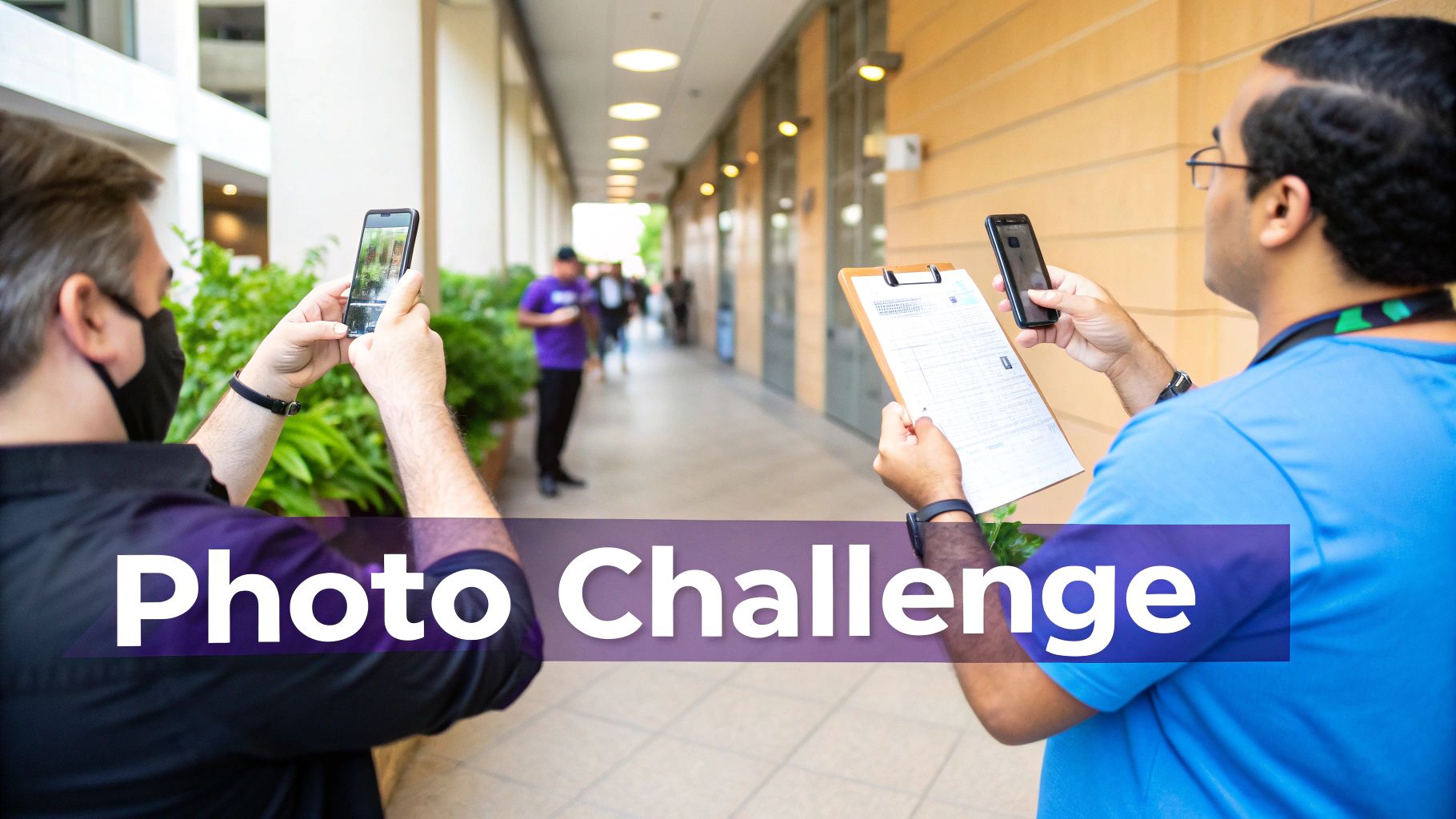
This activity is perfect for breaking up long meetings or injecting fun into a team-building day. Companies like GitLab use virtual scavenger hunts to connect their fully distributed workforce, while Google often incorporates them into new employee onboarding. The challenge can be adapted to any environment, from a physical office to each team member’s home.
How to Play
- Preparation: Create a list of items to find or photos to take. For an office hunt, items might be physical. For remote teams, prompts could include "a picture with your favorite mug" or "something green from your kitchen."
- Team Formation: Divide the group into small teams of 3-5 people. For virtual hunts, use breakout rooms to allow for collaboration.
- The Hunt: Set a timer (15-20 minutes is a good start) and send the teams off with their lists. They must collect photos as proof for each completed item.
- Sharing & Judging: Once time is up, each team shares their most creative or funny photos in the main group chat or session. Points can be awarded for speed, creativity, or both.
Facilitator Insight: Theme the scavenger hunt list around company values, a recent project, or an upcoming holiday. This adds a layer of relevance and makes the activity feel more connected to the team’s purpose.
Why This Game Works for Teams
- Encourages Collaboration: Success requires teams to strategize, delegate, and communicate effectively under pressure.
- Sparks Creativity: Prompts can be open-ended, encouraging teams to find clever and humorous solutions.
- Boosts Energy: The physical movement and lighthearted competition serve as a powerful energizer, especially during long workshops.
This game is ideal for both new and established teams that would benefit from a fun, high-energy activity. For more inspiration on adapting this for a remote setting, explore these virtual team-building activities.
9. Personality or Strength Assessment Games
Transforming self-discovery into a team-building exercise, personality or strength assessment games offer a structured way for colleagues to understand themselves and each other better. This activity involves a short, accessible assessment like StrengthsFinder, DiSC, or a simplified Myers-Briggs. The results become a framework for meaningful conversations about working styles, communication preferences, and collaboration.
This approach adds a layer of depth to typical teams icebreaker games by grounding conversations in established psychological frameworks. Companies like Salesforce and IBM have long used these tools to foster stronger team dynamics, turning abstract personality traits into practical insights for improving teamwork.
How to Play
- Preparation: Select a light, accessible assessment tool that fits your team's culture and budget. Many offer free or low-cost versions perfect for an icebreaker. Share the link with the team and ask them to complete it beforehand.
- Sharing: In the session, invite team members to voluntarily share one or two key takeaways from their results. This could be their primary strength, personality type, or a communication preference they identified.
- Group Discussion: Facilitate a discussion around the results. Use breakout rooms to group people with similar or complementary traits to discuss their shared experiences or how their styles can work together effectively.
- Team Insights: Bring the group back together to share key insights. Focus the conversation on how this new understanding can be applied to improve team collaboration, communication, and mutual respect.
Facilitator Insight: Frame the activity by emphasizing that these tools are for awareness, not labels. Explain their limitations and stress that the goal is to appreciate diversity in thinking and working styles, not to stereotype.
Why This Game Works for Teams
- Builds Empathy: Helps team members understand the "why" behind their colleagues' behaviors and communication styles.
- Provides a Common Language: Gives the team a shared vocabulary for discussing work preferences and potential friction points constructively.
- Actionable Insights: The results can directly inform team agreements and processes, making it a highly practical icebreaker.
This game is perfect for teams looking to move beyond surface-level bonding and invest in deeper, more sustainable collaboration. It is particularly effective for project kickoff meetings or for teams that are experiencing communication challenges.
10. Reverse Icebreaker or Quirky Questions
This activity flips the script on standard introductory questions, inviting team members to answer unusual and thought-provoking prompts. Instead of asking "What do you do?", the "Reverse Icebreaker" uses quirky questions like "If you were a kitchen appliance, which one would you be and why?" to reveal personality, humor, and creativity in a much more memorable way.
This game is fantastic for breaking down formal barriers and encouraging spontaneous, genuine interactions. Creative agencies and startups, including Buffer and Wistia, use this method to foster a culture of fun and psychological safety, making it one of the most effective teams icebreaker games for sparking immediate connection.
How to Play
- Preparation: The facilitator prepares a list of 10-15 unique and thought-provoking questions. The key is to have a mix of absurd, introspective, and lighthearted options.
- Posing the Question: The facilitator presents one question to the entire group. This can be done verbally, on a shared screen, or in the chat for virtual teams.
- Sharing Answers: Each person takes a turn answering the question. Encourage creativity and short, anecdotal explanations behind their answers. There are no right or wrong responses.
- Rotate and Repeat: The facilitator can pose a new question for another round, or simply move on after everyone has answered one. The goal is engagement, not getting through a long list.
Facilitator Insight: Model a great answer first. When you answer a question like "What's a secret, useless talent you have?" with a specific and funny story, you give everyone else permission to be creative and open.
Why This Game Works for Teams
- Sparks Creativity: Moves beyond rote answers and challenges participants to think metaphorically and imaginatively.
- Lowers Inhibition: The playful and often silly nature of the questions makes sharing feel less intimidating than personal, direct inquiries.
- Creates Lasting Impressions: Teams are more likely to remember that a colleague sees themselves as a "reliable, multi-functional stand mixer" than their job title from a previous company.
This icebreaker is perfect for creative teams, new groups, or any team that needs a quick jolt of positive energy. For a great list of prompts to get you started, check out these funny ice breaker questions for work.
Comparison of 10 Team Icebreaker Games
| Activity | 🔄 Implementation Complexity | ⚡ Resource Needs | 📊 Expected Outcomes & ⭐Quality | Ideal Use Cases | 💡 Tips |
|---|---|---|---|---|---|
| Two Truths and a Lie | Low — simple rules, quick facilitator setup | None; 15–30 min | Builds rapport and humor quickly — ⭐⭐⭐⭐ | Onboarding, remote icebreakers, mixed groups | Set 1–2 min limits; model first; use polls remotely |
| Human Bingo | Moderate — requires card design and facilitation | Printable cards, space; 20–40 min | Encourages one-on-one discovery and movement — ⭐⭐⭐⭐ | In-person/hybrid retreats, large meetups | Customize cards; avoid sensitive prompts; offer prizes |
| Speed Networking | Moderate — structured timing and rotation management | Prompts, timer/ bell; 15–30 min | Broad connections fast; surface-level interactions — ⭐⭐⭐ | Conferences, large teams, onboarding | Prepare 4–5 prompts; use clear signals; use breakout rooms virtual |
| M&M / Skittles Game | Low — minimal setup, simple instructions | Candy + color-topic key; 15–20 min | Light, playful sharing; morale boost — ⭐⭐⭐ | Casual teams, quick icebreakers, remote with mailed candy | Provide dietary alternatives; mix personal/work topics |
| Common Ground | Low–Moderate — needs group facilitation | Paper/whiteboard; 20–30 min | Builds cohesion, uncovers shared values — ⭐⭐⭐⭐ | Cross-department bonding, D&I sessions, small groups | Start with easy topics; mix departments and tenure |
| Would You Rather | Low — easy to run but needs space or tech | Open space or polling tool; 15–25 min | High energy, visible diversity of thought — ⭐⭐⭐ | Energizers, large groups, virtual polls | Mix silly and thoughtful Qs; avoid divisive topics |
| Story Swap / Show & Tell | Moderate–High — advance prep and safe facilitation | Personal item/photo, time slots; 30–60 min | Deep emotional connection and memorable sharing — ⭐⭐⭐⭐ | Small teams, retreats, trust-building workshops | Give 1–2 weeks notice; set boundaries; lead by example |
| Scavenger Hunt / Photo Challenge | High — logistics, rules, and coordination | Item lists, smartphones, prizes; 20–45 min | Promotes teamwork, creativity, and competition — ⭐⭐⭐⭐ | Offsites, large groups, hybrid/remote events | Thematize lists; balance difficulty; ensure safety |
| Personality / Strength Assessments | Moderate — requires chosen tool and skilled facilitation | Assessment platform (may cost); 30–60 min | Generates self-awareness and team insights — ⭐⭐⭐⭐ | Team development, leadership sessions, long-term planning | Respect confidentiality; explain limitations; facilitate discussion |
| Reverse Icebreaker / Quirky Questions | Low — minimal materials, needs energetic facilitation | Question list or prompts; 20–30 min | Memorable, authentic, humorous responses — ⭐⭐⭐ | Creative teams, startups, short energizers | Prepare 10–15 Qs; encourage specificity; allow passes |
From Icebreakers to Breakthroughs: Making Connection Count
You’ve explored a diverse toolkit of teams icebreaker games, from the classic “Two Truths and a Lie” to the more introspective “Reverse Icebreaker.” But the true value of these activities isn’t just in the laughter or the surprising stories shared. It’s about what comes next. The real goal is to transform a simple warm-up into the foundation for a more connected, psychologically safe, and ultimately, more innovative team.
Think of these games not as a meeting prerequisite, but as a strategic tool. The right icebreaker, chosen with intention, does more than just fill the first five minutes of a call. It sets the tone for the entire interaction. An energizing game like a “Virtual Scavenger Hunt” can prime a team for a high-energy brainstorming session. A trust-building exercise like “Common Ground” can create the empathy needed for a difficult conversation about project feedback.
Key Takeaways: Moving Beyond the Fun
As you integrate these games into your team’s routine, remember these core principles to maximize their impact:
- Intentionality is Everything: Don't pick an icebreaker at random. Align your choice with the meeting's objective. Are you trying to energize, build trust, or spark creativity? The games in this list are categorized for this exact reason. Choose the tool that best fits the job.
- Facilitation Matters: A well-facilitated game is the difference between an awkward silence and a genuine moment of connection. Your role as a leader is to set clear rules, manage time, and encourage participation from everyone, especially quieter team members. Create a space where it’s safe to be a little vulnerable.
- Consistency Builds Culture: A one-off icebreaker is a nice moment. A consistent practice of connection builds a resilient culture. By making these small rituals a regular part of your team interactions, you signal that relationships are just as important as results. Over time, this fosters a deep sense of belonging and mutual respect.
Actionable Next Steps for Your Team
Now it’s time to put these ideas into practice. Don't let this list just be another article you read. Take immediate, concrete steps to make your next meeting more engaging.
- Schedule Your Next Icebreaker: Look at your calendar for the upcoming week. Identify one meeting, whether it's a daily stand-up or a weekly sync, and choose one specific game from this list to try. Start small. A five-minute “Would You Rather” is an easy and low-stakes way to begin.
- Gather Feedback: After the meeting, ask your team what they thought. A simple poll or a quick question in your team chat can provide valuable insight. Did they enjoy it? Did it feel useful? Use this feedback to tailor your future choices.
- Build a Connection Playbook: Create a shared document where you list the teams icebreaker games your team has tried and enjoyed. This becomes a quick-reference guide for anyone leading a meeting, making it easy to incorporate connection into your workflow without adding extra stress. For more ideas on fostering genuine connection and collaboration, you might explore other impactful team building activities to add to your playbook.
Ultimately, mastering the art of the icebreaker is about understanding that great work is built on great relationships. These simple games are powerful because they’re human. They remind us that behind every screen, title, and project deadline is a person with unique stories, perspectives, and quirks. By taking the time to see and acknowledge that humanity, you’re not just breaking the ice; you’re building the trust, empathy, and creative confidence required to achieve true breakthroughs together.
Ready to turn the energy from your icebreakers into tangible results? Bulby helps you channel that newfound connection directly into structured, productive brainstorming and problem-solving sessions. Stop letting good vibes fade after the warm-up and start transforming them into your next big idea with Bulby.