
Have you ever had a brilliant idea pop into your head during a meeting, only to hold back from sharing it? That little voice inside warning you, "What if they think it's stupid?" is a universal feeling.
That hesitation has a name: evaluation apprehension. It's the anxiety that kicks in when we feel like our performance or our ideas are under a microscope, and we're worried about what others will think. Think of it as stage fright for your thoughts.
The Core Concept of Evaluation Apprehension
At its core, evaluation apprehension is about the fear of being judged negatively. This isn't some kind of personal weakness; it’s a hardwired social instinct. We’re naturally inclined to seek approval from our peers, so the simple act of having an audience—even just one colleague on a video call—can trigger this response.
This isn't just a fleeting feeling, either. It has real, measurable effects on how we perform. When researchers first formalized the evaluation apprehension model on Wikipedia back in 1972, they found something fascinating. For simple, well-rehearsed tasks, being watched actually improved performance by 20-30%. The pressure helped people focus.
But for complex or creative tasks, the opposite happened. That same anxiety caused performance to drop by 15-25%. The fear of getting it wrong was so distracting that it got in the way of critical thinking.
To break this down, let's look at the key components and their effects in a simple table.
Key Aspects of Evaluation Apprehension at a Glance
| Key Component | What It Means | Common Effect |
|---|---|---|
| Perceived Scrutiny | The feeling that others are closely watching and judging your actions or ideas. | Heightened self-consciousness and a tendency to "play it safe." |
| Fear of Negative Judgment | The specific worry that your contribution will be seen as incompetent or foolish. | Hesitation to speak up, ask questions, or offer unconventional ideas. |
| Social Comparison | The instinct to compare your performance against that of others in the group. | Self-censorship and a desire to conform to the perceived group standard. |
| Audience Effect | The change in behavior caused by the mere presence of others. | Increased performance on simple tasks, but decreased performance on complex ones. |
This table shows how a simple feeling can branch out into several behaviors that directly impact teamwork and innovation.
The Double-Edged Sword of Being Watched
This brings us to a real paradox in the workplace. A little bit of evaluation apprehension can be a good thing. Knowing your work will be reviewed can motivate you to double-check everything and prepare more thoroughly. It’s a natural form of accountability.
But when that fear gets too strong, it backfires, creating a culture of silence.
- Creativity gets stifled: People kill their most original ideas before they even say them out loud, worried they might sound silly.
- Participation grinds to a halt: Team members stay quiet instead of asking a question they fear might be "dumb" or challenging an idea everyone else seems to love.
- Collaboration suffers: The team defaults to the most conventional, low-risk suggestions instead of building on each other's unique insights.
The core issue is that when people fear judgment, they prioritize self-protection over contribution. This fundamentally undermines the goal of any collaborative effort and is a major barrier to building genuine team trust.
Recognizing what evaluation apprehension is and how it shows up is the first step toward fixing it. It's a concept that is deeply intertwined with creating a culture of trust and openness, which you can learn more about in our guide on what is psychological safety at work.
The Psychology Behind Fearing Judgment
Deep down, the fear of being judged isn't some kind of professional flaw. It's an ancient, hardwired human instinct. Our brains evolved for one primary purpose: survival, and for our ancestors, survival meant belonging to a group.
Getting kicked out of the tribe was a death sentence. As a result, our brains developed a sophisticated alarm system to sniff out any potential social threat. That jolt of anxiety you feel right before sharing a wild idea? That’s the alarm going off. Your brain is flagging the moment as a social risk, treating the possibility of looking foolish with the same seriousness as a physical danger. This kicks off a classic stress response, getting you ready to fight for your idea, flee the room, or just freeze on the spot.
Social Facilitation Versus Social Inhibition
This internal alarm system creates a strange paradox in how we perform. Sometimes, an audience actually makes us better. This is called social facilitation. Think of an athlete who thrives on the roar of the crowd or a musician who nails a solo in front of a packed house. For simple, well-rehearsed tasks, that little bit of pressure can sharpen our focus.
But when the task is complex, creative, or new, the opposite often happens. The fear of messing up hijacks our brainpower, leading to social inhibition. This is the person who rehearsed their speech perfectly but forgets every word on stage, or the brilliant designer who draws a complete blank during a high-pressure brainstorm. All the mental energy that should be going into creative problem-solving gets diverted to managing the fear of what others will think. These cognitive biases are incredibly powerful, and you can learn to spot them with a few good cognitive bias exercises.
The key takeaway: The same pressure that helps us nail simple tasks can completely shut down our creativity when evaluation apprehension kicks in.
This isn’t just something that happens at work; it starts much earlier. Research in schools shows just how much the fear of judgment can get in the way of learning. One study found that a staggering 62% of students were afraid of what their peers and teachers would think during classroom activities.
Their overall apprehension scored a 3.89 out of 5, and it directly impacted their grades. Students with high apprehension had GPAs that were 0.5 to 1.0 points lower than their less anxious classmates. You can read more about the impact of apprehension on student achievement.
Understanding the psychology of evaluation apprehension is the first step. It’s not a sign of weakness—it's a protective instinct that has gone a little haywire. By seeing it for what it is, a natural response tied to our need to belong, we can start to manage it and build environments where people feel safe enough to share their best ideas.
How Apprehension Kills Creative Brainstorming
Have you ever been in a brainstorming session, a brilliant (or maybe just a wild) idea pops into your head, and you just… keep it to yourself? That's evaluation apprehension at work. It's the invisible force field that stops a creative session dead in its tracks.
You can have a room full of your brightest people, ready to tackle a big challenge, but the moment that fear of judgment creeps in, the whole vibe shifts. Instead of a free-flowing exchange of bold ideas, you get a polite, quiet meeting where only the safest, most obvious thoughts are shared.
This fear isn't just about feeling a little shy; it's a powerful self-censorship switch. Team members start filtering their own thoughts, asking themselves, "Is this smart enough?" or "What if they think this is dumb?" The truly innovative ideas—the ones that often sound a bit out there at first—are the first casualties. They never even get a chance to be heard, let alone debated or built upon.
This map breaks down how our fundamental need to belong can spark a fear response when we think we're about to be judged.
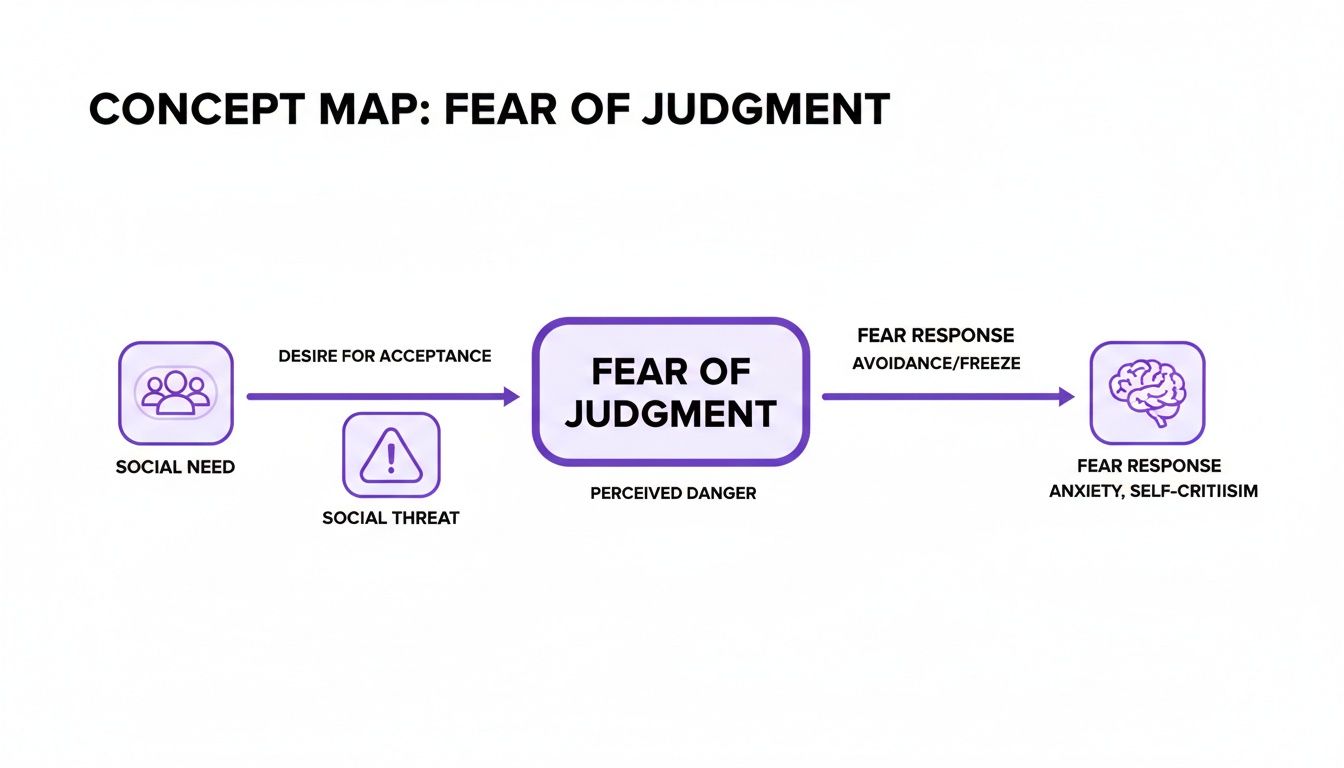
It’s a totally natural, self-protective instinct. The problem is, it’s the polar opposite of what you need for genuine collaboration.
The Ripple Effect of a Single Unspoken Idea
When someone holds back, it's not just one lost idea. It creates a ripple effect that can poison the entire creative process and lead to some pretty damaging outcomes.
- Conformity and Groupthink: When everyone's afraid to rock the boat, the team often latches onto the first acceptable idea that comes up. This creates a false sense of agreement where no one wants to challenge the status quo or suggest an alternative. It feels too risky.
- Engagement Plummets: Why bother contributing if you think you'll be shot down? People who fear negative judgment simply check out. They become quiet observers instead of active problem-solvers.
- Innovation Gets Lost: Here's the biggest cost. Every idea that goes unsaid is a potential breakthrough—a new product, a better process, a solution to a nagging problem—that your company never gets to see.
The real danger here is that the group starts prioritizing comfort over creativity. When the main goal shifts from finding the best solution to simply avoiding criticism, you've essentially cut your team's collective brainpower in half.
Remote Work Just Makes It Worse
If you think this is a problem in the office, it's often magnified in remote and hybrid setups.
On a video call, all the subtle, non-verbal cues that help build trust and signal encouragement are gone. You can't easily read the room. Awkward pauses, frozen screens, and the inability to make natural eye contact can dial up the anxiety and self-doubt.
This digital barrier makes people even more hesitant to jump in. The fear of accidentally interrupting someone or having your idea met with dead silence is very real. Without the reassuring nods and smiles you get in person, the perceived risk of sharing a half-baked but potentially brilliant idea feels enormous.
Learning to navigate these remote dynamics is key. For a deeper dive, check out our guide on how to run a brainstorm session designed specifically for virtual teams. By tackling these challenges head-on, you can start building a culture where great ideas can flow freely, no matter where your team is located.
How to Spot the Signs in Your Team
Evaluation apprehension doesn't announce itself. It’s not a loud, obvious fear—it’s more like a quiet undercurrent that slowly saps the creative energy out of a room. Learning to spot the subtle signs is the first step toward fixing it.
One of the easiest giveaways is apologetic language. You'll hear people hedge their contributions with phrases like, "This is probably a dumb idea, but…" or "I'm sure someone already thought of this, however…" That kind of language is a dead giveaway that they're bracing for judgment before the idea is even out of their mouth.
The Silence and the Over-Talkers
Beyond how people talk, pay close attention to who is talking. You'll often see two extremes emerge in the same meeting when people are on edge.
First, you'll get pervasive silence from a good chunk of the team. These are often the same people who are brilliant and full of ideas in a one-on-one chat but become silent observers in a group setting. It's not boredom; it's self-preservation.
At the same time, the meeting floor gets dominated by one or two loud voices. These people aren't necessarily trying to be steamrollers, but their confidence can unintentionally intimidate others who are too nervous to jump in with a different perspective.
A meeting that ends with quick, total agreement and zero debate isn't a sign of perfect alignment. It's usually a red flag that your team is opting for easy consensus to avoid the personal risk of being criticized.
Subtle Behaviors to Watch For
The signs aren't always about what's said aloud. Sometimes, the most telling clues are in what doesn't happen. Keep an eye out for these behaviors, which show a team is choosing to play it safe instead of being honest.
Here's a quick comparison of what you might see in an apprehensive environment versus a psychologically safe one.
Signs of Evaluation Apprehension in Meetings
| Behavior | High Apprehension Environment | Psychologically Safe Environment |
|---|---|---|
| Asking Questions | People avoid asking for clarification to not "look stupid." | Team members freely ask questions to deepen their understanding. |
| Sharing Feedback | Dissent happens in private DMs after the meeting. | Constructive disagreement and debate happen openly during the meeting. |
| Showing Work | Only polished, "perfect" work is shared to avoid judgment. | Early drafts and works-in-progress are shared to get feedback. |
| Participation | A few dominant voices control the conversation. | Participation is balanced, with contributions from everyone. |
The key takeaway is to look for the mismatch between what happens in the group setting and what happens afterward.
- Lack of Clarifying Questions: If no one asks questions, it’s not because your explanation was perfect. It’s because no one wants to be the person who admits they don't get it.
- The "Offline Dissent" Problem: This is a classic. You get nodding heads and thumbs-ups on the Zoom call, but the private Slack channels are on fire with the real opinions and concerns.
- Hesitation to Share In-Progress Work: People will refuse to show anything that isn't 100% polished. They fear that a rough draft will be judged as a final product, so critical feedback loops never even start.
These behaviors can sometimes be mistaken for other team issues, like a lack of engagement. While they might look like laziness on the surface, they are often rooted in fear. It’s important to distinguish this from other dysfunctions, and you can learn more by reading about the differences in our guide on what is social loafing.
Proven Strategies to Reduce Apprehension

Knowing what evaluation apprehension is and how to spot it is one thing. Actually dismantling that fear is another. The real work begins when you intentionally create an environment where ideas can flourish, shifting the focus from individual performance to collective problem-solving.
As a leader, your job is to build genuine psychological safety—a space where your team feels secure enough to take creative risks.
This goes way beyond just celebrating the wins. When an idea or project doesn't pan out, frame it as a learning opportunity. Talk openly about what went wrong, and make it a point to reward the courage it took to try something new, not just the successful outcome.
Restructure the Brainstorming Process
One of the most powerful ways to lower the stakes is to change how you brainstorm. The traditional, free-for-all meeting often becomes a stage for the loudest or most senior person in the room, which only magnifies the fear of judgment for everyone else. Structured methods, on the other hand, can level the playing field.
A fantastic technique for this is brainwriting, or silent brainstorming. It’s simple: instead of speaking, everyone writes down their ideas on their own for a set amount of time. Then, the ideas are gathered and discussed as a group, often anonymously.
This small shift works wonders:
- It separates the idea from the person. When ideas don’t have names attached, the conversation naturally shifts to the merit of the concept itself, not who suggested it.
- It encourages parallel thinking. Everyone contributes at the same time, which stops the first couple of ideas from dominating the entire conversation and leading to groupthink.
- It gives introverts a voice. Team members who might not jump into a fast-paced verbal discussion get an equal shot to share their best thinking.
By changing the rules of engagement, you can fundamentally alter the dynamic of a meeting. The goal is to create a space where the quality of an idea matters more than the confidence of the person presenting it.
Embrace Anonymity and Focused Feedback
Anonymity can be a game-changer for getting past the fear of judgment, especially on remote or hybrid teams where you can’t easily read the room. Using anonymous channels gives people the freedom to share raw, unfiltered thoughts without the personal risk.
This approach is incredibly effective for getting candid feedback and sparking truly out-of-the-box solutions. You can dive deeper into how anonymous brainstorming can completely transform your creative sessions.
It’s also helpful to look at how high performers in other fields manage pressure. For instance, exploring how to start mastering mindset with sports psychology techniques can provide surprisingly relevant lessons on managing the kind of performance anxiety we see in the workplace.
Foster a Culture of Constructive Feedback
Finally, you have to actively teach your team how to talk about ideas. Without a clear process, feedback can feel like a personal attack. But with a shared framework, it becomes a supportive and collaborative exercise.
Establish some simple ground rules for giving feedback:
- Start with Clarifying Questions. Before anyone jumps to conclusions, encourage people to ask questions to make sure they fully understand the idea.
- Focus on the Idea, Not the Person. Use language like, "What if we explored this part of the idea further?" instead of, "Your idea won’t work."
- Balance Critique with Encouragement. Always find something valuable in an idea before suggesting improvements or pointing out potential roadblocks.
Putting these strategies into practice is how you systematically chip away at evaluation apprehension. It’s a conscious effort, but it’s what builds a team culture where psychological safety is the foundation for fearless collaboration and real innovation.
Your Path to Fearless Collaboration
Overcoming evaluation apprehension is how you finally unlock what your team is truly capable of. We’ve seen that this isn't some personal failing; it's a completely natural fear of being judged that quietly suffocates innovation. It can turn what should be an exciting brainstorm into a parade of only the safest, most predictable ideas, which kills both engagement and real progress.
But here’s the good news: building a fearless, psychologically safe team is entirely within your reach.
By using simple, structured methods like anonymous brainstorming and creating a culture that values learning from mistakes over getting it perfect the first time, you can start to dismantle this fear piece by piece. This journey can turn collaboration from a source of stress into your team’s greatest engine for growth.
For anyone looking to build a truly inclusive and fearless team, learning how to overcome accent anxiety and speak fearlessly can offer some powerful insights into facing down judgment.
You don't need a massive overhaul to get started. Just try one small change in your next meeting. The path to fearless collaboration begins with that single step, creating a space where every single voice is not just heard, but genuinely valued.
Got Questions? We’ve Got Answers.
Digging into evaluation apprehension often brings up a few common questions. Let's clear them up with some straightforward answers.
Is Evaluation Apprehension Just Another Name for Social Anxiety?
Not quite, though they're definitely related. Think of social anxiety as a wide-angle lens—it’s a broader discomfort or fear across many social situations, like feeling anxious just walking into a party.
Evaluation apprehension, on the other hand, is a zoom lens. It’s a very specific fear focused on being judged for your performance on a particular task. Someone can be the life of the party but still freeze up when it’s their turn to share an idea in a brainstorming session. It’s all about the performance, not just the social setting.
Can This Fear of Being Judged Ever Be a Good Thing?
Surprisingly, yes. A little bit of it can actually be helpful.
A small dose of concern about what others think can light a fire under you. Psychologists call this social facilitation, and it’s the reason you might practice a presentation a few extra times or double-check your work. It can sharpen your performance on tasks you know well.
But there’s a catch. Once that healthy concern morphs into intense fear, it stops helping and starts hurting. High levels of apprehension kill creativity, shut down complex problem-solving, and make people clam up. The goal shifts from doing great work to just trying not to look bad.
It’s all about finding the sweet spot. A little pressure can keep you sharp, but too much just paralyzes the innovative thinking you need. You want an environment where people feel motivated to contribute, not terrified of messing up.
How Can I Deal With My Own Evaluation Apprehension?
Taking control of your own apprehension is a huge step. The best defense is a good offense: be prepared. Knowing your stuff inside and out is one of the most effective ways to quiet that fear of being judged.
But preparation isn't everything. Here are a few other things you can do to manage those feelings and build confidence over time:
- Try Mindfulness: A few deep, slow breaths before a big meeting can work wonders. It helps calm your nerves so you can focus on what you want to say, not on your fear.
- Reframe Your View of Feedback: Instead of seeing feedback as criticism, try to view it as a gift—a tool to help you grow. Shifting your mindset turns a scary moment into a chance to learn.
- Start Small: Don't jump into the deep end. Share an idea in a one-on-one chat or a small group first. Getting comfortable in lower-stakes settings makes it much easier to speak up when the audience is bigger.
Ready to create a team where great ideas thrive without fear? Bulby uses structured, AI-guided exercises to break down evaluation apprehension before it starts. See how our platform builds psychological safety and makes sure every voice gets heard by visiting https://www.bulby.com.