

Ever found yourself completely stumped by a problem, only to have the solution—something ridiculously simple—dawn on you hours later? That “aha!” moment often follows a frustrating period of being mentally stuck. This common experience has a name: functional fixedness.
It's a powerful cognitive bias that puts blinders on our brains, forcing us to see an object only for its most obvious, everyday purpose. Think of it as a creativity killer hiding in plain sight.
The Mental Blind Spot Holding You Back
Functional fixedness is basically having a one-track mind for how things should be used. Our brains create these mental shortcuts to be efficient. You don't need to re-learn what a hammer does every time you pick one up, and that’s a good thing for getting tasks done quickly.
But this efficiency comes at a cost. When you need a fresh, innovative solution, that same shortcut becomes a massive roadblock.
It’s what happens when you’re hunting for a screwdriver to tighten a loose screw, completely ignoring the dime in your pocket that would do the job just fine. In your mind, a dime is for buying things, not for fixing them. Its primary function completely overshadows its potential as a tool. That’s functional fixedness in a nutshell. You can dive deeper into how this and other mental shortcuts affect your choices in our guide on cognitive bias in decision making.
To help break this down, here’s a quick summary of what functional fixedness looks like in practice.
Table: Understanding Functional Fixedness at a Glance
| Concept | What It Means | Everyday Impact |
|---|---|---|
| Object Fixation | Seeing an object only for its traditional or most common purpose. | You can't find a hammer, so you don't hang the picture, overlooking a heavy book or a shoe that could work. |
| Mental Block | The inability to repurpose an item for a new or unintended function. | A team struggles with a broken projector stand, not thinking to use a stack of books as a temporary fix. |
| Creativity Barrier | This bias shuts down innovative thinking by limiting your perceived set of tools. | A product designer sticks to conventional materials, missing an opportunity to use a sustainable alternative in a novel way. |
This table gives you a simple framework, but where did this idea even come from?
Where Does This Bias Come From?
We can trace the concept back to Gestalt psychologist Karl Duncker, who coined the term in 1945. His famous "candle problem" experiment perfectly illustrates how this mental block works.
He gave participants a simple task: attach a lit candle to a wall so that wax wouldn't drip on the floor. The only tools they had were the candle, a book of matches, and a small cardboard box filled with thumbtacks. Most people were completely stumped. They tried melting the candle to the wall or tacking it up directly—all messy failures.
The solution? Empty the box of thumbtacks, nail the box to the wall with a tack, and place the candle inside. Simple, right? But most people couldn't see it.
Because participants saw the box's function as only holding tacks, they couldn't reimagine it as a platform for the candle. This inability to see alternative uses is the core of functional fixedness.
This isn't just a quirky brain teaser; it has huge implications. A 2018 Harvard Business Review analysis of 500 innovation failures found that functional fixedness was a contributing factor in an astonishing 40% of cases. Kodak’s infamous failure to embrace the digital camera—a technology they invented—is a classic example. They were a film company, and they just couldn't see past that identity.
Understanding this mental blind spot is the first step. Once you can spot it, you can start to break free from it and unlock far more creative and resourceful ways of thinking. Discover more insights about these foundational experiments on Study.com.
Why Your Brain Gets Stuck in the First Place
To get to the bottom of functional fixedness, we have to look at how our brains are wired for efficiency. Every day, your mind relies on mental shortcuts, or schemas, to get you through the world without having to rethink every single action. When you see a chair, you don't stop to analyze its four legs and flat surface; your brain just labels it "something to sit on."
This shortcutting is incredibly useful. It saves a ton of mental energy, freeing you up to focus on more important things. But here’s the catch: this same efficiency is what builds the invisible walls of functional fixedness. Your brain gets so good at assigning a primary purpose to an object that it has a hard time seeing it as anything else. The object's identity becomes, well, fixed.
The Famous Candle Problem
This mental trap was perfectly captured in Karl Duncker's classic "candle problem." Imagine this: you're given three things—a candle, a book of matches, and a small cardboard box filled with thumbtacks. Your job is to attach the candle to a wall so the wax won't drip on the floor. How would you do it?
Most people immediately try tacking the candle directly to the wall, which obviously fails. Others try melting the candle’s base to use the wax as glue, but that doesn't hold for long. The real solution is surprisingly simple, yet it stumps most people.
The answer is to empty the thumbtacks from the box, use a tack to pin the empty box to the wall, and then place the candle inside it. The box instantly transforms from a container into a shelf.
The brilliance of this experiment is how it exposes our mental blind spots. Because the box was first presented as holding the tacks, its function was locked in people's minds. They simply couldn't see it as a separate, usable tool to solve the problem.
This chart shows just how often our brains get trapped by an object's initial presentation in these kinds of creative tests.
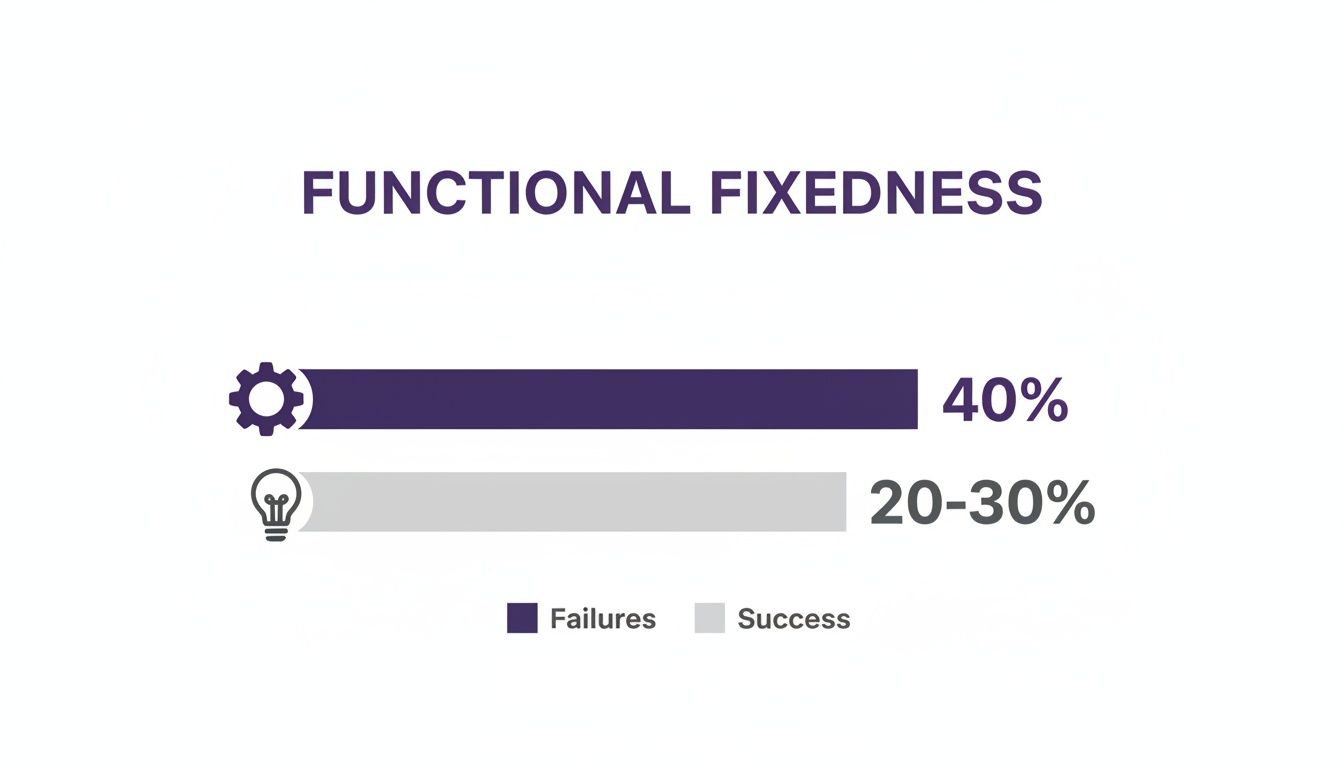
As you can see, a huge number of participants fail because their brains latch onto the most obvious function of the items. It’s a powerful reminder of how strong this cognitive bias really is.
Why Children Often Outsmart Adults
Interestingly, functional fixedness isn't something we're born with; it's a learned behavior. Young kids, whose minds haven't yet built up all these rigid mental models, often breeze through these kinds of creative challenges. Their thinking is just more fluid and less boxed-in by past experiences.
Research has actually put numbers to this fascinating trend. One study found that 85% of 5-year-olds solved the box task, often without missing a beat. That success rate dropped to 50% for 6- and 7-year-olds as their understanding of the world became more structured, and it plummeted to just 30% for adults. It turns out that experience, while valuable, can build the very mental walls that stifle innovation.
This gets to the heart of creative problem-solving: you sometimes have to unlearn. To beat functional fixedness, you have to temporarily forget what an object is for and instead see it for what it is. This kind of flexible thinking is a key part of what’s known as divergent thinking, a skill anyone can build.
This mental rigidity doesn't just stop here. It can lead to other cognitive traps, too. A close cousin to functional fixedness is analysis paralysis, where overthinking grinds all progress to a halt. Both biases come from the brain getting stuck in one gear, unable to shift into a problem-solving mindset. Recognizing these patterns is the first step to breaking free and tapping into a more resourceful, creative way of thinking.
Functional Fixedness in Your Daily Life
Functional fixedness isn't just some abstract concept from a psychology textbook; it’s happening around us all the time, quietly steering our decisions without us even noticing. It’s that invisible barrier that keeps us from being more resourceful.
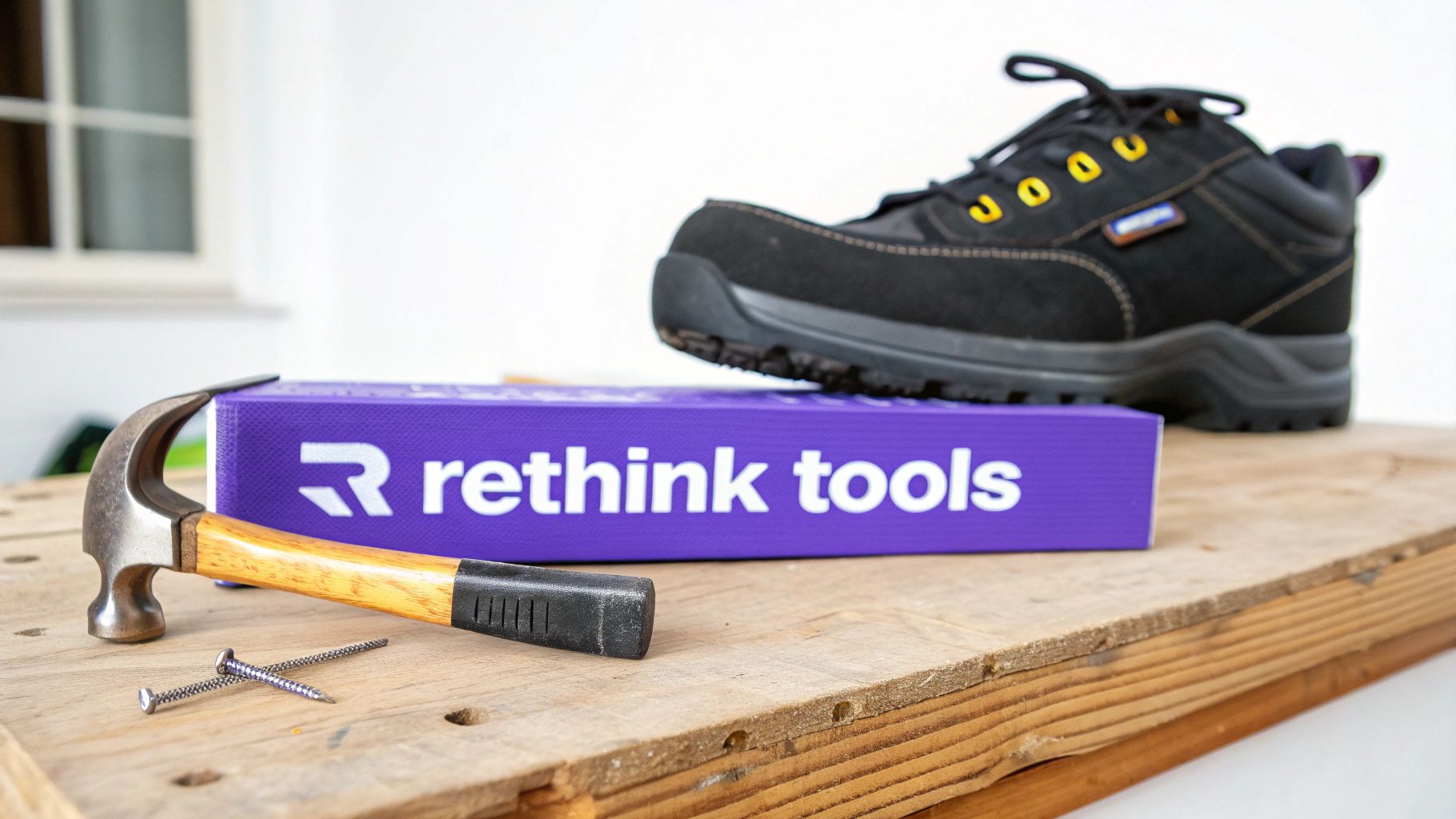
Ever spent ten minutes hunting for a hammer just to hang a small picture frame? You get frustrated and give up, completely ignoring the sturdy shoe, heavy book, or even a wine bottle sitting right there on the counter. Any of them could have easily tapped in the nail.
That moment of frustration is functional fixedness in action. Your mind is so locked into the idea that a shoe is for your foot and a book is for reading that you can’t see their potential as a makeshift tool. Their primary purpose completely overshadows any other possibility, leaving you stuck.
Common Scenarios at Home and Work
This mental shortcut pops up everywhere. Once you start looking for it, you'll see it in the kitchen, at your desk, and in team meetings. Recognizing the pattern is the first step to breaking free from it.
Here are a few all-too-familiar examples:
- In the Kitchen: You’re baking and can't find the rolling pin. It probably doesn't even cross your mind that a smooth wine bottle or a cylindrical glass would do the job just as well. They're for drinks, right?
- At the Office: Your laptop stand gives out, and your first impulse is to open a new tab and order a replacement. You’ve completely tuned out the stack of hardcover books on your shelf, which could create a perfectly stable, adjustable stand in seconds.
- During a Project: A team is tasked with building a prototype, but they don't have the "official" materials on the list. Functional fixedness convinces them they're stuck, blinding them to the fact that cardboard, tape, and paper clips could create a perfectly good model.
In each case, our brains default to finding the "correct" tool for the job. This habit can be a minor annoyance in our personal lives, but when it scales up to a business, it can be devastating.
The High Stakes for Business Innovation
When an entire organization gets stuck in a rut of functional fixedness, the consequences are massive. It can lead to incredible missed opportunities and, in some cases, outright market failure.
The story of Kodak is the ultimate cautionary tale. Believe it or not, a Kodak engineer invented the world’s first digital camera way back in 1975. But the company’s leadership was so rooted in its identity as a film and chemical company that they just couldn’t see the future.
They saw the new technology not as a groundbreaking opportunity but as a direct threat to their existing business. Their fixed view of "what a camera is" and "what Kodak does" blinded them to the digital revolution they had actually started.
This organizational-level functional fixedness is what ultimately led to the company's spectacular fall. They were so fixated on the function of film that they failed to adapt, even as the rest of the world raced to embrace digital photography.
On the flip side, the most creative companies are the ones that actively fight this cognitive bias. They build cultures where employees are encouraged to break down problems and see resources for what they are, not just what they were designed for. When a business struggles with these mental blocks, it often points to a deeper creative issue. You can explore how to break through these barriers with our guide on creative block solutions.
Just look at the humble Post-it Note. It was born from a failed experiment to create a super-strong glue. Instead of seeing a failure, its inventor, Spencer Silver, saw a "solution without a problem." It wasn't until his colleague, Art Fry, broke through his own functional fixedness that the magic happened. He reimagined the weak adhesive not as a bad glue, but as the perfect bookmark that wouldn't damage his hymnbook.
That simple shift in perspective turned a lab mistake into a billion-dollar product. That’s the power of moving past what something should do and seeing what it could do.
Actionable Techniques to Break Mental Blocks
It’s one thing to understand what functional fixedness is, but it’s another thing entirely to actually break free from it. The good news? Creative thinking isn't some magical gift—it's a skill you can build. With the right exercises, you can train your brain to look past the obvious and see a world of new possibilities.
The techniques below aren’t just abstract theories. They’re practical, hands-on exercises designed to jolt your mind out of its comfortable, well-worn grooves. They work by forcing you to sidestep the mental shortcuts that usually help you but end up limiting your creativity.
The Generic Parts Technique
One of the most effective ways to dismantle functional fixedness is the Generic Parts Technique. At its core, this method is about mentally deconstructing an object into its basic components, stripping away its name and intended purpose.
So instead of seeing a "candle," you see "a cylinder of wax" and "a string of wick." This simple shift in perspective is surprisingly powerful. Suddenly, the wax isn't just for a candle; it could be a lubricant or a sealant. The wick isn't just for lighting; it's a piece of string.
Here's how to put it into practice:
- Pick an object relevant to your problem.
- Describe its parts without using its name. A coffee cup becomes "a ceramic cylinder with a C-shaped handle."
- List the properties of each part. The cylinder is "waterproof," "heat-resistant," and "hollow." The handle is "graspable" and "curved."
- Brainstorm new uses. Now ask, "What else could I do with something that's waterproof, hollow, and heat-resistant?"
This systematic breakdown helps you bypass the mental label that’s holding your thinking hostage. You start to see the object for its raw potential, not just its learned function.
Challenging Hidden Assumptions
Another powerful strategy is what I like to call Assumption Smashing. Functional fixedness thrives on the invisible rules and assumptions we make about a problem or a tool. This exercise is all about dragging those assumptions into the light and challenging them, one by one.
Start by listing every assumption you have, no matter how obvious it seems. If your challenge is "we need to hang this poster," your list of assumptions might look like this:
- We must use a nail or a thumbtack.
- The poster has to be flat against the wall.
- The solution needs to be permanent.
- We can only use what's in the office supply closet.
Now, attack that list. What if you don't use a nail? Could you use adhesive putty, tape, or even a binder clip hanging from a ceiling tile? What if the poster isn't flat? Could you drape it or fold it into a unique shape? Questioning these "obvious" truths is often the quickest way to find a clever workaround.
Key Insight: The most restrictive constraints are often the ones we place on ourselves without realizing it. Breaking them down intentionally is the fastest path to a breakthrough.
This tendency to get stuck is common in any creative field. For writers, discovering practical techniques to overcome writer's block often involves challenging similar self-imposed rules about what a story "should" be. The principle is the same: break the rules you didn't even know you were following.
The Power of Visual Deconstruction
How an object is presented to us dramatically influences our ability to think flexibly. Sometimes, just seeing a picture of an object can reinforce our mental blocks more than simply hearing its name.
A 2017 study found that showing people pictures of objects (as opposed to just their names) actually made their mental fixation worse by 28%. The groups who saw pictures came up with 40% more conventional ideas because the visual cues immediately triggered their brains' pre-existing definitions. This finding really highlights why techniques like the Generic Parts Technique are so effective—they force you to deconstruct an object away from its familiar visual form, which has been shown to boost creative flexibility by as much as 50%.
This gives us a crucial tip for brainstorming: try describing the properties you need instead of showing a picture of the tool you think you need. For example, instead of saying, "We need a hammer," try saying, "We need something that can apply blunt force." That tiny shift in language can open up a surprising number of new doors. For more ideas, take a look at our guide on other techniques for creativity you can try with your team.
For a quick reference, here's a breakdown of a few go-to methods to keep in your back pocket.
Your Toolkit for Creative Problem-Solving
This table gives you a quick look at a few powerful techniques, what they're all about, and when they'll give you the most bang for your buck.
| Technique | Core Idea | Best For | Simple Prompt |
|---|---|---|---|
| Generic Parts | Break an object down into its basic components and their properties. | Finding new uses for existing tools or resources. | "Forget its name. What is this object actually made of?" |
| Assumption Smashing | Identify and challenge all the unstated rules and beliefs about your problem. | Getting unstuck when you feel like you've hit a dead end. | "What are the 'rules' we're following without realizing it?" |
| SCAMPER | Use a checklist of 7 prompts (Substitute, Combine, Adapt, etc.) to view a problem from new angles. | Improving an existing product, service, or process. | "How could we substitute one part of this for something else?" |
| Random Word | Pick an unrelated word and force connections between it and your problem. | Generating completely novel and unexpected ideas. | "Our problem is X. The random word is 'cloud.' How does 'cloud' help?" |
Think of these as different keys on a ring. You wouldn't use the same key for every lock, and the same goes for creative techniques. The more comfortable you get with them, the faster you'll be able to pick the right one for the job and unlock a great solution.
How to Run a Creative Thinking Workshop
Knowing the theory behind functional fixedness is a great start. But the real change happens when you help your team turn that knowledge into a practical, shared skill. That’s where a dedicated creative thinking workshop comes in.
This isn’t about a lecture. It’s about creating an interactive space where people can feel their own thinking get stuck—and then learn exactly how to get it unstuck. The goal is to make these big, abstract ideas feel tangible and immediately useful for the problems your team is facing right now.
When you guide your team through a few targeted exercises, you're helping them build the mental muscles to spot and smash through functional fixedness on their own. It’s how a one-off session becomes a genuine upgrade to your team's culture.
Setting the Stage for Success
Before you even think about sending a calendar invite, a little prep goes a long, long way. The absolute key to a great workshop is psychological safety. Your team has to feel comfortable enough to share half-baked ideas, question old assumptions, and get a little weird without worrying about judgment.
Start by being crystal clear about the workshop's purpose. Frame it as a training session to sharpen problem-solving skills together, not a test of who is most "creative." Emphasize that wild ideas are not just welcome—they're required. The initial goal is always quantity over quality.
A few logistical details can also make or break the experience, especially for remote teams:
- Use a digital whiteboard: Tools like Miro or Mural are non-negotiable for virtual collaboration. They let everyone get their ideas down visually and at the same time.
- Set clear ground rules: Kick things off by establishing norms like "defer judgment," "encourage wild ideas," and "build on the ideas of others."
- Keep groups small: Use breakout rooms. They give everyone a real chance to speak up and contribute in a much lower-pressure setting.
If you want to go deeper on the art of facilitation, check out our guide on how to run workshops that actually deliver results.
Sample Workshop Agenda
Ready to build your own session? Here’s a sample 90-minute agenda you can steal and adapt for your team. It's designed to be practical and engaging, whether you’re all in one room or spread across the globe.
Workshop Goal: Introduce the team to functional fixedness and give them hands-on tools to overcome it while working on a real business problem.
1. Icebreaker: The Unconventional Object (10 minutes)
- Activity: Put people into small groups and show them an image of an everyday object—a paperclip, a brick, a coffee mug. In five minutes, they have to brainstorm as many alternative uses as they can, but none of them can be its normal function.
- Objective: This is a perfect, low-stakes warm-up that gets everyone thinking outside the box and tees up the main theme of the day.
2. What Is Functional Fixedness? (15 minutes)
- Activity: Give a quick, engaging rundown of what functional fixedness is. Use the classic "candle problem" as your prime example, and maybe share a relatable business story (like Kodak missing the boat on digital cameras). Keep it short, visual, and interactive.
- Objective: To give everyone a shared vocabulary and a clear picture of the mental roadblock they’re here to tackle.
3. Hands-On Practice (45 minutes)
- Activity: Now for the main event. Present a real, current business problem your team is grappling with. Send them into breakout groups to attack it using one of the specific techniques we've covered, like the Generic Parts Technique or Assumption Smashing.
- Objective: This is where you connect theory to reality. It ensures the skills aren't just academic—they're immediately applied to a challenge that actually matters to the team.
4. Debrief and Action Steps (20 minutes)
- Activity: Bring everyone back into the main room. Have each group share their most promising ideas and, just as importantly, reflect on the process. What assumptions did they uncover? Where did they feel their thinking shift?
- Objective: To lock in the learning and turn messy ideas into clear next steps. Don't let the energy fizzle out—end the session by assigning owners to the best ideas and getting a follow-up on the calendar.
Ready to Unlock Your Innovative Potential?
So, there you have it. We've taken a deep dive into functional fixedness—that pesky mental shortcut that keeps us from seeing all the possibilities right in front of us. It’s the reason we see a thumbtack box only as a container, not a potential shelf.
We’ve seen how this cognitive bias shows up everywhere, from classic psychology experiments to major corporate blunders. It can be the difference between finding a clever solution in a pinch and staying completely stuck.
The most important thing to remember is that creativity isn't some magical trait you're either born with or not. It's a skill. And like any skill, you can get better at it with the right tools and a bit of practice.
From Understanding to Doing
You now have a solid set of techniques to start dismantling those mental barriers and thinking more flexibly. Think of it as your new innovation toolkit. The key strategies are:
- The Generic Parts Technique: This is about breaking things down. Stop seeing a "candle" and start seeing "wax" and "wick." This simple switch reveals a whole new world of uses.
- Assumption Smashing: Every problem comes with a set of invisible rules we've made up for ourselves. Your job is to find them and break them.
- Shifting Perspective: Remember, the way you first see a problem is just one angle. Actively look for others.
The real magic happens when you move from just knowing these concepts to actually using them. Innovation isn't just a thought exercise; it's an action. It starts the moment you decide to question your own assumptions and see the world differently.
Your Next Breakthrough is Closer Than You Think
Ultimately, getting past functional fixedness is about cultivating a habit of curiosity. It’s about learning to ask "What if?" more often than you accept "That's just how it is."
It's about seeing a simple cardboard box and thinking beyond "container." Could it be a prototype? A piece of a costume? A canvas for your next big idea?
Why not start right now? Grab a random object off your desk or think about a challenge your team is wrestling with. Pick one of the techniques from this guide and give it a shot. See what you discover.
By making these exercises a regular part of your routine, you'll start turning those frustrating mental blocks into the building blocks of your next breakthrough. Your most innovative ideas are just waiting for you to unlock them.
Frequently Asked Questions
Once you start learning about functional fixedness, a few common questions usually pop up. People often wonder how it stacks up against other mental shortcuts or how it really affects us every day. This section tackles those questions head-on.
Getting a handle on these details makes it much easier to spot this creative roadblock when it shows up in your own work.
What’s the Difference Between Functional Fixedness and Confirmation Bias?
This is a great question. While both are cognitive biases that can trip us up, they mess with our thinking in totally different ways.
Functional fixedness is all about objects. It’s that mental wall that prevents you from seeing a coffee mug as a makeshift speaker for your phone or a binder clip as a cable organizer. Your brain gets stuck on the intended use of an object and has a hard time imagining anything else.
Confirmation bias, on the other hand, is about information. It’s our sneaky habit of cherry-picking evidence that proves what we already believe. If you’re convinced a new feature will be a hit, you’ll naturally pay more attention to positive feedback and brush off the negative comments.
To put it simply: Functional fixedness is about being stuck on how you use things, while confirmation bias is about being stuck on how you process ideas.
Can Functional Fixedness Ever Be a Good Thing?
Surprisingly, yes. Most of the time, functional fixedness is actually your friend. It acts as a mental shortcut that keeps your brain running efficiently. You don't have to spend a minute every morning figuring out what to do with a toothbrush; your mind just knows. It saves you from re-learning the world every single day.
This automatic labeling is a huge time-saver, freeing up your mental bandwidth for more important decisions. The trouble starts when you're faced with a new problem that demands a creative solution. That’s when this helpful shortcut suddenly turns into a major creativity killer.
How Can I Practice Overcoming Functional Fixedness Daily?
You can absolutely train your brain to become more flexible, and you don’t need any special equipment. The key is to practice divergent thinking—the ability to spin out lots of different ideas from a single starting point.
Try this simple two-minute exercise every day:
- Grab any common object around you—a pen, a book, a water bottle.
- Start a timer for two minutes.
- Brainstorm as many alternative uses for that object as you can. Don't censor yourself; the wilder, the better.
For example, a pen could be a bookmark, a tool to clean tight spaces, a mini-catapult, or a makeshift hair tie. Doing this regularly helps your brain build the muscle for looking past the obvious and seeing what’s possible.
Ready to help your team break through creative blocks like functional fixedness? Bulby offers guided, research-backed exercises designed for remote teams to spark fresh thinking and solve tough challenges. Discover how Bulby can transform your next brainstorming session.