
Building psychological safety isn't something that just happens on its own. It's a deliberate act, a conscious effort built on a bedrock of trust and really clear communication. It starts with leaders who are willing to be vulnerable, and it's sustained by transparent team norms and a genuine encouragement for everyone to speak up without fear. When you get this right, you create a space where great ideas and honest feedback can actually thrive.
Why Psychological Safety Is a Must-Have for Remote Teams
Let's be clear: psychological safety isn't just a fluffy, feel-good concept. It's the absolute backbone of a high-performing remote team. When you're working virtually, you lose all those subtle cues—body language, the casual chat by the coffee machine—that help build rapport. Misunderstandings happen. Fast.
Without that feeling of safety, people just won't take risks. They'll hesitate to ask a clarifying question, they'll hide a mistake, or they’ll stay silent rather than challenge a popular idea. That's how projects stall and brilliant opportunities get missed. A safe environment is the difference between a team that defaults to silence and one that dives into healthy debate to find the best possible answer.
The Business Case for a Safe Environment
If you're looking for a dollars-and-cents reason to invest in this, the numbers are pretty compelling. One analysis revealed that companies that prioritize psychological safety see a staggering 230% average return for every dollar spent.
Think about that. On top of the ROI, when safety is high, employee turnover plummets from 12% to just 3%. The impact on retaining diverse talent is even more dramatic—retention jumps fourfold for women and BIPOC employees and fivefold for people with disabilities. You can dig into the full details of these workplace findings on apa.org.
This isn't just about being a good company; it's a smart business strategy that directly impacts your bottom line. And for remote teams, where connection can feel fragile, these benefits are magnified.
"For an employee, managing personal risk by remaining quiet is an easy solution, and works incredibly well as a means of self-protection. But it's a terrible solution for the organization."
This really gets to the heart of the problem. What feels safe for an individual—staying quiet—is often toxic for the team's progress. As leaders, our job is to flip that script and make it safer to speak up than to stay silent. This all comes down to a foundation of trust. If you need more help on that front, our guide on building trust in remote teams is a great place to start.
The Four Pillars of Psychological Safety
So, how do you actually build this environment? It helps to break it down into four core pillars. These are the foundational elements you need to focus on to create a truly safe and innovative remote culture.
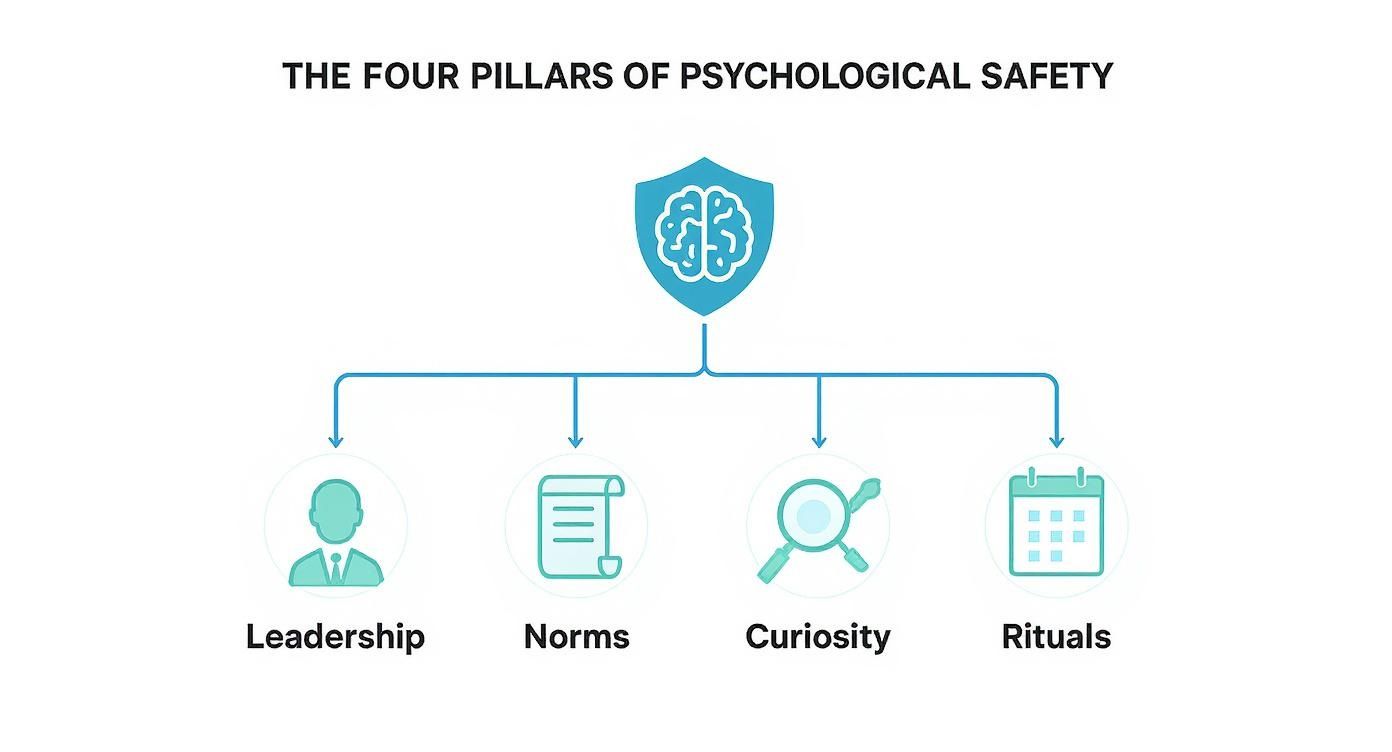
To make this more concrete, here's a quick breakdown of what these pillars look like in the day-to-day reality of a remote team.
The Four Pillars of Remote Psychological Safety
| Pillar | What It Means in Practice | Example Action |
|---|---|---|
| Leadership | Leaders model vulnerability and actively invite feedback, even when it's critical. | A manager starts a meeting by saying, "Here's a mistake I made last week and what I learned from it." |
| Norms | The team has clear, co-created rules for communication, conflict, and collaboration. | Creating a "no-blame" policy for retrospectives, focusing on process improvement instead of individual fault. |
| Curiosity | Asking questions is encouraged over making assumptions. "Why?" is valued more than "I know." | During a brainstorming session, a team member asks, "Can you help me understand your thinking behind that idea?" |
| Rituals | Consistent, predictable team activities that reinforce connection and trust. | Kicking off the weekly team sync with a 5-minute, non-work-related check-in where everyone shares a personal win. |
By intentionally working on these four areas, you can move from just talking about safety to actually living it. This foundation is what makes creative tools like Bulby so powerful. When people feel secure, they have the confidence to fully engage in structured brainstorming and share their boldest ideas without holding back.
Build Trust Through Inclusive Leadership
Trust doesn't just happen; it's the foundation that makes great work possible. In a remote team, where every interaction is filtered through a screen, the responsibility for building that trust lands squarely on your shoulders as a leader. You set the tone, and your actions—not just your words—will determine if your team feels safe enough to bring their best ideas to the table.
Inclusive leadership is how you get there. It’s about more than just inviting people to a meeting. It’s about deliberately creating a space where every single person feels seen, heard, and valued for their unique point of view. This is where you can make the biggest, most immediate impact.
Model Vulnerability and Accountability
One of the most powerful things you can do is show your own vulnerability. I'm not talking about oversharing or complaining. I mean being open about the fact that you're not perfect. When you make a mistake, own it. Publicly.
Imagine starting a team call with, "Hey everyone, I want to talk about a misstep I made on the project timeline last week. Here’s what I learned, and here's how I'm fixing it."
An admission like that does two incredible things. It reframes mistakes as learning opportunities instead of failures to be punished. It also gives your team unspoken permission to be human and admit their own errors without fear.
Accountability is the other side of that coin. When you hold yourself to a high standard, you earn the right to hold your team accountable in a way that feels supportive, not punishing. The conversation shifts from "Who's to blame?" to "How can we solve this together?"
Actively Seek Dissenting Opinions
Groupthink is the silent killer of innovation. This is especially true in remote settings where it's all too easy for a few dominant voices to monopolize a video call. As an inclusive leader, your job is to actively mine for constructive conflict. Don't just ask, "Any questions?" Be more direct.
Try prompts like these:
- "Sarah, you've got a ton of experience here. What potential risks are we not seeing?"
- "Let's play devil's advocate. What's the biggest argument against this approach? Let's spend the next 10 minutes trying to poke holes in this."
This sends a clear signal that challenging the status quo isn't just okay; it's expected. It becomes part of your team's DNA. This is where a brainstorming tool like Bulby can really shine. The platform’s structured exercises can guide this process, offering anonymous ways to submit ideas and critiques. That way, the best idea wins out, not just the loudest one.
"A leader's ability to create a safe space for dissent is a direct measure of their team's innovative potential. When people are afraid to disagree, you've already lost."
This really gets to the heart of it. The best solutions are often born from healthy debate, and your leadership determines whether that debate can even happen.
Create Structured Channels for Feedback
Just hoping people will give you candid feedback isn't a strategy. You have to build reliable systems for it. For a remote team, that means creating several predictable ways for people to share their thoughts—the good and the constructive. This is a critical step in how to create psychological safety that lasts.
Consider putting a mix of these into practice:
- Anonymous Surveys: Use simple tools for quick, anonymous pulse checks on team morale or specific projects.
- Dedicated 1-on-1 Time: Guard this time. Make it clear it’s their time to speak, and your main job is to listen.
- "Office Hours": Hold open, unstructured video call slots where anyone can drop in to chat about ideas or concerns.
The data connecting leadership to psychological safety is impossible to ignore. A 2022 Ecsell Institute study found that when leaders were rated highly by their employees, their teams reported an 84% psychological safety score. But for leaders who were rated poorly, that score plummeted to just 36%. That massive 48-point gap proves that effective leadership is non-negotiable for creating a safe environment. Investing in communication skills training for managers can directly help close this gap.
By building these structured pathways, you take the guesswork and anxiety out of speaking up. To go deeper, you can find more actionable strategies for building trust in the workplace. Ultimately, your consistency is what turns these actions into a true culture of trust and safety.
Set Clear Norms for Communication and Failure
In a remote setting, ambiguity is the sworn enemy of psychological safety. When you can't read body language or have a quick chat by the coffee machine, silence can feel like disapproval, and assumptions can quickly spiral into major misunderstandings.
To head this off, you need to establish crystal-clear rules of engagement. This isn't about micromanagement; it's about creating a predictable environment where your team can stop decoding social cues and start focusing on doing their best work. When people know the "rules," they feel much safer speaking up and tackling tough conversations.
Co-Create a Team Charter
A team charter is a living, breathing document that outlines your team’s purpose, values, and—most crucially—how you all agree to interact. The key here is "co-create." Don't just write it yourself and expect everyone to fall in line. Build it with your team to get genuine buy-in.
Your charter should spell a few things out, like:
- Response Times: What's a reasonable turnaround for an email versus a Slack message? Defining this stops people from feeling anxious when a message sits unanswered for an hour.
- Communication Channels: When is something a quick chat? When does it need an email or a formal meeting? This simple step brings order to communication chaos and protects everyone’s focus time.
- Handling Disagreements: Lay out a constructive process for debate. It could be as simple as a guiding principle like, "We challenge ideas, not people," or a rule that any dissenting opinion must come with an alternative solution.
Getting these norms down on paper is a massive step in building a safe foundation. For a much deeper look at this, our guide on https://www.remotesparks.com/asynchronous-communication-best-practices/ is a perfect companion piece.
Reframe Failure as Learning
Just saying "it's okay to fail" doesn't mean much if the team’s reaction proves otherwise when something actually goes wrong. The real goal is to foster an environment that embraces intelligent failure—those well-intentioned risks that teach you something valuable, even when they don't hit the mark.
It helps to think about failure in a few different buckets:
- Preventable Failures: These are slip-ups from inattention or a broken process. The fix here is to improve your systems, not point fingers.
- Complex Failures: These happen when a bunch of unpredictable factors line up just right (or wrong). Your focus should be on untangling the entire chain of events to see what you can learn.
- Intelligent Failures: These are the gold nuggets. They're the result of thoughtful experiments that just didn't pan out. Celebrate these! They are the price of innovation.
When a team knows that a smart experiment that bombs will be treated as a valuable data point—not a career-ending mistake—that’s when real innovation can finally happen.
One of the best ways to put this into practice is with blameless post-mortems. After a project misses its goal, get the team together to analyze the what and the why—never the who. The only objective is to understand what went wrong with the process so you can make it better next time.
Separate the Idea from the Identity
Feedback is essential, but let's be honest, it can feel incredibly personal. This is especially true on multicultural teams where communication styles can vary wildly. This is where a structured platform can be a game-changer. For example, a brainstorming tool like Bulby can guide a team through exercises that keep the focus of a critique squarely on the idea itself, completely detached from the person who suggested it.
This small shift objectifies feedback. It becomes about making the concept stronger, not judging the individual. It allows for rigorous, healthy debate without making anyone feel defensive.
This is more important than you might think. A global Ipsos survey revealed that only 47% of employees feel their workplace is psychologically safe. And there's a huge disconnect, with 76% of executives feeling safe compared to just 53% of individual contributors. To close that gap, you can implement practical tips for improving workplace communication across your organization.
By setting these clear, fair rules of the road, you build a culture where everyone knows how to engage, disagree, and learn together. And that's the real core of a psychologically safe team.
Champion a Culture of Curiosity
A team that feels psychologically safe doesn't just avoid conflict; it actively hunts for new questions, challenges, and perspectives. The goal is to nudge your team’s mindset from "knowing" to "learning." When asking questions becomes the default, people stop worrying about having the perfect answer and start focusing on finding the right problems to solve.
This all starts with leadership. When you, as a leader, model curiosity, the whole team takes notice. Instead of jumping in with an immediate answer, try turning questions back to the group. Responding with genuine interest sends a clear signal: exploration is more valuable here than instant certainty. It’s a core practice in how to create psychological safety in your day-to-day work.
From Answers to Powerful Questions
Making curiosity a team habit takes a bit of deliberate practice. The easiest place to start? Your meetings. Swap out those closed questions that only get a "yes" or "no" for ones that open up the conversation.
Try dropping some of these into your next team sync:
- "What's another way we could look at this problem?"
- "What assumptions are we making? What if they're wrong?"
- "That's an interesting point. Could you walk me through your thinking?"
- "Is there any information we're missing that might change our minds?"
These questions do more than just fish for information. They invite the whole team to think critically and explore ideas together, without making anyone feel like they're being interrogated. You can find more inspiration in our list of good open-ended questions designed to kickstart deeper discussions.
The Art of Active Listening
Asking great questions is only half the equation. How you react to the answers is what really cements a culture of curiosity. Active listening isn't just about staying quiet while someone talks; it's about showing you truly value their contribution.
Think about it: when a team member shares an idea, especially one that goes against the grain, your response sets the precedent for everyone else. Instead of immediately judging the idea, validate the act of sharing it first.
"Thanks for bringing that up, I hadn't considered it from that angle." A simple phrase like this can completely change the dynamic. It tells everyone that challenging the status quo isn't just safe—it's welcome.
This small habit reassures people that their perspectives will be handled with respect, which naturally encourages them to keep sharing.
Structuring Brainstorms for Exploration
Sometimes, the meeting format itself is the problem. A typical brainstorming session can feel more like a competition for the "best" idea, causing introverted or less-confident team members to clam up. The fix is to structure your sessions for pure exploration, not immediate decisions.
This is where a tool like Bulby’s brainstorming framework can make a huge difference. It walks your team through exercises built to suspend judgment and fire up creative thinking. For example, you could frame a session as, "Let's pretend we're our biggest competitor. What would their strategy be?" This makes the activity feel more like a creative game, freeing people from the pressure of being "right."
By intentionally separating idea generation from evaluation, you create a safe space for the team to play with possibilities without fear. This approach guarantees even the wildest ideas get a fair hearing, letting curiosity and real innovation thrive.
Sustain Safety with Consistent Rituals and Feedback
You can't just "install" psychological safety and walk away. It’s not a one-and-done task. Think of it more like tending to a garden—it needs consistent care and attention to really thrive. After you've done the hard work of building that initial foundation of trust and setting clear ground rules, the real challenge begins: weaving those principles into the daily life of your team.
This is where rituals come in. They’re the predictable, recurring activities that turn your team's values from a poster on the wall into a lived reality. Without them, even the best intentions get swallowed up by the endless stream of deadlines and tasks.
Weave Safety into Your Team's Cadence
Don't treat culture-building like a special event you hold once a quarter. That's a common mistake. Instead, you need to embed these safety-building moments directly into the meetings and processes you already have. The goal is for connection and reflection to feel like a natural part of getting the job done, not just another thing on the to-do list.
Here are a few simple but incredibly effective rituals to get you started:
- Weekly Wins and Lessons: Kick off your weekly team meeting by having everyone share a quick win (personal or professional) and a "lesson learned." Just reframing a mistake as a "lesson" does wonders for normalizing the learning process and taking the sting out of failure.
- Monthly Retrospectives: Once a month, hold a meeting dedicated to reflecting on how you work together, not just what you've produced. A great way to structure this is with a Start, Stop, Continue exercise, which helps you gather really practical feedback on your team's processes.
- Dedicated "No-Work" Time: Put a recurring virtual coffee or happy hour on the calendar with one firm rule: no shop talk. This is crucial for building the personal bonds and friendships that are so often missing on remote teams, which directly fuel the trust psychological safety is built on.
These rituals act like regular health checks for your team, constantly reinforcing that how you feel at work is just as important as what you produce.
Build a Multi-Directional Feedback System
Feedback is the lifeblood of any high-performing team, but let’s be honest—for most people, it's terrifying. To make it work, you have to build a culture where feedback is seen as a gift. It should be helpful and constructive, never a personal attack. And for that to happen, it has to flow in every direction: peer-to-peer, from direct reports up to their managers, and from leadership down.
A huge part of this is actually teaching people how to give and receive feedback. Vague, judgmental comments just make people defensive. On the other hand, specific, behavior-focused feedback helps them grow. You also need to provide safe channels, especially for feedback aimed at leadership. Anonymous surveys or a neutral third-party platform can give people the confidence to share candid thoughts without worrying about repercussions.
When feedback is delivered with empathy and a genuine desire to help, it builds trust. When it’s delivered poorly, it can destroy that trust in an instant. The difference isn't just in the words, but in the entire system you build around it.
This commitment turns feedback from a dreaded event into a normal, productive part of the job.
From Counter-Productive to Constructive Feedback
The way you frame feedback can make all the difference. One approach creates fear and defensiveness, while another fosters learning and trust. Let's break down some common remote work scenarios to see how a simple shift in language can completely change the outcome.
Effective vs Counter-Productive Remote Feedback
| Situation | Counter-Productive Feedback (Creates Fear) | Psychologically Safe Feedback (Builds Trust) |
|---|---|---|
| A team member is quiet in meetings | "You were too quiet on that call. You need to speak up more." | "I value your perspective and would love to hear your thoughts on this next time. Is there anything I can do to make it easier to jump in?" |
| A project deadline is missed | "Why didn't you get this done on time? This reflects poorly on the team." | "Let's walk through what happened with the deadline. What roadblocks did you hit, and how can we better plan for them in the future?" |
| An idea presented has flaws | "That will never work. Did you even think about the budget?" | "That's an interesting starting point. Can you help me understand how we might approach the budget constraints with this idea?" |
See the difference? Safe feedback is curious, not accusatory. It's specific and focuses on the future. It smartly separates the person from the problem and invites them to collaborate on a solution.
When you practice these habits consistently and embed them in your team rituals, psychological safety stops being an abstract concept and becomes something real your team experiences every single day.
Common Questions About Psychological Safety
https://www.youtube.com/embed/2y8SA6cLUys
Even with a great plan, a lot of leaders still have questions when they start trying to build a safer team environment. That’s completely normal. Shifting your team’s culture is a big deal, and it’s smart to think about the hurdles you might face.
Let's dig into some of the most common questions that pop up.
How Can You Measure Psychological Safety on a Remote Team
If you can't measure it, you can't improve it. While there’s no magic "safety score" machine, you can get a surprisingly clear picture by blending a few different methods.
Anonymous surveys are a fantastic place to start. You can ask team members to rate how much they agree with statements like these on a simple scale:
- "I feel comfortable asking other members of my team for help."
- "When someone on our team makes a mistake, it is not held against them."
- "It is safe to take a risk on this team."
But numbers only tell you so much. You also have to pay attention to what you’re seeing and hearing every day. Are people actually pushing back on ideas and debating things in meetings? Are team members willing to admit they don't know something? When you notice less silence and more healthy discussion, you know you’re on the right track.
What Is the Biggest Mistake Leaders Make
One of the worst things a leader can do is engage in performative vulnerability. This is when a leader shares a "mistake" that’s actually just a humblebrag or a story so polished it carries zero personal risk. Think of the classic interview answer, "My biggest weakness is that I just care too much."
This backfires, big time. Your team can spot fake vulnerability from a mile away, and it demolishes trust. It tells them that only "acceptable" mistakes are allowed, which completely defeats the purpose and shuts down any real openness.
Real vulnerability means taking an actual risk. It’s admitting you messed up, that you don’t have all the answers, or that you genuinely need help. Anything less just feels like a show.
How Long Does It Take to See a Real Change
That’s the million-dollar question, isn't it? The honest answer is, it depends. Building psychological safety isn't a quick fix; it’s more like tending a garden. It’s a slow, steady process that demands consistency.
You might see small green shoots in a few weeks—a quiet team member might finally speak up, or someone might flag a problem early instead of hiding it. But to build a deeply ingrained culture of trust where everyone feels safe takes months, sometimes even longer, especially if you’re starting from a place of low trust.
Patience is everything. Every time you respond to a mistake with curiosity instead of blame, you’re laying another brick in the foundation of trust. It's a slow burn, but the resilient, innovative team culture you build will be worth it.
Ready to build a culture where your team's best ideas can flourish? Bulby provides the structured brainstorming exercises that make it safe for everyone to contribute. Transform your remote collaboration and unlock your team's creative potential by visiting https://www.bulby.com.