
The usual advice is to run more brainstorming sessions and build a culture that generates fresh ideas. That can help, but it won't tell you why promising ideas keep waiting for approval or disappear after a pilot.
Start by checking what happens between an idea and delivery. A useful innovation readiness assessment identifies where work gets stuck, what evidence explains the delay, and who can remove it.
Table of Contents
- What an Innovation Readiness Assessment Measures
- Eight Dimensions Every Readiness Check Should Cover
- How to Score Each Dimension on a Five-Point Scale
- How to Run the Assessment in Four Steps
- Why High Scores Can Hide Real Bottlenecks
- A Worked Example From a Brand Agency
- Turn Scores Into a 90-Day Action Plan
What an Innovation Readiness Assessment Measures
An innovation readiness assessment is a structured check of whether a team has the conditions to generate, test, and deliver new ideas before committing money to them. Think of a pre-flight checklist: it doesn't fly the plane, but it confirms that the engine, fuel, and crew are ready.
The assessment needs to cover both capability and results. Otherwise, a busy team can look ready just because everyone contributes ideas.
Innovation involves collaboration, but participation is only part of the picture.

Separate conditions from results
The World Intellectual Property Organization's Global Innovation Index gives its Innovation Input and Innovation Output Sub-Indices equal weight, with each contributing 50% of the overall score. For an internal assessment, borrow that distinction rather than treating the national index as a team benchmark.
- Inputs are enabling conditions. People, processes, tools, and culture belong here. A documented approval step is evidence that a decision process exists.
- Outputs are demonstrated results. Validated concepts, completed experiments, revenue, and campaign performance belong here. A pilot's measured result shows what the process produced.
Keep these sides separate on your scorecard. A pilot with a success metric shows test discipline; its actual result provides output evidence. Neither proves that the organization can consistently launch successful work.
For product managers, agency strategists, and brand teams, the question usually isn't whether people have ideas. It's whether they can pick, test, and finish the right ones. Commercial preparation matters too: Silver Spoon Agency's guide to planning channels before launch provides useful context when checking whether a concept has a route to customers.
Practical rule: Identify whether your concern involves enabling conditions or delivered results before choosing a fix. A creativity workshop can't repair a broken approval process.
Eight Dimensions Every Readiness Check Should Cover
Treat readiness like a chain: capable people can't deliver an idea if nobody can authorize the test. Read the dimensions together, not as independent achievements.
The ISO 56004 assessment principles emphasize organizational value, strategic challenge, development, context, flexibility, and a reliable assessment process. The following practical scorecard applies that holistic approach; it isn't an official ISO scoring instrument.
Readiness dimensions, evidence and strong signs
The strong signs below are suggested working criteria, not industry benchmarks. Agree on criteria that fit your team before collecting scores.
| Dimension | What to Check | Evidence to Collect | Strong Sign |
|---|---|---|---|
| Strategy alignment | Ideas link to named business priorities | Share of ideas tagged to a priority | Most new concepts trace to a stated objective |
| Leadership behavior | Leaders fund tests and accept failed ones | Stop or continue decisions logged with reasons | Leaders approve experiments within an agreed time |
| Culture and participation | Many people contribute, not a few | Contributor count by team and role | Strategy, creative, and delivery perspectives contribute |
| Skills and problem framing | Problems are defined before ideas | Problem statements with a customer and a need | Most briefs name a customer and a measurable goal |
| Idea selection | Written criteria decide what moves forward | Ideas passing criteria compared with total ideas | Criteria applied to every shortlist |
| Resources and tools | Money and time are released promptly | Days from approved idea to funded test | Funded tests start within an agreed window |
| Experimentation | Tests run and results are read | Tests completed and time from hypothesis to result | Small tests produce recorded findings and decisions |
| Scaling and value | Winning pilots reach real use | Share of pilots reaching production or measurable results | Each promising pilot has an owner and a success metric |
Weight by context, not preference
A regulated bank may place greater weight on governance than a creative agency does. An agency handling sensitive customer information may also need strict review controls. Write down any weighting before scoring starts, including why a dimension matters more.
Don't let a weighted average conceal a dependency. Strong participation paired with weak selection means people contribute, but the team can't reliably choose what to pursue. If leaders disagree about priorities, work on leadership alignment before asking employees to generate more proposals.
Some evidence must come from outside the assessed team. Finance confirms whether funding is available; delivery colleagues confirm capacity; clients or customers help establish whether the proposed value is real.
Circle the rows where you have the least evidence. Collect the records named in those rows before trying to settle the score.
How to Score Each Dimension on a Five-Point Scale
A readiness score is more like a temperature reading than a school grade. It helps you decide what to investigate, but only if everyone uses the same instrument.
Use the proposed scale below and require supporting evidence rather than gut feeling. For each rating, combine a process record with evidence of use, such as a decision log and a project history. Record missing evidence as uncertainty, not automatically as proof that the practice doesn't exist.
Five-point readiness score bands
| Score | Label | What It Looks Like | Typical Next Move |
|---|---|---|---|
| 1 | Absent | No practice exists; ideas are informal or lost | Assign a basic owner and a first shared process |
| 2 | Emerging | Practice exists in an isolated team with little record | Document the practice and extend it to another team |
| 3 | Developing | Practice runs regularly but results vary | Add written criteria and a fixed review date |
| 4 | Established | Practice is routine and measured across teams | Tune thresholds and target the weakest link |
| 5 | Embedded | Practice is part of normal decisions and is reviewed | Maintain it, share the practice, and reassess after major changes |
For a hypothetical calculation, suppose the dimensions score 4, 4, 3, 2, 4, 1, 3, and 2. Their average is 2.875, rounded to 2.9. But the resources score of 1 deserves more attention than that average: without access to funding or time, stronger practices may produce little delivery.
Use the average as a summary, not a verdict. The lowest consequential score should guide investigation.
Use categories without borrowing national thresholds
The European Innovation Scoreboard classifies countries relative to the EU average as Innovation Leaders above 125%, Strong Innovators at 100%–125%, Moderate Innovators at 70%–100%, and Emerging Innovators below 70%. Copy the grouping logic, not those thresholds: your team needs a baseline based on its own responsibilities and evidence.
Keep survey responses separate from assessed capability. A Likert scale can capture how strongly employees agree with a statement, but agreement that leaders support innovation doesn't establish that leaders release funding.
Avoid these common scoring errors:
- Scoring by mood. Review the agreed evidence window, not just a successful week.
- Counting ideas alone. Check what happened after submission.
- Comparing incompatible scores. Another company's rating means little if its scope, evidence, or criteria differ.
How to Run the Assessment in Four Steps
Run the assessment like a small audit, not a popularity poll. Someone should be able to inspect the evidence and understand how you reached each conclusion.
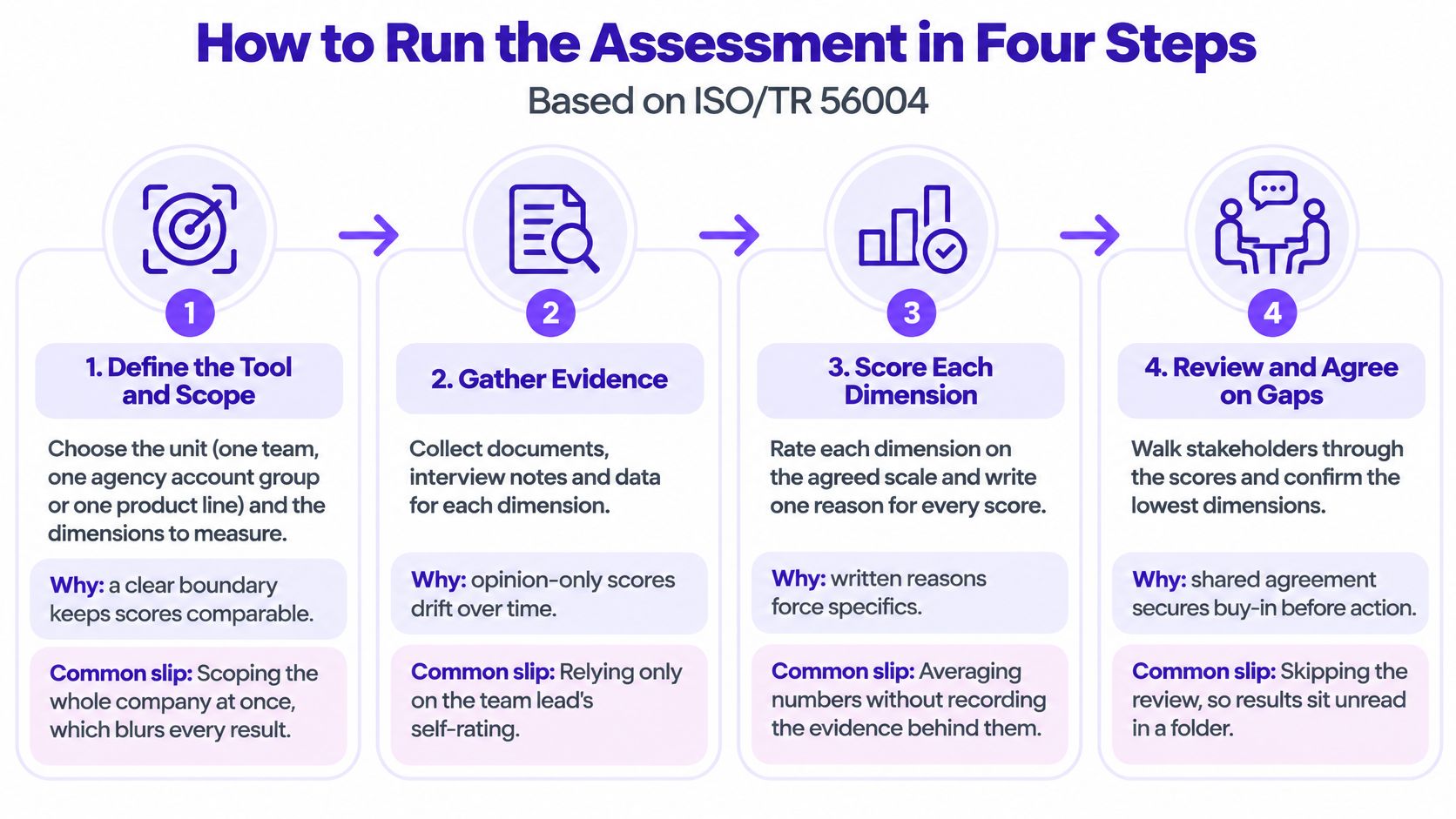
The ISO/TR 56004 assessment guidance describes the sequence of defining the tool and scope, collecting quantitative and qualitative evidence, analyzing results, and converting findings into improvement recommendations. It also emphasizes transparency, comparable data, qualified assessors, and repeatability.
Use this process overview to keep the work bounded.
Set boundaries and gather evidence
Define the tool and scope. Choose a product line, agency account group, or team. Agree on the dimensions, evidence window, assessors, and decision the assessment should support. Clear boundaries keep a client's approval process from being confused with an agency's internal process. The common slip is assessing the entire company before agreeing what readiness means.
Collect quantitative and qualitative evidence. Pull project records showing ideas submitted, tests completed, approval dates, and funding dates. Interview people who propose, approve, build, and deliver the work, including someone whose proposal stalled. Use innovation survey questions to expose differing perceptions, then verify those perceptions against records. A survey alone won't reveal where a request waited.
Analyze and commit to action
Analyze the results. Keep each score beside its evidence, rationale, and uncertainty. Trace stalled work through the handoffs: perhaps selection happened promptly, but nobody booked delivery capacity. Don't average away that dependency or assume that neighboring low scores share the same cause.
Convert findings into recommendations. Review disputed ratings with stakeholders before finalizing priorities. Give the most consequential gaps a specific intervention, accountable owner, and evidence requirement in the action plan. A long recommendation list without authority or resources isn't an improvement plan.
Use an assessor outside the team's reporting line where possible, with enough assessment knowledge to challenge unsupported claims. Repeat the assessment at agreed intervals using comparable records, and document any changes to the method.
For a proposed two-week schedule, use the first week to confirm scope, gather records, and conduct interviews. Use the second to reconcile scores, review findings, and secure owners' commitments.
Use the video as a discussion prompt alongside the assessment work.
Why High Scores Can Hide Real Bottlenecks
A high culture score can coexist with a delivery backlog. People may feel safe suggesting ideas while nobody knows who can approve implementation.
Scaling friction is the gap between a promising concept and measurable value. It includes the decisions, resources, technical dependencies, and adoption work needed to move beyond a successful demonstration.
In Informatica's 2025 survey, 67% of data leaders said they hadn't successfully moved even half of their GenAI pilots into production. That's an AI-specific finding, not an agency benchmark, but it illustrates why completing pilots and delivering operational value require different capabilities.
Follow a concept beyond the workshop
Say an agency leaves a brainstorm with compelling concepts, yet only a small shortlist reaches client testing. Before blaming creativity, examine portfolio selection, evidence thresholds, budget-release rules, data quality, compliance review, and integration ownership.
For each shortlisted concept, check for a defined customer problem, a testable hypothesis, a decision owner, stakeholder evidence, and a feasible route to launch. Ask who will support adoption after launch, too. A technically complete pilot isn't useful if the intended users can't incorporate it into their work.
Symptom patterns, likely bottlenecks and first checks
Read across each row. Find the matching pattern, then run the first check before changing the process.
| Symptom | Likely Bottleneck | First Check |
|---|---|---|
| Many ideas, few tests | Experimentation or resources | Days from approved idea to first test |
| Strong ideas, no owner | Governance and decision rights | Named decision owner for each shortlisted idea |
| Pilots never reach clients or customers | Scaling friction | Share of pilots with a defined success metric |
| High culture score, low output | Skills or process gap | Whether briefs include a problem, customer, and hypothesis |
| Ideas fail late in review | Unclear selection criteria | Whether criteria were written before ideation started |
| Leaders say yes, budget says no | Resource-release rules | Budget-release time and number of approval steps |
These are diagnostic starting points, not proven causes. Review actual stalled projects before choosing among possible barriers to innovation.
Stopping a weak experiment can demonstrate readiness. Continuing it indefinitely without evidence doesn't.
A brainstorming tool addresses ideation. Decision rights belong with accountable leaders, while funding rules require finance or client authority.
A Worked Example From a Brand Agency
Consider a hypothetical brand agency preparing for a major pitch. Its initial self-ratings look encouraging: culture averages 4.5, and an additional idea-generation measure averages 4.2 across assessors. People contribute enthusiastically and like the concepts they're producing.
The delivery checks tell a different story. Resources score 2, while scaling and value average 1.5. Budget approval takes about six weeks, and nobody has responsibility for taking a promising pilot into client delivery.
Change the handoff, not the brainstorm
The agency introduces written selection criteria so account leads and creatives can explain why a concept advances. The finance and client leads agree on a ten-working-day budget decision window, with an escalation route for unanswered requests.
For two selected pilots, the agency names delivery owners and defines success before testing begins. Each owner records the client evidence, the next decision, and the person authorized to make it.
The proposed checkpoints look like this:
- Before testing. Confirm the customer problem, decision criteria, and available delivery capacity.
- During testing. Record findings against the agreed success metric.
- At review. Decide whether to launch, revise, or stop, with a reason attached.
After 90 days, the hypothetical agency reassesses using the same criteria. Scaling and value reach 3, while idea volume stays flat. The team hasn't changed its brainstorm format.
Interpret the improvement carefully
This scenario points toward decision speed and delivery ownership as useful interventions. It doesn't prove that faster approvals alone caused the improvement, because the agency changed selection and ownership too.
The broader distinction between ambition and capability is real: Boston Consulting Group's Innovation-to-Impact benchmark found that only 3% of companies qualified as innovation ready in 2024, down from 20% in 2022.
Copy the diagnostic pattern, not the fictional scores: investigate strong creativity ratings beside weak delivery evidence, then rescore after making a defined change.
Turn Scores Into a 90-Day Action Plan
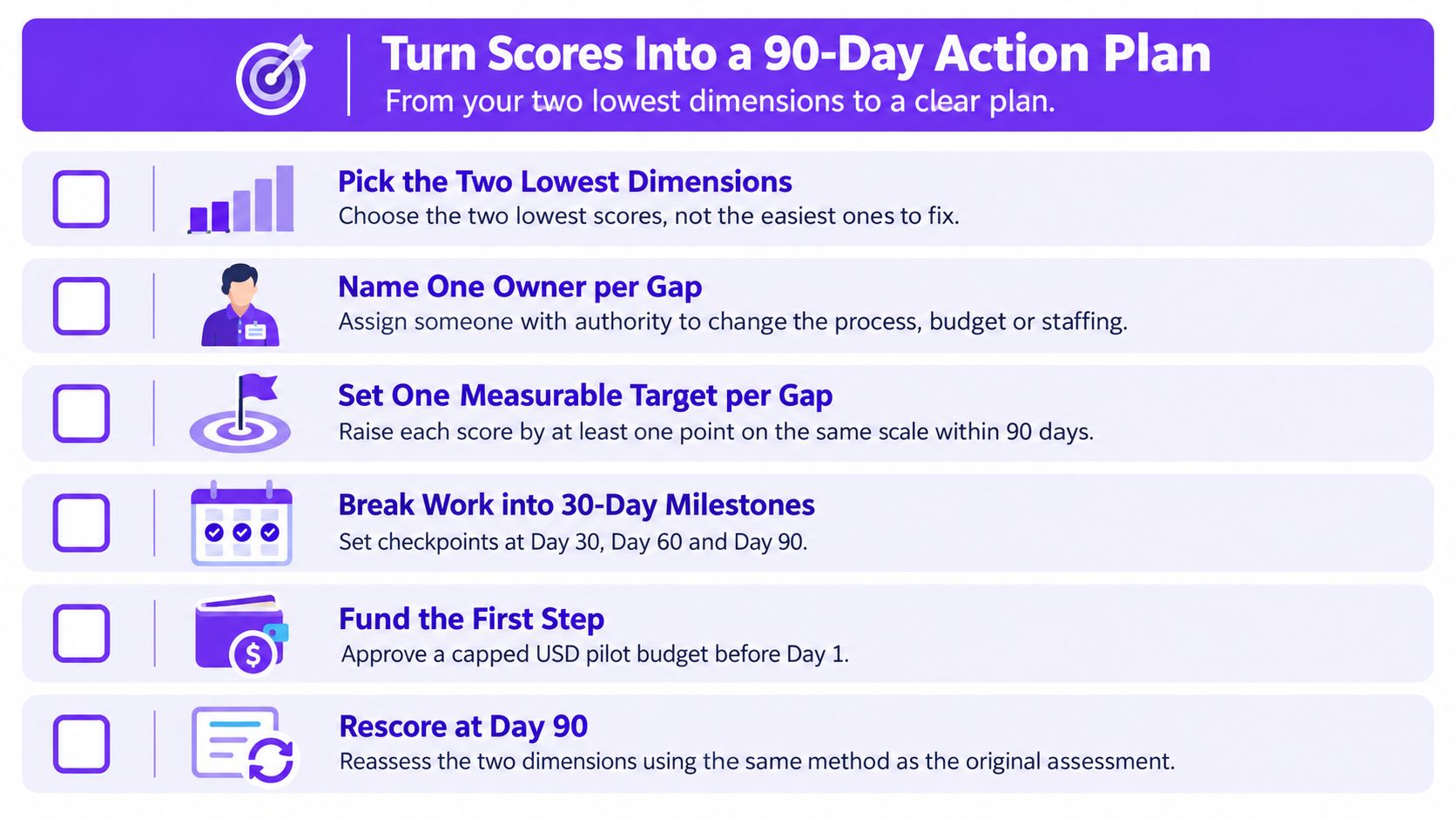
Pick the lowest consequential dimensions, not the easiest improvements. If an upstream dependency prevents progress, address it explicitly rather than selecting a convenient workshop.
Name an owner with authority to change the relevant process, staffing, or budget. A facilitator can coordinate the work, but shouldn't be accountable for approvals they can't control.
Use this checklist to confirm that the plan is executable.
Give each gap a visible evidence trail
The following is a proposed planning template. Choose actions that match the diagnosed cause rather than adopting every row.
| Weak Dimension | Owner | 30-Day Action | 90-Day Evidence |
|---|---|---|---|
| Idea generation and selection | Facilitator or team lead | Write selection criteria and apply them to the next session | Shortlist decisions logged with reasons |
| Resources and tools | Finance or client lead | Agree on and publish a budget-release window | Median days to funded test recorded and falling |
| Scaling and value | Pilot owner | Name an owner and success metric for each pilot | A pilot moved to live use or client delivery |
| Skills and problem framing | Team coach | Run problem-framing work before brainstorming | Briefs include customer, problem, and hypothesis |
At the intermediate checkpoint, inspect whether people used the new practice in their daily work. At the final review, compare both the capability score and delivery evidence. Don't raise a rating merely because someone wrote a policy.
Before starting, confirm:
- Owner acceptance. The accountable person has agreed to the work and has authority.
- Evidence source. The plan names the project log, approval record, or brief to inspect.
- Review date. Stakeholders have booked the decision meeting.
This makes reassessment part of a continuous improvement process, rather than another disconnected survey.
Use tools for the diagnosed gap
If problem framing or idea flow is weak, our structured brainstorming process can support the planned sessions. Bulby's six steps cover posting the challenge, inviting the team with one link, receiving unique random exercises, sharing anonymous ideas with AI-powered inspiration, automatically collecting and summarizing ideas with suggested next steps, and sharing the AI-generated report.
We offer a limited, non-renewable trial at no cost; some features may be unavailable during the trial. The process supports idea work, not budget authority or decision rights.
Book the first 30-day review this week.
Bulby offers structured brainstorming with anonymous contributions and AI-supported summaries to help teams develop and organize ideas. If your assessment identifies idea flow as a weak point, visit Bulby to explore how guided sessions could support your improvement plan.