
71% of B2B buyers say brands sound and act the same, according to Dentsu's 2025 global research in the eMarketer and StackAdapt B2B lookbook. That figure reframes the job. B2B brand messaging isn't a clever line on a homepage. It's the set of claims a buying group hears from product, sales, and procurement packets, and most of those claims blur into one another.
A product manager writes one promise. Sales rewrites it for the deck. A practitioner hears a third version in the demo. Buyers don't experience "the brand." They experience contradiction, then they file you with every other vendor who said "transform your workflow."
I would treat messaging as an alignment system with testable layers. A memorable idea gets you recognized. A proof layer is what a risk-averse committee can check. Miss either one and the pitch sounds sharp in the room and empty in the contract review.
Table of Contents
- The Messaging Architecture at a Glance
- Why Messaging Breaks Down Across Teams
- Balancing Memorable Ideas With Proof
- How to Build Your Messaging Step by Step
- Messaging Templates for Product and Agency Teams
- Measuring Whether Your Messaging Works
- Confirm Your Messaging Before the Next Pitch
The Messaging Architecture at a Glance
B2B brand messaging is the shared set of claims, proof, and tone a vendor uses to explain why a buying group should trust it. It sits between brand positioning and the value proposition and the campaign copy that follows. Positioning decides where you stand. Messaging is what every team is allowed to say out loud.
A complete system has five layers. Skip one and the rest drifts.
| Layer | What It Does | Example for a Product Team | Test |
|---|---|---|---|
| Core idea | Names the buyer tension in one line | Meetings run long because decisions stall | Can a new hire repeat it after one reading? |
| Value pillars | Three to four promises that support the core idea | Faster decisions, clearer owners, fewer status meetings | Does each pillar answer a buyer question? |
| Proof points | Evidence behind each pillar | Measured time saved, workflow data, security details | Can sales cite it without a footnote? |
| Tone | Voice rules for every channel | Plain and direct, no hype words | Does a sample sentence sound like the team? |
| Role variants | Adjusted wording for each buyer role | Executive, practitioner and procurement versions | Does the core promise stay the same in each version? |
The core idea is one sentence a new hire can repeat after a single read. For a project tool, "Meetings run long because decisions stall" names a situation, not a feature list. If the sentence needs a slide to make sense, it isn't the core idea yet.
Value pillars are three or four promises that answer real buyer questions. Faster decisions, clearer owners, and fewer status meetings each map to a different worry. A fourth pillar is fine. A seventh is a brochure.
Proof points are the layer teams skip most often. Measured time saved, a named workflow, or a security fact lets sales cite the claim without hunting for a footnote. A pillar with no proof is a slogan.
Tone is a rule set, not a mood board. "Plain and direct, no hype words" is testable. Read one sample sentence out loud. If it could belong to any competitor, rewrite it.
Role variants change the wording for an executive, a practitioner, and procurement. The promise doesn't change. If the executive version says "faster decisions" and the procurement version says "lower license cost," you have two products.
Check your current homepage, deck, and one-pager against the five rows. Mark which layers you already have and which ones are blank. That gap list is the brief for the next working session.
Why Messaging Breaks Down Across Teams
The fracture starts inside the company, not in the copy deck. Forrester's 2023 B2B Brand and Communications Survey found that 44% of marketing leaders said their messaging failed to address the needs of all audiences, 37% said messages from different parts of the organization confused buyers, and 40% struggled to make brand messages relevant to buyers.

Those gaps are an ownership problem, not a writing problem. Product marketing, sales, corporate communications, and customer-facing teams each write a version of the value proposition. Each version is locally reasonable. Together they contradict, and the buyer has to guess which one is true.
Four teams, four stories
An operations platform is in a late-stage deal.
- Product marketing leads with category language: "the system of record for work."
- Sales leads with the champion's pain: "we'll cut your Monday standup in half."
- Corporate communications leads with the company story: "built for the future of hybrid work."
- Customer-facing teams lead with implementation: "most customers are live in six weeks, if IT cooperates."
The executive heard speed. The practitioner heard a category label. Procurement opened the security appendix and found a third promise about "enterprise-grade transformation." None of those lines is nonsense on its own. The buying group cannot tell which one they are buying, and procurement cannot check a claim that shifted between documents.
Tone of voice guidelines will not fix this if the underlying claims still disagree. Voice rules only hold when the facts underneath them are the same. That is why the alignment work has to produce a proof layer, not just a shared adjective list.
Three signs in your own files
You can spot the split without a survey.
- Different taglines for the same product. Homepage, pitch deck, and email signature do not share a sentence.
- Claims sales cannot back up. A pillar sounds strong until a rep is asked for the customer, the metric, or the workflow.
- Pillars that change by channel. LinkedIn says "fewer meetings." The product page says "AI insights." The RFP says "compliance."
Practical rule: One team owns the narrative, and everyone else uses a short list of approved claims. New lines get added to that list, or they do not ship.
Closing audience gaps and cross-team contradictions is the outcome, not a polish pass after the campaign is built. Start by listing audience needs and the moments people enter the category, then lock one narrative those four teams can repeat.
Pitch reviews often show this pattern, and a single claim can split quickly once four functions touch it.
Balancing Memorable Ideas With Proof
A sharp line that nobody can verify loses the deal at procurement. A pile of features that nobody can remember never gets into the consideration set. You need both, and they do different jobs.
Research summarized by IE Insights finds that creative messaging outperforms purely rational messaging on attitudinal and behavioral responses among B2B buyers. The same picture from LinkedIn's B2B Institute and System1 is blunt: approximately 75% of B2B advertisements fail to support long-term growth. Distinctive work wins attention. Most B2B ads aren't distinctive enough to compound.

Memory is the mechanism. A repeatable promise, a term you use every time, a color, a sound, or a story shape makes the supplier easier to pick out across a long, fragmented journey. That availability has to exist before someone opens an RFP. Rational proof shows up later, when someone has to defend the choice: workflow outcomes, implementation detail, security facts, or a quantified result. Storytelling for marketers is useful here only when the story carries a fact a buyer can retell, not a mood.
Where distinctiveness goes soft
Generic claims feel safe and read as sameness. "Transform your workflow" could sit on fifty homepages. Buyers who already think vendors sound alike won't grant you the benefit of the doubt. Specificity is what makes a line both memorable and credible.
A value proposition that names a situation beats one that names an ambition.
Before: "Transform your workflow."
After: "Cut weekly status meetings by replacing them with one shared decision log."
The second line has a cue people can repeat, a situation they recognize, and a place to attach proof (time saved, a before-and-after agenda, a security note on who can edit the log).
The three-part check
Run every candidate line through three questions before it becomes the core idea.
- Restate. Can a buyer say it back after one exposure, without your slide in front of them?
- Prove. Can procurement find a named source for the claim, not a vibe?
- Situate. Does the line name a specific moment, role, or failure, rather than a category adjective?
Creative distinctiveness decides what buyers remember. Proof decides whether they buy. Test recall and correct attribution on one pass, then test whether the evidence kills the objection on a second pass. Clicks don't answer either question.
How to Build Your Messaging Step by Step
Build in order. Each step has an output you should be able to hold before the next one starts. Skipping ahead is how a favorite sentence becomes the strategy.
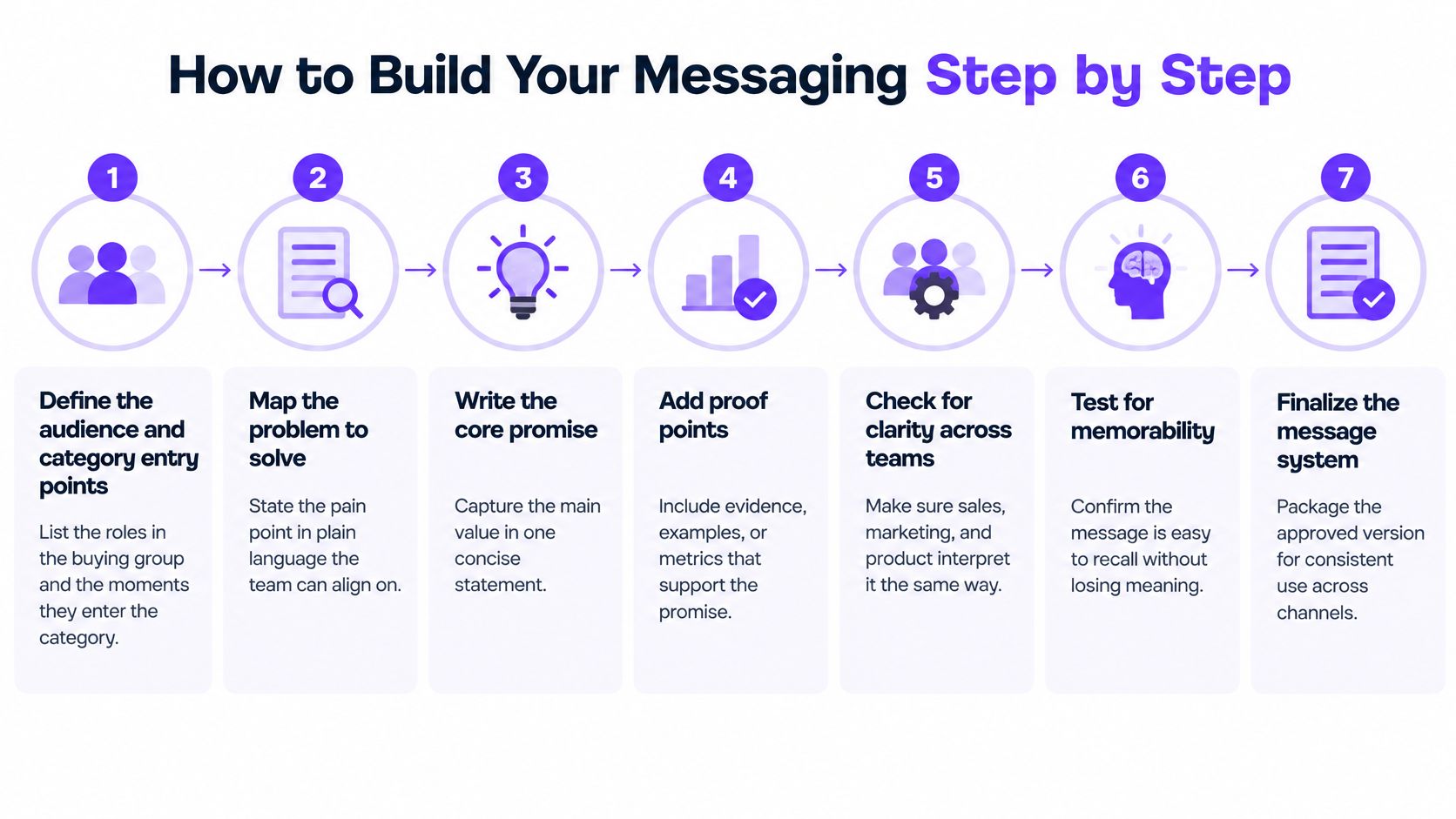
Define the audience and the category entry points. List every role in the buying group and the moment each one first looks for help. An executive might search after a missed quarter. A practitioner might search after a brutal status meeting. Output: a one-page role and entry map. The slip is writing "our ICP" as a single title.
Find the buyer tension in their words. Interview notes, support tickets, and lost-deal reasons beat internal slogans. Output: one sentence that a customer would recognize as theirs. The slip is translating too early into your feature names. If you also write outbound, align cold email messaging with your ICP only after this sentence exists, or the sequence will invent a pain the buyer doesn't use.
Generate several candidate core ideas. Don't stop at the first line that sounds good. That's the common slip, and it's usually the loudest person's line. Run a session where people write before they talk. Bulby is an online AI brainstorming tool that uses brainwriting, anonymous submissions, and AI-generated sparks so quieter teammates contribute and one favorite doesn't win by default. Output: at least five distinct tensions, written down, not debated into one.
Choose with the three-part check. Restate, prove, situate. Kill anything a buyer can't repeat, anything with no evidence path, and anything that could be swapped onto a competitor's site. Output: one core idea and a short note on why the runners-up lost.
Attach three or four value pillars. Each pillar answers one buyer question from step 1. "Faster decisions" answers the executive. "Clearer owners" answers the practitioner. "Fewer status meetings" answers the person who lives in the calendar. Output: pillars mapped to questions. The slip is adding a pillar because a feature exists.
Gather proof for each pillar. Name the source: a customer result, a workflow screenshot description, a security control, a measured time saving. Mark whether a rep can cite it without a footnote. Output: a proof row per pillar. If a row is empty, the pillar waits.
Write tone rules with examples. Two sentences that sound like you, two that don't. "Decisions stall. The log shows who owns the next step." is in. "Enable effortless teamwork." is out. Output: a one-page voice card. The slip is adjectives ("bold, human, expert") with no sample sentences.
When the seven outputs exist, you're ready for the pre-pitch check rather than another rewrite. Don't reopen the core idea because a new stakeholder prefers a different adjective.
Messaging Templates for Product and Agency Teams
Templates fail when people fill them with adjectives. They work when the blanks are filled in a fixed order: buyer tension, outcome, evidence.
| Context | Headline Formula | Pillar Example | Proof Example |
|---|---|---|---|
| Product page | [Outcome] without [recurring pain] | Faster decisions with clearer owners | Measured reduction in status meetings from customer data |
| Agency pitch | [Client tension] solved by [approach] | Tested ideas in one structured session | Workshop output and results from a past client engagement |
| Campaign line | Short claim with one recognizable cue | One promise repeated across assets | Recall and attribution results from the campaign |
Product page
Formula in practice: "Fewer status meetings without another tool to update." Pillar: faster decisions with clearer owners. Proof: a customer who cut a weekly 45-minute round-robin down to a shared decision log, with the before-and-after count in the case note. The page leads with the outcome, then the pain, then the number. Feature grids go below the proof, not above it.
Agency pitch
"Your campaign concepts collapse in the room because the loudest idea wins" solved by "one structured session where ideas are written before they're debated." The pillar is tested ideas, not "creativity." Proof is a past engagement: the concepts that left the room, and what the client did with them. The client-tension slide should match the architecture. If the slide says "brand transformation" and the case says "three headlines tested with procurement," the deck is two pitches.
Campaign line
Keep one cue and repeat it. "Decisions stall. The log doesn't." That phrase shows up in the ad, the landing line, and the sales opener. Proof for the line itself is whether people recall it and attach it to you, not whether the click-through rate moved for a week.
One promise, three readers
Most messaging advice still assumes a person lands on your site. That assumption is thinning. Dentsu reports that 77% of B2B buyers use AI throughout the buying process, including research and RFP review, and 90% say content matters because it has to address different roles in the buying group.
Write one promise, then three variants that an outsider can line up side by side.
- AI-readable summary: "Status meetings run long because decisions have no owner. A shared decision log names the owner and drops the weekly round-robin." Short, factual, hard to summarize into a different product.
- Executive paragraph: Lead with the business outcome, time returned to the leadership team, and the decision speed they can defend upstairs.
- Practitioner detail: Name the workflow. Who writes the decision, who is notified, what happens to the old standing agenda.
67% of C-suite respondents in that same Dentsu work say content is more relevant when it comes from a person rather than a brand. Put a named practitioner on the workflow variant. Keep the promise, the evidence, and the tone identical across all three. If the executive variant promises speed and the practitioner variant promises "insights," you've fragmented the narrative again.
Templates are starting points. Every filled line still has to survive the proof layer. A formula with an empty evidence cell doesn't ship, on a product page or in a pitch.
Measuring Whether Your Messaging Works
Awareness metrics and pipeline metrics often get scored on different scorecards, so teams optimize the number that moves this month and ignore the one that fills next quarter's consideration set. In a 2024 survey of B2B practitioners published by The MX Group, 86% viewed marketing measurement and attribution as a growing priority, while 28% called the lack of standardized brand-awareness metrics a significant problem.
Read the funnel in order. Early rows tell you whether the line is even in memory. Late rows tell you whether that memory changed a deal.
| Metric | What It Tells You | How to Measure | Read It |
|---|---|---|---|
| Unaided awareness | Whether buyers recall the brand without a prompt | Survey buyers after exposure, with no brand name shown | Quarterly |
| Correct brand attribution | Whether buyers link an ad to the right brand | Brand-lift survey that shows the ad without the brand name | Each campaign wave |
| Message recall | Whether buyers restate the central promise | Short interview or survey question asking what the brand does | Each campaign wave |
| Qualified response rate | Whether the proof resolves purchase objections | Qualified responses divided by total responses | Monthly |
| Branded search | Whether buyers are entering their consideration set | Search trend for the brand name | Monthly, with lag |
| Win rate and sales cycle | Whether messaging shortens evaluation | Compare deal cohorts before and after the message change | Quarterly |
Brand effects often show up in revenue months after the exposure. If you only read win rate in the launch month, you'll conclude the line failed while buyers are still moving from memory to a shortlist. Lag the read. Hold the audience definition still so a spike isn't just a new segment.
The LinkedIn B2B Institute found that conversion campaigns aimed at technology buyers produced a 2.3-times increase in conversion among people who had first seen brand messages, compared with audiences who only saw demand-generation conversion messaging. The same work found that only 19% of an average audience both noticed and correctly attributed a B2B advertisement, from 53% noticing it and 36% branding it correctly. Visibility isn't memory. Memory is what later conversion spends.
Score the line, don't vote on it
Before a line ships, score it on five things: distinctiveness, comprehension, proof strength, audience relevance, and a downstream behavior you can watch. Use a holdout or a geo split where you can, and an A/B test on the page or the ad when the change is a line, not the whole offer. Creative preference is the weakest vote in the room. The person who likes the line isn't the buying committee.
Pipeline programs still matter once the message is stable. Webinars and partnerships are a reasonable place to watch qualified response rate, as long as you don't treat lead volume as proof that the sentence is memorable. If unaided awareness and correct attribution stay flat while form fills rise, you bought responses, not a brand.
A message that only wins in the creative review hasn't been measured. It's been preferred.
Confirm Your Messaging Before the Next Pitch
Run this before the next pitch, launch, or product page goes live. Five checks, in order. A miss is an open assumption, not a debate about taste.
- Restate test. Someone outside the project reads the core idea once and repeats it. If they add a feature you didn't write, the line isn't done.
- Proof on every pillar. Each pillar has a proof point and a named source. "We'll find a stat later" fails the check.
- Sales can say it. A rep repeats the same promise in their own words, without the slide. If they drift to a different benefit, the narrative isn't shared yet.
- Variants match. Executive, practitioner, procurement, and any short summary an AI tool might quote keep the same promise, evidence, and tone.
- A measurement plan exists. You know how you'll read awareness and pipeline, who owns the read, and when the lag makes the number fair to judge.
Book one working session with the project team and one outside reader. Go through the five checks in order. Write every failure as an assumption ("we believe procurement will accept the time-saved figure without a named customer"). Assign an owner and a date. The session surfaces disagreements early. It doesn't replace judgment about which proof is strong enough to publish.
If you're briefing a live pitch, fold the same five checks into how you prepare the pitch so the deck, the talk track, and the leave-behind don't fork on the morning of the meeting. Questions on the check itself can go to hello@bulby.com.
Book that session this week. Pick the first message you'll test, not the whole site.
Bulby gives product and agency teams a structured way to brainstorm messaging tensions before one loud idea becomes the strategy, using anonymous brainwriting and AI sparks so more people shape the core idea. If your next pitch needs several candidate lines instead of the first sentence that sounded good, try a session on Bulby and run the survivors through the proof check before they hit a deck.