
Three proposal decks are open on your laptop, and Thursday's shortlist meeting is already on the calendar. Each brand positioning agency looks credible. The case images are sharp, the client logos are familiar, and someone on your team has already picked a favorite.
Hire on that favorite and you mostly buy the presentation. I would score measurement design and post-launch governance first, and treat the portfolio as a tie-breaker. A handsome identity project that never set a baseline will not tell your board whether the position did anything.
Use one filter from here: a scorecard, a brief shops can price, questions that expose rehearsed answers, a test before launch, and a straight rule for agency versus in-house.
Table of Contents
- Brand Positioning Agency Scorecard at a Glance
- How to Write a Brief Agencies Can Price
- Interview Questions and Red Flags to Screen Out
- How to Test Positioning Options Before Launch
- How to Measure Whether the Position Worked
- Decide Between an Agency and an In-House Team
Brand Positioning Agency Scorecard at a Glance
Agency pitches are built to impress. Buyers hire the deck and the awards, then find out the "method" was a tagline workshop with a mood board attached.
Score every brand positioning agency on six criteria. Strategic method and measurement design are double-weighted, because those two predict whether you can defend the result. The other rows still matter, but they should not rescue a weak method.
| Criterion | What good looks like | Red flag |
|---|---|---|
| Strategic method | Starts with customer research, non-customer research and competitor mapping | Starts with a logo, tagline or mood board |
| Evidence of past results | Shares named projects with a baseline, a metric and the outcome, including misses | Shows awards and portfolio images only |
| Category experience | Has worked in your category or a close neighbour and understands its buying process | Generic experience with no category overlap |
| Measurement design | Proposes baseline, control or comparison group and a pre-agreed success metric | Judges success by likeability or creative preference |
| Team continuity | Names a senior lead who stays through workshops and launch | Pitch team differs from the team that delivers |
| Pricing transparency | Fixed scope with defined deliverables and review rounds | Open-ended hours with no listed outputs |
Give each shortlisted agency a 1, 2, or 3 on every row in a single sitting. Double the points for method and for measurement design, add the rest, and rank the totals. A 3 on pretty case images plus a 1 on measurement is a weak score, not a close call.
The disappointment that shows up most often is a strong portfolio with no baseline, no control, and no success metric agreed before kickoff. Awards do not tell you whether consideration moved.
How to compare the fee
Price three models against the same brief.
- Fixed-scope fee: Listed deliverables and a set number of review rounds. This is the easiest total to judge, because the outputs are on the page.
- Monthly retainer: Stated capacity, such as workshop days and revision cycles. "Ongoing strategic support" with no hours attached is not a price.
- Hourly billing: A cap. Without one, every extra meeting becomes your problem.
Ask each shop to price the same review rounds and the same workshop attendance. Totals only compare when the scope matches. If two agencies tie, read how they talk about competitive differentiation. Keep the one that names a single difference and says how they would prove it.
Practical rule: Score three agencies in one sitting, lock the numbers, then write the brief. A second charm meeting should not reset the table.
How to Write a Brief Agencies Can Price
A vague brief produces vague pitches, and you cannot compare fees that describe different jobs. One or two pages is enough. The short map below shows the shape. The eight steps are what you write.
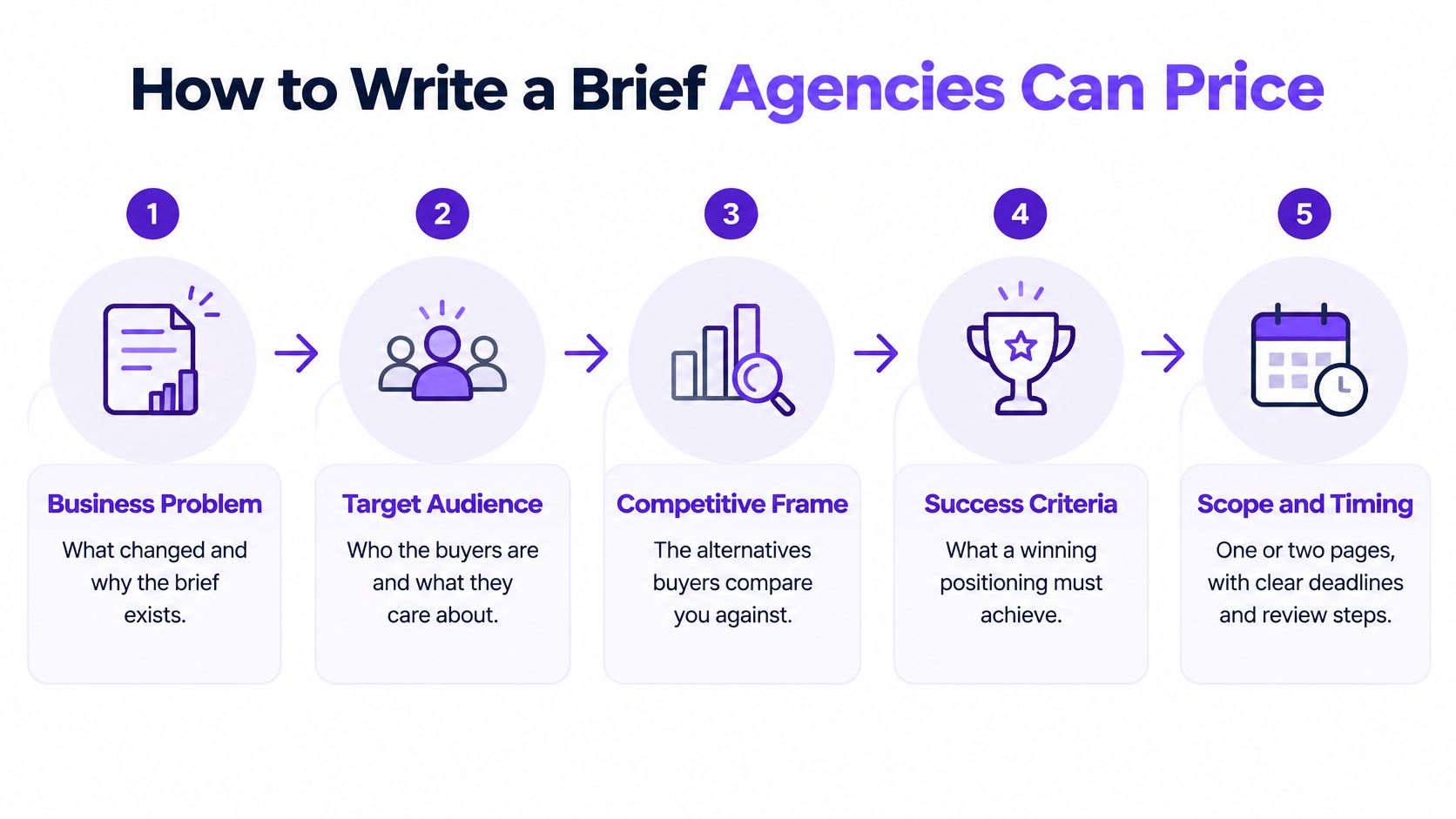
Eight steps that make the price comparable
- Business problem. One paragraph on what changed and why a new position matters now. Skip the company history. The slip is a goal like "be more premium," with no event behind it.
- Who you want. Name the target segment and the non-customer you want to win. Leaving out the non-customer makes the work a loyalty exercise.
- The set buyers already use. List three to five competitors and the substitutes people choose instead, including "do nothing." Teams forget substitutes, then wonder why the position sounds brave and loses in the sales cycle.
- What you already know. Share current perception, even if the file is thin. Hiding weak research forces the agency to rediscover it on your budget.
- Decisions, not tasks. Say which audience to lead with, or which claim to test. "Make us famous" is not a decision they can price.
- Money and calendar. Give a budget range and a timeline. A blank budget invites a pitch aimed at a different project than the one you can buy.
- Outputs and the signer. Name deliverables, the approval owner, and the number of review rounds. No owner means the fifth round of comments arrives from someone who missed the workshops.
- How they will judge the work. Ask for the approach and the evaluation method, not only the fee. A price with no test plan is a design quote.
Run a short internal session before you send anything. Bulby is an online AI brainstorming tool that uses brainwriting, anonymous submissions, and AI-generated sparks to help teams solve problems creatively. Six steps get you a usable pack: put in the challenge, invite the team with one link, give each person unique random exercises, write and share ideas anonymously with AI-powered inspiration, let AI collect and summarize while surfacing the best ideas and next steps, then share the report. Attach it. Shops price faster when your disagreements are already on paper.
The skeleton to paste
Start from a creative brief template if you want headings, then cut to this page:
- Business problem
- Target segment and the non-customer you want to win
- Competitor and substitute set
- Existing research
- Decisions the agency must make
- Budget range and timeline
- Deliverables, approval owner, and review rounds
- Evaluation method
If a section is a single vague line, the pitches will not match, and the scorecard totals will not mean anything.
Interview Questions and Red Flags to Screen Out
The interview is where a polished shop shows whether it can reason. Use the same five questions with every finalist. Listen for a trade-off, not a slogan.
| Question | Strong answer sounds like | Red flag |
|---|---|---|
| How would you test whether our position is distinctive? | Names the competitor set and proposes a test with a control group | Relies on creative preference or focus-group taste |
| What have you measured after a past positioning project? | Shares the baseline, the metric and the result, including misses | Shows only awards or case studies without numbers |
| Who will lead our workshops and stay after the deck? | Names a senior lead and states the time commitment | The pitch team differs from the delivery team |
| How do you handle conflicting internal opinions? | Describes alignment sessions and how decisions are documented | Says the agency decides and the client only approves |
| What would you not do for us? | Names a scope, claim or category they would decline | Says yes to everything |
A TUM study of four positioning strategies found that benefit-based and surrogate, or user, positioning generally outperform feature-based positioning on favorability, differentiation, and credibility, though no single strategy wins on every dimension. A strong answer on question one will offer to test those three, not defend a feature because it is easy to say. Check their sample against your own market research framework so you can tell whether they would talk to category buyers or only to fans.
What should end the conversation
- A tagline promised in week one. They are selling a line before they know the frame.
- No failed projects. Every real case has a metric that did not move. Silence on misses means you will not hear bad news later either.
- Awards as the whole story. Prizes are not a success metric. The same screening habit shows up in broader marketing agency advice from Blu Dragonfly: ask what they would refuse, not only what they will deliver.
- Two or three finalists, same brief. Make them answer your page, not a generic credentials deck. Ask who will sit in the workshops, and what they would decline.
A strong answer names a trade-off, a cost, or a project where the approach did not work. A rehearsed answer praises your category and never picks a side.
Keep two or three finalists. Drop anyone who cannot name the person staying past the deck.
How to Test Positioning Options Before Launch
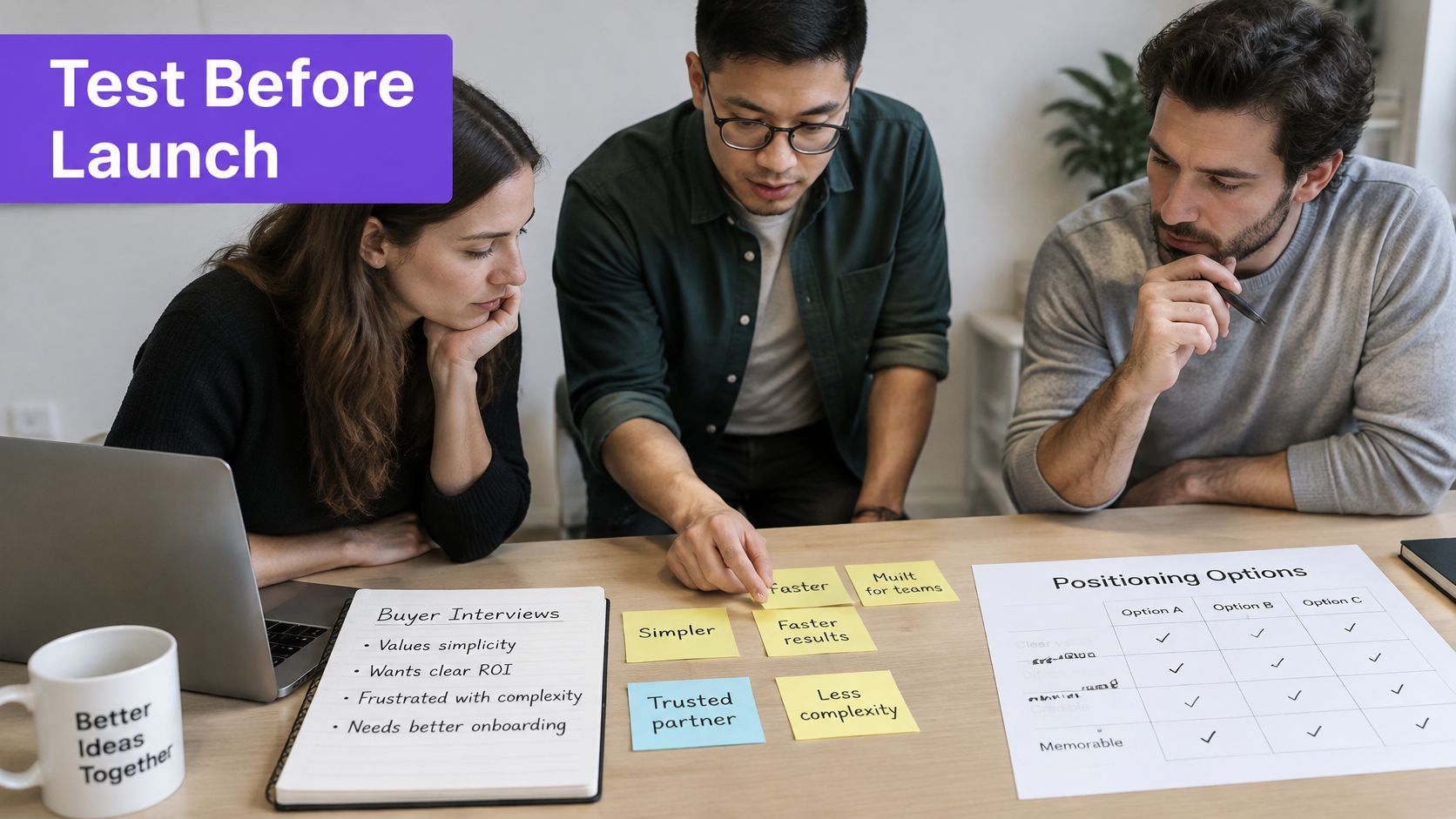
A positioning line is a hypothesis until category buyers react to it. Fans will clap for almost anything you already say. The work in the room, like the session below, only counts once strangers in the category have seen controlled variants.
A Springer article on brand-differentiating messages reports that those messages can positively affect ad awareness, brand liking, brand consideration, purchase intent, and purchase, while cautioning that affective ad responses do not reliably translate into brand-level outcomes. That is why the test has to cover the funnel, not recall or taste.
- Set the frame. List what buyers would choose if your brand did not exist. Without that set, "different" has nothing to differ from.
- Isolate one difference. One meaningful point, not a stack. You need a clean cause if perception moves.
- Build paired messages. One variant carries the difference, one does not. The gap between them is the evidence.
- Test category buyers. Not your email list of advocates. Advocates already like you, so they cannot show distinctiveness.
- Read the funnel. Awareness, distinctiveness, credibility, consideration, and purchase intent. Add sales or qualified leads where you can see them.
- Lock the rules first. Pre-register the primary metric, record a baseline, split results by priority audience, and keep a control or a historical benchmark. Watch it after launch, not only on the day of the readout.
For ways to structure those variants, use concept testing methods that keep one variable moving at a time. The same trap shows up in physical goods. Teams that avoid common mattress positioning mistakes still have to isolate one difference a buyer can believe, or the claim stays a feature list.
Two ways the readout lies
- Likeability as proof. People can enjoy an ad and still not shift brand consideration. Preference for the creative is not a win.
- Too many differences at once. If three claims change together, you cannot tell which one did the work, and the brainstorm stays a pile of unranked lines.
Rank the hypotheses. Kill the ones that do not move the primary metric. Do not launch the one the room liked best.
How to Measure Whether the Position Worked
Buyers often grab the wrong signal at the wrong time, then blame the strategy for a number that could not have moved yet. Read the window before you read the story.
| Metric | Signal type | Typical first read |
|---|---|---|
| Message comprehension | Leading | 2-4 weeks after launch |
| Qualified inbound demand | Leading | 1-3 months |
| Branded search volume | Leading | 1-3 months |
| Consideration in buyer survey | Leading | 3-6 months |
| Win rate | Lagging | 2-4 quarters |
| Sales-cycle length | Lagging | 2-4 quarters |
Leading signals, comprehension and qualified demand, are how you learn whether people understood the idea. Win rate and sales-cycle length are lagging. They need several quarters, and they mix in price, product, media, and the market. A change in win rate alone does not prove the position worked.
Nielsen's 2025 Annual Marketing Report found that only 32% of marketers globally measure media spending holistically across digital and traditional channels, with even lower figures in Europe (23%) and Latin America (29%). If that is your starting point, build the baseline before the agency writes a line. Define the audience and the competitive frame, record awareness, consideration, and sales indicators, and name leading indicators such as message comprehension and qualified inbound demand.
Separate the position from everything else
Keep a comparison group or a staggered rollout where you can. Log every outside change on the same timeline: a price move, a product release, a media burst, a competitor's launch.
Say win rate rises in the quarter you launch, and the price dropped the same month. Report a combined effect. Do not credit the position alone. Your brand strategy and management owner should assign a metric owner to each row before kickoff, so the person who can act is the person who reads the number.
A rise in win rate after a price change is a combined effect. Do not hand that lift to the position alone.
Decide Between an Agency and an In-House Team
Hire an agency when you need outside research, reach across several markets, or an independent read on a crowded category. Build in-house when you already hold current research and people who can run tests. Either route fails without a named owner. The position drifts across sales, product, customer success, and regional teams.

The State of Market Research 2025 stresses tracking perception, preference, price sensitivity, brand attitudes, usage patterns, and customer journeys, not stopping once a statement is published. That record is how you know, six months later, whether the teams still use the idea.
Governance before anyone launches
- Name the owner. One person signs off any change.
- Collect frontline language. Pull phrases from sales calls, support tickets, and win-loss notes.
- Approve local wording against the idea. Same distinctive thought, different sentences by market.
- Set the trigger. A sustained drop in message recall means refine. A broken competitive frame is what justifies a full rebrand.
Three checks: message-recall interviews, a sales-proposal audit, and a quarterly customer-expectation check. Skip in-house if the research predates the last major market shift, nobody can stop an off-position campaign, or the position is only a slide. If a fractional lead is also on the table, Revenue Nomad's CMO versus agency comparison lays out the trade.
Within the next 30 days, pick the route, score at least two agencies or confirm the internal owner, and run one short session to collect brief inputs. Bulby offers a 14-day free trial. Create an account and start it, and use the window to surface the lines your teams already disagree on.
Before you brief a brand positioning agency, get your own team aligned on the problem, the non-customer, and the single claim worth testing. Bulby walks teams through structured brainstorming so those inputs land in one report instead of a scattered thread. Start a session at Bulby.