
Forty feature ideas sit in a spreadsheet, a whiteboard photo is still on your phone, and Thursday's review needs three of them. You don't have an idea shortage. You have a judging problem, and it's the same one most product teams are living with this quarter.
The useful shift is to stop treating AI as an idea machine and start treating it as a filter and a judgment engine. It can widen a question, sort messy inputs, and pressure-test a rationale far faster than a meeting can. What it can't do is decide what your customer needs, what your brand can credibly claim, or which trade-off you'll defend when the numbers come back flat.
That distinction is where many teams get stuck, and it's what everything below unpacks.
Table of Contents
- What AI-Driven Innovation Means in Plain Terms
- Where AI Fits Across the Innovation Process
- Practical Applications for Product and Creative Teams
- Run an AI-Assisted Brainstorm That Widens Before It Narrows
- Turning Raw Ideas Into Actionable Outcomes
- Measuring Whether AI-Driven Innovation Pays Off
- A Responsible Adoption Approach for Teams
What AI-Driven Innovation Means in Plain Terms
AI-driven innovation is the practice of using AI as a working partner across the steps that turn a problem into a tested idea, so your team sees more options, judges them faster, and acts on the few that survive contact with customers.
Here's the scene this usually starts with. A product manager has forty rough feature ideas, one week, and a review where three need to pass. She runs them all through a model, gets forty polished versions back, and now has a worse problem than before. Everything reads plausible, and nothing is ranked. That scene is usually a shared screen and a lot of opinions.

Think of AI as a good editor rather than a ghostwriter. An editor doesn't write the book. She marks the paragraph that repeats itself, asks the question the author dodged, and flags the chapter that only makes sense to the person who wrote it. The author still writes. AI behaves the same way on a backlog, a creative brief, or a pile of interview notes: it sorts, compares, redrafts, and asks. The decision stays human.
Why the advantage moved
Stanford's 2025 AI Index reports that 78% of surveyed organizations used AI in 2024, up from 55% in 2023, and that generative AI use in at least one business function rose from 33% to 71% over the same period (Stanford AI Index 2025). Access stopped being the differentiator somewhere in that jump. What separates teams now is how they fold AI into the way they think, decide, and collaborate.
Working definition to keep: AI-driven innovation is the disciplined use of AI to widen options and tighten judgment, not the automation of the decision itself.
Three questions do most of the work from here: where AI fits in the innovation process, which everyday tasks it improves, and how to adopt it without flattening originality.
Where AI Fits Across the Innovation Process
AI adds the most value at the front of the process and in the sorting, and the least at the final gate. That's the short answer. The front is where volume helps, because a wide set of options costs little to generate and a narrow set costs a quarter to build. The sorting step is where AI has a structural advantage, because grouping two hundred interview notes into themes is tedious for people and nearly instant for a model. The final gate is where AI should have the least say, because being wrong there is expensive.
A funnel is the right picture. AI widens the mouth. Your team decides what passes through the neck.
| Stage | What AI does well | What people must decide | Example |
|---|---|---|---|
| Problem framing | Reframes a brief into several how-might-we questions | Which problem is worth solving | A brief asking for more sales yields five distinct problem statements |
| Divergent ideation | Generates dozens of varied angles quickly | Which angles reflect the brand and audience | Forty angles for a coffee brand reduced to eight by the team |
| Concept development | Drafts concept summaries and copy variants | Feasibility, tone and claims accuracy | A draft concept reviewed for legal and budget limits |
| Evaluation and selection | Groups duplicates and scores ideas against stated criteria | Final priority and trade-offs | Three concepts chosen from twelve clusters |
| Validation and launch | Summarizes test results and drafts reporting | Go or no-go and what to learn next | A two-week landing page test read by the product owner |
Why volume got cheap
The economics changed underneath all of this. The reported cost of querying a model performing at GPT-3.5-equivalent capability on the MMLU benchmark fell from $20 per million tokens in November 2022 to $0.07 by October 2024, a reduction of more than 280-fold in roughly 18 months (Stanford AI Index 2025 research). Asking for sixty variants instead of six, or clustering every support ticket this quarter, stopped being a budget question.
Read the table with that in mind: give AI the stages where volume helps and errors are cheap to catch, and keep people at the stages where a wrong call costs a quarter, a client, or a recall.
Practical Applications for Product and Creative Teams
The fastest way to pick a first use case is a simple filter: volume-heavy and judgment-light. Any task where someone reads, sorts, drafts, or reformats a lot of material qualifies. Any task where the output carries legal, brand, or pricing risk does not, at least not without a review step.
- Product teams spend hours turning messy inputs into themes: interview transcripts, support tickets, sales call notes. Hand the same pile to a model and ask for recurring pain points with a quote attached to each one. Then use it to generate feature options for a roadmap debate, and to write alternative onboarding copy so your test compares real options rather than two versions of the same sentence.
- Creative and agency teams apply the same move to campaign concept territories, messaging angles for one brief, naming routes, and content themes across channels. The value is walking into a client pitch with three distinct territories instead of one territory in three costumes.
- Cross-functional sessions gain the most, because AI can hold several functional perspectives in view at once, which is exactly what a room of specialists struggles to do.
What the P&G experiment showed
A preregistered field experiment with 811 Procter & Gamble participants tested generative AI in cross-functional new-product-development work. AI increased solution quality by 0.37 standard deviations for individuals and 0.39 standard deviations for teams, both statistically significant at p < 0.01 (the study published through ACM).
The mechanism is the interesting part. The gain wasn't faster text generation. AI helped integrate functional perspectives, reducing the tendency for R&D participants to overproduce technical solutions and commercial participants to overproduce market-oriented ones. In practice, that means a brainstorming system should expose people to structured prompts and alternative viewpoints before idea selection, not after.
Design rule: broaden the solution space first, then let experts own feasibility, brand fit, and prioritization.
One worked example
Say an agency is briefed on a beverage launch with three audience segments. Ask the model for ten angles per audience, thirty in total. Put them on a wall, group them into three territories, name each territory in plain language, and take those three to the client. The model produced raw angles. The team produced the structure, the names, and the recommendation. Anybody can run the first half; the second half is the job.
Three cases need a different shape. In regulated categories, park every AI-generated claim until someone checks it against a primary source. Where briefs contain sensitive customer data, use approved tools only. And when a client arrives with one decided idea, ask the model to argue against it rather than around it, which beats a hundred alternatives nobody will read.
If you're choosing where to begin, a shortlist of AI tools for product managers is a better entry point than a platform-wide rollout.
Run an AI-Assisted Brainstorm That Widens Before It Narrows
Widen the question before you narrow the answer. That single rule changes a session's output more than any prompt trick you'll pick up.
Why ordinary brainstorms drift
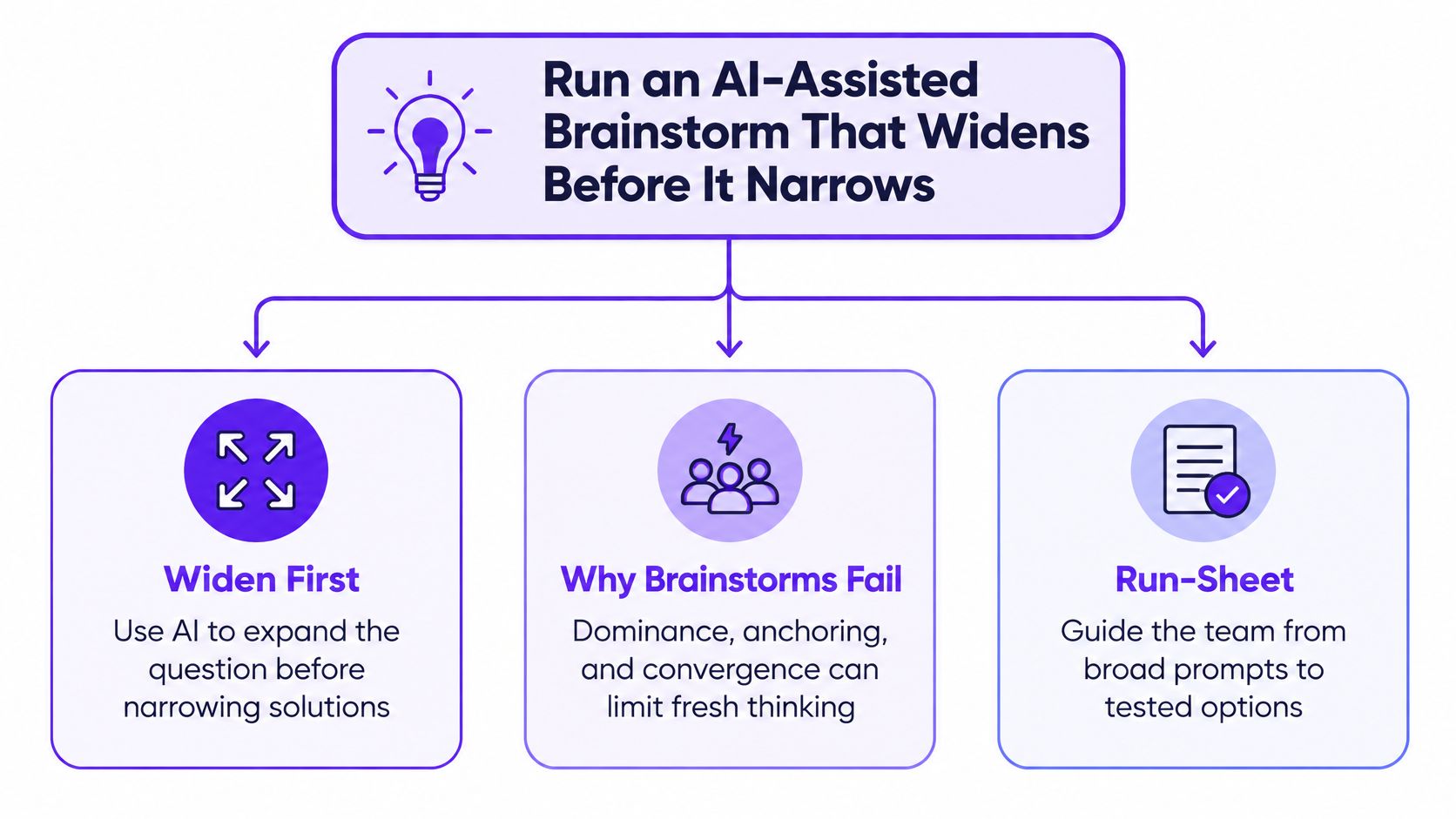
Three failures show up in almost every group idea session. The first is dominance: whoever talks first and loudest sets the frame, and everyone else builds inside it. The second is anchoring: once an idea is on the board, later ideas become variations on it. The third is convergence, the group's quiet agreement to pick something safe before the hour runs out. None of these are personality problems. They're structural, and structure is the thing you can change.
The 60 to 90 minute run-sheet
Set up with five to eight people, one how-might-we question, and one constraint. The constraint carries weight. "How might we improve team meetings" produces a survey; "How might we cut meeting time by a third without losing decisions" produces options.
- Write the question and the constraint (10 minutes). One question on the screen, one constraint beside it. No list of solutions yet.
- Silent, independent thinking (10 minutes). Everyone writes alone and submits anonymously. Anonymity removes the status pressure that makes a junior person soften a good idea in front of a director.
- Add AI provocations (15 minutes). Ask for angles from unexpected categories, and instruct the model to challenge assumptions and list constraints before it proposes polished concepts. This ordering is the whole trick.
- Cluster and score (20 minutes). Group duplicates, then score each cluster against criteria you agreed before the session started, not criteria invented around a favourite idea.
- Pick three and brief each one (20 minutes). Problem, evidence, owner, next test, kill criteria. One page each.
This walkthrough covers the same widen-then-narrow sequence if you prefer watching it before running it.
What the evidence says about who holds the pen
A randomized controlled experiment with 486 participants compared human-led questioning, model-led refinement, conventional AI use, and no AI at all on a creative ideation task. Human-led questioning improved idea quality with an effect size of Cohen's d = 0.49, and model-led interaction produced a similar gain at d = 0.50, both significant at p < 0.001 (the study on human-led versus model-led ideation). The difference shows up in what else moved. Model-led assistance improved quality while reducing idea diversity and perceived ownership.
That's the finding to design around. Quality and diversity pull apart the moment the model leads. So use the model to question, not to conclude. The honest answer to whether AI can generate ideas worth keeping is that it widens the field cheaply, and the selection is what makes them good.
Run it in this order: people explain constraints and challenge assumptions first, the model suggests finished concepts last.
A team asking "How might we improve team meetings to save time?" usually ends with ten distinct formats on the wall, not three versions of the same stand-up. A silent first ten minutes. A decision-only agenda. A walking review. A written update posted before the meeting instead of a status round inside it. The model supplies the unfamiliar ones from other industries. The team keeps the ones it can defend.
Solo versions work too: run the same five steps in a 25-minute timed note session, writing ideas before you open any tool. Teams of two or three merge steps three and four and add AI provocation directly into the clustering wall. To rehearse the flow on something low-stakes, Bulby keeps a public demo session open with no login required, built around the question "How might we improve team meetings to save time?"
Turning Raw Ideas Into Actionable Outcomes
Here's the bottleneck nobody budgets for. AI produces ideas faster than a team can judge them, so the scarce capability isn't ideation anymore. It's disciplined collective evaluation.
Consider what the access numbers show. Deloitte's 2025 State of AI report reports that sanctioned worker access to AI rose from under 40% to under 60% in one year, yet fewer than 60% of workers with that access use it daily. Most firms also report faster time-to-insight, while new revenue from data and AI stays rare. Access alone doesn't change a decision.
Six questions that separate a concept from a hunch
| Criterion | Question to ask | Red flag |
|---|---|---|
| Customer problem | Is the pain specific and observed in real behavior? | Vague, or only the team's own wish |
| Distinctiveness | Does a competitor already own this angle? | Looks like the category default |
| Evidence quality | What data, interviews or tests support it? | Only an AI-written rationale |
| Strategic fit | Does it serve a stated brand or roadmap goal? | Pleases one stakeholder but serves no stated goal |
| Feasibility | Can we build or produce it within budget and time? | No owner, or unknown dependencies |
| Validation | What is the smallest test that could prove it wrong? | No test named |
Run every surviving concept through those six questions before it gets a slot in a plan. A concept that clears them earns a one-page brief: the problem, the evidence, the named owner, the next test, and the conditions under which you'd kill it. That last field is the one teams skip, and it's the one that saves quarters.
The edge case worth naming is a concept that scores high on novelty and low on evidence. That isn't a reason to reject it and isn't a reason to approve it. Give it a small test with a defined outcome, and let the test decide. A structured idea validation process exists precisely for that middle zone.
Measuring Whether AI-Driven Innovation Pays Off
The most flattering number in any AI pilot is the number of people who touched the tool. Logins, seats, and prompt counts tell you about exposure. They say nothing about whether a decision changed, and decisions are where innovation shows up.
Track three layers, not one
- Activity. The share of your team using AI in a normal working week, counted through artifacts rather than logins: briefs drafted with it, transcripts clustered with it, variants produced with it.
- Decision quality. How many ideas entered each gate, how many were killed, and how many reached a real-user test. A team that kills eight of twelve with recorded reasons is healthier than a team that advances all twelve and tests none.
- Business outcome. New revenue, launched offerings, and cycle time from brief to tested concept. Pick one of the three and track it for two quarters before you draw conclusions.
Set the baseline before the pilot. Write down last quarter's cycle time and how many concepts reached a user test. Comparing afterwards to a number nobody recorded is how teams end up crediting AI for a seasonal swing.
Early months will often show more ideas and no revenue movement. That's a signal to inspect the gates, not a verdict on the programme. Ask which gate most ideas stalled at, and whether anything stalled at all. If nothing gets killed, the gate isn't working.
For the reporting side of a broader transformation, measuring AI ROI with AmasaTech covers how to monitor progress without drowning in dashboards.
Review all three layers after each brainstorm cycle and after each user test. Then retire any AI practice that adds ideas without changing decisions. A practice that only increases volume is costing you meeting hours and buying nothing. If you want a wider frame for the decisions layer, this guide to how to measure innovation goes deeper on the metrics that survive a quarterly review.
A Responsible Adoption Approach for Teams
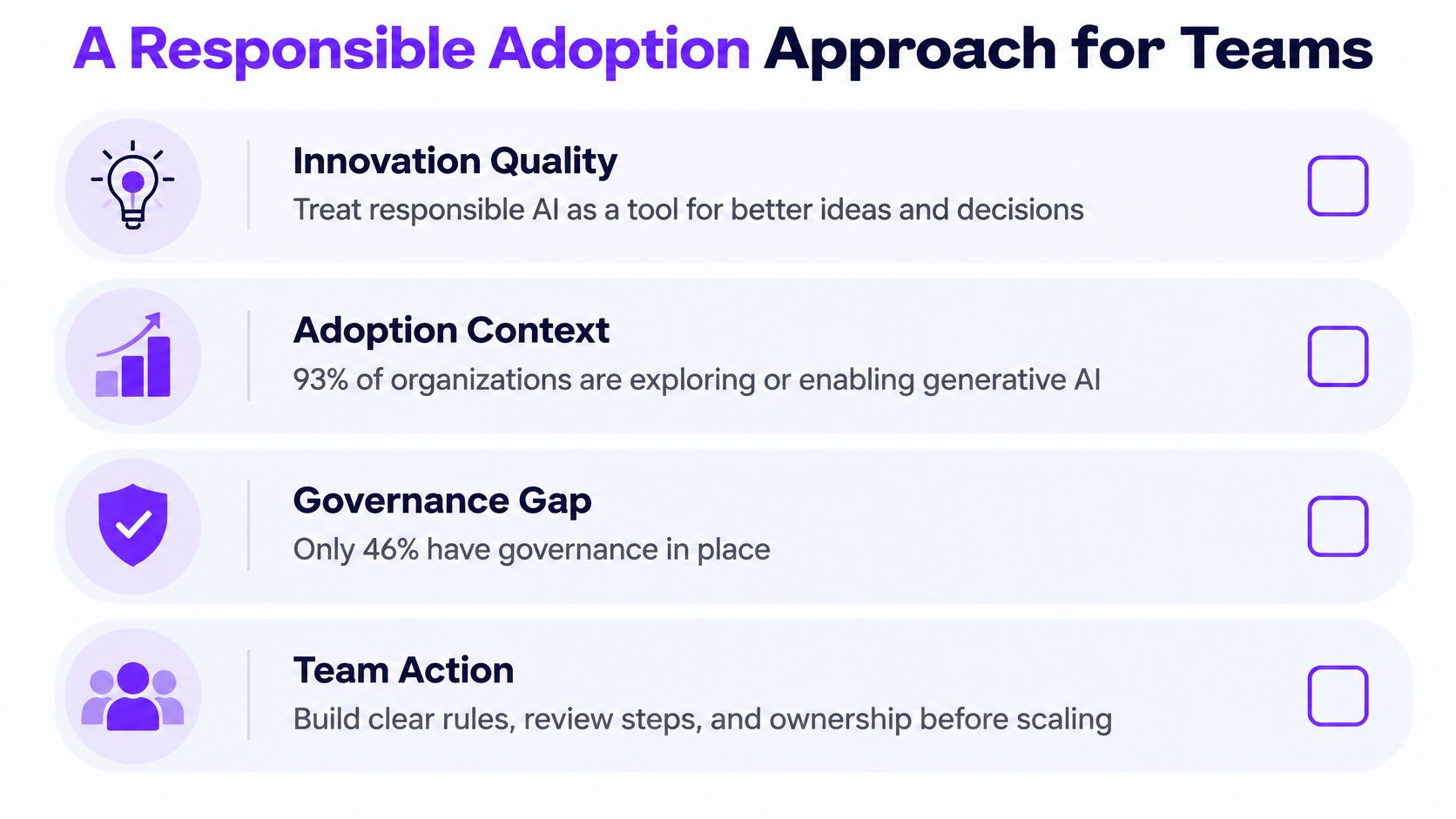
Responsible AI usually gets filed under compliance, which undersells it. Treat it as quality control on the ideas themselves. A team that can't say who approved a concept, or which voices were missing when it was chosen, isn't innovating faster. It's producing confident guesses at speed.
The enthusiasm is not in question. Capgemini reports that 93% of organizations are exploring or enabling generative AI, but 71% say they cannot fully trust autonomous AI agents for enterprise use, and only 46% have governance policies in place (Capgemini's generative AI in organizations research). The gap between those first two numbers is where bad decisions breed.
Five rules that protect idea quality
- Name a decision owner for each gate. One person per stage says yes or no, and their name sits beside the decision in the notes.
- Capture pre-AI thinking. Ideas written before any prompt goes in are your control group. Without them you can't tell whether AI improved the session or merely restyled it.
- Log evidence and uncertainty together. Next to each claim, record what supports it and how confident the team is. Confidence without a source is a guess wearing a suit.
- Force one alternative. Before any concept is chosen, someone argues the strongest competing option out loud. A decision that survives an honest attack is worth funding.
- Audit who is missing. Compare the participant list against the people who will live with the outcome. Support staff, sales, and frontline teams hear things a workshop never surfaces.
| Risk | Warning sign | Control |
|---|---|---|
| Conformity | Ideas all sound like the first AI answer | Require independent ideas before AI prompts |
| Automation bias | Team accepts the top-ranked output unchanged | Require a named person to justify each pick |
| Missing voices | The same three functions dominate every session | Audit participants and invite frontline staff |
| Unclear ownership | No one can say who approved a concept | Record a decision owner for every idea |
| Unverified claims | Statistics or competitor facts appear without sources | Check each claim against a primary source before a pitch |
| Confidential inputs | Client data is pasted into unapproved tools | Keep an approved-tools list and clear data rules |
Where confidentiality and claims bite
Three situations deserve their own rule. When a brief contains unpublished client data, that material goes only into tools your organisation has approved, and the rule is written down rather than remembered. When AI drafts a claim about market size or a competitor, it waits for a primary-source check before it reaches a pitch deck. In regulated categories, brand and legal review happens before the concept is presented, not after the client has fallen for it.
For teams scaling this past a single workshop, governance guidance for enterprise AI adoption from devPulse walks through the policy layer in more detail. A practical innovation governance model helps here too, because it turns these rules into stages rather than suggestions.
On the workshop agenda: named owner per gate, pre-AI ideas captured, evidence logged, one alternative argued, missing voices checked, approved tools only.
If you want to run this rather than read about it, Bulby turns the widen-then-narrow session into a guided flow: you enter the challenge, invite the team with one link, and each participant gets a different exercise, writes anonymously, and receives AI-powered inspiration before ideas are collected and summarized into an AI-generated report with next steps. That structure is built to protect the things this guide keeps returning to, independent thinking first, judgment with a named owner, and a clear path from raw ideas to tested options. Take a look at Bulby and put one real product question through it this week.