
You're halfway through a workshop, the board is crowded with ideas, and the loudest voices are already arguing over which one to build. Then someone asks what the team decided last time, and nobody can find a clear answer. A collaborative design process gives those conversations a path: it helps a team learn from people affected by a design, make decisions visibly, and check whether those decisions work in practice.
The aim isn't to get everyone to agree with every choice. It's to make sure people can contribute fairly, the right person makes each decision, and the team can trace how evidence changed the design.
Table of Contents
- The Five Phases at a Glance
- Roles Every Collaborative Team Needs
- How to Run Each Phase Step by Step
- Rituals and Session Rhythm That Keep Momentum
- Facilitation Techniques That Keep Input Fair
- Deciding When the Team Disagrees
- Tools That Fit Each Phase
- Measure Each Round Before You Start the Next One
The Five Phases at a Glance
A collaborative design process is a repeatable cycle in which a team and its stakeholders move from a vague problem to a tested answer through five phases.
| Phase | Main question | Output | Decision gate |
|---|---|---|---|
| 1. Frame | What problem are we solving? | One-sentence problem statement and a success measure | Sponsor signs off on the brief |
| 2. Explore | What do users and stakeholders really need? | Interview summaries and a pain-point map | Team agrees on the top 3 needs |
| 3. Generate | What could we build or try? | A set of possible ideas, recorded before evaluation | Ideas sorted into 5-8 themes |
| 4. Converge | Which ideas deserve more time? | Shortlist of 2-3 concepts with scores | Scoring criteria agreed before scoring |
| 5. Prototype and test | Does it work for real people? | Low-fidelity prototype and test notes | Each concept kept, changed, or dropped |
A decision gate is a short, explicit yes-or-no moment. It isn't a vague sense that the group agrees. At each gate, the team checks whether the phase produced its required output and names what happens next. If the answer is no, the team gathers what's missing instead of moving on with an unresolved question.
A systematic review of participatory design examined 88 articles and found that 79 studies, or 90%, used multiple participation techniques, such as interviews, workshops, observation, or prototyping. It also found that 65 studies, or 74%, involved stakeholders at multiple stages of the design process, according to the systematic review in Design Science. A single brainstorm can produce ideas, but it can't replace recurring input or show how that input shaped the result.
The phases move in order, but they aren't a one-way track. When a test reveals that a prototype misses a core need, loop back to the relevant phase, revise the work, and test again. As a quick check, look at the notes from your last session. If nobody used them in a later meeting or decision, your process is missing a working gate.
Roles Every Collaborative Team Needs
A team can't make fair decisions if nobody knows who facilitates the discussion, records input, or owns the final call. Assign roles before the first session. A small group can combine responsibilities, but each responsibility still needs a named owner.
| Role | Owns | Typical headcount | Watch for |
|---|---|---|---|
| Sponsor | Final decision and budget | 1 | Joins only at gates, then overrides late |
| Facilitator | Agenda, timing, and fair turns | 1 | Becomes the main idea-giver |
| Note-keeper | Shared record of ideas and decisions | 1 | Summaries that drop dissent |
| Domain experts | Technical and market facts | 2-4 | Speaking first and most |
| User or customer voice | Real needs and reactions | 2-5 | Being invited once, then ignored |
| Design lead | Prototypes and design choices | 1-2 | Defending their own concept |
Small teams can double up. A team of five can cover all six roles if people wear two hats, as long as responsibilities don't disappear into the group. The facilitator should guide the session without pitching their own idea. The sponsor should attend decision gates, not every workshop, so the working team can explore without turning each conversation into a status meeting.
Consider a six-person fintech product team. The product manager sponsors the work, a UX designer facilitates, and an engineer keeps the shared notes. Two support agents bring customer questions and frustrations into the room. A design lead develops the prototype and can share responsibility with the UX designer.
Three common problems need a direct fix. If domain experts speak first and most, start with silent idea writing, then invite them to respond after others have contributed. If the note-keeper's summary removes disagreement, record competing views and attribute each to its evidence. If the design lead defends a favorite concept, have another person present and score the options against criteria chosen in advance.
For teams working across functions or locations, a shared way to communicate roles and decisions can help keep work visible; this guide to cross-team collaboration offers useful context. Before the first session, write each person's role on one line, share the list in the team space, and confirm it together.
How to Run Each Phase Step by Step
The sequence matters because every decision should have a reason the next person can inspect. A team that generates ideas before understanding the problem risks solving the wrong thing. A team that ranks ideas while they're still being generated can silence options before anyone has examined them.
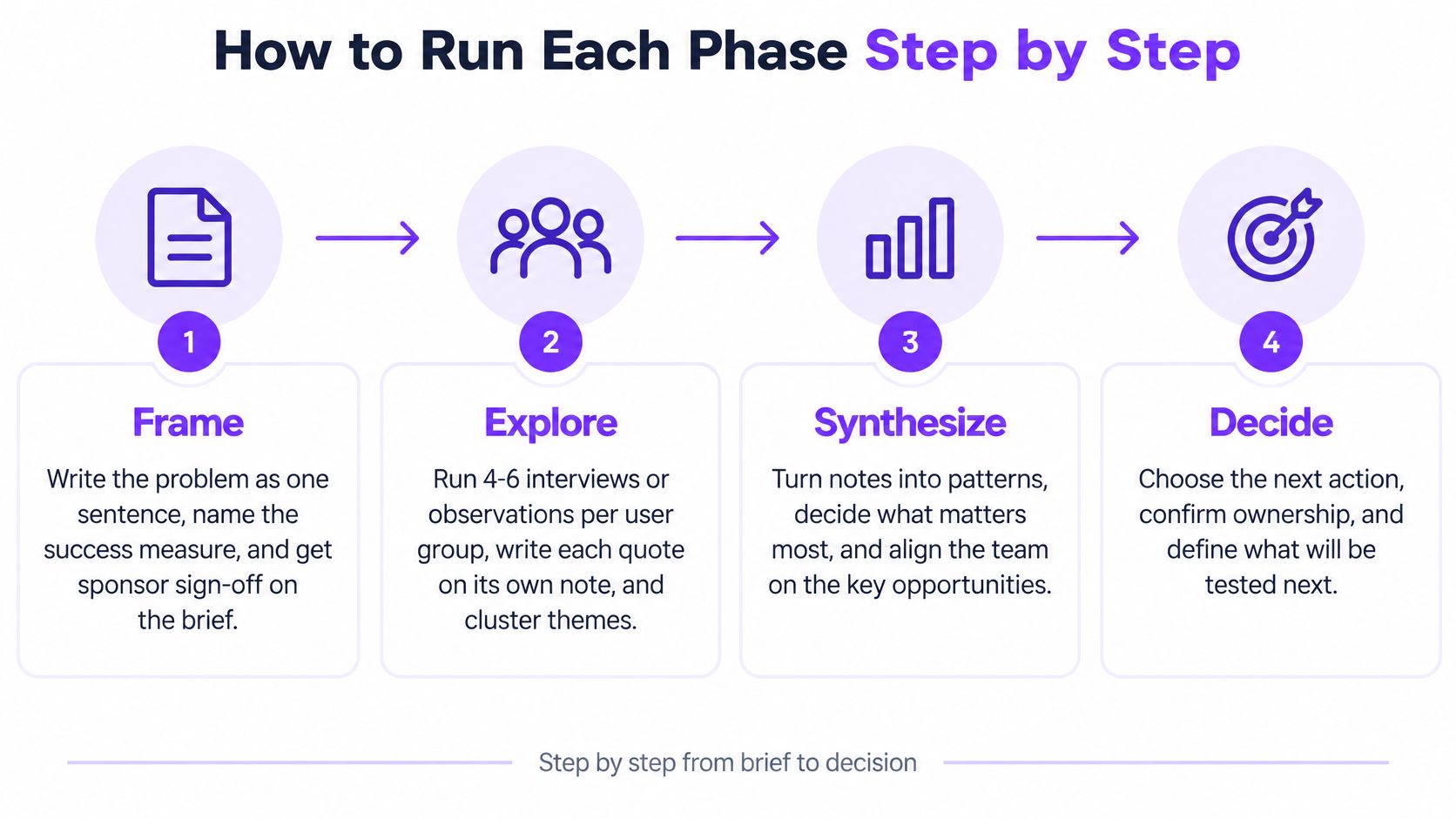
Frame the problem. Write the challenge as one sentence, name the measure that would indicate success, and get the sponsor to sign off on the brief. If the statement already assumes a particular solution, rewrite it so the team can explore alternatives.
Explore user needs. Run 4-6 interviews or observations per user group, write each useful quote on its own note, then cluster the notes into themes. Keep the original wording and source with each note, so a team summary doesn't replace what a person said.
Diverge before judging. In a 60-minute session, ask everyone to write ideas for 10 minutes before sharing them, and aim for 30-100 ideas. Quiet writing gives people time to think without anchoring on whoever speaks first. Treat the target as a prompt to explore, not a quota that makes weak ideas valuable.
Separate generation from ranking. Stop generating before the team evaluates ideas. Move ranking to a different session or take a 15-minute break first, because switching between open exploration and judgment can shut down fresh thinking.
Converge against agreed criteria. Choose 4-6 criteria and their weights before reviewing the ideas. For example, the team might assign user need a 30% weight and feasibility a 25% weight; score each idea consistently, then keep the strongest 2-3 for further work.
Prototype the riskiest assumption. Build the simplest version that can test the part of the concept most likely to fail. That might be a paper screen, a short service storyboard, or a clickable mock-up. Don't polish what the team hasn't validated.
Test with users. Run 5 user tasks per round and record where people stall, what they misunderstand, and what they do instead. Ask participants to try the task rather than tell them how the design is supposed to work.
Make and log the decision. Keep, change, or drop each concept. Record the evidence behind the call, who supported it, any open disagreement, the prototype change, and what the next test will check.
Loop with new evidence. Begin the next round from the changed prototype and what the test taught the team. Research guidance on participatory design emphasizes connecting decisions to evidence and observable design changes, while keeping idea generation separate from selection; see this collaborative design process guidance.
These steps map to four broader activities: assess needs, share decisions, develop and test prototypes, then review feedback and the team's own process. If your team is improving an end-to-end service, guidance on how to design better customer journeys can help you spot friction points to bring into exploration.
Rituals and Session Rhythm That Keep Momentum
A process needs a rhythm, not just a list of workshops. Schedule the cycle before the kickoff so everyone can see when the team will explore, make decisions, test, and reflect. The table gives a practical default for a four-week cycle.
| Ritual | Cadence | Length | Who attends |
|---|---|---|---|
| Kickoff framing | Once at the start | 90 minutes | Sponsor, facilitator, full team |
| Divergent workshop | Weekly during generate | 60 minutes | Full team, plus users when possible |
| Silent ideation round | Twice a week | 20 minutes | Everyone, async allowed |
| Convergence review | At each decision gate | 45 minutes | Core team and sponsor |
| Prototype test session | Each test round | 60 minutes | Designers, users, note-keeper |
| Retrospective | End of each cycle | 30 minutes | Core team |
In the default cycle, week 1 covers framing and exploration. Week 2 is for generating ideas; week 3 moves into convergence and prototyping; week 4 is for testing and a retrospective. Use the retrospective to name what helped participation, what slowed decisions, and what the team should change for the next round.
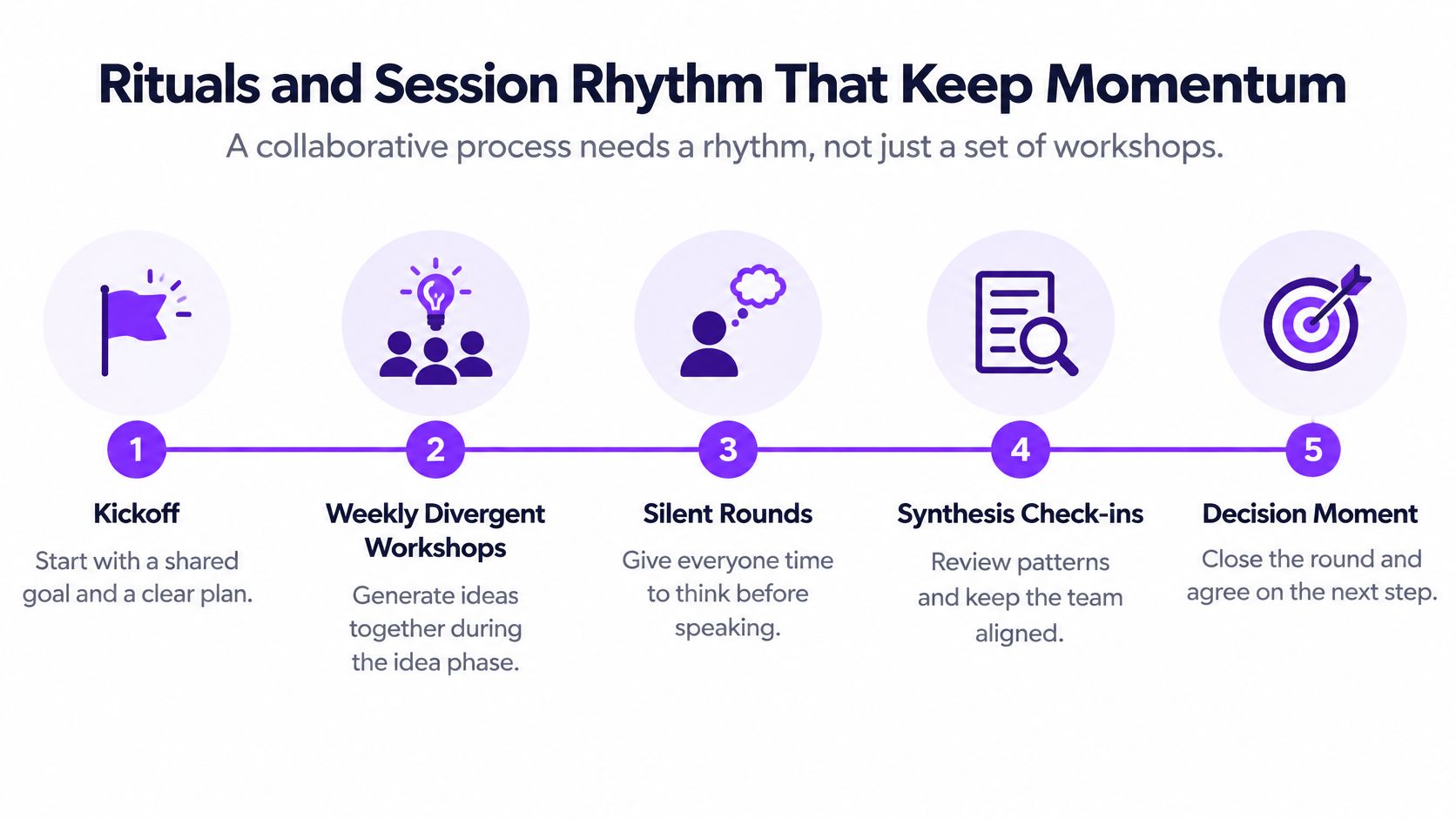
Silent rounds are a low-effort way to keep ideas flowing when calendars are full. People can add thoughts asynchronously, then the facilitator brings the contributions into the next session. Keep convergence reviews within the scheduled 45 minutes; if the group can't decide, record the disagreement and assign the next action rather than extending the meeting without a clear purpose.
A tight deadline doesn't mean skipping gates. Compress the work into a one-day sprint, but keep the sequence: frame the question, explore evidence, generate, converge, and test or agree on the next test. If the sponsor can't attend a gate, the core team can still hold a 15-minute decision review, log its recommendation, and mark it for sponsor sign-off. Remote team members should join the kickoff and retrospective on the same schedule as in-room participants. Put the full rhythm in calendars before the kickoff, not one meeting at a time.
Facilitation Techniques That Keep Input Fair
The usual fairness problem is simple: one or two people shape the conversation while quieter participants hold back. Inviting people into the room isn't enough if the process gives some voices more influence by default. A 2025 ACM panel on participation highlights the need to distinguish consultation from shared decision-making and to consider how the timing, format, and frequency of participation shape who can contribute.
Start with silent brainwriting. Give everyone 5-10 minutes to write before anyone speaks, then place the notes on the shared board. This helps prevent the first idea from becoming the anchor for the rest of the discussion.
Use a round-robin when the same people usually speak first. Ask the quietest person in each round to go first, and let each participant pass if they aren't ready. For dot voting, give each person two votes and reveal them only after everyone has voted, so early choices don't turn into a popularity contest.
When hierarchy is strong, collect ideas anonymously and have the note-keeper read them aloud. Bulby uses anonymous idea submission to overcome biases that favor certain perspectives. A team could also rotate the facilitator between sessions and add a contribution-tracking column to record who proposed or changed each idea.
For example, if a senior architect dominates every meeting, switch to written ideas first and invite the architect to comment after others have spoken. In remote sessions, give remote attendees the first turn in each round and put their notes on the same board as in-room contributions. For more practical ways to guide group conversations, see these group facilitation techniques.
Deciding When the Team Disagrees
Disagreement can reveal what a team hasn't learned yet. But requiring full consensus at every step can push a group toward a safe, lowest-common-denominator option instead of a more ambitious design. Agree in advance that consensus is the goal when framing the problem and exploring needs; at convergence and decision gates, name a decision owner who can make the call if the team stalls.
State the disagreement. Write the difference of view in one sentence in the decision log. Avoid reducing it to “we disagree,” which doesn't tell the team what needs to be resolved.
Ask what evidence would change each view. Each side should name the user evidence that would make them reconsider. This turns a personal dispute into a testable question.
Test instead of debating again. If the disagreement concerns two design concepts, put both into the next prototype or test. For a booking flow, for example, a user test can show where people get stuck without requiring the designers to argue indefinitely.
Let the owner decide if the test doesn't settle it. After one 15-minute break, the named decision owner chooses, records the evidence used, and keeps the dissent as an open risk. Don't erase the rejected option from the log; the team may need to revisit it if new evidence appears.
Check the choice against the brief. Confirm that the selected concept meets the original success measure, rather than settling for a change that feels safe but doesn't address the problem.
A clear decision log makes those calls easier to revisit. This guide can help teams manage agent proposals with Projectify, while a primer on consensus decision-making can help the group set expectations before disagreement arises.
Tools That Fit Each Phase
Use one shared board and assign one owner to each artifact. If interview quotes, scores, and decisions live in separate tools without clear links, the team will struggle to explain why it chose a direction. Choose a category that fits the work first, then use a tool the team can maintain.
| Phase | Tool type | Example job | Caveat |
|---|---|---|---|
| Frame | Shared doc or brief template | Problem statement and success measure | Keep one version with one owner |
| Explore | Interview notes board | Quotes clustered by theme | Tag every quote with its source |
| Generate | Anonymous idea board or brainwriting tool | Raw ideas before discussion | Anonymity reduces anchoring on loud voices |
| Converge | Scoring matrix | Weighted scores for 2-3 concepts | Agree weights before seeing ideas |
| Prototype and test | Clickable prototype tool | Task-based test flows | Test 5 users per round |
| Idea support | AI brainstorming tool | Sparks and summaries after anonymous input | Check every suggestion against user evidence |
An online AI brainstorming tool can help teams gather ideas, but it shouldn't decide which concept wins. Bulby uses brainwriting, anonymous submissions, and AI-generated sparks to help teams solve problems creatively. Before an AI suggestion reaches the shortlist, compare it with user evidence and log why the team accepted or rejected it.
If your team is choosing software for broader workflows, this guide to collaboration software for enterprise workflows offers another starting point. You can also compare options for creative collaboration tools. At every gate, export or screenshot the board and store it with the decision log, so the reasoning stays attached to the choice.
Measure Each Round Before You Start the Next One
Attendance and satisfaction can tell you whether people showed up or enjoyed a session. They can't tell you whether participation changed the design. A study of 51 innovation-project teams associated more disciplined use of design-thinking methods and tools with divergent and convergent thinking, team reflexivity, psychological safety, and stronger innovation performance. The same study of design-thinking practice also discusses a gap in how participatory design is evaluated, supporting a practical rule: decide what you'll measure before the work begins.
Track five signals: distinct concepts generated, stakeholder coverage across user groups, decision reversals after testing, prototype-task success, and time from insight to validated recommendation. Set the target for prototype-task success at the framing gate, so the team can judge results against its own stated aim.
- If the concept range is useful, stakeholder coverage is broad, and prototype success meets the target, then move toward build.
- If decisions keep reversing after tests, then return to exploration with a narrower question.
- If stakeholder coverage is thin, then add interviews before generating again.
- If none of those conditions applies, then repeat convergence without changing the agreed criteria.
For a related approach to selecting innovation measures, see this guide to measuring innovation. This week, run one 45-minute practice round on a low-stakes question such as “How might we make team meetings shorter?” Log the five signals and apply the same decision rules to your first real project. Bulby also offers a public demo that requires no login, where you can try brainstorming around “How might we improve team meetings to save time?”
Bulby guides teams through structured brainstorming, with anonymous idea submission and AI-generated sparks to help turn scattered input into useful next steps. Try the public demo or use Bulby to run a focused ideation session with your team.