
How do you generate marketing brainstorming ideas that go beyond the same predictable concepts, without replacing them with something strange that nobody would buy?
Start with campaigns that ran. Then borrow the participation mechanism, not the headline, visual style, or celebrity. A customer-designed product, a personalized package, and a live response campaign ask audiences to do different things. That difference gives your team something concrete to develop.
Creative quality deserves that attention. In an analysis of nearly 500 fast-moving consumer-goods campaigns conducted in 2016 and early 2017, Nielsen attributed 47% of advertising-driven sales to creative, compared with 22% to reach. That's a reason to interrogate the idea, not just plan its distribution.
The campaign formats below offer practical starting points, from crowdsourced products to real-time responses. Some require manufacturing support. Others depend on moderation, production capacity, or unusually fast approvals. None works just because a famous brand tried it.
If your brief centers on social commerce, short-form creator campaigns for ecommerce brands offer another useful execution route. But choose the audience action first. Decide whether you want people to submit, share, visit, create, or buy before deciding what the campaign should look like.
Table of Contents
- 1. Crowdsourced Product Ideation Contest
- 2. Customer Idea Submission Platform
- 3. User-Generated Ad Contest
- 4. Social Media Challenge with a Cause
- 5. Personalized Product Packaging Campaign
- 6. Real-Time Marketing and Newsjacking
- 7. Personalized Response Video Campaign
- 8. Location-Based Gamified Promotion
- 9. Structured Ideation Sprint as a Public Co-Creation Event
- 10. Limited-Edition Creator Collaboration Drop
- 10 Marketing Brainstorming Ideas at a Glance
- Turn These Formats Into Your Next Campaign
1. Crowdsourced Product Ideation Contest
Lay's Do Us a Flavor turned a product-development question into a public invitation. Consumers proposed chip flavors, and selected concepts reached store shelves. The useful mechanism wasn't just voting. Participants could imagine their contribution becoming a real product.
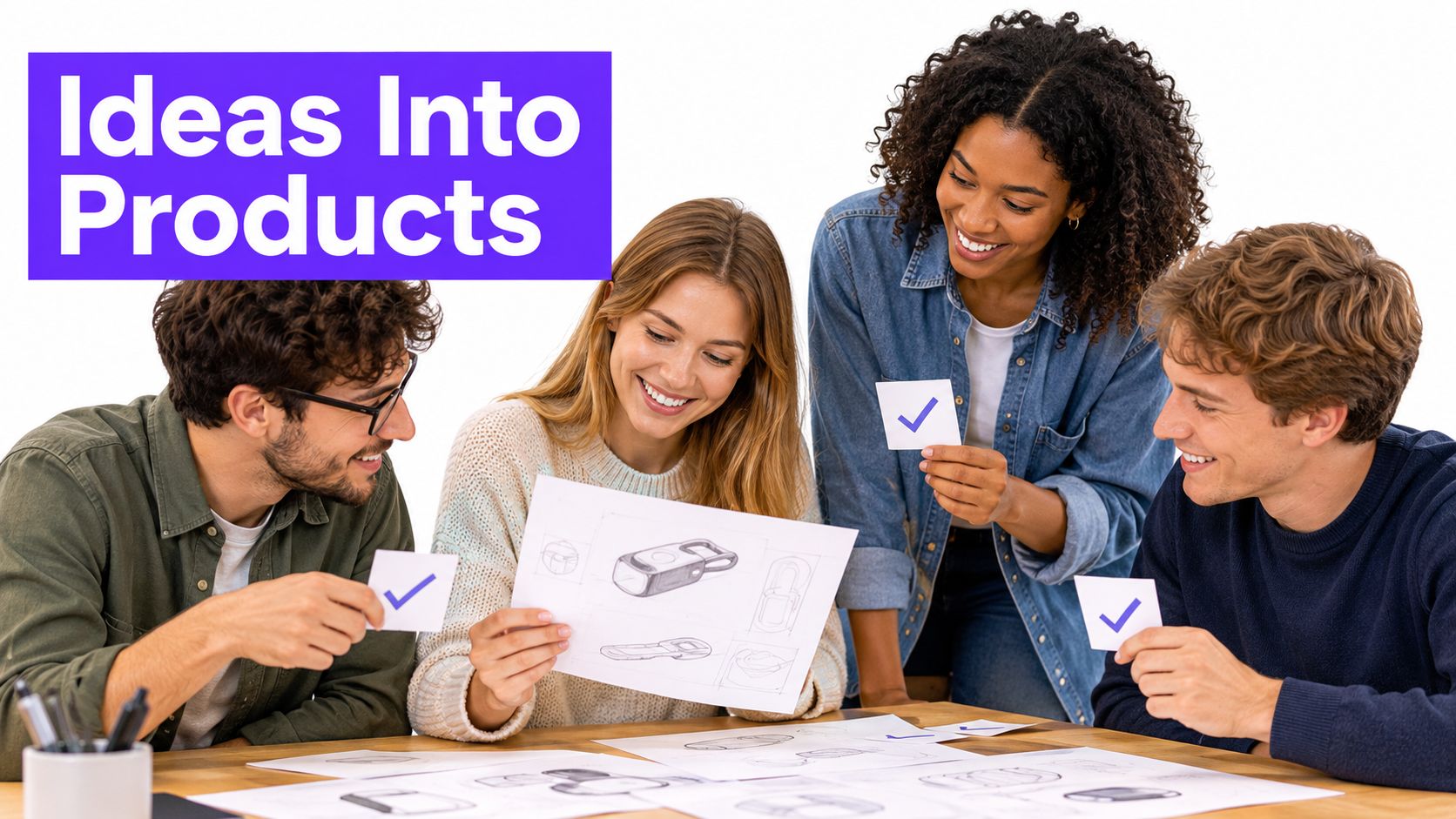
Use this format when customers understand the product well enough to suggest meaningful variations. Flavors, prints, accessories, and packaging designs are easier entry points than technical features requiring specialist knowledge.
Start with what you can actually make
Say a frozen-dessert brand wants a seasonal launch. Ask customers to propose flavor combinations using ingredients the production team can source, rather than inviting unrestricted inventions.
Before pitching, settle these decisions:
- Submission boundaries: Specify eligible ingredients, materials, themes, or product categories.
- Selection authority: Explain whether public voting chooses the winner or informs a judging panel.
- Delivery commitment: Reserve production capacity and define what happens if the winning concept fails testing.
Browse these examples of crowdsourcing to distinguish product co-creation from a simple popularity contest.
The trade-off: Public enthusiasm isn't purchase validation. People may vote for a funny flavor they'd never eat. Test shortlisted concepts for taste, usability, cost, and buying intent before promising a commercial launch.
Brainstorm prompt: How might we let customers shape something we're prepared to produce?
2. Customer Idea Submission Platform
A contest has a deadline. An idea platform creates an ongoing obligation to listen.
My Starbucks Idea gave customers a dedicated place to suggest improvements, discuss submissions, and vote. Its value as a brainstorming reference is the public feedback loop: customers contribute, the company evaluates, and selected suggestions become changes.
This format suits products or services with recurring customer friction. It's less suitable when the team has no capacity to respond or when most decisions can't be discussed publicly.
Design the response before the submission form
For a subscription software product, invite suggestions around a defined theme such as onboarding or reporting. Ask contributors to describe the task they're trying to complete, what gets in their way, and their current workaround.
An idea management system can help organize that input, but someone still needs responsibility for reviewing it. Publish clear statuses such as under review, planned, implemented, and not proceeding.
Don't open a suggestion channel unless someone owns the answer.
The trade-off: Voting favors people who participate, not necessarily the customers most affected. A popular cosmetic request shouldn't automatically outrank an accessibility problem or a serious workflow failure.
Use votes alongside support tickets, interviews, and product evidence. When you reject a suggestion, explain the constraint without becoming defensive.
Brainstorm prompt: What recurring customer frustration could we turn into a visible, ongoing improvement program?
3. User-Generated Ad Contest
Doritos' Crash the Super Bowl invited consumers to make commercials, with selected entries receiving a major broadcast platform. Unlike a product contest, participants weren't designing what the brand sold. They were interpreting how to sell it.
That distinction matters. Your brief needs a recognizable product truth that outsiders can dramatize without extensive training.
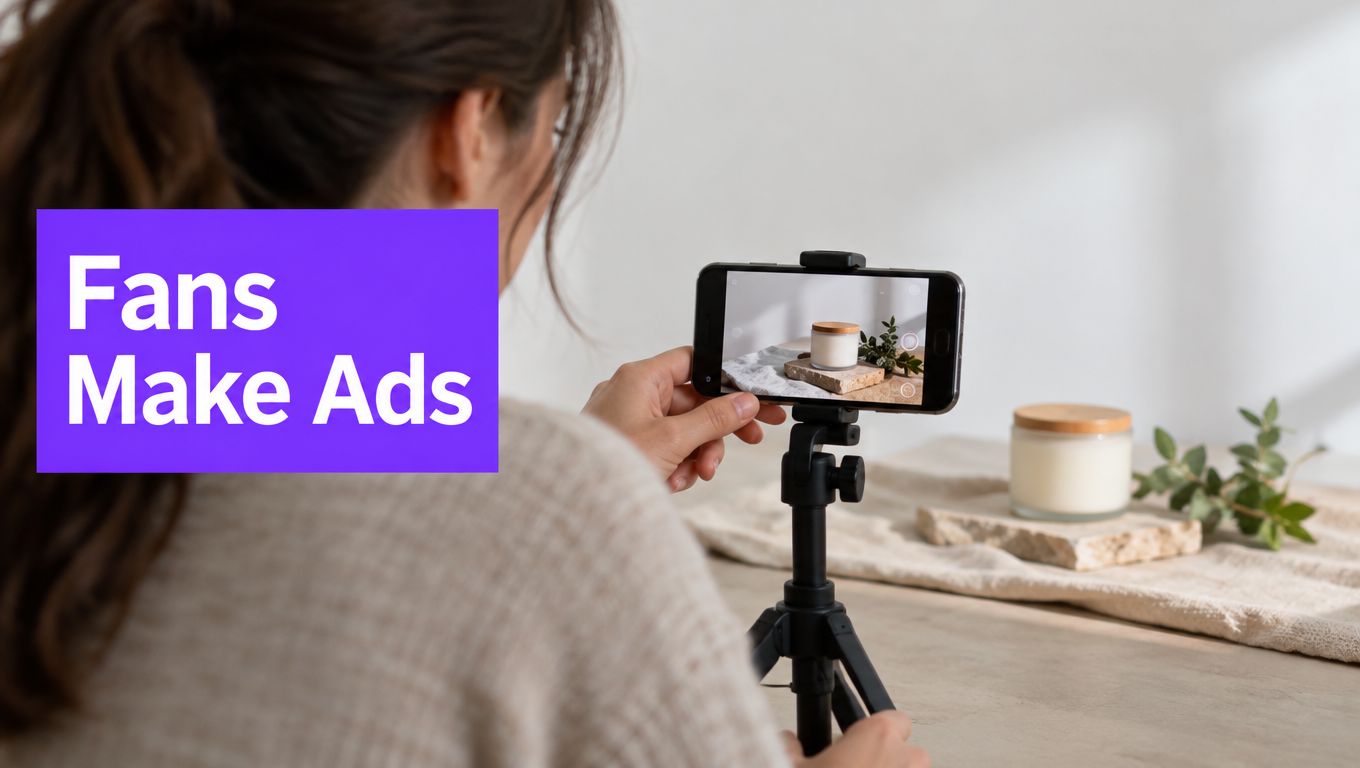
Say a cleaning brand invites short demonstrations of an everyday household mess. Provide approved product claims, safe-use instructions, brand assets, and examples of acceptable filming approaches. Leave room for participants' humor and perspective.
- Make entry achievable: Don't require professional production unless you're deliberately recruiting filmmakers.
- Define usage rights: Explain where entries may appear, how creators will be credited, and what compensation applies.
- Review before voting: Check claims, permissions, music, safety, and suitability before publishing a shortlist.
For the distinction between audience-created submissions and commissioned creator content, see customer-style video ads explained.
The trade-off: A contest isn't automatically cheap content production. Promotion, moderation, legal review, prizes, and editing still require budget. You also need a plan if submissions don't meet the brief.
Brainstorm prompt: What product truth could customers demonstrate more convincingly or entertainingly than our usual advertising?
4. Social Media Challenge with a Cause
The ALS Ice Bucket Challenge connected a recognizable action with public participation, nominations, and a charitable cause. The transferable idea is a participation loop that other people can understand without a long explanation.
Don't begin with a hashtag. Begin with the relationship between the action and the cause, then decide how participation leads to practical support.
Make the contribution clear
Say an outdoor brand partners with a local conservation organization. Participants could document a safe litter collection, share disposal guidance, and direct others toward an established volunteer or donation page.
Develop the action using these social media campaign ideas, but keep the charity's needs ahead of the brand's appetite for content.
- Keep it accessible: Offer an alternative for people who can't perform or film the main action.
- Explain the support: State whether participation triggers a donation, invites one, or promotes volunteering.
- Seed responsibly: Brief initial participants on safety, messaging, and the organization's role.
The trade-off: You can generate visible participation without meaningful help. Separate posts and mentions from donations, volunteer registrations, or another outcome agreed with the charity.
Avoid challenges that pressure people into disclosure, spending, physical risk, or public nominations they may find uncomfortable. The cause shouldn't become scenery for a brand stunt.
Brainstorm prompt: What simple, safe action could help people contribute rather than merely signal support?
5. Personalized Product Packaging Campaign
A customer looking for their own name on a bottle isn't interacting with ordinary packaging. They're searching, comparing, and potentially choosing a gift.
Coca-Cola's Share a Coke used names on packaging to make a familiar product feel personally relevant. The mechanism gives shoppers a reason to inspect individual packs rather than treat every unit as interchangeable.
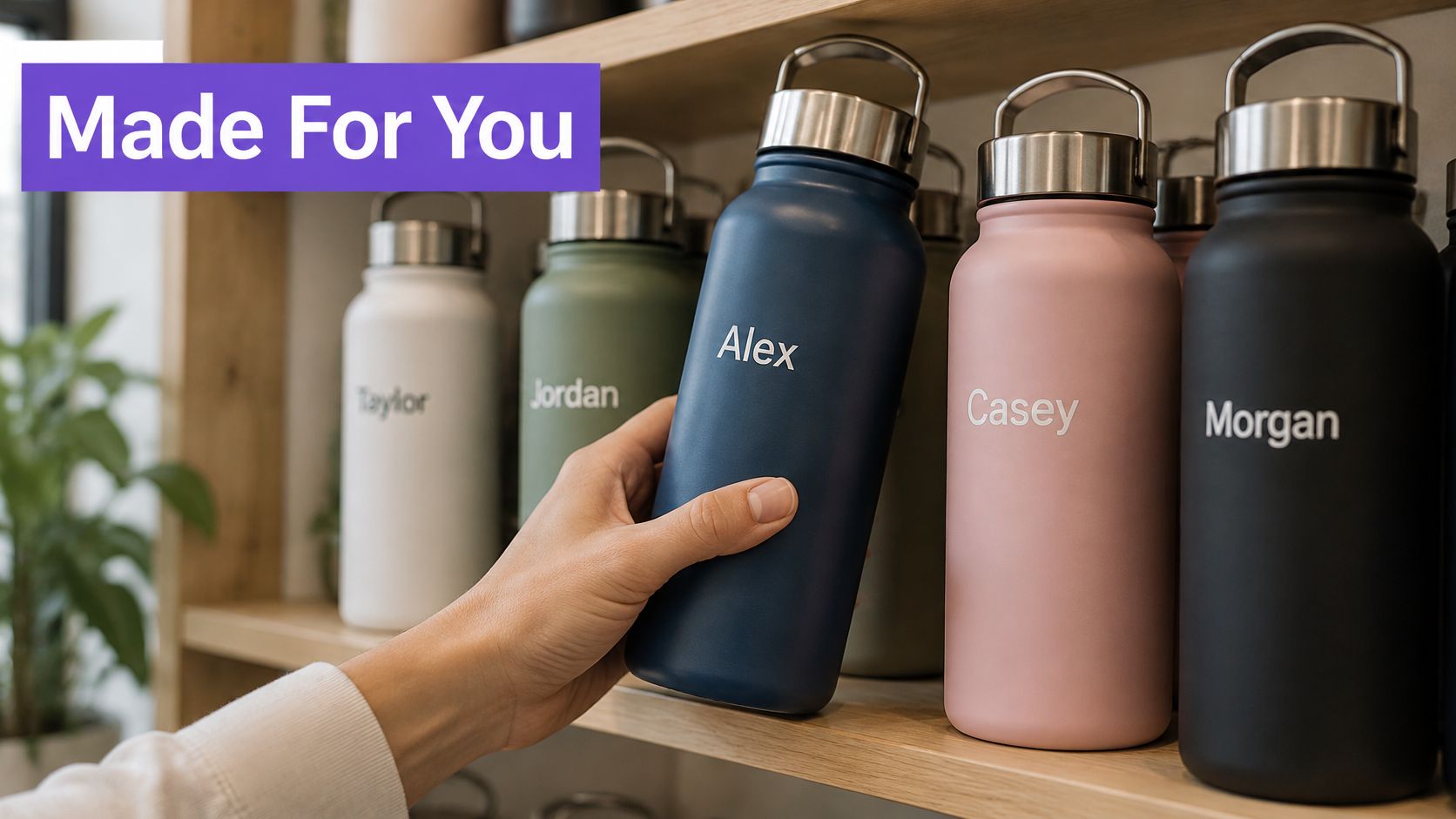
For a reusable-bottle launch, brainstorm names, team roles, shared interests, or gift messages. Choose the approach that fits how customers buy and exchange the product.
Solve inclusion and inventory together
Names create personal recognition, but no stocked range can represent everyone. Offer broader terms or a custom-order option if your operation can support it, and check language choices with people familiar with the market.
The trade-off: More packaging variants mean more production and inventory decisions. A popular design may sell out while others sit untouched. Retail teams also need a display that makes browsing manageable.
Start with mockups and observe what people select. Do they look for themselves, a friend, or a funny message? That behavior should guide the range and the sharing prompt.
Keep personalization subordinate to essential product information. Buyers still need to identify the variant, ingredients, size, or compatibility.
Brainstorm prompt: What could appear on our packaging that would make someone think of a specific person?
6. Real-Time Marketing and Newsjacking
Oreo's response to the Super Bowl stadium blackout connected an unexpected interruption with an established product behavior: dunking a cookie. The idea made sense for the brand without needing a lengthy explanation.
That's the standard to borrow. Don't mistake joining a conversation for adding something worth seeing.
For a typical use case, consider a snack brand responding to a harmless interruption during a live entertainment event. The team might create a product-based visual joke, but only if it remains understandable without extensive context.
- Assign an approver: Name the person who can authorize publication while the event is happening.
- Prepare ingredients: Assemble approved assets, product shots, tone guidance, and editable layouts.
- Set exclusion rules: Avoid tragedies, emergencies, personal distress, and subjects the brand can't handle responsibly.
These innovative marketing strategies can help broaden the brief beyond routine scheduled posts.
Approval rule: If the idea needs a long explanation of why the brand belongs in the conversation, don't publish it.
The trade-off: Speed limits review. A team that normally requires layered approvals shouldn't promise spontaneous publishing without changing its decision process.
Rehearse with fictional scenarios before a live event. Check whether the team can spot a relevant moment, develop a clear idea, and reject a weak one without escalating everything.
Brainstorm prompt: Which live moments could we respond to through a behavior people already associate with our product?
7. Personalized Response Video Campaign
Instead of asking what the brand should announce, ask what it should answer.
Old Spice's Response Campaign used its established character to respond to audience comments through personalized videos. Individual replies became entertainment other people could enjoy, even when they weren't the recipient.
The mechanism combines recognition, performance, and a consistent voice. Personalization alone isn't enough. Reading someone's username before delivering generic copy won't justify the production effort.
Build a repeatable performance system
Say a cooking brand has a recognizable chef character. Invite questions about everyday kitchen dilemmas, then turn selected questions into short demonstrations with a consistent set and tone.
Prepare reusable openings, transitions, props, and endings. Keep the actual answer specific to the question rather than assembling interchangeable scripts.
The trade-off: Production capacity becomes the constraint. Each published response also creates expectations among people who haven't received one.
Explain that you'll select contributions rather than answer everyone. Obtain permission where needed, avoid exposing personal information, and give the performer clear boundaries around sensitive questions.
Choose responses for their broader entertainment or practical value, not merely the size of the commenter's following. Plan captions and accessibility during production rather than treating them as cleanup work.
Brainstorm prompt: Which customer questions could our brand answer in a way people would watch even if they hadn't asked?
8. Location-Based Gamified Promotion
Pokémon GO's sponsored locations, including partnerships with McDonald's and Starbucks, connected digital play with physical places. For marketers, the relevant mechanism is a reason to visit that fits an activity people already enjoy.
You don't necessarily need an augmented-reality game. A location-based campaign can use a digital trail, venue check-ins, collectible stamps, or a partner's existing game environment.
Make the visit worthwhile
Say a museum district creates a discovery trail across participating venues. Visitors gain access to digital clues at each stop and receive a relevant reward when they complete the route.
The experience needs to work on the ground:
- Brief frontline staff: Explain eligibility, redemption, common questions, and what to do when the technology fails.
- Check the route: Consider accessibility, opening hours, queues, and places where people might gather unsafely.
- Minimize data collection: Request only what the experience needs and explain how location information is used.
The trade-off: A game visit isn't necessarily a commercial visit. Players may arrive for the reward without considering the venue's offer.
Give them a natural next step, such as a relevant sample, exhibit, demonstration, or redeemable offer. Track participation and redemption separately from sales so you don't confuse activity with incremental demand.
Test the experience with people unfamiliar with the plan. Staff shouldn't need to explain the entire campaign to every visitor.
Brainstorm prompt: What playful reason could bring the right people to our location without getting in their way?
9. Structured Ideation Sprint as a Public Co-Creation Event
The Google Ventures Design Sprint is a process reference rather than a consumer campaign. Its useful contribution is the progression from a defined problem to a prototype and customer feedback.
Turn that progression into a public co-creation event by inviting relevant customers to help solve a focused challenge. Don't present a workshop as a campaign unless participants can see what happens afterward.

Say a transit operator invites riders, accessibility representatives, designers, and frontline staff to develop clearer disruption messages. The output should be testable message prototypes, not a gallery of sticky notes.
Separate contribution from persuasion
Use silent individual ideation before discussion, then compare proposals against agreed criteria. A remote design sprint can support distributed participation when travel would exclude useful contributors.
A BCG study summarized by Consultancy.uk found that companies with above-average management diversity generated a 19% higher share of revenue from innovation than those with below-average diversity. That association doesn't prove a workshop will succeed, but it supports looking beyond a familiar leadership group for perspectives.
The trade-off: Public participation creates expectations. State which decisions participants can influence, compensate specialist contributions appropriately, and publish what you tested and changed.
Brainstorm prompt: Which campaign problem would become clearer if customers helped build and test the answer?
10. Limited-Edition Creator Collaboration Drop
Nike and Off-White's collaboration with Virgil Abloh provides a recognizable example of a creator bringing a distinct design language to an established product.
The useful mechanism isn't scarcity alone. It's the combination of a product people understand with a collaborator whose contribution gives them a new reason to care.
Say a stationery brand partners with an illustrator on a limited notebook collection. The strongest brief gives the illustrator room to influence the object, not merely decorate the outer sleeve.
Pitch the contribution before the countdown
Establish what the collaborator changes and why their audience would value it.
- Define creative authority: Agree on design decisions, approvals, attribution, and use of the creator's identity.
- Explain availability: Be clear about release access, stock limitations, and any planned restock.
- Prepare customer support: Anticipate checkout problems, delivery questions, purchase limits, and disappointment.
The trade-off: A fast sellout can coexist with frustrated customers and a poor experience. Don't treat difficulty buying as proof of brand strength.
Choose partners for audience relevance and creative compatibility, not follower count alone. Show the work behind the collaboration through sketches, material decisions, or prototypes so the audience can understand the contribution.
Scarcity should describe the release, not substitute for a reason to want the product.
Brainstorm prompt: Who could change our product in a way that neither partner would credibly create alone?
10 Marketing Brainstorming Ideas at a Glance
| Idea | Best For | Main Strength | Main Risk | Famous Example |
|---|---|---|---|---|
| Crowdsourced Product Ideation Contest | Testing demand for new product ideas | Engages customers and generates validated concepts | Entries may be unworkable or off-brand | Lay's “Do Us a Flavor” |
| Customer Idea Submission Platform | Ongoing customer-led product and service improvements | Builds loyalty and surfaces continuous feedback | Requires ongoing moderation and may favor vocal users | My Starbucks Idea |
| User-Generated Ad Contest | Creating audience-led advertising content | Generates shareable creative at low production cost | Quality, brand fit, and usage rights can be difficult to manage | Doritos “Crash the Super Bowl” |
| Social Media Challenge with a Cause | Raising awareness and donations through social sharing | Low-barrier participation can spread organically | Virality is unpredictable and messaging can become diluted | ALS Ice Bucket Challenge |
| Personalized Product Packaging Campaign | Encouraging personal connection and retail sharing | Makes products feel personal and shareable | Complex inventory planning and limited name options | Coca-Cola “Share a Coke” |
| Real-Time Marketing and Newsjacking | Responding quickly to trends and live events | Delivers timely relevance and earned media | Can appear opportunistic or tone-deaf | Oreo's “You can still dunk in the dark” tweet |
| Personalized Response Video Campaign | Turning audience comments into engaging social content | Creates personal, entertaining videos at scale | Requires intensive production and scripting | Old Spice “Response Campaign” |
| Location-Based Gamified Promotion | Driving visits to stores or venues through games | Connects digital play with physical foot traffic | Relies on third-party platforms and can be hard to measure | Pokémon GO partnerships with McDonald's and Starbucks |
| Structured Ideation Sprint as a Public Co-Creation Event | Quickly developing and testing concepts with diverse teams | Produces focused concepts and cross-team alignment | Requires skilled facilitation and follow-up validation | Google Ventures Design Sprint |
| Limited-Edition Creator Collaboration Drop | Reaching new audiences with a scarce co-branded product | Combines creator credibility with built-in demand | Poor partner or inventory choices can frustrate customers | Nike and Off-White collaboration |
Turn These Formats Into Your Next Campaign
These marketing brainstorming ideas are useful because they give teams specific mechanisms to adapt. They aren't guarantees. A famous execution shows what a format can look like, not what your audience will do.
Choose the format that fits your objective and operating capacity. If manufacturing can't support a public product promise, don't pitch a flavor contest. If approvals are slow, don't build the concept around spontaneous publishing. A campaign should stretch the team's creativity without pretending its constraints don't exist.
Turn a format into a focused brief
Frame your starting point as a How might we question. For example: How might we help customers demonstrate our product's most useful benefit through their own everyday routines?
Then give participants the evidence they need:
- Audience context: Identify the behavior, frustration, or motivation you're addressing.
- Commercial objective: Specify what you want people to do beyond interacting with content.
- Operating boundaries: Name production, legal, budget, accessibility, and brand constraints.
- Decision criteria: Compare relevance, distinctiveness, feasibility, and the strength of the supporting insight.
Generate independently before discussing. Group concepts by their underlying idea, not just their channel. A video, a poster, and a creator partnership may all express the same thought, so don't count them as distinct strategic directions.
Use AI to challenge the shortlist
Ask AI for alternatives, missing assumptions, and possible audience misinterpretations. Don't let polished wording stand in for customer evidence or human approval.
That quality-control step matters. Gartner reported that 77% of marketers were exploring generative AI, while 44% were realizing significant benefits, identifying challenges around emotional and cultural nuance and brand alignment.
At Bulby, we guide solo and team brainstorming through six steps, using brainwriting, anonymous submissions, and AI-generated sparks before collecting ideas into a summary with actionable next steps. The structure helps teams develop options without making the loudest participant the default creative director.
Finish your session with a concept owner, a prototype, and a defined test. Decide how you'll measure which social content to repeat, but also track the campaign's intended behavior, whether that's submitting an idea, visiting a location, redeeming an offer, or buying.
Pick a format, write the question, and build enough of the idea to test it. Don't leave the next decision buried in a brainstorm document.
Bring your campaign challenge to Bulby for guided brainstorming with anonymous idea sharing, AI-powered inspiration, and actionable summaries. Try our public demo without logging in, then use a format from this list to frame your next solo or team session.