
About 60% of employees said they make suggestions to improve the quality of their team, yet only 11% of businesses reported introducing new or significantly improved ways of organizing work, according to figures brought together in the 2024 Chartered Institute of Personnel and Development report. That contrast changes the usual question. Teams don't first need more ideas. They need a fair way to hear the ideas they already have, choose one, test it, and tell people what happened.
That's the practical heart of employee driven innovation. It's not a suggestion box, a yearly workshop, or a hunt for one brilliant breakthrough. It's a repeatable path that helps people closest to the work spot a problem, propose a change, and see that change tested. If any link in that chain is missing, ideas pile up while work stays the same.
Table of Contents
- What Employee Driven Innovation Is and Why Ideas Stall
- How to Turn Employee Ideas into a Test
- Voice Channels That Fit Team Size
- Three Workplace Levers That Raise Ideas
- Examples of Who Gets Heard
- Start the Next Idea Cycle With an Owner
What Employee Driven Innovation Is and Why Ideas Stall
Employee driven innovation means employees propose and help develop changes to how work is done, what's offered, or how a service is delivered. It doesn't leave innovation to senior leaders or a specialist team. A producer who redesigns a client handoff, a designer who spots a repeated revision pattern, and a support worker who hears the same customer complaint every week are all doing the starting work of innovation.
Think of it in three layers. First, people closest to the work often see friction before leaders do, because they handle the files, calls, delays, and exceptions. Second, whether they speak up depends on how the workplace is designed, not only on confidence or personality. Third, thinking of an idea and putting it into practice are different jobs, and the second job needs time, ownership, and a decision.
Workplace design shapes whether people contribute
That second layer matters because many managers treat silence as a lack of creativity. Often it's a lack of permission, support, or a clear route forward. The 2020 peer-reviewed study "Getting the Measure of Employee-Driven Innovation" analyzed nationally representative data from Britain's 2017 Skills and Employment Survey, which covered workers aged 20 to 65. It found that employee involvement in workplace decisions, training and development, supportive line management, and performance systems that recognize contribution were all positively associated with employees' willingness and ability to propose new ideas about work processes, products, and services.
Together, those workplace factors explained almost half of the observed variation in employee-driven innovation in that study. Read that plainly. If your team produces few useful suggestions, don't start by asking staff to be more imaginative. Ask whether they can influence decisions, whether a manager helps them shape an idea, and whether anyone notices when they contribute something useful.
The benefit isn't just a longer idea list. Problems surface earlier, while they're still cheap to fix. Changes also fit real client and production conditions better, because the people who'll use the change helped design it. Staff can see their knowledge shape the work, which gives them a reason to raise the next problem instead of working around it.
The gap between suggestions and organizational change
The table below uses UK survey figures, so treat them as a clear example of the conversion problem rather than a universal law for every country or industry.
From employee suggestions to organizational innovation
| Measure | Share | What it covers | Source period |
|---|---|---|---|
| Employees making innovative suggestions to improve team quality | About 60% | Individual suggestions inside the team | CIPD 2024, citing employee reports |
| Businesses with 10 or more employees that were innovation active | 36% | Firms introducing innovation over three years | UK Innovation Survey 2023 |
| Businesses introducing new or improved ways of organizing work | 11% | Organizational innovation in the latest three-year period | UK Innovation Survey 2023 |
A kitchen analogy makes the gap easy to see. Any cook can call out a faster way to prep vegetables during a busy service. But unless someone tests it, writes it into the prep sheet, and tells the next shift, the better method leaves with that cook. Most workplaces have plenty of shouted suggestions and very few changed prep sheets.
Ideas usually stall for ordinary reasons. The problem is vague, so suggestions point in ten directions. Nobody records the idea, so it can't be compared with others. A manager likes it but has no time or authority to test it. Or the team never hears a decision, so people learn that contributing is pointless. Those failures compound the common barriers to innovation that keep good local knowledge from becoming a shared improvement.
Practical rule: Don't measure success by how many ideas a session produces. Measure it by how many ideas receive a clear decision and a test.
That rule reframes the manager's job. You're not collecting creativity for its own sake. You're building a short, visible route from a person's observation to a small change in real work, with feedback at the end. Once that route exists, you can run it again on the next problem without starting from zero.
How to Turn Employee Ideas into a Test
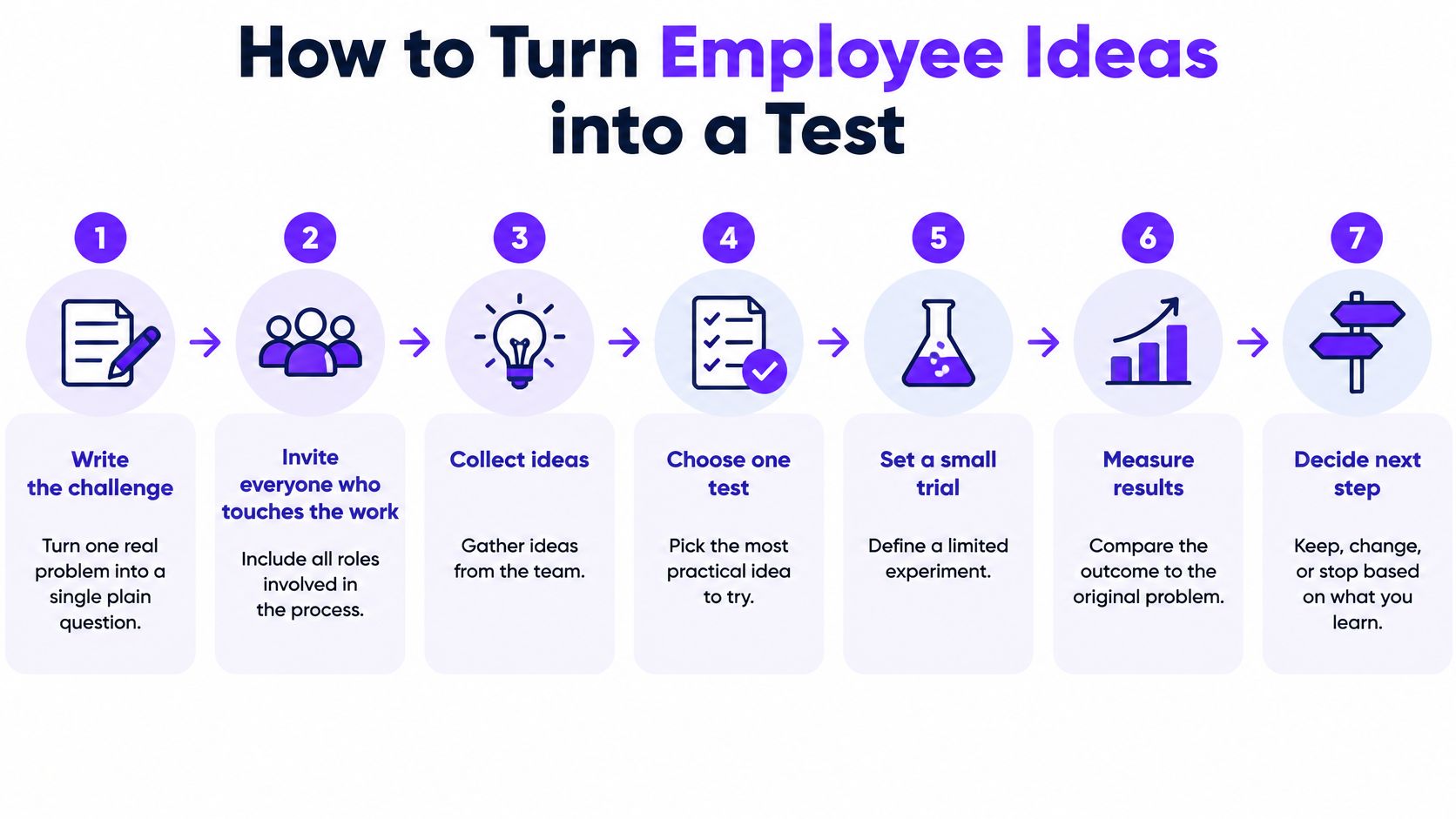
Use one real problem this month, not a broad call for innovation. A client handoff that wastes time, a review stage that always slips, or a campaign brief that arrives incomplete is specific enough. Then follow the same seven steps from start to finish.
The seven steps
- Write the challenge as one plain question. For example, "How can we stop client files arriving without final copy?" A vague challenge produces vague ideas that nobody can test.
- Invite everyone who touches that work. Include quieter roles, not only the people who usually lead meetings, and give everyone the same short brief. If you invite only senior staff, you'll miss where the work breaks.
- Let each person write ideas alone first. Do this before group talk so the first confident voice doesn't set the menu for everyone else. Ten quiet minutes often changes the range of what you hear.
- Put every idea in one shared record. Group near duplicates into themes, but keep the original wording where it adds useful detail. Ideas that stay in private notebooks or scattered chats are effectively lost.
- Score each theme against the same criteria. Use fit to the problem, effort required, and likely effect on clients. Score the idea itself separately from how polished the pitch sounded, or presentation skill will outrank usefulness.
- Name one owner, one small test, and a review date. The owner doesn't need to build the final solution, only run the trial and report back. Without that person, even a strong summary tends to die in a slide deck.
- Tell contributors what was chosen, parked, and why. A short written note is enough. Silence after a session teaches people not to bother next time.
Step 5 is where many teams get confused. You're not proving an idea will work before you try it. You're checking whether it's clear, relevant, and small enough to learn from. A simple idea validation process helps you separate that early check from the later evidence you get in the test itself.
A one week version for a small team
You don't need a month. Share the challenge on day one and collect individual ideas before any discussion. Review and score the themes on day three. Start one small test the same day, then write up the result by day five, even if the result is "this didn't help."
Keep the test narrow. Say a design team wants fewer late brief changes. It could try one new checklist on two live projects, note how many changes still arrived late, and compare that with the usual pattern. Guidance on measuring design project progress is useful here because a test only teaches you something if you decide in advance what you'll look at.
A failed small test isn't a failed cycle. It's useful information, as long as someone records it and shares the decision that follows.
Repeat the path for each new challenge. Employee driven innovation works as a habit of small cycles, not as a yearly event that produces a wall of notes and no owner. The rhythm matters more than the size of any single session.
Voice Channels That Fit Team Size
One workshop or one suggestion box is a weak design because each channel hears a different kind of knowledge. Talk is fast, writing preserves detail, and a representative route reaches people who weren't in the room. The right mix depends partly on how big the team is.
An analysis of 17,890 European firms published in the British Journal of Management study on employee voice and innovation found that verbal, written, and indirect employee voice mechanisms were each positively associated with a firm's propensity to innovate across small and medium sized enterprises. The relationship between verbal voice and innovation was significantly stronger in small firms than in medium firms. Medium firms gained more from combining voice mechanisms with different levels of formalization, such as balancing direct verbal input with indirect or structured channels.
That study is observational, so it doesn't prove that any single tool causes innovation. It does support a sensible design principle. Use more than one channel, and add structure as the team grows.
What each channel does well
Employee voice channels by team size
| Channel | Best fit | Strength | Main risk |
|---|---|---|---|
| Verbal discussion | Small firms and small agencies | Surfaces tacit client and production knowledge quickly | Idea disappears if that person is absent |
| Written capture | Growing teams that must compare ideas | Preserves ideas for later review | Slower, and unread notes help no one |
| Indirect or representative route | Medium firms and formal structures | Reaches people who are not in the room | Can filter out frontline detail |
| Combined channels | Teams as they grow | Balances speed with a record and an owner | Needs someone to coordinate the handoff |
In a small creative agency, verbal discussion can surface client, production, and market knowledge that nobody would bother writing into a form. Someone says, "That client only approves copy after legal sees it," and the whole schedule makes sense. The risk is memory. If that person is away next week, the insight may go with them, so capture the key points in writing the same day.
Written capture solves a different problem. It lets you compare ideas later, group duplicates, and see whether the same issue keeps coming up. A traditional suggestion box idea can play that role, but only if someone reads the entries, groups them, and replies. An unread box is just a slower way to ignore people.
Indirect routes, such as a team representative or a manager who carries themes into a review, help when not everyone can attend. They're useful in larger structures, but they can smooth away the exact frontline detail that made an idea valuable. Ask representatives to carry short original examples, not only their summary.
A simple combined workflow works for many teams. Collect input individually, synthesize it in a shared record everyone can see, then send the prioritized concepts to a named decision owner. Keep the fast verbal part, but don't let speed replace a record.
Three Workplace Levers That Raise Ideas
Tools don't raise employee driven innovation on their own. People contribute more when the surrounding workplace gives them influence, support, and a reason to believe a useful suggestion will be noticed. The scarce resource is rarely the idea itself; it is whether that idea receives a fair hearing and a path to a test. Three levers cover most of that system.
A nationally representative British study using the Skills and Employment Survey 2017 found that three workplace factors together explained almost half of the observed variation in a jobs index, as reported in the British Journal of Industrial Relations analysis: employee involvement in decisions, support and development, and performance management. Within that explained share, involvement and support carried similar weight, while performance management mattered slightly less. This is correlational evidence rather than proof that one program causes innovation, so use it to decide where to look first instead of treating it as a promise of results.
Workplace factors linked with employee driven innovation
| Workplace lever | Practical sign | Monthly action |
|---|---|---|
| Employee involvement in decisions | Staff help shape how work changes | Give the team one decision they can influence |
| Support and development | Training and a manager who helps refine ideas | Run a short session on writing a problem statement |
| Performance management | Useful contributions show up in reviews | Add a review question on what idea was tested |
Involvement means influence before the decision
Involvement fails when leaders ask for comments after they have already chosen. A practical sign is that staff help shape how a workflow changes while options are still open. A production team might choose between two handoff formats after testing both, instead of receiving the winner.
This month, give the team one real decision they can influence. Keep it bounded and honest: say what the team can decide, what a manager will decide, and by when. False consultation is worse than none, because people remember being asked and then ignored.
Support turns a rough observation into a usable proposal
A raw observation works like a rough sketch. It shows the shape of the problem, yet it takes training to turn it into a testable proposal that names who is affected and what a small trial would change. That points to a skill gap more than a creativity gap.
Line managers matter because they are usually the first audience. A helpful manager asks, "What happens now, and what would we see if this worked?" A dismissive one demands a polished business case before a tiny test. Run one short session on writing a problem statement, then let managers practice refining two real examples without rewriting them beyond recognition.
Recognition makes contribution safe to repeat
Performance management is the third lever. If reviews only count raw output, suggesting a change feels like unpaid extra work or a career risk. People then keep improvements to themselves and protect their numbers.
Add one review question such as, "What idea did you raise or help test, and what did we learn?" Recognize useful contributions even when a test fails, provided the reasoning was sound and the result was shared. You are rewarding learning and follow through, not only lucky wins.
Don't treat brainstorming as a separate creativity layer. Connect it to learning, manager follow through, and how contributions are judged.
Apply all three levers inside your idea cycle. Involvement gives people a say in the choice, support helps them express the idea, and recognition gives them a reason to contribute again. They work like the legs of a stool: if one is missing, the other two carry extra weight, and the seat still wobbles.
Examples of Who Gets Heard
A busy brainstorm can look inclusive while still favoring fluent, senior, confident, or culturally dominant voices. Attendance is easy to count. Fair hearing is harder. A headcount tells you who entered the room and nothing about whose idea left it.

Three short cases
Say a small agency relies on verbal debate. The account lead speaks first because she knows the client relationship, and her framing sets the direction. The junior producer knows the file problem causing the delays, yet she stays quiet rather than contradict the lead in front of everyone. The team leaves with energy and misses the operational cause.
Now say a growing product team writes ideas down, which looks fairer. Only polished slides reach the review, though, so a confident presenter with clean visuals beats a support specialist holding a rough note and better customer evidence. The team has swapped "loudest voice wins" for "best deck wins." Checking for unconscious bias in creative ideas helps you see whether the filter has moved instead of disappeared.
The third case is documented rather than hypothetical. Research summarized in the Aston University paper on innovative behavior and innovation support found managerial support was the most immediate contextual influence on creativity-related behavior across European countries. That behavior covered communicating ideas, involving others, initiating implementation, and overcoming obstacles, alongside generating the idea itself. In multinational teams the same pattern tends to sharpen, since language differences and local norms about speaking up add one more filter between an idea and its hearing.
The short video below gives another view of the participation problem.
Checks that separate inclusion from noise
- Anonymous and asynchronous contribution: Let people add ideas in writing before or after a live session, without names attached during first review.
- Plain language: Write the challenge and criteria in short, direct words, and translate them where the team needs it.
- Structured turns: Give each role a set moment to add what others may have missed, instead of relying on who jumps in.
- Frontline representation: Include someone who does the work daily when themes are interpreted, not only when ideas are collected.
- Separate scoring: Judge problem fit and evidence apart from presentation polish, accent, seniority, or confidence.
You can also audit the pattern. Look at participation and implementation rates by role, location, language, and seniority, and report only group patterns so individuals aren't exposed. If suggestions from one location rarely reach a test, you have a hearing problem even when submission numbers look healthy.
End with one question. Is the easiest voice to hear also the person closest to the problem? If the answer is no, your process is filtering knowledge before it ever reaches a decision.
Start the Next Idea Cycle With an Owner
Pick one live challenge, not a culture program. A late approval, a repeated client question, or a messy internal handoff is enough. Small scope is a strength here because people can see a result and learn whether the cycle works.
Before you invite anyone, confirm three conditions. First, name an owner who will run the test and report back. Second, provide at least two ways to contribute, so quieter people aren't limited to speaking in a live meeting. Third, set a date when contributors will hear what was chosen, what was parked, and why.
If any condition is missing, wait and set it. Don't hold another open brainstorm to fill the gap. A session without an owner creates expectation without movement, and the next invitation will get less honest input. Moving from idea to implementation starts with that go or wait decision, not with generating a bigger list.
Once the owner and date are set, start the first cycle that day. If you'd rather have the path facilitated, we can help through Bulby's six step process. You put in the challenge, invite the team with one link, and participants receive unique random exercises. They write and share ideas anonymously with AI powered inspiration, then ideas are automatically collected and summarized with AI surfacing stronger options and actionable next steps, and you share the AI generated report with the team.
Anonymous submission is useful here because we use it to overcome biases that favor certain perspectives. It doesn't replace your named owner, and it shouldn't. It makes the first hearing fairer while the owner keeps responsibility for the test and the report back.
We also offer a free private brainstorming consultation for the next 27 sign ups if you want help choosing the first challenge. Whether you use support or run it yourself, keep the decision rule firm. Run the next cycle only when an owner will report back.
Turn your next employee driven innovation cycle into a fair, owned test with anonymous idea entry, structured exercises, and a clear summary your team can act on. Visit Bulby to set your challenge, invite your team with one link, and start with an owner and a report back date already in place.