
52% of U.S. consumers said they stopped using or buying from a brand because of a bad product or service experience in PwC's 2025 survey of 5,511 consumers. That's a strong reason to understand customer expectations before committing to a product, campaign, or service promise.
The importance of customer research isn't that it removes uncertainty. It helps teams make uncertainty visible, choose what to test, and replace internal guesses with evidence. The useful output isn't a presentation full of preferences. It's a better-supported decision.
Table of Contents
- Customer Research Pays Off in Measurable Results
- Asking What People Want Versus What They Do
- Representative Samples Prevent Costly Mistakes
- Turning Research Into a Repeatable Routine
- Using AI Without Losing the Customer Voice
- Measuring Whether Research Pays Off
Customer Research Pays Off in Measurable Results
Key evidence on customer research outcomes
| Finding | Figure | What it means for your team |
|---|---|---|
| Consumers who stopped using or buying from a brand after a bad product or service experience, U.S., 2025 | 52%, from the PwC survey cited above | Investigate expectations and friction before making promises customers may find disappointing. |
| Consumers ready to act on generative-AI recommendations, across 12 countries, 2025 | 68%, according to the Capgemini Research Institute's survey of 12,000 consumers | Include AI-mediated discovery when studying how customers choose. |
| New products remaining in stores after three years | About 40%, in the loyalty-program analysis described by Kellogg Insight | Don't treat initial sales or enthusiastic early buyers as proof of durable demand. |
| Product success associated with synchronizing development and customer requirements | Standardized coefficient 0.636, in a PLOS ONE study of digital product development | Translate customer needs into explicit requirements that guide development. |
| Positive ROI reported for continuous, cross-functional feedback programs | 85%, compared with 55% for one-off projects, as summarized in Clozd's product research guide | Give findings a recurring route into business decisions. |
| Outcomes for teams embedding research in business strategy | 2.7 times better than teams rarely using customer insights, also summarized in Clozd's guide linked above | Evaluate whether teams use insights, not just whether they produce studies. |
Read the evidence without overpromising
These findings answer different questions. The consumer surveys describe reported attitudes or experiences. The product-survival analysis concerns a particular retail setting. The digital-development study measures a relationship, not a guaranteed improvement from running interviews.
The standardized coefficient isn't a percentage increase in product success. It describes the strength of an association within the study's statistical model. Likewise, the program comparisons are directional evidence, not a forecast of your organization's return.
Still, they support a practical distinction: collecting customer information and using it are different activities. A team can commission an excellent study and then approve the same campaign it preferred before seeing the findings.
Decision test: If a finding couldn't change what your team plans to do, clarify why you're collecting it.
Connect research to a business choice
Start with a decision that has meaningful consequences. Should your team simplify onboarding, change positioning, narrow an audience, or revise a service promise? A market research framework can help connect that decision to the evidence needed.
Then identify what would make you choose differently. For a campaign, that might be customers misunderstanding the main benefit. For a product, it might be buyers valuing an overlooked task more than the feature your team wants to build.
List the major decisions your team made last quarter. Beside each, record the customer evidence available when the decision was made and whether anyone changed course because of it. Empty spaces reveal where research could become useful.
Asking What People Want Versus What They Do
Say a shop owner asks customers what would improve the store. Several request more choice, but purchase records show that familiar items account for most sales. This is an illustrative scenario, not a reported study, and it presents a useful research question: do customers need more products, or do they want reassurance that suitable options exist?
A survey captures part of that question, not the whole answer.

Listen for meaning and watch for choices
Customer research is a structured way to learn what customers need, struggle with, and choose, before and after a decision. Interviews and surveys reveal motivations, frustrations, and the language people use. Observation and behavioral records reveal what happens when people encounter a real task or trade-off.
Planning a walking route provides a useful comparison. Asking someone where they want to go tells you their destination. Watching where they stop, turn back, or ask for help tells you about the obstacles.
Useful methods of observation include watching someone compare products, complete setup, or locate delivery information. Ask neutral follow-up questions rather than explaining the intended experience.
- Stated preference: What someone says they want, expect, or intend to do.
- Observed behavior: What someone selects, completes, purchases, repeats, or abandons.
- Interpretation: Your explanation of the gap, which still needs checking.
Investigate contradictions instead of choosing sides
Consider another illustrative scenario: a clothing brand hears requests for a wider color range, while purchases concentrate in familiar shades. Don't assume customers are being dishonest. They may enjoy browsing variety but choose a practical color when spending their own money.
A product team might hear enthusiastic promises of daily use, then find that trial users seldom return. Follow-up interviews could reveal that users need the product only for occasional tasks, or that setup prevents them from reaching its useful features.
Segmenting those behaviors helps avoid misleading averages. Chartsy's guide to grouping customers by value and engagement offers a useful way to distinguish commercially different groups rather than treating all respondents alike.
When recording an insight, keep separate fields for what was said, what was done, and what you think explains the difference. That last field is a hypothesis, not a customer fact.
Representative Samples Prevent Costly Mistakes
A vocal group of loyal buyers can be the wrong audience for predicting a new product's success. The loyalty-program analysis summarized by Kellogg identified a segment termed “harbingers of failure”, whose adoption was associated with products that later failed. Their enthusiasm wasn't useless information, but it wasn't a reliable signal of broad commercial demand.
The mistake is treating every positive reaction as equally relevant. A respondent may love novelty, have no realistic buying authority, or accept a price that your intended customer won't pay. More positive comments won't repair that mismatch.
Recruit for the decision you need to make
Define eligibility before recruiting. Consider participants' use cases, category experience, willingness to pay, purchasing authority, and retention behavior. Use customer segmentation examples to turn a broad audience description into recruitment criteria.
Research method by business question
| Business question | Best research method | Who to recruit |
|---|---|---|
| Why do customers leave or switch? | Churn interviews and retention data | Recent lapsed customers |
| Will this concept sell at the target price? | Choice test with several price points | Buyers in the target segment |
| Does this message make sense? | Comprehension test with short exposure | Target-segment respondents, not internal staff |
| What tensions exist in this category? | Open interviews and diary studies | Mixed users, including heavy and light buyers |
| Will users keep using this? | Behavioral tracking over several weeks | Trial users in the target segment |
A comprehension test, for example, shouldn't ask whether someone likes your headline. Show the message briefly, remove it, and ask the participant to explain the offer in their own words. You're checking understanding, not collecting compliments.
Discovery and validation need different evidence
Exploratory research helps you discover possibilities. Recruit varied participants to uncover motivations, workarounds, and experiences your team hasn't considered. An unusual account can be valuable even when it doesn't describe the typical customer.
Validation research tests a defined proposition with people who resemble its intended buyers. Give participants realistic alternatives and constraints. A concept chosen at a plausible price provides different evidence from an idea praised in an open discussion.
Also separate demand problems from delivery problems. For a mobile product, 99tests' discussion of preventing costly defects in mobile releases is a useful companion: investigate whether users reject the proposition or encounter something broken before they can experience it.
If participants wouldn't realistically buy or use the offer, their positive reactions aren't yet evidence that your intended customers will.
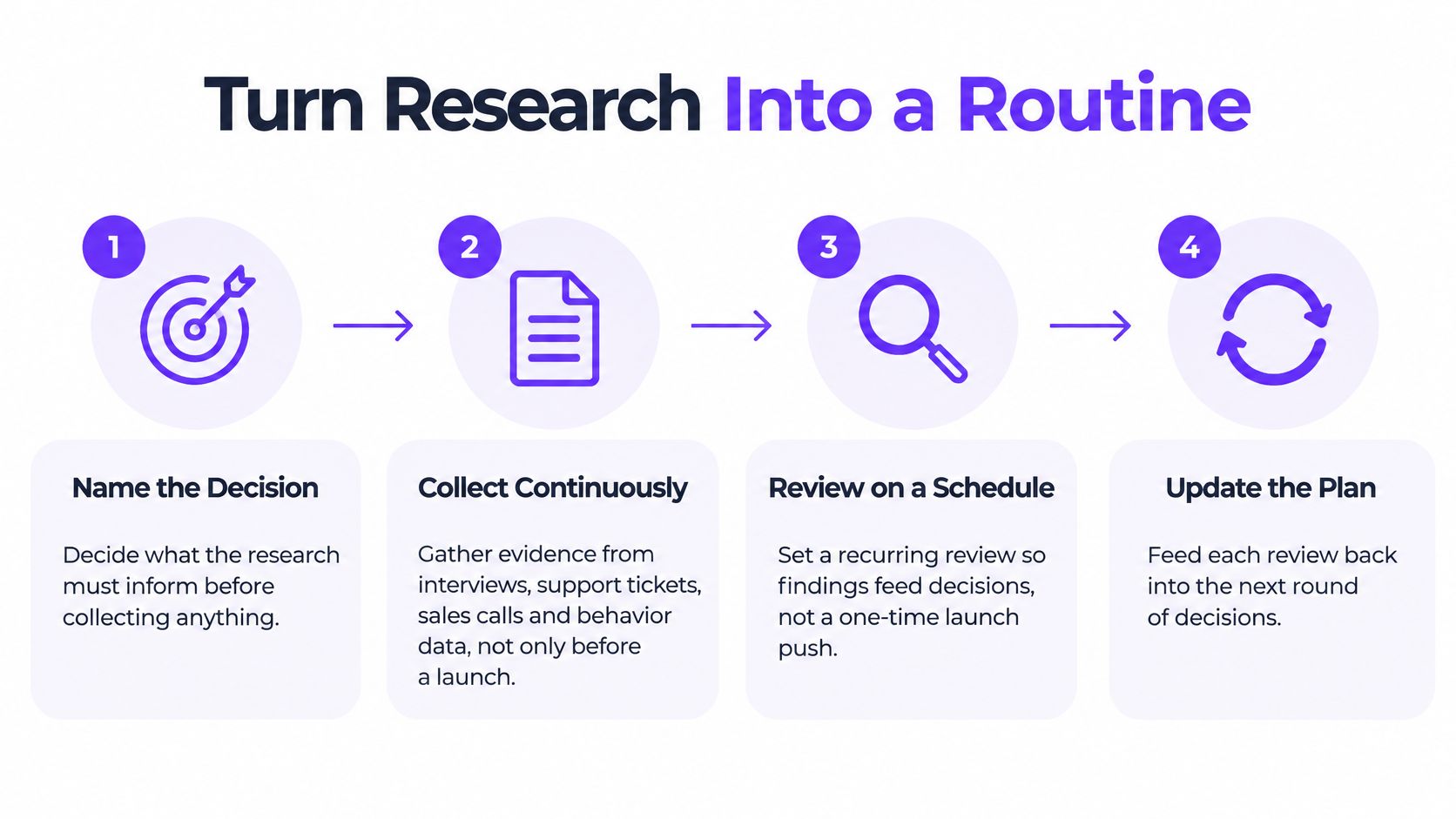
Turning Research Into a Repeatable Routine
Research continuity doesn't require a permanent stream of formal studies. It requires a dependable way to capture evidence, examine it, and give the right people responsibility for acting on it.
A recurring process keeps findings connected to work in progress rather than confined to a launch presentation.
Build a lightweight evidence-to-decision routine
Name the decision. Write what the team must choose before collecting anything. Replace a broad request to understand customers with a question such as whether to simplify setup or add guided assistance.
Collect evidence continuously from interviews, support tickets, sales calls, and behavior data. Keep the original source and customer context attached so colleagues can examine the evidence themselves.
Cluster recurring needs and tensions. Group related observations, but keep repeated reports from the same customer distinguishable from independent accounts.
Mark whether each theme rests on reported preferences, observed actions, or your team's interpretation. This prevents a plausible explanation from becoming an accepted fact.
Write a usable problem statement. Identify the affected segment, the task they're attempting, and the obstacle, without prescribing a solution.
Choose the method and participants that can test the uncertainty. Agree on the validation metric, such as completion rate or repeat use, before execution.
Connect ideas to evidence. Attach a documented insight to each proposed campaign concept or product idea, then record which decision it influenced.
Assign an owner to share findings across product, strategy, account, and creative teams. Give that person a recurring review point and permission to flag briefs that lack evidence.
Turn a complaint into an opportunity
Consider a hypothetical onboarding problem. Support tickets mention slow setup, and session observations reveal that new users pause when asked to connect an external account. The useful problem statement is that new users can't finish setup without help, not that the team needs a new tutorial.
The team might test clearer permission guidance against a deferred connection step. It would define completion consistently, record where users hesitate, and check whether successful setup leads to meaningful product use.
At Bulby, we support structured brainstorming in design thinking, hackathons, and product development. That work benefits from a clear customer problem, but brainstorming doesn't substitute for evidence that the problem exists.
Working output: Maintain a one-page opportunity map containing the target segment, unmet need, supporting evidence, uncertainty, proposed test, decision owner, and current status.
Review that map before each brief. Archive resolved questions, update contradicted assumptions, and keep unresolved opportunities visible. The point isn't to preserve every comment. It's to give each new idea a traceable reason for being considered.
Using AI Without Losing the Customer Voice
AI assistance is already part of research work: 58% of product-research respondents use AI, particularly for analysis and transcription, according to Maze's 2025 user research report. Those tasks are useful starting points, provided someone checks what the system produces.
Keep source conversations available while reviewing automated summaries.

A tidy summary isn't necessarily a faithful one
Automated clustering can combine experiences that sound similar but have different causes. A confusing checkout and an inaccessible checkout might both appear under friction, even though the required remedies differ. Review emotionally complex accounts and minority experiences separately rather than assuming the largest cluster deserves all the attention.
Before uploading material, check participant consent, access controls, retention settings, and whether the tool can use submitted content for training. Label synthetic responses clearly and keep them separate from evidence supplied by actual customers. Plausible language isn't proof of lived experience.
For teams applying AI to marketing strategy, the same distinction matters: a generated explanation can help formulate a hypothesis, but it can't establish customer demand.
Examine both the analysis and the discovery journey
Customers' willingness to act on generative-AI recommendations also makes discovery worth investigating. Ask participants how they first encountered an option, which recommendations they considered, and what they checked before trusting them. Don't assume their journey began with your website or a conventional search.
Use these checks before accepting an AI-assisted synthesis:
- Trace themes to source material. Confirm that the underlying quotes support the interpretation.
- Tag confidence and sample limits. Make missing segments and contradictory evidence visible.
- Review edge cases manually. Preserve distinct accessibility, emotional, and high-consequence concerns.
- Compare the summary with randomly selected raw sessions. Look for omissions, invented explanations, and lost context.
Use any additional learning material as a discussion prompt, not a replacement for reviewing your own evidence.
Measuring Whether Research Pays Off
Start with a break-even test using your own costs. Estimate staff time, recruitment, incentives, and tools, then compare that total with the spending or rework the decision could affect. Ask whether the findings could plausibly change enough of that commitment to justify the study.
Keep this estimate separate from demonstrated return. Avoided waste is difficult to prove when you never execute the rejected option, so document the assumptions rather than presenting them as measured savings.
Track decisions rather than study volume
Use a decision log to connect the work to outcomes. A practical customer research analysis process should preserve the original question, evidence, choice, and result.
| Decision-log field | What to record |
|---|---|
| Decision | The choice the team needed to make |
| Evidence used | The finding and its limitations |
| Action | What changed because of the finding |
| Success measure | The metric agreed before execution |
| Result | What happened and what remains uncertain |
Where feasible, compare alternatives through a controlled test. When that isn't possible, record other explanations for the outcome, including pricing changes, seasonality, acquisition mix, or technical problems. An improvement after research doesn't automatically establish that research caused it.
Balance experience measures with behavior
Satisfaction measures can complement conversion, completion, and retention records. SignalZen on CSAT and NPS provides context for choosing between measures of a specific experience and broader recommendation intent.
Give the routine a quarter, then review evidence-informed decisions alongside an earlier comparable period. Check whether teams acted on findings and whether the chosen measures improved. If nothing changed, inspect the full chain: recruitment, interpretation, implementation, measurement, and the link between insight and action.
Don't automatically blame the study, and don't automatically defend it. The importance of customer research becomes concrete when your team can explain what it learned, what it changed, and what happened next.
Bring a documented customer problem to Bulby and use guided brainstorming to develop ideas your team can test. To practice before using a live brief, try our public demo session, which requires no login and asks how we might improve team meetings to save time.