

Most marketing concept development advice starts with the same instruction: generate more ideas. Run another brainstorm, add more people, ask an AI tool for more angles, and hope volume eventually produces something distinctive.
That approach confuses activity with progress. Agency teams rarely suffer from an empty page. They suffer from concepts that sound acceptable in the room, resemble familiar category work, and collapse when a client asks a simple question: Why this idea, for this audience, from this brand, now?
The better standard is judgment. A strong process helps a team define the challenge, find an insight worth building on, produce different options, and eliminate weak concepts before production absorbs time and budget. The framework below treats idea generation as one stage of a larger decision system.
Table of Contents
- Why More Ideas Is Not the Problem
- Turn the Brief Into a Real Creative Challenge
- Find the Insight That Anchors the Concept
- Run Ideation Sessions That Actually Produce Options
- Frame the Concept and Stress-Test the Message
- Validate Quickly Before You Spend on Production
- Hand Off to Production Without Losing the Idea
Why More Ideas Is Not the Problem
A long list can create the illusion of strategic progress. The team fills a board with taglines, visual territories, campaign names, and content hooks, then selects the option that feels easiest to explain. That isn't concept development. It's accumulation followed by instinct.
Group brainstorming often makes this worse. A meta-analytic review summarized in industry commentary reports that brainstorming groups produce fewer and lower-quality ideas than nominal groups, with larger groups experiencing stronger performance loss. The same source recommends separating individual generation from group discussion, collecting ideas anonymously, and treating groups of more than six people as a productivity risk. The review and its practical recommendations point toward a useful correction: people should think independently before they negotiate meaning together.

The agency pattern is familiar. A strategist presents a broad brief, several people offer safe variations, a senior voice receives early approval, and the remaining ideas disappear. The team calls this alignment, but often it's just premature consensus.
| Metric | Typical Agency Brainstorm | High-Judgment Team |
|---|---|---|
| Starting point | Broad brief and open prompts | Defined creative challenge and insight |
| Idea generation | Public discussion from the start | Independent writing before discussion |
| Selection | Seniority, enthusiasm, or ease of execution | Explicit criteria tied to the brief |
| Differentiation | “It feels fresh in the room” | It survives comparison with category conventions |
| Output | Many related options | A small set of distinct, defensible concepts |
The real bottleneck
The marketing environment makes this judgment problem more urgent. Deloitte Digital's marketing trends coverage describes faster AI-assisted output alongside growing sameness in content, and notes that 94% of European marketing organizations aren't at advanced generative AI maturity. That combination matters. Teams may be increasing the speed of ideation before they've improved their ability to distinguish a useful concept from a polished cliché.
A concept earns the right to move forward when it does four jobs at once:
- Creates relevance: It addresses a real audience tension or need.
- Expresses brand truth: The brand has a credible role in the idea.
- Offers creative range: The idea can produce multiple executions, not one clever line.
- Survives scrutiny: The team can explain why it's different and strategically useful.
Practical rule: Don't ask, “Can we make this work?” Ask, “What evidence says this deserves to be made?”
That question changes the room. It moves discussion away from personal taste and toward decisions the strategy, creative, account, and client teams can defend.
Turn the Brief Into a Real Creative Challenge
Most weak concepts begin before anyone has agreed on the problem. A client may ask for a campaign, a launch platform, or “something more distinctive,” while the agency fills in the missing strategy. Creative teams then solve different versions of the assignment.
Rewrite the brief as a falsifiable creative challenge. It should make clear who needs to change, what must change, and what the brand can credibly contribute.
Start with three questions
Who are we trying to move? Name the audience by situation, not just demographic label. “Busy professionals” is too broad. “People who have chosen the cheaper option but now regret the hidden effort” gives the team a tension to explore.
What behavior or belief needs to shift? A campaign may need to prompt trial, reconsideration, conversation, preference, or trust. If the desired shift stays vague, the concept will become a collection of attractive messages without a job.
Why can this brand earn attention? The answer should come from product truth, customer experience, distinctive capability, or a credible point of view. If any competitor could claim the same role, the challenge isn't ready.
A useful challenge has a built-in test:
“How might we help [specific audience] move from [current belief or behavior] to [desired belief or behavior] by using [brand truth], without relying on [obvious category convention]?”
The final clause matters. It prevents the team from returning to the category's default language, visuals, and emotional territory.
Remove the usual brief defects
A brief becomes difficult to use when it contains several objectives with no priority, a target audience described as everyone, or a message that asks the brand to be rational, emotional, premium, accessible, disruptive, and familiar at once. It also fails when the mandatories dominate the document before the team understands the human problem.
Before the workshop, circulate a one-page version that includes:
- The audience tension.
- The behavior or belief to change.
- The brand permission.
- The single most important response.
- The convention the work should avoid.
For teams that need a clearer definition of the document itself, this guide to creative briefs in marketing provides useful grounding. The practical test is simple: can a strategist, art director, copywriter, account lead, and client describe the assignment in nearly the same words?
If they can't, don't brainstorm yet. Spend the time on the challenge. Fifteen minutes of sharper scoping can save days of concept polishing.
Find the Insight That Anchors the Concept
An observation describes what people do. An insight explains the tension that makes the behavior understandable and gives the brand a meaningful opening.
“Customers want convenience” is an observation. “Customers say they want the fastest option, but they keep choosing the product that makes them feel more in control” is closer to an insight because it contains conflict. That conflict gives creative teams somewhere to go.
Combine three kinds of truth
A useful insight sits where customer reality, category behavior, and brand truth overlap.
Customer reality comes from interviews, support conversations, reviews, search behavior, sales calls, and observed routines. Qualitative research is especially valuable when the team needs to understand language, hesitation, workarounds, and emotional context. This introduction to qualitative research can help teams distinguish what people report from what their behavior reveals.
Category behavior shows what competitors already say and do. Collect the repeated promises, visual codes, proof points, spokesperson types, and emotional shortcuts. A concept may sound original until you place it beside the category. If every competitor celebrates confidence, speed, empowerment, or simplicity, those words aren't a differentiator by themselves.
Brand truth defines the territory the client can own. It may be a feature, service model, founder belief, operating principle, customer experience, or unusual proof. The insight should create a role for that truth, not merely decorate it.
Write one sentence, then attack it
A practical insight formula is:
People want [visible outcome], but [hidden tension] because [human reason]. This creates an opportunity for [brand] to [distinctive role].
Don't treat the first sentence as final. Test it against four questions:
- Specific: Could another category use the same sentence?
- Tension-filled: Does it contain a contradiction, hesitation, or trade-off?
- Generative: Can it produce several strategic and creative directions?
- Provable: Can the brand support its role with something real?
A strong insight can fuel a platform. A weak one can only produce a line of copy.
For smaller organizations that need practical ways to translate limited resources into audience-focused work, this expert guide to small business advertising offers useful context. The point isn't to borrow tactics blindly. It's to notice how a clear audience problem creates sharper choices than a generic request for “more visibility.”
Keep research from taking over
Research decks often become storage units for evidence. The strategist presents every finding, the room debates each one, and the concept loses its human center.
Instead, create a short synthesis page with three columns:
- They say: Direct language from customers or stakeholders.
- They do: Observable behavior, workaround, or choice.
- We can prove: The brand fact that earns a response.
Then write the insight from the tension between those columns. If the sentence doesn't change what the creative team could make, it isn't doing enough work.
Run Ideation Sessions That Actually Produce Options
Once the challenge and insight are clear, the workshop should become narrower, not louder. The aim isn't to collect every possible answer. It's to create a few territories that differ in point of view, behavior, and executional potential.
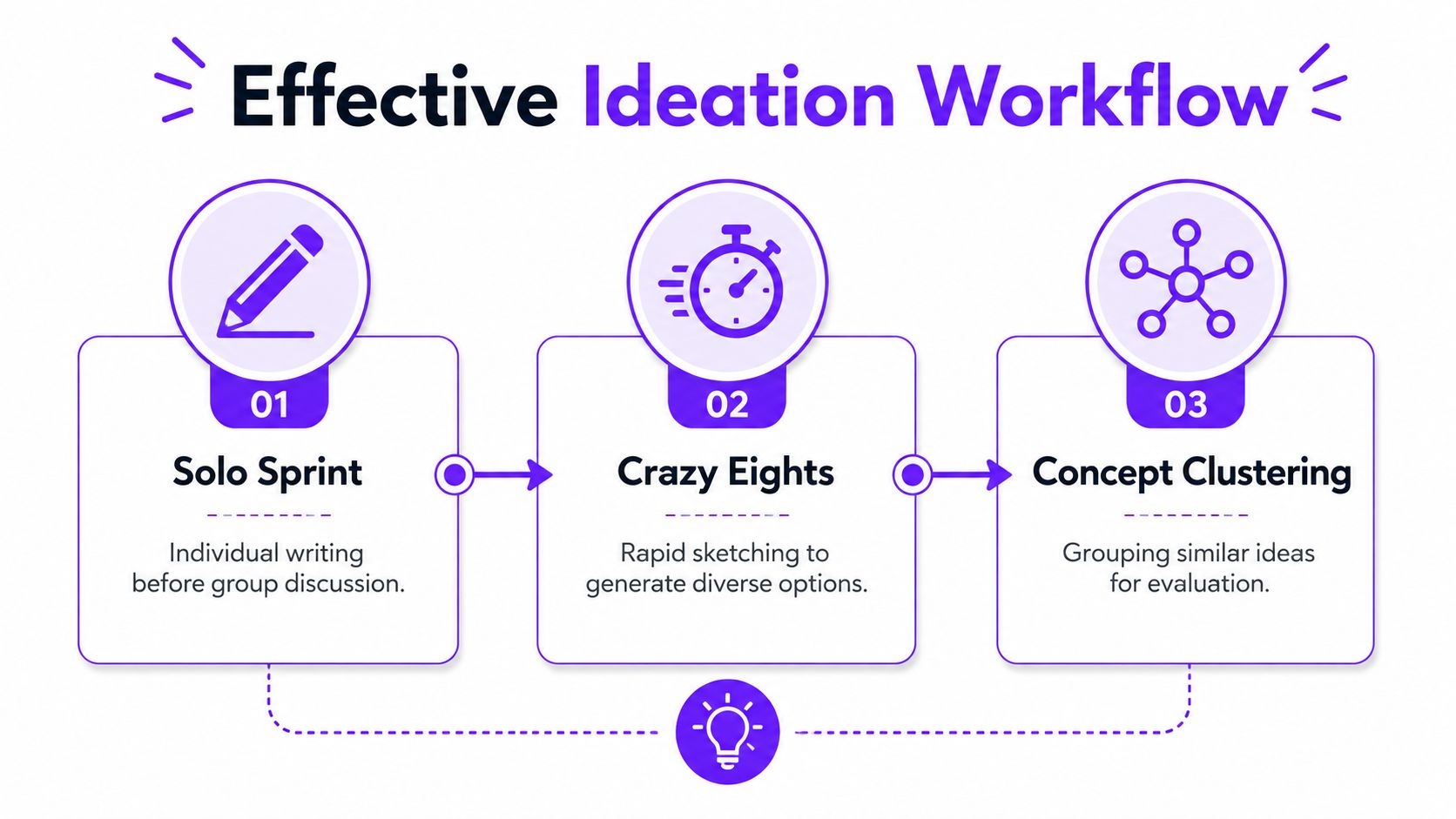
Begin with a solo writing sprint
Give each participant the same challenge and insight. Ask them to write without discussion:
“Find a way for the brand to make the audience's contradiction visible, then resolve it in a way competitors can't easily copy.”
A short, silent sprint works because junior team members aren't competing with the first confident answer, and senior people aren't unconsciously anchoring the room. Collect responses anonymously before anyone advocates for an idea.
Guardrail: No evaluation during generation. Mark unclear ideas for later, but don't kill them because they sound rough.
Use forced perspective to break habits
Category conventions survive because teams approach the problem from the same angle. Assign each person a perspective that changes the source of the idea:
- The skeptic: What would make the audience reject the category's normal promise?
- The antagonist: What does the brand oppose or refuse to accept?
- The participant: What could the audience do, rather than merely watch?
- The outsider: How would a person from another category solve this problem?
Ask participants to produce a concept from the assigned perspective, not a polished headline.
Guardrail: The perspective must alter the strategic premise. A new tone applied to the same old idea doesn't count as a new concept.
Teams using AI can ask for expansions after human thinking has established a direction. For example:
“Take this human insight and develop distinct campaign territories based on ritual, reversal, participation, and proof. Explain the strategic premise of each territory. Avoid familiar category language and don't write taglines yet.”
AI is useful for exploring permutations, counterarguments, and adjacent frames. It shouldn't decide which direction is original, credible, or appropriate for the brand. Those decisions require context and accountability.
This is also where a structured platform such as Algomizer custom marketing may help teams organize content and audience thinking around a more personalized approach rather than defaulting to generic output.
Cluster by premise, not wording
After generation, group ideas that share the same underlying thought. Ten headlines may represent one concept. Three rough sketches may represent three distinct territories.
Use a simple label for each cluster:
- The human tension it addresses.
- The brand role it gives the client.
- The behavior it could create.
- The reason it differs from the other clusters.
A brainstorming session template can help facilitators keep those stages separate. The facilitator's job isn't to reward the most polished contribution. It's to protect independent thinking long enough for the team to compare premises fairly.
The workflow should leave the room with a small set of territories, not a crowded document of near-duplicates.
A short visual explanation of structured ideation can help teams align before they run the session:
Frame the Concept and Stress-Test the Message
A promising idea becomes a usable concept when the team can describe its audience, promise, proof, and personality without hiding behind a slogan.
Use a concept statement with four parts:
Audience: Who is this for, in a specific situation?
Promise: What will the audience understand, feel, or do?
Proof: What makes the promise credible?
Personality: What tone or behavior makes the concept recognizable?
For example, a fictional home energy brand might develop this concept:
For homeowners who feel that energy choices are complicated and opaque, the brand turns everyday usage into clear, manageable decisions. It proves the promise through transparent tools and plain-language guidance, with a calm, practical personality.
That statement has more value than “Make energy simple.” It gives creative teams a problem, a role, evidence, and a tone.
Score the work against the assignment
Use a rubric before the team falls in love with presentation quality. Scores aren't a substitute for judgment, but they expose where judgment is coming from.
| Criterion | What to Look For | Score 1-5 |
|---|---|---|
| Audience relevance | The idea addresses a real tension for a defined audience | 1-5 |
| Brand fit | The brand has a credible, ownable role | 1-5 |
| Distinctiveness | The premise differs from familiar category approaches | 1-5 |
| Generative power | The idea can create varied executions and messages | 1-5 |
| Proof | The concept rests on evidence, not aspiration alone | 1-5 |
| Feasibility | The team can deliver it within known constraints | 1-5 |
Don't average away a fatal weakness. A concept with strong craft but poor brand fit shouldn't survive because other scores are attractive.
Apply the differentiation test
The most useful test is not “Does this feel fresh to us?” It's “What would a neutral outsider recognize as familiar?”
Run the concept through three comparisons:
- Category replacement: Remove the brand name. Could a competitor use the same idea with minor changes?
- Execution removal: Ignore the film, visual style, or headline. Is the underlying premise still distinctive?
- Language removal: Replace the polished wording with plain language. Does the idea still have a different point of view?
A concept fails when its freshness depends on craft alone. “We help you live better” may look beautiful, but the strategic premise is interchangeable. A concept survives when the brand's role changes the story. In the energy example, turning invisible usage into understandable decisions gives the brand a specific job that can support tools, content, service, and campaign work.
Kill early, without drama
Write a one-sentence reason for rejecting every concept:
- “Relevant, but category-typical.”
- “Distinctive, but the brand has no proof.”
- “Strong promise, but no clear audience tension.”
- “Interesting execution, weak platform.”
That record protects the team from reviving discarded ideas during client pressure. It also makes revisions more productive because the team knows which component needs repair.
Validate Quickly Before You Spend on Production
Validation shouldn't turn concept development into a long research program. Its purpose is narrower: identify assumptions that could make the idea fail before producers, designers, writers, and media teams invest heavily.
Start with an internal reaction read. Show the concept statement and a rough expression, not a fully designed execution. Ask each person to answer privately:
- What do you think this idea is saying?
- Who do you think it's for?
- What makes it believable?
- What feels familiar or confusing?
- What would make you remember it?
Collect answers before discussion. A senior stakeholder's immediate interpretation shouldn't erase several quieter signals.
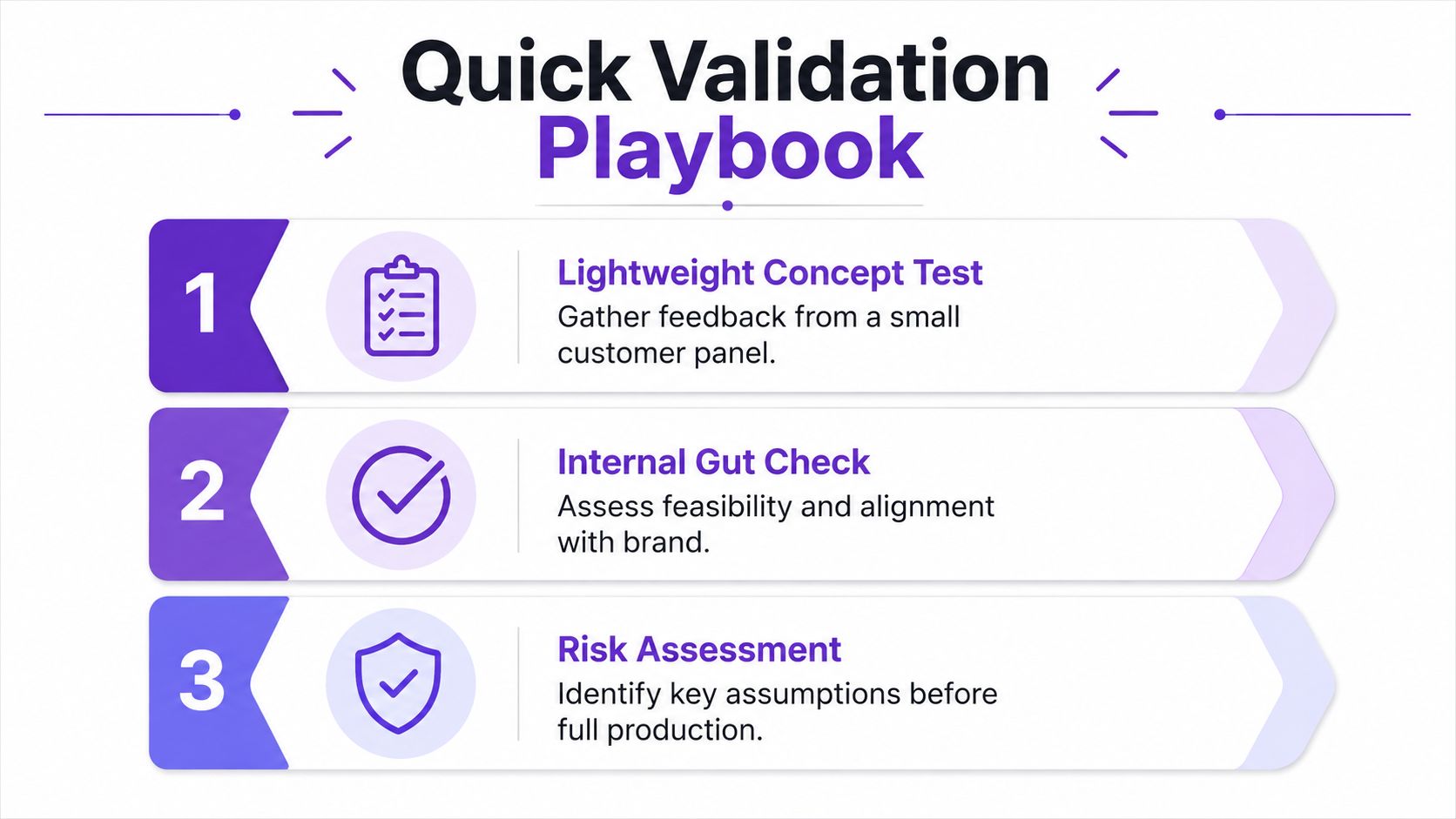
Test the idea with the right people
Use a small customer panel that matches the audience situation, not merely the brand's broad customer file. Keep the conversation focused on interpretation and relevance rather than asking whether people “like” the concept.
A useful script is:
“Tell me what you think this brand is offering here. What part feels made for someone like you? What would you need to believe before acting on it?”
Follow with a comparison question:
“What other brands or messages does this remind you of?”
That last question reveals sameness better than a direct originality rating. People may call an idea new because the presentation is new. Comparisons expose the category associations underneath.
Separate signals from preferences
Feedback becomes dangerous when the loudest person turns a personal preference into a strategic diagnosis. Record comments under three headings:
- Comprehension: People don't understand the premise.
- Relevance: They understand it, but it doesn't matter to them.
- Credibility: They see the value, but don't believe the brand can deliver it.
“I don't like the color” is an execution preference. “I don't know why this brand is involved” is a concept problem.
A practical guide to concept testing methods can help teams choose an appropriate lightweight approach. The decision rule should stay explicit: ship when the audience understands the idea, the intended audience recognizes its relevance, and the brand's role feels credible. Revise when one of those conditions fails. Reject when the concept remains interchangeable after the team has removed executional polish.
Hand Off to Production Without Losing the Idea
Many concepts don't fail in strategy. They fade during handoff. The original insight gets shortened into a line, the proof disappears from the production brief, and a series of reasonable client revisions turns a distinctive premise into familiar advertising.
Treat handoff as a protection ritual, not an administrative task.
Give production a decision spine
The handoff document should contain the concept statement, the audience tension, the brand role, the proof, and the essential distinction. Add examples of what the idea is and isn't. A producer needs enough clarity to make practical choices when a location, casting option, edit, format, or budget constraint forces a trade-off.
The creative director and strategist should also identify the sacred element. It might be the reversal in the story, the audience participation mechanic, the unusual proof point, or the brand's specific point of view. If that element disappears, the work may still look good, but it isn't the same concept.
For product teams, the same discipline applies to writing product requirements. Requirements should preserve the user problem and intended outcome, not merely describe a list of outputs.
Make revision answerable
When a client asks for a change, classify it before editing:
- Clarification: The idea is sound but needs clearer expression.
- Constraint: A legal, channel, budget, or production requirement changes the execution.
- Strategic revision: The audience, promise, or brand role has changed.
- Preference: The request reflects taste without improving the concept.
The first two may be normal refinement. The third requires a new strategic decision. The fourth deserves a question, not automatic compliance.
Teams can make this repeatable through a short concept review at every major milestone. Ask whether the audience tension remains visible, whether the brand still has a meaningful role, and whether the work remains recognizably different from category defaults.
AI can expand options, summarize input, and surface alternative angles. It can also increase sameness when teams accept the first fluent answer. Use it after the brief and insight are clear, then require a human explanation of why the selected concept deserves to survive.
A platform such as Bulby can support structured brainstorming with anonymous submissions, AI-generated sparks, and a summary report that organizes promising ideas and suggested next actions. That makes it one possible aid for teams that want to move from scattered contributions to a clearer concept review, but the final differentiation judgment still belongs to the team.
If your agency needs a more disciplined path from raw thinking to client-ready concepts, Bulby provides guided brainstorming exercises, anonymous input, AI-assisted idea expansion, and summary reports with next steps. Visit Bulby to give your next marketing concept development session a clearer structure and a stronger decision process.