
You've got a room full of sharp people, a deadline that's getting uncomfortably close, and three campaign directions that all sound good in the moment. One is funny, one is elegant, and one feels “different,” but nobody can say which one is the right answer for the client's business problem. That's usually where creative strategy starts to matter.
It's the part of the process that stops a team from mistaking polished ideas for useful ones. In agencies, that distinction shows up fast, because the work can look clever in a deck and still miss the audience, the objective, or the channel it needs to live in.
Table of Contents
- The Moment a Good Idea Is Not Enough
- Defining Creative Strategy Without the Jargon
- The Core Components Every Creative Strategy Needs
- Creative Strategy Versus the Strategies Around It
- How Agencies Build a Creative Strategy Step by Step
- Measuring, Learning, and Bringing AI Into the Room
- Two Mini-Cases That Show the Difference
The Moment a Good Idea Is Not Enough
A team can spend two weeks building a concept everyone in the room likes. The headlines are smart, the art direction is clean, and the client smiles during the presentation. Then the campaign goes live, and the numbers don't move.
That failure usually doesn't come from a lack of talent. It comes from a lack of decision discipline. Someone generated ideas, but nobody forced the team to answer the harder questions, like who the work is for, what response it should trigger, and what tradeoffs the concept makes to stay focused.
I've seen this in pitch rooms where every idea tries to impress at once. One line is witty, one visual is beautiful, and one execution is trying to be a social stunt, but the campaign has no center of gravity. The result is entertainment that doesn't accumulate into a message.
Practical rule: if your team can't explain why one idea wins over another in plain language, you probably don't have a strategy yet, you have a preference.
That's why the strongest teams treat creative strategy as a filtering system. It narrows the field before production starts, so the work that survives has a clear job to do. If you want a useful way to think about idea validation, the logic in this idea validation process is close to what strong strategy teams do before they spend serious money.
The promise of creative strategy is simple. It turns creative instinct into a repeatable decision process, so the right idea is easier to recognize and the wrong one is easier to kill.
Defining Creative Strategy Without the Jargon
creative strategy is the decision system that turns a brand's positioning into a specific communication approach. It defines what the work should say, who it should speak to, what response it should aim for, and which execution style is most likely to carry the message with force.
Positioning decides what the brand stands for. Creative strategy decides how a specific campaign expresses that position, to whom, and toward what response. A brand can stand for reliability, for example, but the campaign still has to choose whether to express that through proof, tone, imagery, or a particular call to action.
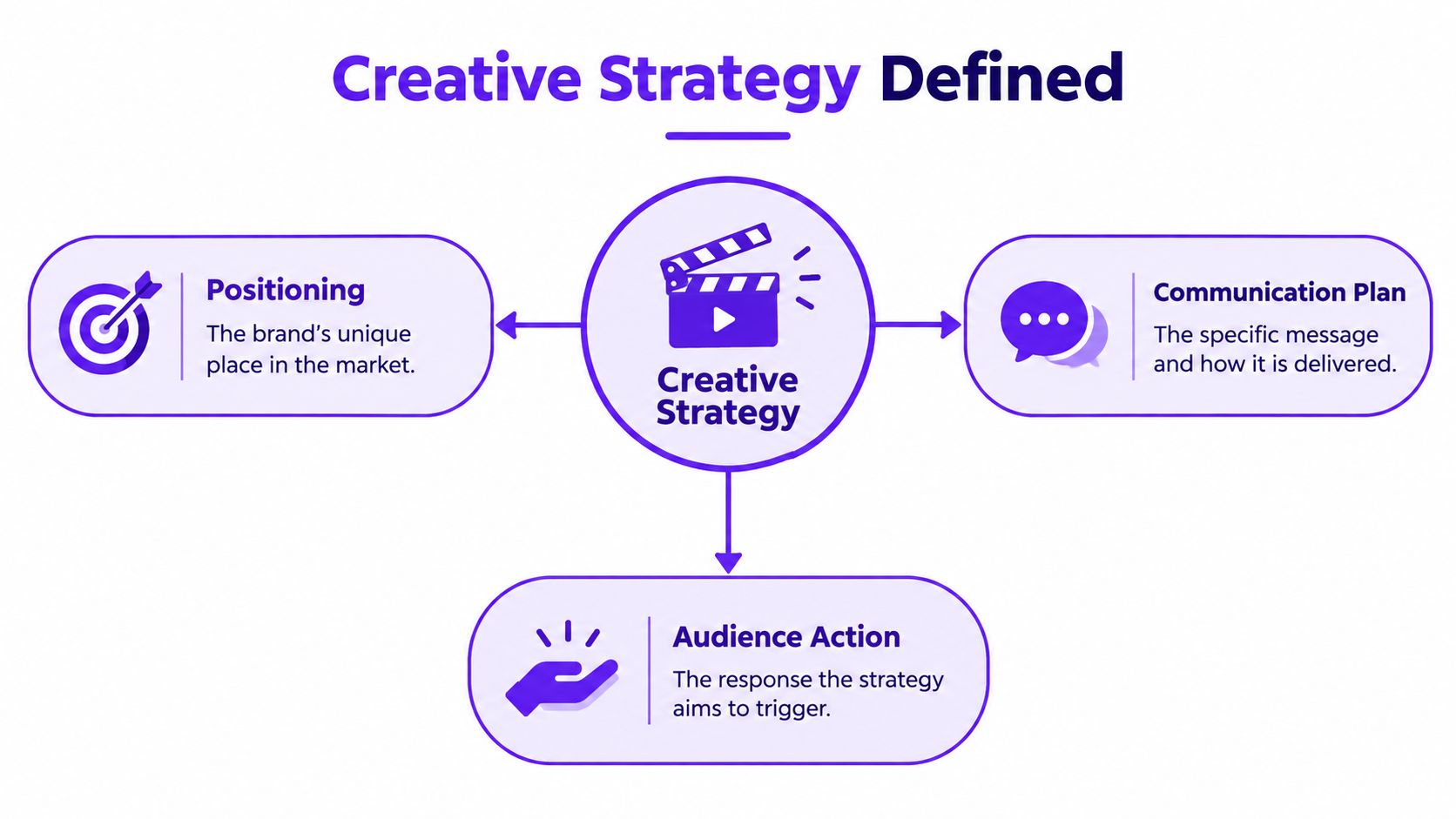
A useful way to separate the pieces is simple. Creativity generates options, and strategy decides which option deserves to become the work. That choice is not just about taste. It weighs audience fit, business intent, and whether the idea can hold up once it meets the market.
Seen that way, creative strategy works like a filter. In an agency setting, one concept may be witty, another visually polished, and a third easy to produce, but only one may connect the insight, message, and response cleanly enough to justify the budget. That is why structured brainstorming tools such as Bulby can help teams collect scattered input, compare directions, and move toward defensible creative choices instead of a pile of attractive possibilities.
Historically, this way of thinking developed as advertising moved from product description toward brand meaning, and the 1960s Creative Revolution pushed copy and art direction into a more integrated practice. If you want a broader planning frame, browse the content strategy guide offers a useful adjacent reference. For a tighter comparison with language decisions, what messaging strategy is helps separate the wording system from the wider creative plan.
A clean working definition is this, creative strategy is the structured decision system that turns business intent and audience insight into a distinctive communication approach. It gives the team a basis for choosing the work that should go forward.
The Core Components Every Creative Strategy Needs
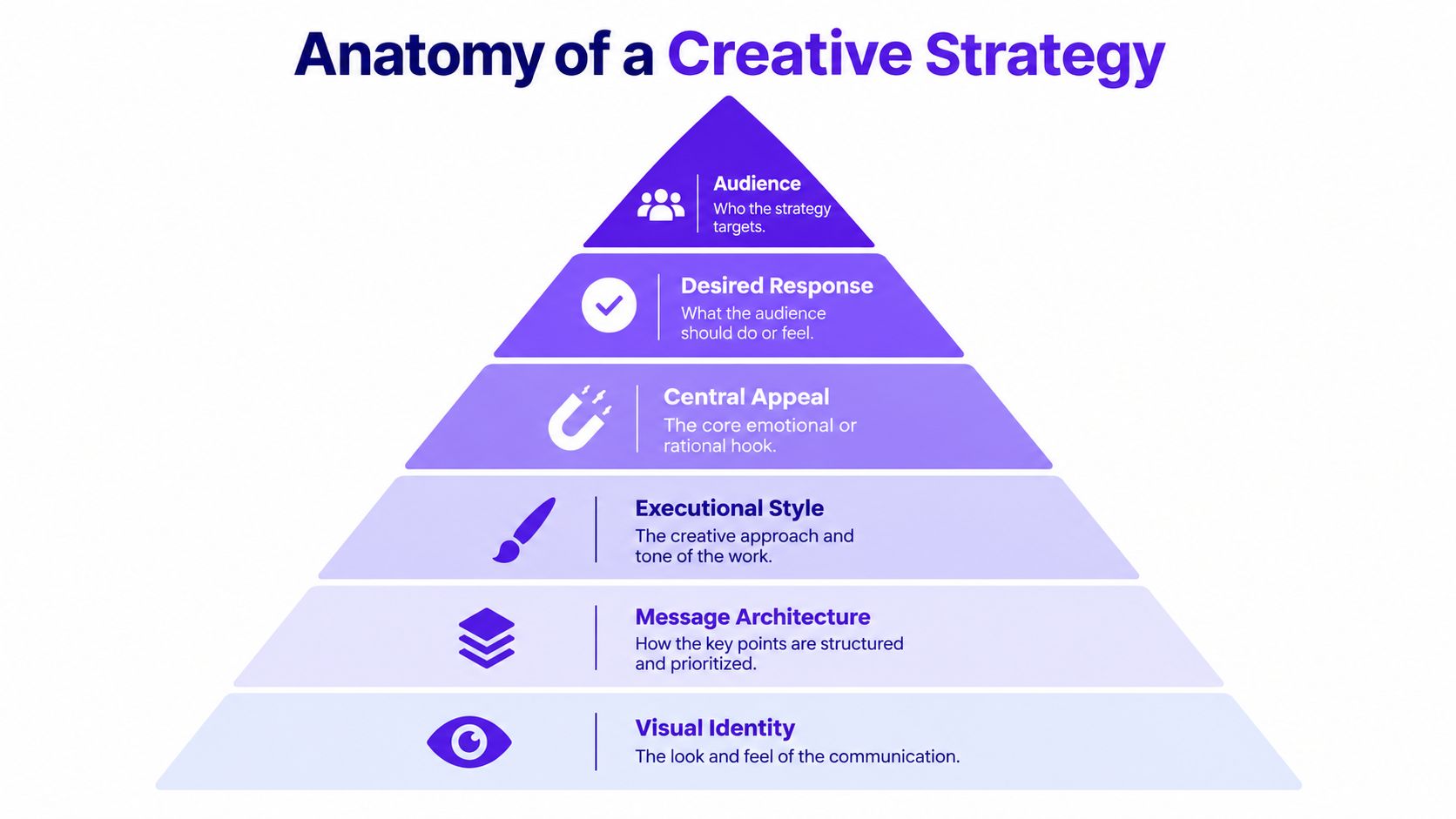
A good creative strategy answers a set of concrete questions before anyone opens Figma, writes copy, or briefs production. Each answer narrows the work in a useful way. Leave one out, and the team starts improvising in the wrong places.
The choices that shape the work
The first decision is audience. Not “everyone who might buy,” but the specific group whose mindset, tension, or moment makes the message relevant. If the audience definition is vague, the concept drifts toward generality.
Next comes desired response. That might be a click, a trial, a memory shift, a change in perception, or a purchase. If the team can't name the response, it can't judge whether the idea is working.
Then there's the central appeal, the single reason the audience should care. Some campaigns lead with rational proof, others with emotion, humor, status, belonging, or relief. The point is to choose one main hook and not ask the idea to do five jobs at once.
Executional style is where many teams confuse taste with strategy. Humor, storytelling, demonstration, or visual metaphor are not decoration, they're delivery choices. They shape how the message lands and what kind of attention it earns.
Message architecture decides the order of the argument. What comes first, what gets repeated, and what gets left out? A campaign without architecture often feels clever but slippery, because no one knows what should stick.
Finally, visual identity gives the strategy a recognizable form. If the tone, layout, and style don't support the same promise, the work feels disconnected even when the words are right.
A strategist can use this compact reference table to pressure-test a concept before production.
| Core Component | What It Decides | Typical Output |
|---|---|---|
| Audience | Who the work is for | Audience profile, segment note |
| Desired response | What should change | Objective statement, success signal |
| Central appeal | Why the audience should care | Single-minded proposition |
| Executional style | How the idea is expressed | Tone and format direction |
| Message architecture | What comes first and what follows | Key message hierarchy |
| Visual identity | How the work looks and feels | Visual rules, mood direction |
The simplest test is this. If you remove one component and the concept still feels complete, that component probably wasn't doing enough strategic work.
Creative Strategy Versus the Strategies Around It
Creative strategy is often confused with brand strategy, marketing strategy, and the creative brief because all four shape the same campaign. Their jobs differ, and separating them prevents teams from solving the wrong problem.
Brand strategy fixes what the brand stands for over time. Marketing strategy fixes how the business reaches its market and chooses channels. Creative strategy fixes what a specific campaign says, why the audience should care, and how the message should land. The creative brief records those decisions for the people producing the work.
| Strategy Type | What It Answers | Typical Time Horizon | Main Output |
|---|---|---|---|
| Brand strategy | Who are we, and what do we stand for? | Long term | Positioning, values, brand platform |
| Marketing strategy | How do we reach the market? | Quarter to year | Channels, audience plan, budget logic |
| Creative strategy | What idea will make people feel and act? | Campaign or brief level | Insight, promise, execution direction |
| Creative brief | What must the team build? | Production phase | Instructions, constraints, deliverables |
The distinction becomes practical when a campaign feels wrong. A weak brand promise is a brand-strategy problem. A poor route to the audience belongs to marketing strategy. A message that lacks relevance or a clear response belongs to creative strategy. Confusing these levels turns a useful diagnosis into a vague debate about taste.
Creative strategy translates the business direction into a message system that can work across ads, landing pages, social posts, or video. It should make choices visible: which audience matters, which promise leads, and which execution gives that promise the best chance of being understood. Structured brainstorming tools such as Bulby can help teams organize scattered input before selecting and defending those choices.
The brief then compresses the agreed decisions into usable production guidance. It should state the task, constraints, audience, and deliverables clearly. It does not invent the concept, and it cannot compensate for unclear strategy. If the brief tries to perform the strategist's job, production receives vague language instead of decisions, and late-stage arguments become more likely.
The strongest teams keep the layers distinct long enough to make each one useful, then connect them tightly enough that the work stays coherent.
That distinction gives an agency a practical diagnostic. When a client says the campaign feels off, ask whether the issue is the brand promise, the market route, the creative idea, or the brief that translated it. Each answer points to a different fix.
How Agencies Build a Creative Strategy Step by Step
Strong agencies don't treat creative strategy like a waterfall where one neat phase ends and the next begins. It behaves more like a sequence of decisions that keep getting sharpened. The later insights should change the earlier assumptions, especially after testing or production reveals what the room missed.
A useful starting point is to frame the business problem precisely. “We need awareness” is too soft. “We need hesitant buyers to see the brand as the safer choice” is closer to a decision problem, because it points toward a response and a message.
The next move is to pressure-test the audience insight. Good insights feel specific enough to be slightly uncomfortable. If the insight sounds like a generic demographic fact, it won't guide the idea very well.
The team then chooses a central promise. This is the one thing the campaign wants to own in the audience's head. If the promise sounds like three promises merged into one, the concept will probably splinter later.
The executional approach comes next. Here the team decides whether the work should feel like a demonstration, a story, a joke, a comparison, or a visual metaphor. That choice matters because a good idea can die in the wrong format.
After that, the team writes the creative strategy statement and translates it into the brief. At that point, the brief should feel like a disciplined compression of the thinking, not a bloated document.
A good production partner still has to stay involved. If you're mapping the handoff to the content production process, the strategy should remain visible inside it, not disappear after approval. The same logic applies if your team uses a formal campaign development process, because the strategy should keep steering the work after the first concept is chosen.
Here is the practical sequence teams can follow:
- Frame the business problem. Ask what has to change, not just what has to be made.
- Interrogate the audience insight. Look for the tension that makes the audience reachable.
- Choose the central promise. Decide what the work must stand for.
- Set the executional territory. Pick the style that best carries the idea.
- Translate it into a brief. Reduce the strategy to usable constraints.
- Pressure-test again. Use research, review, or stakeholder feedback to catch drift early.
The process only works if the later stages can send you back to revise the earlier ones. Strategy that can't change after testing is just paperwork.
Measuring, Learning, and Bringing AI Into the Room
A campaign can look successful in a presentation and still teach the team very little. Creative strategy becomes more useful when measurement works like a feedback system: each signal answers a different question, and each answer informs the next decision.
Attention shows whether the work gets noticed. Comprehension shows whether people understand the message. Emotional response indicates whether it creates a feeling. Brand linkage tests whether that feeling connects to the brand, rather than to an interesting image or phrase alone. Conversion shows whether the work changes behavior.
These measures should not be flattened into one score. A bold concept may win attention while leaving weak brand memory. A quieter idea may create stronger linkage and better commercial results. Diagnostic signals help explain why an execution performs; success signals show whether it achieved the campaign's objective. Keeping those roles separate makes creative choices easier to defend.
A useful review asks one question per signal. Does the hook stop people? Is the message clear? Does the idea perform brand work, rather than merely produce content? Does the response support the intended stage of the funnel? The answers help a team refine the work instead of arguing from personal taste.
AI can speed analysis and production, but people still decide what the findings mean. The AI marketing research report reports that 43% of companies use AI to evaluate creative elements such as visuals and messaging, while 47% use AI in content creation. It also reports that 90% of marketers want agile production paired with intelligent data, while 76% say creating content quickly remains a barrier to effective personalization. The pattern is clear: faster output does not resolve an unclear promise or a weak audience insight. If you are mapping where AI fits into planning, this guide to AI for marketing strategy shows how it can support the learning loop.
Human judgment remains part of the system. According to the CMO Survey, 87% of leaders said future marketing strategies will require more human creativity and empathy, while 78% said generative AI will not replace human imagination. AI can generate routes, compare variations, and surface patterns. Teams still judge taste, context, cultural fit, and whether an idea deserves to represent the brand.
Bulby supports that judgment by giving brainstorming a defined structure. It guides groups through challenges, generation, and refinement, turning scattered input into ideas that can be compared against agreed criteria. Used properly, it does not replace creative thinking. It gives the team a clearer decision trail, so the chosen direction rests on reasoning rather than the loudest hunch in the room.
Two Mini-Cases That Show the Difference
A DTC skincare brand once built campaign after campaign around novelty. Every launch tried to outdo the last one with a new visual hook, a louder headline, or a more playful tone. The team enjoyed the work, but the message kept shifting, so the audience never got a stable reason to care.
A competitor took a narrower route. Its creative strategy stayed consistent, the promise was clearer, and each execution reinforced the same point of view. The work wasn't louder, but it was easier to remember because the idea did one job well.
Takeaway: a tighter strategy often beats a more inventive pile of concepts, because consistency builds recognition faster than novelty alone.
A B2B SaaS agency ran structured brainstorming sessions with explicit scoring against strategic criteria. Instead of debating whichever concept sounded cleverest in the room, the team compared ideas on audience fit, message clarity, and executional feasibility. The final set of concepts was smaller, but it was easier to brief, easier to defend, and more likely to support pipeline goals.
That team also used the output to write a sharper campaign message example for stakeholders, which made the logic easier to transfer into production. The key wasn't the number of ideas. It was the quality of the decisions behind them.
Takeaway: structured brainstorming doesn't reduce creativity, it reduces noise, which gives the best idea a fairer shot.
If your team needs to move from scattered brainstorming to decisions you can defend, Bulby gives you a structured way to do it. It helps agencies and brand teams turn raw input into clearer campaign directions, which is exactly what creative strategy asks for. Visit Bulby to see how it can support your next strategy session.