
A team can have strong campaign concepts and still lose time because nobody agrees on what to call the work. The pitch is tomorrow, the planning session is starting, or the launch brief is already circulating, yet the naming discussion keeps drifting between clever phrases, internal jargon, and names that sound interchangeable.
The strongest campaign name ideas do more than sound good. They signal the audience, objective, tone, and next action. A name built for a client pitch won't necessarily work as an internal campaign label, and a memorable public-facing idea may be a poor choice for reporting or cross-channel coordination.
Use the directions below by starting with the strategic job the name must do. Then adapt the examples with your team. Test each option for clarity, distinctiveness, proof, audience fit, and execution potential. A useful name should give the team something to build, not just something to applaud in a meeting.
Table of Contents
- 1. Spark and Strategy for Collaborative Creativity
- 2. BrainBoost for AI-Powered Ideation
- 3. Beyond the Obvious for Predictable Thinking
- 4. Pitch Perfect for Ideas That Win Attention
- 5. Collaboration Catalyst for Smarter Team Thinking
- 6. Idea Velocity from Concept to Campaign
- 7. Creative Confidence for Research-Backed Ideas
- 8. No Bad Ideas for Bias-Free Brainstorming
- 9. Strategic Simplicity for Complexity Made Clear
- 10. Thought Leadership Accelerator for Positioning and Ideas
- Top 10 Campaign Name Ideas Comparison
- Turn One Strong Direction Into a Naming System
1. Spark and Strategy for Collaborative Creativity
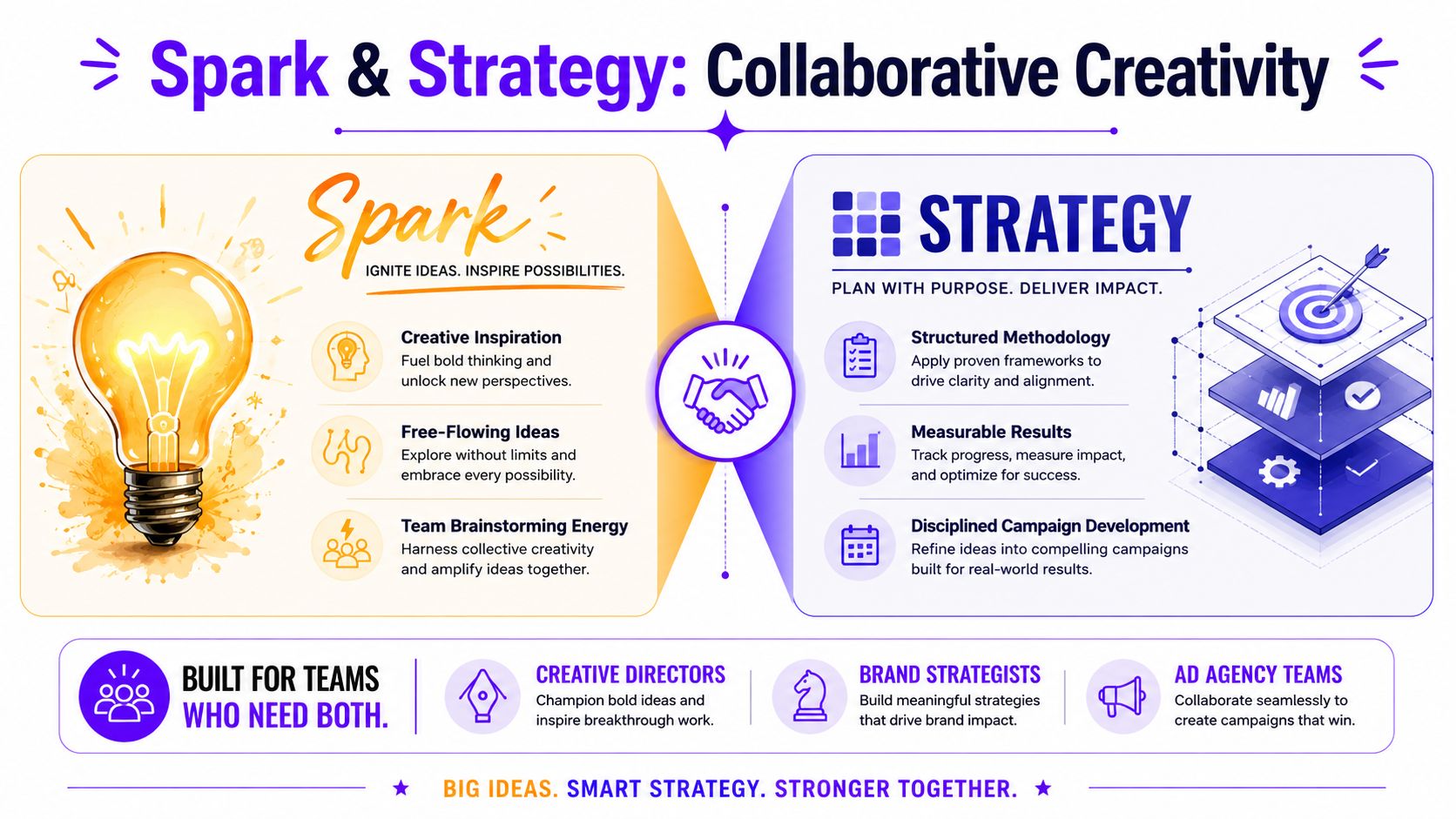
Spark and Strategy works when your campaign needs to connect imaginative thinking with a disciplined route to execution. “Spark” gives the name energy and emotional appeal. “Strategy” reassures clients and internal stakeholders that the idea won't disappear into an unstructured brainstorm.
The direction sits between inspirational language and practical planning. It can suit a campaign for a creative platform, an agency workshop, or a brand initiative that helps teams move from loose possibilities to a focused concept. Think Different and Think with Google show how thinking-led language can frame creativity as an active business behavior, not decoration.
How to put it to work
Use a visual system where a burst of light flows into a grid, framework, or campaign map. In a pitch, show the transformation from a messy wall of ideas to a concise concept, but don't imply that creativity is valuable only after it becomes tidy.
- Audience: Creative and strategy teams that need a shared working language.
- Objective: Make structured ideation feel energizing rather than restrictive.
- Prompt: “What unexpected idea could solve this brief, and what evidence would make it usable?”
- Risk: “Spark” can sound vague if the campaign never explains what the team does.
A split-screen presentation can help. One side shows raw possibilities, while the other shows the chosen direction, audience, message, and next action. For practical collaboration guidance, teams can also use these creative team collaboration principles.
2. BrainBoost for AI-Powered Ideation
A pitch team facing repeated briefs and a short deadline needs more than another list of ideas. BrainBoost positions AI as a creative accelerator, helping the team widen the starting point before it sorts and shapes the strongest direction.
The name promises momentum, so the campaign must show the work behind that promise. Demonstrate how people compare options, apply context, refine language, and make the final call. AI can guide the process, while creative judgment remains with the team. Taste, experience, and knowledge of the audience still determine which route deserves development.
Adobe Firefly, Grammarly's AI writing positioning, and HubSpot's AI-powered marketing language show how functional technology descriptions can become campaign platforms. Each connects a tool to a recognizable user benefit rather than presenting the technology alone.
Use a brief demonstration as the campaign's proof point. Begin with a brief, generate several directions, apply clear filters, and show the team selecting one route. A process comparison gives the audience something concrete to assess. Avoid promising that every team will work faster.
Best audience: Agencies preparing pitches or handling parallel client work.
Useful message: AI expands the starting point, while the team owns the decision.
Refinement prompt: “Which part of this idea needs human judgment that automation can't provide?”
Risk: “Boost” may sound like a generic productivity claim when the workflow is not visible.
The execution can show a before-and-after sequence: an unstructured brief, several AI-assisted routes, then the chosen concept with its audience, message, and next action. That sequence clarifies what the name means without presenting automation as the whole creative process.
For a naming session, use an external AI naming tool for campaign directions to generate inputs, then judge each suggestion against the brief instead of accepting the first appealing option.

Teams examining technology's role in ideation can use this guide to AI-generated ideas to frame the discussion around collaboration, judgment, and execution.
3. Beyond the Obvious for Predictable Thinking
A team reaches for the same category phrase, rejects anything unfamiliar, and leaves with a safe campaign name. Beyond the Obvious gives that team a clear strategic job: challenge predictable thinking while keeping the final direction relevant to its audience and usable across media, design, and messaging.
The name signals a deliberate break from familiar references and consensus. That process needs structure. A review from The Conference Board on group brainstorming research found little evidence that interactive brainstorming produces more or better ideas than the same number of people working independently. The review also found that idea output plateaus above six or seven group members, while productivity per person falls as the group grows.
Run the session in two stages: ask each participant to write routes independently, then bring the options together for comparison and development. This protects unusual ideas from early social pressure and gives the group a stronger basis for choosing.
Practical rule: Separate generation from evaluation. Do not ask the room to invent and judge simultaneously.
Build contrast into the campaign
Apple's “Think Different” used a concise invitation to challenge category expectations. Old Spice created an unusual brand world that disrupted familiar assumptions about personal care. Those examples show two possible routes, but neither should be copied automatically. Start by naming the expected category phrase, then move away from it with a reason tied to the customer or campaign objective.
Use these prompts during refinement:
- “What would this sound like without category conventions?”
- “Which obvious metaphor should we reject?”
- “What might a skeptical customer find unexpectedly surprising?”
The risk is novelty without a clear audience, purpose, or execution path. Apply these lateral thinking techniques to expand the options, then test each name against the brief and its planned channels.
4. Pitch Perfect for Ideas That Win Attention
A client presentation is approaching, the brief is crowded, and the team needs one idea that people can repeat after the meeting. Pitch Perfect suits that pressure point. It frames naming as a presentation tool, while leaving room for the harder work of proving why the campaign deserves approval.
The strategic job is to make the direction presentable, defensible, and easy to remember. Use the name as a thread connecting the audience insight, creative platform, channel choices, and next action. Salesforce's direct “No. 1 CRM for Sales” positioning shows how a claim can establish a competitive frame. Figma's “Design the future” language demonstrates how an aspirational outcome can give a pitch room to expand.
Build the pitch around three questions:
- Insight: Which audience tension does the name capture?
- Evidence: What research, observation, or customer input supports it?
- Expansion: Can the direction become a headline, visual system, activation, or content series?
Give every presenter the same one-sentence explanation. Then test the name aloud with a strategist, creative director, and account lead. If each person explains a different idea, the name needs sharper boundaries.
The main risk is promising an outcome the team cannot substantiate. Keep Pitch Perfect as an internal working label if needed, and make the client-facing name express the customer's problem or desired change. Ask: “What would make this credible to a skeptical buyer?” and “Which execution proves the idea fastest?”
Review these campaign design examples to check whether the direction can support more than a title slide. Use a team campaign planning guide to connect the idea with owners, timing, and delivery choices.
5. Collaboration Catalyst for Smarter Team Thinking
Collaboration Catalyst fits campaigns designed to bring strategists, creatives, account teams, media specialists, and clients into one working process. Its strategic job is to improve participation without creating more meetings. The name becomes credible when the execution shows how people contribute, compare evidence, and make decisions.
Microsoft Teams' “Work together, work from anywhere,” Miro's “the infinite canvas for work that matters,” and Mural's collaborative positioning make participation part of their identity. Apply the same principle to the campaign by showing what changes in the room. Junior contributors might receive a clearer route to submit ideas. Strategists and creatives might assess the same audience evidence. The team should also be able to trace how a selected idea developed.
Set the process before opening discussion. Ask participants to submit ideas privately, then bring the options into a shared review. Speakwise's review of brainstorming statistics summarizes research suggesting that writing ideas before discussion can produce more ideas and more original ideas than verbal brainstorming alone. Treat that finding as a process choice, not a guarantee.
Use these checks to refine the direction:
- Audience: Cross-functional teams where participation is uneven.
- Objective: Make contributions visible and reduce reliance on the loudest voice.
- Prompt: “What would you suggest if nobody could see your name beside the idea?”
- Risk: “Collaboration” may sound vague unless the campaign demonstrates a clear working method.
A shared idea board, recorded rationale, and named decision owner give the concept practical shape. The collaborative idea management practices can help connect open participation with accountable choices. Before approval, ask, “Which part of this process makes better thinking possible?” and “What would stop a quieter contributor from joining?”

6. Idea Velocity from Concept to Campaign
A campaign team has a promising brief, several name directions, and a deadline approaching. Idea Velocity gives that situation a clear strategic job: move from concept to campaign without sacrificing the creative tension that made the idea worth pursuing. It suits agencies and in-house teams managing demanding schedules, provided “speed” means clearer progress rather than rushed output.
The working method should make each transition visible:
- Brief: Define the audience, business objective, and constraint.
- Generation: Create independent name directions before debate narrows the field.
- Selection: Score candidates against agreed criteria and assign a decision owner.
- Expansion: Test the chosen name across messages, visuals, and channel executions.
- Handoff: Record the final rationale and naming convention for delivery teams.
Asana's “Work on what matters,” Monday.com's “Work OS,” and Jira's focus on project velocity show how operational language can make progress visible. Apply that principle to naming by tracking open decisions, not just the number of ideas in a document. A shared sprint worksheet can connect each naming stage to a delivery milestone and expose where work is waiting.
The main risk is that “velocity” sounds like pressure to rush. Pair the name with quality checks, clear ownership, and a prompt such as, “What decision is blocking the next useful step?” Then ask, “What evidence shows this direction can support a full campaign?”
Teams can use this LinkedIn post topic ideas tool to test whether a naming direction generates follow-up content. If it produces only one appealing phrase, return to the brief and strengthen the strategic idea before approval.
7. Creative Confidence for Research-Backed Ideas
A campaign team can pursue an unconventional name without defending it through personal preference alone. Creative Confidence signals that originality has room to develop, while selection rests on evidence the team can explain to clients and stakeholders.
Use a naming scorecard covering memorability, pronunciation, emotional resonance, competitive differentiation, and cultural fit. Naming research guidance from Conveo recommends testing these dimensions with target audiences when a name must work across markets. Adapt the scorecard to the campaign objective: add channel fit for a social launch, or message flexibility when the name needs to support a broader creative system.
Research should inform the decision, not replace it. Audience testing can expose confusion, awkward pronunciation, or unwanted associations. Strategists still need to assess whether each candidate supports the brief, gives the creative team room to build, and can be explained without unsupported claims.
Give the direction a working proof point. Run a workshop in which participants apply SCAMPER, Six Thinking Hats, or lateral thinking to the same brief, then compare the kinds of names each method produces. This turns the campaign into a practical demonstration rather than a vague claim about science.
- Best audience: Strategists and creative leads defending an unconventional route.
- Useful asset: A shortlist scorecard with the reasons each candidate advanced.
- Refinement prompt: “What evidence would raise our confidence, and what would change our mind?”
- Risk: Research language may make the campaign feel academic or slow.
In a client presentation, place the decision logic beside the creative expression. Show what the name means, who it serves, where it works, and which claims the team can support.
8. No Bad Ideas for Bias-Free Brainstorming
No Bad Ideas is memorable because it addresses a familiar fear. People often hold back when a senior person dominates the room, when the first suggestion anchors the discussion, or when participants assume their ideas won't survive public judgment.
The name shouldn't mean that every idea receives equal investment. It means the team creates a fair generation phase before applying rigorous evaluation. That distinction protects the campaign from two opposite problems: dismissing useful early thinking too quickly, or treating every suggestion as equally viable.
Separate safety from selection
Start with an anonymous or silent collection of names. Group similar ideas without ranking them, then apply criteria such as audience relevance, clarity, distinctiveness, and ability to expand across channels. This process gives quieter contributors a route into the work without removing editorial judgment.
Netflix's culture discussions, IDEO's “Never Criticize” brainstorming rule, and Pixar's emphasis on psychological safety are useful reference points for the broader idea that people contribute more freely when the process makes room for expression. Use them as inspiration, not as proof that one rule solves every team dynamic.
- Audience: Cross-functional groups with strong hierarchy or uneven confidence.
- Prompt: “Which idea would we miss if we only listened to the fastest speaker?”
- Risk: The phrase may encourage careless ideas unless the evaluation stage is explicit.
9. Strategic Simplicity for Complexity Made Clear
A campaign called Strategic Simplicity appeals to teams tired of complicated briefs, endless stakeholder edits, and naming discussions that generate more confusion than direction. The name promises focus, but it shouldn't imply that complex work has an effortless solution.
The useful distinction is between simple language and simplistic thinking. A clear campaign name can hold a nuanced strategy if the team explains the audience tension, desired action, and creative territory behind it. Google's “Beautifully simple” design philosophy, Basecamp's “Getting Real,” and Apple's association with simplicity show how concise language can become a broader operating principle.
Turn the name into a decision path
Create a visible route from brief to shortlist:
- Define the person the campaign must reach.
- State the behavior or belief the campaign should influence.
- Choose a tone that fits the brand and context.
- Generate several directions independently.
- Remove names that need a long explanation.
- Test the remaining options in realistic headlines and layouts.
A decision tree can make this process easier for new team members and external partners. The risk is over-compression. If “simple” removes an important audience distinction or makes the campaign generic, clarity has become a constraint rather than a benefit.
Use short walkthrough videos, annotated examples, and plain-language prompts. A team should understand not only which name was chosen, but why the alternatives were rejected.
10. Thought Leadership Accelerator for Positioning and Ideas
Thought Leadership Accelerator suits agencies that want a campaign to strengthen reputation, clarify a point of view, and create material for talks, articles, podcasts, or industry discussion. It supports positioning when the campaign has a useful idea behind it, not just a polished name.
Start with one audience problem and one question the campaign can answer repeatedly. Define a method for developing those answers, then assign formats such as interviews, articles, case studies, or short videos. This gives the name a practical role across the campaign rather than limiting it to a launch headline.
Cannes Lions provides a reference point for creative recognition. Wistia's “Video for the internet” and Mailchimp's “Do Your Thing” show how a concise position can organize broader brand expression. Their lesson is practical: choose language that can guide creative decisions without explaining the entire strategy.
Test the idea beyond the launch
Use these prompts with the team:
- A point of view: What does the campaign argue that competitors frame differently?
- A teaching asset: What can the audience apply after seeing it?
- A conversation: Which question could a strategist, customer, or creative director debate?
- A content system: Can the idea support headlines, visuals, interviews, case material, and follow-up prompts?
- A reputation signal: Does the name reflect the organization clients should want to hire?
The main risk is claiming authority without offering original value. Avoid calling familiar advice thought leadership. Use naming research methods for audience recall and emotional response before launch, then check for confusion with existing campaigns or organizations. Confirm that the name is practical to distribute, search, explain, and adapt across formats.
Top 10 Campaign Name Ideas Comparison
| Campaign Name | Implementation Complexity 🔄 | Resource Requirements ⚡ | Expected Outcomes ⭐📊 | Ideal Use Cases 💡 | Key Advantages ⭐ |
|---|---|---|---|---|---|
| Spark & Strategy: Collaborative Creativity | Moderate 🔄 (align creative + process) | Moderate ⚡ (visuals, case studies, cross-team work) | ⭐📊 Balanced creativity + measurable process; higher engagement | Agencies needing both innovation and structure | Clear value prop; memorable; broad appeal ⭐ |
| BrainBoost: AI-Powered Ideation | Low–Moderate 🔄 (tech demos, safeguard messaging) | High ⚡ (AI demos, analytics, testimonials) | ⭐📊 Faster ideation; measurable productivity gains | Time-constrained teams, innovation units | Strong ROI narrative; modern/tech appeal ⭐ |
| Beyond the Obvious: Breaking Predictable Thinking | Moderate–High 🔄 (thought leadership, bold creative) | Moderate ⚡ (case studies, original content) | ⭐📊 Distinctive, original ideas; stronger differentiation | Award-focused agencies; creative reinvention | Highly differentiated; emotional resonance ⭐ |
| Pitch Perfect: Campaign Ideas That Win | Moderate 🔄 (pitch templates, proof points) | Moderate–High ⚡ (win/loss data, testimonials) | ⭐📊 Higher pitch win rates; measurable business impact | New-business teams; client-facing agencies | Direct revenue tie; easy ROI measurement ⭐ |
| Collaboration Catalyst: Smarter Team Thinking | Moderate 🔄 (org change, facilitation tooling) | Low–Moderate ⚡ (training, diagnostics) | ⭐📊 Improved alignment; increased participation and fairness | Teams with silos; HR/ops-led initiatives | Inclusive culture, reduced friction ⭐ |
| Idea Velocity: From Concept to Campaign | Moderate 🔄 (workflow integration, sprint design) | Moderate ⚡ (time-tracking, integrations) | ⭐📊 Faster time-to-delivery; quantifiable time saved | High-volume projects; tight deadlines | Measurable speed gains; strong ROI story ⭐ |
| Creative Confidence: Research-Backed Ideas | High 🔄 (research, validation, citations) | High ⚡ (white papers, academic partnerships) | ⭐📊 Greater decision confidence; premium positioning | Data-driven agencies; enterprise clients | Trust via evidence; thought leadership ⭐ |
| No Bad Ideas: Bias-Free Brainstorming | Moderate 🔄 (facilitation, bias audits) | Low–Moderate ⚡ (diagnostics, guides) | ⭐📊 More diverse idea sources; perceived fairness | DEI-focused teams; junior-heavy groups | Reduces bias; boosts participation ⭐ |
| Strategic Simplicity: Complexity Made Clear | Low–Moderate 🔄 (process mapping, simplified UX) | Low ⚡ (visuals, checklists, quick-starts) | ⭐📊 Reduced confusion; faster onboarding and decisions | Account teams, junior creatives, client-facing roles | Clarity, easier adoption, lower learning curve ⭐ |
| Thought Leadership Accelerator: Positioning + Ideas | High 🔄 (long-term content & PR strategy) | High ⚡ (awards, PR, case studies) | ⭐📊 Industry recognition; talent attraction over time | Agencies pursuing reputation and awards | Aspirational positioning; attracts top talent ⭐ |
Turn One Strong Direction Into a Naming System
The best campaign name ideas don't stay as isolated phrases on a whiteboard. They become systems that guide the brief, the creative work, the presentation, and the content that follows. Choose the strategic direction that matches the campaign's real job, then remove any promise the team can't support.
Start with the objective. If the campaign needs participation, a collaboration-led name may be more useful than an ambitious thought leadership label. If the campaign must help a team escape category clichés, choose a direction that gives people permission to challenge the expected answer. If the name will appear in internal tools, reports, and platform folders, pair the public-facing concept with a practical naming convention that records the product, objective, date, funnel, audience, and geography. Campaign naming convention guidance highlights the operational value of structured fields and warns against avoidable problems such as special characters, inconsistent case, duplicate-sounding names, and unclear formats.
Then test the name with people who will use it differently. Ask a strategist what it means, a creative what it enables, an account lead how it sounds in a client meeting, and a channel owner how it works in a headline or ad label. Check pronunciation, unwanted associations, cultural meaning, existing campaign similarity, domain availability, and social handles. For advocacy work, campaign naming guidance from Commons Library also emphasizes the balance between memorability, scalability, positive framing, audience fit, and potential confusion with existing organizations.
Use this short exercise in your next session:
- Generate: Ask each participant to produce three variations without discussing them first.
- Sort: Group the names by tone, audience, and objective.
- Filter: Score them for clarity, distinctiveness, audience fit, and execution potential.
- Expand: Turn the strongest options into a headline, visual idea, call to action, and follow-up content prompt.
- Shortlist: Keep the directions that remain clear when separated from the explanation.
Bulby can support this workflow as an AI-powered brainstorming platform for structured, collaborative idea generation. Use it to guide the team from raw options to a focused shortlist, while people remain responsible for context, judgment, validation, and the final decision.
Bulby helps marketing agencies, creative teams, ad agencies, and brand strategists run structured brainstorming sessions for campaign concepts, naming directions, messaging angles, and creative strategies. Visit Bulby to turn your next campaign name session into a clearer path from independent ideas to a collaborative shortlist.