
Inviting more people into a brainstorm isn't an innovation strategy. The useful lesson from successful companies isn't that they invent alone or collaborate constantly. It's that they give collaboration a structure: a clear challenge, a way to contribute, a filter, and someone responsible for what happens next.
Interest in partnerships is strong. In KPMG's survey, 83% of surveyed U.S. business leaders at companies with annual revenue of at least $1 billion planned to expand their partner ecosystems in 2024. But expanding participation and producing something useful are different jobs.
The collaborative innovation examples worth copying reveal how teams connect those jobs. Wikipedia makes revisions visible. LEGO Ideas filters proposals through supporter demand. Netflix defines a measurable challenge. Threadless combines community taste with commercial judgment. P&G looks beyond its own organization, Doritos invites consumers into creative production, Pixar separates critique from authority, and Google Design Sprint time-boxes the journey to a test.
Each approach offers a mechanic you can adapt to a brainstorm, product review, or client workshop. None requires copying the whole organization.
The work is to turn team discussions into executable context: record the reasoning, resolve disagreements, and assign the next move. Start there, rather than with a bigger invitation list.
Table of Contents
- 1. Wikipedia Collaborative Editing
- 2. LEGO Ideas (Fan-Submitted Product Design)
- 3. Netflix Prize
- 4. Threadless Community-Driven Design
- 5. Procter & Gamble Connect + Develop Open Innovation
- 6. Doritos Crash the Super Bowl Consumer Co-Creation
- 7. Pixar Braintrust Story Collaboration
- 8. Google Design Sprint
- 8 Collaborative Innovation Examples at a Glance
- Build Your Own Collaboration Playbook and Put It to Work
1. Wikipedia Collaborative Editing
Wikipedia's most useful lesson is not just that volunteers can write an encyclopedia. It's that contributors can inspect, challenge, and revise shared work rather than send suggestions into an invisible approval process.
Revision history makes changes traceable. Discussion attached to an article gives contributors somewhere to debate the content. A shared principle such as neutral point of view gives them a framework for evaluating edits beyond personal preference.
That's a practical model for teams developing positioning, campaign strategy, or a product brief. Don't circulate disconnected documents and ask someone to reconcile every comment afterward. Give collaborators a shared working draft and keep disagreements beside the passage they concern.

Make the reasoning visible
Say an agency is rewriting a client's brand promise. The strategist adds customer evidence, the account lead flags a delivery constraint, and the copywriter proposes language. Rather than overwrite each other without comment, they attach a rationale to substantive changes.
Use a simple operating agreement:
- Shared standard: Judge proposed language against customer evidence and the agreed positioning.
- Visible decisions: Record why the team accepted or rejected a major change.
- Named resolver: Assign someone to settle disagreements that contributors can't resolve.
The trade-off is maintenance. Open editing requires people to review changes, resolve disputes, and prevent endless reopening of settled questions. A revision history alone won't make those judgments.
Steal this tactic: Before your next collaborative document session, add a decision log beside the draft. Require contributors to explain consequential edits, not every punctuation change, and keep that explanation available to whoever implements the work.
2. LEGO Ideas (Fan-Submitted Product Design)
A fan who proposes a LEGO set contributes more than a product concept. They also offer a view of what a particular community wants to build, display, or celebrate.
LEGO Ideas connects fan submissions, supporter interest, and company review. The important distinction is that community enthusiasm earns consideration, not an automatic production commitment. A popular proposal still needs commercial, technical, and rights-related scrutiny.
Fan-driven concepts such as the Back to the Future DeLorean and the Friends Central Perk set illustrate the appeal of inviting customers into product development. People can express demand through a concrete design rather than an abstract request for something new.

Separate interest from approval
For a product team, the transferable mechanic is a published demand threshold followed by expert review. Set the threshold before submissions open, and explain what happens when a proposal reaches it.
Say you're choosing a customer-requested integration. Ask supporters to describe the workflow it would improve, not just click a vote button. Then have product and engineering assess feasibility, maintenance, and strategic fit, using these product innovation examples as prompts for distinguishing a feature request from a broader opportunity.
Practical rule: Tell contributors what support unlocks before asking them to gather it.
The trade-off is popularity bias. Familiar concepts and well-connected contributors can attract attention that a less obvious idea doesn't receive. Keep a separate route for promising proposals with limited public support.
Steal this tactic: Add a demand gate to your next idea review, but pair every vote with a use case. Publish the review criteria and explain rejected decisions so participation doesn't feel like unpaid pitching into a void.
3. Netflix Prize
The Netflix Prize offers a different collaboration mechanic: don't ask everyone for general inspiration. Define a problem precisely enough that outsiders can demonstrate progress.
Its recommendation challenge gave participants a shared target and a way to compare approaches. Teams could work independently, combine methods, and evaluate whether a proposed solution improved the specified measure.
That structure suits technical or analytical problems better than open-ended brand questions. A recommendation model can be evaluated against a defined benchmark. A new positioning idea needs a wider judgment about meaning, distinctiveness, and customer response.
Write the scoring rule before the invitation
Say a product team wants better search results in its help center. Instead of requesting ideas to improve support, prepare an approved set of sample queries and explain what a useful result looks like.
Your challenge brief should distinguish:
- The outcome: What users should be able to accomplish.
- The evaluation: How reviewers will compare submissions.
- The constraints: Privacy, response speed, operating cost, and integration requirements.
- The handoff: Who will turn a promising approach into a supported product.
These crowdsourcing examples are useful for choosing between an open challenge and a more tightly managed contributor group.
The trade-off is metric fixation. Contributors can optimize the score while creating something expensive, fragile, or unsuitable for real users. Benchmark performance isn't the same as deployment readiness.
Steal this tactic: Write the evaluation rubric before you invite solutions, then add an implementation review after scoring. Use approved or synthetic information where possible, and have the appropriate privacy specialists review any external data-sharing plan.
The winner should solve the business problem, not merely win the exercise.
4. Threadless Community-Driven Design
Would someone wear the design, or do they merely enjoy looking at it? That distinction matters when you use community voting to choose creative work.
Threadless brings designers and potential buyers into the same process. Artists submit work, community members express preferences, and the company makes selection and selling decisions. The crowd contributes both creative options and signals about taste.
Unlike the LEGO Ideas model, the useful emphasis here is ongoing creative curation. You're not only finding a product proposal worth developing. You're deciding which expressions deserve a place in a changing collection.
Treat votes as evidence, not instructions
Say a creative agency is developing merchandise for a music festival. Invite illustrators to submit concepts, then let the intended audience respond to a curated selection.
Don't ask only which design people like best. Ask which they'd wear, which feels specific to the festival, and what they'd change. Present concepts in a consistent format so polished mockups don't overwhelm the underlying idea.
- Community input: Identify emotional appeal and audience language.
- Expert curation: Check originality, production quality, and fit with the collection.
- Market testing: Use a limited production commitment or preorder test before expanding.
The trade-off is creative convergence. If designers chase whatever previously attracted votes, a community process can produce familiar work rather than distinctive work. Leave room for an editorial selection that challenges the prevailing taste.
A popular design is a candidate for a test, not proof of a purchase.
Steal this tactic: Run audience preference testing alongside an independent creative review. When the results disagree, investigate the reason instead of averaging the judgments into an unremarkable compromise. Give contributors a clear explanation of why their work was selected, revised, or declined.
5. Procter & Gamble Connect + Develop Open Innovation
Your team may understand the customer problem without owning the technology needed to solve it. P&G's Connect + Develop approach makes that gap a reason to look outward, rather than a reason to abandon the opportunity or rebuild everything internally.
The core mechanic is matching an internal need with an external capability. Suppliers, independent inventors, and other organizations become potential development partners, not merely sources of inspiration.
This isn't limited to formal co-invention. A comparative inventor survey covering the United States and Japan found that approximately 30% of inventions involved external collaborators who contributed without being listed as co-inventors. The same study identified users and suppliers as frequent collaborators, reinforcing the value of looking along the route from customer need to delivery capability.
Give the partnership an internal owner
Say a packaging team wants an easier-to-open format without compromising protection. The useful invitation isn't to send packaging ideas. It's a clear description of the opening problem, material constraints, manufacturing environment, and evidence a proposed solution must provide.
Assign a scout to find relevant capabilities and an internal sponsor who can commit people to evaluation. Without that sponsor, external submissions can accumulate while nobody has authority to develop them.
For practical collaboration for innovation, settle the working arrangement early:
- Ownership: Identify pre-existing intellectual property and proposed rights to new work.
- Access: Decide what information each partner genuinely needs.
- Progression: Define the evidence required to move from discussion to trial.
The trade-off is coordination cost and exposure. Partners need enough information to contribute, but unrestricted sharing can create commercial and intellectual-property risks.
Steal this tactic: Write a capability brief before searching for partners. Describe the missing capability, appoint the receiving team, and agree on evaluation and ownership terms before detailed joint development begins.
6. Doritos Crash the Super Bowl Consumer Co-Creation
Doritos' Crash the Super Bowl invited consumers to make advertising, not just comment on advertising. That changes the relationship: the audience becomes a source of finished creative interpretations of the brand.
The mechanic is bounded creative freedom. Contributors receive a recognizable brand and an opportunity to create within its world. The brand retains responsibility for selection, suitability, rights, and publication.
For agencies, this is more useful than the vague instruction to involve the community. Decide what participants are making and how far their influence extends.

Open the concept, constrain the risk
Say a snack brand wants creator-led social videos. Provide the product truth, intended audience, prohibited claims, required disclosures, and delivery format. Leave the comedic premise or storytelling approach open.
Make submission terms understandable before creators invest their effort. Explain compensation, attribution, usage permissions, selection, and whether the brand may request edits. Have qualified reviewers examine legal and rights issues before publication.
The trade-off is review burden. An open invitation can generate work that's entertaining but unusable because of music rights, unsupported claims, unsafe behavior, or a mismatch with the brief. Contributors also deserve clarity about how much unpaid development you're requesting.
A public vote doesn't remove the brand's responsibility to make those judgments.
Steal this tactic: Ask for a treatment or storyboard before a finished execution. Give shortlisted contributors specific feedback and clear terms before they invest in production. This preserves creative freedom while making it easier to identify unsuitable concepts early.
Keep moderation criteria separate from creative taste. A submission that fails a rights requirement needs a different explanation from one that isn't the strongest campaign idea.
7. Pixar Braintrust Story Collaboration
Candor is difficult when everyone in the room thinks their suggestion might become an order. Pixar's Braintrust offers a useful distinction: peers diagnose problems, while the filmmaker retains responsibility for the solution.
That separation changes the purpose of a review. Participants don't need to negotiate ownership of every note. They need to explain where the story isn't working and what they experienced as an audience.
It's a strong model for campaign reviews, product narratives, and client presentations. A senior colleague can identify confusion without prescribing the headline, layout, or entire creative direction.
Separate criticism from control
Say an agency reviews a campaign concept before presenting it to a client. Ask reviewers to describe where they lost interest, what they misunderstood, and which claim they didn't believe. The creative owner records the problem and decides how to respond.
This separation still requires explicit governance. A Scottish Highlands case study identifies the design and coordination of collaborative rules as important for addressing unequal influence and sustaining meaningful participation. In a creative review, that means stating who advises, who decides, and how dissent receives consideration.
Review-room discipline: Challenge the work directly without turning your preferred solution into an instruction.
The trade-off is trust. Advisory feedback can become disguised authority when a powerful reviewer expects every note to be implemented. Conversely, an owner who dismisses every concern makes participation pointless.
Use a facilitator to distinguish an observation from a prescription, and ask the owner to explain which problems they'll address.
Steal this tactic: Split the session into diagnosis and response. Reviewers describe audience problems first; the owner discusses revisions afterward. Use these creative team collaboration approaches to establish review habits before a high-stakes project makes honest disagreement harder.
8. Google Design Sprint
A meeting can end with agreement while leaving the central assumption untouched. The Google Design Sprint approach pushes teams toward something more useful: a prototype that exposes the assumption to potential users.
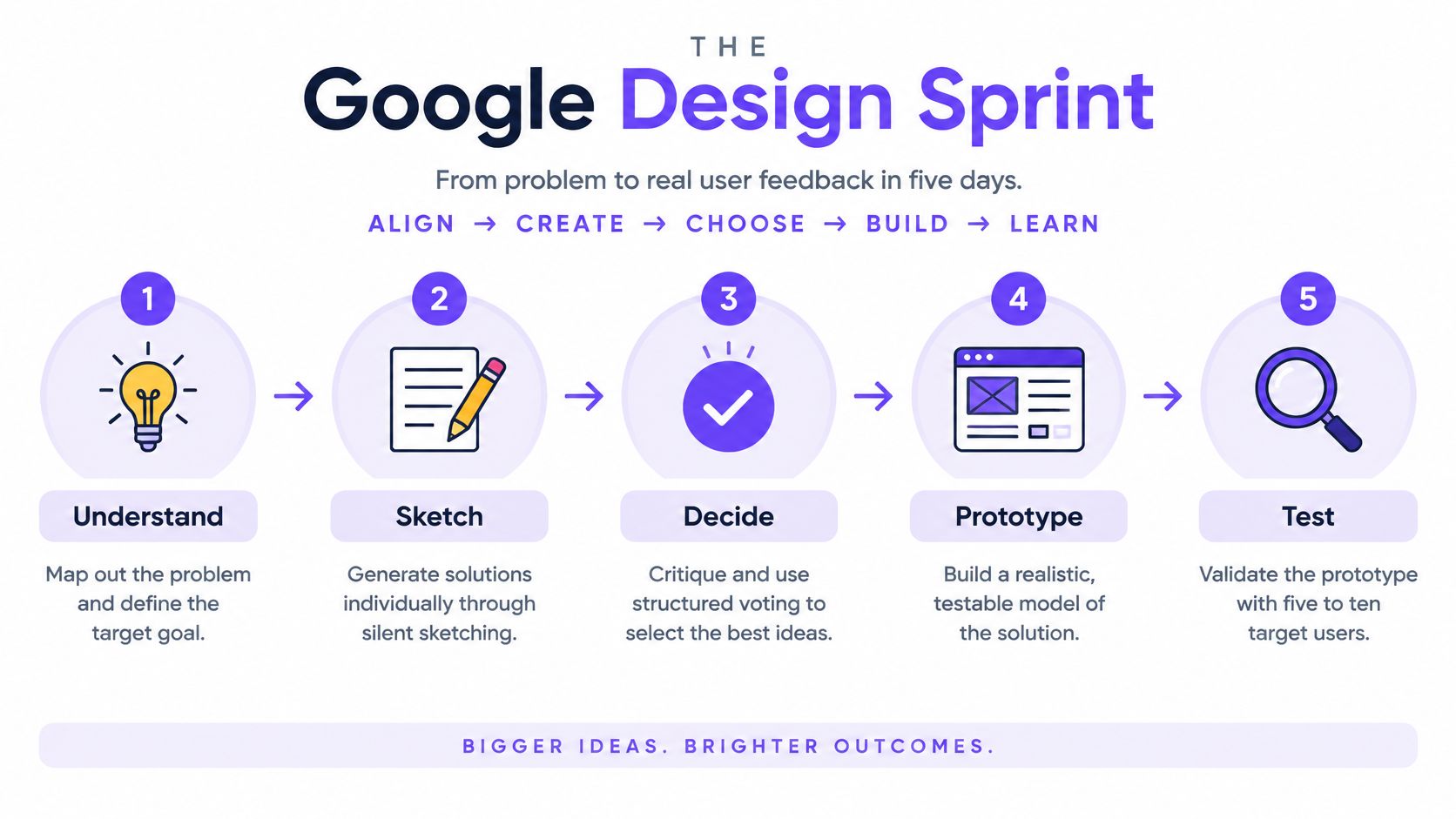
Its transferable mechanics are time-boxing, individual sketching, explicit decision authority, and testing before full implementation. Silent work gives participants room to develop an approach before they encounter the loudest person's preferred answer.
Use the process flow to keep the group oriented toward a testable output.
Prototype the risky assumption
Say a software team wants to redesign onboarding. The critical question might be whether customers understand which setup path applies to them, not whether they like a new visual style.
Have participants sketch independently, review concepts against that question, and let a named decider select an approach. Build only enough of the experience to observe whether target users understand the choice.
A public-sector review of collaborative innovation emphasizes active coproduction and measurement of costs and benefits rather than assuming collaboration simplifies delivery. Apply that discipline by naming an implementation owner and recording what evidence would justify continuing, changing direction, or stopping.
For a distributed team, a remote design sprint needs explicit instructions, accessible materials, and clear handoffs between independent and group work.
This video offers another way to explore the sprint approach.
The trade-off is compressed discovery. A focused sprint can test an assumption, but it can't replace missing customer understanding or resolve every organizational dependency.
Steal this tactic: Reserve the test and recruit suitable participants before the workshop begins. End with a documented decision and owner, not a prototype that nobody has agreed to develop.
8 Collaborative Innovation Examples at a Glance
| Example | Collaboration Model | Who Contributes | Best Lesson for Your Team |
|---|---|---|---|
| Wikipedia Collaborative Editing | Open editing with discussion and revision history | Volunteers, moderators, and administrators worldwide | Set clear ground rules and keep decisions transparent |
| LEGO Ideas (Fan-Submitted Product Design) | Fan submissions validated through community support and company review | Fan designers, supporters, and LEGO product teams | Use clear thresholds and review criteria to prioritize ideas |
| Netflix Prize | Open competition with a measurable goal and prize | Individuals and teams worldwide | Define success metrics and plan for implementation early |
| Threadless Community-Driven Design | Community-submitted designs selected through voting and curation | Designers and community voters | Balance popular votes with expert curation and originality |
| Procter & Gamble Connect + Develop Open Innovation | Structured partnerships combining external ideas with internal R&D | Inventors, suppliers, startups, and P&G teams | Build clear processes for external collaboration and agree on IP terms early |
| Doritos Crash the Super Bowl Consumer Co-Creation | Consumer-created ads selected through voting and judging | Consumers, judges, and brand teams | Set creative guardrails and secure usage rights before launch |
| Pixar Braintrust Story Collaboration | Structured peer feedback with decision authority retained by the project lead | Senior creative peers and the project director | Make critique candid and focused on the work, not the people |
| Google Design Sprint | Time-boxed process from problem framing to prototype testing | Cross-functional team, facilitator, decider, experts, and target users | Clarify roles and test ideas with users quickly |
Build Your Own Collaboration Playbook and Put It to Work
Don't copy an entire company's process because its name appears on a successful product. Choose the collaboration mechanic that addresses your team's actual failure point.
If people generate interesting but irrelevant ideas, sharpen the challenge using the Netflix model. If promising proposals overwhelm delivery capacity, borrow LEGO Ideas' separation between demand and approval. If senior opinions dominate creative reviews, use Pixar's distinction between diagnosis and decision authority.
More participation isn't automatically better. A study of innovation projects in German manufacturing companies found inverted U-shaped relationships between collaboration breadth and radical innovation, and between collaboration depth and incremental innovation. The practical lesson is to add contributors deliberately, with a clear reason for their involvement and a workable route to a decision.
Assemble the process around the problem
For an agency developing a campaign, a useful combination could look like this:
- Frame the challenge: Define the audience problem and the decision the workshop must support.
- Generate independently: Let participants write before group discussion, using anonymous submissions where status could influence evaluation.
- Develop visibly: Keep comments, revisions, and supporting evidence attached to each concept.
- Review with boundaries: Separate creative feedback from final approval and legal requirements.
- Test and assign: Choose the assumption to test, name its owner, and record what happens after the result.
Anonymity can reduce the influence of job titles during idea generation. It doesn't remove the need for accountable decisions afterward. Similarly, community voting can reveal interest without proving commercial viability, and time-boxing can focus effort without making an uncertain answer correct.
At Bulby, our process combines brainwriting, anonymous idea sharing, and AI-powered inspiration, then collects and summarizes contributions into a shared report with actionable next steps. Use that structure to support human judgment, not to avoid it.
Before your next session, write down what participants can influence, who makes the final decision, and what evidence will move an idea forward. Afterward, track which concepts reach a test, why others stop, and whether the selected approach addresses the original problem.
That's the useful standard for collaborative innovation: not how many people contributed or how energetic the workshop felt, but whether the team made a better-supported decision and knows what to do next.
Try a structured, anonymous brainstorming session with Bulby, using AI-powered exercises in our free public demo with no login required. For a process designed specifically for your team, request a custom plan and a free private brainstorming consultation, available to the next 27 sign-ups. Subscribe to our newsletter for ongoing creativity and problem-solving tips you can bring into your next workshop.