
A customer journey map is a visual of one persona pursuing one goal across stages, touchpoints, actions, emotions, and obstacles, used to find the gap between the experience a company intends and the one customers have.
The popular advice is to start with a tidy sequence of awareness, consideration, and purchase. That's a useful filing system, but it's a poor substitute for finding out what happened. In an agency workshop, the valuable moment isn't when everyone agrees on the arrows. It's when customer evidence changes the creative brief.
Table of Contents
- What a Customer Journey Map Really Shows
- Layers Every Working Map Needs
- A Filled Example Map for One Persona
- The Designed Path Versus the Real One
- How Widely Maps Are Used and Why
- Agency Templates and Campaign Examples
- How to Turn a Map into Creative Tests
- Choose One Journey and Test the Gaps
What a Customer Journey Map Really Shows
A customer journey map is a structured picture of what someone experiences while trying to achieve something with an organization. It includes their questions and obstacles, not just the interactions the company scheduled. That distinction separates a useful map from a campaign calendar or an internal process chart.
Say an agency is reviewing a software launch. The creative team credits the hero ad because it introduced the product, while the sales team credits its demo. A customer account might reveal a different story: a colleague suggested the software, an independent review provided reassurance, and a confusing signup form nearly stopped the purchase.
Follow the customer rather than the departments
The customer doesn't experience marketing, sales, and product as separate departments. They experience a promise, a decision, and whatever happens next. A map follows that experience across channels, including places the organization doesn't control.
The method has a longer history than its association with UX might suggest: a review in the Journal of Marketing Analytics traces journey-oriented thinking to Elmo St. Elmo Lewis's 1898 Awareness–Interest–Desire–Action framework, the phrase's service-operations use to Tseng, Qinhai, and Su in 1999, and mapping's establishment as a distinct method to around 2009.
The core components help you describe the experience without reducing it to company activity.
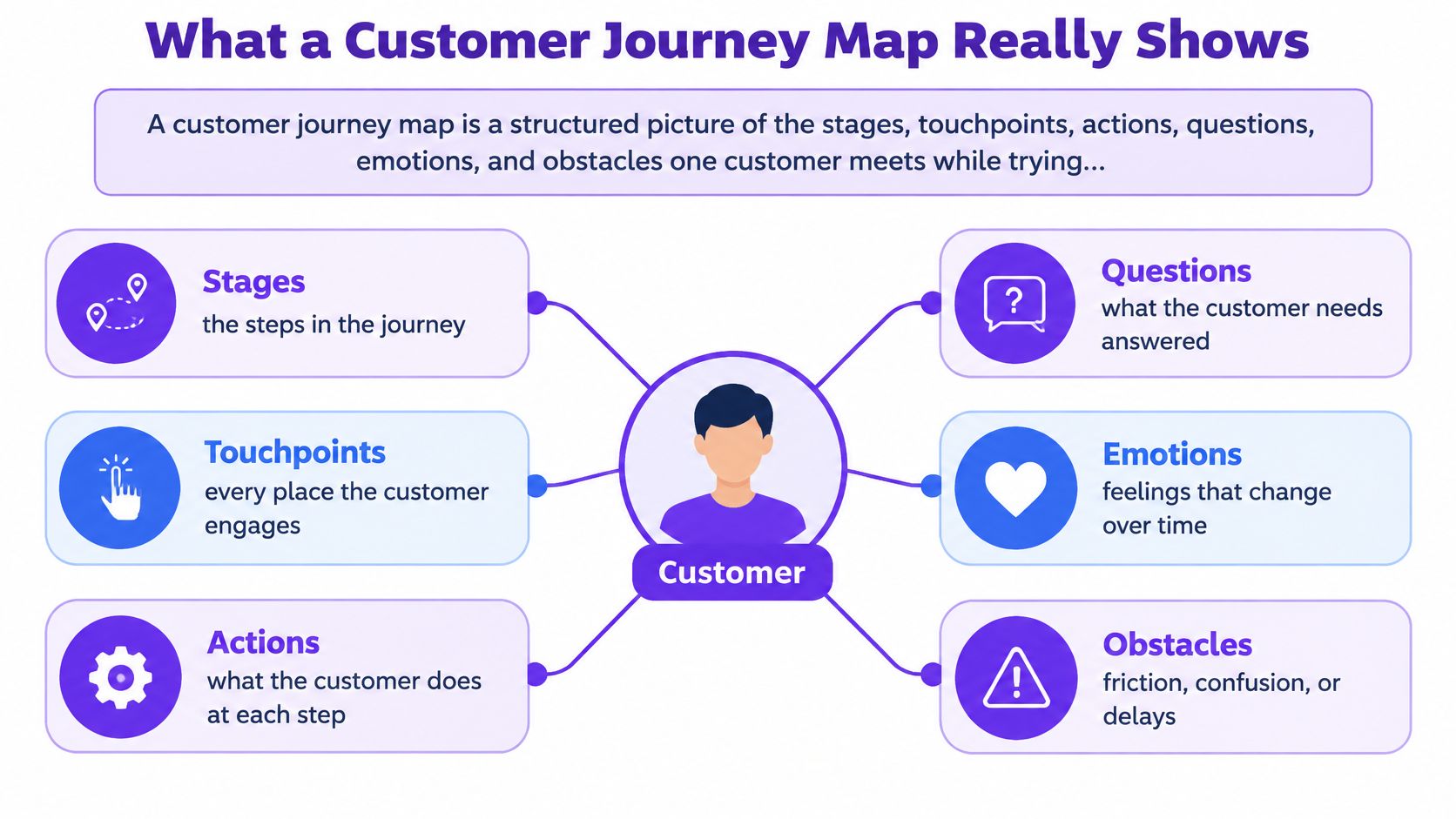
A broad map can cover discovery, evaluation, purchase, onboarding, usage, support, retention, and advocacy. Those labels organize the work, but they shouldn't dictate what the customer must have done. Someone may return to evaluation after buying, especially if setup makes them question their decision.
For another accessible explanation of the building blocks, you can explore the components of journey maps with Purple Engage. Use component lists as prompts, not as proof that your map is complete.
Practical rule: If the map contains only things the company sends or does, you've probably mapped the company's activity rather than the customer's experience.
The diagnostic question is where the believed story diverges from the lived one. In the software example, that could change the brief from making another hero ad to improving comparison content, clarifying the offer, or repairing signup.
Layers Every Working Map Needs
Start a blank template with the actor and scenario, not the touchpoints. Name the person you're mapping and the task they're trying to finish. A small-business owner choosing invoicing software needs different information from an accountant evaluating it for several clients.
Next, place stages across the page in time order, leaving room for returns and pauses. Under each stage, record interactions, actions, questions, and feelings. Use plain emotional language such as confidence, doubt, frustration, and relief, and distinguish customer statements from your interpretation.
Fill the template in a useful order
Choose evidence that can answer the question in each row. Interviews can explain hesitation; behavioral records can help locate a stalled task. These types of customer research offer different ways to investigate rather than asking a workshop group to guess.
Layers of a customer journey map
| Layer | What to record | Decision it supports |
|---|---|---|
| Persona and goal | One actor and the job they're trying to finish | Stops the map from describing everyone |
| Stages | Time order from discovery through advocacy, including loops | Shows where people stall or repeat |
| Touchpoints and channels | Ads, site, sales, store, app, support, plus non-brand moments | Reveals influences the brand doesn't own |
| Actions and questions | What the person does and what they need to know | Points content and sales help at real tasks |
| Emotions | Confidence, doubt, frustration, or relief at each stage | Flags moments creative should reassure or prove |
| Pain points | Extra effort, missing information, failed handoffs | Names what to redesign first |
| Opportunities | Research, message, offer, or service change | Turns observation into a creative brief |
| Owner and metric | Accountable team plus conversion, effort, satisfaction, retention, or referral | Connects the map to a measurable test |
Be precise about touchpoints and channels. Email is a channel; a welcome email containing setup instructions is a touchpoint. A colleague's recommendation belongs on the map even though the agency can't schedule or control it.
For service-heavy journeys, Sift AI's explanation of routing customer touch points to support is a useful companion when deciding how customer questions should reach the right team.
Connect friction to an outcome
A pain point should describe the problem, not merely name a location. Pricing page is a location; cannot tell whether the advertised price requires an annual commitment is a problem. The opportunity might be clearer billing language, not a complete page redesign.
An ISG analyst perspective on journey maps emphasizes cross-functional measurement and aligning operational metrics with the moments customers value. Apply that by naming an accountable owner and a relevant success measure for each important touchpoint.
The causal chain is straightforward: friction can prevent someone from progressing, and repeated blocks can contribute to abandonment, weaker renewal, or fewer referrals. But don't assume every frustrating interaction causes those outcomes. Treat the connection as something to investigate and test, rather than a conclusion established by a sad face on a diagram.
A Filled Example Map for One Persona
Consider a hypothetical customer, Dana, a small-business owner shopping for invoicing software. Her goal is to send her first invoice within a week. The details below illustrate a completed map, not findings about an actual product.
Dana's scenario is deliberately narrow. If your team can't agree on an equally specific actor and task, use a persona creation workshop before filling the journey with assumptions.
Dana's working map
| Stage | Experience and emotion | Pain or opportunity | Owner and measure |
|---|---|---|---|
| Discovery | Dana sees a paid social ad promising faster billing and hears a colleague mention the product. She feels curious. | Provide a proof asset for the moment she searches for reviews. | Paid media lead; click-to-trial rate |
| Evaluation | She reads three review sites and compares pricing pages. Curiosity becomes doubt. | The annual discount is hard to find. Test a clear price comparison on the landing page. | Web team; trial starts |
| Onboarding | The welcome email promises a ready template, but the first task asks her to connect a bank account. She feels frustrated. | The promise and product education don't match. Introduce a first-invoice guide. | Product marketing lead; first invoice sent within seven days |
| Renewal | At month eleven, Dana feels confident using the software. | Offer an easy referral ask after a successful billing task. | Lifecycle lead; referral rate |
Notice that the onboarding recommendation isn't just to send more emails. The team needs to explain the bank connection or change the first task so Dana can reach the promised outcome.
A completed-looking cell isn't necessarily an evidenced cell. Keep assumptions visible until someone can support them.
Copy these rows into your template, then mark unsupported cells with a question mark. Dana's wider relationship provides context, but if the active brief concerns onboarding, keep the experiment focused on her first successful invoice.
The Designed Path Versus the Real One
Is the map supposed to be a neat staircase, or the messy way people decide? The familiar sequence of awareness, consideration, purchase, and retention is easy to present. It can also leave out the conversation or interruption that changed the decision.
The contrast is easier to see when the intended route and the actual route sit beside each other.
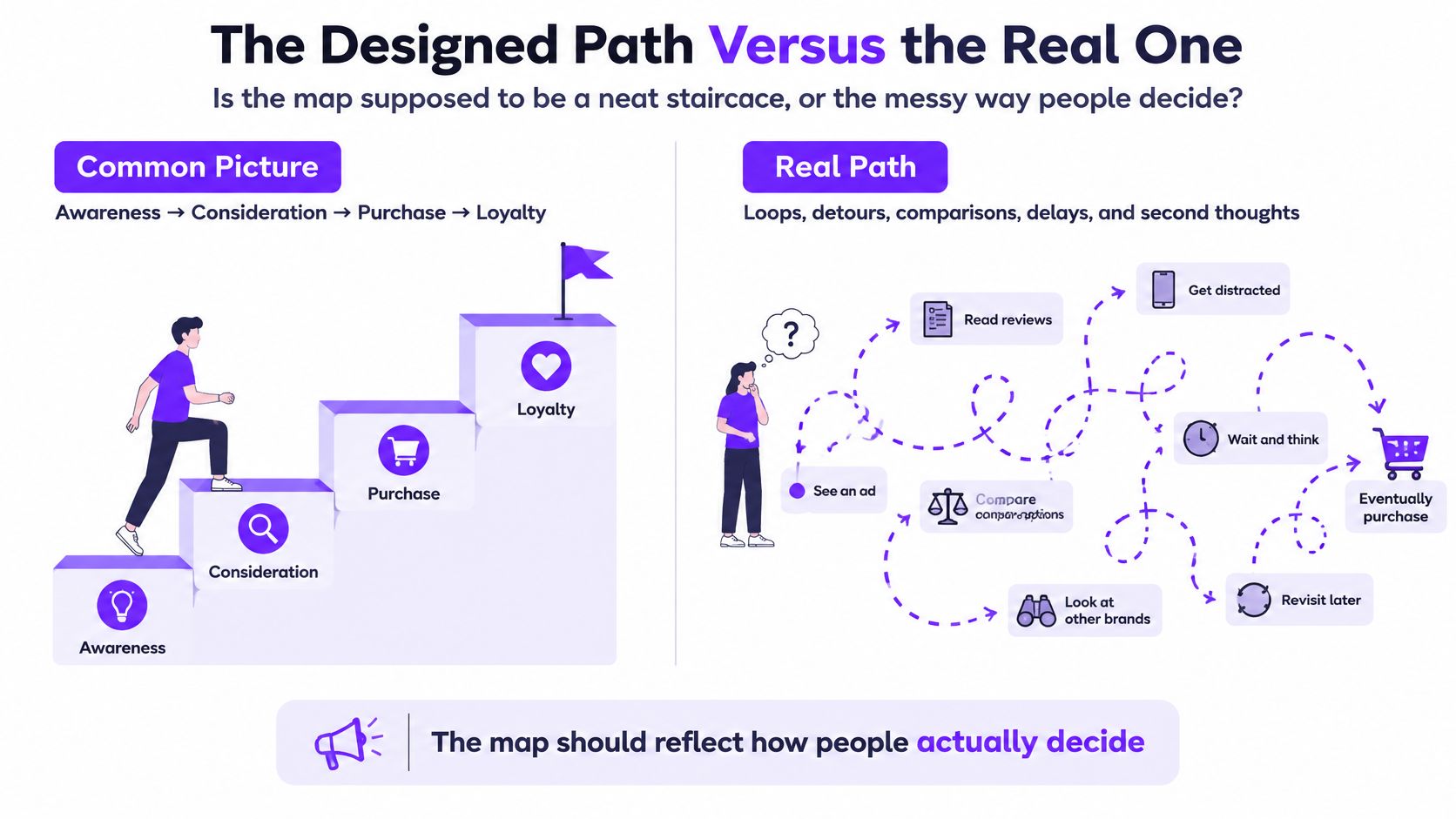
An academic article published by Taylor & Francis challenges conventional mapping for concealing nuance, assuming linear progression, and remaining provider-centric. It also distinguishes remembered journeys from lived experiences, an important warning against treating a retrospective interview as a perfect record.
Keep intention and evidence separate
The designed journey describes the experience the organization expects to deliver. The evidence-based account records what customers experienced, including detours, repeated comparisons, offline advice, and channel changes.
For a B2B purchase, a prospect might compare alternatives to 6sense using Docket's resource before contacting a vendor. That comparison belongs in the account even if the vendor's planned path starts with its own website.
Invite customers and frontline staff to sketch the route in their own terms. Use a deliberate approach to gathering customer feedback, asking what happened before and after an interaction rather than suggesting the expected answer.
Preserve uncertainty instead of smoothing it away
A customer may remember that a recommendation mattered without remembering whether it came before or after a demo. Record that uncertainty and seek corroborating material, such as an email, support conversation, or observed task.
A SINTEF service-design case study describes how comparing planned and actual journeys revealed user issues and service-delivery gaps that pointed toward redesign. The comparison is useful because it makes failed handoffs, unavailable information, and unnecessary effort visible.
For a visual explanation of journey mapping, use the following video alongside your working notes.
A less tidy map can be more strategically useful. Keep the detour that explains the decision, even if it makes the presentation harder to arrange.
How Widely Maps Are Used and Why
The adoption figures describe a practice that's established but far from universal. The industry report on customer journey mapping provides the findings below, including its cited 2024 Ansira figures and the earlier 2022 summary; treat them as separate reported snapshots, not a directly comparable trend.
Journey map adoption and reported usefulness
| Finding | Figure | What it means |
|---|---|---|
| Surveyed companies already using a defined map in the Ansira report | 39% | Mapping is common but not universal |
| Surveyed companies building or planning a map | 51% | Many teams are mid-build and need a method |
| Organizations using three to five maps | 55% | Practice includes several journeys, not one poster |
| Organizations using six to ten maps | 15% | Some organizations map many specific paths |
| Respondents identifying decentralized data and silos as a barrier | 32% | Teams need shared customer evidence |
| Companies with a map in the 2022 summary | 47% | Adoption was near half, reported as 12% higher than in 2019 |
| Respondents reporting usefulness for new products or services | 94% | Maps can inform offers aligned with customer needs |
| Respondents using maps to find existing product or service gaps | Nearly nine in ten | Maps serve as a gap-finding tool |
| Respondents reporting support for sales initiatives | 91% | Maps inform commercial conversations, not only design |
Read adoption as a scope decision
For an agency, the practical implication is to choose a specific journey rather than promise a universal customer diagram. Acquisition, onboarding, support, and renewal involve different tasks and different evidence. A map attached to a clear assignment is easier to challenge and maintain.
The headline adoption comparison is shown below.
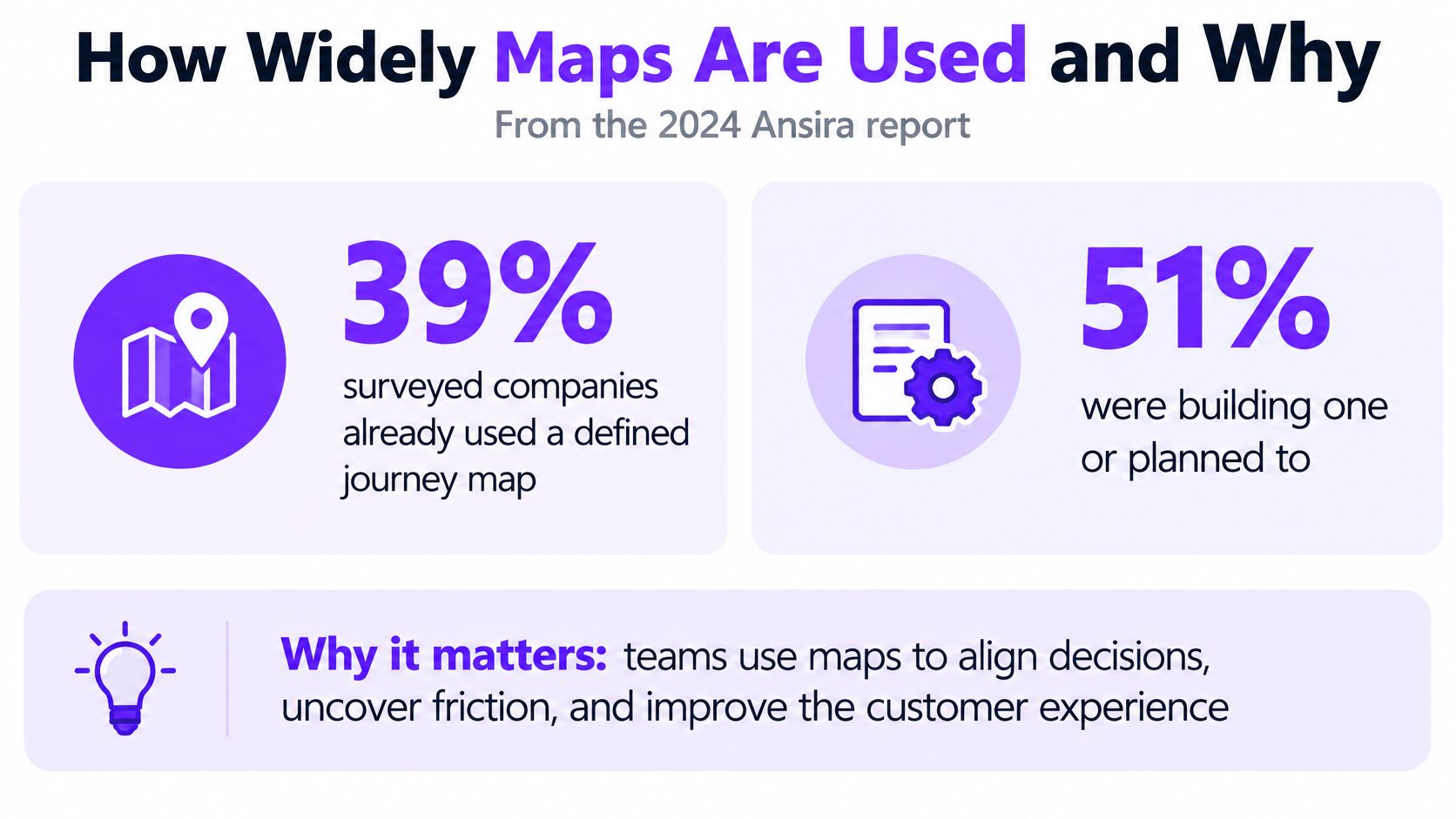
Reported usefulness isn't proof of a guaranteed performance lift. These responses tell you what organizations found useful, not what result your client will achieve. Use them to justify investigating a journey, then judge your own work against customer evidence and a defined outcome.
Treat missing information as a boundary
If sales notes, campaign records, and support conversations can't be connected, narrow the claim. You may have enough evidence to map a support handoff without claiming to explain the entire customer relationship.
That discipline also improves an omnichannel marketing strategy. Start with the transition the customer needs to make, then decide how the channels should cooperate. Adding more channel boxes won't resolve missing context between them.
Agency Templates and Campaign Examples
A reusable template should help a team change a decision, not reproduce a layout. The following hypothetical client scenes show how similar map structures can lead to different creative work.
Acquisition and evaluation
A consumer brand briefs an awareness film for a first-time buyer choosing a household product. The buyer moves from interest to hesitation when comparing unfamiliar brands, and the map identifies independent reviews as the unresolved moment. Instead of commissioning another broad-reach film, the team develops a demonstration asset that answers the comparison question.
For B2B evaluation, take the perspective of a department manager championing a purchase. Their goal is to secure internal agreement, but enthusiasm becomes anxiety when finance and technical colleagues raise different objections. The pain isn't a lack of general product information; it's the difficulty of explaining the choice to other people.
The creative response is a role-specific system. Give the champion a concise case they can forward, give finance a clear explanation of commercial value, and give technical reviewers material that addresses implementation questions. Don't force every stakeholder through the same landing page argument.
Agency journey templates and the brief they change
| Template | Journey it covers | Campaign decision it unlocks |
|---|---|---|
| Acquisition | First notice to shortlist for one persona | Swap generic awareness ads for proof at the real comparison moment |
| B2B evaluation | A buying committee across a long consideration phase | Split messages by role and add proof a champion can forward |
| Onboarding | Signup through the first successful use | Align the ad promise with education and the first-week handoff |
| Renewal and advocacy | A satisfied user who could renew or refer | Place a clear ask where confidence is high and effort is low |
Onboarding and advocacy
For an onboarding assignment, consider a new signup who expects immediate progress because the campaign promised simplicity. Excitement turns to frustration when the welcome email describes features while the product demands unfamiliar setup decisions. The pain may originate in the campaign claim, missing education, or a handoff between teams.
The creative move is to revise the ad, welcome message, and first-task guidance together. Decide what the customer can reasonably accomplish first, then make the promise and instructions agree. A more persuasive email won't fix an impossible expectation.
For renewal and advocacy, imagine a satisfied user who has just completed an important task. Relief becomes confidence, but the product offers no simple way to recommend it to a colleague. Test a relevant referral invitation with a clear explanation of what happens after sharing.
Choose the template tied to the business outcome in the client brief. Even when other stakeholders influence the decision, keep the working perspective anchored to a defined persona and goal.
How to Turn a Map into Creative Tests
A map becomes operational when someone can act on its evidence. An Eastasouth implementation paper describes resource constraints and fragmented collaboration, reinforcing the need to coordinate action rather than optimize isolated interactions.
Move from evidence to a decision
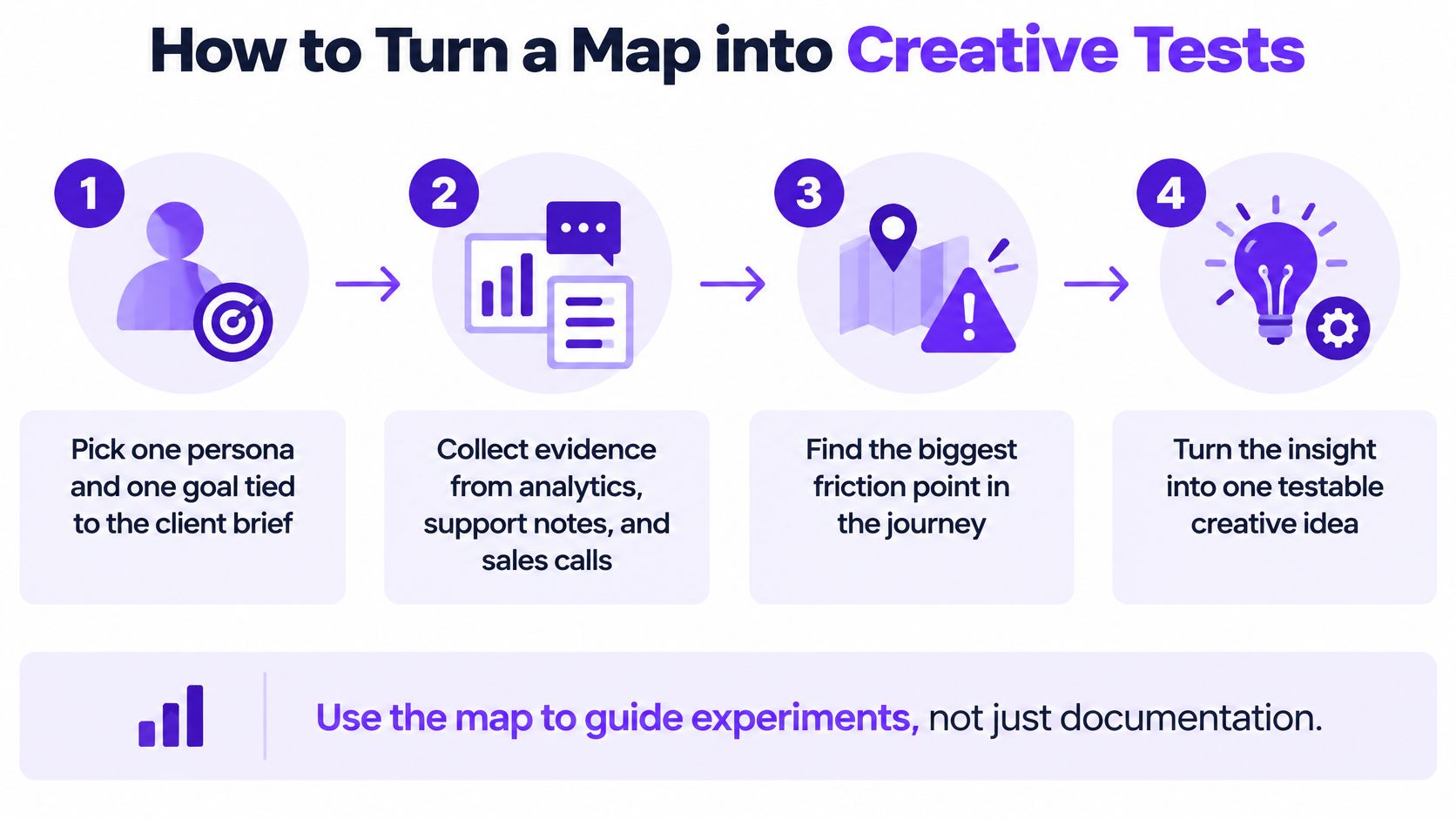
Choose the assignment. Select a persona and a customer goal already connected to the client's business objective. Write the task in customer language, such as choosing a suitable plan, rather than campaign language such as increasing engagement.
Collect evidence. Bring analytics, support notes, and sales-call material into the same workspace. Invite customers or frontline staff to sketch their route, and label interpretations that haven't been checked.
Plot the comparison. Set the expected path beside the reported experience. Preserve loops and non-brand influences so the team can locate the point where its assumptions stop matching the account.
Separate symptoms from causes. A complaint about slow onboarding doesn't automatically justify a reminder campaign. Investigate whether the delay begins with an unclear promise, missing instructions, or an internal handoff.
Make a decision record. For each priority moment, write the customer goal, business outcome, accountable team, evidence source, and next test. Name an owner who can coordinate the necessary changes, not merely the department nearest the problem.
Write the hypothesis. Specify the message, channel, audience, and measure of improvement. Use this guide to conducting A/B testing to plan a comparison rather than changing everything and attributing any movement to the new creative.
Limit the workshop's output. Select a manageable set of evidence-backed opportunities. Put unresolved questions into a research backlog instead of stretching the session into an exhaustive poster exercise.
The practical sequence can also be condensed into a working visual.
Test relevance rather than assuming it
More personalization isn't automatically the right answer. Before proposing customized interactions, ask whether the team can explain why someone received a message, maintain consistency across channels, and assess relevance without increasing distrust.
Workshop check: Can the owner explain what will change, why the evidence supports it, and how the team will judge the result?
A filled hypothesis might read: For first-time buyers arriving from review-related searches, a comparison proof asset on the landing page will increase shortlist rate compared with the current brand-led page. The creative lead owns the asset; the web team runs the comparison using a predefined shortlist action. That's a decision a client can approve, not just an observation they can agree with.
Choose One Journey and Test the Gaps
Choose a client journey already attached to active work this week. It might be acquisition, onboarding, support, or renewal, but freeze the scope before inviting the team. Write the persona, customer goal, and primary success metric at the top of the working document.
Use that metric as the score for this effort. If the assignment is successful onboarding, don't declare victory because more people opened the welcome email. Ask whether more people completed the task the email was meant to support.
Give the working session a concrete output
Bring the strongest friction points and their supporting evidence into a session with strategists, creatives, and account leads. Ask participants to develop campaign concepts, messaging angles, or content themes against those specific problems. At Bulby, we guide users through the critical steps of the creative process, providing structure for that work.
Leave with an accountable owner, a proposed change, and a test the agency can show the client. A polished diagram without those commitments is a false finish. Keep the chosen customer outcome visible when deciding which idea deserves to move forward.
Bulby offers guided brainstorming to help teams turn journey-map gaps into campaign concepts, messaging angles, and content themes. Bring your map and its supporting evidence to Bulby, then use a structured creative session to develop ideas your team can assign and test.