
In 2025, 95% of generative-AI pilots produced no measurable return, according to the MIT NANDA initiative's analysis of more than 300 deployments. That figure lands hard because it describes the most funded, most watched innovation wave in a decade. It also describes something much older than AI.
In the same year, only 16% of AI initiatives had reached enterprise-level scale, according to the IBM Institute for Business Value's 2025 CEO Study. Put those two numbers side by side and the problem isn't a shortage of pilots. It's a shortage of pilots that survive contact with the rest of the business.
Teams rarely fail at the sticky note stage. They fail in the middle, somewhere between a promising workshop output and a funded, staffed, repeatable piece of work. This article lives in that middle, and it separates three outcomes that people lump together under one word, failure: a bad idea, a good idea tested badly, and a good pilot starved while it was scaling. Each one needs a different fix, and treating them as one problem is why teams keep applying the wrong remedy.
Table of Contents
- Why Most Innovation Efforts Stall Before Customers See Them
- The Seven Causes That Sink Most Initiatives
- How the Causes Reinforce Each Other
- How Fear and Incentives Filter Out New Ideas
- Why Good Ideas Die During Scale-Up
- Diagnosing Whether the Idea, the Test or the Funding Failed
- Set Up Decision Gates Before Your Next Brainstorm
Why Most Innovation Efforts Stall Before Customers See Them
Ask a room of executives how confident they feel about their innovation decisions and the honesty is refreshing. In McKinsey's survey of senior executives, 65% said they were only "somewhat," "a little," or "not at all" confident in the decisions they made about stimulating innovation. And 19% said growth or innovation didn't appear in the strategic-planning process at all, which stayed focused on budgeting and forecasting.

That gap is the difference between innovation as an aspiration and innovation as an operating discipline. A team that talks about running a marathon but never schedules a training run hasn't started training. It has started talking. The same is true of a company that admires innovation, prints it on a lobby wall, and then plans its year around keeping the lights on.
Failure then shows up in three predictable places. Innovation has no line in the plan, so it loses every argument with a quarterly target. The people who could build and test ideas are already committed elsewhere. And nobody has agreed what a failed experiment is supposed to teach. Moving a working pilot into a live process is its own skill, which is why Ryshe's notes on production AI deployment are worth reading even if your initiative has nothing to do with AI.
Treat the rest of this piece as a diagnostic. By the end you should be able to say which of the three outcomes your last few initiatives hit, and which link in the chain broke first. That diagnosis changes the treatment. Sometimes you need sharper ideas. More often you need customer research that kills weak concepts early, one named owner, or a budget that survives the second month.
The Seven Causes That Sink Most Initiatives
The table lists the causes teams meet most often, ordered from the most basic structural problem to the most specific decision failure.
| Failure cause | Warning sign | What it breaks |
|---|---|---|
| Innovation treated as an aspiration | Missing from strategic plan; budget forecasts only | Ownership and funding |
| Weak talent and capacity | Ideas stall at prototype or testing | Ability to build and validate |
| Siloed structure | Teams hand ideas over and lose context | Knowledge and technology sharing |
| Weak incentives | Only successful launches are rewarded | Willingness to report learning |
| Fear of failure | Weak concepts are hidden or never raised | Early dissent and candor |
| Poor implementation | Frontline and line managers not engaged | Adoption in daily work |
| Missing decision gates | Pilots run indefinitely or stop at random | Evidence-based progression |
The middle rows are the ones leaders underestimate, because they never appear on a project plan. Research on American companies groups these barriers into cultural, strategic and process categories, and notes that functional silos impede knowledge and technology sharing while hierarchical structures restrict autonomy and experimentation, as reported in this study of organizational barriers to innovation. The same body of work points to a systematic review finding that roughly 70% of planned change initiatives fail, with resistance, communication barriers and shortages of qualified staff among the most frequent contributors.
How to Use This Table in a Review
- Score each cause from 1 to 3 for one live project, where 1 means it's clearly present and 3 means it's clearly handled. The gaps show you where to spend the next hour, not the next quarter.
- Find the cause that enables others. A missing owner usually explains the thin budget, and a thin budget explains why no specialist ever touched the prototypes.
- Re-score in 30 days. If a cause hasn't moved, the team doesn't believe fixing it is allowed, which is itself information worth acting on.
How the Causes Reinforce Each Other
Picture a house with four small leaks. Patch one and the water still rises, because the other three keep running. That's how these causes behave. None of them is dramatic enough to trigger an emergency meeting, and together they drain an initiative so gradually that nobody can point to the day it died.
Here is the loop that plays out most often, start to finish:
No named owner -> thin budget -> no specialist time -> prototypes never reach customers -> the team stops believing in the work and hides its doubts -> leadership sees no evidence and cuts the budget again.
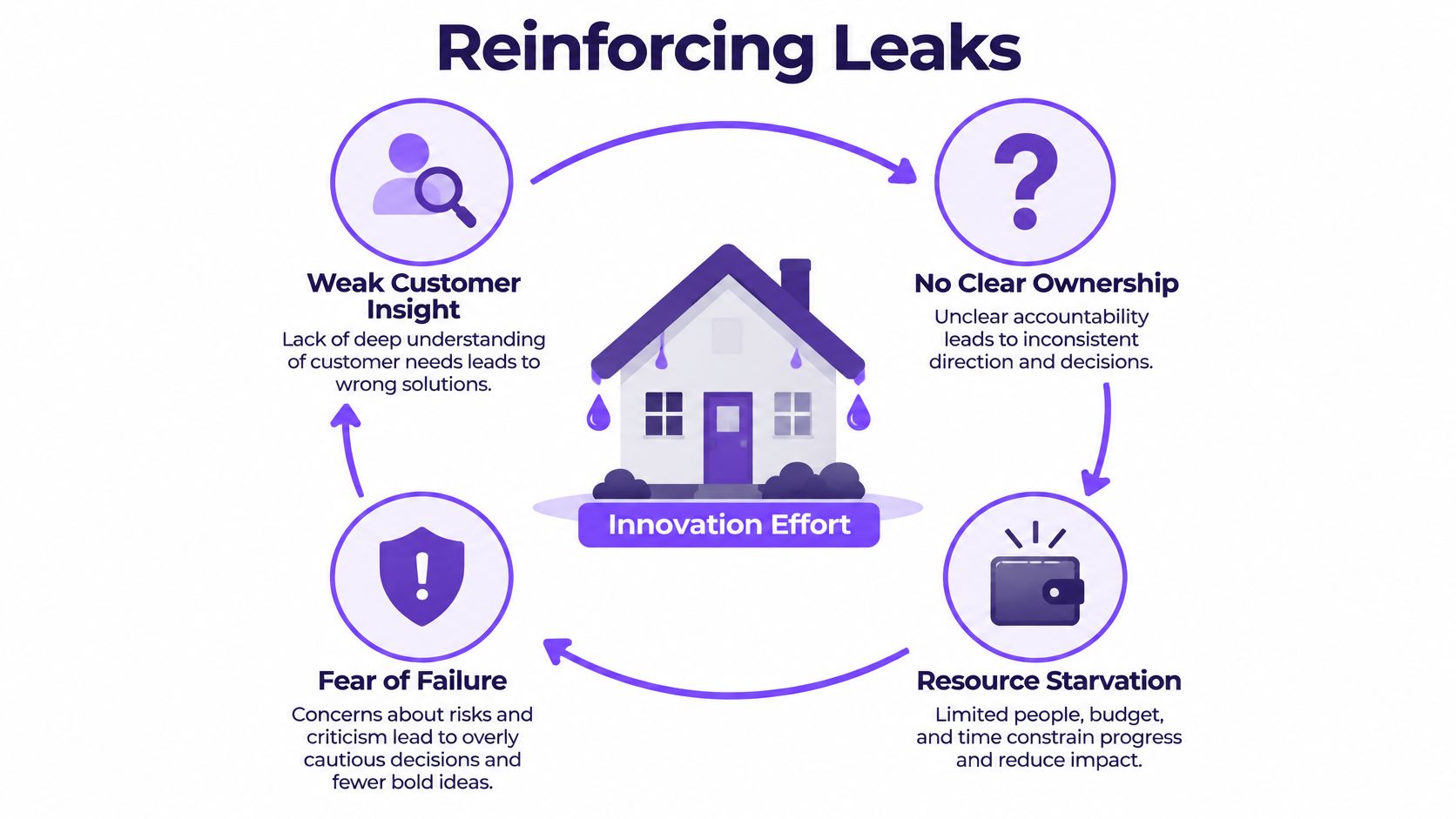
A second loop runs alongside it and makes the first worse. When incentives reward only launches, nobody volunteers that a test failed, so the next decision gets made on optimism rather than evidence. That decision funds another round of the same work, which produces another quiet non-result, which nobody reports either. The result isn't one visible failure. It's a slow decline that everyone senses and nobody can name.
The practical test is quick. Take the seven causes and ask which two are wired together in your own project, then ask which single one, fixed first, would loosen the others. For many teams, the answer is ownership, because an owner with budget can hire the missing skill, open the gate review and give people permission to speak their minds.
How Fear and Incentives Filter Out New Ideas
The standard response to weak innovation is another brainstorm. That response rests on an assumption worth challenging: that ideas are being lost because too few were generated. Ideas are often lost later, after someone decides which ones are safe to repeat out loud.
The data on how safe people feel is not flattering. PwC's 2025 global workforce survey found that only 56% of workers feel safe trying new approaches, and only 54% say their teams treat failures as opportunities to learn and improve. Which means close to half of your room is editing itself before the session starts.
Three Things to Measure Instead of Idea Count
- Who contributes. Count how many people spoke in the first ten minutes of your last session, and how many ideas came from the two most senior people in the room. A short list from a small group tells you the funnel is filtering, not the market.
- Whose ideas survive. Track the journey from raw input to the shortlist. If the same three names appear every time, you have a status effect, not a quality effect.
- How dissent is handled. Note what happens when someone says the leading concept feels weak. If the answer is a polite nod and a return to the same concept, the team has learned that disagreement costs more than silence.
The fixes are mechanical rather than cultural. Score the first round anonymously so nobody can anchor on a job title. Rotate a role that argues against whichever idea is currently winning, and give that person a script so it doesn't feel personal. Separate the criteria for idea quality from the criteria for how confidently it was pitched, because the best presenter and the best concept are rarely the same person. If your team visibly braces when a new approach is proposed, the patterns behind resistance to innovation usually start with how the last attempt was received.
Then run the test. Take your next batch of ideas, score them anonymously first, and compare that ranking with the one the group produced in open discussion. The difference tells you exactly how much novelty your current process is throwing away.
Why Good Ideas Die During Scale-Up
The most expensive failure in innovation isn't a flop. It's a success that never travels. A team proves a concept in one market, one client account, or one product line, everyone nods, and the pilot ends when the quarter does. Nothing was wrong with the idea. The organization never built the path from idea to implementation.
Participation decides whether that path exists. In McKinsey's research on transformations, a closely related class of large-scale change effort, only 3% of programs succeeded when line managers weren't engaged, compared with 26% when they were. With frontline employees engaged, the success rate reached 28%. The variable isn't the quality of the concept. It's whether the people who do the work were part of shaping it.
Support Is Not Adoption
An executive sponsor can open doors and release budget, and still leave the initiative with nobody who knows how to run it on a Tuesday. Say an agency tests a new campaign format for a retail client and it beats the control. The account managers who'd need to sell it to other clients weren't in the session, don't know why it worked, and have no authority to adapt the brief to a different brand. Six months later the deck is still in a folder. That isn't resistance. It's a design flaw, and a predictable one.
Three moves prevent it. Bring the people who will run the work into the first workshop, not the launch meeting, so they hear the reasoning while it's still forming. Give them authority to change the approach as they learn, because an operator who can't adapt will abandon it. And set a date at which the pilot either moves into a second unit or stops, so the decision happens on a calendar rather than on whoever remembers it.
The question to ask about any pilot: who runs this every day once the project team moves on, and what would make them stop?
If nobody can answer both halves, you don't have a scaling plan. You have a demo with a longer timeline.
Diagnosing Whether the Idea, the Test or the Funding Failed
Teams use one word for three different events, which is why their post-mortems keep arriving at the same conclusion: the idea didn't work. That conclusion is comfortable, because it costs nothing to accept once the work has stopped. It's also wrong in at least one of three ways.
A bad idea is one where customers don't value the problem even after you explain it clearly. Think of a scheduling tool pitched to a team that already solves the same problem with a shared calendar and never complains about it. A good idea tested badly uses the wrong customers, measures against a number nobody agreed on, or runs for three weeks when the behavior cycle takes eight. A good pilot starved during scale-up has strong early results and then loses its budget, its owner or its time to a reorganization.
| Outcome | Typical signal | Right response |
|---|---|---|
| Bad idea | Customers do not value the problem even when it is explained clearly | Stop or reframe the problem |
| Good idea tested badly | Wrong customers, unclear success measure or too short a test | Redesign the experiment and rerun it |
| Good pilot starved during scale-up | Strong early results but no budget, owner or time to grow | Protect resources and name an accountable owner |
The distinction matters because the three responses cost very different amounts. Killing a concept is free. Redesigning a test costs a few weeks. Protecting a proven pilot costs money at the exact moment when a finance team is looking for savings, which is why it's the failure that goes unrecorded. Research on multi-stakeholder innovation portfolios finds that conflicting incentives and unclear governance leave promising pilots isolated while unsuccessful projects keep consuming resources when learning isn't built into portfolio decisions.
Resource gaps do the rest. A meta-analysis of empirical innovation studies identifies insufficient financial, human and technical resources as direct failure mechanisms, because constraints cut experimentation capacity, delay iteration and stop concepts reaching technical validation. A starved pilot often looks creatively weak when it was underfunded.
When the signals are mixed, and they usually are, don't review the project against how people feel about it now. Review it against the gate criteria you set at the start. If a test comes back with no clear winner, that's rarely proof the idea failed. Otter A/B's guide to rescuing inconclusive test results treats it as a design problem to fix, which is the correct first instinct. A repeatable idea validation process then turns that instinct into a habit rather than a rescue mission.
Set Up Decision Gates Before Your Next Brainstorm
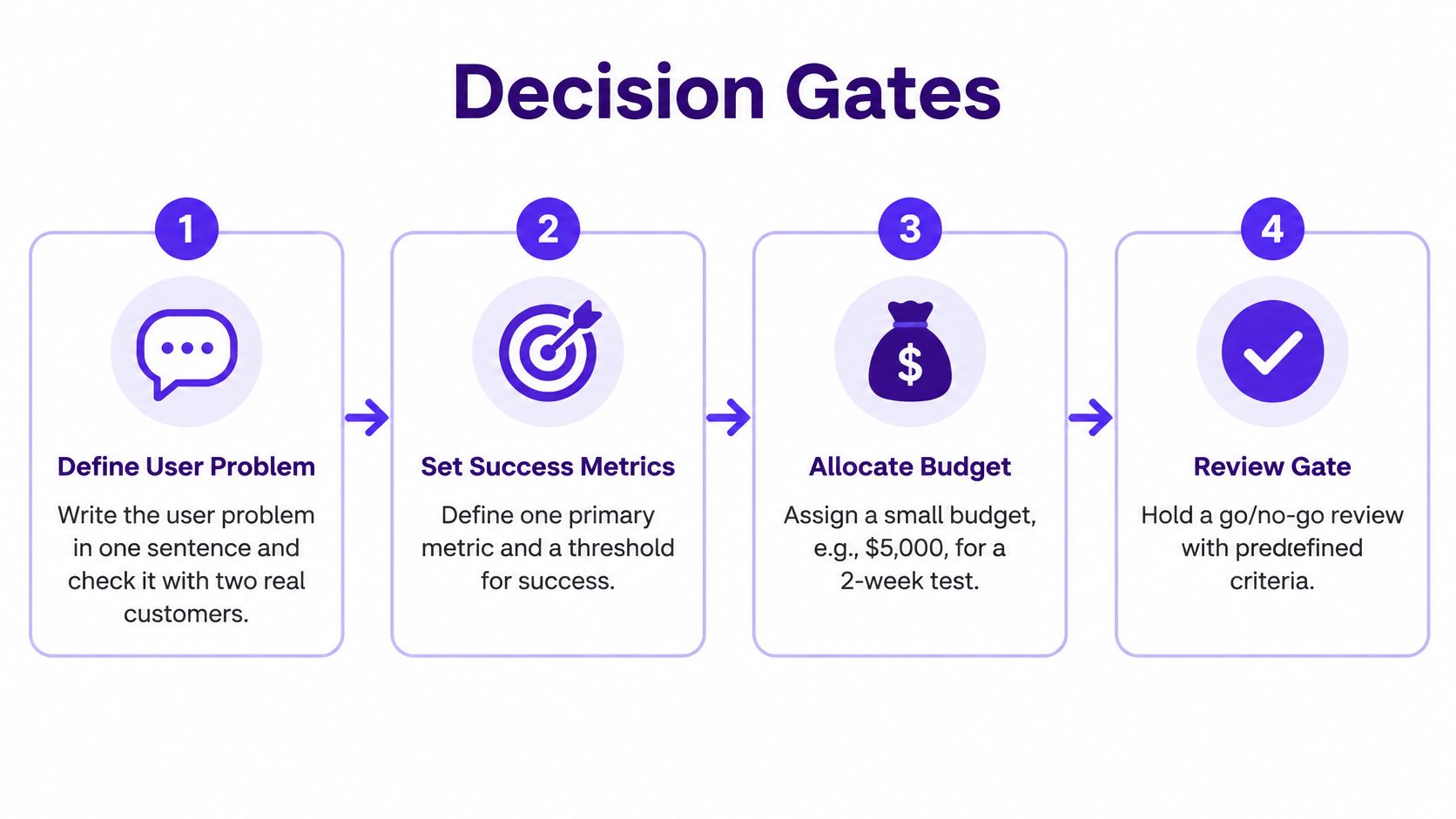
A workshop output becomes a funded initiative through six decisions, not through enthusiasm. Write them down before the session, because the moment a concept gets a nickname and a champion, clear thinking gets harder.
- Write the user problem in one sentence and check it with two real customers. A problem you can't state in a sentence can't be tested, and two conversations cost less than a wasted build.
- Name one accountable owner with time and budget attached. Unowned pilots drift until someone senior notices, and by then the useful momentum is gone.
- Specify the smallest credible experiment, with a two-to-six-week limit. Short tests produce evidence while people still care about the answer, and a tight window forces you to pick one measure instead of six.
- Set minimum evidence thresholds for moving forward. Document the customer problem, the delivery path, the expected business impact and the test window, so the decision isn't a gut call made in a room full of enthusiasm.
- Agree a kill rule before attachment builds. Something as plain as "we stop if the test misses its measure twice" prevents the zombie pilots that consume budget for a year out of politeness.
- Review resources at each gate instead of assuming them at kickoff. Budgets approved once get spent on the first obstacle, and a starved pilot is the most common late-stage loss in the whole sequence.
For software-facing tests, you can shorten step three considerably by replaying real traffic against a new version before release, which is the practice GoReplay describes for alpha and beta testing. It surfaces behavior that a friendly demo audience never will.
The one-page gate sheet: the user problem, the owner, the smallest test, the evidence threshold, the kill rule and the review date. If it doesn't fit on one page, it isn't a gate, it's a wish.
Tooling helps at the front end and can't substitute for the back end. Bulby's six-step process runs from putting in the challenge through anonymous idea submission and AI-generated inspiration to a summarized report that surfaces the strongest concepts with next steps, which gives a team a clean starting shortlist. The gates still need a named owner, and the governance behind those gates is what decides whether the shortlist becomes work. Pick the top idea from your last brainstorm and write its gate sheet this week, before another session adds more input to a queue that isn't moving.
Teams don't need more ideas; they need a way to find out which ones deserve a budget, and that's the part Bulby was built for. Anonymous idea submission, randomized creative exercises and AI summaries that end in concrete next steps mean a session produces a shortlist you can put straight through the gates above, not a wall of notes nobody opens twice. Take the challenge your team is stuck on and run it through Bulby this week.